Very Fine Japanese Original Mountain Stone

One more for the natural stones. This is a dark green hard but strong cutting and fine Japanese natural stone that I got off of Buyee (proxy service that allows you to bid on Japan’s version of Ebay).

I’ve bought a lot of stones, and I’ve sold stones (but only on a break-even basis). The reason for the metallurgical scope in the first place was to resell an abundance of straight razors that I’d accumulate and sort and honestly grade stones. This green stone is really one of the very few “something for nothing” stories, as it’s a near full size stone that’s either nakayama or narutaki mine (but the characteristics match that of nakayama – a hard fine but strong cutting stone that’s very strong on slurry despite not being coarse – on water with no slurry, the stone is a bit harsh feeling. The bottom line is that this is as good of a stone as you will find for a japanese finish stone of the fine and hard nature, and better than a hatanaka stamped stone that I also had (though hatanaka stamps until recently were always uncommonly uniform and aesthetically interesting – I looked on buyee now years removed from selling stones and see that the hatanaka stamp is now being forged as it was present on misshapen and common stones. That’s too bad).

I think the myth about japanese stones being “30k” grit equivalent is finally not the norm when their fineness is discussed. They are similar to the best of the trans or black arkansas stones, but with a little better fineness and stronger cutting power on harder steels (japanese natural stones from the mountain with the best mines are between 15-20% natural aluminum oxide from volcanic ash. If you’re the grouchy western type that thinks that’s mysticism, that’s tough – they do actually have aluminum oxide in them, but not in the same concentration that something like a shapton stone would – it’s mixed in with SiO2 (which itself is in the neighborhood of another 60% of the stone matrix).

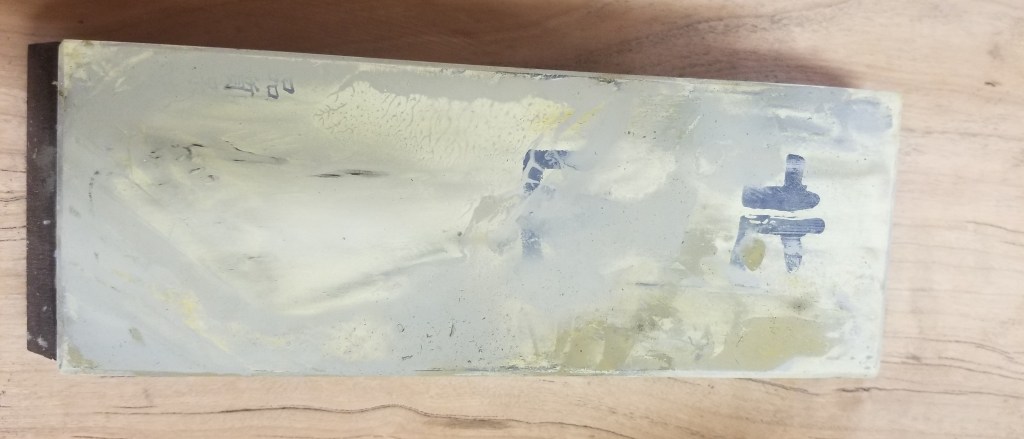
So, what was the win? This was an “unmarked” stone sold by someone who picked barber shops and after flaking some of the crud off of the end of this stone, it has a very old stamp that more or less just says “original whetstone” or something of that sort (The kanji isn’t on the stone in 6 places with bright new purple ink and it doesn’t say “nakayama super best gaijin magnet” or anything like that, it just clarifies that it’s from the original mountain and that it’s got its bona fides. This was $32 plus proxy and shipping fees. But no worries, I’ve had plenty of $400 stones that really were $250 stones and when I did finally sell this one, I sold it for less than half of what it should probably have been sold for. You can’t keep everything And I still have somewhere around a dozen japanese finish stones.

I’ve had around 200 japanese natural stones in total. Very few feel the same if you’ve seen enough to start differentiating them. I’ve not had a large stone that was quite as good as this one at what this one is good at (hard, releasing no slurry, but with a fine biting slurry that’s very practical if the slurry is kept).

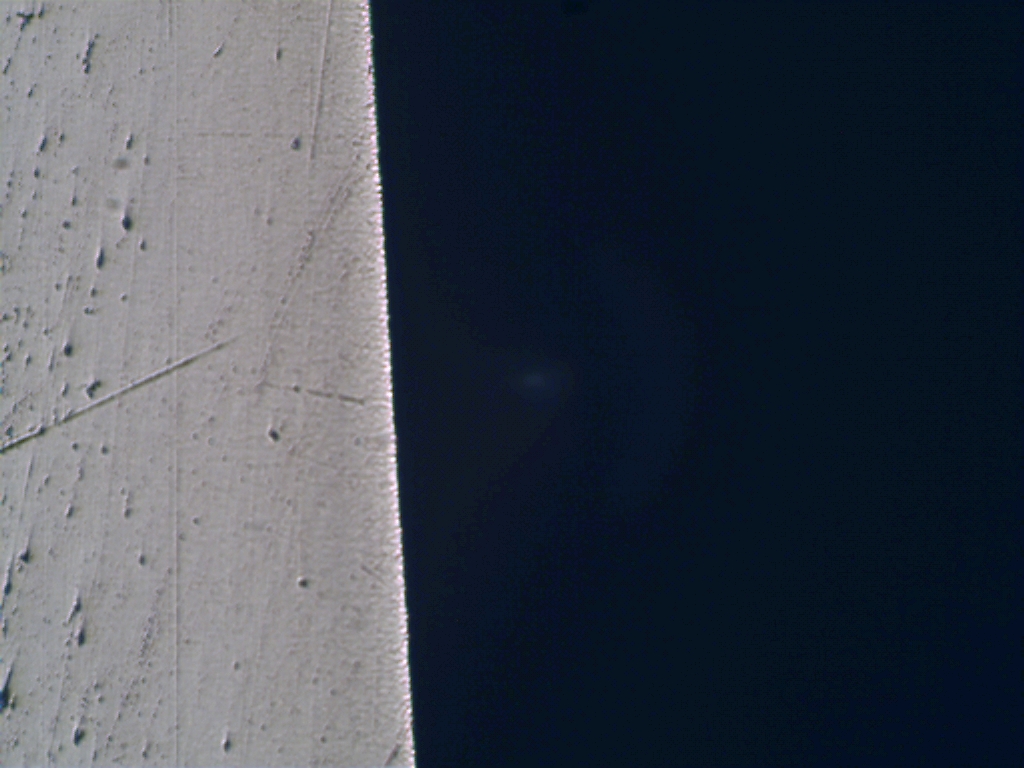
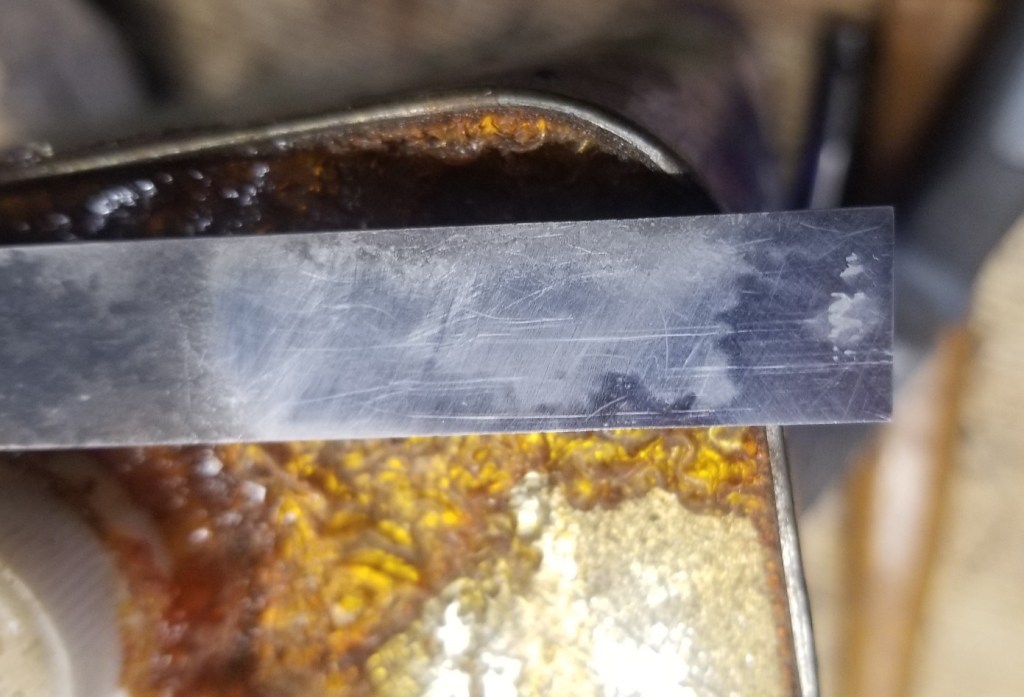
A picture of what this stone does both on slurry and then on clear water is below. If the objective was to get this picture to near optical clarity, then the stone must be allowed to dry while the honing process continues.

Compare this Picture to the 8,000 Grit Waterstone

With a fine slurry. Note the lack of dominant straight scratches. The abrasive rounds the edge over very slightly, but not in a way that threatens sharpness)
The same stone with another 20 seconds or so clearing the stone off to clear water. This isn’t a soft stone and this type of stone isn’t known for being silky smooth on clear water, so I would reserve clearing the stone off (or a skim milk slurry just prior to this) for razors. It’s not that practical for tools unless you can add a bit of water to move the slurry away from a spot and just use that spot. It starts to be fiddling and the slurry edge is fast to get and very fine – and the stone is a joy to use.

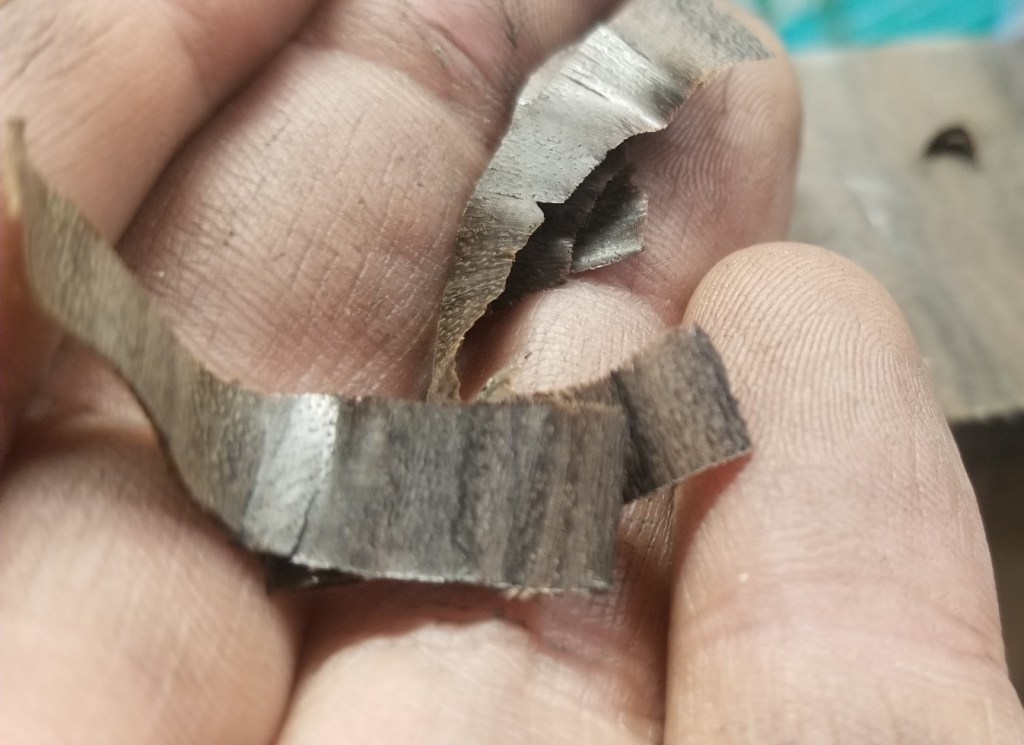
The surface of the older stone – a little dry swarf left on top. Many stones have this color of green, but the really good stones are usable and make things sharp. The same appearance is common from a modern lower quality stone that may scuff on the surface and release a clump of particles.

I cannot recommend buying japanese stones for no reason, unfortunately. I don’t think you get what you pay for from dealers, and on average, the new stones are not a match for picker-sold old stones (but the latter is the kind of thing where you buy 10, keep the two you like most, sell 6 and throw away the two that broke or delaminated either before or after you buy them).

What you find on proxy services is a good reminder that people in Japan don’t necessarily think the stones are worth as much as we do aside for some uncommon stones with rare characteristics. And you won’t guess what those are when you’re new, so you’re far more likely to overpay (at one point, I purchased a large atagoyama stone off of the proxy service from a hardware store – i.e., retail – in japan. $235. I saw the same stone, same stamp, same size on a continental european “japanese stone specialist” site for $900. What do you get for the difference? nothing – atagoyama is one of the few mines that had stones in such abundance that the stones were consistent in appearance and cutting properties after they were separate by grade.

Ultimately, if you have tools that can be sharpened by a high quality black arkansas or translucent stone, how much better is the resulting edge from a japanese natural stone? It’s not, it’s about the same. In fact, the best of the natural fine stones all land around the same place.

Dan’s Black Arkansas

One more for the sharpening stone omnibus. The Dan’s Black arkansas, and a first quality one at that. Dan’s has the finest black stones I’ve ever seen. They’re not the fastest cutting, which is the way the rules work generally with good arkansas stones. In my book, a good washita does the step just below this well and faster than any “normal” oilstone that’s not a true washita, so I don’t have any soft spot for an arkansas finishing stone that’s a little coarse. They will all break in, but a fine one will continue to be fine even if you scuff it a little.

You can also consider the results of this to be identical to a translucent stone (I’ve had at least a dozen trans stones of decent quality). I’ve also had black stones from Halls, which I believe may be Preyda now – they are decent, but not quite as good as a first quality Dan’s and sticking with Halls, as that’s what I recall their label, the fineness was a bit less and on the ones I tried, a stray clump here or there could come out of the stone. I’ve not had that happen with Dan’s.

Translucent stones that pass light well are a safer bet – the lack of air space to allow light through that easily is hard to fake on a translucent and the only risk is whether someone may be selling you an entirely different stone. If a translucent stone only barely passes light, though, you may be in for something with more cutting power than you expect.

Arkansas stones leave a flatter groove, but are very sensitive to steel hardness. Their particles fight an even battle with 62 hardness iron carbides or steel matrix, or however you’d gauge it. Much lower than that (like a soft pocket knife) and even the stone used for this picture will raise a strong burr. If you run into that, light strokes to thin the wire edge and then go to a compound.

Compare this Picture to the 8,000 Grit Waterstone

Notice how the edge has good uniformity finishing with light pressure and there are a few stray scratches on the bevel. On a hard chisel or plane iron, the arkansas excels at creating this burnished surface. It doesn’t excel at removing stray scratches. Its job is refinement.

It takes some time and skill to get to this finish level whereas the autosol picture, you just need to not have nicks beforehand. I think the day to day use of a trans or black arkansas stone for chisels and planes is more work than the results yield. Why? The washita cuts faster and nearly as fine, and as bloated as they have gotten in price, they’re still less cost (push the lilywhite aside) than a good translucent or black arkasnsas. And once you finish with the washita, have raised a burr and teased it off, a couple of swipes on softwood or medium hardwood with autosol or something similar and the edge is finer than the arkansas stone can create.

Back to the Dan’s black. 2x8x1 is my suggestion, but they’re expensive. It’s a lifetime stone if you don’t drop it. If the price is just too step, find a first quality dan’s combination with a soft stone for one half of the thickness and the subject stone here for the other half. The feel will be the same and 10 workmen would never go through half an inch of black arkansas stone in a lifetime. It’s just easier to use these stones when they’re raised in a case.

Which leads to one more point (aside from one more reminder that these will reward skill and you may have difficulty at first with them) – keep your stones in a case or covered. With the high hardness, one stray piece of anything lands on one of these and the first pull or push across it and you’ll have a tiny notch in your iron.

How long does a stone like this last planing when you take the time to finish the edge as above? about 85% of the footage planed that 1 micron diamond will yield. Yes, I know. It’s not the result that I wanted, either, but the discussion of properties changed in steel and the (other) unicorn to be chased at the edge to find miles and miles of planing beyond just finishing the edge, it’s not there.

But, these are nice stones and they do come into their own with really small tools and crisp corner carving tools.

One more thing (Columbo?) – if you bring a damaged edge to this stone, you won’t ever finish it. You can vary pressure and get different results, but if you lean on a tool too hard, you can actually create small chips along the edge. Firm to light pressure – but keep your feet on the floor. And – they’re not great stones for someone who uses a guide. All Arkansas stones reward touch. When you’re using a guide, you’ve mostly lost the ability to do that. Your skill comes in getting this stone only to work the tip of the tool. This skill is enormously aided by spending $15 for a very small USB hand scope (as in, hand held microscope) so you can see what you’re doing.

1 Micron Diamond – Another Standard

I tested plane irons 2 years ago to examine edge life claims. At the time, I also did some extra tests with different finishing stones, methods to see how much extra life is imparted to an edge with finer abrasives. It turns out to be relatively substantial, but also in planing effort – sharper is a large difference in effort keeping a plane in a cut, starting a cut, and in total feet planed). The test was actually a duration test, so I planed somewhere around 30,000 – 40,000 feet as controlled as is possible. The later posted CATRA testing on knifesteelnerds finds ratios much the same as I found.

Because some of the planing was with irons that have vanadium carbides, I used diamonds as the sharpening media. 1 micron diamonds was my practical finishing step – first on hardwood, then on a wonderful cast plate that someone provided along with the test. A cast or steel plate with such fine media needs to be really good – just attempting to flatten a plane sole and use it will not work – the texture on the sole will damage the edge somewhat during use and until you manage to wear the sole to a high finish, it’ll actually raise a burr.

Very few steels will raise a burr on 1 micron diamonds.

It turns out, they will also create an edge that outlasts any stone that I have (15-20% more edge life), but much like the discussions of the true applicability of the tests, in heavy work, you won’t be able to see that gain – only if you are planing continuous clean wood.

So, I haven’t really made any “official” classifications, but I’d call an 8k stone the fine standard, and the 1 micron diamonds, the standard for extra fine (and autosol on wood is surprisingly good at that).

Great edge uniformity – even if a little tooth around the turn, the apex is crisp and wear under normal conditions is uniform (there is no unusual damage that occurs due to the edge being sharpened by diamonds, though diamonds 3 microns or larger do start to result in poorer edge life).

My apologies for the different looking image. Windows versions (changing computers) forced an expensive turret camera replacement and this picture was taken just before the prior PC gave up the ghost. Same magnification, though, and same length of edge shown in the picture.

The one nice thing about very small diamonds is that they will leave a very fine edge on anything, including steels not hard enough to hold it. Natural stones, on the other hand, have much larger particles and steel hardness will go far in determining how fine the actual edge is. The harder the steel, the slower they cut and the finer the edge. Diamonds are like a disposable camera – you just use them.

Typical Price at time of posting (2021): $10 for a vial of dry lapidary grit. Avoid pastes or woodworking suppliers for diamonds – you don’t get much volume compared to buying vials or bags of lapidary grit. Use with any lubricant (a thin oil is nice, WD-40 is fine). Just the same, avoid any “Formulated diamond lapping fluids”. Most specialty fluids targeted at amateur woodworkers are nothing more than hydrocarbons bottled in little bottles and marked up horribly.

So, if they work better (by edge life, and by sharpness), why don’t I use them? I just don’t love the feel of a cast plate, but its effectiveness can’t be denied. A heavy hand on a cast plate can also cause small nicking in the edge (too much pressure), and if there’s any ambient dirt on something like cast, it will notch the edge on the tool you’re sharpening.

“Kitayama” – The 8000 Grit Waterstone Finish

First to be shown in the “omnibus” is the typical 8000 grit waterstone finish. This sentiment is now out of date, but when I started woodworking, nearly everyone used waterstones in the hobbyist world and a king progression finishing at 8,000 grit or something similar was a standard paint-by-number suggestion.

I would suggest unless you’re really new and progressive and these types of stones aren’t something you’ve seen, this is your standard to compare other finish stones to. There are finer, and there are more coarse, but there’s nothing in hobby woodworking that this won’t cover.

This stone is the “kitayama” stone sold by imanishi. It’s very inexpensive in japan, sometimes marked up here.

Edge uniformity is decent, but the slurry makes the edge itself a bit toothy.

The stone with slurry dry – the markings on the surface will wear off, but I’ve since sold this stone. This stone works far better with slurry of its abrasive than just with clean water.

If you keep something to level the surface of this stone handy, it’s easy to use and wide for beginners using guides. It will gouge fairly easily, though, and is limited if you move to things like carving.

Typical Price at time of posting (2021): $60.

If you see this stone listed for much more than that, you probably ought to consider what else is marked up. Sometimes that’s an issue of distribution and not retailing, but retailers with prices near or above $100 for a stone like this are generally high on everything. I’d refer to those types of retailers as beginner’s traps – they have catalogues and lots of advertising, and are trawling a net to continuously find new customers.

A Sharpening Stone Index Will be Forthcoming

Last year or the year before, I took pictures of the scratch patterns from a lot of sharpening stones. Most of them, I still have, but I have the pictures nonetheless and more can be added.

At the time, I posted on a woodworking forum a “sharpening stone omnibus” or some such thing. It didn’t generate that much discussion, but when I’m exploring, it’s never a matter of seeking adulation, so that’s not a problem. What I’d hoped (And did nothing to facilitate) was some visual record of what sharpening methods do as there’s nearly no correlation between cost of sharpening method and speed or results (fineness). At the time, I showed that with psa 80 grit (as a grinder) and a throw-away fine india stone and a white buffing stick that I bought for $0.99 off of the Sears clearance rack was finer and just as fast as anything. The india stone came in a group, but if you had to price it, you could claim that it was a dollar (what I wanted from the bag of stones was some natural stones and those were already a bargain).

So, more in the spirit of showing what natural stones do, and providing information and maybe preventing expensive unnecessary purchases, I am going to gradually repost and index the results here.

There are a lot of debates about what stones are fast for fineness, or so and and so forth (for example, on a razor forum that I once visited, the strong notion existed that only the naniwa chosera mid stones were worth having unless you were short on money. This is, of course, not true, and the microscope will show a razor edge before and after a shave). I’m generally avoiding the middle honing and the grinding, though – it’s always the search for a magic fine stone where people dump huge amounts of money.

And if that’s what you want to do, that’s fine, but you’ll be able to see what you’re getting.

What I found in general is that when you have a fine even matrix somewhere around 1 micron, then all but tiny scratches at the very edge of a bevel disappear. There is a whole lot out there that’s cheap and strong cutting that’s in that fineness, unlike 75 years ago. And there is no natural stone that will outdo synthetic grits if you want to chase fineness and edge longevity in push cutting (planing). It’s a hard truth, as I’ve spent as much as $700 or a little more on a single sharpening stone (not often) and that amount or a little less may be very typical for rare natural stones or the more highly marked up Japanese stones. Those rare stones are wonderful to use – and the more stones you’ve been exposed to, the more you start to notice the wonderful different feels and smells of various natural stones, and the quality (as in, properties other than outright sharpness) of the edges they give, and the aesthetics of a laminated edge that they can be manipulated to perfect. But for outright blistering sharp, you can get that for less than it costs for a nice lunch.

Unlike most claims of woo, I have the microscope pictures to prove it, and at one point in a group of tests planing tens and tens of thousands of feet of wood and taking edge pictures, I have the longevity data to settle the argument about whether or not some special transformation of edges happens under certain natural stones. Unfortunately, it doesn’t. Any burnishing or adhesion that’s done to an edge is something worn off quickly when planing wood.

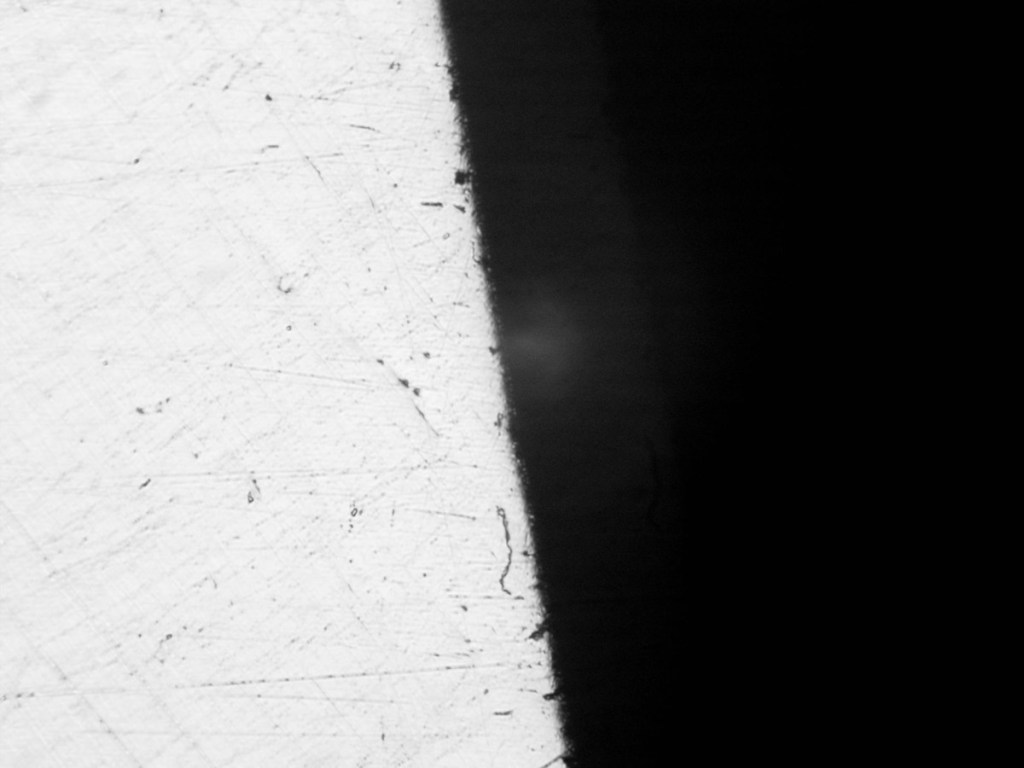
Just as a teaser – below are two pictures – one is an edge on a slurried very very expensive very fine and hard japanese suita. The other is an edge created more quickly with a washita and autosol compound on wood. You can guess which is which (and while the pictures may change slightly with technique or no slurry, etc, and lighter pressure), the overall theme doesn’t change.

What you’re looking at is the backs of two plane irons photographed under a metallurgical scope at 150x magnification. The length of the edge is around 2 hundredths of an inch. The only thing that really matters is the edge and a couple of thousandths behind it – basically how even the line is dividing light from dark.

The little black bits that are irregular are just dirt or fibers from clothes or a rag after cleaning an edge – I didn’t always get everything cleaned off completely, and doing so is actually fairly difficult as the lightest amount of oil will look like bubbles all over the magnified surface.

What about Rehardening Low Quality Tools? ($3 Buck Brothers Iron)

The rehardening of Stanley tools is encouraging. The steel quality is there to do it, but not all older tools have fared as well. I’ve rehardened a few Ohio Tool irons, which exhibit the characteristics of an iron that is not top quality, though I couldn’t say specifically why. It could be low quality steel or lack of carbon (both can show the same thing).

I’ve also had some specialty irons from oddball toolmakers in the 1800s where rehardening didn’t result in a hard iron. With Parks 50 and an iron (Which is a relatively thin cross section) this shouldn’t be the case and the result suggests the iron isn’t hardenable to the extent that a woodworker would want it to be.

I’ve also had excellent experience with defective new tools. About five years ago, I saw a new set of boxwood handle Marples chisels (tang style, but round tang. I would guess something like 70s or 80s make). I do not recall a tool that was suitably hardened in the group, but three fourths or more of the group was unhardened for any practical purpose (softer than a saw would be) and any attempt to strop a chisel would roll an edge. One push through softwood and the edge would roll badly. In that case, a simple quick heat and quench (handle still on the chisels, just sticking out of the forge with a very wet towel around the wood), and then a blacksmith temper (holding the chisel over heat and tempering to straw and then quenching again to stop the tempering process) results in a good working chisel.

New for those chisels may not be a great term – they were unused, and $160 for a set of 10. I doubt the owner of the chisels knew they were bad, they were probably just a flipper (none had any signs of use or sharpening).

So, A current Version

Buck Brothers used to sell a cheaply made iron (stamped out) for a stanley 4/5 sized plane in home depot. Interestingly, over time, the origin of the plane irons changed from USA to china and back. Some of the blades I’d found (and bought) said “USA” on the packet and had a sticker over the packet that said “CHINA”. Who knows what the case was – maybe they were just packaged here. It doesn’t matter, they were $2.99.

Those irons were actually usable, but they hone and slough on an india stone very quickly, and then they need a little help on the final bevel to hold up to hardwoods. A bit of a roundover with the bevel and they’re OK, but they have the feel of a steel with 0.6% carbon (like cheap imported chisels). They give themselves up in how they feel on stones – lower carbon steels feel a little smoother on a stone without any grip, but hone quickly.

I don’t think there’s much of anything else in those irons, so I rehardened one, and then tempered again in the 400F sweet spot.

What happened? Almost no change. Why? When you lower carbon, you can get high initial hardness, almost as high as a 1% steel iron, maybe just short. If you under-temper an iron you can keep it at high hardness, but it will chip. If you continue tempering, then the hardness of the tool being tempered will be lower than something with a higher carbon content.

26c3 sort of illustrates this. It’s about 2 points harder than O1 or A2 at the same temper, it has more carbon. This comparison goes a little awry when you add lots of other alloying elements – like bunches of chromium, but that’s outside of my scope. The only stainless I heat treat is XHP, which has a huge amount of carbon, but comes out of the quench lower than something like O1, and then lands around the same hardness after tempering. It’s got far more carbon than 26c3, so just carbon content alone isn’t a perfect indicator.

Back to the Cheap Iron

I didn’t take any pictures or do testing, but I did buff the edge of the iron and plane some Louro Preto (high hardness dusty wood, about as hard as indian rosewood). It worked fine, but it wouldn’t wear long in that – buffing the edge helps it avoid instant damage.

The thinner you would get in terms of taking shavings with an iron like this, the faster you’d find out that it’s not that hard. Low carbon and low hardness result in inability to hold a fine edge.

Is the iron useless? No, I used a pair of them to plane knotty pine a couple of years ago. When they get damaged, they grind and hone really quickly. To make them usable, use the cap iron on a plane, buff the tip and keep the plane in the cut and just sharpen quickly.

But they do help illustrate in this case, if the quality of the underlying steel isn’t there, just rehardening it isn’t going to improve anything – it’ll go back close to where it was after temper, and if you try to cheat by undertempering, you’ll have worse problems.

Interestingly, these irons were fair exchange at a $3 price, but I have seen them on ebay now for anywhere between $8 and $25. Avoid them at that cost. I’m guessing flippers feel like they can find a buyer for them because they say “Made in USA” on them. The Chevette diesel was made here. too. That doesn’t make it as good as a truck made in Louisville.

If you have some of these because you couldn’t resist the $3 price, they’re not at all bad in a jack plane where you’re doing just as much wedging of wood as you are cutting.

Rehardening a Stanley “Made in USA” Socket Chisel

This post follows the first three posts rehardening various Stanley plane irons, which can be found as subtopics here.

The summary from those articles is that Stanley used a range of steels at the very least (each of the rehardened irons is definitely a different composition), but that in the heyday, the irons were tempered to a target and could’ve been left far harder. Even the later (type 20) plane iron had potential to be better, but less so than the earlier tools.

What about a Stanley Chisel?

Stanley’s socket chisels are a general-purpose construction site type, and provided in different lengths. I’ve worked on construction sites, but not since high school, and we would’ve scraped grout or pried something with chisels, so what sites were like in 1920 or so, I don’t know. Higher hardness 1800s English cabinetmaking chisels wouldn’t have made much sense for site work, though, and it’s fair to say that cabinetmakers would’ve had no interest in Stanley socket chisels (as evidenced by no change in the English market until toolmaking was automated – even then, the tang type remained, just with rounded tangs turned on a product lathe).

It’s likely that the early (720, 750 and Made in USA socket types) chisels were hardened to a spec that was considered to be OK for various sharpening media and various uses. Overall, I find the idea of gripping the handle (vs pinching a chisel tip to hold a chisel in place) at a bench uncomfortable, and have few socket chisels. But I do have one earlier Made-In-USA socket chisel that’s no world beater at its stock hardness.

“Made in USA” socket chisel. Older and well finished (for Stanley). Dark due to rehardening.

At some point in the past, I ground the subject chisel for this post into a skew, and for this test, I undid that, removed half of the bevel after squaring and ran it through “the hardness cycle” that starts with re-establishing new grain, shrinking it with thermal cycling and then rehardening it. Tempering is again 400F (double tempered).

How Hard is It? What’s in it?

I would estimate the hardness of the rehardened chisel is around 62. It may be a click harder, but it isn’t any measurable amount softer. The back side of the chisel is pretty much immune to the washita and no significant bevel can be cut on the bevel side (which is the aim of using a hard chisel on a washita – any cheap aggressive stone can prep the bevel for the washita to finish it). Back work is doable on an india stone, but it doesn’t just slough away.

As far as the alloy? I don’t know. To add to the confusion, the older irons that I examined previously (sweetheart era or thereabouts) were two different compositions, and this chisel isn’t the same as either of those. To guess at any of these three would require someone who wanted to get an XRF analysis (that’s beyond my scope). This chisel is a little slick feeling on the stones, and may be an oil hardening alloy. Strange as it may seem, oil hardening steels (like O1) have a notable slickness compared to very plain carbon steels like you’d find in files or saws.

How does it Compare to Boutique Chisels when Rehardened?

It’s easily an even match for an A2 or V11 chisel, and probably even with something like an Ashley Iles bench chisel (in feel). I can’t do a quick test in the same wood to compare those, though I’ve tested V11 and Iles chisels in the past. V11 is an outlier as it’s created differently and I couldn’t easily prevent minor damage when testing the “Unicorn” method, though the damage it took on in a small section of maple was minor. In the same test, a mid-level japanese chisel and the Iles Mk2 chisel sustained no damage.

I chopped twice as much maple with this chisel (and it’s half the width of the chisels mentioned above), so the edge itself has seen four times as much use. No notable damage.

A picture of the initial edge at 150x optical after the washita. The black stuff and what looks like a nick is just carpet or clothing fibers from wiping oil off.

The volume of maple chopped (about 2 cubic inches – which in tasteful drawer work would be half a dozen or a dozen half blind sockets):

If you don’t have a microscope, you can do something similar to this – just chop, feel for damage (rolling edges with your finger, or use the tip of your fingernail to find nicks by running along the edge). And look at the chopped wood to see if there are any small lines. None on this.

The edge after this chopping – note how the chopping appears to have removed the initial apex but only to the order of ten thousandths of an inch, and left behind a bit of worked metal at the very tip. The chisel is perceptively the same sharpness here. The steel is beginning to be burnished a little bit, but the edge will chip long before it’s worn to the extent the plane irons show in other posts:

Note the compressed looking edge. Not all of the edge looked like this, though – some remained closer to the initial sharpened edge.

I thought it would be interesting to pare rosewood with the remaining edge, which isn’t that choosy (due to density) in absolute sharpness, but a poor edge will prevent you from being able to pare at all. Unfortunately, all of my rosewood is loaded with silica (sometimes it’s not, and is pleasant working wood)

(note, the black oxide from rehardening may look odd, but rest assured, this is just a labeled stanley “Made in USA” chisel)

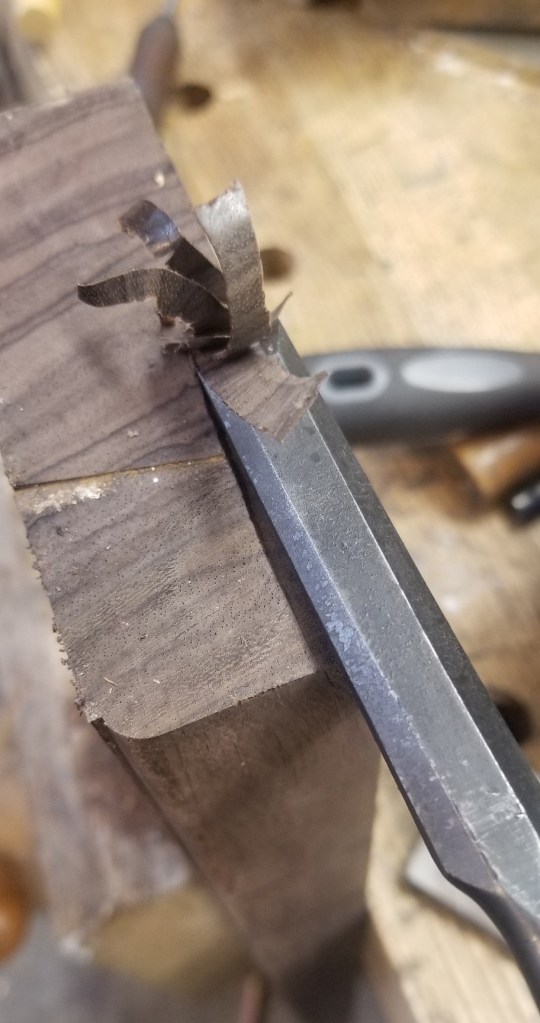
Paring was no issue (no resharpening has occurred), but silica in end grain will spare nothing. Before accumulating any damage, though, you can see the bright finish on the shavings – no nicks in them:

As a matter of illustration, this is what silica will do to tools. Note the scratches. This will sometimes terminate in nicks at an edge with the scratch following, or in the case of some, scratching that starts away from the edge. Good geometry will protect the edge to some extent and scratches can form without notching the actual bevel (but sooner or later one will take part of the edge with it).

Is the edge nick related to the scratch? It’s hard to know for sure

If you had clean wood in the rosewood hardness range, though, this chisel would handle it fine. A stock stanley chisel could do it with more edge modification (a steeper initial apex), but less modification of the edge means better perceived sharpness.

What’s the Conclusion?

The chisel, like the prior plane irons, is delivered at a temper softer then could’ve provided. This was a choice by Stanley, likely to aim at their market. They could’ve used less capable steel, but chose not to. At present, the chisel is a match in terms of usability for anything marketed and would only be bettered by Japanese chisels (white or matrix steel like YXR-7). More importantly, is the assertion that the steel in Stanley chisels isn’t a match for boutique tools now correct? No, I’d prefer the result of rehardening here to anything with more alloying – it will easily hold its own in durability, but doesn’t have much in it that resists cool fast grinding and easy rehoning.

This wasn’t a difficult tool to reharden (but you would still need to be good at hardening to match these results, so this isn’t an encouragement to buy a plumbing torch and attempt this with canola oil – it’s a little more involved than that). But it’s not unruly like the laminated iron, and anyone competent with hardening in open atmosphere could do this. At near zero incremental cost (probably 20 cents of propane/electricity for hardening and tempering).