Last year or the year before, I took pictures of the scratch patterns from a lot of sharpening stones. Most of them, I still have, but I have the pictures nonetheless and more can be added.
At the time, I posted on a woodworking forum a “sharpening stone omnibus” or some such thing. It didn’t generate that much discussion, but when I’m exploring, it’s never a matter of seeking adulation, so that’s not a problem. What I’d hoped (And did nothing to facilitate) was some visual record of what sharpening methods do as there’s nearly no correlation between cost of sharpening method and speed or results (fineness). At the time, I showed that with psa 80 grit (as a grinder) and a throw-away fine india stone and a white buffing stick that I bought for $0.99 off of the Sears clearance rack was finer and just as fast as anything. The india stone came in a group, but if you had to price it, you could claim that it was a dollar (what I wanted from the bag of stones was some natural stones and those were already a bargain).
So, more in the spirit of showing what natural stones do, and providing information and maybe preventing expensive unnecessary purchases, I am going to gradually repost and index the results here.
There are a lot of debates about what stones are fast for fineness, or so and and so forth (for example, on a razor forum that I once visited, the strong notion existed that only the naniwa chosera mid stones were worth having unless you were short on money. This is, of course, not true, and the microscope will show a razor edge before and after a shave). I’m generally avoiding the middle honing and the grinding, though – it’s always the search for a magic fine stone where people dump huge amounts of money.
And if that’s what you want to do, that’s fine, but you’ll be able to see what you’re getting.
What I found in general is that when you have a fine even matrix somewhere around 1 micron, then all but tiny scratches at the very edge of a bevel disappear. There is a whole lot out there that’s cheap and strong cutting that’s in that fineness, unlike 75 years ago. And there is no natural stone that will outdo synthetic grits if you want to chase fineness and edge longevity in push cutting (planing). It’s a hard truth, as I’ve spent as much as $700 or a little more on a single sharpening stone (not often) and that amount or a little less may be very typical for rare natural stones or the more highly marked up Japanese stones. Those rare stones are wonderful to use – and the more stones you’ve been exposed to, the more you start to notice the wonderful different feels and smells of various natural stones, and the quality (as in, properties other than outright sharpness) of the edges they give, and the aesthetics of a laminated edge that they can be manipulated to perfect. But for outright blistering sharp, you can get that for less than it costs for a nice lunch.
Unlike most claims of woo, I have the microscope pictures to prove it, and at one point in a group of tests planing tens and tens of thousands of feet of wood and taking edge pictures, I have the longevity data to settle the argument about whether or not some special transformation of edges happens under certain natural stones. Unfortunately, it doesn’t. Any burnishing or adhesion that’s done to an edge is something worn off quickly when planing wood.
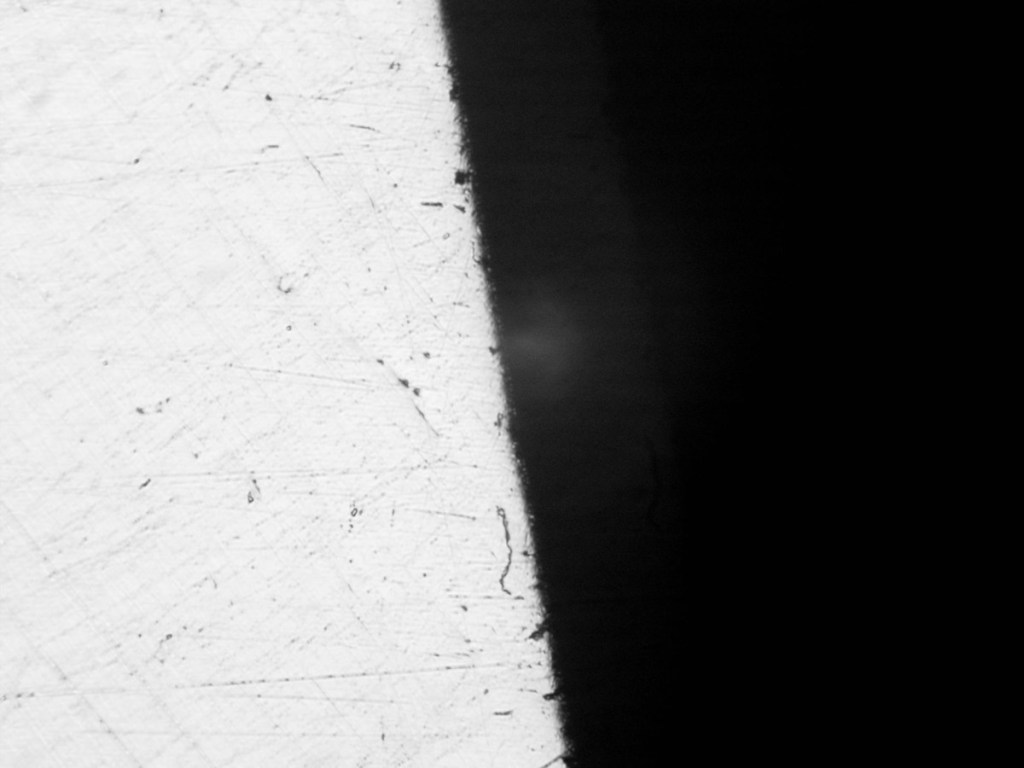
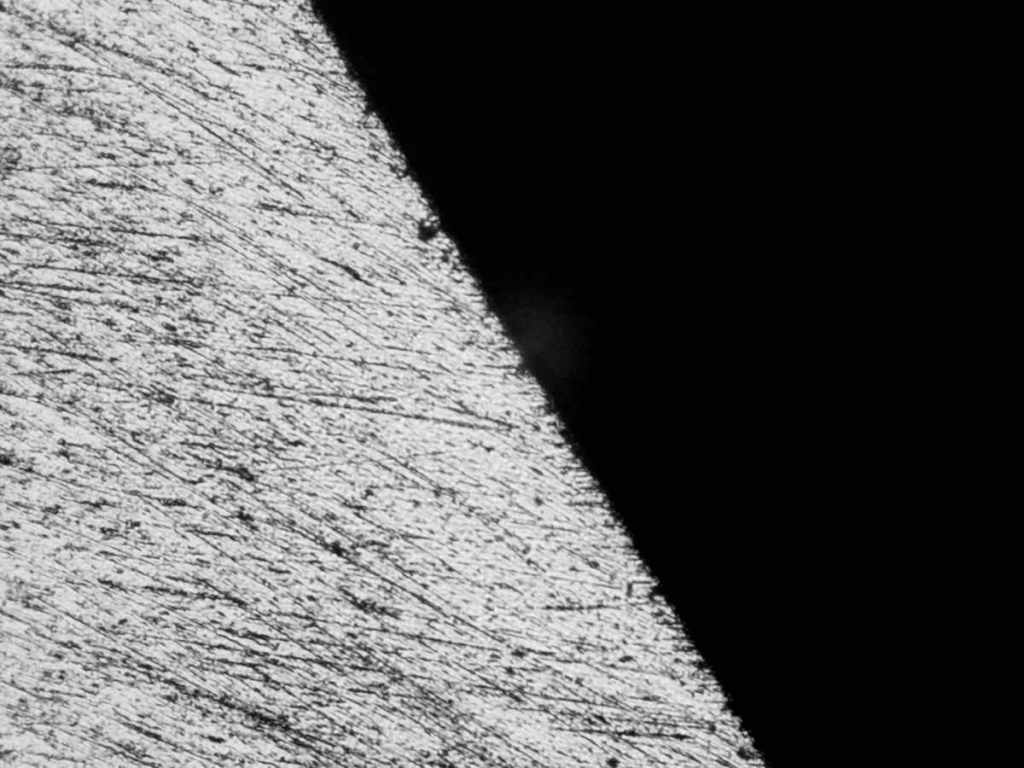
Just as a teaser – below are two pictures – one is an edge on a slurried very very expensive very fine and hard japanese suita. The other is an edge created more quickly with a washita and autosol compound on wood. You can guess which is which (and while the pictures may change slightly with technique or no slurry, etc, and lighter pressure), the overall theme doesn’t change.
What you’re looking at is the backs of two plane irons photographed under a metallurgical scope at 150x magnification. The length of the edge is around 2 hundredths of an inch. The only thing that really matters is the edge and a couple of thousandths behind it – basically how even the line is dividing light from dark.
The little black bits that are irregular are just dirt or fibers from clothes or a rag after cleaning an edge – I didn’t always get everything cleaned off completely, and doing so is actually fairly difficult as the lightest amount of oil will look like bubbles all over the magnified surface.
 Of Making by Hand with Wood and Steel
Hi David,
Ok, ok, ok, I finally broke down and ordered some Autosol polish on eBay to see what all the fuss is about!
Any idea how Autosol compares to other polishes, like Simichrome or the Tormek grey stuff they sell for their honing leather wheel?
Can/will you be discussing the type of wood you’ve used to support the Autosol polish?
Thanks.
LikeLike
Hi, John – to my knowledge, Autosol and Tormek PA-70 is the same. I’ve only had one tube of simichrome, but I recall it maybe being slightly less abrasive (but probably alumina – and the SDS could probably also confirm that).
I like to use autosol on anything, I guess – hard softwood or medium hardwood is nice (scrap yellow pine, cherry). Too soft of wood and it can’t dig in at all.
Like any other lapping or polishing material, it’ll leave a black filth on the wood and you can add a drop of oil to that for a while before needing to refresh with another pea size amount of autosol (any more, and it’s just all over the sides of everything).
LikeLike
Looking forward to the index. The “omnibus” on Wood Central is surely one of the greatest things ever posted there, but like most things on forums it eventually becomes almost impossible to find.
LikeLike
I got a lot of complaints about showing stone scratch patterns (some of the folks on WC thought it wasn’t close enough to hand tools and was clogging the boards). But the illustration was useful.
One thing that I didn’t do back then and will do now (at least I don’t remember it) is track down another vial of 1 micron diamonds – somewhere in my shop is a tiny cigar butt sized container, but it’s lost to the world probably behind piles of wood). Garrett Hack mentioned charging his oilstones with diamonds. I think if diamonds are smaller than the particles in an oilstone (substantially smaller), the stone itself charged with them might make for something far more pleasant than putting the diamonds on cast iron, and more practical than dropping them in wood).
LikeLike
Hi David,
Big fan of you yt videos! I am so glad I found your site a couple of days ago, personally I’d prefer reading other than watching a video(hard to find content that I want to revisit later).
I do have a question about autosol/durasol on wood. I am sure it is the last step of the sharpening, do you use only pull strokes(like stropping) or push/pull strokes(like a normal stone) on it?
Thank you!
LikeLike
Hi, Brian – you’ll end up doing mostly pulling to avoid the iron or chisel you’re sharpening digging into the wood. I guess waterstone users would find that normal, but I am used to having pressure on an edge in both directions, so I tend to pull the iron or chisel and just drop the back end a couple of degrees when pushing it forward so that it doesn’t dig in.
the harder the wood, the more freedom you’ll have. on really soft woods, you’ll build some concavity pretty quickly and find the tip of the cutting edge digging into the wood now and again.
Either hard or soft wood will work – soft will give a finer edge finish in pictures, but not to a point that it matters in actual use.
LikeLike
Hi David,
Thank you so much for your prompt and detailed reply! I just tried it on a piece of scrap cherry with 1.5 micron diamond paste, the result is great, I can pare the end grain of hickory with ease. The thing is that I did have to be very careful otherwise the chisel would easily catch/dig into the wood.
I’ve been wanting to try the oil stones for quite some time, but never has been a priority on my list, due to the high price of the stones and I’ve been quite happy with diamond plates followed by stropping, later changed to your unicorn method. Last week, a “true hard Arkansas stone” turned up on my local classifieds site with the right price, I picked it up and at first glance I thought it was more like a Washita based on you video. It has sandy/yellowish color with a slight hint of purple/black hue, mottling embedded in the body, with a sg about 2.13, sounds like metal while tapping on it. At this point I was about 80% sure it was a Washita but have nothing to compare it with. Two days later, I came across a labelled Behr-Manning soft Arkansas stone, but only half of it about 5″ long, for really cheap. It is pure white with a sg around 2.23 and cuts much fast than the previous stone. Now I think I got lucky and have a true Washita, only problem is it cuts very slow, even after lapping it flat. But it has only been a week, I will have to use it more to get a true feel about how well it works.
I mention the above story is to say thank you for sharing your knowledge with us. As far as I know, no one talks in depth like you do on the internet about different types of stones and sharpening techniques. Thank you and keep up the great work!
LikeLike
the gray and white types come in soft from dan’s, and also from a bunch of private label stuff (case, smiths, whatever else).
smiths had a habit of calling soft stones “hard”. If you double check the SG and find it to be 2.13, it’s really a fairly low density soft stone and then the question is only in how fast it cuts.
Later behr manning ungraded washitas – as in, the label could just say “washita oilstone” instead of what grade – often are finer than older washitas. I can’t visually tell the difference sometimes between their soft and washita stones and wonder if there is some subjectivity in categorizing. 125 years ago, a pike soft arkansas was a more expensive stone than a washita. I’ve never bought one of the old pike softs, so I can’t comment about whether or not they’re just a fine washita, but the SG again is down in the washita range and there’s definitely overlap, as I’ve had washitas that are 2.05 and others that are very fine and nearing 2.5.
Bottom line with them, I guess, private label or norton or whatever is find out what they like in terms of use. It’s definitely the case that fine diamond on wood following them will result in a sharper and longer lasting edge in good wood that doesn’t nick an iron.
But a washita will get you right up to the point where you can go straight to the fine diamonds and not have to spend much time on them.
LikeLike