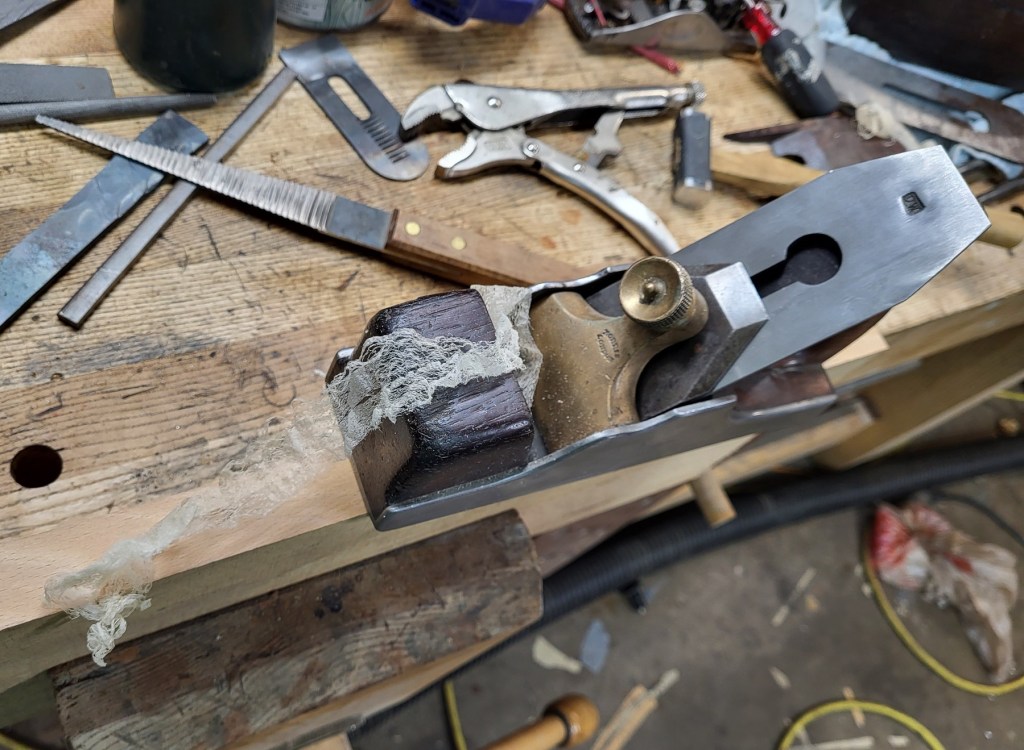
Something I’ve forgotten about for quite some time is ever attempting to make a tapered bench plane iron freehand, or even in a jig. This may sound like something that should be reserved for machine tools, but I’m convinced that the golden age of laminated plane irons (mid to late 1800s in England) existed not based on precise jigging, but rather on a job grinder who was able to grind taper into irons on a wet wheel quickly and also grind some concavity into the backs of irons.
I realize also that most folks may have never thought about this concavity, but visualize the old plane irons as follows: The top of the iron that faces the cap iron will be flat. This is the side opposite of the bevel.
The back or bevel side of the iron beds against the plane bed. If you can help it, you want the iron to bed as close to the mouth as possible and again at the top of the bed with not much significant contact between the two. At least not on a double iron plane.
A well sprung cap iron will create some of that concavity on its own by bending the iron itself, but but this bias exists on older irons, anyway. I think the reason is because without it, the point of contact still could be a little bit further up the iron’s length vs. being right at the top of the bevel on the back. Getting these little details in your favor and not high centering or having uneven bed pressure makes a plane lock down tight, work well though minor seasonal movement over time, and adjust appropriately. As a maker, these biases are important – not only to ensure success, but to ensure excellent success.
But most tapered plane irons that I’ve seen new – other than japanese irons – are just two flat planes that aren’t parallel with each other – a sign that they’re either created in a jig (older irons) or just machined and ground (newer).
A Couple of the Doses of the Cant’s
About a decade ago, I wanted to try to harden a plane iron, but I knew as much as most people know. Almost nothing. A professional plane maker advised me not to bother as I’d be able to make a tolerable iron but never a good one. I’m past that.
Another professional plane maker gave me a different “can’t do it” around the same time when I asked if there was a way to taper plane irons for a hobbyist. The advice at that time was that it would take a minimum of $3,000 (more now) just to be able to begin to think about tapering.
I wasn’t thinking the same way – the precise machine way, and came up with a way to taper moulding plane irons well enough, but it was crude. Crude but it worked and was almost free.
My point isn’t to celebrate that I got past the can’ts, but more to mention that doing it – whatever *it* is – is often solving a problem and maybe you can’t solve it right away. I could taper moulding plane irons pretty easily. I tapered a thick plane for an infill shooter years later with a cheap ryobi belt sander idler, but it was a slow process – 2 hours of dusty filthy burnt hands with less control than I’d really like. These things have been incremental, satisfying curiosity, the involvement of handing the process – by hand – is bliss, rather than the thrill of solving a problem, and the the rigid boredom of repetition thereafter.
For reasons I don’t have a clue about, I bought something completely unrelated and got the wild idea last week that now that I have an 8″ contact wheel belt grinder, I could probably make taper plane irons. So I’ve made two. The first one was a bit slow, but by iron #2, the grinding adds about half an hour of time to making a larger plane iron. In this case, the entire process from start to finish is about an hour before a quenched iron goes into the freezer.
What was the unrelated item? 1095 Cro-Van. 1095 itself is a good spring steel. As a knife steel or chisel steel, or even a plane iron steel, it’s not that great. The steel itself triggered this idea – what to make – because I could only find it in a thickness that would probably be suitable for an infill plane. And somehow, that got me thinking about tapering it (too thin) and over to the rack for O-1 and off to the races.
No Great Reason – Sometimes Just for Making
I don’t really have a need to make these irons. My second double iron plane was a cocobolo smoother that I like, but I really like a stanley 4. That smoother has an I&H sorby iron that is a touch soft – unusual for that brand. Irons that are a bit soft and made of water hardening steel don’t last very long smoothing wood, but set the shaving a step or two thicker and they work wonderfully. About like a try plane – for people who measure shavings, somewhere from half a hundredth to a hundredth thick shaving in cherry and a little less if the wood gets harder. If you’re working entirely by hand, especially on something like sticking for mouldings where you also want a pretty good finish, that’s very useful.
It occurred to me that I could make a copy of the iron, but a smarter move would’ve just been to run the original iron through a quick set of thermal cycling and then reharden it. I made the irons instead. In the back of my mind is also that I’ve always made wooden planes with irons that someone else made. There’s no compromise to the design of a good iron and cap iron that I’m willing to go to, so making something like a single iron plane with a flat iron in a wooden plane isn’t going to happen – why bother when you’re working at my level – the level of an experienced dolt, not just an inexperienced dolt.
To apply the taper, I used a wooden block, a pair of vise grips, a belt sander with a platen and the contact wheel on a belt grinder. It worked great. That doesn’t explain the process well, but it’s literally what I used.
The first attempt of anything for me is always something I’m wiling to fail at and learn from, but the first iron turned out fine. It’s not perfect, it’s fine. This line of thinking – knowing what you want to do but then going and doing it and counting problems as guiding you to the right solution is important – it dominates sitting around and pondering hypothetical problems and successes. Knowing exactly what you want to make is important, but knowing exactly how you’re going to make it isn’t. If you’re creative, you figure that out. The second iron took half as long to make and I made it more accurately because of what I learned from the first.
I don’t really have much of a point other than that I’ve crossed something off of my list. The idea of working freehand often and being creative with a belt sander platen, the idler and the contact wheel on a belt grinder is why this was successful, and I’d put the idea of making a large tapered iron on the back burner long ago – if it takes 3 hours to make when you can find good Mathieson and other irons online, there’s no real point.
It’s also a reminder that if you don’t allow yourself to get boxed into things other people have had success with, the little things you learn to do by feel will open the door to do some things you may not have intended. Once you get to the point that you know exactly what you want to make, start making it. If some part is hard or fiddly, figure out another way to do it. I can almost guarantee that you’ll be able to make something twice before you’d ever get through with one paralysis analysis version, and it’s pleasant if you don’t take yourself so seriously that you feel like you’re too good to fail or that you can’t throw away something you make.
Lastly, understanding all of these little aspects of what makes a good cap iron or a good plane iron, including this curvature on the back of an iron, has resulted in being able to stuff both of the new plane irons into their subject planes with no adjustment to the wedges – they fit and work ideally right away. That wasn’t by accident. I liked the proportions of the original irons and have the ability to match the taper. The biases that an intelligent maker came up with in the past carried the rest of the load.
I don’t have a way to video this process, and also don’t have a wiling camera to help. Being realistic, I don’t think too many people would want to try it, so other the bits and pieces mentioned here, I think I’ll defer and not go into detail about the method – it’s less important than celebrating something that would’ve seemed too difficult 10 years ago but now is fairly low effort. And celebrating not falling into the trap of following the can’ts or “won’t be any good if you make it by hand”.
A Few Pictures
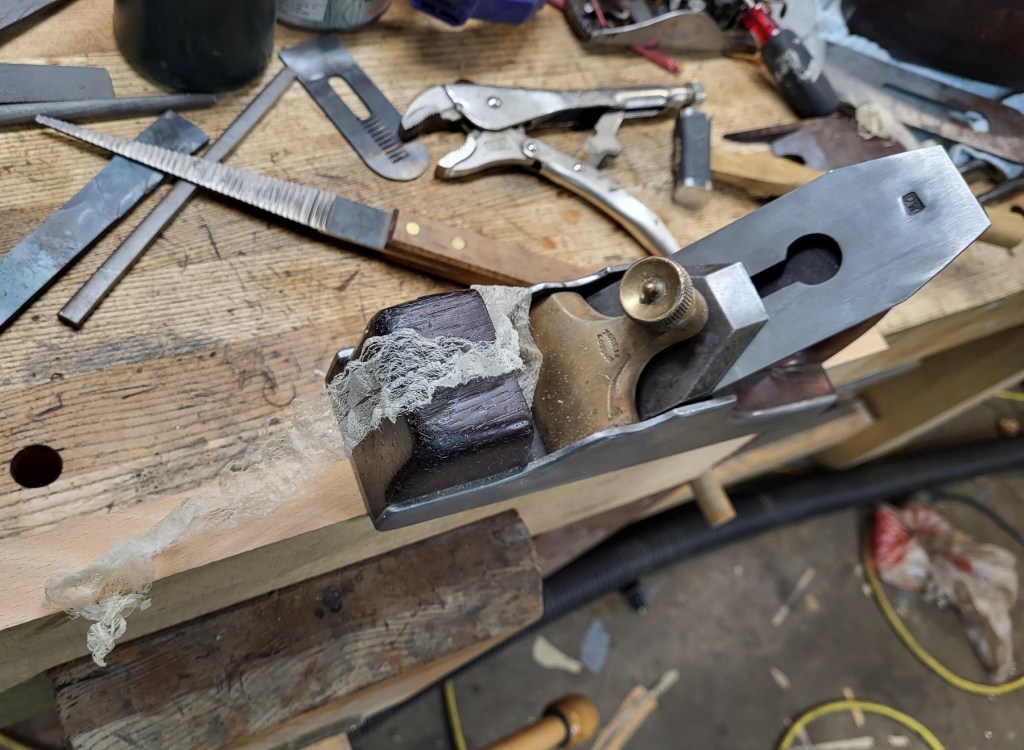
I’ve got a fair number of wooden planes, but not an enormous number by any means. Maybe a dozen bench planes and smoothers. I do have infill planes that will take the same size irons, so some of this is done with those – both used in this case are norris A13s – one beater of a smoother and one long panel plane that I forgot to photo.
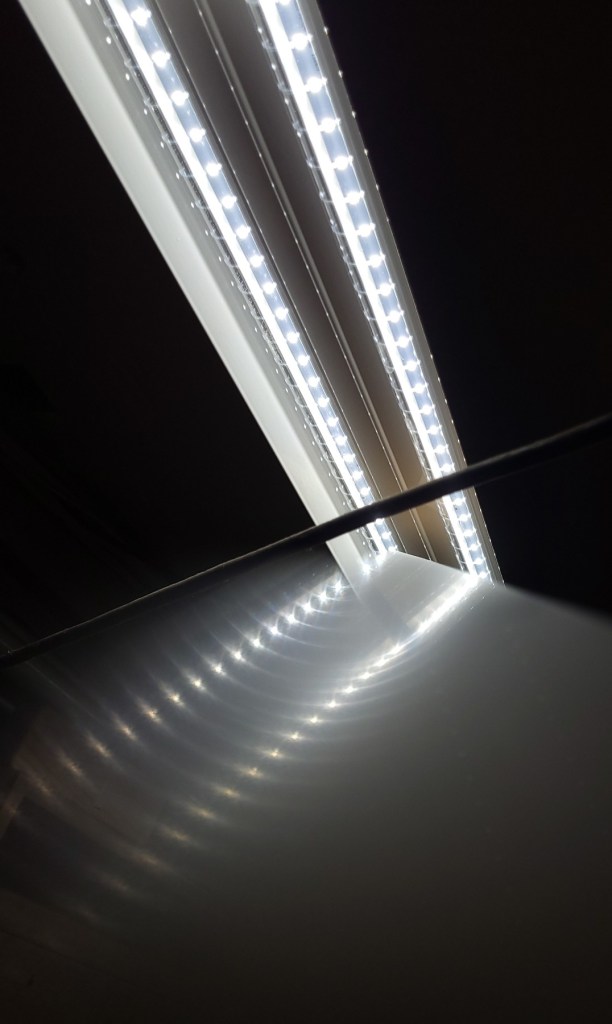
There may be some disagreement, but the reality is that the spring in a double iron plane makes really small adjustments in a smoother less easy. It also makes the plane a real treat with a shaving a little thicker – like a truck with heavy suspension. I use the infills to take thinner shavings and test the surface quality the iron makes, and after getting the edge fully prepared, ensure that a the iron can plane a hundred or a couple of hundred feet with a fine edge and not develop any nicking. So, these pictures are generally at random and the ones that show no planes at all are the edges of the boards being planed – and the reflected image on them.

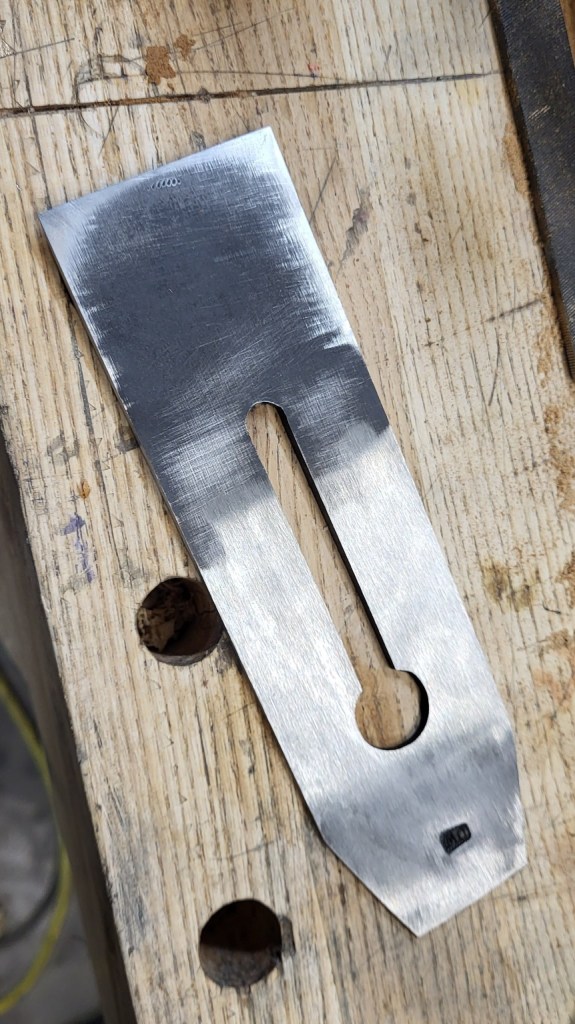
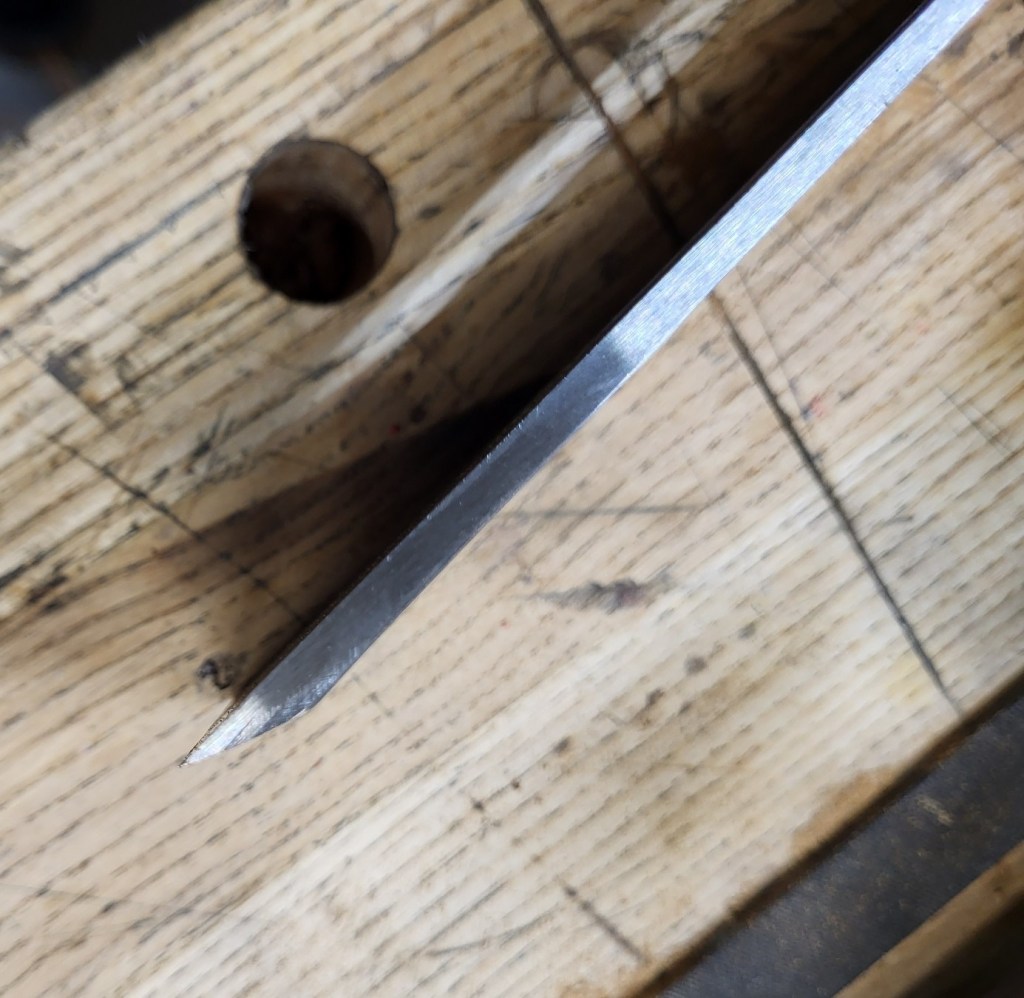
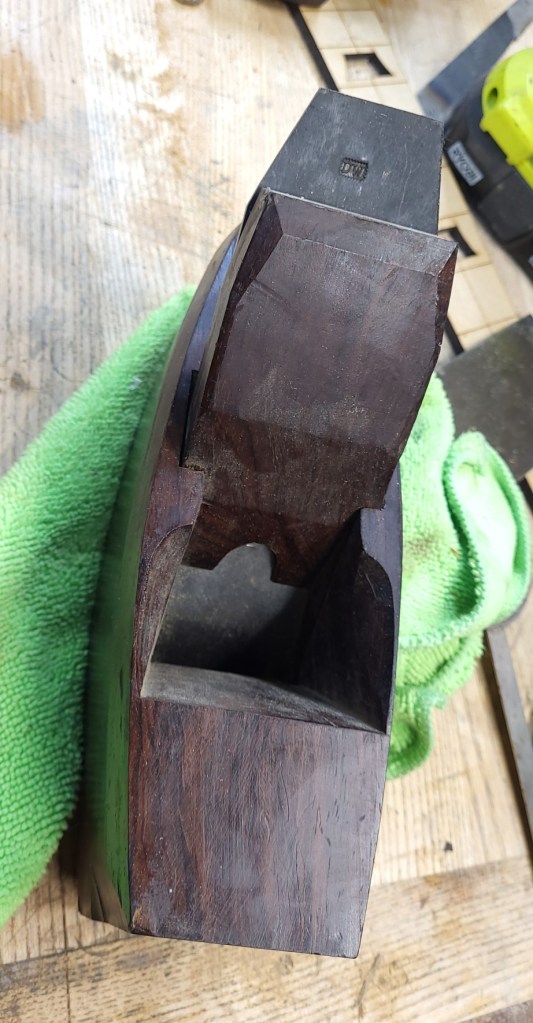




I haven’t yet made a cap iron or a cap iron screw, but I think I’ll live long enough to do that.
 Of Making by Hand with Wood and Steel