It’s not that important as it’s not a steel I’ll use for much of anything, but solving the grain growth and proving it is something I wanted to follow up on. I may be repeating something from yesterday’s blog post, but you may recall that I made some samples of 1084 and one that I intentionally overheated but only for a short time showed drastic grain growth.
This is a picture of that sample – for scale, 0.1″ thick.
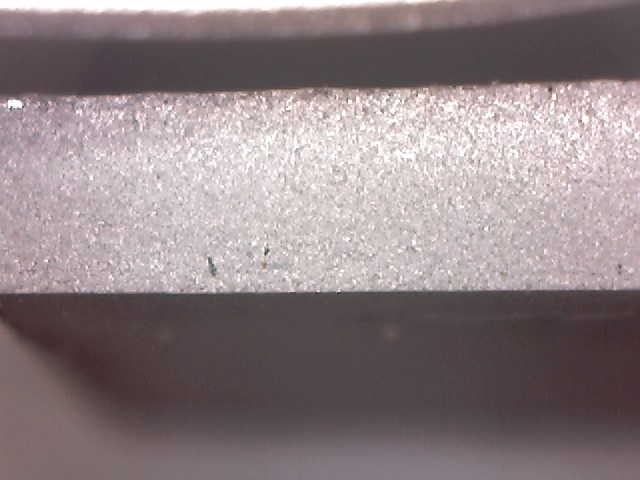
I can tell what made it grow like this, but the loop isn’t closed until I can set up a process that will shrink the grain regardless of where it starts, and I would at least like it to match the best results with a low temperature heat and quick quench. A furnace may do all kinds of things that improve results greater than grain growth, but I’m only concerned with whether or not the steel is good enough for woodworking and if the cycle can be done easily.
The problem was temperature, though – what 26c3 (1.25% carbon with a small amount of chromium) likes and doesn’t suffer from at all is terrible for 1084. it’s just a little too hot, but only a little.
That means modifying the thermal treatment cycles a little and heating a little bit less upon quench, and then the results with the exact same bloated grain tab above moves back to this on the first try:

This is visually similar to what it would look like before overheating at all. I’m pleased with this. The change in what I typically would do is very small.
if I have a use for 1084, at some point, i will have samples tested, but right now, the need doesn’t go past good hardness and toughness “good enough”.
Good enough means not chipping in a plane a hardness above 60.
I’ve learned another lesson – don’t ask any questions about heat treatment on a knife forum unless you’re going to nod and say yes when half of the group says “sell everything you’ve got, you’re not getting good results no matter what, and you won’t until you buy a furnace”. But it’s hard to criticize that, how would someone making knives know what works well in a chisel. One is biased toward toughness first, the other toward appropriate hardness (strength). After all, they’re selling boutique knives that people are going to hit with clubs to split wood. We will probably pick up an axe or a froe.
Just how easy this issue (low toughness in my 1084 samples) was to address, first in preventing growth and then in reversing it without a difficult, expensive or time-intensive process does egg on my desire to solve problems rather than only go for the book solution.
If you want to sell things (including yourself), you’ve got to go with the flow. I have no idea why one-dimensional answers have to apply when someone isn’t doing that, though.
 Of Making by Hand with Wood and Steel