1095 Steel – Finally – Good to Master, but No Ultimate Use

1095 is a steel that most people think of when they mention modern handsaws or card scrapers. Or perhaps older knives and some current kabar knives. Except none of those knives are actually 1095. They’re a modified alloy with chromium and vanadium.

But, you can’t really get that publicly.

I had a relatively lengthy post – OK..all of them are – about solving 1084. Solving 1084 had to do with just how fast grain grows in 1084 if it’s overheated a little. Other steels seem to like a fast overheat just before quench, and 1095 is one that doesn’t suffer too much. but….

What’s wrong with 1095?

You’ll probably never see 1095 in commercial tools other than spring steel. It’s really cheap, and it tends to have some of the manganese (hardenability) replaced by chromium, presumably because just adding carbon to 1084 results in a really brittle steel.

Chromium takes up some of the slack for missing manganese in terms of hardenability, and 1095 is what you would call a high hardness steel with poor hardenability. The former refers to hardness potential. The latter refers to have fast steel has to cool to get there. 1095 needs a fast quench. Parks 50 is the only thing I’ve found that gets it right. You can screw around with water/brine and intermittent quenching or whatever else, but Parks 50 and a very thorough quench will probably harden better than anything you can do with water that doesn’t end in cracking.

I have since found “solving” 1095 that it’s tolerant of a little temperature overshot, which probably has to do with having chromium in the alloy. But less tolerant than 26c3. So if you’re going to quench it, heat it past nonmagnetic a little but not too much and not for too long, then quench it as fast as you can and get it to the lowest temperature you can at the end of the quench as fast as possible. For me, this is parks 50 for a couple of seconds and then immediately to cold water after the high heat has been removed, and then into the freezer. This sounds stupid, but I leave a band of frost on the freezer and within about 30 seconds from hot like to stick a plane iron or chisel to the frost in the freezer and then I leave it in the freezer while the tempering toaster oven and the “metal sandwich” that stabilizes temperatures heats.

But….that’s not what’s wrong with it. What’s wrong is two things: 1) there’s nothing really in 1095 that will prevent a soak from getting and leaving a lot of carbon in solution – far more than the eutectic limit. 2) I don’t think the quality of 1095 that’s available now is that great, but some is good. And I’ve been warned by several people that the quality is iffy.

All three sources that I’ve used for bar stock have been different. It’s nice to find someone who lists the alloy, and then purchase whichever source has the highest chromium level. And hope that it’s quality – if it’s not, move on.

What about #1, though? if steel has too much carbon in the lattice, and not in iron or other carbides, the form of martensite is different and it can be filled with small cracks. If you get 1095 just right, it’ll be about as tough as O1. if you don’t, it might be half as tough, and in my experience, that’s enough of a problem to have a chippy plane iron.

I still like it better than 1084 when it’s done right as far as plane irons go. Why? it feels sharper. I can’t think of a real reason to use either 1095 or 1084 for plane irons at this point, though. 80Crv2 makes a better plane iron than 1084 and 1095. But it’s nice to experiment, and if you can really nail 1084 and make it work at high hardness, and the same with 1095, it will improve your accuracy and make heat treatment of other steels better.

Three Tries – Three Different Steels

First, I sent samples to Larrin Thomas without thinking much. I just applied the same heat treatment routine that I would use for O1 and 26c3. I think this causes a little bit of grain growth. Keeping the thermal cycles tighter (right at the point nonmagnetic starts to occur and then let the steel cool) will keep the grain from growing and keeping the temperature overshot lower will keep grain small but beyond just the looks, the result is slightly less hard. My 400F samples were 63.1 hardness and something like 4.3 ft lbs toughness. You’d expect something more like 61/62 and 8-10. Had i tempered them further, I have no clue – maybe they’d have been OK.

After solving 1084, I did the same with 1095, snapping samples and both observing grain size and seeing how easily they broke untempered. Steel should break easily when hit with a hammer untempered, but there are alloys that retain austenite at a high % that would prove that wrong. None of the plan steels that I’ve tried will resist breaking though. Breaking tempered steel would be more accurate in terms of actual usable toughness, but high toughness steels can become really hard to break so I don’t do it – the grain is the focus.

The first 1095 that I bought was from New Jersey Steel Baron. Since I didn’t have Parks 50 at the time, I was kind of unimpressed by it. It was also very cheap, so I didn’t care that much and put it aside. fast forward to now and I like the version that New Jersey Steel Baron sells. I try to avoid anything that would resemble a soak to maximize the amount of carbon in carbides. I do this with a pre-quench and then a sort-of anneal in vermiculte, and then do as much as possible to not go past nonmagnetic for thermal cycles before quenching.

Still, the result isn’t exactly a cornucopia of carbides and I haven’t found the free lunch. But the early samples that I made showed almost no carbide and I’ve gotten to this point. The iron may be a point softer, but the edge holds up. And the straightness of the edge is wonderful. This uniformity seems to be important along with an edge that doesn’t look very rounded right at the tip (AEB-L, for example, wears longer, but the edge shows a more rounded profile – I don’t know why this is).
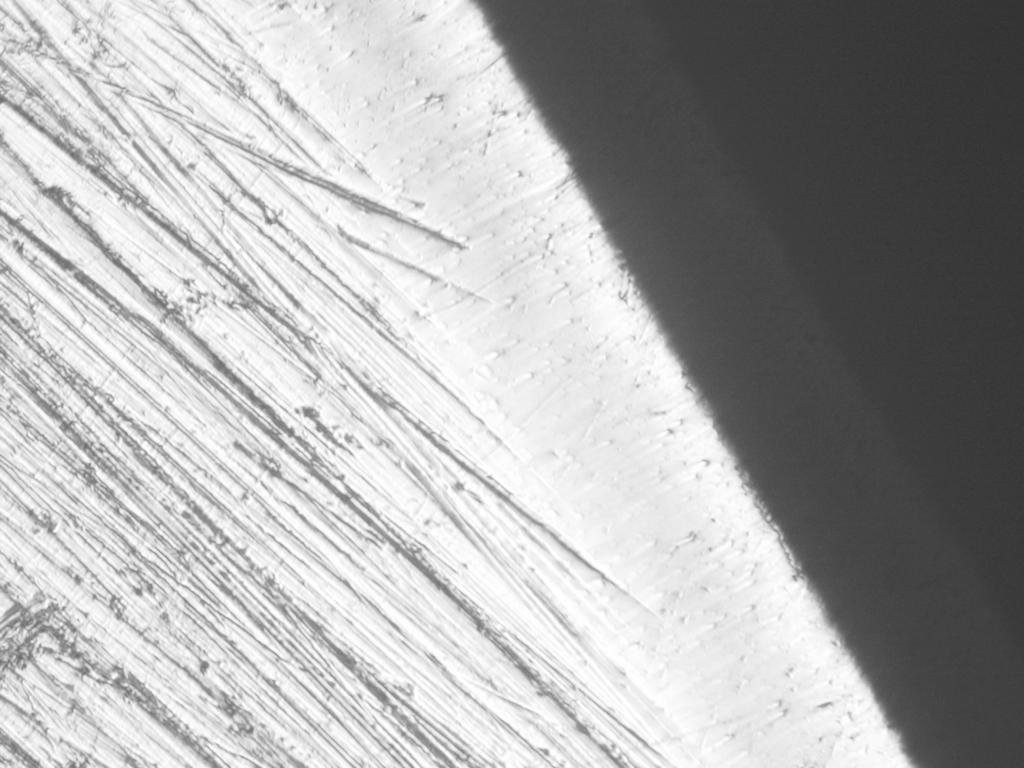
NJSB 1095 tempered at 375F – a very sweet plane iron.

The second 1095 that I bought was from Alpha Knife Supply, which is where I get 26c3 (love it for chisels, obviously). The listing doesn’t reveal the mill but mentions that if you want great quality, finding bohler or ordering a melt from bohler is safe – or something to that effect. So, it’s probably not bohler, or the listing would say. This 1095 seems to have some oddness in it – not terminal by any means, but the shiny spots in it look like something that wasn’t fully dissolved, and I didn’t normalize the steel or do anything unusual, it’s just bar stock, so I think this is how it arrived. This bright spot wears just a little slower and leaves a stripe on wood that can be seen but not felt.

Alpha Knife Steel 1095 – nice fine carbides, but what is the bright area? It’s about 4 thousandths long. Is it undissolved Chromium? Notice that the edge isn’t as neat – reminds me of 52100, and then it’s very neat on either side. The effect on wood (there are more spots like this in the edge) is little stripes that aren’t as bright looking.

The AKS sample here is actually the first one I got right, and I puzzled about the stripes in use until getting the blade under the microscope. If the iron isn’t very good, there will be defects, anyway, so you don’t know right away if you did something wrong or if it’s the steel. It’s *rarely* something in the steel.

In an effort to find 1095 with more chromium, or more like an an observation while browsing for other steels, I found that USA knife maker had a listing with chromium near the upper end of the spec range and also had added nickel. The results of that are also good, just as the NJSB version. There’s no guarantee that some of the vendors aren’t selling wholesale to each other or selling from the same wholesale source, so the first and third pictures could be the same stuff just from different sellers.

usa knifemaker’s 1095 steel

I don’t see much there, but will take another shot at wearing one of these irons. it seems the key to getting a really robust view of the carbides has to do with setting the cap iron closer and wearing more deeply in to the back of the iron.

nonetheless, this iron seems to work well.

I haven’t done any roughing of wood lately so I don’t know if toughness will be an issue. These irons subjectively wear a little less long than 80CrV2 or O1, but not too much less. the edge quality is nice and they feel more crisp than 1084.

But I also can’t think of a practical advantage to continue to make or use them. It’s just nice to get them right.

1095, like 1084, is cheap. if it costs more than $7 of bar stock to make an iron, I’d be surprised.

I sure would love to get a hold of the Sharon 50-100B (I only have the version without vanadium) or Carbon V or whatever Kabar is currently using to make knives. I get the sense that the extra chromium and the vanadium do the same favors they do in 80CrV2 and the toughness would be greatly improved enough to maybe be worth using that steel in chisels as well as plane irons.

AEB-L Stainless – Not What I Expected

I heat treat in a propane forge. That generally means I can’t do what’s important for stainless steels, which is a high temperature soak. I can do the other part of the need for chromium stainless steels, which is get a small area of steel really hot. But along with breaking the rules, this is usually highly controlled for temperature and duration, and temperatures that you really can’t get away with in the open atmosphere.

Instead of doing that, I preheat steel quickly to above critical, let it cool just back to where critical would be and then ramp up temperature by eye to as hot as I can as quickly as I can and quench. I’m aiming for almost yellow and not much exposure time to open air and then quench and get to cold as fast as possible. Stainless and high chromium steels often will cool with plates just fine, but I’m just tinfoil hatting that I will come up a little short and I want the quench to be fast.

Is this a long term plan? No. If a stainless shows potential, then at some point, I will either get a furnace or I will send a batch off and give half of them away at cost. But I’m not there yet.

V11 is Somewhat Stainless

A few years ago, two posters on woodworking forums talked about an XRF of V11 showing that it is CTS-XHP. I don’t know if it is exactly, but the composition matched CTS-XHP spec. XHP is a relatively high carbon steel with enough chromium to be referred to as stainless – very high if you’re used to numbers like 0.8 or 1%. I don’t know enough about steel chemistry except to speculate that a lot of the chromium gets tied up with carbon when the carbon content is high and stainlessness won’t just be discernible by percent of chromium because chromium has to remain in the lattice and it even has to remain in the right place in the grains in the lattice. Put differently, a very very low carbon steel may be very stainless with 13% chromium, but XHP is only borderline stainless if you’re really going to neglect a knife.

Why did I bring up V11? I learned that the high temperature soak for stainless steels that frees elements to go back into the steel’s lattice/solution before quenching isn’t just important for dissolving chromium carbides. If you reason that you don’t need to do that and you can just heat it and quench it at a lower temperature, it will lack hardness. As in, you can’t just reason that you’ll work with what’s already in solution quickly and get hardness – it comes up short.

That comes to play here. I’d suspect that if you’re willing to make XHP really hot really quickly and quench it and then run it to the freezer very quickly after finishing the tail end of the quench in water, you can get 60+ hardness after temper. That is, you can get close to the furnace schedule. In doing this, you’re relying on the bars from Carpenter Steel being good quality to start. It seems to be fine.

Here’s another why – XHP has a lot of carbides in it, and it’s a little lacking in toughness in chisels. There’s a little something else going on that I don’t know – it could be volume of carbides (cracks start in carbides) or it could be lack of the same directional property that some other steels have. the following link shows a micrograph of XHP, the white “balls” are carbides, you can read the entire page which is half history lesson at knife steel nerds.

AEB-L, however, is a completely different animal.

What is it?

First start with the micrograph (you can click this)

Notice how fine it is? It’s much lower in carbon. XHP is about 1.6% carbon and AEB-L is about 0.67% carbon. A drastic difference. I’ve quick heated it in the past without knowing just how important the high temperature is and it makes a kind of soft iron that needs to have the edge buffed to not fold. Then it planes a long time, but that’s no good.

AEB-L is also cheap – it’s a steel used to make razor blades. Knife steel nerds also has a nice write up on where it’s used. Just follow the link above and search for AEB-L.

An interesting side fact here is the idea that PM steels are the finest grain-wise ignores reality. PM allows steel compositions that would be too coarse if it cooled from a large ingot, but it doesn’t negate the fact that there are other compositions that are very fine without needing a powder process. This results in AEB-L being finer than any powder metal stainless that I’ve seen.

What’s the Draw of Fine Grain?

Somewhere this seemed to imply “it’ll be like carbon steel but stainless”. That’s kind of true, maybe? If you read about AEB-L, it can be done in furnace and finished with a cryo dip after the quench to get very high hardness and still have good toughness. 64, in fact. it should hold up at high hardness better than XHP/V11, be finer grained, and I surmised maybe a little easier to sharpen.

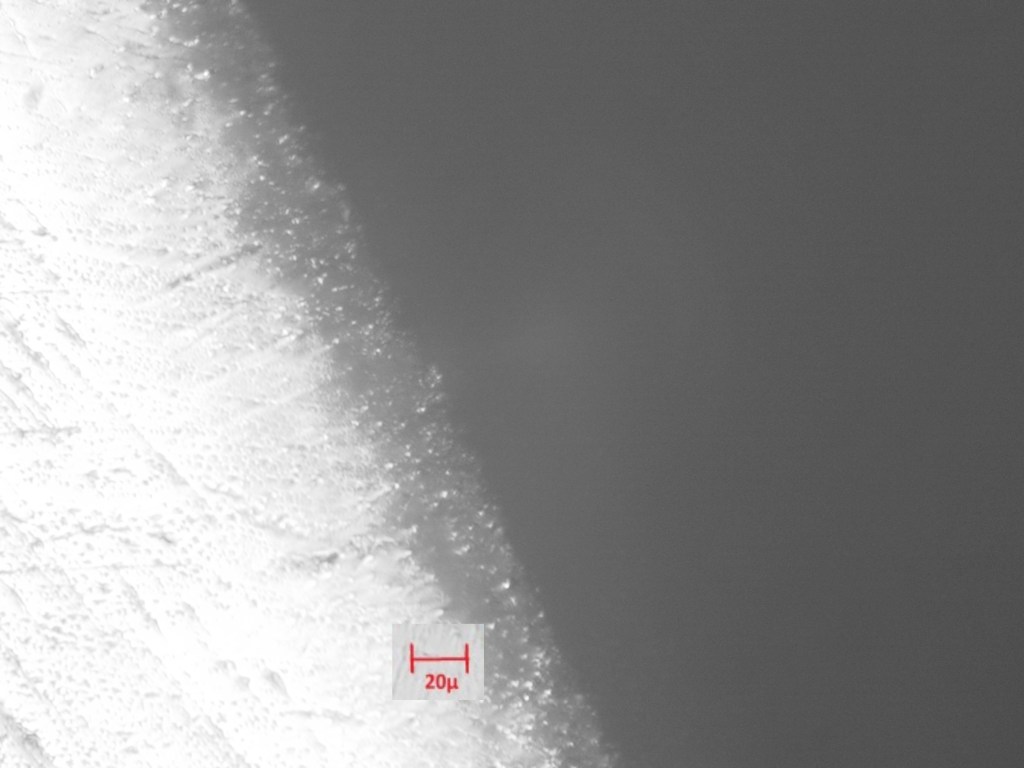
So, yesterday I gave heat treatment another try concentrating heat just on the last inch of the plane iron, quick quench, finish in the freezer. I don’t know what the hardness is, but it must be close to 60 as it shows no ills. It also appears from pictures following that there’s no evidence of suffering anything from not being soaked – for woodworking purposes at least. it would be interesting to see what it’s like at high hardness, but I don’t have the means to get the steel any harder.

Suddenly vs. prior samples, this sample has strong hardness and it’s not quick to hone. Prior versions of this had planing test edge life of 1.6 or 1.65 times more than O1 steel. I’d need to use this iron planing for about 2500 feet in edges just to test that once, and I don’t really have the desire right now.

The reality is that wear resistance makes it slower to sharpen and it is. It also makes it grind kind of hot, which isn’t what we want. It’s not a high temperature tolerant steel and the temper is 350F in the sample here. Grinding it to an accidental brown edge will have undesired effect.

This is part of the conundrum with steels like XHP and now confirmed with AEB-L, too. When you grind these steels, which you’ll be doing a fair amount if you use tools much, the steel wears more slowly and it grinds less cool. XHP takes about twice as long to grind even without considering that and AEB-L speculatively took me twice as long to establish a bevel on a belt grinder. Just estimating based on wear life in wood, AEB-L would grind only about 60% as fast, but that’s compounded further by having to stop more to dip.

Overall, finally getting a hard sample and that’s a little bit of a road block to day to day use (it’s annoying). But it’s worth having a look at how it wears.

This image is the wear after 540 feet. It wears slowly and the wear area looks so odd because of the lack of any visible carbides even at 300x optical . I usually get wear pictures on carbon steels to see carbides at only about 200 feet of planing on cherry. If this iron felt like carbon steel in wood – like in a free lunch way – longer wearing, feels the same – I’d consider planing a volume of wood.

But, it doesn’t. I don’t know why for sure, but I’m starting to get the sense that some carbide volume right at the edge makes for an edge that wears more thinly somehow.

So, this iron would last a long time, but it doesn’t have the feel that carbon steel does, and strangely, XHP/V11 with its high carbide volume has a really keen and sharp feel. Its achilles is that in less than perfect wood, it takes nicks like anything else, or maybe even a little easier, and grinding and honing them out is twice the work.

So, I think I’m back to using plain steels. Too bad. if I ever get a furnace and a dewar of liquid nitrogen, I’ll consider trying to make a very high hardness sample and see if the edge is different.

So…..razor blades? I don’t think AEB-L is ever used in a plain razor blade. I think it’s used as the steel stamping, then it’s honed, and then the edge is coated with something hard. You can see ads claiming razors are platinum coated or whatever – I have no idea what they are actually coated with, but I have honed the coating off of them before when they are dead to see if they can be resharpened, and what’s left is just steel that’s too soft to work at an acute edge.

Steels that d0 well in straight razors rather do have a relatively large volume of carbides compared to AEB-L, but they’re iron carbides and not chromium carbides.

Free lunch yet again not found.

But I have confirmed previously that this steel, which is slower to sharpen but not difficult like steels with a lot of vanadium, will wear much longer than A2 steel and it’s creeping up on XHP – and it’s cheap. About $10 per plane iron in steel costs.

I have no idea if the qualities of picking up shavings more easily during a wear cycle are important to the average user. They should be for anyone who may be sometimes planing several hundred board feet from rough each year as how easily the shaving is picked up is far more important in terms of effort than how many feet are planed carefully in a test. This same factor is why I don’t care for 52100 – it will technically wear longer, but it requires more effort from the person using the plane to keep it in the cut as it dulls and that just isn’t very practical.

For Reference

Here’s how much wear I encountered in the O1 test on the same board after 540 feet. You can see that a great deal of wear has occurred rounding a larger section of the edge and forcing me to increase the light level significantly.