….for wayward boys with acromegaly.
(Millvale is just a local town here, but maybe one close to the city and burbs where you could actually afford to rent commercial shop space as a serious hobbyist).
A joke, of course. I survived making the second chisel – both are pretty much the same thing.
The first one is ever so slightly harder than the second, so I will keep the second. As a maker, as dumb as it sounds, you generally send the good one out and keep the one that’s not quite so great. In theory, I could have another go at hardening the chisel, but aside from not passing the rosewood endgrain malleting test, these chisels will chisel.
They may also be the ultimate test of identifying people who buy tools they shouldn’t. That is, if you are a hand tool only or mostly woodworker, you’ll find use for these. I get why Bill Pavlak likes them – they’re kind of half hatch, half paring gouge. But if you were a power tool woodworker, these chisels would rust before they saw oilstones again.

Shown with an English cabinetmaker’s chisel for scale.
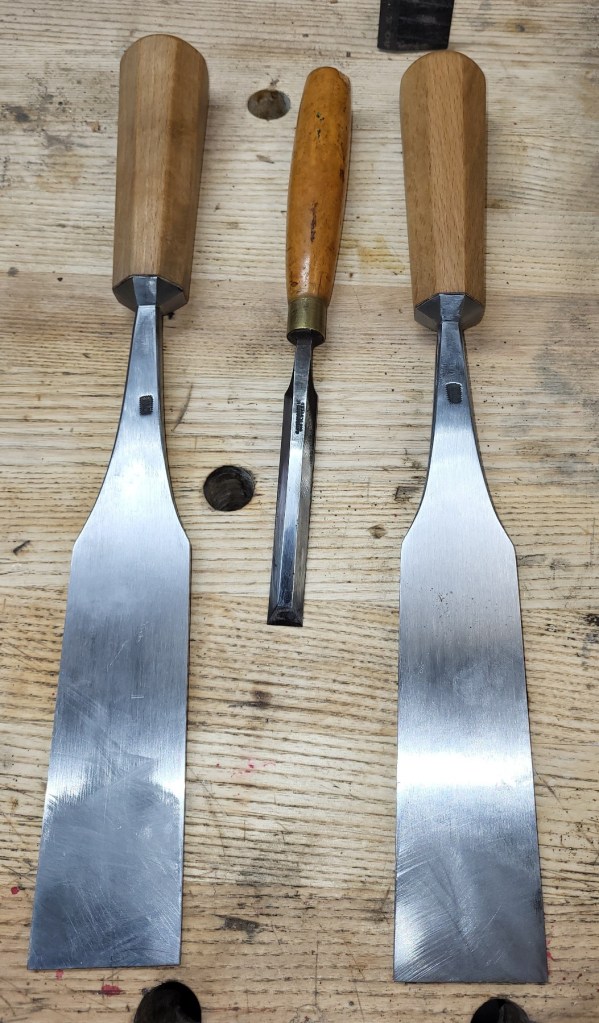
I did mark the back of them, but probably wouldn’t have marked them had I made them first. the maker’s mark has to go on before something is finished, anyway – no clue what they did in the old days when they made a tool or four that were the toolmaker’s version of X-out golf balls.
I’ll live.
Coincidentally, the chisel in the center comes from Tyzack, and the set is quite soft but pleasant to use. it wouldn’t be so great in rosewood, but that’s for me to worry about. As a toolmaker, I want to make a tool that will do everything.
Among forums, it’s a disease – people who will never work rosewood, or leadwood or whatever else they want to dream up – demanding that their favorite tools that they often imagine using should allow them to imagine working exotic woods.
W2 arrives today, and after some oddball reading, I found that NJSB (steel supplier) now carries a steel called 125cr1 up to 3/8ths thick. It is almost the same as 26c3 (about a 1.25% plain steel that would be suitable for razors if clean). So maybe I will eventually have made four more of these.
Haunting me a little bit is a a 19th century long flat gouge of about the same size (less weight) that holds an edge a little better. I can’t let that go.
And maybe it’s a spontaneous unrelated thought, but as I was heating the bolsters on both of these to forge welding heat, which is doable with oxy/mapp on top of the already capped out forge heat level – I realized that perhaps a better method of heating the bolster would be an induction forge. That doesn’t sound like a tool for amateurs, but it’s also not a particularly expensive tool, at least in relative terms, and it would allow me to expedite some thermal processes in smaller steel items – like chisels.
 Of Making by Hand with Wood and Steel