A Stone Box – But Not Nesting

Everything is associated some way in my mind, at least if there is a weak multi-degree association. I realize being a poor processor of outside information, at least without a lot of repetition, this stuff has a low probability of being noticed or digested the way I’m thinking. Which reminds me of a comedian at one point suggesting that jokes that are too complicated or obscure just aren’t funny. This comedian has this same disorder that I have – pattern noticing, association, predicting, checking, testing accuracy of predictions. But I get what he was saying – that you can have two issues when something gets complicated just to be interesting to the person, in this case, telling the joke. First, you’re just being a snot and arrogant trying to cater to a very narrow audience. I don’t much care for personal ego leveling up or “high end groupism” and labeling, so that’s not my bag. The second, is you end up saying a bunch of stuff that nobody gets.

And sometimes that is. So I apologize for some posts on here where I go deep on W2, or whatever else – I’m in my own bubble drawing associations between things and to some extent, documenting them for my own edification. This blog isn’t about trying to draw a big following and monetizing it. If I want to monetize something, eventually I will sell tools, but it won’t be through the blog unless I’m desperate for money. I guess that’s possible, but it won’t be soon.

So, what’s the title a play on? Nesting boxes. I am actually building a stone box, but it’s not a nesting stone box. Boy that would be weird. But it’s also a play on my previous comment about shop nesting. Shop nesting is a trap – one that leads to wasted time and then too much time spent leads to a lot of folks not wanting to dent or allow anything to get dirty. If the nest is the point, that’s fine – I wonder how many people feel like it isn’t the point but they get stuck in it. A perfectly clean shop with a lot of money spent, especially when you count the cost of real estate occupied, and walls full of jigs (that aren’t for recurring professional jobs – I think we’d call those patterns) lining the nest.

It’s my goal to make things in the shop. I hate cleaning – and I hate extra effort organizing. Organizing to a large degree is necessary in a shop with more than one person and shared space. It’s necessary for us at work. if you’re working in your own shop by yourself, it’s not that critical and has little chance of increasing the volume that you make. It does have the chance of costing you money, wasting time and I guess if you are thin skinned, you can show your friends your shop without being embarrassed about disorganization.

So, I have this bug in the back of my head- if incessant organizing is needed to actually do work, then I have too much stuff and need to dump things instead.

Back to the box. Keeping a nice organized bunch of exotic woods (OK, I keep a bunch, they’re not organized) is nice in one sense. They’re never as dry as they claim. In another, loss of wood over time, it’s not so great. Stuff cracks in winter here. So, the fodder for making a box comes from a stick of Louro Preto (you can find it on wood database) that has delaminated a little around a growth ring. Since it’s already fire fodder, it’s good waste for a box and I fixed the ring by gluing it with CA.

Even in the Little Bits, There’s Chance to Experiment.

I don’t want to spend any significant time making this box, which means i’m not going to come up with some router setup, i’m just going to drill it out and fit it to the stone after chiseling off the sides and corners. I’m not sanding it, I’m not scraping it, not any of that.

But there’s an opportunity. Louro Preto isn’t that great to plane. It’s hard, and the grain is often disorganized. The wood database puts it just below rosewood, but it’s worse to plane. The general stat at the wood database is dent hardness and density.

I had no intention of posting pictures of this, but as I was planing, I realized this is a wood that will illustrate the shavings issue. Look at the shavings, and now look at the wood surface. the wood surface (aside from the sapwood) looks pretty good. Look at the shavings – see the little holes in them? You would have to make a second set for the cap iron to plane this really cleanly (really close) and this doesn’t rise to a project of that level. So I don’t do it, but I know when this sees shellac, there will not be a mirror surface. From experience, I also know that if I french polish it for sport (something you can do while watching videos – a functional fidget spinner), they will be sealed.

But there’s information in those shavings. I’d say trying to smooth plane Louro Preto would be in the single percentage digits up with the worst woods. It’s relatively hard, but between the rings and in some of the ribbons is weird powdery wood. So you get shavings and a pleasant aromatic dust.

Don’t discount what the shavings show much more easily than does the wood.

Planing the Ends

More than just planing – Louro Preto also splinters easily. This box will have bevels – plane them to size, or plan ahead a little better. I should have marked the board carefully, but didn’t, because the wood had a delamination and I thought I’d just be going for another length next. If you’re working by hand, think about stuff like this. I can mark and saw something like this by hand in a way that very little work and no squaring will be needed on the ends. I just didn’t do it in this case because I wasn’t particularly engaged in the whole process.

There’s not much end to plane here. If I hate sanding, I hate sanding end grain five times as much. It feels like an activity meant for people with no brain. I also don’t like the look of sanded broken edges, so I don’t do that either. you can plane the bevels on the fresh wood, but it’s faster to use a file or super shear, so the dust you see on the bench top is just what came off of the super shear. This box isn’t think enough for large bevels, and if one were to make a decorative box with them, mahogany would be smarter. It’s more stable, anyway, and five times easier to work.

After planing the end grain, I shear it off a bit with the super shear and that’s it. It takes much longer to type this than it does to do it. It’s important to note that since this is a splintery wood, but practice in general, the bevels are on before the planing, and they are also safer with a file on wood like this as even planing the bevels can cause small splits at the corners. the planing itself is done in a way that the iron goes on askew and comes off askew. If you don’t do that, you’ll find out why when you try to bull the wood and it splits in a long line parallel to the width of the iron.

The stone is in the box here to help with alignment. It’s in tight enough that it won’t allow the lid to move while planing – that can be addressed with light scraping of the sides later.

And if you’re actually thinking about making a stone box, break the edges just a little bit on the bottom part of the box. Your hands will come in contact with them. Nothing garish is needed, just a small break of the edge, and if it’s a facet filed, it’ll actually look better. Even if it’s done quick and sloppy like this box.
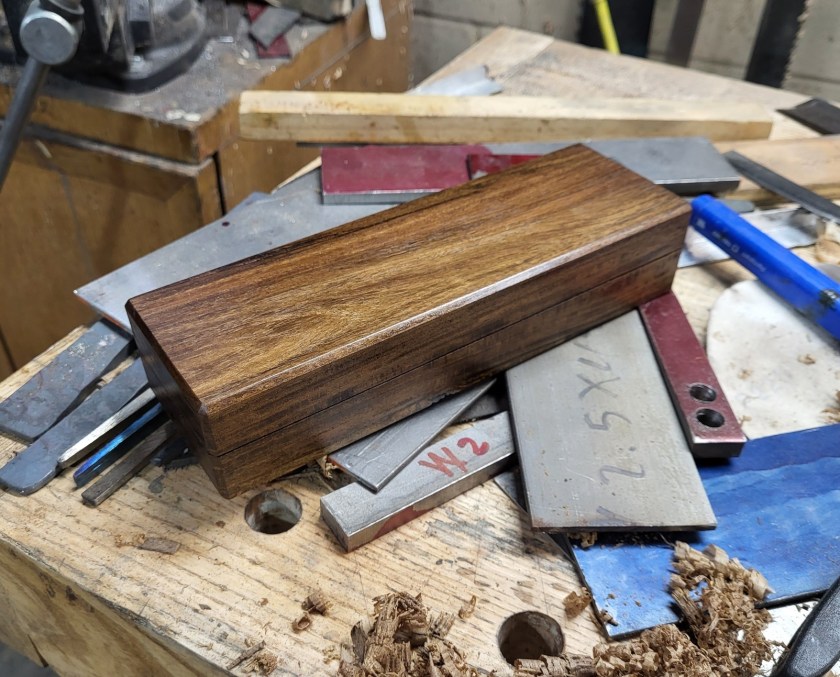
I plan on sticking something non-skid to the bottom and adding more shellac than this first bit rubbed in through linseed oil. Not because it needs to stay pretty – the shellac will get dinged and so will the box. but because I don’t want the box to be black from handling down into the wood.

You can only just see the evidence of the edge being broken in the last picture – it’s discontinuous. the small bevels around the top of the box meet in a triangle at each corner, made by starting pulling a file backwards to start. those would also be punishing if let untouched. If you make fast-as-you-can small bevels like this and they don’t all line up, just adjust the long bevels slightly as they meet and then address later vs. pretending you’re a machine trying to make four perfectly identical freehand bevels. they only need to be close. You probably didn’t look at the picture and say oh, how uneven. Save the fine efforts for work, not the nest, unless you’re testing a method in earnest that’s going to be used on work soon enough that you won’t forget it.

Flattening Plane Bottoms and Advice on Functionality

(Take me to the short version)

This is a popular topic on forums. For a plane, and let’s assume we’re talking about stanley planes because the decent versions are practically impossible to improve on functionally, there aren’t very many things that need to be right. But before we move on, if you want to check these basic things every time you have a plane that seemingly doesn’t work as well as others:

  • Check to make sure the iron is sharp. If needed, resharpen and see if you can shave hair off of your arm with the iron both bevel up and bevel down. Sharpness and lack of a false edge or burr fragment will do this.
  • Confirm that you have cutting clearance with the iron. If needed, hone with a medium stone and a guide at 33 degrees or so until a burr is raised and then go over the same angle or a degree or two steeper with the finest media you have thoroughly without lifting (this is a dead common issue on planes and irons I’ve examined – it’s sneaky because the iron may still look good)
  • Check that all screws on a plane are tight and that the handle and the knob cannot physically be separated from the casting. You can have a very sneaky issue with planes where the front screw on a rear handle (if there is one) holds the handle tight (to the eye) against the casting, but in use, the handle lifts/vibrates with lack of firmness. this is a torturous thing to not notice, but relatively common as handles continue to shrink with age (fast at first, but they never really stop) and everything looks good but the thread on the metal stem does not allow complete tightening. A mechanical fix is needed for the rod and boss in the handle to apply very firm downward pressure

Those are probably the three that are most common that aren’t related to flatness. Everyone mentions the first, but the other two are not as visually obvious and can drive you crazy. After all, with the third bullet point, you turn the screw, it’s tight and won’t go any further, but you can’t see that it’s just fully seated in the casting and the boss at the top of the handle isn’t actually applying pressure. I like to fix this one with small washers – you can reduce thread length by shortening the bolt, but do it a thread or two at a time and not “i’ll just grind a while” and find out that the thread quality in the casting isn’t so great and is only tight at the bottom – which you can suddenly not reach.

OK, but What About Flatness

Raffo – note the tangent, it’s avoidable for some, seemingly not for me.

For everyone else, the items above are related to flatness, because flatness isn’t immediately easy to see. Clearance issues are easy to feel with experience, so are flatness issues. The little handle trick is harder to see and easier to just test by fixing rather than some other way.

Flatness of the variety of several thousandths at the toe and heel, where both are low and a feeler would go under the middle is not easy to measure, but it’s a real pain. If the error goes the opposite direction and there’s no twist, you will never notice it – as in, if you put two thin feelers under the toe and heel and the mouth still touched a flat surface, no problem.

Even if you can measure things, there’s mental trap here with this whole slightly hollow in the length idea, and I’ve gotten a lot of flack for actually measuring what matters and reporting. Why? You can push the plane down only moderately hard and push all of the “bad” flex out – if the heel and toe touch only on a machinists reference surface, it’s probably not more than 10 pounds to get the center of the plane to touch. You will not be doing this in use, though, and when you plane, the toe and heel won’t always be on the work. You’ll never plane a fine flat surface with a plane like this perhaps other than once for show if you can win a bet doing it.

However, this seems to be common. I can’t say “90% of planes will be ____”, but I can say that of lower wear planes, especially later, I have seen a lot of planes with the low toe and heel, but the amount low is small. I think this is an artifact of stanley’s manufacturing. I’m not a machinist, so I’ll leave it to them to say why, but I did finally see a machinist this week mention that if the last passes aren’t fine, low toe and heel will remain. Too bad the bias wasn’t the other way around, we’d never notice it.

So, What does this Mean for You?

I have addressed flattening planes functionally in videos and maybe on here before. I rely on a 1.5 thousandth feeler and a starrett straight edge. I haven’t got a great idea of how you would be able to check things reasonably well with a lesser straight edge because a 3 thousandth error over 2 feet is below the spec of a lot of steel straight edges. Starrett’s spec is something bonkers – like 2 ten thousandths per foot.

Doing this by hand is different than with a surface grinder, though. You only need to do what counts. If I refer to plane probably needing 2 or 5 thousandths or whatever it is removed, I am not measuring in the last tiny fraction of the toe and heel. I just don’t care whether or not the last bit where there can be a big fall off is addressed. It’s possible that a beat up toe or heel could be multiples of the error.

This apparently creates controversy, because I’m not the only person talking about these things. I’m measuring with a starrett and only checked feelers. My smaller straight edge has some mile and has been cleaned up a couple of times, but I have another that’s mostly unused to check it against. This is what a toolmaker would have. To get a 24″ starrett for someone who doesn’t care about this stuff is a bit of a push as it’s over $100 at this point. That’s a trivial expense to me, but I wouldn’t spend $100 for sandpaper for a $1000 project. We all have our priorities.

With all of this in mind, you have to decide what camp you’re in, because there are two that are definitely false camps: 1) the machinist who says nobody can make a plane flat by hand. This is a false statement, and perhaps a victim of society’s inability to properly use terms that mean probably vs. definitely. 2) that you can just lap every plane flat with a defective polished tombstone. maybe you can do it with many, but you can’t do it with all.

So, my camp is simple. I will always do this by hand. it’s extremely uncommon for it to take longer than 1 1/2 hours, and sometimes it’s 10 minutes. Neither of those is longer than waiting to get a plane back, and the cost (close to zero, just the cost of sandpaper and maybe some wear on a file) is less than what it would cost to ship a plane one way. Your camp may be sending the plane off to be machined even if you could do it by hand – because you want to. Or because you don’t know at all and you don’t want to. Either of those is fine.

But try to avoid becoming someone who lowers the discussion level by repeating something you’re told and declaring that it’s universally true. I have been told more than once that a plane that I flatten won’t be flat. There are never any questions about what I’m observing to declare a plane flat, because someone who has concluded that is engaging in mental laziness – the conclusion occurs before the discussion.

I will admit when someone says they just started woodworking and they’re lapping all of their planes, I squint a little bit, too. It’s probably better to wait a little bit so you know what to expect performance wise.

And what’s that? that if you have a known flat surface, you have a plane that will plane that surface and make a continuous shaving from end to end without clipping ends off, and when you switch planes around, each will continue the efforts of the prior without any time spent planing the wood to the shape of the plane sole.

Why this is controversial – and it seems to be – is beyond me. If you’re going to do a significant volume of work and you have to take four shavings depth across a large panel for every panel after a try plane just to get a smoother or jack-set-as-smoother shaving to be continuous, only to find that the surface is convex……well, that’s not realistic. It’s just one more small way to figure out who says they do most of their work by hand, but doesn’t.

Back to What this Means for You

Here’s my advice – don’t assume you’ll do a perfect job flattening your first plane if you want to do that. And if you do, take it slow and have a good reference straight edge. I’ll stay out of going all the way back through what counts in this case, but keep in mind even small errors (like dirt on a bench top under a glass lap) will throw you off. Check often, do no more than you have to.

If you want to get a plane ground because you just don’t want to do any of this, by all means, go for it. Just don’t believe it’s the only option. If there is a menu of solutions and they all work, then pick one and don’t worry about it – worry about how to learn to use the plane so well you would trust it in all work and use it for pleasure.

Premium Planes will Guarantee Success?

No, but they will increase your odds of having to do nothing.

I’ve only had about four LV planes, and I didn’t keep any of them long enough to get to knowing how accurate they were.

I have had ten Lie Nielsen planes – half new and half not. Two out of 10 were hollow just under 2 thousandths. They would not create a flat or slightly sprung joint. The first, I was afraid to fix ( a LN 8 bought new ) and the second ( an LN 62 that I bought testing the unicorn ) I just fixed. Same error in height, but shorter plane and more consequence to it. I would plane a surface flat to the starrett and the 62 couldn’t touch the center of it if it had any length at all. No bueno.

I’m not encouraging you to modify premium planes. At this point, I have no qualms. I knew I wouldn’t keep that plane, but I also knew that even in an anonymous ebay listing I could explain what I did to improve it clearly enough that it would sell easily. It did. On a straight auction, it brought far more than new price.

I sold the 8 much earlier disclosing why I was selling it. it also had no problem selling as stock. Maybe someone didn’t believe that it would matter. By the amount of use on the used LN’s I’ve bought, it probably wouldn’t. I couldn’t match plane a cabinet side joint with the plane and not have the ends separated, though, and that should be doable without ever having to check the joint in the first place.

lastly, I have from time to time gotten a stanley plane that’s so worn or beaten that I won’t flatten it. It’s bad enough that I don’t think I would bother sending it to be ground, either. Who wants a stanley plane with .03″ (not .003″) of material removed. I don’t. That’s the nature of buying older planes. Most days, you get a big mac. Some days, you’re eating fine chocolate right out of the box, and some days, you’re eating with the dung beetles.

How People Get Dumb – Stay Dumb and Mislead Others

I stopped posting on the UK forum January 1. There’s just no chance for anyone to learn there because there is too much opposition there by people who really don’t care about getting better at anything, or perhaps who are missing the nerve endings or bandwidth or ability to discern things.

However, I have learned something over time. If you are better at something than someone else is, a few people will notice, and they will imitate you. I’ve always hoped that enough people would work by hand that fertilizing the idea would lead to other people telling me things I didn’t know. This happens once in a while, or perhaps it results in someone pointing me to an old published source of something I’ve backed into just out of laziness, and the source provides more background and confirms what I’ve found and perhaps adds some resolution that gives some incremental improvement, that’s great.

There’s one individual that I gather from discussions and exasperation has failed at most things in life. They refuse to offer helpful advice, and constantly rail about things that don’t exist or aren’t occurring with an undertone of being cheated out of appreciation they deserve or that everything is part of a lifetime of hard breaks that they got and nobody else did. These kinds of people are a waste of time, but just like with negative news, they have some ability to convince other folks that they will offer some kind of reward. That is, if you are not having success at something, you can rely on someone else who implies that they are much more experienced to confirm that the failure is certain and then you don’t have to feel the obligation to do something better.

I can’t post on that forum as I’ve asked to have my ID ghosted. In the past, I would’ve had the urge to jump on such a forum and disprove (not difficult) or provide an exercise of some sort in a project or as a side by side comparison to make a point. One or two people would do it. There is something fundamentally wrong with enough others that prevents them from being able to get far enough to prove themselves wrong, or actually prove me wrong (I like this when it occurs – if I am proven wrong, I adopt something better).

Of course, as the nature of forums go, the original poster just asked a separate question – can you round off only the corners of an iron and get something useful out of it. Sort of, but you can do the same with a square iron, just a little better with rounded irons. You can use a square iron and plane a track free surface by biasing the lateral set just a little bit, getting a surface flat and then carefully taking overlapping strokes with a plane in the direction that favors the bias. That is, if you’re working from the right to left edge, the bias will be the opposite of the left to right. It’s not practical, and the original poster will have no idea, nor will anyone else on the thread (I can guarantee) have the experience or capability to give that answer. There are probably dozens or hundreds or thousands of people in the world who could actually give this answer, but the forum nature drives them away.

What you Will Get

I’d guess the chances of someone taking advice and attempting it in a way that they’re determined to get good at it is less than 5 percent. The chance that they’ll succeed is well less than that, and the chance that they’ll avoid discussing it because of the collective comforting incompetence of everyone else is very high. Everyone gets dumber and stays dumber. There’s a steady state, and it is unfortunately a bar that someone working a couple of hundred years ago would’ve passed in a matter of months. Everything related to better work in the past (design, sawing, planing, basic efficient sharpening) suffers and all that is left in the wake is people firing paul sellers, tage frid, rob cosman mortars at each other. Relating actual experience and describing it in resolution is mostly off the table because it leads to someone telling you what you’re doing wrong. People who despise someone else who is better at something than them are going to have a huge problem with this. People who are good at one thing and not that good at another tend to freely admit what they don’t do or fail to do well. If they can’t do that, it’s something to work on.

I don’t build a lot of furniture. I’ve perhaps burned through about 1500 board feet of wood on furniture in 15 years. It’s not stimulating, it’s a hobby and it’s hard to find an end user for what you make. Most forum members don’t make much of it, either, and the folks who do it for pay have trouble admitting that there are things they aren’t good at, especially if, for example, they’re selling to clientele who wouldn’t be able to spot fine work in the first place.

So, that’s all fine. Here’s where I get pissed off. When incompetent people attribute statements to me or deny reality. Here’s an example:

“David denies that higher angles can prevent tearout”

Say what now? I’ve literally never said that. Of course increasing angles can prevent tearout. However, now that it’s in print on a low-wit forum exchange, I suppose it will become fact. Is it intentional? I don’t know, but it’s stupid. What function does this perform? It shows someone who sees that statement and who can tell they reduce tearout with a higher angle that somehow my advice on cap irons is unreliable because that statement wouldn’t hold water. However, the problem with this chain of events and conclusion is that it’s false because the assertion that it starts with was never made in the first place.

Here’s what “David said”. If you want to do more than smooth wood that comes from a planing machine and you limit yourself to controlling tearout with tight mouths and high angles, individually or in combination with other methods, you are on a dead end trip to dimensioning wood. I learned this the hard way. I guess there are a lot of people who can’t do the learning part on their own and will refuse it when it’s shown to them. There is an imaginary world where you can still get perfect old growth wood that is all down hill. If you can find it and it isn’t $25 a board foot, you’re ahead of me. With cherry, maple, beech, anything I could find, relying on high angles while trying to dump power tools was a no go.

Eventually, someone will repeat this, perhaps a lot of times – the false statement that is – or a question will come to my inbox as to why I think high angles don’t work. Or scrapers or whatever else. But it won’t come from an origin that had the potential to help anyone learn. It’s only coming from people who intentionally or unintentionally will lower the level of discussion.

If you run into anyone who makes a statement like this, feel free to ask them to locate where I actually made it or tell them that I didn’t. The last thing I’d want to do is have an argument so weak that it relied on making false statements about other methods. So, I don’t do it.

Here’s Another one thinly veiled and shot at me:

Real Craftsmen only Look at Surfaces and Shavings Don’t Show Anything

It’s not hard to disprove this. I learned to use the cap iron in a vacuum. It seemed like there should be a way to just plane material, at least reasonably, and even if it’s so bad (like dried up Louro Preto) that you will probably have to sand some, anyway, you can limit the amount of dust in the air by a factor of ten. Let alone not have to create some ninny thin plywood rack with a neatly piled assortment of sandpaper and constantly run and buy sandpaper and try to figure out when you should stop using it. Just avoid that. When i’m forced to sand something, it’s generally with one grit, manually and linear. There needs to be something really worthwhile to get out an ROS (the worst of woods bordered by a moulding, for example – even that can just be scraped and burnished). I have two ROS sanders. I always have the feeling of regret using them about halfway through because the tease of 2 minutes with them turns into 20 and changing paper and then checking to make sure there are no swirls or uneven parts left.

So, I used the shaving to discern what was going on. If the shaving coming out of a plane changes just a little bit from curling up or coming out torn, and it’s continuous, the cap iron is set well. Laziness brings you to this – how else are you going to figure out how to get through wood planing faster and safer – create an app and a measuring device? The historical basis for this exists (it’s nice to find confirmation later) in Nicholson talking about what will happen with the jack (the chip will break), and Holtzappfel (starting page 475 in the 1875 edition on google books) showing a very intentional diagram of a straighter shaving feeding through a plane in a picture, and describing that when a steep angle also shows modifcation of a chip, it will be polygonal more than curled.

There is information in the shavings. You have to be smart enough to use it to discern things, and the bar to figure that out isn’t very high. You can figure it out long before you see any texts, but not actually using planes much or staying busy trying to get more paul sellers or rob cosman mortars to load in a wobbly artillery piece won’t get you there. If you can read the older texts (pre 1900 when planing efficiency would’ve been routine), and take the very compact discussions and make them work rather than believing “oh, that guy is just an author or editor, so he probably doesn’t know what he’s talking about. But Chris Schwarz does!”…well, i’d bet you’re ahead of me. I had to figure it out by feel – which is actually easier. At least, i think it is. I learned of the historical precedent in text by people asking “are you saying this?”, and found the holtzappfel entry a little less than a year ago. It is sublime, discussing specifically that the polygonal shaving from a steeper angle will mean something, and then very accurately going further to state that the cap iron will instead achieve the same thing but just holding the shaving down while severing fibers at an unmodified angle. This is better.

Holtzapffel also states that the plane will be harder to push. It will. This ignores a hidden variable for someone who wants to conclude that means “don’t do it”. Weigh the shavings and notice all of the other variables. You’ll only need to do it once. If you’re above examining an outcome for a couple of minutes so that you can remain in the dark for an entire lifetime, I’ve got little to offer. But you’ll find that every aspect of planing improves in the case where that effort is warranted – the shavings will be heavier, the surface and planing more even and controlled and overall, the effort far less. The sharpening interval will lengthen. This may not be taught in tax preparer’s class or on a router outing dvd, but it is fact.

It doesn’t matter if it comes from me or nicholson or whoever else, you can observe it for yourself. Because there is one other pure fact – I am better at observing things than a lot of people, but there are many better than me. However, my inclination to do things, especially repeatably, if they are tediously difficult is tiny. There is absolutely nothing that I do that is reliant on it being me doing it. You can do every bit of it, and if it’s useful for you, you will figure that out on your own.

One Other Shaving Observation – In the Shaving, On the Surface

If you are good at planing, you will finish something planing generally straight down the length of whatever is being planed, and if there is a moulding, you may need to skew the cut somewhat to avoid creating a mess. When you finish plane something, or even try plane, you find out that you are done and on to the next step when overlapping shavings through the length of a board are continuous. If shavings are discontinuous, the surface is probably not in plane. This is obvious. What should be obvious but seems to be elusive is if the shavings are not continuous when they are coming out of the plane, something is discontinuous on the surface of the work.

It could be a knot or a defect from a prior step (or if you like power tools, from a planer, but vertical or elusive to see because of the light). The shaving will show you that it’s there by having little holes in it, gaps or whatever else. if the shaving is not continuous, what would give someone the idea that magically down the length of the surface, all of the irregularity just came out in the shaving and the surface left behind is perfect?

Even if you are a sand-a-holic, you will learn that certain things in shavings mean departing from the as-is condition work will lead you astray. Sanding tiny fractions of an inch off of a surface, isn’t that big of a deal. Sanding a surface to get rid of three sheets of paper of tearout depth, and your surface will look like mushrooms are trying to emerge from various spots. And you will have wasted a lot of time and created a lot of dust to get there.

What is True

I have said less than flattering things about the idea of using someone like sellers as a single source or believing that in year 12 of your enthusiastic woodworking career, there’s more to come learning. I feel the same way about cosman, or anyone else similar.

If you are going to make your own way and get to the point that you can discern things, you learn what you need to learn to get started and then go out into the wider world.

To say something like this, or to refer to the focus of the above not being fine work, but a narrow view of what’s out there will get you fire from people who have determined that online personalities are their friends. Because they have spent money and had a one-sided relationship that is an alternate curated slice of “it’s not real” reality.

This comfortable familiarity and wanting to avoid dealing with finding out what your hero is not good at is a low ladder. It’s about as dangerous as finding out that you’re not good at something (I’m terrible at freehand drawing – I’ve seen George Wilson do it and it looks like a 25 year old walking the way he does it – it’s so easy looking) and then deciding that you’ll not venture out and try to be good at anything else.

In this case, Paul and Rob may be very good at something they’re not showing because it’s above the level of the audience. I don’t know what it would be. I’ve seen some of both, not just guessed at what they present. It’s strange to me when there is someone who just loves Paul and hates Rob or the converse, but that kind of stuff pops up, too. In my opinion, they operate the same business and present the message differently.

I learned basic sharpening and basic planing from David Charlesworth. Instant success because I followed what he said. It would be hard for me to say without the guilt of lying that I didn’t pass everything that David teaches with planing, but I was able to do it because I got a start with his stuff. I have some adoration for the late David Charlesworth because the early success gave me a basis to work from. I didn’t want to stop at what he presents. None of us should be bound to that. If you can learn something from what I do and then you progress past it, by all means, please share and prove and think about how you can help someone else.

And be smart enough not to make false statements or get emotionally involved in thinking about your own failures and somehow making me or anyone else responsible for them.

And one last thing – I don’t post under anonymous or alternate IDs in comments or on forums. Ever.

Another Constant Doozy – “A Good Craftsman Doesn’t Care about Plane Shavings”

I’ve dealt with this one for years, with some smug incapable professionals as well as high-self-opinioned amateurs saying the same thing.

That no good craftsman observes what the shavings from the plane look like. The response is this. “I look at the surface, it’s the only thing that counts”.

First, the easiest way to tell if you’ve set a double iron properly is to observe the shaving. If it worked by the action of the cap iron, it will take on a different quality – from somewhat irregular to thicker shavings actually going straight for their entire length or long sections. This is useful to see – it doesn’t guarantee no tearout, but it guarantees safe planing for the time being. Without this cue, you’re potentially headed into the weeds blowing past marks.

Second, fine tearout that ruins a finish planed surface or shows up only once you apply finish will show up as discontinuity or holes in thin finish shavings. This kind of thing is hard to see on the surface of bare wood, or judge if it’s just the structure of the wood (lack of density in grain) or if it’s actually fine tearout.

To tell beginners that nothing can be discerned from plane shavings is stupid, and when it’s paired with assertions of much professional accomplishment, the accomplishment and the planing are not linked.

This kind of stuff is just too bad, but as mentioned in the prior post, you can’t bulldoze water uphill.

What do most of these folks do? I’m sure they sand everything, and their use of planes is far more infrequent than they admit. Some of them I know from actually talking to them. With revisionist opinions about good plane setup that match nothing that they said prior to 2012, it’s a bit obnoxious.

You may be asking, what’s the big deal if you’re going to sand? Aside from giving terrible limiting advice to people combined with puffery, even if you are going to finish sand a surface, you will be able to do it far more quickly and to a final level if you are good at planing a clear surface. Perhaps in one linear grit.

Someone capable with planes will not rely solely on shavings, but they will discern an awful lot from them.

What is a Firmer Chisel? And Why is it so Difficult to Answer?

I’ve seen this question a few times. Someone pointed me to a dumpster fire post on Sawmill Creek describing what  firmer is, and it slipped on a cowpie into declaring registered chisels as being something made up or a made up word, as if they’re no different than firmers.

As usual, the discussion devolved into assertions that firmers are flat-sided only, and are “firm” so they can be hit harder.

Before this morning, I’ve never looked up firmer. If a word in English doesn’t make much sense or describe function, it’s probably a mangled version of another word. In woodworking, I guess we don’t have too much German or we’d have chisels that go by five-word compound names.

The short answer is findable in a regular dictionary. Imagine that. Firmer is an English mangling of a French word that means “to form” or “former”.

Referring to Nicholson’s Mechanic’s companion, the firmer is described in a way that probably won’t make sense to the typical 21st century hobbyist. Basically, the way I make chisels and probably many did before they become “tapered flat planes”. A flat bottom, and a top with curvature leading to a relatively thin edge (with flat sides as of 1840) with the last few inches closer to parallel. If that doesn’t make sense, it will if you ever seen an older firmer and wonder “why is a chisel intended to be ‘hit firmly’ not thicker”. The reaction to this is sometimes that “tools now are made better, they’re heavier”. That’s also not correct.

Understanding why a firmer is the “former” of the wood, according to Nicholson to be followed by a paring chisel when needed, clues us in to why the heavier chisels referred to as registered chisels are not the same thing. They are, in fact, much heavier cross section chisels with a heavier tang and stronger bolster design, intended to be struck. A 1928 Marples catalogue shows these at this page, this picture specifically.

If you travel to the the first link, you’ll find the picture mentioned, and you can see firmers listed on the prior page, with and without bevel edges. Entirely different purpose and format vs. registered chisels, and the firmers aren’t “fat” chisels intended to be pounded. I would imagine two factors led to the introduction of bevel edge firmers later, which explains why nicholson described them as flat sided – synthetic abrasive wet wheels so that a trade grinder could quickly grind side bevels on a hard chisel. And steel that could have added thickness at the middle and still through harden without being quenched in water. When you use the plainest of water hardening steels, many will cease to through harden fully on cross sections bigger than 1/8th inch.

One of the other differences (firmer vs. registered) that you will find with factory handled chisels is the registered chisels are also hooped, but catalog listings show them sold unhandled, so this isn’t a guarantee, and I’ve had more than one thin cross section delicate firmer that’s been rehandled with a hoop. To get an idea of what chisel would’ve been sold as a registered chisel if it matters to you has more to do with understanding the thickness of the chisel’s profile – which type would have come from the maker with the intention that it could be levered in heavier work. Firmers are generally more like a bench chisel, but longer and thinner. The whole idea of fat “bench” chisels and fat overweight firmers (not registered chisels) is a modern thing, also aided by oil and air hardening steels that can through harden pretty easily, but then the chisel becomes overweight and not very nimble in work. On a jobsite, though, such a chisel would be harder to bend over and break by apprentices.

I didn’t look up the origin of the word “registered” in the context of chisels, but the average person would probably consider that “registered”, like an internet tough guy would say “these chisel using hands are registered as lethal weapons in 14 states”. I would guess that the original word was also not English and has nothing to do with that, but rather like the firmer, the use or function of the chisel. It is more reasonable to say “i’m guessing” because, that’s what I’m doing.

I could probably ask Warren and not have to do any work. Next time I see him, maybe I will. If it also started out as French, he’ll know.

One Could Look at this Two Ways

Why forums (and writers, and woodworking personalities and magazines) remain such a terrible source of information other than who is currently selling woodworking tools is probably a combination of two things.

The first: The resident experts usually providing information will not peel an onion back very far, and they’ll refer often to someone who they like. It could be Paul Sellers or in this case, Adam Cherubini, who declared that the term registered appears to have been made up. It’s a little weird for someone to be that involved (costume and all) and not be curious enough to answer this question. The person who overruled a legitimate comment by referring to Adam as if he is the atomic clock of tools, less surprising.

That’s my relatively dim view of it – the first round of answers you’ll get may include a correct one (it could be Warren, he’ll answer briefly). After that, a fast layer of guesses and answering “from reliable friends” and personalities. One in this case referring to Adam Cherubini – someone I don’t really care for but that’s OK. If there is a right answer or something more likely, why don’t we just establish it and move on so we aren’t making insane guesses for 2 decades. Forums are generally traffic heavy in “at the bar” discussions of things, even topical, and the ancillary bits that could be used to define or clarify things are not well thought out. I don’t think they were intended to do that – I think they were intended to create an easy format to draw in beginners and connect them with advertisers in the interest of the forum owner. That’s important to remember – the system itself does not function to provide information. It functions mostly to coordinate advertising or e-begging members for money.

The second view about forums, and one that I discounted in the “could we curate this to move up a level and have better advice and real answers” frustration……..Nobody really cares on forums if answers are accurate. A few people will, but they’ll come and go. I remember George Wilson’s response, that eventually, he realized that if you provide good advice, it’s not as if people will necessarily follow it vs. the next blog post by Chris Schwarz, or an article about blue tape on dovetails as priority #1 before considering if a piece will have the potential to look nice in the first place.

And there is one more important point that goes with this. To have answered this question like I did here, were I still on the forums, creates two things. First, it kills productive follow up discussion. The origin of firmer is simple, it’s factual. And second, if it doesn’t kill discussion, what follows after it is a cow pie of “that’s probably wrong” or “what would a dictionary know about woodworking vs. Adam C.”. And that leads to resentment. If there was always a brief accurate response, which by necessity, would have to come from a number of different actual professionals or very enthusiastic Don McConnell (who used to provide superb dead-on answers, but long ago disappeared from doing it), that creates resentment. If good answers come from the same person in disagreement with “friends” (imagined friends, pointing also back to the strange dynamic that if you pay Paul Sellers, Rob Cosman or Chris Schwarz, then he’s nicer than someone who offers you a brief answer that you could go confirm), that creates resentment. And I can guarantee you some of those folks will complain to forum ownership, and you will find out that the purpose of the forum is more about 20 posts that leave the question standing than one that answers it.

I’ll be clear about this, too. I don’t know Adam C. and I doubt he posted an answer on knots eons ago thinking it would come back to bite. He just ends up being the source example in this case because that’s what actually occurred. He posted something, and it got referred to as if it is as reliable as Nicholson, an old Marples Catalogue or Holtzapffel.

Where do you really find answers to most of your hand tool questions? Not from me, not from Adam Cherubini, and certainly not from Chris Schwarz or Derek Cohen. You can just go to google books and read an older text. Just the bits you want a little at a time. You don’t have to buy stockings or a pirate shirt. You’ll be shocked for something like Nicholson’s Mechanic’s Companion how compact the descriptions of tools and their uses are. And how accurate they are. But if you start referring to those sources, you can expect that if you try to do it on a social mock-informational medium like a forum, it will work like citronella to create some social distance and you may hear crickets.

My Motivation Here is a Little Bit Selfish

I fell into the same trap early on. I thought Adam C. woodworked for a living. I never got a legitimate vibe from Chris Schwarz outside of his publishing other peoples’ works, and fortunately woodworked long enough before the loud Sellers videos to see that there was something missing there.

But I don’t want to be a better source of information. It’s not a competition. I have some resentment that when I figured out how to use a double iron more or less in a vacuum, it’s something that could’ve been taught to me earlier. I wasted 6 years to get to that point, and I’m sure others much more. My selfish motive is wanting to have accurate answers that I can learn from. Someone pointed me to Nicholson (probably Warren answering something), but it was years before I ever even heard of Nicholson. Before that, I was pointed hundreds of times to the woodworking personalities, etc, of the sorts mentioned above.

To look for this type of discernment ends up being a little bit dividing. At least if the folks offended by finding out they’re giving bad advice can’t get over it. I get that. But it’s more important to me to heat treat steel better in isolation than it is to do it the way Paul Sellers does it and come up with a subpar result that dozens will cheer for.

A New Idea (for me) – Induction Forge

Not by any means a new idea, but seemingly available at home with enough power to forge steel – probably a little newer.

I envisioned buying an electric heat treat oven when I started making more stuff out of metal years ago. But I haven’t yet found a practical steel for my purposes that demands taking up space, and worse, waiting for the thing to do what it does ramping temps up and down.

So, as I add another tool for metalwork, it still isn’t an evenheat or paragon furnace. Instead, where I spend time is heating steel to shape it and to forge weld the bolster. I want control, not just a high heat source – especially if this may be usable to heat chisels by eye as I do with a forge – to quench them.

For plain steels, I’m not much into the idea that everything has to be soaked. It can be, but my tested samples suggest that it’s not needed and in the case of 26c3, my samples were better than furnace heat treated samples by a large margin.

So – Then What?

I have three different forge type setups, all gas forges. One is just a paint can (small) with insulation. A second is two diameters of stainless exhaust pipe – long and narrow, capable of high controllable heat and good for knives and paring chisels. And the third is a typical two burner stainless forge that would be big enough to heat axes and mauls. I don’t need that. I need higher, faster heat that can be directed. That’s what he device below does -create a short distance field around a coil of copper tubing and apply a lot of current to it. With the coil sized right for the project, there is enough power to burn steel and reach temperatures you don’t want to go to. From demonstrations, it appears there is also enough control to do a lot less, and do it fast. it should afford the ability to heat chisels to be forge shaped in about 30 seconds, one at a time, so no losing track of what’s in the forge and what isn’t.

It’s easy to find videos of these in use on youtube, I haven’t wired this one yet – they do require a lot of current and the manual demands a direct wired circuit, no plug. 40 amps at 240. Sounds like a lot, but it’s no more draw than a kitchen oven with all of the burners on.

The bottom unit is just a water cooler made for a welder. it circulates water in through the forge and into the coil continuously so that the coil doesn’t heat itself or get burned by the hot steel around it. The whole thing is a nifty idea, and hopefully it will do exactly what I want.

if you’re offended by my hand sawn shop constructed screwed together table, I’d challenge you to think about whether you’d like to spend extra hours making a table for something like this, or if you’d like to make half a set of chisels with that time. I’d prefer the latter, and can’t think of too many amateur shop nesters who actually make much. I got into that for just a little bit of time early on, and then realized that it’s like treading water at best. No thanks!

If you’re in the cap of believing that hand ripped wood is just a mess that requires a lot of time, look at the faces of three of the legs. they are straight off of a five point rip saw – as fast as i can rip in rhythm, which is different from “as fast as I can go”. to rip this by hand instead of setting up the track saw or the wall hanger table saw, about 50 linear feet of ripping in total, was about 20 minutes. SYP cuts fast and is nice to work with in general until the the rings dry. Once the rings have some age, it’s a pain.

the edge of the plywood at the bottom is also just handsawn – you can see the little “teat” of the top veneer that didn’t come off quite so neatly as the two ends of the cut met. Two years into the hobby, I would’ve been ashamed to make something this crude. and even with power tools, it would’ve taken three times as long. No thanks!

Oh….and hand ripping this was a pleasure. I sit on it like an old fat guy. I’m not that old. it’s kind of like taking a walk when the stock and the cut made allows sitting. You’re the clamp, and only spending energy sawing the wood, not holding yourself up and getting red faced.

I’ve got an Idea – the Short Versions

I have no delusions that my interests and depth of pondering are going to appeal to a large group, nor do I have any interest in the whole fascination with brevity when brevity gives an incomplete picture with overconfident information gatherers running around and saying “according to dave _____” with horrifyingly inaccurate statements following.

I’m also not that deluded to think many people are quoting me, but a few have.

However, I recognize as a reader initial of Larrin’s metal stuff on knife steel nerds that it was superb for me (and more concise than my writing), but I would guess the average person who isn’t trying to use something and pick the cow patties to find the corn – well, they probably think the articles on larrin’s site are too long or confusing.

“Just tell me what’s good!”

So as I write new posts and then categorize them, I’m going to put a link just below the title “give me the short version!” that distills the main point from the posts without the pondering and without the pictures. I’ll also gradually work backward through useful older posts and add the same thing to each.

I’m never the consumer of this type of thing, but I think almost everyone else is.

So if you read the posts and lose track, you can hit the easy button and see what I think in outline or in shorter writing. I’ll start with the ruby stone.

(Really Close Up) Adventures in W2 Steel – Part 2

(Take me to the summary version instead)

OK, back to the W2. This time with pictures.

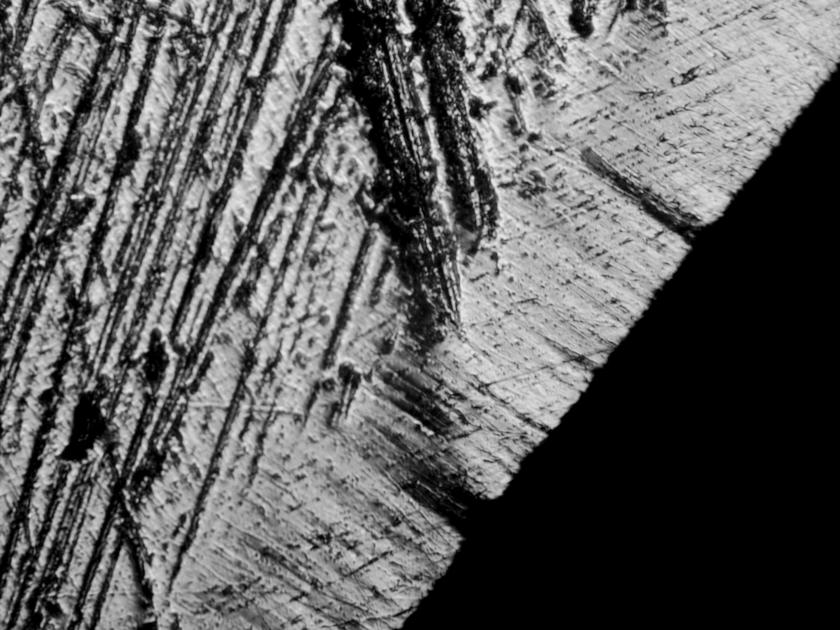
These pictures are the tail end of my testing, after getting a sense for how steel sharpens and grinds. I first want to see if the steel rolls or chips, if so, when, and how, and get an idea of the carbide pattern in the steel. Why? There are published micorgraphs of carbides for most steels. I don’t know that there are any of W2, but W2 is a lot like 1095, and the carbides may be slightly more coarse, but it should look a lot the same.

Translation in this case, I should be able to see them, but they may not be quite as prominent as expected since there’s not so much alloying to keep excess carbon (>0.77%) out of the matrix.

Compare this to 52100 bearing steel (tough, hard to break) where there’s enough chromium to make it less easy to dissolve carbides and free excess carbon. According to Larrin Thomas, this is what’s influencing how the martensite in steel – the stuff that we want to create and then temper – is arranged. With carbon more in the 0.75-0.8% range (my guess), the martensite is formed in laths. As you get closer to 1%, the martensite can form in plates without laths, and I’m guessing some combination between.

What does this do? Subjectively, plates form with excess carbon and the carbides will not be as prominent as expected given the carbon content. Laths would suppose more carbides and maybe bigger in the same or similar steel composition.

Laths are associated with toughness (do they interlock like fingers? I don’t know) and plates, less strength, and a toughness test where steel is broken by striking it in the middle shows at higher hardness, the toughness can differ by a factor of three. Tougher football players are better, right? Tougher shoes, tougher cars, tougher tires, so tougher steel is always better? if you’re bending a knife in a split in a tree or stabbing ice cubes, the toughness will prevent breaking. I haven’t found an ultra tough steel that I like too much in chisels, and only one in plane irons (80crv2, though 1084 is OK – it’s just not as good as many other options).

I haven’t had W2 toughness tested, nor hardness tested (I can guess at the latter accurately). I care more about how the irons or chisels perform in wood than knowing how much energy they absorb when being broken in the middle. it took quite a bit of experimentation to know that just getting more toughness and using it to allow more hardness doesn’t necessarily translate to greatness at the edge.

But I suspect W2 isn’t very tough. Perhaps similar to O1 or only slightly tougher. Anyone have a problem with O1’s toughness in tools? I don’t.

Strength is what most of us think of when we talk about the condition of tool edges – how much can steel tolerate before it begins to deform in a way that it doesn’t “come back” after deforming. Breaking is long after this. We like steels that are “strong”. Toughness is harder to make a generalized statement about.

I have found over time, too, that unlike knives, if a steel is tough – it will retain deformation. you will then push deformation through material (imagine cutting with a knife that has a rain gutter shaped bit curling around the edge instead of an apex). All good chisels, if challenged, let go of the edge instead and what’s left behind is less wide than a rolled/deflected edge.

Soooooooooooooooo……

to get an idea of how all of this works out, I set the cap iron really close so that it pushes the wood into the back of the iron, rubbing some of the matrix away and hopefully leaving carbides standing proud. Getting pictures of carbides is a real trick – not so much getting pictures of them, but comparing them. To see them, we need something to cast a shadow. However, if they are round domes, the microscope looks directly down on them and it prefers light that comes right back up. That means if we see a shadow, we can assume that’s pretty reliable, but the bias of the scope is not to show one in the first place. Higher light level also means less shadow, and lower light level means more, but discerning details becomes difficult as it gets too dim.

Moral of the story? Don’t trust everything you see. At some point, I may screw around with introducing a lateral light source stronger than the top tube light to game the system, but I haven’t yet.

the magnification of these pictures is a true optical 300X. This is beyond the capability of hand held cheap scopes, and for scale, these pictures are a little less than .01″ tall from top to bottom.

First iron of the pair, this is the first picture that I took:

This picture was disappointing. The halogen bulb in the scope was on its last leg because I left it on for days recently (oops). What we see seems to be a lot of carbides 1-2 microns. good, but I learned the low light is a bit deceiving because most of my other pictures are at a higher light level. also, the edge doesn’t seem to wear very evenly. These are tiny deformations, but other stuff (26c3, O1, 80crv2) seems to wear with almost no interruption in the line). But since this is the first use, it’s possible some damage is left from initial grinding, even though shallow. The grinding and honing of these irons, and flattening is brisk and harsh. I’m sure the same is true of commercially made tools.

Nonetheless, with dense carbides, my thoughts tend toward “well, it might be slightly soft compared to what I’d guess”. it’s easy honing and only the third or fourth hone really gives a good idea of where hardness will be – when all damage is removed and there are no deep scratches in the back that hone away easily.

I set up the second iron, but came up short doing it. it still provides interesting information:

What happened here? I changed the bulb in the scope and took a picture. The carbides are harder to find. This reminds more of O1 – at least no big odd carbides at this point – that’s the worst possible outcome.

the edge looks wavy, but if you look closely, you can see large deep scratches remaining above the edge. Those are from a 180 grit diamond disc. the edge still looks a little more ragged than expected. Higher light level does a better job of showing all of it, so the low light ragged edge is probably better than it looks – the lower grooves just can’t reflect enough light back for the camera software to decide to show them.

when I flatten the backs of these irons on the rotary disc, I have a drill in one hand and hold the irons with the other. Once in a while they grab and probably leave some deep scratches in the very tip of the iron even though the iron looks honed otherwise. Translation, these are deep at the edge, but they definitely are gone in the rest of the iron, and i just need to go spend two or three minutes honing more focused at the edge.

But first, I took another picture, as it would be nice to know if those scratches got to the edge. On a good iron, if there is a defect, the iron wears away around it. With steel that’s less stable (bigger particles, like V11), more damage will occur around the groove creating a bigger deeper nick before everything becomes stable.

that’s what I wanted to see. Notice how the deep scratches, at least one of them got to the edge, and then the iron wore a little faster around the scratch, but the shaving direction is perpendicular to the edge, so it wore away some of the edge and then created its own route back from the edge in the direction of the shaving. To see this and not see the remaining divot wider than the original scratch is fabulous. this is what older irons often do that newer irons with large particles don’t.

I bring up V11 because it has high carbide volume. A2 has less volume, but it does have carbides about as big and sometimes unevenly dispersed. Cracks start in carbides, and five microns is about the size of the smaller groove at the top. A five micron round carbide isn’t five times the volume of a 1 micron carbide, off the top of my head, it’s 25 times as large in volume.

The edge looks more even away from the damage. The carbides are hard to find, though. The faint diagonal lines going the other way are oil. A tiny amount of it after wiping off the iron several times – it’s hard to get rid of all of it. that’s oil left after use, not after honing, too. And that’s why your oil stone sharpened tools never seem to rust and waterstone sharpened tools do quickly. You probably never get all of the oil off even when you think it’s gone. The carbides are there, but not big enough to cast a shadow. the shape of the wear is sometimes scooped, but it’s not here. If it’s scooped, from the shaving wear as the cap iron pushes the shaving back down to resist it, we can see the carbides easily. More wear to the edge rounding it would also help, but I didn’t plane enough.

Back to the other iron with the new bulb and a lot of light to try to see if the edge really is uneven…after two more hones. it looks pretty good. Same iron as the first picture, the light washes out carbide shadows.

There’s some relief on my part here – an iron that wears unevenly at the edge is no good because it feels dull sooner. Recall from the revilo high speed steel iron, I’m sure the steel has better abrasion resistance than plain steel, but the lack of uniformity at the edge while it’s wearing eliminates any ability to actually make use of it in wood. Uniformity is good.

One last experiment then, taking a pair of pictures of the two irons in lower light – I sure hope they show carbides and are similar.

Oops, a little too dark. This is the same iron as the last picture – notice the scratches haven’t moved. Round carbides make what look like little comets, though they’re probably not really ideally round. The carbide is at the front and the tail of the comment is the steel matrix that’s protected from wear a little bit longer. You can also see how at low light, some of the edge disappears at the apex, giving a false sense that the edge is uneven. I’m still learning all the time!

then, the other iron at slightly higher light.

Notice how even yet after a few minutes, the almost very edge of this iron still has some scratches. it’s pointless to remove them if they don’t get to the edge. They will be removed by subsequent wear and honing. the same is true for someone getting a new iron and believing they need to have an optical polish for the first inch.

You are better off buying one of the cheap hand held scopes to avoid wasting time on stuff like this. While those scopes won’t do much to show carbides like this, they will show most scratches that are visible. I’d have very very easily seen the stray scratches that bungled the first efforts in two and three. But the blessing of those is they answer how stable the steel will be around a defect. Because scratches aren’t the only thing that propagate damage – nicks do the same thing.

I’m glad to see the carbides again at lower light. When you’re going back and forth with different pictures, you get all kinds of thoughts. “maybe the composition isn’t uniform in the bar stock”. That happens rarely, but it’s possible. The variable in this case was me.

This is a very stable steel, though I can’t see any commercial value to someone like LV or anyone else making plane irons. It takes a different skill set, and it would take a savvy experienced buyer to appreciate it in a plane. It would be appreciated in a chisel pretty easily, though, but not practical in a market where people like lego-like chisels crudely made but with a high level of finish and an optical back.

If I go pro at some point in the future, I’ll offer stuff like this for people who just haven’t tried enough different stuff yet.

Bridge City Musings – Cut Harvey some Slack

Maybe these thoughts are more kind of a study in how people reason, and what they assume they know. I will share something that most people wouldn’t, though it’s becoming more common – a little less than a decade ago, I went through a deep depression that was probably there a little just because most people who like to think aren’t that happy, but drastically exacerbated (by a factor of 100 times – the experience was not pleasant) by an adverse reaction to migraine medication. And that was lasting.

What that left me with was living too many layers deep in the onion, as I’d put it. Pondering how many things we really know and how many do we assume out of convenience or just nothing more than we haven’t disproven them.

This isn’t a great place to be, but it taught me something very important (I recovered, of course, with no real harm done other than the misery). What it taught me was to explore things and always assume I could be wrong in a way that isn’t just bubbling insecurity. Rather, it’s being less assertive about things you don’t know well and waiting to see if information comes your way to give the opportunity of discussing things more accurately with people. I think we owe that to each other – your entitlement to have me tell you something that is correct is more important, by far, than my entitlement to believe something and then insist to you that it’s true when it may not be.

I don’t know if this onion thing has been defined by anyone else, but I would say standing on the outside of the onion is parallel with hearing something from someone else or just supposing it on your own, proudly and confidently asserting it without any self awareness and never choosing to look further. Even when proven wrong. The first layer of the onion is thinking about things, making a reasonable decision and then running with it. I think most people do this, but due to ego, there is resistance to changing of disproven.

As you go deeper and get too deep for daily usefulness, at least staying this many layers deep, you start to realize things like “we haven’t really proven that the reality that we perceive is actually reality, or that there aren’t 100 realities going around us or 100^100, and that our perception is changing with actual reality”. That kind of stuff is temporarily interesting, but not so great to think about if you’re trying to keep track of things that your spouse told you to take on and you forgot to write down.

My desire for outcomes in the hobby and then understanding instead of coming up with an analogue that I read, or whatever else comes from this – but somehow it goes far beyond just the burden to elevate discussion (however poorly received) that’s accurate to other people. I used to be sometimes a surface of the onion guy and other times first layer, and then willfully second. But if I was on the surface and someone was bugging me from the second layer on something else, I was ready to dismiss them as a pain or a pedant). I am still a pain sometimes, but now far more conscientious about whether what I’m saying accurate for the sake of someone else, not just me. Self awareness.

So, what does this have to do with Bridge City?

I have almost completely stopped reading the forums. The forums go to a steady state of paul sellers and rob cosman and whatever else that I just don’t care about. If the forums are a bucket full of gravel (the hand tool sides at least), those are the big rocks, and vibrated into the spaces between them are constant discussions about which tools to buy and how “nice of a guy” this or that guy is.

Enter John E. John is a somewhat unique individual. I have zero Bridge City tools, which isn’t by chance. This is an outcomes thing – I don’t get the need for them. But some people love them, and if you love them and more than you don’t love paying for them, then they’re for you. I’m not heading down the layers of the onion to try to make you have the same conclusion as I do as consensus building is quite often inertia to being accurate.

What’s happened with Bridge City? Well, they publicly stated (they being John, I guess) several years ago that they sold to Harvey Tools, and I stand to be corrected if that’s not correct. But what occurred initially was that the BC tools that we began to see being sometimes much more expensive here than in Asia were being handled here for orders in the US. I don’t remember what that meant – maybe it meant looking over, final fixing of little nits, who knows.

John said he had been working with Harvey Tools or Harvey Industries, whatever it may be and the rest of the details went out of my head after that. But I assumed that we don’t know how long ago Harvey was doing a lot of the grunt work or more for the BC tools, and I felt like for buyers of those tools, if that was the case, transparency would’ve been nice earlier. But it’s not that out of line – that kind of thing is really common, and I’d bet it’s common all the way down to a lot of the small boutique makers, as some have stated publicly that they subcontract work. Konrad Sauer, for example, was asked if he did the machining on some of his planes, and the answer was that some part of the process was done for him and then he took over. No big deal.

But what I’ve noticed on the forums is that there’s a huge tendency toward “that guy’s my guy, he does all of it, so you’d better not tell me different”. Having seen the actual Bridge City tools discussed on an international woodworking forum and noticing that in some cases, the prices were a fraction of what they are in the US, I suspected the reason for the price difference was charging what the market will bear. I also suspect the whole Harvey thing has a lot to do with it, and being the pondering type, I felt bad for Harvey, who purchased a business and probably little changes with who is actually doing most of the work, but now due to a change in perception, it may be difficult going forward to keep the same US market prices and clientele. Many of those regular purchasers are older, and just really liked the whole message.

BUT….

Seeing this come up a few times on forums lately, and seeing really harsh posts about wanting to see the Harvey operation go broke now because “now they’re being made in China, I think some folks could probably peel a layer or two off of the only both in what they’re learning and what they expect of themselves.

What do you think the likelihood is that the “now they’re Chinese tools!” wares weren’t generally Chinese tools before is true? Maybe that answer is known, but I don’t know it. I suspect it’s another instance of being the designer and purveyor vs. being the manufacturer no matter how large the business scales – that those are two different things.

And people need to chill out.

I have another admission – when Harvey took over, I also quietly thought once the aura of “these are American made tools” wears off, maybe they’ll be made in fewer variants and in greater numbers and be more accessible.

I’ve gotten a lot of steel from Voestalpine and Buderus lately. In fact, I’ve never knowingly bought steel from China, but what if Voestalpine and Buderus buy supplies from China or even contract finished steel and then they roll it and it comes out great. I don’t care. And if there were a supplier of steel from a small scale Harvey-like operation in China where there was a guy who was just a nutball like we can be about really liking to make and process good steel…..I’d probably buy the steel, and probably not assume that there are no other end users for the guys wares adjusted or relabeled in other countries.

I’d bet John E has heard some of this stuff over the phone from patrons, and if I’m right about this being a business arrangement going back reasonably far in terms of years, he’s probably had to bite his lip.

And that’s something I wouldn’t be able to do. Which is where my fault is. I’d probably inform the person on the other end of the phone that reality is different and the tools are generally the same, and most things have some contribution in them from China or Vietnam or wherever else and that I personally think that’s OK.

Because I’ll bet Harvey (if that’s his name) is probably a decent guy, and I’ll bet there has been no shortage of sweat done by him and his crew in helping to make what a lot of people like and consider to be good tools.

Cut Harvey some slack – wishing he starves doesn’t do you any good. Consider that he may have made some of the tools you already have if you have that type, and if you like them, they’re still the same tool. This isn’t the real life version of Red Dawn.

Some Things Above at Odds

If anyone reading has known me long enough, this “grandpa’s waiting to be wiser” thing of being cautious about what you know probably doesn’t match how I have the reputation for being belligerent or intolerant on things that I do know well, like the function of the double iron or heat treating steel in a forge by eye.

That’s certainly the case. Being considerate and thinking about other people doesn’t mean you need to be a pushover and roll over when some BS floats by.

In my case, it leads me to discussing certain things that I’m confident of a lot and very little of others (ever see me providing much advice on power tools? What about turning bowls? which finishes to buy or which retailer is “the nicest person”).

And I’m always open to being clued in to something I missed. Even on the things I think I know well. 20 years ago, I could’ve gone off track and lumped Harvey in with a specific date that “tools went from being made in the USA” to “now they’re made in China”.

Maybe I’ll grow to find out I knew almost nothing about the double iron or looking at steel or whatever else, but it won’t be because I was closed to learning or pushing a version of reality that I hoped for. And when I don’t live up to that, I hope to be called out and proven wrong.

Pulling back from the forums and not constantly being annoyed by who is on the right layer of the onion and not having a T chart of knowns and unknowns worked through for every discussion until there was proof for all has been nice. Nicer than I thought. But it’s sort of like going to the zoo now. Whether I’m the people at the zoo and the forums are the animals, or I’m an animal looking at the people at the zoo – that’s yet to be determined!

The Ruby Stone – One more for the Omnibus

(Click here for the summary version)

If you peruse ebay or aliexpress or possibly youtube, you’ll see some of the stones offered from China. There are a few that are unique (agate, the gray slate stones distributed usually to shaving enthusiasts, etc).

One that’s stood out to me but I’ve been selectively too cheap to buy is the ruby alumina stone. By rating, it’s sort of an in between stone, and it appears to be just abrasive either in almost nothing for a matrix or in nothing at all (fused or sintered?).

The reason I drag my feet on these is that I just don’t need another stone that’s about 40-50 bucks that just goes in the drawer.

At some point, I decided otherwise, and since aliexpress lets you sign in 99 different ways, I have no idea what I logged in through to make the order, so I couldn’t tell you the cost. But I can tell you it wasn’t 40 or 50 bucks because I ordered a 2×8 version of this stone that is combination.

If you’re ever on the fence about something expensive, like a dan’s black or translucent, or anything where the stone by commodity/availability just isn’t going to be cheap, ordering a combo is a good way to cut the cost. I mention the arkansas stones with this because something that is really hard is also something you’ll never get through a 10th of even half of the thickness of the stone. So this stone was probably about 25 or 30 bucks.

I chided myself a little bit for buying it even at that as I’m trying to get over a very long time habit of buying things out of curiosity (rather than need).

The other reason I dragged my feet on this is, I guess, several reasons. I have three white fused alumina japanese “barber hones” that are actually a little bit too fine. They are what you’d want from spyderco if you had a choice, though – giant 8x3x1 ceramic. And they work. I’ve also got a few nifty ultra ultra fine india stones from japan, which is something I wish was sold here. They’re a freehanders delight. Why? the explanation is something I learned with razors – if you want an ultra fine edge, the last step should install it and not try to do two. Typically, I would hone with two stones and then buff strop (just light work on the buffer, not the whole unicorn thing) when sharpening plane irons. You’ll see pictures in a second as to why the stropping still (it’s five seconds, not arduous). At some point, how long before I grind is defined by how fast the second stone is – everything ties together – I’ll stop there or this will be 10 pages of combinations of stones that I think work nicely for freehanding.

The point of that bit about speed, though is if you really go very fine, it should be 10 or 15 seconds of something that’s so fine you couldn’t expect it to follow a second hone. In razors, a fallacy is the idea of some really fast stone that will be ultra fine and pass this test with proof under a microscope. No such thing exists, and attempts at getting close to it are super expensive without being the best option. when I sold some japanese stones that I’d fished from japan, I found that very fine slow stones (but not junk, good stones, just extremely fine) did well finishing a razor, but they did well when paired with a stone that’s not quite fine enough. The result is that the pair works faster than the “it” stones, the edge is better, and the cost of two stones that aren’t “it” stones is often about 1/4th the cost of an it stone. It’s about getting results more than it is having the perfect stone.

Phew

I did it again, grew a tangent tree.

The above drawn out stuff is a slow way of getting to thinking that maybe because these (ruby) stones are labeled as 3000 grit that maybe they are an in between stone. What I’m really fond of is stones that finish edges fast, but aren’t quite coarse enough to raise a burr on good steel, and that can be followed by little buffing but still improved by the buffer. That gives you the option of very crisp sharp edge, or you can go full unicorn if there’s a need (chisels, planing nasty wood…).

Grit is a funny thing in china. You may see an agate stone that is too fine and slow to do anything, and it will be labeled 1500 or 2000, and then someone else will call it 12000. A stone that’s a little too coarse for me is no good, though.

It turns out that the stone is actually on the very fine side, but not quite as fine as a good hard (trans/black) ark. A picture of the 2×8″ combination stone follows:

Weird color, huh? It’s likely just the color of the type of alumina used. The bottom side is also relatively fine, about like a medium spyderco, and it’s described as “boron carbide”. I haven’t used it. I don’t care for combination stones other than the money saving trick because anything sticks to the bottom and are you really going to clean sides of the stones off every time you sharpen? No.

This stone follows an india stone nicely, and hopefully it won’t get any finer. Having made two W2 irons that are of pretty good hardness (probably 62), it seemed like a good time to compare this to a cheap hard ark with diamonds, as there’s nothing at all in W2 that alumina will not cut.

The burr from the india stone came off, and with minor teasing of the edge, little of anything was left. A picture of what this looks like will follow, as will a subsequent point about buffing (or stropping if you’d rather strop).

And one other side comment – a warning. I have no clue if all of the vendors of these stones are selling the same thing, or if they vary.

But in estimating the fineness of this stone, I would say it’s more similar to a 6k grit stone, and from experience, if the alumina is truly fixed, it will dull and slow down, and if it does, I will adjust it with a worn out diamond hone. I already have really fine slow stones.

Edge Pictures

I was on a multi-faceted mission and not thinking of posting about this stone. That mission included gathering feel data about the W2 irons to see how similar they were as I heated one a bit higher than the other before the quench (on purpose) to see if there would be a hardness difference. There is a little – maybe a point. I also realized, and the reason for busting this out, that when making harder irons, the arkansas stones are a long term edge refresher. They’re a little lacking for getting everything in order after working over the backs of tools and then needing a couple of sharpening cycles to get everything good all the way to the edge. I’m trying to get from a house made iron to “can’t be improved” in five minutes, so the exercise isn’t like a half hour session when you buy a new already flattened chisel and follow a video procedure for half an hour. I have no problem with that, but it’s not a good match for making several things a week where one or two might have some minor warp issues to grind out and then hone.

So, the first picture isn’t actually proof of anything but being a good match for one single pass across the buffer, as I just sharpened one of the two irons to see how it would come out in a day to day 1 minute honing cycle.

This picture shows something that’s really in line with what I wanted. There’s no rounding of the edge, and the edge itself is straight and thin. it doesn’t, of course, look like a 0.5 micron oxide edge (that would just be plain white), but it’s quick.

To compare the edge uniformity to another standard option, you can see the 8k kitayama waterstone edge here. They look similar, except this quick edge isn’t rounded over by rolling slurry. It’s sharper, and certainly much faster and less fiddly.

A shaving from the harder of the two W2 irons, from cherry:

That’s pretty good. The shaving is thin enough to not even bother with stretching it over the writing. I’d guess somewhere around 3 or 4 ten thousandths as that always seems to be about what I can get with something that has a good thin crisp edge.

Excellent – pleasing both with uniformity of the edge from the iron itself, and from the ability to go quickly from a fine india stone to the ruby stone to five seconds passing the iron in one swipe on each side across the buffer.

But the question arises of how much of the picture is the work of the buffer and how much is the stone. It should all be the buffer as I never work the back of a stone in a direction such that the perpendicular lines will be created.

That is the work of the ruby stone itself. When you get away from something approaching a full polish, it becomes difficult to tell how fine it actually is. The important thing for me is I don’t ever use anything without stropping in some way because the results aren’t consistent enough and I find it annoying. You could plane with this without issue, but it would probably lose about 25% of the edge life vs. the quick buffed edge. Interestingly, if I keep buffing the edge to refine how it looks and make the bevel side more uniform, it would be a good edge, but also lose some life unless something in the wood demanded the rounded edge. Finish planing or try planing clean wood usually doesn’t.

Most importantly, you can see that even though I teased the burr off, there’s little remnants of it. If I leather stropped this, the appearance of everything but the edge wouldn’t change much, but the uniformity of the initial edge would be better as the false bits of jetsam would be taken away. When defects are larger, they actually can propagate in steels that are too tough. I really don’t know if you just plane this stuff off if it makes that much of a difference, but that’s a false dilemma, because we can buff the junk off and refine the edge in five seconds.

The second picture here is the second W2 iron – not the same iron as the first picture. So I buffed this one even a little less long to see what the edge would look like. This last picture and the picture of the unrefined edge are the same edge. If you’re gauging how much buffing, I would say firm across the back of this iron nearly tangent to the buffer and one pass that takes about one second. And then the bevel side across the corner of the wheel (softer, less honing or rounding). Less than five seconds, I guess.

Less buffing and some original scratches remain. The ones that do could actually be from something laying on the stone or they could (different iron than the first) some remaining scratches left by the original flattening on an india stone.

The shaving from this effort looks like this:

No reason to bother stretching the shaving out for more wow factor on the picture. It would be uncommon to chase shavings like this in work, even on the finest smoothing. The wood doesn’t usually demand it. They describe a lot about the process and the capability of the iron, though.

And as there are a few stray marks left on the second iron, what the real aim is is getting to the point that the back work is just done on the red stone with no remaining stray marks, and with an iron that has enough edge stability to never really need anything more coarse on the back side. Sharpening becomes then a 1 minute process in the rhythm of work.

And I think there was probably a lot of historical practice of this idea 200 years ago when the work was fine work. The beginner’s concept of variation in what’s happening or stopping to “grind out nicks” or whatever else would’ve been intolerable pretty quickly.

Conclusion for the stone

What I was hoping with this stone was a lucky match – something that would work pretty quickly getting all of the bevel side work out at the tip from the fine india, faster than a trans ark, for example, would do. That’s achieved. Also, fine enough that significant buffing isn’t needed if desired. That’s achieved.

Would we find some magic property where it was much faster but also super fine on its own without the buffer? No. So if you see one of these and consider it a replacement for autosol or a very slow fine stone, it’s not that.

I like it enough that I’m going to make a box for it and use it, though. It’s as fast as the mid (next to finest) arkansas stones, not messy, more tolerant of chasing slightly higher hardness in plane irons and chisels, and it’s harder and should wear more slowly. Everything in the shop has to have a box – that might be different for you. I have ambient metal dust floating everywhere, and even the finest of it or even wood dust would destroy the edge shown in the picture. Not because the wood is harder than the metal, but because when the iron goes over it, the edge can be deflected.