Just by chance, I ordered a Stanley 9 1/2 last week off of Ebay. I had premium block planes in the past. They’re long gone. I like to say that I have only one block plane (Stanley 18), but that’s not strictly the truth because I have some junkers for my son to drop.
The reason I have a Stanley 18 instead of a 9 1/2 is because when I ordered my “one” block plane, there was some kind of trend for hobby fly rod makers to buy a 9 1/2. And they were very expensive for what they are.
While smoothers and jointers seem to have near doubled, I looked the other day for a pre-Mexico 9 1/2 and was able to find one easily for less than the fly-rod-craze prices.
I wouldn’t have known for sure, but the #18 and a later pack of replacement irons for a #18 are just butter soft. One of my group for that plane is laminated and the others were solid steel. In a previous post very early in this blog, I rehardened one of the solid steel irons to find that they have a whole lot of potential to be much harder than they are as delivered. Every one of them is butter, which would vex honing guide users, as they just will not hold the apex.
On a whim while testing a low angle jack to see if the unicorn method was viable on bevel up planes, I decided it might be a lot faster to use the #18 and it’s small soft irons. To my surprise, once they were buffed, they would plane cocobolo with silica in it with no issue, and they would last longer than my hands could tolerate pushing the plane. That sort of put the nail in the coffin – though already known – that you could solve much just keeping honing the same and buying an expensive supersteel iron. You can’t get hardness and toughness in combination in any super steel such that you can plane minerals or silica or even just a lot of the hard woods with varying grain direction.
But you can hone a very very soft block plane iron and then buff the tip off of it and it will outrun just about anything. The rehoning process is should-be-illegal easy.
The next two pictures show a piece of *was rough sawn* louro preto. This is a dusty wood that’s a little hard on irons, but the billet had ambient dust from the shop on it.
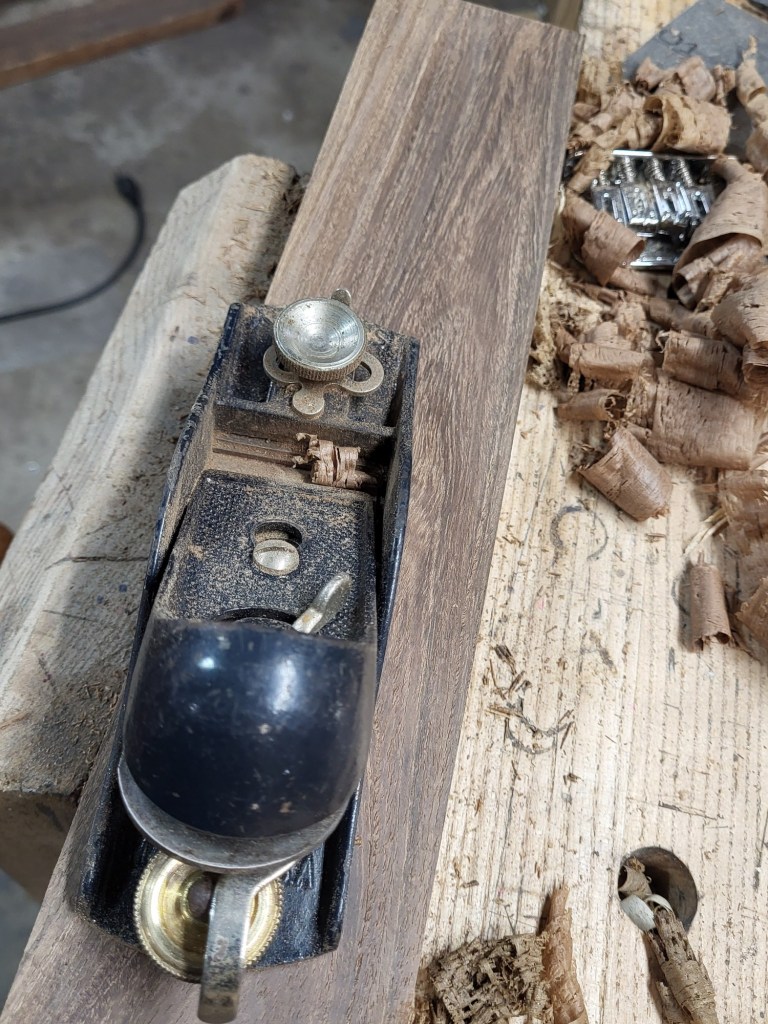
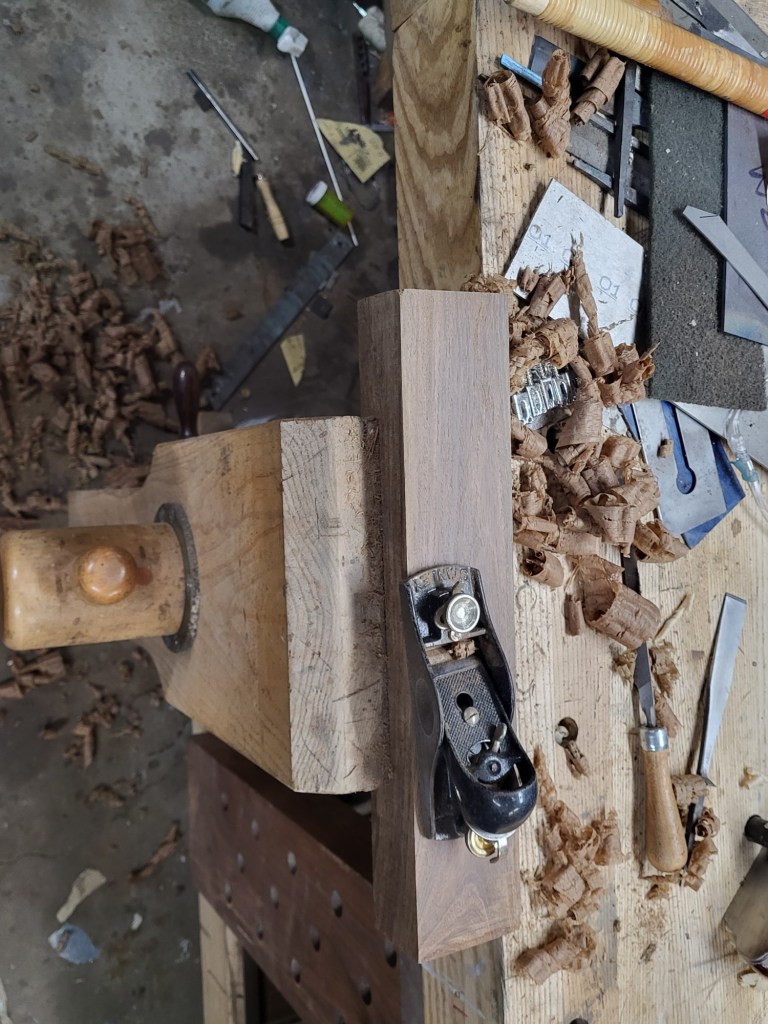
See any defects or lines? I don’t. Louro Preto isn’t the hardest wood, but it’s far harder than oak or maple or anything we’d work with in great volume. The dust on the plane is just the nature of the wood. You plane nice clean shavings and the dust comes out of the wood at the same time coating your hands with light brown filth. The aroma isn’t unpleasant, but it reminds of aromas in wood that would be associated with sneezing. It’s like a floral version of the rosewood and cocobolo pepper scent.

This picture shows the shavings more closely – these were some of the last to come off of the block plane. No resharpening, no anything like that. The seam down the center of the closest shaving is some kind of artifact from the large grain cathedrals.
I don’t use a block plane for much. I don’t care for low angle block planes because a block plane in my hands is a walking around plane for edges or planing small items. Older texts don’t prescribe low angle planes for this work for a reason – tearout – and I don’t see any virtue in it either. the effective angle on this plane is probably about 60, so the consequence of the high bed is nothing – it’s actually nicer to work with.
And one last thing – I have the metallurgical microscope. When you view a 12 degree bedded low angle block plane iron, the wear on the back of the iron is substantial and long. For some reason, once the iron is bedded at 20 degrees, almost no wear appears on the back at all. It’s bizarre.
Was the rash of low angle block planes and bench planes an improvement over anything? Definitely not. Stanley’s bench planes already do everything better than those planes – all you have to know is how they need to be set up.
The fact that these can easily be hardened to ice hard lets me know that stanley tempered them soft on purpose – probably for ease with site sharpening (carpentry) and chose a higher carbon steel than they would’ve needed to prevent the steel from having gummy edges that would fight your ability to tease off their wire edges while finish honing.
 Of Making by Hand with Wood and Steel
In my extremely limited experience low angle block planes are very nice when trimming end grain in joints or trimming dowels to be flush. As I said earlier I find the Lie Nielsen 102 (it also fits the hand and is a beautiful little jewel of a tool)to be very useful for stuff around the house. But I also have this small cheapo indian ambika 102 that is even more useful because it is cheap and crappy enough to be used for rough carpentry stuff.
To be honest neither of planes are mine, both are borrowed from my father. He also has this small cheap japanese plane which I only used at a course we both went to and was very nice both on end grain and long grain.
How is the 9 1/5 on end grain? If I lever get my own block plane it would be nice if a standard angle block plane would do as well. They are usually cheaper. On the other hand some small tearout is not a problem on a window.
LikeLiked by 1 person
good point about the flush pegs. I hadn’t considered it as if I peg a joint, I flush saw it and then pare it off with a slice.
it would be dandy if stanley kept and released their engineering and testing/finding notes for various things.
I don’t use a block plane for much on end grain. If the cut thickness was slight, the high angle isn’t a problem. If it’s being used to do significant trimming, then a low angle would be better, but that ignores the fact that a smoothing plane would be better than the low angle block plane.
And that itself describes why there isn’t much separate addressing of end grain in older texts. I think you just mark it and put it in a vise and plane it like anything else whereas the more modern idea of trimming the end of a panel or something with a block plane is very very hard on the hands and slower to complete.
LikeLike
The comment about using a smoothing plane at the bench is right on. This is also why I get a bit annoyed when reading comments (or at blood and gore) bashing planes like the Stanley 102, 110 and 130. They are not meant to be precise instrument for fine furniture making. They are very useful when doing interior fitting or carpentry. When I got in to woodworking I bought a Swedish 130 at a fleamarket for the equivalent of $5. I later gave it away to a charity shop. I still kick myself that I did that, It would have been extremely useful when i moved a built in wardrobe from one room in the house to another.
LikeLike
I find it really enjoyable reading your posts because you bring to light things long forgotten by most. There are still plenty of people around (Warren, George, etc) that know these things from a lifetime of making by hand, but not many people writing about them. Those that write today typically just make excuses for things in the past, like that Stanley just couldn’t make a better iron at the time or didn’t have access to “super steels” or better sharpening media, etc. Rather than revealing the more likely reason which you always seem to get at. It makes so much more sense that back when people had to work only with hand tools the stuff we see from that time was done on purpose.
Jonathan
LikeLike
it’s cumbersome stuff to talk about and discuss and I guess there’s no real payoff to it. To the detriment of people who don’t like to talk about it, I do! The fact that stanley put a soft iron in a plane but the iron could be harder, and that cost a little more suggests that they tested a bunch of options and just liked it better.
Later on, I think the penny battle won.
Along comes someone like me (article a while ago on here) rehardening and finding out how good these irons could be, and then for something like this – I couldn’t say for sure when the angle is steep enough that the iron would be better to use if it was harder. Arguably, it’s better soft because it’s so fast to grind and hone.
LikeLike
I think that unicorning a BU iron should work. It works on my BU jack. If the key in unicorning is removing a fragile apex, then why wouldn’t it work? I would expect a ruler trick not working properly as it could mess up a clearance angle, but slightly rounded tip would have a steeper angle and that’s it, right?
Also yeah, BU planes weren’t an improvement. I think it’s just overall quality of BU planes is better these days, you know, some what better depth control, adjustable mouth, adjustable and fixed lateral positioning, more weight, etc. But not the fact that the cutting angle is formed differently, it’s the same angle anyway.
LikeLiked by 1 person
You’re right about the adjusters on old block planes – especially the lateral adjusters. I guess one could figure out a way to bolster them, but maybe the fact that they’re a bit loose is an indicator of how they were used.
Yes on the unicorning – it’s a godsend on bevel up planes. A heavy dose of buffer adds edge strength like +20 degrees, but edge life better than without at the lower angle, and an edge impervious to dirt and silica. My prior testing (with the #18 and a now-gone LN #62) suggests tearout protection is about like +5%, so it’s not really a threat to make an iron behave like it’s blunt.
I haven’t looked very closely at the accuracy of the sliding mouth on older block planes, but they are often well out of flat with the sliding mouth out of place. They can be lapped in about 3 minutes and I fix the mouth where it’s lapped and never move it.
The modern planes are probably far better suited to a beginner, but fine adjustment can impart bad habits as far as slowness goes.
The later stanley 4 with a soft iron and fine adjustment that’s no match for Lie Nielsen’s taught me a lot more about efficient planing than the boutiques ever did. it excels if used the way it was probably designed to be used, but wouldn’t fare that well in a fine shaving contest where contestants alternate between shavings of 0.5 and 1 thousandth. it’ll do those things fine, but the adjuster is clearly not intended to make tedious little adjustments easy.
Lv shot themselves in the foot with some of their planes and the whole high bench idea, but some people won’t take advice or lessons from history. I get where that came from but it’s like telling someone to play baseball, but the new way of swinging requires you to have your elbows touching your sides but strikes are chin to chest.
LikeLike