There are always things to learn or understand. For me as an amateur toolmaker, one of those is the impact of alloy choices. For the most part, you and I can feel things like hardness, and on the stones, you can get a pretty good idea once hardness is known how long the potential edge life may be. Briefly put, the longer it takes to sharpen something of the same hardness -and really fully sharpen it – the longer it would last in a planing test.
How long it lasts in real use when cuts are interrupted in rough work is entirely a different matter, and is why in my work, V11 doesn’t measure up to its hypothetical test results. In my hands, actually, those tests were spectacular – it lasted twice as long as my O1 irons in long grain. In actual work, since smoothing continuous wood is really just the last step and over in a sniff, there isn’t much like the test. As confident as I was in the test results having planed something like 40,000 feet, I realized that I would need to test the irons further in rough work, but this is far less easy to test in a way that’s repeatable by someone else as you’d have to have enough rough work of similar boards, and a plane that you’d like to do it with. I didn’t.
In the end, I learned a lesson – abrasion resistance doesn’t matter if the edge gets damaged instead of abraded. Stability of the edge in actual wok is top dog and an iron with less wear resistance may be less work.
On to the Stanley
In the hardness testing results here and discussed here, I was surprised to find that a later type stanley iron tested just fine. 61.5 hardness. Without going into details, I’d regarded the later types as generally kind of soft, they don’t wear that long, and in a prior post in the blog, I showed pictures of the worn edge. It *feels* like softer steel in planing, but has no carbides in it. Edge life isn’t great, but no professional would care. It’s not that bad, and the somewhat false need for edge life comes from the idea that all shavings are thin.
I hardened another one of those irons with sharp corners at the top and it tested at 63.5. This was a shock, because it still ignores the fact that their edge life is less than O1. The two things together beg a question – is it the lack of iron carbides that create the issue? O1 steel itself isn’t really that plain – it’s got excess tungsten and a little bit of excess chromium and it does last longer in an abrasion test than “plain old carbon steel”. So some of that is involved, but there’s almost certainly some alloying in the stanley irons to make them more hardenable. There isn’t enough of it along with enough carbon to form carbides that cast visible light. Roughly speaking, details about a micron in size begin to show up as visible under my metallurgical scope.
But I still had a Wild Card – a Round Top Stanley Iron
I’ve been advised and generally advised folks that the round top irons in later planes are a little weak. Fine for coarse work, but if you do a lot of fine smoothing, you’ll be doing a lot of sharpening. If you’re planing hardwoods, even more, as the apex of these irons seems to be somewhat intolerant of impact.
I figured this would finally be the iron that proves stanley jumped the shark with hardness.
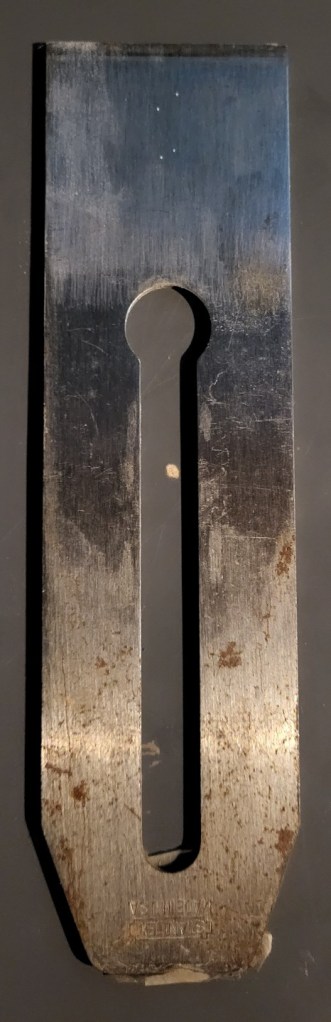
Pardon the tape or whatever is stuck to the top. These irons aren’t actually round topped, they just have rounded edges/corners at the top. I think I have two of them and I’m still going to find the other one and ensure that one also tests the same before this is all settled, but this iron tested all strikes of 61 and 61.5.
I scraped it, cleaned it off, whatever, same number.
The aldi chisels do the same fooling. I tested one – the first one was 58.5. They feel a little softer than that, but close enough. The other three that I dug up yesterday were just under 60.
This isn’t going to turn into some sellers-esque lifestyle woodworking where I claim they measure up to the better English chisels. They don’t. The differences aren’t unhardened vs. hardened, but a person working in some volume will appreciate how much better a ward chisel is, both in steel and proportion.
I’m fairly sure that what’s being observed with all of these is a combination of wear resistance with very little alloying, but also lower carbon, as well as something described as edge stability by the knife community.
We all know “toughness” and “strength” even though people often use the terms incorrectly. They are measured on a larger scale than just at the apex of a tool, at least the couple of thousandths that we use. Edge stability is a term used by the knife folks. It turns out to be somewhat similar to the whole Unicorn concept, though I knew nothing of it other than an old video of Cliff Stamp talking about managing the angles to dictate where edge failure would occur, and my own experience seeing that edge failure in tools – to the point that we are forced to sharpen, is rarely more than a couple of thousandths deep.
Larrin’s older post discusses this here:
With knives, the discussion is more wide open because there isn’t such a standard use as there is with chisels, and some edge failure is tolerable in the case of a knife with a thinner bevel. Think cutting cloth or boxes or something vs. chiseling. Knives have a much more wide ranging application.
My article about the unicorn is currently not up on Woodcentral. I don’t have any idea why, but I’ll be rewriting it and hopefully in an improved way, and posting it here. Several years of use and a different format necessitates it. Something of its absence could be the redesign by a site administrator who doesn’t know anything about woodworking, or also by the less than flattering results obtained with V11 given that Lee Valley is an advertiser on the site. Who knows, I don’t.
I observed a problem, I solved it. Whoever came up with linen and leather did the same thing. A long stropped comfortable straight razor has a very acute following angle, but the edge worn slightly by the strop and then becomes very stable and probably could be used for years with nothing more than linen and leather.
I think what we’re finding in what’s really just observation of toolmaking experiments is that below about 0.8% carbon, we don’t have the edge stability that we’d like. I wouldn’t be surprised if later stanley irons are a little less than that. That’s below 1084, and typically in the matrix steels (AEB-L and matrix versions of high speed steel), the carbon content is low. For AEB-L, it can be down to about 0.6%.
For lower carbon steels of this type that aren’t also alloyed, heat treatment becomes simplified. No carbides, nothing to dissolve, and nothing is keeping grains from being reset very easily – no carbides or vanadium pinning grain, no chromium of note, etc. That translates to the same hardness as earlier irons, maybe due to tempering being less, but the time the steel needs to spend hot is less, and the temperature that needs to be used is less.
This is by no means a recommendation to seek any of these irons out unless you’re looking to sharpen more often. The perception from actual use still remains – they’re not that great. They can be used, but they will not match even a good O1 iron. Too, there is no guarantee that the other one, if I can locate it, will test the same, as the shape is slightly different.
It’s definitely true that I didn’t notice the same thing with later stanley mexico planes -the iron in them isn’t exactly a thriller, but it does have some carbides in it that show up under magnification.
 Of Making by Hand with Wood and Steel
Isn’t the lesson also that you can just continue using the stock iron and that with proper geometry you can make up for steel quality?
LikeLike
Absolutely. Learning to use the cap iron and then understanding how edges fail pretty much eliminates the need for things to be perfect. Both of them in combination actually favors a plain steel iron that sharpens quickly and easily, and that stays ahead of denting.
I’m vexed by this iron and will have to try to find the second one tonight, because I just realized it’s the other one that I did actually use when making my bench. David Charlesworth had suggested that one couldn’t get any work done, so I smoothed the top of my entire bench in two sharpenings.
maybe it’s not relevant for all, but I think working with a marginal plane iron and chisel and getting work done with it will be instructive both for learning how to get more out of better tools, and also for making you (me, anyone) realize.
I really don’t know if there’s a critical mass of folks who want to learn to use the tools more than trying to find the best ones, and my side curiosity is trying to match the best ones, knowing that they’re not needed, but at the same time wanting to learn why the best stuff was the best. It turns out to be different reasons than I’d have guessed a decade ago.
LikeLike