As I’ve continued to put anything interesting and clean to the hardness tester, I’ve found a few more recent solid Stanley irons. I still don’t think I’ve found the original round top iron that I used to flatten my bench. I thought the one that I tested the other day was that iron, but I’ve got an affinity for later type Stanley planes and realize that there are at least three round top 2″ irons and the one that I tested is probably a more recent purchase, even if it’s not a more recent iron.
I went through a phase where instead of junking irons, I would hold on to the few that were no good at all until I needed to do something stupid. Like scrape something destructive of whatever else. And then those irons get tossed around all over the place so as not to put them in the “useful” drawer.
Nonetheless, I found yet another later Stanley iron, though probably not T19 or 20 – I don’t know. I can’t get that excited about the whole type thing or official names as I can hardly remember the names of things day to day in general.
Anyway, I located this iron and tested it:
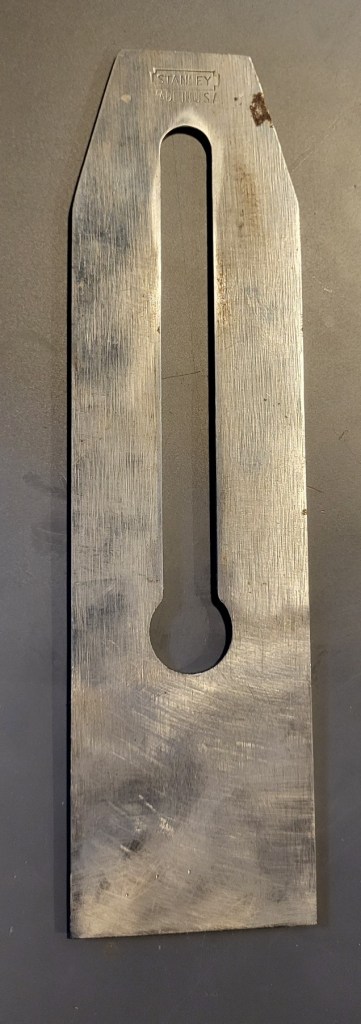
You can see a couple of little dots. I’m wising up as everything is getting pocked up with little craters, and if the finish on the back of the solid irons is good enough to be tested, I will pock the backs up instead of the fronts. This iron isn’t in hand, but the back is probably just milled and too coarse. Too coarse or dirty or really anything that doesn’t provide both perfect footing on the anvil and a solid continuous clean surface where the diamond goes and the results can be off the mark *and* useless.
Guess the hardness. 61.5
Again.
And then in the same pile, I found a recent Stanley Mexico iron. It had an annoying coating on it, but consider the market. I scraped it off of both sides and tested it:

Guess what the hardness was.
61.5
That makes five irons now that have hardness of 61 or 61.5. No solid stanley iron that I didn’t reheat has tested otherwise, though I’m sure changing eras or a much larger pool of irons from the era of these could prove to find something. Could and would are different things.
When I first got the tester, I stuck a couple of laminated irons. Their reading is too high to be believable, and the laminated thickness is below the minimum thickness for the tester, so I’m not going to test any of those or any irons thicker than a stock bench plane iron. There’s no reason to have bad information.
This makes a light bulb go off. First, the reports of the soft irons are false. Not just the recent ones, but in general, Stanley’s irons from 1900 or so at least and beyond that are not soft.
I used to think they were soft, but at some point, learned to use the cap iron and suddenly they seemed to hold up fine. I admit that I attributed it to some “protective” unexplained effect of the cap iron, and there is definitely some, but it’s not an extension of useful hardness as far as I know as irons that get below 60 suddenly have issues denting or forming a burr in hardwoods. Both of those things are obnoxious because they lead to the plane giving up before the iron is actually worn.
The effect of the cap iron, as far as I can tell, is just to take an iron that is thin and maybe not that stable if not used properly, and put it on wood and keep the wood continuous without a bunch of chattering.
I have another iron to test this theory – an IH sorby tapered iron that went into a cocobolo smoother years ago, and I instantly figured out that it sharpens fine, but it doesn’t last long in smoothing work. The solution was easy enough – use the smoother for work more coarse than smoothing, and that’s what I did with it. But I forgot to test the iron.
I’ll bet it’s going to be measurably softer than stanley’s irons.
After figuring out the double iron, using a stock stanley iron to make that cocobolo planes was one of the first things I did. Why? To find out if I wasted my money buying a bunch of high hardness and high speed steel irons before that because they were always the advice given, or almost always, if you were planing something exotic and needed “better than they used to use”.
I dimensioned the cocobolo plane blank and then did all of the planing to rough the coffin shape, and made the wedge with that iron and a stanley #4 and had to stop to sharpen once about 3/4ths of the way through.
Hardness is one thing here, though. Abrasion resistance is another. These Stanley irons are hard enough, but they would be the choice of an experienced user vs. something with a bunch of abrasion resistance. If the user is changed to someone with a honing guide and 6 minutes of sharpening with 6 stones, I think such a user would find the modern irons more pleasing. When you first start, everything is smoothing, and if it’s more than smoothing, it’s a million feet of planing to get to final smoothing. And suddenly when you do a lot more woodworking, the smoothing is after try planing and it’s over in a flash. Try planing doesn’t benefit from ultra hard irons because the shaving is thicker. But the try plane makes the work of the smoother very little. And suddenly everything starts to make sense with why nobody was clamoring for extra hard or extra alloyed steels until recently.
That doesn’t explain the 1920s-1960s or so, but anyone in the US will be honest and admit that there wasn’t a whole lot of fine hand plane use going on during that period. This is the United States and until the antiques craze hit, 99.9% of the population embraced modernity. My thrifty grandparents spent the extra money they had embracing some convenience after a life of wearing themselves out. The only hand tools I saw my grandfather use were axes to split wood and wrenches to fix equipment.
That big lull from the early 1900s until woo woodworking gave us a long time to forget why things were designed the way they are in stanley’s planes. Even in Hasluck’s guide to hand tool use, there’s a maniacal explanation of why hollow ground bevels are far better than complex, but it refers to a comparison vs. a site worker with poorly set saws (at least as far as I can remember). Somewhere between the late 1800s and then, the talk of the cap iron no longer was provided in long form. I think the explanation as to why that would be is simple – a combination of a lot of veneered furniture and the lack of economic value in finish planing when work went to factories.
 Of Making by Hand with Wood and Steel