You have probably heard conflicting information about this. I have actually tested it planing, so I’m going to tell you what really happens (additional fineness imparts significant additional edge life, not just a stroke or two), and then mention pitfalls at the end – things to figure out so that you actually get full edge life of any edge.
What really happens? If you have any level of competence, or are aiming to, edge refinement greatly extends edge life in the kind of planing people actually do now, and edge life isn’t the only thing that will improve. How easily a plane enters or stays in a cut and the amount of effort to do that will both be greatly improved and much less, respectively.
Why am I telling you this? I’ve heard twice already that Katz-Moses just did a test and that it proved that a high level of edge fineness is gone in short order, is transient and not worth the effort. Or something like that. I saw about a minute of the video, but, and I apologize if you’re the type who likes to get along with everyone – I can only see a minute before the overwhelming pressure of fakeness just makes the videos of people like Rex or JKM intolerable to me.
Those channels are not people who are “your friend”. They are people who look at you and think, “what can I get out of my audience without having to be a skilled woodworker. What can I sell to the mush-brained folks watching, and how can I spend my spare time learning to optimize youtube revenue streams rather than learning to teach people to be better woodworkers.”?
Fake as a football bat, as Jim Cornette would say.
That’s my opinion, and if you feel like it’s wrong, realize you are comparing people like JKM and Rex to Paul Sellers. That’s like determining whether or not it’s a good idea to gamble your money on blackjack vs. investing it because you’ve compared blackjack and roulette and ignored investing.
Is this specifically linked to JKM or anyone else? No. The reality is this kind of “definitive” testing is part of a long-term pattern of people who don’t have the skill or discernment wanting to attract attention and become a voice of authority because it’s good for their real business – selling ads, attracting sponsors, getting people to sign up for online schools or getting people to buy link-through items where the presenter directs a viewer to a product or service and then the viewer is tracked and the presenter gets a % of the sale.
The Truth about Edge Life – In Relative Numbers
In 2019, I planed about 40,000 feet of wood and took microscopic pictures of edges both from the start (you’d be surprised how often you didn’t finish the job sharpening if you use a guide and count strokes), and then along the way while planing. I was comparing alloys, but an offshoot was to compare sharpening angle and then edge life determined by edge fineness.
For ease, the ultimate test steps involved honing to a final flat microbevel of 35 percent to eliminate edge failure. You can theoretically get extra edge life by chasing the final angle lower, but it won’t be much below 35 that you are creating more work for yourself both by not extending edge life and increasing damage so that you don’t finish sharpening.
The values below are relative edge life by media. All done with the same plane on the same edge of the same board and with length planed recorded as well as weight of shavings. the test stops when the plane won’t stay in the cut by itself (this happens abruptly, not gradually).
The finest media that I used was 1 micron diamond, which is a good compromise of fine and fast, but only if you are willing to work just the tip of the iron. I will give that a relative score of 1. that means every other decimal is the percentage of feet planed by the same plane and iron vs one micron diamond.
- One micron diamond: 1.00
- Dan’s Black arkansas: 0.85
- Fine washita arkansas: 0.8-0.85
- 8000 grit kitayama waterstone: 0.85
- 2.5 micron diamond probably 2-3 micron particles: 0.7
- 5 micron diamond: 0.65
I want you to think about the results above – they are from actual planing, and they show only the feet planed based on edge finish. Note, I also tried polishing one side finely and the other with 5 micron diamonds. Edge life tended toward the more coarse of the two sides, so there’s no point in trying to cheat and get a free lunch.
If you look at Holtzapffel’s description, they didn’t say “for the finest work only” for the sharpening method. There is one. They would’ve been aware at the time that refining the edge and removing the burr at the same time with fine work resulted in less labor and better results. They weren’t on youtube, and they weren’t experts in circular saw blades or festool dominos or mirka deros, they were experts at working wood with edge tools from rough to finish.
They knew better by doing – not by cutting strings and calling it the right answer for planing.
I personally found five micron diamonds intolerable. If you are going to use planes, you should be good at it. Every single thing needed for accurate effort minimized planing, and mark free planing on smooth planing, suffered greatly with the 5 micron abrasive. Diamond is aggressive enough that I would point out that 5 micron is probably more like a 2-3k waterstone, not almost a polish stone.
My personal opinion is that I don’t love using 1 micron diamonds all the time on cast or some other substrate, so I don’t usually, and I’ll give up the difference, or buff a little bit to remove the burr at the same time and make up the difference.
Science Would be Replicating Planing
There’s a bad public habit of defining anything that looks like a test as being scientific. In real research, the research team at Eastman Kodak would’ve involved creating a machine that imitated people planing, and potentially collecting actual data of people planing unless the sales department found that the string test showed some untruth that was more favorable for selling a proprietary product.
But that would’ve been marketing (sound familiar?) and not a strong research group. Realistic research involves observing a relevant outcome. The outcome is easy to observe in this case. It’s just planing and doing the work to get the result, and repeating some tests to show that the result is repeatable in a narrow range.
So, it’ll Take a Long time To Sharpen?
No, it won’t. You grind, hone and finish the apex. If you try to skip finishing the apex, you have to learn how to deal with a large burr and do it neatly. Amateur and pro circular saw blade experts don’t have a good grasp of dealing with burrs in the first place.
It takes about one minute to sharpen an iron that’s well ground by honing the wear off and preparing for dealing with the apex and then installing a high level of finish at the apex.
If you absolutely have to use a guide, this means working the back of the tool with your finest stone, and then setting up a secondary bevel and bumping the tertiary bevel up a degree or two.
if you feel like you’ll be able to treat an entire wide bevel with all steps, you’re wasting your time. It takes no more time to sharpen finely than it does to do a poor job, but you have to figure it out.
If you don’t, and you conclude everything you know based on 600 grit wet and dry or a 1200 grit diamond hone, you’ll just have incorrect conclusions about what can be planed and what can’t, and how neatly and how much sanding, and so on.
So – How does an Edge Get Screwed Up?
First, the apex of the tool needs to be able to stand up to the work. If you use substandard tools or damage the initial apex, you’ve just lost the game regardless of how fine you did or didn’t sharpen.
You need to be able to work yourself up to a method where you can set up the apex that stands up and that has a fine level of polish quickly.
Chasing angles too low is another pitfall. You read that you can pare wood at 25 degrees, or that LV touts that you can use V11 at very low angles? I have pictures of what happens. the edge gets destroyed. With just a small volume of low angle work, you will have several minutes at least of white knuckle honing to remove the damage.
So, you need to be able to actually finish an edge, which means you’d need to be able to confirm you did (something that you can do with nothing more than a $15 hand held USB scope), and you need to be able to understand how to prevent damage.
This sounds like big demands when you’re a beginner. It’s just basic hand tool work.
I figured I’d track down a couple of pictures from my planing test. I not only counted distance with irons in rotation on the same board, but I also checked the thickness of shavings coming from the plane often and weighed them. Some irons cut more sweetly than others when wearing. It’s not an even test unless you measure both distance planed and weight and confirm that you could set a plane so that the weight is proportional to distance.
The first picture is a box of end grain shavings waiting to be weighed. Yes, I tested planed lengths of end grain to see if the long grain relative wear ratios would hold up (comparing magic alloys to simpler steels, they don’t – end grain planing is just harder on edges and the wear isn’t just similar to abrasive wear).
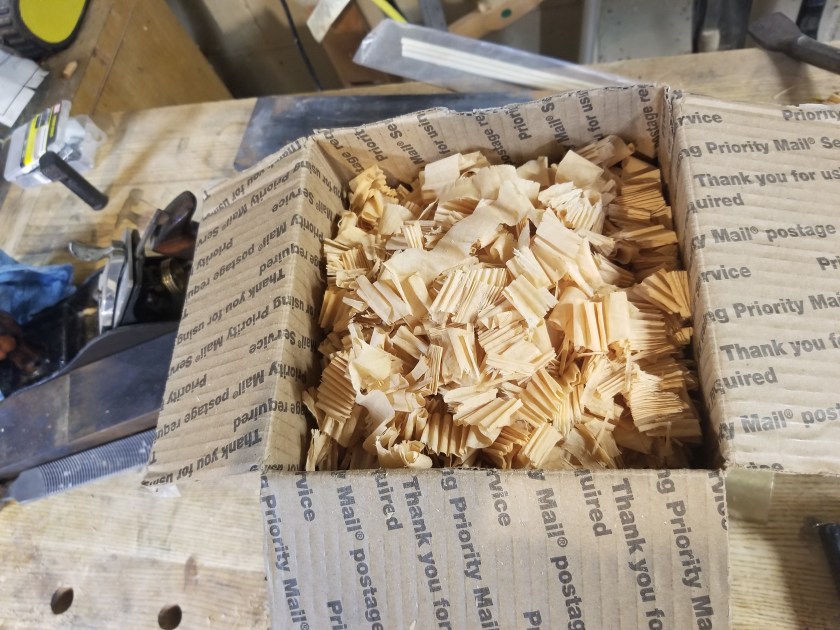
Long end grain shavings of Cherry from the large Plane Test

A large pile of uniform continuous beech shavings from a plane iron test simulating smoothing flat machine planed or try planed wood. Test done to gather edge life of various alloys and setup variables.
 Of Making by Hand with Wood and Steel