If anyone here started woodworking around the same time I did, you may recall that Blood and Gore (Patrick Leach’s site of Stanley tools) referred to the Stanley 112 as potentially the best thing ever to come out of Stanley.
Around the same time, LN and LV were coming out with various scraper planes – two large ones similar in proportion to the #112 and a smaller one for each, and LN also copied a stanley “cabinet scraping” plane or something of that sort with a fixed angle.
This predated figuring out the chipbreaker for me, so naturally, I did what people did back then. I bought some of these and a friend who was also interested bought others. After watching a Charlesworth video with a novel way to set a really neat precise and robust hook, they worked great. At least on wood that was already flat and clear.
With Stanley 112 and the large LV scraping plane in hand, I ran into a blanket chest project that had a lot of hard highly figured maple. After glue up, I set out on getting the surfaces near finished. One problem. A day or two elapsed after glue up and a couple of the panels cupped a little bit.
No Way No How
Despite setting these things as well as anyone I’ve ever seen, with five relatively large curly maple blanket chest panels to clean up, there was no way I could do it physically. These scrapers excel in taking a thin shaving on a surface that’s flat, they have a wide footprint, and they last surprisingly long in a cut, but nothing compared to a real plane – especially when you put the cap iron on.
A helpful forum member proposed to me at the time that since the panels were out of flat, but probably not in a meaningful way, that a scraper with a smaller footprint would probably do the job. And, thus, I bought the LN #212, too. And I got by with it, but it left little narrow scraped scallops and it was still arduous. Of course, not meaningfully out of flat means those panels were uniformly gradually cupped and once in a frame or with more seasonal movement, they’d have been no problem.
Well, I never finished the chest because ultimately, I didn’t care that much for the chest in the first place, and I don’t have a landing spot for it. The kids and the wife don’t want it in any of the bedrooms and it’s not needed anywhere else.
I suspect, but can’t confirm, that the popularity of these scraping planes had a lot do to with veneer on substrate where the substrate was dry and flattened. Why? Because by the time they were out in numbers under Stanley, that was the style of furniture being made in factories or on a small scale basis in the US. They did get made in some relatively large number – not like a Stanley 4, but it’s not like they only made two dozen of them. They just don’t make much sense for solid wood work when a double iron, card scraper and if needed, some sanding, is far more practical.
Of course, I don’t have any of those planes any longer, and if there’s any virtue on the boutique plane side, neither of the two boutique types that I had (LV large scraper plane and LN #212) were hard to sell and I doubt I lost much on the Stanley #112. The friend who also bought the LN #112 because we wanted to get our hands on them still has his, and he’s never actually used it since a little bit of trialing.
It’s my opinion that the popularity of these scraper planes follows the talk around them, which is folks are delighted to have a “problem solving tool” in hand, without knowing if it’s actually a problem solving tool, or just a space occupier and problem creator.
In true form, I’ve seen some folks mention that LN suggests sharpening with no burr rolled and just a honed edge. That’s too bad, the planes work far better and leave a better surface with a rolled burr, but I get it. The same company still recommends various frogs to avoid tearout on a plane that has a chipbreaker. It’s the way of the world.
But I’m happy to see less talk about them as they fall into the category of “is it really better to try something if it’s not likely to be useful in the first place?”. In this case, I think no. And while it’s very easy to set a burr freehand, even on these, once you get a feel for angles, I doubt a large percentage of folks using a scraper of any type learn to create a good uniform burr quickly.
There was such a huge array of advice being given when I first started woodworking that it was hard to really sort out what was useful. I think the Seaton chest probably gives a pretty good idea of what’s needed to work by hand outside of marquetry and being a trade carver, but let’s be honest – few are ever going to go from Paul Sellers or YT product placement videos to doing either of those.
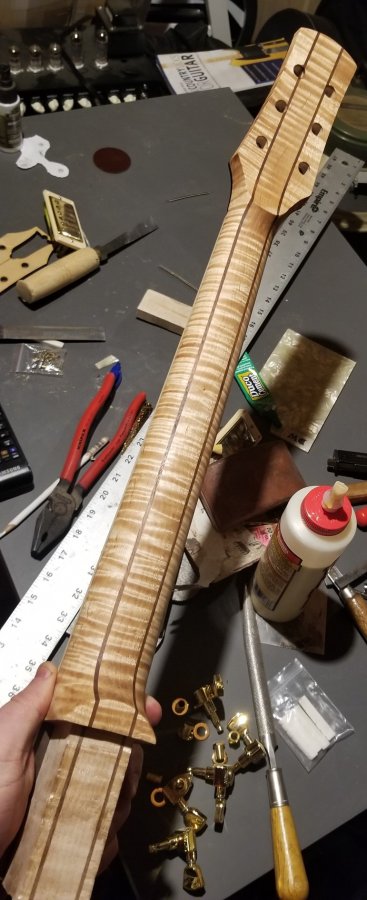
Oh, nearly forgot – what ever happened to all of this curly maple? Well, it sat for a dozen more years and I didn’t have the heart to throw it out, but just didn’t feel like finishing the blanket chest. Last year, I finally found a use for it – to keep it as stock for laminated guitar necks. it’s flatsawn, which results in a pleasant orientation for laminated necks, and in general, it’s not a good idea to make a single solid curly maple guitar neck in the first place, so the stock thickness of a solid panel is already close to what you want. Somehow, it’s no longer a big deal to plane it. But there was no good advice around – high angle and scraping was the suggestion and it just wasn’t and never will be practical for anything of size.
I like guitars more than blanket chests, and am glad that I never finished that job.

 Of Making by Hand with Wood and Steel
Are you making any of the chisels ? For sale or what ?
This is the only way I’ve found to contact you, after seeing Graham show your chisel off .
Cheers
William
LikeLike
Hi, William – at this point, my regulars day job schedule doesn’t allow. The chisel that Graham has is actually a mule, a test chisel done all with an induction forge instead of with a gas forge. I told him quite some time ago that i’d send him a chisel and I figured since he kind of reminded me of it (looong later), I’d send him that one just so he could get a feel for the proportions.
I think most people wouldn’t like the chisels, but a lot of people ask if I’ll make them.
Short answer, no, I just don’t have time to take orders and get them out timely. Day job is sometimes full time, sometimes more, and I’ve got two kids in school who are in a bunch of activities.
LikeLike
By the way, I didn’t know Graham would make a video with the chisel, but I knew he does make videos and figured he might at some point. I’d have sent him a properly finished and slightly thinner chisel had I known that, but it does create the odd situation is there is some dumb guy (me) making chisels like this for a hobby, but they’re not really available. And to get the performance of my good chisels from anyone making seaton chest shaped chisels isn’t guaranteed. I haven’t got a great suggestion as I can’t imagine anyone making them cheaply.
it takes me about 2 1/2 hours to make one well handle and all, which means if I did make they for pay, they’d have to be expensive.
I *think* pfeil could make something close if they wanted to, but the market is probably limited. the big bolster on the wider chisels would be a hurdle for a drop forging manufacturer to get over.
what I would like to do is get more people into serious hobby toolmaking – everything I do is by eye and freehand. I won’t say it’s easy, but it’s not impossible to get good at pretty quickly, either.
LikeLike