“Best” Copal Varnish

A break from the Nicholson talk. I’ve been trying varnish making beyond my first attempt 5 years ago. That varnish was just a pine/dammar resin combination to be used on a guitar. It was OK, but it lacked hardness which is a problem when used on a guitar. Simply put, with a long time inside a gig bag, the guitar took some imprinting from the bag liner.

At some point, I think varnish making is going to do rounds on the boutique scene, though I don’t know how many people will do it. It needs to be done outside, it’s somewhat unhealthful and potentially very dangerous if you do stupid things.

But what is it in general? With natural resin oil varnish making, it’s preparing (flax/linseed) oil and resin, cleaning the oil, if needed, to make it dry faster and then cooking both separately and then combining them. The oil and resin in a successful attempt bond together and you get something that has different properties than the parts.

Varnish is just a term people use. Almost everything that’s left on the market that’s a varnish is alkyd or modified tung oil with a bunch of solvents in. With new VOC rules, this gets less and less predictable as to healthfulness, and they’re stinky and generally designed for boats or something, anyway.

But even among natural resins, the variance is great. The pine and dammar resins are generally softer and make a varnish that isn’t that durable. At the far other end is amber -which you’ve probably seen sold to tourists in chunks where a bug is magically suspended in the middle. Amber is typically resin that has existed for a long time and is a fossil (or is it a semi-fossil?…whatever, it’s not something that dripped out of a tree ten years ago). Amber is hard, and can be tricky to make into a varnish because the point where it melts for the initial cook is at or sometimes above the temperature that it would burn.

What’s Copal then?

Copal is a group of resins, but fossil or Congo or Zanzibar copal is resins that are semi fossilized and also melt at a very high temperature – could be anything from 450-650F, and some that I’ve “run” (heated to cook out undesirable stuff before used) leaves bits behind that don’t melt at 650F.

But (semi-)fossil copal, unlike pine and dammar resin (and many others), makes a finish that’s much harder, and to my findings, indifferent to water in any reasonable period of time. It was stylish for a pretty long period of time up to the early 1900s because it makes a good varnish, frees the varnish makers from catching their varnish and themselves on fire with amber, and can be a lighter color. Some of us like finishes with a tone, but there was a time when harder darker resins left people grasping for what compromise to make to varnish light colored woods or to make pigmented varnishes of light colors. This is pretty easy to follow if you’ve ever used something light colored or mixed it and had it react and become dark. The best copal resin is lighter in color and if the process is gamed, can probably leave a very durable but relatively light colored varnish.

So, rather than paying my dues properly working all the way up, on my 6th batch of varnish (several others being just variations of one type), i just decided to do fossil copal – went great. And then I decided to do a second batch with some pieces of resin in the container that I got that looked dirtier, and I “smoked” that batch a bit. Smoked meaning that I wasn’t able to find the point where some of the resin would melt before it was just burned. Fortunately, most of the burned stuff seems to have fallen out as sediment and the varnish is still good, but the brief struggle with expensive resins wasn’t that pleasant.

I’m not encouraging anyone to make varnishes and take it lightly. Imagine you are dealing with a 650F resin or a 550-600F linseed oil that could (but shouldn’t) catch fire or splash, and the former is sticky, so aside from noxious high temperature cook fumes, you have the chance of getting serious burns. Or as George Wilson put it to me when he was trying to cook a type that’s somewhat reactive, and ignited it “creating a mushroom cloud” in your back yard.

However, if you’re really serious, this is something accessible and while it’s not that cheap to do in terms of the materials, the equipment to do it is pretty much used pots and pans dedicated to the use and a two-burner electric hot plate.
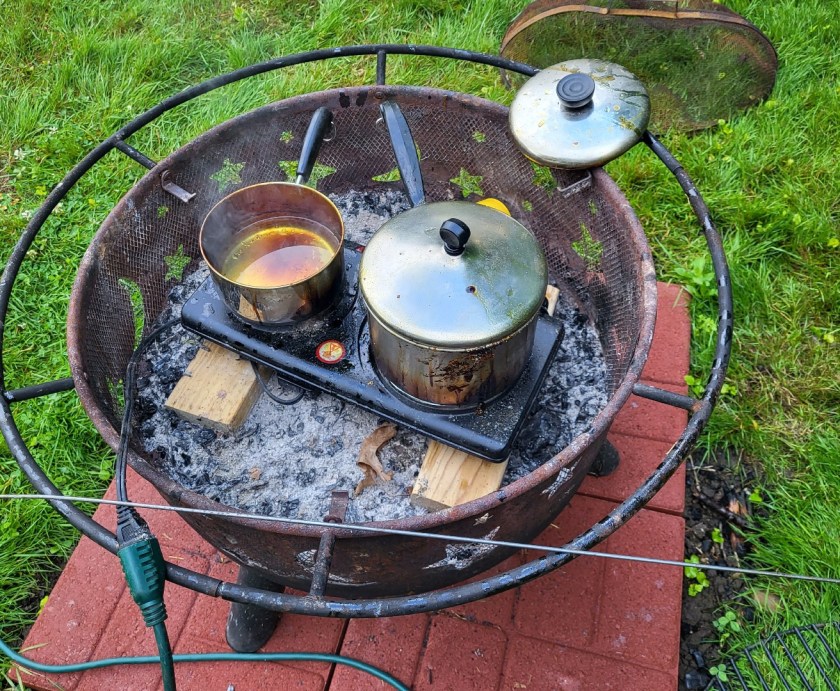
This is my setup – that’s it. Later, the varnish is strained when it cools, but on the left is a pot with oil in it. On the right is (not very instructive), copal from the second cruddy run trying to get hot enough to melt and cook out the impurities.

Here is what the better pieces of copal look like:
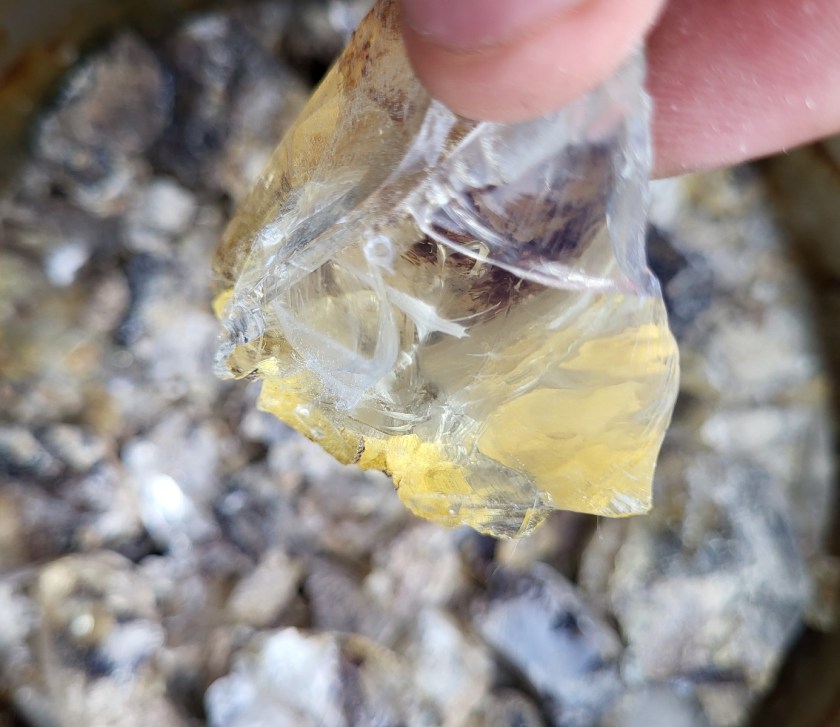
Probably about 20% of what I get in a bottle – and if you want to find this, all you have to do is search “Congo copal” on google. There’s only one supplier that I know of. Anyway, probably 20% of the congo copal is bright like this and then it varies after that with some of it having some clarity but dark coloring in it. In the old days when it was more plentiful, the various bits were most likely sorted to save all of the lighter bits for the highest paying customers.

The high temperature cook darkens it a little bit – but there is no way to avoid the high temperature cook with the harder resins, so it’s part of the process. Beyond that, once the oil and resin combine, the varnish is made better by extending the cook somewhat, which will further darken it.

Other than for maple (which I don’t care for too much other than for guitar necks or tops – color will be desirable there), I prefer some tone in finishes, and the tone matches the wood. The darker the wood, the darker the finish when choosing shellac. I’ve made too little varnish to have well formed thoughts.

But here is where copal varnish ends up:

This picture is the varnish after cook in the jar, and the jar has been leaned to the side so you can get a sense for the color.

This is what it ends up looking like on beech:

The line on this plane blank divides the better batch from the one that got burned/smoked a bit. This is just two very light padded coats, and the dark corner at the top can be ignored- the wood was dirty, and I scraped it while it was damp (picture of why below) – you’d not have that situation on a regular piece.

I had two test pieces drying in the sun get rained on, and to my surprise, even with a sheer finish, there is no evidence of water having been on the varnish – even though it’s only just initially dried and will continue to dry further over time.

note, the varnished part sheds rain. The bare wood below it definitely does not!

This is the same blank before padding the less desirable batch on the short end. The whole thing got left in the rain and other than some varnish that I may have had on my thumb (see the dry spot?), the wood otherwise just soaked in the rain. The thin coat of copal varnish was indifferent, and didn’t so much as degloss or blush at all.

To see how long this would last, I took another test piece later and put more water than this on that test sample and allowed the water to sit on the varnish until it had evaporated. Again, no evidence left.

Which brings me to the point of making varnish. I love shellac, but shellac isn’t durable in some situations where there’s a lot of hand contact or contact with water. I also can’t think of any cured finish that I’ve used outside of soft spar urethane (gross looking and too soft for a guitar – feels like a plastic case) that has this kind of water resistance. Not even some of the solvent urethanes or various common spray finishes used on commercial furniture.

Making a varnish for use gives the same option to have a warmer tone like shellac, but to have excellent long-term durability. And the resin and the finished varnish have unlimited life on the shelf. There are no driers in these varnishes, though they could be added if something needs to be hard in a day. Otherwise, UV light or longer term exposure to oxygen will cure the finish without any dryers. Making the varnish without eliminates the constant battle you hear people talk about with skinned over commercial varnishes.

Where can you Read About Varnish Making?

There’s a ton of talk on violin boards about making varnishes, but the varnish made for violins isn’t of great use for furniture or cabinets. You can find older texts in the public domain on archive.org or google books or just by searching google. Holtzapffel Turning and Mechanical Manipulation and another text called “German American Varnish Making” come to mind. These describe a relatively commercial process, but there are recipes in the books and enough to start to understand how interesting and broad this trade once was.

I’m not ever going to describe the trials and tribulations in great detail – if it’s something you want to do, you’re better off reading older texts. Just know that the descriptions of using jacketed vessels or open fires or cooking 10-100 gallons at a time are all not going to apply. You’ll be trying this in stainless, cast iron or enameled cast iron pots – the last being the best.

And once again, if you live in an apartment or don’t have somewhere to cook this away from your house and in an area where you can tolerate fire and really stinky smoke, don’t even think about it.

One more thing (Columbo reference)

It’s not cheap – the solvent of choice to add during the cook and thin later is true pine turpentine. There is diamond G in the US or a good quality of pine turpentine that can be gotten on ebay from Portugal a little cheaper. You can make varnish with less good materials – that would be your choice. I wouldn’t bother.

To make the copal batches cost a little bit more than waterlox gloss would cost in quarts when you compare the actual solids content from one to the next. I figure the brown quart jar in the picture cost about $65-$70, but the varnish is also about 65% solids or more, so a quart will go a very long way compared to most commercial finishes. In the case of guitars, it would be enough to finis several high quality guitars, and suddenly, the cost doesn’t seem so high in that context. Could very well be enough in one quart to seal a whole set of kitchen cabinets and pad on a sheer (but very durable) top coat just with one quart, too.

Other resins are much cheaper and can make suitable varnishes, though unfortunately, my initial impression is that the fossil copals really do live up to the glowing comments in older texts about durability and ability to take a high polish.

Nicholson on Planing Straight Edges

Page 134 bottom of the above link.

Nicholson splits what most people will think of as edge jointing. There are two types, with the latter probably being assumed to be the standard method – striking a board’s edge or using the term “shooting”, which people now often think of as planing end grain.

However, this entry is the first – we’ll visit the second later as I think it’s not practiced that often for typical edge jointing these days unless the edges are thin. Which does lead into one condition for today’s entry – it’s not for very thin boards, which you would trouble to plane or feel squareness on if they were in a vise.

This type of planing is similar to what we refer to now as match planing, where two boards are planed at once in a vise, and the result is checked against itself. When done properly, you start with a rough edge and then plane the edge until the joint is matched and can be glued as a rub joint or with very little clamping pressure. Much different than the more common idea of every joint being sprung. I don’t think in the days of accurate hand work, there was a need for significant edge spring, but I haven’t read all of this text yet, either, so I could be proven wrong.

The Process

The text is short, so you can read it really without referring to what I say and follow it easily.

Take two boards, install them in the vise and knock off any high bits. This is done by eye, and my comment to you is that the sole of the plane will also tell you a lot if you allow it to. If your plane is running straight across an edge, it will have a feel. If the wood is peaking just a bit and you run a plane over it, even if it’s a very small amount, you’ll feel the effect – the slight loss of security and support. Nicholson refers to starting and working sectionally with a jack plane vs. walking the length of a board, and this is definitely true. No need to plane a long edge through if there are one or two small peaks in it to start, or uneven roughness to remove.

Step two, still with your jack plane, is to plane through a couple of strokes. There is something perhaps assumed here, and that is that you have at least one jack that’s not drastically rank, and if I had a suggestion on two planes to set up – it would be two jacks. One set rank and one set much less so, but just a bit more radius than the try plane. I typically use one and rely on the try plane more as the ability to remove material with the jack is nice courtesy of getting standard rough lumber that’s not going to be cut by a sawyer catering to hand toolers.

At any rate, you follow the jack work by walking through the board’s length (added comment from me – attempting to feel and remain square. A matched joint will line up with some lack of squareness due to offsetting errors, but it’s bad policy to do anything but attempt squareness and learn to develop the skill of feeling square, too). You do this second walk through with the try plane, and the text mentions again that if the edges are long, finishing with a jointer is good policy. That’s true, though in cabinet or bench type work, it may not be too common that you have to resort to a plane longer than 22-24″ long.

If you plane through and the boards aren’t a good match, you must continue on until they are. If you have a good feel for your planes, you will come to expect there isn’t much of an issue with matching, just support the front of the plane entering the cut, make sure the cut entrance is clean and then support the back of the plane as the front is going off of the opposite end. With a flat or slightly convex sole, this will create a straight edge and you should expect you won’t have open gapped ends when you lay one board back on top of the other.

Also implicit in this advice is that the soles of your planes are flat and not concave. The method will not work with plane soles even a bit concave, and though I haven’t read it, one would expect that the precision required for basic hand planing and rub joints assumes that you are caring for the tools and not dealing with substandard sole shapes.

Lastly, Nicholson refers to the fact that you must have a clean shaving end to end and left to right covering the entire territory that you’re planing. Though it’s often said on the forums that there’s no information in plane shavings, nobody with any competence would believe that. Shavings that are not continuous suggest that you are either dealing with tearout or planing areas unevenly because perhaps some part of your edge is low. From experience, having not read this passage before the last couple of days, if you match plane panel edges often, you’ll well know this already – it’s pointless to check a joint if the shavings aren’t continuous.

This work is also territory for the cap iron, and it’s not automatically territory for tissue thin shavings. If the try plane or jack plane provide a joint that will be rub joint quality without tissue shavings, take that gift and move on.

Too, this type of match joint may require some facing of boards if they are uneven and will not clamp together, but if you have pretty good quality rough wood that is also flat, you can do this work on an edge without addressing the faces. It’ll be necessary at some point to joint edges, and with this process, you will be doing the rough work and getting a top quality edge joint at the same time with no doubling of efforts or checking.

The only thing you need to do other than checking for gaps – and check both sides of the joint – is lay one board atop the other and check them with a straight edge to make sure that the faces are relatively flat with no tension on the joint.

We often clamp things, and at this point when match planing joints, I will often lay glue on the joint, rub and then put clamps on before taking anything out of the vise. The whole thing leads to joints you won’t match with power tools only, and from rough to the joint, you are talking a matter of a couple of minutes and not a lot of fiddling, as well as not much use of measuring tools to check square or flat, etc. The wood tells you everything you need to know.

Nicholson on Planing Flat Surfaces

Starts at page 135 – “To Face a Piece of Stuff”, and is one of the more interesting sections in how little it provides. Which is a clue to you that planing a surface flat is not always going to be a system of the same steps. It’s more of a feel thing.

Toss out most of the board facing exercises you see on youtube intended for beginners. Planing X’s or whatever, that’s not reality when you dimension by hand. It’s just some attempt to get beginners to feel like they have a do-all method.

Nicholson describes a flat surface as one made of straight lines, which we would think of as a plane, of course. His point is that you can draw a straight line from one point to another and then draw another line and both would be in the same plane. And that winding sticks placed anywhere in pairs would be viewable across the top with no wind.

I’m assuming that you understand wind/twist, and so on. If not, you can look them up.

Instead of a generalized method, Nicholson suggests that you should see what the board is and then address it. This makes sense. Recall some of the prior discussion of the use of planes, that the work is with the grain and not across it. We won’t be taking every board, going across it for no reason and then planing an “X” pattern on the board to guarantee it’s flat, we’ll generally be planing through the wood and removing the impediments to the ideal above about everything being in a plane.

In the example of a board with wind (twisted), there will be two corners higher than the others. To deal with them, we just plane the high parts. Not through the entire board, but rather deal with the corners that are high. I don’t recall if we’ve discussed the cap iron yet, but assume you can plane the board in any direction. You’ll plane whatever is easiest, but you don’t need to worry about being unable to plane in one direction or another.

Here’s my tip at this point – you may be thinking of planing as if it’s going to be like taking a strong jog and you’re just cranking. That may be the case if the board has large sections to work, but it may also be the case that the most important thing is that you do enough and not too much. If thickness needs removing, you’ll have a chance to do that once the board is flatter and you can work in rhythm.

This kind of work is no place for a scrub plane, it’s jack plane work or in worse wood (runout) or better wood (already close to flat), it may be try plane work to start with. The try plane is a strange concept if you’re of the jack/jointer/smoother power tool background type. The try plane works more like half jointer, half fore. It’s not set for a rank cut, but it’s also not going to take tissue paper shavings. The jack plane is set to cut strongly, somewhat rank, but it’s not going to be set so that it’s tearing chunks out of boards or breaking off corners. If you use something like a “scrub” plane and you set a wooden jack a little bit finer and then measure the weight of wood planed, you’ll find the jack plane to equal the scrub pretty easily, but the work left behind will be much closer to flat and it will be ready for the try plane.

In Nicholson’s example of a board with wind, the jack is doing the work and at some point, the wind and any other high spots are generally gone and the board is in plane and can be moved to the try plane.

That’s it, there’s one example. Not one for cup, one for twist, one for boards with knots. It’s assumed that you will be able to plane wood competently. If you’re just starting out, this may not be a given, but it’s something to work toward – that you can choose a section – let’s say a high corner, and plane with it (center of the board off the end) or start with the high corner near you and start the cut and plane into it.

At the end of this short section, once the jack plane has gotten the board finished, Nicholson makes reference removing the jack plane ridges with the try plane, but then checking work to be certain you are keeping a true surface true.

This is minimal in words, but it’s loaded with things of “reality references” to me from learning to plane in a vacuum (self taught), but not wanting to resort to machine planing without the case being a project that’s just undesirable in the first place or with absolute trash wood.

First, it’s clear that you should shoot for flat with the jack plane, which is antithetical to the oft-given advice that the jointer is what makes wood flat. It isn’t, though it can do that, of course, you’re wasting your time if you’re still jacking wood away only to get the jointer in position to start removing wood to get it flat. You should have your stock flat and plane as much of what you need to do as possible with the jack plane. It’s easier to push not necessarily in pushing force, but it’s lighter, and if you have a 17 inch jack plane, it’s long enough with skilled eyes and hands to make a fairly flat surface. You will appreciate that you’ve done this when you get to the try plane and it’s quickly getting into continuous cuts vs skimming across various bits of wood for a long time and then still planing a piece that’s left with twist or an end falling off out of plane.

Second, it’s not said explicitly, but there is an assumption that you can plane a flat surface and keep it flat. There’s a whole host of things that goes into this, but it’s definitely the case that you should or you will get to the point that you can plane a board or panel end to end with a try plane, not have the plane in and out of the cut due to tearout and keep a panel relatively flat as you’re working the surface into the level of fineness that it needs to be to put the stock aside to be sized or smoothed. This state of removing layers does not exist without the cap iron or a very steep angle single iron plane. If you try to do this whole exercise with a steep angle single iron plane, you won’t do it for long.

My tip to you is to expect to get to this type of planing sooner rather than later so that your strokes with the plane are in the direction of the wood and will mimic what your final through planing will be. Work will progress and be completed much later without wasting time trying to get cross-planed wood or diagonally planed wood to cut continuously with through shavings. The try plane will communicate whether or not the “piece of stuff” is flat, and you can turn the plane askew a little bit each way to make sure that the work is not falling off to one side unevenly. Check things by eye and refine your eye and leave checking with winding sticks and a straight edge to when you either need a break or you’re doing a final look.

And appreciate that you have this discretion to plane off the high stuff with shavings in the length of the board in most cases, rather than just employing one same method over and over. You’ll find that this type of flattening can be very sparing of a board that would not meet thickness needs if run across a power jointer until flat.

So, does this mean that you’re never going to traverse a panel? No, there will be cases where you have panels that are short and relatively fat and traversing them or planing them diagonally is a relief to your back. With time under you’re belt, you’ll figure out what’s easiest. In my estimation from experience, though, planing directly across something over and over is uncommon unless the quality of wood is terrible and you’re *thicknessing* after one side is already flat.

Develop that feel, though – the feel when the plane is communicating that it stays in a long flat cut, and let it tell you what’s high and what’s low in the process of work so that you are working and adjusting continuously, and not stopping and checking with sticks and making pencil marks or whatever else.

Are there other things unsaid here? Sure, like if a board seems to be a bunch of high and low bits on both sides, which side do you start with? It may be necessary to plane the opposite side of a board to knock off some high spots just to be able to face the side you want to. If you have a board that’s got a lot of cupping, it’s helpful to plane the convex side first. If you have a board that has so much twist that it doesn’t want to stay flat, constrain it somewhere that’s not in your way, and that won’t bend the board – but so that you can plane the high spot without the board seesawing up and down. You’ll figure those things out pretty quickly. And that’s probably why this section is brief in the book.

Nicholson on Planing with Bench Planes

page 94

Use of the Jack Plane: Nicholson in the Jack Plane description mentioned two things I didn’t discuss on the prior post. First, that the corners of the iron must never touch the wood or the plane may clog. This isn’t actually the case, but it’s not a bad policy to set the jack so that the plane is not cutting the full width of the iron. If the corners dig in with some depth, you’re tearing or scraping the top of the cut out on two sides. This will burn through your lunch fuel in a hurry – don’t do it. Second, Nicholson says the cap iron should trace the profile of the iron arris. It should rather trace the profile of the plane sole – I’ve not seen a benefit to having the cap iron follow the iron contour – it seems ideal unless you think harder about the thickness of the shaving at each part of the iron. There’s no need for relief and doctoring the jack plane cap iron in a wooden plane could cause serious fit problems.

In the entry after defining the jack plane, Nicholson goes on to say that stock should be laid in line with the bench and planed along its length. He describes planing to extend arms. Leaning and extending arms is good technique, but you don’t need to put your arms out like you’re holding an attacker. Just use the momentum from leaning to extend an amount that doesn’t tire your arms before the rest of your body. It will end up being almost full locked out extension, but it won’t quite be that. Experiment and figure it out by seeing how easy you can make it seem to plane the same thickness and length. Do this now and again to make sure you’re not making things hard. Making planing feel hard is usually a sign of too heavy of a cut, or more often, generating power from the shoulders to the hands – instead of initiating with a lean or a twist at the hips and shoulders. Facing the direction of planing vs. twisting is a better idea with dimensioning. Your lean should be subtle and not end with you dropping down to shoulders at board level – the last thing you want to do is push a 5 pound plane and end up bending up and down as if you’re picking something up off of the floor. You’re also leaning down and into the plane, not trying to get under it or work with a high bench and push it in front of you. The high bench concept is modern nonsense if applied to more than fidgeting with planes.

OK, I added a lot of this discussion, but you will need it. Your goal is to figure out how to plane efficiently and in rhythm, and with relaxed legs that are straight or almost straight. No squatting, no rigidity. Your hands will have a grip but not be white knuckled, and they’ll be your means to make an adjustment.

Back to the board – you have your board in line with the bench, and Nicholson says to start planing the section your on until it’s how you’d like it to be. Then move and repeat.

There is one caveat here – if you’re planing a lot of thickness off of pieces, you’ll need to do some at a time, and that’s about what Nicholson suggests – plane off sectionally and then move back the length of the board and do it again. If you’re not planing much off and just facing a relatively flat face with saw marks, you may need to do this only once.

It’s at the end of this that Nicholson says to remove “protuberances”. The average person will prefer removing the high spots from a board first instead and then proceed with the rest. It allows you to get to full cuts sooner.

Use of the Trying Plane: wider but thinner shaving than the jack of course, but used much the same. My edit to this is if you’re using a 22-24″ try plane, you should finish with overlapping through strokes on the work planing in the board’s length. I think this will be covered in how to face a board. And then check flatness. There will be precious little to do with a smoother after this if you’re accurate, and using the cap iron, you should be accurate even if you don’t think you’ll be as the plane will not be removing varying thicknesses of wood due to tearout.

Nicholson mentions that the planing effort is about the same with the jack and the try plane.

The long plane and jointer plane are described without additional fanfare about method until later sections about making straight matching edges and facing boards.

I’ll post a separate post about that.

Nicholson on Bench Planes

Once you’ve mentally mastered the sharpening ideas of Nicholson, it’s time to move on to the bench planes. When you read these entries, note that the point is to have a compact but relatively complete description about the size of the planes, the function and how you use them. I’m splitting this up into this post about the planes and the next will be about their use. It seems preferable to making 6 or so individual posts about each plane and repeating some of the core principles.

Again, there is a link to the text for you. There is a reading tool at google that might even allow me to link a single page, but I don’t have confidence that links to it won’t change.

Planes are under “Joinery” on page 91.

They are, Jack Plane, Trying Plane, Long Plane, Jointer Plane, Smoothing Plane, Compass, Straight Block and Forkstaff to make up the group of bench planes. I won’t mention the Forkstaff plane further – but you can read it and you can google pictures of them. Nicholson says they are typically used in volume by coachmakers. I’ve never met someone making fine coaches or truck bodies or truck cabs with hand planes.

The Jack Plane: Nicholson’s take on the jack plane is quite long. A lot of the language describing how the insides of the plane are arranged is there to set the state not just for the Jack plane, but for others. Important details are there, though. You can disregard these and say you like a 12″ plane for jack work or whatever, but you’re peeing into the breeze trying to get work done. This text is stellar and it’s better to follow *most* of the key items.

The Jack plane is about 17″ long, 3″ high with an open handle, and about 3 1/2″ wide. As a planemaker, this translates to a plane that would house a 2 1/2″ iron with an open handle. It sounds a little odd to me. More typical now is a 2 1/8- 2 1/4″ iron meaning the plane will 3″ wide or just over and almost square in cross section. Now is probably a poor term – what we find that dominated a few decades later.

For sharpening, Nicholson mentions a nearly flat arris on the honed edge – something that happens when you freehand sharpen. Remember, this is the last tiny bit honed, not the grind – that’s important. An arris like this does put the strength right at the tip, though, without leaving a bunch of intruding steel rubbing the wood when you plane. Nicholson mentions Convexity again in the profile laterally, and of course, we are familiar with this and some would refer to it by radius. Commentary follows that it needs to be set up to get the most done. This will vary based on what you work with, but it’s safe to say that most of the planes I’ve seen are set up with a jack iron almost flat because they’re kept by hobbyists – or radically radiused like a plane meant for wet soft wood. Something in the middle is better.

To set up the cap iron, there is an arris right at the terminus into the iron, too. This is refreshing to read. In 2012, I wrote a cap iron article. After testing, an iron with a slight radius just at the tip, but not too steep seemed to work better and be more intuitive than a flat bevel.

Note, too – 45 degrees for the bed, and the discussion of different radii depending on whether you plane crap or hard or soft or whatever else. You’ll find something that works well and stick with it – stay away from the idea that you need to start buying several irons.

The Trying Plane: the trying plane is used to knock the ridges off left by the jack. Nicholson specifies a slightly narrower plane at 3 1/4, which is still about enough width to squeeze in a 2 1/2″ iron. I’m going to give my opinion – if you want to work by hand, width to a plane is relatively important as it will impart flatness on what you do and ease some operations. If you are male, you can push a plane with a 2 1/2 iron. I can’t speak for all of the ladies, but at least some could, too. This blog may live for 20 years without anyone who can sweat without stinking, though.

The iron is sharpened the same way, and the cap iron is set up the same way, but of course with a flatter radius profile than the jack plane. In my estimation, good is when this is somewhere around 80% as flat or more of the smoothing plane – as in much closer to flat than it is to the jack profile.

Nicholson specifies 22″ in length. This is pretty easily found. 20-24 is probably a good range, but Warren has opined before that my own try planes (that I’ve made at 24″) are more like a long plane. I’d stick with 22-24″ as it’s common to go from the try plane to the smoother and be done.

Comments in the text state that the plane is both longer and more broad than the jack, leading me to believe the jack is probably more like 3×3 in cross section. Too, Nicholson states the trying plane is about 3 1/8″ tall. If you start to make planes, you will find that a plane long planes will work best when they’re just a bit wider than they are tall.

The Long Plane: this is a 26″ version of the try plane, but somewhat wider and slightly longer. The text doesn’t say it, but you can use my rule of thumb from planemaking – you will be comfortable making a plane well at about 3/4″ wider than the widest part of the tapered iron. That makes this plane somewhere around 2 3/4″ wide expected for the iron. This is obviously not a name we hear day to day in modern planes, but it’s a reflection of the standards at the time. As much dimensioning as there was, perhaps in a very large shop, it would be useful to have a 22″ trying plane and 26″ long plane. I think you don’t need to worry about having both. I’ve had 2 3/4″ planes – and as a bit of a tub but with reasonable smooth power, 2 3/4″ in hardwoods is starting to be a load. It’s uncanny how it makes a difference. Could prove to be useful match planing a joint that was right at the limit of a 2 1/2″ iron, though.

The Jointer Plane: specified even a little wider than the long plane and 30″ long. Mentioned for planing long straight edges, not a surprise, but also laid on its side to shoot a jointed edge on long narrow stock. If you have ever looked around for older jointers, you find that 26-28″ is far more common. Don’t confuse this jointer plane with having the same name as a Stanley 7 – the length makes the front of a 28-30″+ jointer very heavy and even though it may only be a pound or two heavier than a 26″ plane, it will wear you out with lack of balance. It makes sense that wider use isn’t offered. You want to use planes in a way that you can use planes again tomorrow. Pushing a 10 or 11 pound plane that’s nose heavy might improve your preacher curls, but too much use and you will be touching the top strap on your forearm all day, fascinated with the way it feels.

These are the things that Nicholson says for long flat planes. I’ll tell you my preference, because I’ve bought everything. I’d rather have a jack, 22-24″ try plane and a stanley 7 or 8, so long as you have the ability to make sure it’s flat. Even though the length is the same, the try plane will outwork a Stanley plane easily trying up after a jack plane and the Stanley plane will be easier to set finer and work effectively just a bit flatter in yucky wood.

The Smoothing Plane: Nothing earth shattering here if you’ve seen a coffin smoothing plane or any other basic unhandled smoother. The size mentioned (7 1/2″) seems a bit short, but coffin smoothers are generally a bit fat and short. The size corresponds with an iron of about 2-2 1/8″, I think. It’s been a long time since I made a coffin smoother, but the rules for iron size judged from width are a little different because the plane bed behind the widest part of the body. If you’re try planing or jointing faces or rails, there won’t be much to do with the smoother, and the text uses the words “used in cleaning off the finished work”. That’s somewhat key as you can gather from it tearout from “rougher” planes before the smoother really isn’t accepted.

On to the next:

The Compass Plane: You might be familiar with the stanley 114 or the #020, but there are really a lot of coffin shaped compass planes out there with an adjustable boxwood, toe. They may seem a trick to use, but if you learn to set the cap iron, they work well. These are specified, of course, to plane out inside curves in work – such as in a drawer front. These days, people tell us to plane across the grain everywhere, but that’s usually incompetence. The compass plane is designed to plane downhill with the direction of the curve from both sides or concave trim.

The Straight Block: By its description, it’s used for smaller miters and edge striking where using the jointer would be cumbersome. The plane is still specified to be quite wide, 12″ long and just under 3″ high. This is not a dainty little block plane, and it’s not meant to put in a carpenter’s pocket. The iron angle is described to be a little bit more acute.

Nicholson describes a plane with a more acute angle and thus a smaller arris (more acute sharpening angle). You can assume that you either have a shallower angle double iron plane or a single iron plane with a lower bed and an iron set to cut around 60 degrees effective. Anything else, and you’ll in no-man’s land for actual work. Low angle and tight mouth is torturous shooting narrow edges- it will still allow tearout, and nothing in these older texts suggest that planing torn surfaces was OK. Maybe more on that from my point of view in a future post. Short and to the point – if you are experiencing tearout, you are losing productivity and accuracy, and it’s not tolerated if you’re dimensioning.

Strange concept there for the average person to fathom – that you need to control the shavings and the surface to some extent to be accurate on *rougher* work.

Too, you will get nowhere if you try to make this group of planes with single irons. I’ve used a single iron setup – it’s intolerable with current wood. If you’re like me, go ahead and try it so you can compare. Time operations that you do and weigh shavings vs. your perceived effort. Measure sharpening intervals vs. the volume of wood planed, and so on. Single iron planes generally suck after the introduction of double iron planes. If you wear tights for recreation, and a clip on pony tail, maybe they look more appropriate, but you probably also need to go to a rare private woods with an axe and get old growth timber to make those planes work right. It’s not to be when you’re gluing up FAS cherry or Walnut and facing a board.

My opinion – this write up by Nicholson is excellent, though some things aren’t quite as clear. It could be because it was written very close to the turn of the 19th century. Planes and tidy slim profiled all steel cap irons are typically more mature in the mid 1800s.

More on Johnson’s Wax – Never Safe from Changing Info!

My can of Johnson’s wax has carnauba in it. This is in response to my prior post, and almost right after as I thought it’d be smart to go look at the SDS and get an idea of the recipe and start from there.

To my surprise, there’s no Carnauba in the 2016 SDS. Just “hydrocarbon waxes” and stoddard solvent. Confusing!

A quick search for older SDS shows the 2004 SDS with ranges to protect the manufacturer from giving the exact formula, but carnauba was somewhere between 1/6th and 1/2 of the wax solids.

I’ll shoot for something between with a bias toward higher shine and faster drying. By my calculations, a pound of house made wax with 10% carnauba and 20% paraffin will be about $5-$6 to make.

The solvent is less fast-evaporating than VM&P naphtha, which itself can be mixed with mineral spirits or stoddard solvent.

If Johnson’s already had no carnauba in it, it may not be much of a loss.

So Long Johnson’s Paste Wax

My favorite cheap paste wax has bit the dust, and I’m near the end of my original can. First can that entered my shop was Minwax. I never cared for it – it’s wax, it’s in distillate solvents, like other waxes. But it’s dull.

Johnson’s is also soft and dull, but it’s a little better, locally available and it doesn’t have the sharp brain killing smell of Briwax’s toluene. As my English friend here said to me when I was younger “it may ruin your baby batter, but that only matters if you’re planning to use it”. He said that based on the warnings on the can. In fact, I was between kids at the time.

What’s better about Johnson’s than Minwax? It has a little bit of Carnauba in it instead of just essentially paraffin. Paraffin is soft and it doesn’t build to a gloss. Carnauba is hard with a high melting point and will rub to a gloss. A little added makes a considerable difference. I can’t recall what’s in the Briwax, but they may be one of the groups whose SDS says the wax mix is a trade secret. That is really annoying. About as annoying as V11 hiding the alloy when the boast of what’s in the alloy should be used as a selling point.

Anyway, Johnson has confirmed that they’re no longer going to make the wax.

It’s not that difficult to see that most finish products other than those of the “modern water based miracle products” (insert Bronx cheer noise) are solids or polymers in solvents. I’d have bought another can of Johnson’s wax just for ease – maybe it’s a good thing. From now on, I’ll make my own. You can, too. You can google various waxes like shellac wax, paraffin, beeswax, carnauba, etc, and heat solvents on a hot plate outside and dissolve the wax in the solvents, stir and let the whole thing cool and put it in a jar or can.

Making varnish lately has provided more insight into solvents and solids, but years ago, a violin maker pointed me to Wood Finishing Enterprises, leaving me with bags of carnauba and shellac wax, and something else not at the top of mind. WFE is an interesting site, but over the head of a beginning woodworker. It’s a varnish maker’s paradise. Thinking ahead here, having VM&P naphtha on hand is probably a good starting point for an inexpensive solvent to go with it. It’s not too aromatic, but it won’t take days to evaporate, either.

Too bad it wasn’t the minwax wax that got canceled!

Not so secretly, I wouldn’t be surprised to see the same wax as Johnson’s show up as another brand at Lowes and other retailers just so the price can be doubled.

Nicholson on Sharpening and Grinding

Page 93 of the Mechanic’s Companion. This will cause an “oh” moment for some as it remains accurate now. Nicholson talks of the usefulness for plane irons. You can read the text – I don’t plan to just copy and display sections for my own use, even though it may be perfectly legal to do so. These books are in print and reprint now, too, but you don’t need to buy something you don’t yet know will be a reference – if at all. They are not the property of the republishers and it’s your discretion to support those folks. You are not obligated to pay someone to reprint public domain if you don’t want, though.

On to the sharpening and grinding.

As you read the text, you’ll see Nicholson prescribe a round grinding stone. This would’ve been sand stone though there may have been natural corundum wheels made, I doubt they’d have been large. Steel at the time didn’t need corundum, anyway. Friable coarse sandstone would do the job. As the method is discussed, you will see that Nicholson prescribes holding up the iron to press it against the stone, and then to prepare a relatively shallow bevel that would not hold up if it was the honing bevel. Put differently, he’s telling you to grind shallower to give yourself room to hone later. He also goes on to say that when properly done, or in his words, when the grind matches what you see in your mind as what the result should be, you will have a hollow that matches the wheel. Not flat, not convex, not sloppy, but neatly done.

We have rests now for grinders and this can be done easily. I’ve always felt from experience that a bench grinder 6 or 8 inch type hollow grind improves your productivity because it makes it harder to do the next steps and chase bevel angle steeper by accident. At any rate, you still are better served by being able to use a flat rest where you hold and control the tool otherwise, not constrained by jigs or holders, and developing this skill to grind neatly.

After describing this, Nicholson prescribes honing the edge of the tool steeper with a turkish oilstone. You’re probably not going to have one of those. They were stones that were somewhat superior to what we see as a Black Arkansas stone now as they were very fine but slightly friable. you can look for them in google pictures – the good ones are black/brownish with what looks like fracturing in the matrix. There are cretan/greece hones sold now, and they are close to this, but I doubt as fine. I have one of these – and a lighter brown turkish – you get what you can find. The turkish is a finer stone, more like a fine washita but with more cutting power.

This part is important – you lift the iron to the extent that you find it should be lifted with experience when doing this honing step. The text says that you have ground at an angle that a honed edge won’t hold up, so of course, you need to hone steeper to make up for that. Who thought secondary bevels were a new thing? I doubted they were, but being a lazy person on the side of reading things, never found these references until a year or two ago. At any rate, Nicholson uses the term “nearer to perpendicular” when describing this steeper secondary edge finish. Don’t confuse that with perpendicular. Though it’s not provided here, Holtzappfel in another text does prescribe 30 for the secondary angle for softwoods (off of a shallower bevel) and 35 for hardwoods. That may sound too steep – you don’t have to follow it to a T, and the rest of this will clarify that you should be getting back to grinding before you get a big fat secondary or tertiary apex.

After that, Nicholson describes that when you refresh the edge without grinding, you should use a rub stone before using the Turkish stone. Now, we’re up to 3 bevels. If you’re going to use a fine edge all the time – and there’s no reason not to, you’ll need 3 stones or a process that has three steps. A rub stone is nothing but a larger sandstone that would be equivalent to a coarse/middle honing stone for us. Choose what you like by experience.

You could read this section to imply that the rub stone should be used at the same final angle as the Turkish stone – it’s not clarified. You can, but I think it’s at least as practical or more to be careful and choose to do this wear-chasing with the rub stone at an angle slightly less than your final angle. Doing that will drastically improve the uniformity of your edge, even on lazy days…or especially on those days.

Nicholson then says, somewhat predictably, that use the process without the grinder eventually leads to a honed edge that gets too thick. You’ll find this on your own. There should never be variance in your results – pay attention to what you’re doing and give yourself a break. Trying to hone as this bevel gets too large is a fool’s errand. Do what Nicholson says next once this honed secondary, or secondary and tertiary bevel gets too thick…

…..return to the grinder.

Do the stones matter? No. I used to be bonkers for expensive synthetic stones. I still love the feel of all of the natural stones, but I can’t make the case that they will give a superior result because you can get graded abrasives and use them on a substrate and actually get a finer edge. If you want to use a cheap grinder, an india stone and 5 micron honing bar on MDF with a drop of mineral oil, you will do well with that. If you want to use a hard surface, the final step will need to be a good bit finer to get a really good edge.

You should not assume that you pair levels of sharpness to different tools. As in, there is not “sharp enough for the jack” or whatever else – everything is sharpened to the same level, perhaps with some extra care if you need to pare something.

One more tip from me – when you are honing with your middle stone, lighten up a little bit on the last couple of strokes. Leave the burr on the tool until you’re done, and if it comes off on the stone, use your finger and get rid of it or it can spoil/roll your edge.

Well, two tips – the discussion doesn’t mention laser flattening of tool backs, but the back of your tools should at least be finished to the same degree as the bevel uniformly. It doesn’t need to be the entire back, but if you lay a tool down on your finest stone and the burr doesn’t go back to the bevel side, you have a problem to address. Use chasing the wear on the back as a way to thin the burr.

Mechanic’s Companion – Nicholson

A link to the text to be discussed – courtesy of google books, and after that links with commentary on Nicholson and old texts in general.

Nicholson on Sharpening and Grinding

Nicholson on Bench Planes

Nicholson on Planing with Bench Planes in General

Nicholson on Planing the Face of a Rough Board

Nicholson on Planing Straight Edges

Nicholson on Cutting Rebates

Owing what I’m about to say to the forums, or really lack of information about working entirely by hand and doing it productively- I figured much of what’s written in this text out on my own just over time, and don’t regret it. However, at one point long after sorting out the cap iron, Warren Mickley pointed out Nicholson to me. I’m sure it had been mentioned before, at least by Warren, but the significance didn’t really set in at first.

Regardless of not having “the key to the castle” on woodworking by hand, there is enough resource and enough that you can figure out on your own that you will come to do much of what’s in this book just out of productive laziness. That is, you can make something by hand entirely and do it any way you’d like. If you do much of it for long, though, you will start to prefer the older English tools, which just seems to happen, and you’ll do things the older English way – because there is just a natural inclination to.

Why Nicholson and not Roubo or Moxon? Full disclosure – I’ve never read all of anything that any of the above wrote. The difference between the earlier texts and Nicholson, though, is Nichlson’s book was written once hand tools were mature, and in an era where unlimited large first growth wood was probably declining in England. Before the cap iron was added to the plane iron, hand tools weren’t mature. Excellent work was done in volume, but have found with modern wood, trying to do this with single irons is a torturous hassle. You can try and compare if you don’t believe that. I had primo single iron planes, too – even a long plane that was unused from about 1830. I still have that plane. You never know if you’ll have a reason to make something like that -I don’t think I will – but just in case, it’s OK to have one.

After reading Nicholson, I’ve only changed one thing so far that Warren mentioned in Nicholson, sectionally jack planing long work rather than working up and down the length of a board. We’ll get to that. Nicholson’s method is a little more efficient and just involves learning the neural part of things – how to move the tool through leaning and rotation and extending and not through something that resembles a white fisted dumbbell press.

Maybe reading through this while posting will also allow me to find something else. There is but one thing that I don’t agree with in the text, and it doesn’t matter. That is the treatment of the cap iron to match the profile of a plane. I think the relative profile of the cap iron should be in relation to the sole of a plane. The practical difference in use isn’t anything, though. Too, with this is a comment from Nicholson that the cut should not extend all the way to the outer margins of an iron because those parts will induce a clog. This could’ve been an early problem or a problem of fit quality with wedges that moved more than planes with age (fingers coming in from the sides of the plane leaving a trap). My earliest double iron plane is from about the same time period as this book (1820s or 1830s). It doesn’t suffer this fault and no plane that I’ve ever made does, either. Nor do many Griffiths and Mathieson and so on – the cap irons and wedge fingers were set up to allow consistent feeding – far better than what was achieved with single iron planes. You can freely take a full width shaving if you want.

Next post will be the first topic – sharpening, and in generalized terms (I love it), not which stones you have to buy and which DVD-copied method. I was shocked to find that the method matches mine. But it’s less of a shock if you are an experimenter and you try things and refine – to find out where you stay has historical precedent.

The reward of experimenting is not getting into a rut of reading and not doing, which is pleasurable for people who are literary savants, and then finding that making what you read happen effortlessly is trouble. The hands on experience and seeing what has worked better with incremental improvement makes me confident. Not saying because I don’t read 80 pages a day that I’m a fool, just giving context.

I’ve also probably bought 40 wooden bench planes over the years, made another 25 or so, and had a sinful amount of metal planes and infills. This is not exactly a practical way to winnow the chaff and end up with the cleanest wheat, but it will work. Side by side comparisons without the time for your mind to make errant comparisons due to latency is a great thing. You can do what’s written in Nicholson (especially, but also Hotlzapffel) and avoid wasted effort if you just want to get to wood.

Bad Advice

Life is better mostly not participating on forums. I think I believed 10 years ago that we could advance the discussion, but forum vehicles are meant to hold people in discussion as a captive pool for advertisers and the point isn’t really getting members to the point they own their own outcomes.

I stopped posting on the UK forum a few months ago – it’s as far as I can tell part of a for-profit network, but very secretive about who the owners are and the “please donate” gimmick is all over it without describing how the board is funded. I think that’s dippy. Too, there’s a member and perhaps one or two others who either don’t do what they constantly post about or intentionally don’t want discussion to advance. I refer to one as Facob, but the others are just disciples of Sellers or other folks who really are power tool users but claim to be old timey hand tool users. This idea that people who learned in the 60s are “old chippies” is dumb. Even publication of reputable material sort of lost its way around 1900 when hand tools became garnishing tools rather than the chef’s main ingredients, so to speak.

This whole concept in general with forums is sort of a plague. If you have a retiree who gets notifications and a few other people who are disciples, the whole thing is lost. I left in that case and asked to have my ID ghosted when the moderators suggested I was too hard on Facob for offering bad advice, and they would prefer if everyone ignored him. They have a job to do, I guess, but I don’t need to be part of it or create content for them. The other folks remaining do a fine job of that – the forum needs content. It doesn’t need good content or accurate content.

Surprisingly, I’ve never actually been permanently banned from any forum. While I’ve been harsh on people who seem fraudulent to me, I don’t think I’ve ever done anything that would deserve a permanent ban, it’s still a surprise as keeping the environment artificially “agreeable” is important to advertisers. Advertisers hate conflict, and moderators, too, hate complaints even from soft-minded folks who view discussions as always neutral where nobody is right and anyone is wrong. Trust me, if you challenge someone to prove something, you’ll hear about the complaints through whining moderators (“oh, you’re making my job difficult when you disagree or question posts made by others!”).

Planing isn’t Hard – But Sellers and Krenov and Others Will Lead You Nowhere If you Want to Do it Well

An example of this is a two-fold thing. First, you have to understand when it matters what the sole condition is and when it doesn’t. There are some things on a plane that will prevent you from doing simple operations like match planing to a light-tight joint. You cannot have a plane with any concavity, not even a couple of thousandths. As much as you can prove you can flex the casting of the plane in some kind of contrived test, you can’t control the toe and heel of the plane going concave when they are off the ends of boards. It has to be removed, or you need to find a plane without concavity.

I’ve measured this over the years making planes and refurbishing a whole bunch. You can remove a few thousandths of concavity pretty easily, but it may take 20 minutes in a smoother and perhaps an hour on a long plane. It seems to be a bias in stanley type planes, that the toe and heel are low, and I’m guessing this has to do with rushed final grinding passes flexing the casting. Too bad. I’ve seen the same on 2 out of 7 LN bench planes that I had, and neither was capable of closing the ends of a matched plane joint. Period. No amount of dismissing it because it’s “only a couple of thousandths” will change it, but you have no hope if you migrate to a forum and find the Facobs and others who say all things can be overcome with technique.

Too, I’m not saying you have to flatten your planes, but if you’re going to do true hand tool work, you need at least a couple of planes that don’t have this flaw, and that don’t have twist. When this work was done in quantity, most of it was probably done with two wooden planes and maybe a metal plane at the end of the process. It’s very easy to true a wooden plane’s sole, and there is nothing a user would do truing a wooden plane that would leave the toe and heel low.

The interesting thing about these types of discussions is they bring up relatively recent elderly woodworkers who never did this, but don’t kid yourself, someone working in the 1960s would’ve been using power tools. The comment about technique rather than understanding the issue will leave you guessing at some mystery ghost that doesn’t exist. If you can’t plane through a matched set of boards and get the ends to close without pressure, you have something to address. It may be technique along with the sole of the plane you’re using. Try different planes. If one works and the others don’t, you have problems more than technique. Too, if one works, then you really don’t have an obligation to address the others, but you need one that works.

You get to observe your outcomes. Design and things like elaborate carving are hard and demanding. Basic planing of flat surfaces is just exercise once you have some experience, and you should expect flatness as a routine outcome that’s better than you’ll get out of a lunchbox planer. Same with thickness- if you mark accurately, you’ll probably find variances in thickness of about .005″ just as a matter of exercise -not a matter of tedium.

Too, one number doesn’t mean the same thing everywhere. If you have a sole where the mouth is .002″ lower than the toe and the heel and no twist, you’ll never have an issue using the plane in question. It’s interesting how the same effect in the opposite direction is toxic, but this is the nature of reality – you have to heed what actually happens and not get wrapped up in doofus ideas like not being able to do something because someone else who isn’t doing it says you can’t.

As a close to this, after reading an entry about flatness not being that important and that one could use a straight edge and a block plane with skill to work edges, the response from the same person in another post was that match planing is bad advice because the error is doubled on the ends of the work.

This is almost comedy. Facob’s response was that match planing is a myth. Good lord. Two people advising on flatness who apparently can’t do a bread and butter operation that you’ll need to do on rough boards with rough edges if you’re going to work by hand. Match planing an edge and jointing the edge both happen at the same time, and when you have a plane that physically can do it and you have some experience, it will take little time or effort to do it.

Credibility by Numerous Non-Credible Responses

You can get consensus of a whole bunch of varying false opinions on a forum as long as they say you can’t do something. It creates an illusion of consensus and credibility because if you’re a beginner, you don’t know any better. You can hear all kinds of things, like not being able to match plane a joint, to not being able to flatten planes to be more usable, to never using shellac because polyurethane is better.

Consider the situation where you migrate to a forum as a newbie – you ask a question and there are 10 responses. Two suggest that you can do something advised, and one actually demonstrates it. 8 suggest that you can’t through any number of reasons – the poster can’t do it, they have never tried, or they know of a guru like Sellers or Schwarz who says it’s meaningless. I peed upstream against the Schwarz consensus when figuring out the cap iron and went from hearing that it didn’t have any effect because Chris said so to later getting suggestions from folks (after Chris found out he was wrong) that “I should go read Schwarz’s blog posts because he could teach me how to use the cap iron”. Barf. In the 2 to 8 scenario above, one or two of the folks will claim the confirmatory demonstration of something was false, a one time lucky shot or dishonest. A beginner just finds that 8-2 is the score and thus they should go buy a high angle plane, a router jig or an expensive sander when they probably already have tools that will do the job better.

The best way to get away from this false nonsense isn’t to listen to me, but it’s to read older more credible sources and prove you can do something rather than proving to yourself you can’t. Own it. From sawing to chiseling to marking to planing, all of these things are simple and you should assume you can do all of them well and expect to get there – they are sort of first order operations that are simple enough that you can do them with good habits and experience and observe and consider other things while you’re working.