Not like go-nad, but “new anvil day”. I used to like buying stuff, but I kind of despise it now. And buying a new anvil or a good used one is something I’d have liked to avoid. The 115crv3, by the way, is definitely a lost cause, but more on that afterward.
I have seen anvils over 300 pounds hours away and I’m fairly sure that my ability to get them into the car without damaging the car, and then get them back out is not great. So, I ordered a hardened ductile iron anvil from JHM. Ridgid (peddinghaus) also makes a 275 pound anvil that’s apparently a step further up in quality but it’s both hard to find in stock and also a step up in cost – a full one. Nothing is cheap in the world of anvils unless you’re a lucky flea market shopper. I will be practicing either asking for forgiveness instead of asking permission, or perhaps husbandly hiding and avoidance.
The deciding factor was first that I don’t believe I need “the best and super hardest 60HRC anvil” and despite the scant feedback on the ductile hardened cast anvils, I saw no actual reports of damage. The big one (the “competitor”) was on forged in fire, and I have to admit when I see products placed, I usually avoid them, so that was a strike against the anvil.
The company that makes them, though, was quick to respond to a freight quote request, and they shipped the anvil pretty quickly. The only question was that at an actual weight of 270 (claimed size is 260), how hard would it be to lift. If you have a bad back, I don’t want to goad you into lifting heavy things, but the lift was less eventful than I thought it would be. Anvils have no lateral leverage – the weight is just all right below you and centered unlike a weight bar – the latter being something my hands haven’t touched in decades. I had other plans if it couldn’t be lifted, but they involved a hydraulic jack and pushing over to the stand, and I had a real fear that would potentially result in an anvil slipping off of something and falling.

In the end, I decided if I could prop up the anvil about 2 1/2 inches on the bag cart, that would take away the hardest part – the first few inches, and that was true.
I’m not a strong guy if there are strong guys in the room, so I’m pleased. Youth did provide some chance to work in a rural areas, including on farms and finagling rounds to be split for firewood (far more awkward and threatening to backs than anvils, for sure) – I guess that turns out to be useful.
The anvil in this case sits with one of my favorite things – the induction forge. Put rod through that little ring and the first heat, you’re forging in one minute. After that 15-30 seconds between heats. Weird device, but super – no combustion of propane in the shop setting off smoke detectors elsewhere in the house and aside from a somewhat unsafe (by US standards) shielding of the live wires on the back, it’s predictable and cheap to run.
So, here’s a comparison of old and new – the old anvil being a very nice farriers anvil, an unmarked copy of a Soderfors anvil. I only wish it was 250 pounds instead of 125.
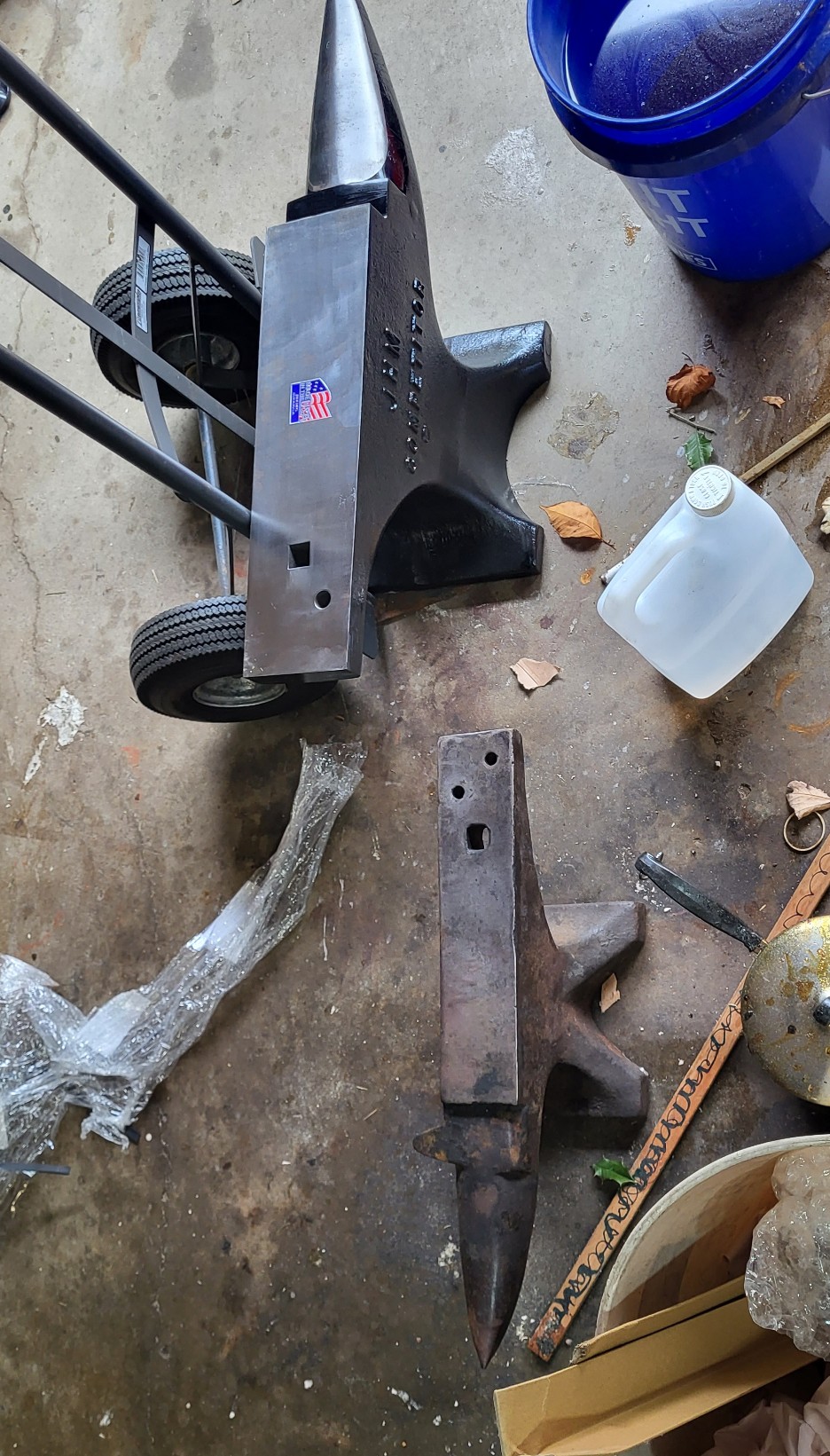
I find myself now in the place of someone who just wants something good, not wanting to be barraged with the “no anvil under 300 pounds or $4,000 is worth having”, which you can get. And I see through the lens of someone who has been woodworking for one year and who runs into several people giving advice, all the way up to “nobody can do woodworking without Kikohiromahru chisels”. Or Tasai – fill in whatever you want. I’ve seen both of those being advised to someone who hasn’t made much of anything yet.
The challenge for us is a little different – be less particular about making demands of only having the best, and try a little harder to prove we need something better because the tools are limiting. This anvil won’t be that – i’m a piker with a heavy hand hammering hot metal, not ball peining anvil surfaces.
phew.
On to the 115crv3
I encountered various things, like stable graphite in the snapped steel samples, and what never gets to be more than very superficial hardness. But the chisel that’s shown in the couple of prior posts and that I probably will swap for another to wrap up that series of posts first, doesn’t get to the hardness I should see after quench even with brine. And then second, what hardness it does have is lost far more than expected with a very cool tempering temperature.
I forged those, so maybe it was me.
A test of the 115crv3 rod that’s as simple as cutting a sliver off, doing nothing other than normalizing, cycling and heat treating shows the defects are in the rod, and hardness is less even with the sliver. With W1 and O1, the forged goods also seem to get slightly above the hardness target I’d get from flat stock. we’ll see if that holds up.
I’ve attempted to cancel the rest of my second order of 115crv3 from the seller (Maedler) but haven’t heard back. The last thing I want to do is sit waiting for a backorder when it’s likely the stock won’t be any good. Plans to try to hammer it thin and make knives or something, it’s really just unsuitable for anything all the way down to trying to make a thin plane iron out of a forged sample at .08″. never experienced anything like it.
What I do have is a second iron forged at the same time out of 0.75″ O1 rod. First order of business with that one is to see if it has any defects that rolled flat stock doesn’t have due to my potentially damaging influence forging (escaping carbon, bad microstructure, etc), and then after that, to identify any differences in looks under the microscope or feel in use and see if there is anything positive about forging the iron.
So far, I just don’t know, but the O1 version is a point harder than I expected and so far not brittle. I realize a point sounds like nothing, but when you’re working with stock that you know the spec of and see no variance, when you get an extra point of hardness, it’s first a potential worry and then also a curiosity. Is it possible that the forging doesn’t lose that much carbon into the atmosphere but may get more of it in solution? I don’t know. 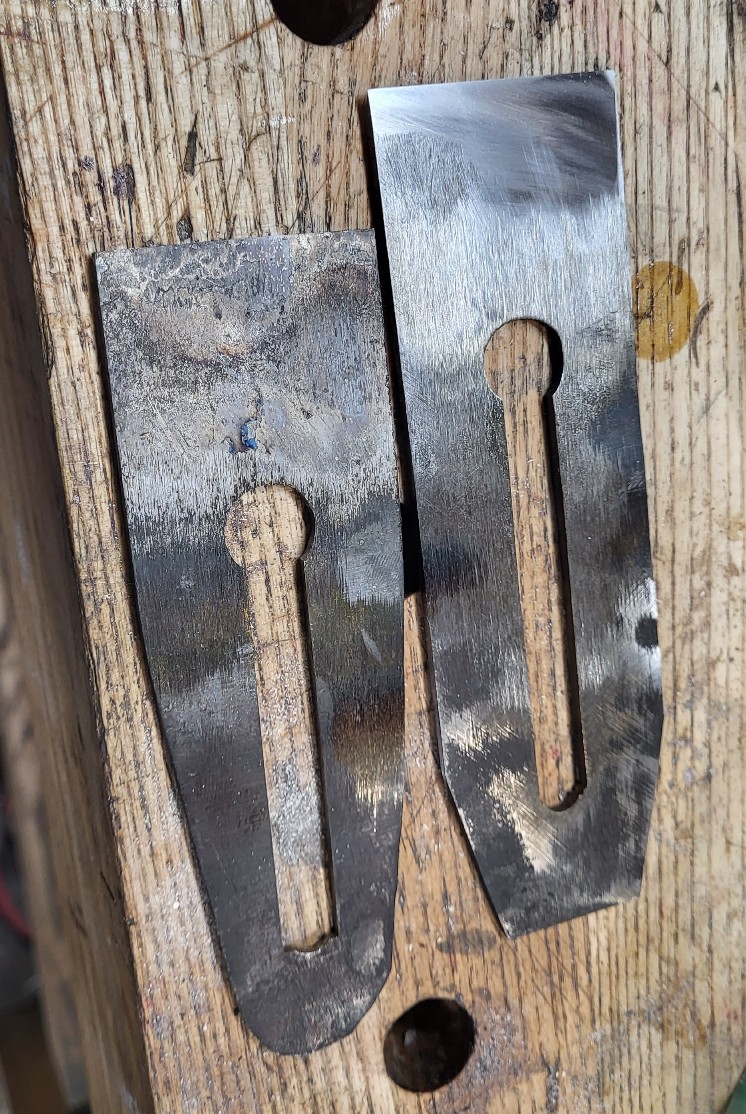
Both the 115crv3 test iron on the left -that can only get superficial surface hardness that’s lost into the mid 50s with a 350F temper (should be 64 at that point at the very least), an the O1 iron on the right, which after a double 385-390 temper is still 63.
if it looks like the back is out of flat, keep in mind, I flattened this iron with a contact wheel and eyesight, not a flat surface. if it’s any good, the little bit falling off on the right will be worked out with subsequent sharpenings. No sense going nuts and finding out that I don’t care much to use the iron. Starting out with 3/4 tool steel rod and hammering these out by hand isn’t that smart, but it takes a lot of heats and really gives me an idea of whether or not decarbing will be a problem because of that. It’s a good learning exercise, though. The iron on the left is oddly shaped because of hammering technique. The one on the right is straight because the first one wasn’t.
Edit/Update – Anvil Use – Poo on the Idealists
After using the anvil a little bit this afternoon, I’m ashamed that I allowed the discussion of what’s ideal lead me astray. I have no idea why anyone would claim they couldn’t work on it vs. “it’s not my preference”. Love it. It’s a bit of a ringer and that will need to be addressed – it will take a mark from a misstrike, but the rebound is almost as good as the small one in the picture above and the size increase negates that small different several times over. It should outlive me, and if I can ever use it so heavily that it becomes unusable, I will boast loudly about how much work I did.
Also, I think I might be wrong about it being the anvil on forged in fire. Emerson Horseshoe and Traditions are two I remember, but at the same time, I am no expert on forged in fire and only learned that it existed after a coworker said it when I mentioned making chisels (“You mean forging? like forged in fire?”).
 Of Making by Hand with Wood and Steel