The Curse of Agreeability

My gripes about what we get from three boutique sources for big money sort of reminds me of something. Do I think that nobody at any of those three tool retailers can design something better, or if making something substandard, make such a thing more efficiently?

I don’t think that’s the case.

Do I think they’re bad conniving people? Of course not. If you want to make money for doing little and dragging in big margins, you need to do something like misleading people, especially by doing nothing other than bringing things in from overseas and branding your junk with your name. The biggest layer of fluff that comes out of our wallet doesn’t happen at manufacture – it happens by manipulation or relationship leverage after that.

But what about agreeability – I have no burden for it here. I learned a long time ago online that if you want to be nice and make everyone feel good, it’s really hard to get anything across. I get things across like the complaining about the three mortise chisels partially becomes they come to mind, and also because I think it’s fair. Fairness is a big thing to me, but nobody will have a universal view of it.

For example, I was looking for something via google search yesterday and google took me to lumberjocks. Someone reviewed an IBC (which may give you IBS given the price) bench chisel against a veritas chisel and the implication is that the two are the top of the market. Neither of these chisels is a match for the admittedly rare middle production Ward and Payne bevel edge firmer. Not just in edge holding alone, but for all kinds of things. you may be able to get those W&P chisels for $100-$125 per if you could find them. In fact, I’d be surprised if they were that expensive.

However, the test shown and the statement about one being better than the other was then contradicted by someone in the following posts saying they had the opposite experience. I looked at both and though “wouldn’t want either”, but if someone else does, no real problem from my front door.

One of the first responses suggested that the test looked like an advertisement. This is actually not that far from reality as when IBC and Veritas had some rift in the past, the IBC rep or president showed up on the blue forum and went full on pitch man all the way to saying that they were jointly responsible for awards LV received. it was offputting.

Nonetheless, what happened next was hilarious – Stumpy Nubs showed up and berated the poster for questioning whether or not the test was in fact veiled advertising. Of all people who could’ve showed up, for Stumpy Nubs to berate someone else about ethics is something I found worth laughing audibly in a room by myself. Whatever he said beyond that was edited out by moderators, and he’s lucky I wasn’t a poster on lumberjocks at that point. Because my version of fairness involves the original poster disclaiming involvement and answering a question others may have wanted to know. I’ve never observed Stumpy Nubs to offer anything useful – certainly not anything I could run with – but he spends great amounts of time pretending that reviews or commentary are something other than link farming sponsorship.

There was little other response – people are agreeable inherently when they’re in a group.

Back to the Mortise Chisels

It’s not like I go off half cocked on a post like the prior one about the mortise chisels. I thought about it yesterday. I thought about it again today – is it fair when there are groups of folks trying to do the right thing in most cases. At least as much as they can.

I think it is. It’s objective – I have no personal issue with any of the three makers and there’s nothing else provided other than my genuine surprise yesterday – surprise that someone doesn’t make an 80crv2 chisel in Europe drop forged and ground for about $50. I don’t get it.

But as easy as it is for me to point out the things that would improve those chisels, I’m not a wizard. What I am is unhindered. I can buy about 50 mortise chisels (probably accurate over the years) and try various chisels and think while cutting mortises “what would make this better is “. Nobody is stopping me and I’m not at work with someone I have to work with tomorrow and month trying to accommodate anyone. I’m also not making chisels for pay tomorrow, at least not in the traditional sense of that. This isn’t some grand plan to create a trail showing myself as some kind of expert with a big product line rolling out by a “surprise, I never planned this” fake message going along with the rollout. I can simply see a problem, try and solve it, and take no other suggestions unless I can see their value.

I could not work in a tool design group as an employee and make my best effort – there are too many things in the way that aren’t the final tool. In my day job, I don’t smash other opinions or point out how they’re dumb, and others don’t do it to me. I’m part of a team there, and there’s a dynamic. We can’t act like sole proprietor single employee entrepreneurs with the nimbleness and disregard of failure. Or in my case, just being a garage enthusiast who isn’t going to stop at assembling a tool kit and celebrate from there.

What if the boutique makers could do that? I think you’d end up with self promoters pushing their way to the top, the same way we see some small brands being relabeled stuff with exclusivity agreements. Remember someone named Ken selling a bunch of sharpening materials? I think whatever agreement was there between retailer and “specialist” may have gone away, but during the time, it just resulted in guruism and expense products linked to the guru.

Ten years from now if I can retire, how will it play out with me? I guess I’ll work by myself. The same burr that makes me want to improve things in front of me also would prevent working with anyone else where accommodating would be needed.

Another Mortise Chisel and Complaining

First, the mortise chisel. The big one that I posted made from O1 works better than I could’ve guessed, but I wouldn’t want to make smaller mortise chisels out of O1 and sell them to general population in this jail we call middle age life.

The reason for that is that I think they will break easily by bending. So does D2, and so would V11. A2 is some more tough than O1 as far as bending tests go, so it’s probably not a bad choice for a solid steel chisel. Cryo treating it actually improves the edge stability but reduces the amount of force an A2 chisel will tolerate.

I won’t drive Volkswagen products again in my life, and I won’t buy A2, though. Just two personal rules.

So, it seems reasonable to see if 52100 will harden in a 3/8″ square cross section because at least that and below could be made of a steel that’s known for toughness. Well, it does. 69 out of the quench and 64 after a long double temper at 400F. I think even at that fairly strong tempering schedule, it could probably use a little more, but we’ll see in use. Steel is interesting in that what makes 52100 really tough (able to withstand a lot of lateral force before breaking) is at odds with hardness. Difficulty with it for amateur knife makers is getting the steel into something that can be quenched and will result in high hardness. Larrin Thomas has a nice article on it.

I don’t care for the way it behaves when it’s tough, because the characteristics aren’t what we like in edges, which is for them not to move at all.

But you can “cook it a little harder” hand and eye and get past that. I don’t have a furnace, but it looks like a bit of a nuisance time wise to get flat stock and do what needs to be done.

Larrin’s best result with a fairly technical bunch of stuff is 67.4 hardness with an oil quench and a relatively low furnace cook. That’s actually pretty impressive. With more temp and a faster quench, it’s probably similar to my result. His charts are two points shy of my finish hardness, and elsewhere, you can see that the toughness falls off after a certain point. The actual deal with that is it starts to feel like something else, except at 64, it’s sluggish on sharpening stones, but we can live with that. It’s about as abrasion resistant as O1, but slightly more slick on stones.

So, short story long, this chisel may be ideal for a bench chisel but a little too much of the characteristic toughness is traded for hardness in my heat treatment. Pictures of the chisel, the bolster, a little more square – left it like that just to see how it looks, and you can see that the cross section is slightly relieved (trapezoidal). This is essential for mortises that aren’t shallow.

For an idea on size, here is this chisel with the bigger O1 chisel and an older “pigsticker”.

These are not small. The pigsticker is a little longer in comparison, but being at the back of the photo makes the phone sort suggest something closer is bigger, for the same reason people hold out fish in front of them to get them closer to the camera.

the handle is a touch longer than I’d put on a bench chisel, but it’s nice to have some room to work. Short handles on mortise chisels make no sense to me at all.

If these need to be 62 hardness after temper to be tougher, I have another 50 degrees of tempering room and that would just about do it.

Here’s the Gripe

There was an interesting thread on reddit last week or early this week. Some guy snapped a ray iles D2 mortise chisel in two places. I did what I usually do, which was start pondering answers in type and drowining the people there. I don’t often post on reddit and don’t read it regularly – google brought it to me – but I usually drown everyone in pondering regardless of the venue. I thought those chisels were CPM D2 steel (about as tough as A2), but I think they are just D2 (about 1/3rd as tough as A2). Like V11 would be in a normal sash mortise profile or one like mine above, they’re not resistant to lateral forces breaking the. This is yet again a point where I’ve mentioned that V11 (XHP) makes little sense in chisels, and it’s attribute for Veritas buyers is that LV pushes the hardness up reasonably high. if they made a 62 hardness A2 chisel for mortising, it would be a much better idea.

So, I said something to Steve (or typed it) that I’d not consider making mortise chisels for sale in the future because they’re a pain to make. Only the large one was. This second one was already no more work than a bench chisel. And because they could be made reasonably elsewhere and you’re giving people something that they think they can pull on like a drawbridge lever, because instruction about cutting mortises is pretty poor and so is ad copy.

And then I went and looked at what’s available.

IBC (Cosman pushes them, but maybe others do) makes an ugly straight sided chisel for $145. This is appalling not because it’s $145, but because of what it is for $145. A2 is not expensive, and it’s just a flat sided slab of A2 with a short handle and a screw thingy through the handle. The handle is cherry, I guess because of a metal threaded gadget that goes through it, but it’s short and fat. I think what we see with this and others is the loss of skill and insight. It’s probably harder to create side relief on these chisels. If you’re working freehand, you just create it by eye and then work to width. To get perfectly square would be a pain, but you could get close. But the chisel, as well as the cheap looking flat stock bench chisels for moon price, I don’t get it. They are garden variety A2 in a spec that A2 lands if you heat treat it – there’s no substance there.

I had LN’s chisels. they have no side relief and I couldn’t tolerate it, but they were pretty and well made. Again, though, socket mortise chisels with short handles, I don’t really get it. At the time, they were $60. They’re $115 or something now, which is hard to swallow because they are not ideal for even small cabinet mortises with square sides. Is it the case of something that could be relatively good isn’t because the trapezoidal cross section is harder to machine? I don’t know. The whole bit of the sides being flat to aid in alignment sounds good, but it doesn’t work in practice. Instead, they work like a drill bit that’s wandering and there’s no way to stop it, and they bind tight and someone reading this will at some point break out the side of cabinet parts fighting these chisels out of a binding mortise, especially if the wood isn’t perfect. Not that this is hypothetical – I’ve done it. I like LN. the price doubling is a surprise, but they may be replacing production tooling like LN is. There’s the stick for CNC – it’s expensive and it doesn’t last and wear/replace like more crude but harder to engineer production solutions. Again, some art has been lost. These could be forged and ground probably for less cost.

That leads us to LV’s chisels. They’re infrequently available, the cross section is horribly tall for a cabinet size chisel, they’re made of a steel that has poor toughness (but good abrasion resistance and hardness – just an application mismatch here), and the steel is expensive. It is legitimately expensive, they’re not running a shell game charging more for it. Height of a mortise chisel should correspond to mortise depth. Pigsticker height is a deep mortise production thing, they were not a cabinet chisel. There is at least some side relief on the LV chisels based on the ad copy, but the cross section is a nuisance if you’re making face frames or cabinet doors. They could be 2/3rds as tall made out of A2 and be a better chisel.

I’ve described what I like here in something for, for example, 1 1/2″ long mortises 5/16ths wide and maybe 1 1/4″ or 1 1/2″ deep. If you make furniture or cabinets, you’re going to be making a lot of those, and some smaller and some about like that but longer in length of the mortise. Flat sided firmer type chisels are fairly common and probably met a lot of this need. Sash mortise chisels are often long and have square sides, and most of us aren’t making sash, but for someone with deep pockets, something like what I’ve made above is a pleasure to use. You ride the bevel cutting mortises and at the bottom of the cut, lift the chisel just lightly and rotate it a little bit (“levering it”) to pull break the bottom and sides of the little bit unbroken at the bottom. The lift is needed so that you don’t have the tip completely buried in virgin wood – if you do, you’ll probably find yourself breaking tips off.

This rotation is a combination of elegant and a little bit of force. You don’t want straight sided chisels interfering with the force you’re applying so that you can’t feel what you’re doing. It makes no sense, you can’t maneuver them. And you need some depth to do this rotation relative to the length of the bevel. The taller the chisel cross section, the longer the primary bevel becomes and the rotation point is out of the cut on shallow mortises. It should be obvious to someone designing tools, but maybe it only becomes so when you do get the chance to cut a deep mortise and see why pigstickers are so good at doing that.

It took me about 2 hours to make the mortise chisel above. I could profitably make that as a guy in a garage and it’s better than any of the offerings above. It is alarming that I can say that without guilt or reservation – that I am just working in a garage freehand and the commercial offerings don’t make sense compared to what I’m making with about $15-$20 in materials and consumables.

The one unknown variable is warrantying things. I’d never consider taking returns and I wouldn’t replace chisels broken from abuse, which would garner loud complaints.

And I’m also not in a position where I could just start making chisels in quantity, so this part, at least, is hypothetical.

What would I do if I were buying at this point? I’d get imported mortise chisels that are square ash type and grind them into a trapezoidal shape.

Maybe I missed a chisel being out there with what I showed above. I have some older chisels with those attributes, so it isn’t like I’m inventing anything.

The state of things is awful for the white collar buyer who may actually enjoy cutting mortises by hand, though. It’s wonderful to do after you get through the steep part of the learning curve, but can be made seemingly much harder than it is by tools that are just not designed well for the task.

The Finished Mortise Chisel

Finishing the chisel after the prior pictures was uneventful. As dumb as it sounds, even when you work freehand, you have to come up with routines on how you’ll do something. Which contact wheel, where on the flat belt sander, how to avoid overheating anything.

Yeah, not great pictures with the mess in the background. it’s bigger than it looks, about 13 1/2 or 14″ total. The handle is pretty but the feel of it is forgettable. It’s large and more figured than the picture show – london plane tree again, but indistinguishable to the average person vs. hard maple.

When I tested this chisel after tempering, it’s 61 hardness at the tip and 63 an inch back. I harden with forges and temper usually with a toaster oven. Toaster ovens are wildly accurate on average, but the temperature swings around, so I put chisels and plane irons in an aluminum sandwich. I think this chisel may help me figure something out, though. The plates are stable, but I think the ends might be slightly warmer than the middle, and I’ll drill a second hole in one of the plates to get a measure of the stack temperature on the end vs. the middle. if it’s different, then I’ll need to engineer something slightly different.

The functional difference won’t be anything on a mortise chisel – better this than a paring chisel. Bench chisels don’t experience this because they are short enough that the business end is near the thermocouple. if you have a choice with most steels, full hardness halfway up and tempered a little further beyond that would be lovely.

A theme here probably starts to show. All of my chisels look the same. This one has an extra fat and longer handle, it’s more like a shovel handle in size, but you can’t tell that so easily online because proportion is observable. I have somehow ended up with larger than average arms and forearms and teeny little hands, so my dainty fingers are no help.

I’ll cut a mortise at some point and post the picture at the end of this. It’s nice to have made something different here, but I can already see areas for visual improvement, and that’s kind of annoying. It’s the kind of annoying, though, that makes you do more, not less. So that’s not that bad. I suffered the other kind long enough when first starting out – the one where you don’t know what you want to build, how you want to build it and when you’re done, it looks just OK and you haven’t the slightest clue how you’ll make the next one look better.

Edit: Mortise picture added. I did this first with dry SYP. Which is marshmallow and glass. SYP works like it’s greased when it’s wet. When it’s got some age, the rings are crap, and so is the stuff between them. I’m at a loss for scraps because I’ve got an over-full shop and I decided a while ago if I have scraps that could maybe potentially possibly sort of kind of be useful at some point in the future, I would burn them. I’m not poor enough to hassle myself. And so, here we are, I’ve got nothing but good FAS wood and a gaggle of exotics that I don’t want to cut test mortises in.

And after 15 minutes of looking, I finally found a piece of cherry that I received in a lumber lot , and it’s shockingly worthless and this is the rough size of it!!

I’m sitting here thinking about all of the ways O1 might fail and completely failing to remember that I’m not a hard core chisel prying guy. I don’t think the pigstickers were actually intended to be pulled on like someone pumping a jack lifting three tons, either. the tall cross section is to rotate in the bottom of the cut. The more you get away from that and the more you try to be stronger and faster, the slower you’ll mortise.

And so, I’ll never break this chisel. The first edge *should* be sacrificial, but even it holds up fine before the marks are even out of the back, and with nothing more than setup using an india stone.

Too, the sides of this chisel are sharp and crisp on the bottom. scotchbrite belted the tops to take off their tooth, but leaving the edges alone on the bottom is important. This chisel has a pretty good bit of trapezoidal relief, and the bottoms are sharp and crisp. it works better than I expected, creating a clean mortise without any real effort.

Iv’e got thoughts on cutting mortises, too. I’ll post about them sometime. I despise anything other than cutting mortises by hand with no drilling, no machines, no routers, etc, and I cut them in a way that is probably common but doesn’t resemble much taught now. Some of the methods taught show the instructor has no idea why there is a tall cross section on these chisels in the first place, and the idea that it’s there to make it strong so you can put both feet on the end of the bench and lean back is no way true. Just like the idea that the top curvature on tall mortise chisels (rounding at the top of the bevel) is to protect the ends of the mortise.

I’ll save actually discussing cutting mortises easily point and shoot for another day. If you have a thicker cross section chisel like this and you try it, you’ll think 20 lightbulbs just lit when you see how the chisel works in your own hands.

Kind of a Pain – Mortise Chisels

I haven’t made mortise chisels yet for a simple reason – I don’t need any and I like the ones that I already have.

Except for one.

But somehow this has translated into having three in process, but this post is just about one.

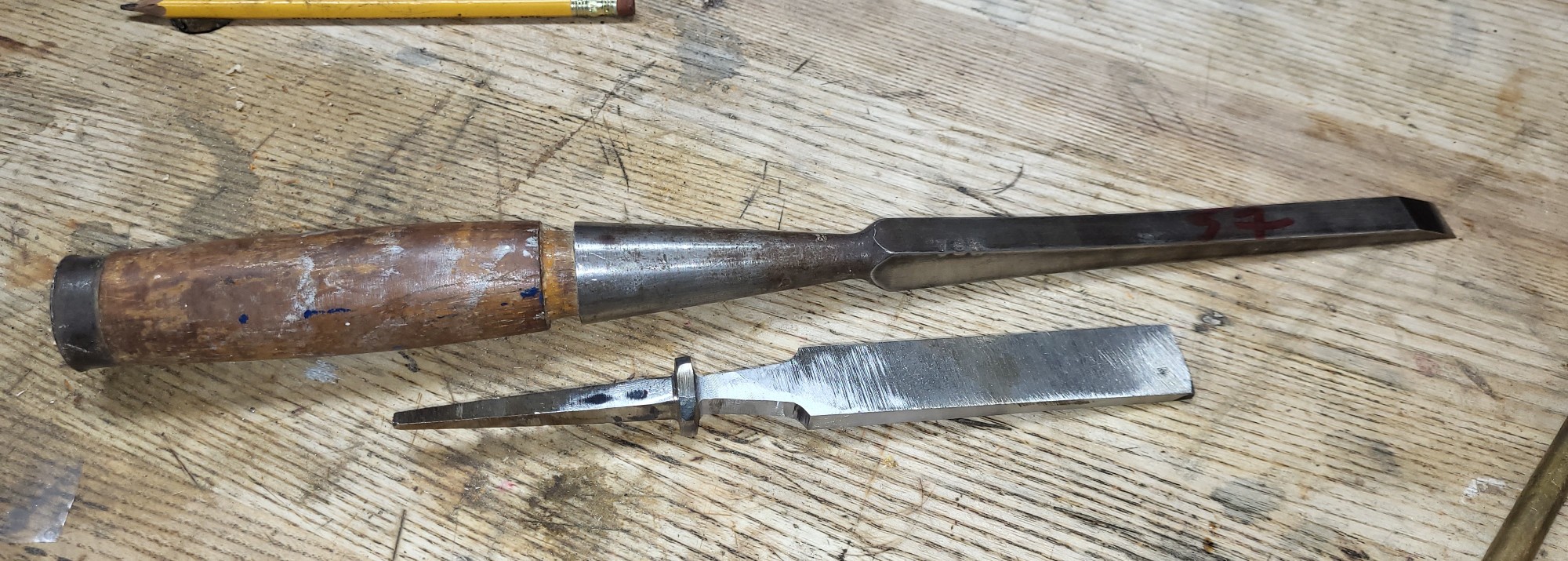
The one that I have that I sort of like but am lukewarm about is this one, a 1/2″ chisel that I call a “bed mortiser”, because I’ve only used it for bed mortises.

I showed this chisel wiht a typical 5″ long bench chisel bit just so that the scale can be seen. The bottom chisel doesn’t have any purpose other than that. The chisel on top is thicker than it looks because of its size. About a quarter inch thick at the tapered business end. It’s sort of a weird thing, because longer mortise chisels for furniture like oval bolstered type have a tall cross section to aid splitting out bigger thicknesses of material deep in a mortise, especially as you work toward the lower corners.

Someone gave me this one and another one just like it, but it’s soft and annoying in anything where there is a challenge. The solution is to ratchet up the edge support until it’s half dull.

So I’m going to make a chisel to replace it. However, a thick cross section in a long chisel like this probably is territory either for a laminated tool (not at this point) or O1 steel or something else more hardenable. More alloyed than O1 is undude for me, so O1 it is.

The chisel also doesn’t need to be as large , especially as long, as the one above, and I don’t care that much for socketed chisels, so it’ll get the typical bolster treatment.

There are several reasons I don’t use O1 more often for chisels, but among them are low toughness (breaks easily when levered compared to other steels) and the fact that when I’m grinding the chisel, even cooling it with water will cause partial hardening. Grinding the bolster area itself before filing also results in a thin cross section that air hardens enough on the surface to destroy files. I could probably figure this out, but mortise chisels are the only place I can think of that O1 has an advantage.

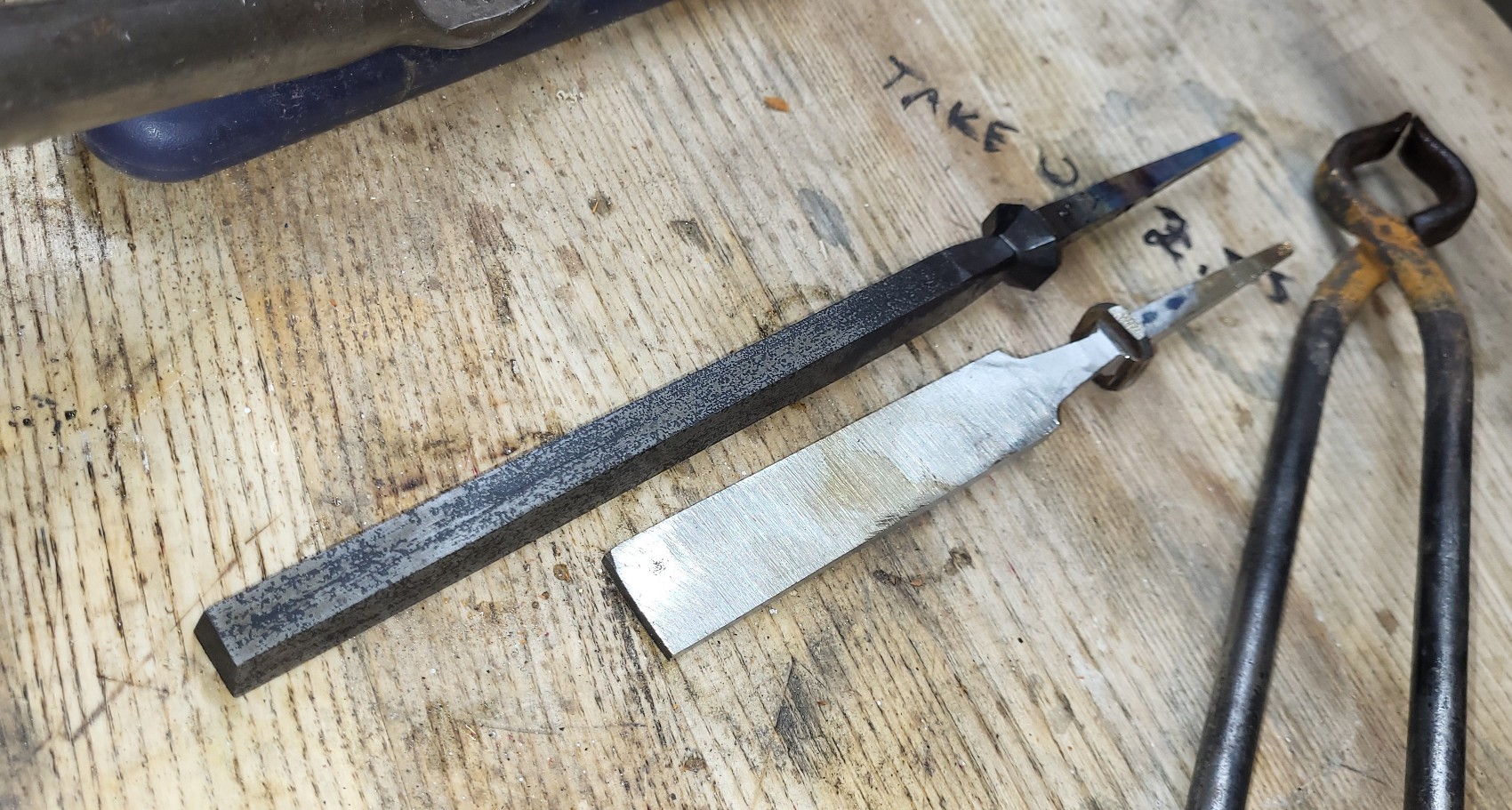
So, the bolster on this one is wonky – it’ll just remain dark like it is here – because it’s ground on a high speed wheel freehand with a fine belt. that certainly creates enough heat to soften it, but a trip over to the vise to file and it’s already destroying files again, so it’ll stay as it is.

O1 warps a little bit, but it’s within finish grinding for me, and rarely much trouble. This chisel is about 2 or 3 hundredths wider at the tip and tapers uniformly back toward the tang. More would be fine and maybe better, but it’s not going to be my life’s work, and the nuisance of grinding volume with these is enough for me to know I won’t be making any big mortise chisels in number.

After heat treating, and a somewhat shocking initial hardness before temper – 67 – the chisel looks like this:

I love the way the top line of the socket chisel looks with the elegant curve, for furniture mortises, it would actually be more useful if it’s taller. Anything shallow can just be done by a smaller chisel.

There’s a little rule mentioned in here for you to think about. For deeper mortises, a taller chisel is useful. For shallower small mortises, it generally isn’t. So, Paul Sellers type demos with the “ooh, look, a blue chip is a better mortise chisel than this pigsticker” completely ignores what the purpose of the larger chisel actually was. It was a production tool, not something for small cabinet mortises.

I already have ungodly tall vintage oval bolstered “pigstickers” so I guess I’ll add a little top curvature to this thing to make it look a little nicer, but it won’t need much loss of height, and if it’s improved by that, it can always be done later.

All of the finish grinding and curvature is introduced on a ceramic belt once a chisel is hard. That includes bevels on bench chisels – they’re incompatible with a fast quench, and with the right high speed really coarse equipment, it’s not that hard to do all of this grinding to a hard chisel without eliminating hardness.

Cross section of the chisel looks like this – taper on the sides is essential both for some relief, as well as cutting ability of the chisel sides to shear material:

This is forged from round stock, of course, all one piece, and ground freehand on a flat belt sander and an idler wheel.

This and two other smaller cabinet sizes in W1 and 52100 will let me see if it’s worth making more. The W1 and 52100 chisels won’t have the same unexpected hardening, and in more typical cabinet sizes, should through harden when introduced to a brine quench.

I think I’ve had it with youtube

Maybe this is my mid-life crisis. Quitting forums, and now quitting watching youtube and probably pulling my videos from there.

There’s no big blow up about anything. I use an adblocker about half of the time and the other half I don’t. If I’m running YT in the background while working or doing something in the shop, I stream it through my PC with an adblocker.

Of course, YT doesn’t like this. My videos also are, let’s be fair, generally forgettable, and I don’t have ads enabled, which gives them even lower priority. YT lays ads over them, anyway, and at this point, I have no idea how many it does lay over them -but it’s at least one per video, and probably more. Since I opted out of adsense, they just keep whatever they advertise, which based on actual view counts is about $2 a day.

I get why they are suddenly stopping content I have in the background if I’m using an adblocker – they have a platform that is crap compared to what it used to be, and they have a parent company that doesn’t pay dividends and shareholders who will tolerate that only as long as growth looks like it needs to be log transformed to make a reasonable chart to view. Except that’s no longer the case.

The original YT of unique content is gone in favor of Anne of All Trades (Animal Trades as the YT closed captioning program will spell it out) and Numbly Stumps and other people who are really at the low end on my list of people. Fake nice conversations thinking about what they can get out of other people and that’s about it. I’m sure they’d disagree, but I don’t care.

Yesterday, for the first time, my layer of users (sometimes adblock and sometimes not) got high enough priority for YT to stop videos and badger me about having to dump the ad blocker or buy their pay service.

No thanks! I found it a little bit annoying at first. But as I thought about it more, I realize I haven’t examined my thoughts in general about the platform and not wasting time there. I couldn’t tell you the last time I saw something useful for woodworking or toolmaking, and usually, I’m streaming something at low resolution minimized like a podcast – that you can just listen to somewhere else.

Most of the other upstart video sites have also gone to crap for various reasons. I remember when vimeo was first set up – it was low traffic, but it looks like it’s probably been bought by a venture capital group or a new private owner and now they’ve sort of stopped pretending that they aren’t just hoping to get the content creators to pay. The content that comes up on it shows what looks to me like a change in favor of curated advertising or marketing spots of a few minutes long.

I went to Rumble, and it’s full of a lot of stuff I wouldn’t watch, but in between some of that is more typical main stream stuff old style like YT used to be – no censoring words or whatever else, and one ad at the beginning of a 2 hour podcast, and the ad isn’t 3 minutes of someone claiming to have the cure for cancer or trying to sell some inane idiotic thing like I get on YT ads if I’m not able to go to my non-adblock devices and turn skip ads.

It’s kind of like a refreshing throw back – to hear words that have been woked right out of other podcasts. And I don’t mean political words, but things my mother would’ve called “adult language”.

So, goodbye YT. You and google have just gotten too greedy for me. I’d literally rather just turn on over the air TV in the background at this point.

A Blast from the Past

It’s not often these days there is much worthwhile on forums. Sawmillcreek is just one of the flavors, but in a decidedly fake egalitarian environment. That fakeness was to attract advertisers and the kind of traffic advertisers want. But, once in a while, there was some gold there.

I have a serious distaste for the forum for several reasons. One, it’s framed to look like it’s not for profit (with .org, and various “pens for soldiers” things, that the ownership gets surprisingly territorial about given that’s actually supposed to be a not for profit). You’ll find folks often willing to speak up if they mentioned any other pen charities on SMC or mentioned they couldn’t find where to send pens so they sent them to another one. They just won’t speak up on SMC. When you contribute, and especially in the past when people ran around everywhere with “please contribute” in their signature footers, you find your contribution goes to a for-profit entity, the forum owner’s sign company.

What set me off at the time was rudeness to George Wilson. George is the equivalent of running into a +7 (like below par average) golfer on a public golf course. Eventually, the shankers and wankers don’t want someone like that around, and they want to talk about some tip they learned and do it without someone who knows what they’re talking about squinting. If George said something in a definitive way, it drew heat. If he said something about one of the gurus, like Chris Schwarz, people would literally register or resurrect their old IDs to go there and try to get him in trouble. I suppose the unexposed person may not know the difference between carrying water for Schwarz and seeing a legitimate master who is selling nothing to anyone (unlike Schwarz, who is willing to sell you bloated price plans or get you to pay to see yet another iteration in his “the right way” sharpening nonsense).

Between that and the “everyones’ mileage varies” crap that was the norm there, and the fact that it appears to be a for profit site always complaining about people not giving enough to it, I was out. It sucks, at least in my opinion, and it’s pretty much dead as a doornail now.

But this is about XHP….

..and the fact that it’s V11 and so on, at least nominally by composition. It strikes me as even a little more interesting that the resident psychologist was so involved in this thread and later went on to tell everyone that it’s much the same as 10V or A11 is V11. These statements aren’t remotely close to true. The latter two are vanadium carbide steels and XHP is a high chromium carbide volume steel.

Lee Valley is an advertiser at SMC, which is why it’s odd that remains. All forums favor advertisers. SMC goes further by blocking out non-advertisers from answering questions from posters. I don’t think most posters know that, but more than one retailer or company person got a hold of me elsewhere and flatly stated that their IDs were ghosted because they wouldn’t sign on to advertise. The terms refer to it as a “non-competitive” advertising atmosphere. The slant there while I was posting in favor of Grizzly was humorous, but that was fortunately out of view in the hand tool section.

How did I get to posting about this? I still browse over there once in a while. I noticed yet another sharpening thread there browsing this morning very early morning, but it doesn’t have the same fervor it used to. It went from cold water to water bottle temperature, let alone to any smoke or fire, and quickly got to people who make one post a month threatening to leave. The same kind of people who would only make a post to complain about George. Notice there is useful information in the post I linked, but no such thing really appears at this point because people move on and there’s nothing attractive to bring a new Kees or Patrick Chase in, and both of those guys XRF-ed V11 to find that it was XHP. Someone else in the US mid-south also did the same thing.

One of the things that came up in the thread was that “the crystal structure of V11 is finer than older steels” or something along those lines, and “finer than O1 and A2”. I wonder why people believe this. Maybe it was said in ad copy or given as a platitude about powder steels. Powder metallurgy is fine. Very little of what’s made from it is as fine as the more plain ingot steels. The purpose of PM is to take something that makes a real turd of an ingot steel, like D2 or up from there, and spray out a zillion little tiny particle ingots so that the constituents don’t cool into gigantic apex killing poorly dispersed carbides. 154CM vs. CPM154 is a good example, but it goes up from there. XHP/V11 is “more” than D2 or 154CM, and 154CM is already as an ingot steel, something that will not even take an edge off of a stone without letting parts of its edge go. CPM 154, the powder version is kind of like XHP. Actually, PM D2, CPM 154 and XHP are sort of a family of increasing amounts of carbon and varying levels of chromium among them.

I found this old SMC thread because I googled “XHP micrograph grain boundary”. I didn’t find any grain boundary pictures. You can find pictures of XHP micrographs and compare them to O1 if you’d like and note how much finer O1 is. The discussion of what the micrographs tell you other than being able to see a much more coarse carbide structure in XHP is a little more nuanced, so we won’t get into it. But given XHP soaks in grain enlarging temperatures as part of its heat treatment process, I seriously doubt that the average grain size is less either. Important here if you’re not a steel person to see the carbides as kind of hard BBs and the grains as relative clods of compacted dirt, though the clods can be smaller than the BBs.

When I tested plane irons actually planing about 40,000 feet of wood in 2019, I came up with wear results about the same as the machine Kees made to abrade the steel. It sharpens more slowly than A2 or O1. This isn’t a surprise. We constantly hear about how it sharpens faster and is finer than other steels. Both of these are false.

I miss the days of useful information coming out of forums. To have a discussion like that on Reddit is gone. The woodworking psychologist may yet again forget about what XHP is and call it the same thing as some Vanadium high speed steel, but that’s just part of online life.

I know XHP and V11 are the same thing based on three people doing an XRF analysis, despite Lee Valley’s desire to try to keep the alloy secret after spending money on a picking and testing process. I’ll leave that there, because plenty of people think they invented an alloy or developed one. They can see this and correct me in writing if they are willing to do that. Woodworking companies don’t develop alloys, and XHP had enough positive press in the knife world that I think Lee Valley should’ve just said what it is and boasted about it.

So, I know it all?

No, I know a lot more now. I’ve tested a lot of stuff side by side, and I’ve found plenty of folks doing other ingot steels not that great and have been nonplussed.

In 2013, several years before this, I was totally on board with the newer stuff having to be better than the older. After all, that’s what we were told, we can analyze it, nobody can do things by hand unless they want to be grampy under the shade tree, and of course people were tortured and suffering in 1830, and they must’ve been dumb.

Except none of that’s really true. So it’s having come from that and getting my eyes opened a little bit. The first thing that opened my eyes was planing with a few irons and seeing the edges, and then planing with a butcher iron from around 1830 that was little used, and then seeing the most uniform spectacular even wear and what looked 10 times finer than anything in the new irons if chromium was involved. And finer than O1. I was stunned.

The thread on sawmillcreek has a little of every flavor. Old is always better all the way to “they were dumb and of course new is better” to the old engineering platitude “we could just always make it better”. I can’t really make tools better than Ward did, even if I cheat and use 26c3. And I’m using what someone may have made on a Tuesday afternoon at Ward, not my best weekend effort with a fresh head.