Mulling Mulling

After writing yesterday about pigmenting the varnish, any beginning art student would probably say “hey, dum dum…you have to mull the pigment into the finish or it’ll be gritty”.

Mulling pigment also binds the pigment to oils if done in something like linseed oil. I haven’t done it – too lazy, but I’ve used linseed oil and pigment to paint things outside. I just mix them – it’s sloppy – as in the result isn’t that great, but if the oil goes on like flat paint soaking into the wood, it still looks fine.

In a fit of “you have to do it to experience it rather than read it and just imagine it”, I bought fine pigments from Rublev. There is a lot about making varnish bases for paints in Ralph Huff’s book. I think you will see something from Steve Voigt about it at some point, but there are things simply stated in the book that don’t make great sense -like making a varnish and then adding a similar volume of oil.

Once you do things in practice, that makes sense. I think I already said that brushing varnish can be a pain because it’s string or its adhesion causes it to pull all different ways when you’re brushing it. You can thin it, but it doesn’t lay out like lacquer does and it takes a little work. It’s a superior finish, but if we’re being reasonable, who here needs a better finish than plasticized lacquer? I don’t – you can repair it forever. But what I can’t actually do is buy it and then spray it here. It’s too obnoxious and I already cannot tolerate brushing lacquer fumes without getting dizzy and being off the mark for the rest of a day. No thanks.

At any rate, the book refers to “Grinding pigment in”. That makes me think of a vitamix, which would probably also work, but I don’t think I’m going to try it.

I assumed the little nits in my japanning trials were probably mostly dirt, but they’re more likely at this point to be pigment that wasn’t mulled, and taking a kiridashi – ok, not a real one, one that I made – and squashing the pigment on a hard plastic surface gets the big stuff out but not all of it.

Mulling is a step further and at one point from what I’m reading – of course I’ve got zero hands on – mulling was part of the process when buying pigment as an artist – the pigment needed to be mulled to make it finer, and then to bind it into a medium.

https://www.naturalpigments.com/artist-materials/how-to-make-water-based-paint

I haven’t read far about it and I’m not going to read that much. I’m waiting for a wide flat glass muller to show up so I can get on with this and then read. Do, then read, is always more effective than read, tell everyone you know everything and try it 12 years from now.

Mulling appears to be a lot of work, and it’s not done with high volumes of finish at a time. But I’m hoping to japan a few small metal items and I’d maybe come up with something else if making a varnish paint.

I often drone on about getting in contact with people who are doing things and learning from them, not people who primarily write about things. George Wilson changed my life as a two bit maker. I’m now two and a half, but just in how he thinks and talks – I am wired for that, but I was afraid it would be a waste of time.

I am making varnish only because Steve told me three times that you can actually make varnish – which I’d done, but somehow by the third, I’d noticed he said you could make better varnish than I’d made.

Now, I need to get out locally and see if there are artists supply places in Pittsburgh that sell pigments – because it’s pretty easy to blow $100 quickly on pigments, and some in person looking may be helpful. I think at this point, the fine pigment idea for varnish isn’t going to be a great thing for slathering all over stuff outdoors, but maybe there are more reasonable grades. I think I will not ever paint rooms in my house with paint I’ve made, but it’s not completely off the table.

By the way, we are, of course, lucky that these days, you can buy pigments that are already finely ground. I think from what I gather using cadmium red, what’s more the case here is that I’m breaking apart some particles that may be fused. I’m not going look at them under the microscope yet to see what’s going on. That seems a little undude, but if you have the bikini, wear it microscope, look through it.

Baking Pigmented Varnishes

This may sound like an odd title, but you already know of a baked varnish. Ashphaltum japanning. Coincidentally, the older texts refer to something like a gilsonite asphaltum japanning as a cheap finish. Japanning was used on a lot of metallic items in layers, with the higher quality work being a base and then clear varnish on top. Things like sewing machines, and so on, and decorative items for high class, probably up from there.

But experimenting while tempering some knives last week, I put the long oil tung/linseed varnish on a knife blade that I had sitting around – one that I made early on and will probably never turn into a knife because it will rust faster than rust. The hardness of the baked long oil japanning was shocking. That on the wood can still be dented by a fingernail and it’s a couple of weeks old and may always have this level of pliability. But the baked varnish was stuck to a knife blade that was just bare metal and not that easy to get off. it didn’t shatter off like paint – you could scrape it off but you had to scrape to the metal. No prime, no cleaning the metal, and so on. the color of the varnish in what was probably a 400F cook, though, was a dark straw. I was tempering knives at 340F, but the test blade was exposed to the radiating heat from the elements while the knives were safely tucked in between two really big thick plates of aluminum to block that.

Black Japanning and What?

Asphaltum is actually a dark brown, but you get enough of it with metal behind it and it looks black. it becomes the resin in a varnish and it crosslinks to the oil. You can do that cold and cook hot enough for it to become a varnish after it’s applied, or you can do like I did and just cook it together and keep it like that so that there’s no stirring in the future and no settled anything. I prefer that.

But it triggers any reasonable or unreasonable person to say “what else melts around 350F and crosslinks with oil. As in, is there a whole palette of colors that might be available by simply finding natural resins. I think the answer is no. I’m sure there are others, but it’s too complicated.

So it may seem like there is something about asphaltum, and there could be in terms of how it chemically bonds with metal. But the long oil varnish is worlds better than any spray paint no matter how good the spray paint says it is, and it will cost little.

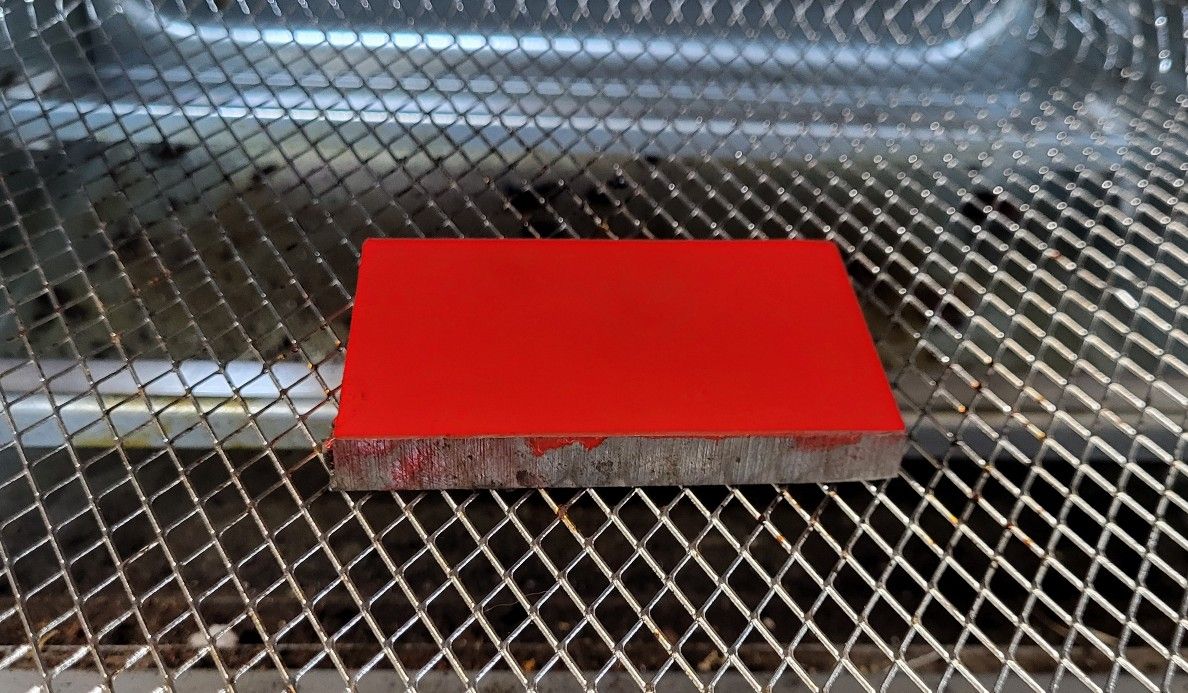
Knowing that it went to dark straw, then the question is – what will look good? I think a mid red and a mid dark, but bold and deep blue would potentially be nice on tools, and comparing a lamp black base long oil varnish to the asphaltum japanning would be interesting. I shot very bright on red pigment to try the red, and here’s what it looks like:

Cadmium red. Not exactly maroon. The long oil varnish is in the bag and you can grind or mull pigment into oils and finishes, but I’m not doing that. We have some freedom here, though – adding oil to this mix with mulled pigment in it would be no big deal due to the reality that in a cook, it would just crosslink with the varnish and still end up with varnish.

This idea of how good the varnish is baked isn’t something unsubstantiated – the old texts talk about the varnish being superior when it’s baked instead of drying by other means. You just can’t bake everything at 400F, though, even though there are some references in terms of how to prep wood to try, anyway.

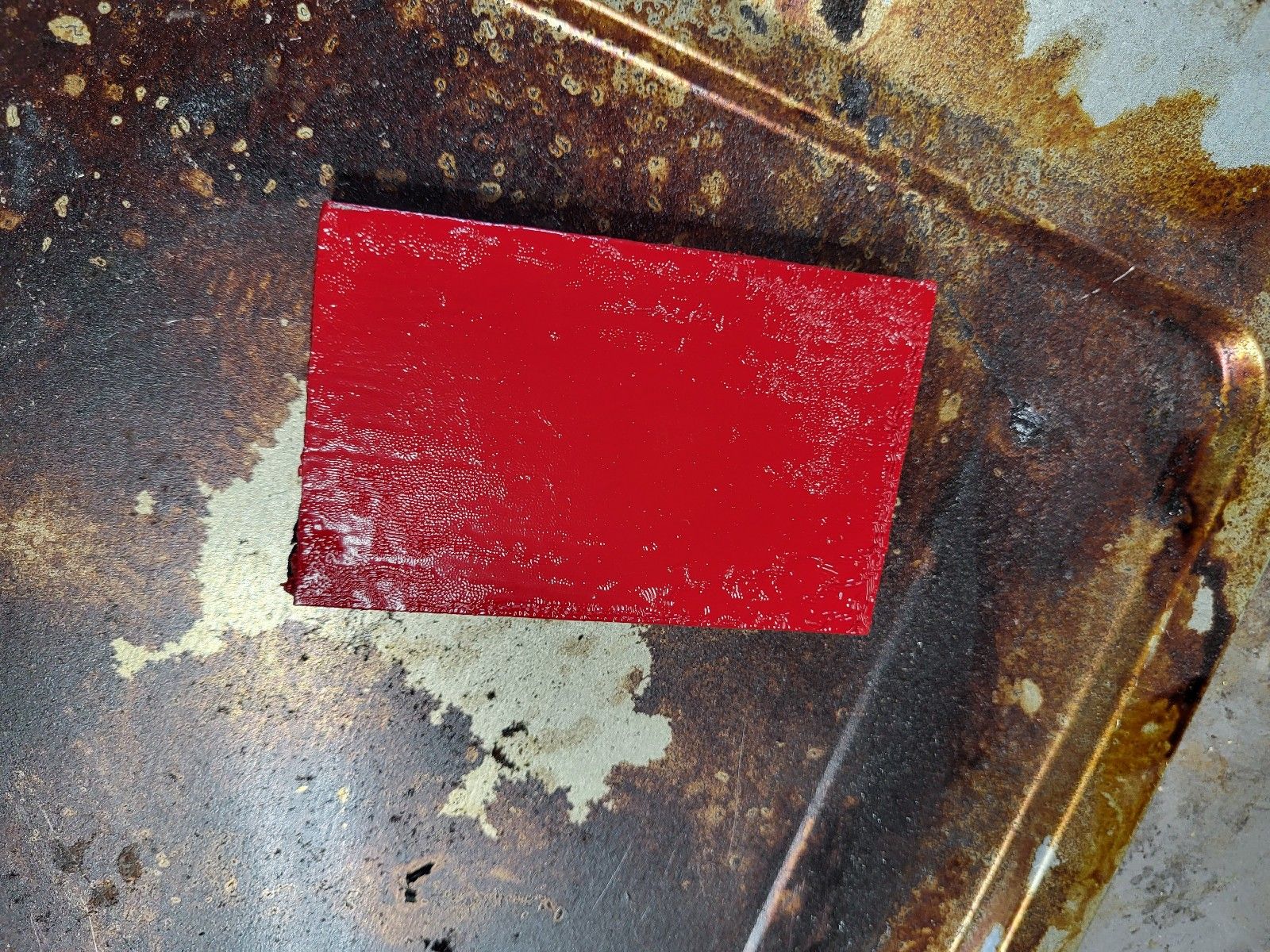
Laying this 80s-reminding color on a chunk of steel gives this:

Pretty bold. One coat left marker on the steel “80CrV2” still telegraphing through, and a second problem. The picture above is after slathering another coat on if I recall.

That problem is crows footing or whatever you’d like to call it. Which I believe is always or maybe almost always the result of the finish skinning and pulling on itself before the layer below has given up all of its solvent.

The result is this, though:

The color isn’t darkened much, either, but I cooked this at 350 and shielded it some. it needs more heat to become a bit more subtle in terms of what I was expecting.

Less heat to start, or really low heat for a while is an option, but the other that may be more intelligent is just to let the varnish gas off and cure for a day on the piece and then bake it. I’ll see how that goes.

At this point, the second prong of this – cooking at a higher temperature to darken the varnish to a less bold color is in the works.

it’s the durability of the varnish that’s desired here. It would be lovely if the top layer was glossy, but we can actually do what they did for higher quality work, which is to set the color based on the finish applied as the base, and then bake another clear varnish application on top.

Cleanliness when applying the varnish is key – any little piece of dust or anything, even metal sanding dust from cleaning off the steel results in piles of little dots. One of the things that varnish really loves to do is take a tiny fleck of dust and stick to itself (the varnish) above that dust and make it look 100 times as big. it could be that the solution to that is still adding un-cooked oil in with the varnish so that the finish lays out more like a lacquer, but we’ll cross that bridge only if we need to. if you look at the japanning on any older plane you have, it’s good, but it doesn’t look like an automotive finish with no imperfections in it.

I don’t have a real need at this point, but I’m curious. I wouldn’t mind ruining a few older planes with surprise colors, but done so well that it raises the question “why would someone who can do something that nice do something that wrong?”.

AEB-L and Making Knives

I don’t know how many knives I’ve made. It’s not hundred, but realistically, if you’re going to make knives for other people to use in a kitchen, you’ve got to tackle using stainless.

XHP (V11) is stainless, but not very. Food acids will discolor it and it can be broken fairly easily by the uninitiated, which both probably have to do with why Lee Valley is the only using of the Carpenter XHP alloy that I know of. Those things don’t matter that much in a plane iron. I still read often how great it is for chisels, but anyone doing a comparison with a better chisel in the same task side by side, grinding and sharpening on top of that, would probably decide otherwise. Its attributes suit planing more than chiseling.

There are tons of stainless steels that you can probably heat treat in a forge. I use AEB-L. AEB-L is a fairly lower carbon steel, but it’s a matrix type. Carbon is between 0.6 and 0.7, and there’s no nitrogen or molybdenum to step up the sharpness. When I make knives, I’m doing it as an amateur and handing them out – I want steel that sharpens like a chisel. I have missed the mark on hardness with AEB-L and XHP before learning just how much open forge heat it takes to get them to decent hardness quickly, and the knives are usable, and at least as good or better than something like a Wusthof knife, and ground to a better angle. But they’re better yet if they are more like a chisel hardness. Nobody has broken a knife yet, so I’m not concerned about someone breaking ice with one and breaking one – I know they’re not going to break from regular use.

AEB-L can reach higher hardness than you’d guess – if you have a furnace and nitrogen. Larrin’s shown as-quenched hardness that’s in the 64 range and if you double tempered where I do – 340F, the hardness would probably still be 63. I am working with a forge and a freezer and that figure for me is 62 and 61, respectively.

This week, someone asked if I’d make them a knife that was 6″ long and more in proportion (not a copy, but proportion) like a large japanese petty knife.

I came up with the following profiles varying things I’ve got on hand, and decided to throw in a common classic parer type profile since I’ve already sent this person, a friend, a very thin small parer that’s almost like a razor. It’s a treat to use one of those tiny little parers that’s really thin at first, but it’s not practical for working on a cutting board, and feels a little dangerous in the middle of food or coring. It cuts too far too fast, and if friction sticks it and it releases, it could be a real problem.
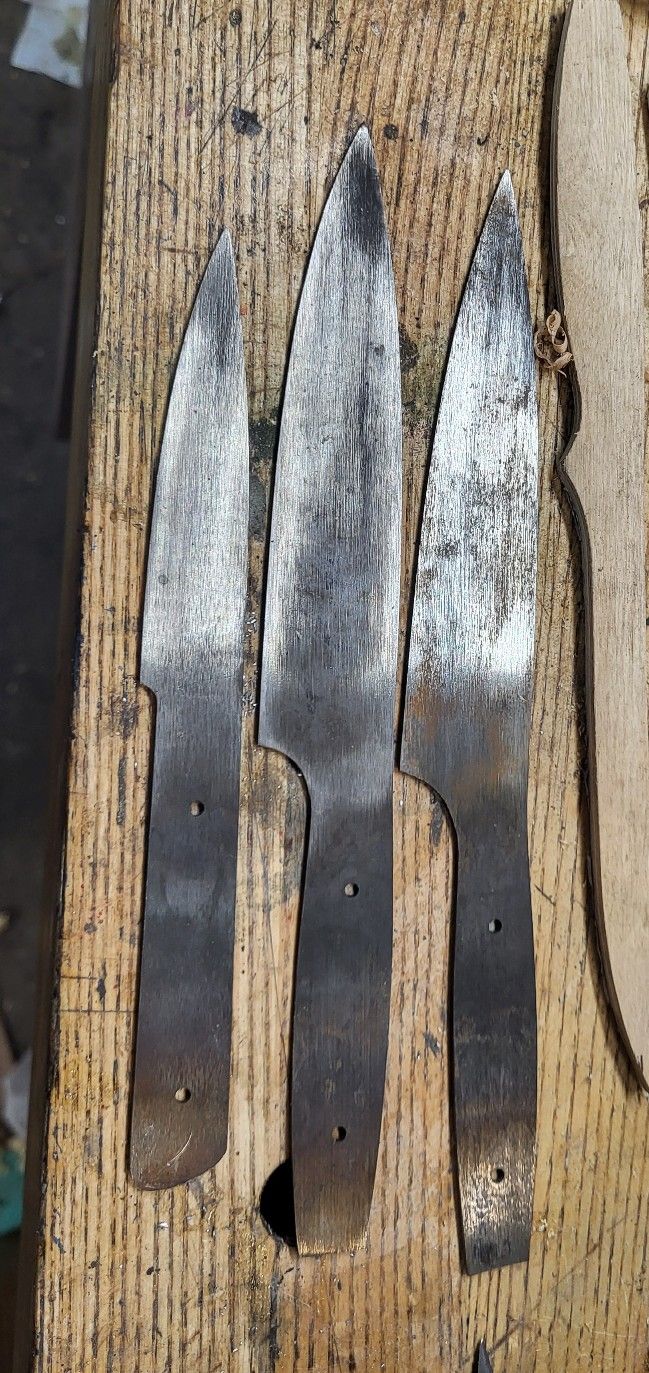
All of these knives are .062″ stock and they’ll be slightly thinner. Two of them are 61 hardness post temper, and one is 60.5. I’m pretty pleased with what experimenting has brought in terms of results as I thought stainless would finally lead to me buying a forge. Instead, I’ve gotten one induction forge and now am getting a second as the first has some quirks and I’d rather assign it to part time.

If you look at the three knives, there’s some subtle differences between the middle one and the one on the right. The middle is straight through and I think it could benefit from more hand relief and it needs to be more pointy to do what a petty knife would do. I’ll see through finishing it, but the feel led me to make the one on the right figuring it’s just not good enough.

I generally put simple slab handles on in some kind of nice wood and then pin with 1/8th bronze or brass. I do that so that replacing the scales if something should fail is easy. If someone can’t find 1/8th bronze, often a clothes hanger will fit and if not, you can buy brazing rods and sand or scrape off the flux coating or whatever is on them. I haven’t lost a handle yet either, and use 180F epoxy, but something will come off sometime.

Good choice for wood on the handles is something hard with closed pores. Gabon ebony, macassar ebony, brown ebony, katalox – all work nicely. You can pore fill rosewood. I think I’m going to try a wood on these handles called Sapodilla, but not totally sold yet. it’s hard, and it will eventually be a mid brown, but it’s purplish when fresh, and not very dark. it’s far less work to shape a handle that’s softer wood, but it seems like it would spoil the effort.

So, with the steel, there’s no long complicated process. I want no decarb with AEB-L and furnace schedules will create it without neutral gas or something covering the steel. Instead, I use a piece of exhaust pipe and torches. We need to get the steel to somewhere around 1950 at least, and in a quick heat, maybe slightly higher. A big propane forge has no control without a muffle and a muffle means hitting a temp and sitting for a while to get there. And preheating all of it. No thanks.

this is my anvil area. The top of the anvil may look rusty from disuse, but I’ve quenched a bunch of stuff with brine lately, and it looks like that in a hurry and then I sand it off.

The induction forge would be a treat to use for this if it made enough heat, but induction forges are keyed to a depth, and that depth is beyond the thickness of a knife. It will heat these blades to about 1500 to speed preheating if that’s important, but the magnetic forces try to go further into steel than there is steel there, they hit each other and cancel out. Otherwise this forge will take something like a chisel and turn it into falling apart sparking globs in a little over a minute – chisels are thicker.

I don’t have everything lined up totally here, but I get a non-flammable stand for the torches, whatever I have available, and set one in the pipe there and lift the back curtain that’s there for dust control when grinding. There is no mass in that pipe, just kaowool. there’s a second pipe to the right of the forge that I have used as a liner for the kaowool, but it’s better as a former – use it to tightly pack the kaowool and then insert it in the larger pipe and pull out the steel pipe and you’re left with the form and no need to heat that piece of steel pipe. It’s a detriment to something like this.

I visually get the AEB-L to a point that is a really bright orange and a step away from yellow, then quench the top end in an oil quench and over to the anvil it goes to get plated between the anvil and the aluminum tempering plate, which does double duty as being a thermal mass in the toaster oven tempering things like longer knives. the little hole allows a thermocouple probe which is kind of needed if tempering is going to be really accurate. And it needs to be. Good heat treating, tempering and cool grinding all have to be had or the knife will be garbage can fodder.

AEB-L warps, and getting the top part of the quench done quickly yields decent hardness, and then there’s time to get the lower end finished and constrain the steel so it stays flat. This is also usable for making plane irons and so on. The top part of the quench must be fast, and the bottom end really cold, but there’s a little time to constrain and the item being heat treated in between both of those, along the lines of 10 or 15 seconds here, and I have noticed no difference in hardness by not just rushing the quench. Stainless doesn’t need the same speed usually, but that trick works fine with 52100 and other carbon steels.

the final step here, especially with stainless, is getting the blank into the freezer. I have a little cheap freezer, but it will get down to -40F. That’s not remotely close to liquid nitrogen, and it doesn’t do as much, but it does improve results half a point or a point vs. letting a knife sitting around air cooling to a higher temp at the end. Larrin Thomas had an excellent article on this – liquid nitrogen gives you some time to screw around and still see improvement. If the temperature drop isn’t as significant, then whatever you’re hardening needs to get into the freezer or bucket of propylene glycol cooled in the freezer really fast. I swipe stainless with a file on the way to the freezer. Since as quenched hardness for me is about 62 with AEB-L , if it’s short, it’s fileable. Even if it’s only a couple of points short. Just barely, but you can feel it. All in all, from first contact with the oil to being in the freezer, it’s probably less than a minute and I speed up the cool off by holding the knife against the frost in the freezer and then dropping it in.

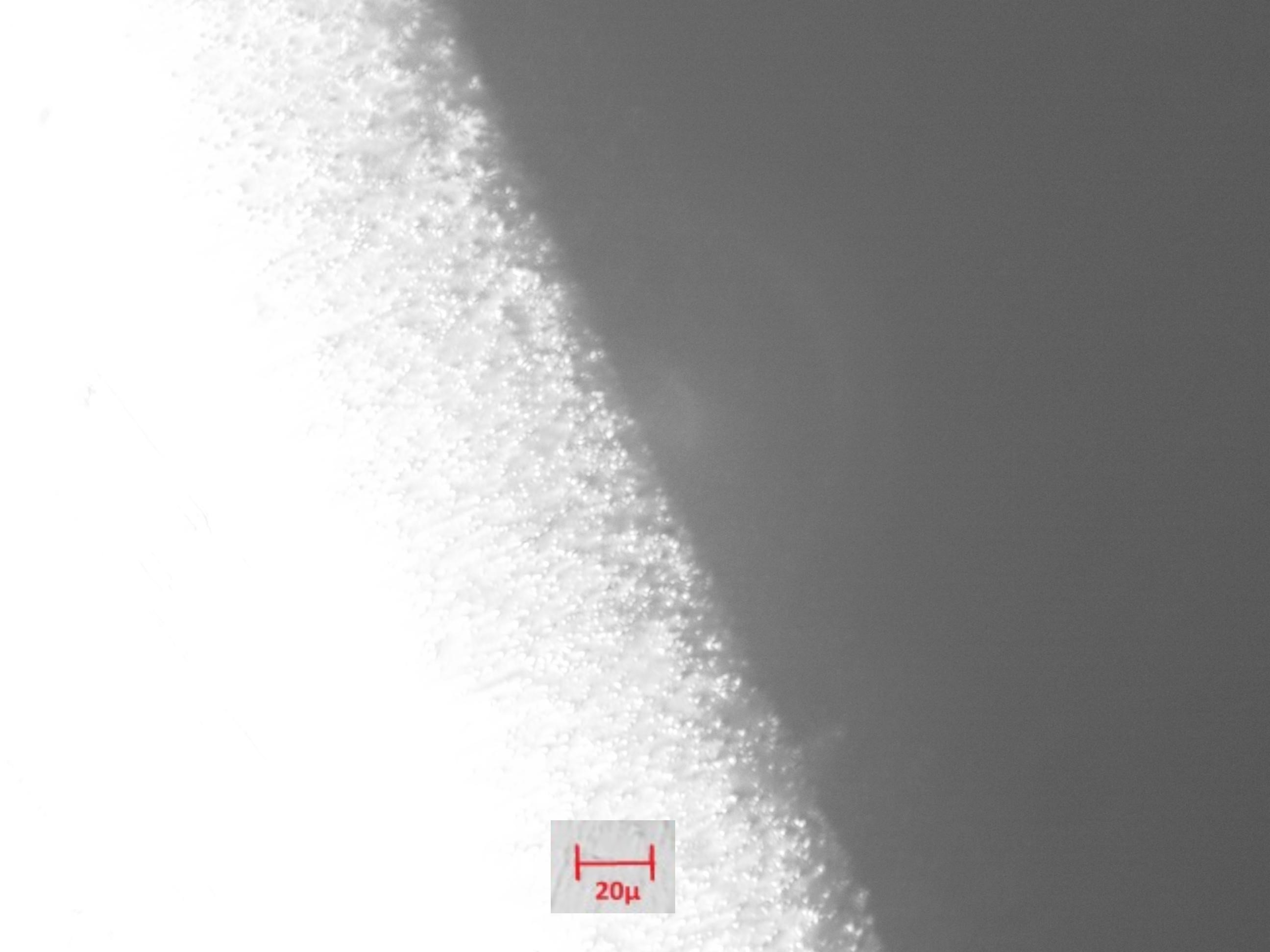
If you’re heat treating and not going to do any analysis other than checking hardness, you do at least need to snap samples and confirm your process doesn’t grow grain. This is a .062″ sample and it’s close to what I see with carbon steel. I asked Larrin what I should see because I thought maybe the high heat needed with bloat grain some, but Larrin said it should look similar. What the anomalies are, the shiny white dots, are probably artifacts more of my cheap hand scope. it’s hard to get a clear picture of these little samples and they break irregularly, so it’s not easy to get them in the metallurgical scope to look at where something needs to both be very level to the lens and also broken without any change in depth.

Whatever the case, this effort is fine and will make a good knife. The sample above is 62.5 which is about as hard as I’ll get out of the quench. could a furnace and nitrogen do better for a knife in practice? I don’t know, i think maybe it could, but I’ve made really thin knives out of AEB-L that are so thin I’ve accidentally bent them and then bent them back and given their hardness, that’s pretty good. And they sharpen well and hold their edge well, and the steel does fine in a plane iron. I don’t use it in plane irons because it seems like these ultra fine carbide irons don’t have the same feel as they dull.

While we can see the magnified grain here, the carbides do not cast a shadow on a plane iron when I wear away, so they are not visible and likely below 1.5 microns. The surface of the steel just looks like fudge instead.

When I asked Larrin what I should see snapping grain, he remarked there is no easy way to see carbide patterns and I told him my little trick – which is to set the chipbreaker on a plane so the shaving rubs the edge with force and exposes carbides. You can see the carbides below from 80crv2 steel. These are about as small as I’ve seen – if they get a notch smaller, they won’t show up. They won’t show up for AEB-L and often on older cast steel, they also do not appear in any quantity.
This is kind of a boring post, and it’s hard to make it relatable if you’re not doing the same thing, but it’s just another illustration of figuring things out and testing them.

Henckels sources “FC61” steel knives from Japan. Those are AEB-L, but they’re kind of expensive – between $130 and $300 per knife. it costs about $20 including the wood for me to make each knife, and about two hours. They’re not as complex – there’s no bolster or pattern welding, but there’s no bullshit, either. Humorously, the Henckels knives say “Kramer by Zwilling Meiji” and they’re made in Gifu, Japan. Probably by a separate contractor. They look nice enough, but the maker from Gifu could just be used without having to pay to use two more names and probably short the pay to the contractor. No thanks.

All of this is doable – the forge doesn’t need to be part of this and AEB-L doesn’t air harden easily when cut, so you can work with hand tools. You can shape the handles with a belt sander or by hand with files, but I guess it’s honest to say while it’s not difficult, there is some learning curve difficulty and this is one thing that I’ve gotten into where the hardness tester is immensely valuable in checking things quickly.

the stainless pipes – both the bigger and smaller are literally stainless exhaust pipe sections – the cheapest way I found to get something with some substance and strength in stainless.

A $225 “bucktool” belt sander and a spray bottle is enough to grind these into a finished knife without burning them – using ceramic belts. I do usually use a high speed grinder, though instead, but have done knives in stainless only on the 4×36 sander. This isn’t the same knife, but since I haven’t finished these knives, I figure a picture of a knife that was finished is in order – they’ll end up being similar to this. Understated, not expensively made and not expensive looking, but a small fine bevel and blistering sharp. I’m a little bit partial to hand finishing the sides not to a super fine finish for two reasons – one, they don’t instantly look marked, and two, if someone marks up a knife, then without doing anything else, you can always freshen the finish on these kinves by laying 400 grit sandpaper over a wood block in a vise and pushing the knife linearly across it. I don’t know why it bothers me, but I think it’s a shame to have a decent knife that is hard to freshen up once the knife gets covered with scuffs and little scratches.

What’s Happening to the Forums?

I see the debate is lively again on the dying forums as to why they’re dying. Some of the people complaining the loudest are the same people who have never contributed anything other than harassing beginners or pretending to be experts behind a veil of self-inflicted personal failure of some sort.

What’s not uncommon is the “what’s changing” complaining has been going on for more than a decade and the folks who complain loudly are never the ones who are contributing. But I think at this point, contributing doesn’t matter, anyway. Other mediums do more for peoples’ dopamine, and the reality is that most of the people on forums were there because it felt to them like they were learning something or planning to do, and putting off doing. If most of us who have been around for a while went back to the older forums, the post volume was unreal. Woodcentral, if I recall, had post volumes in the neighborhood of 100 a day on average and gradually got to 100 a month. The other forums whether they moved at the same speed and are dead now or just have 10% of their original traffic, same story, just the details are different.

Group Buying of Forums

The era of cheap interest (now over) and waning forum traffic seems to have been a success for groups like Group Builder, who is tagged at the bottom of the UK forum. What happens to forums like that that continue, but with seeming indifference at the surface always confused me. What I mean by that is the forum gets new ownership, and little seems to change except for some “hey bro” PMs appealing for cash, and the ubiquitous “we’re replacing our server”. I’d ask them for an agreement that you’ll get a picture of the dedicated server after the fact, it looks in my opinion more like an appeal for cash as part of a business plan.

You can belong to forums set up like that to eliminate ads without paying anything. That should be a red flag because it doesn’t make sense.

I browse all of the forums sometimes. There are a few former members i like to observe, and I guess I shouldn’t admit this, but some of them in humor more than seriousness. There isn’t anything I’ve read on the forums in a long time that goes into the “learned” category because that’s just not what happens on forums with buildalongs. Unless you are copying someone building along, you’re looking at something now you might apply 4 years in the future in a different context. It’s kind of pointless except for entertainment.

So, I don’t see the UK forum often because it is abysmal in terms of information level, and the indifference persists.

But someone on there pointed something pretty smart out in the context of private equity or VC or private capital enterprises just buying things up and putting them in a framework. And that is that most of the sites now have economic value not for the current forum members or advertisers to members, but by being set up to attract beginners who are one-offs. What’s a one-off? It’s someone who is looking for information to do something once and then seeks to use google to find instruction. It could be someone who wants to sharpen one thing, or someone who has no exposure to woodwork at all but just had a daughters (or son!) dribble nail polish remover on a lacquered table.

What’s your Value as a Member?

If you’re a long member on a forum, telling people technique with nothing leading to a sale, the value to advertisers is low. Too, let’s be realistic, when people have an issue to solve, their first thought is “how far can buying get me in solving this”, not, I’m willing to try three or four things and they may not work. We all thought we were valuable, but what’s valuable is having a giant database of posts for google to crawl so that someone searching – who knows nothing about the forum – may come across the forum when they search for “ruined table finish” or “table finish repair”. If you’re a member, will you tolerate a 15 second full screen ad every time you log in? You definitely will not – you’ll tolerate appeals for “money for the server” and PMs of the “hey brother, can you spare a dime because our costs have gone up” stuff, but you wouldn’t tolerate an ad. One will drive you away, the other will drive you to complain, which takes no effort to solve. You’ll give up on that if the appeal doesn’t occur too often.

We are worth less than the database of general info at this point, and realistically – if I start posting answers or Derek Cohen starts posting long build threads, the person looking to get information and a link to amazon following what to buy just isn’t going to be interested.

Not encouraging anyone to go to the UK workshop – I have an aversion to the way the site has changed and the strategy in general, but just as a check, I browsed over to the site. As a nonregistered guest, I got a half page banner ad for Ashley furniture, four video ads and two animated perimeter banner ads. Actually, having Ashley pop up for someone looking to fix ruined furniture is pretty smart, even if the furniture itself probably leads to need for repair soon when bought new.

If you see someone complaining about what killed the forums and they are the type who never contributes any legitimate advice or help, ask them what their contribution has been and what they do for a day job. The honest answers probably aren’t continuous employment, lots of woodworking and frustrated by too much success.

Long-Oil Varnish is The Oil Finish you Wish Oil Was

When I started making varnish, I made a recipe that was supposedly for violins. I think it’s as bad or worse than plain rosin and linseed varnish. Oil varnishes are for the most part some part resin, some part oil and then a solvent both to stop the varnish from bricking itself quickly, and to make it usable or brushable, or sprayable.

But after that, I tried a few things to make rosin and linseed varnishes quickly and attempt to get some hardness. My kind of favorite varnish so far is 1 to 1 types, or one resin and one oil, and I usually store them with one part turpentine. They’re too thick to use at that if they have one of the harder resins, but store well. Drier comes in later.

Even if rosin varnish can be made a little harder by adding lime, which dissolves in the varnish, it turns out that it’s still not very good, and it can’t tolerate water. Varnish with good adhesion doesn’t seem to lay out like lacquer and you have to degloss the surface to apply more. if not, it literally pools in some areas and “pulls itself toward itself” leaving bare areas. It’s really bizarre. it’s easier to do this sanding neatly if you can use a little bit of water – this deglossing. At least it is to me because it’s easy to wipe off anything that stays around. Varnish finds anything unusual on a surface and then builds around it, so little missed dots of trash are a problem.

Except rosin and linseed won’t really tolerate varnish and the surface gets squishy.

Steve V. pointed me to a book by Ralph Huff, which is as far as natural resin based varnishes go, pretty modern. Pre-WWII, but not by much. Huff predictably says rosin and linseed isn’t worth giving recipes for after describing it. As time goes on, I agree, and older texts were hit or miss. There are things you can do with rosin to improve it, but they are not something anyone reading this will ever do and unless you’re imitating violinmakers or trying to on a $25k violin, I personally wouldn’t bother with them either. There are other resins that are as good as modifying rosin to a darker longer form would be, and they are usable after a couple of hours of running (cooking out impurities at a very high temperature).

But Huff in the book then quickly goes on to describe the usefulness of tung oil. Most people reading this know tung as the very expensive polymerized oil that comes in a solvent. It’s probably $50 or more per pint after the solvent evaporates – that is for a pint of actual oil. Why that stuff is so popular is a bit of a mystery to me, other than it’s easy to use, i guess, and it dries a little faster than raw tung. But raw tung from a bulk supplier like Jedwards is high quality and literally about $34 a gallon with no solvent. So if you’re going to make basic varnishes, there’s a lot of substance to it. And getting away from what I see in the finish industry as taking stuff that doesn’t cost that much and putting it in little cans and making it cost a lot.

Raw tung will dry reasonably hard and it can also be heated or thinned to penetrate. if you want it to dry faster, and it will dry nearly clear compared to the cloudy polymerized stuff, 1 percent klean strip japan dryer will do the trick. I’ve learned to wash it with hot ethanol, too, and get rid of kind of the stinky nutty smell that’s in it.

But it is an in the wood finsih, a very good one, but that looks a little dull, and if you dare allow a little bit of the fairly hard but rubbery finish to dry on top of wood, good luck getting something that looks suitable.

Transforming the Linseed oil Varnish

By the way, before I start – I made some odies like stuff with wax in the actual oil with drying agents. I think putting wax in a finish is stupid – just my opinion. Wax is a short molecule and maybe there’s some magic that makes it still feel waxy and bond in a finish, but I think if that were actually the case, the hardwax oils would be fully waterproof. And they’re not. tung oil with a little wax in it works like shit – it spots with water if you allow the water to lay on it and then you have an ugly look. It feels just grand when you apply it because of that, and I know people like the dull look but I don’t. So that option to use tung another way is out in my book.

Tung itself will form a hard layer in wood, and so will linseed oil, but tung is more waterproof than linseed. it’s still missing the ability to go in the wood and make a nice finish on the surface.

Enter the 1 to 1 linseed rosin varnish that I have, really waiting until I just give up and burn it.

As I was at the beach reading, I noticed Huff provided a recipe that’s roughly 1 part limed rosin varnish, 1 part linseed oil and 2 or a little more parts tung oil. He also mentions an industry trick back then to cover up the use of mineral spirits, which are much cheaper than turpentine – and that is to use a very strong solvent that’s in the class of limonene as a fraction of the solvent and the rest mineral oil, so it seemed like two things to try. Oh, and the comment that clued me in was Huff saying that this recipe made a durable varnish for outdoor use, or something along those lines. All Tung is even better, but part linseed oil would definitely be easier for a new cooker because of how reactive Tung is.

I got back from the beach, busted out my junk rosin and linseed varnish, cooked the solvent of (which wasn’t trivial) and then added tung slightly greater than two times the original linseed. The result is a finish that has some characteristics of varnish, but isn’t nearly as sticky as a very good varnish is, it levels out easier, and it has great clarity.

This is that long oil varnish on satinwood, which is an interesting wood. The depth isn’t quite what a 1 to 1 high end varnish looks like, but most people reading have never actually seen that in person. This inexpensive and fair to say, not the hardest varnish in the world, but very tough when it dries, has better color and clarity than any polyurethane I’ve ever seen, and it lays out nicely. Pouring water on the surface and letting it evaporate leaves no evidence.

You can wipe it, brush it, and I’m sure if you wanted to thin it a little more, spray it.

I added 1% japan dryer by solids volume, which allows brushing a healthy dose once a day, or easily wiping two coats a day. If you’re uber something or other about driers, since a good choice for varnishes has cobalt (which helps prevent skinning, or put differently, helps to have the layer dry evenly and avoid cracks and crows feet), then you can apply thin layers and find the sun and you’ll have a touchable surface in a couple of hours.

This isn’t a hard varnish to cook, though it’s not really wise to make the rosin/linseed varnish first and then cook off the solvent – cooking the solvent out to get enough out for the Tung and prior varnish to crosslink isn’t as trivial as just cooking off some of the solvent. As you get less solvent, the temperature needed to cook more off goes up and you soon get kind of pinched into a place where the varnish could turn into a ruined pot full of gel. Fortunately, I didn’t get there.

I’ve already made similar but limed rosin and all tung varnishes 1 to 1 and not long oil, and they are almost shockingly good as a furniture finish. But a little bit more difficult to apply.

There’s a short clip showing the liveliness of the surface. when the rubber hits the road on the cost of this, it’s not more than any decent consumer clear finish. of course, you do have to cook it, but if it ends up being around $50 a gallon to cook, I can’t think of anything for $50 a gallon that comes close.

In the video, notice the kind of sheen the wood has. it looks a little bit three dimensional in person and remains a full colored look from across a room in raking light rather than looking like a dull surface. I sure hope this look comes back in style at some point. Not that it’ll affect what I make or the finishes I use.

Every little extra new thing with varnish or spirit types (french polish) just narrows the already narrow chance I’ll buy any finish in the future that’s commercially made. Now this provides a pretty easy to use option that will wipe like an oil, and if thinned, it will penetrate like one, but also show good clarity on a surface if it’s built. I have nothing wood outside at this point other than tung oiled garden wood with green pigment in it. Pigment in the finish is a whole other ball of wax, but the point of mentioning that is unfortunately, I have no real object outside to test how this stuff holds up in the sun. The sun kills anything that it can get to over time. Pigment is one way to limit how far in it goes.

I know for sure that helsman urethane that I’ve used in the past on south facing railings isn’t really suitable. It’s a just passable consumer finish, and it’s cheap if you compare it to a real varnish like epifanes. But I wouldn’t be surprised if this would outlast it in the sun. helmsman always got brittle and cracked at joints pretty quickly for me. That was the undoing of my wooden rails – sound wood showing, and rotted joints hidden inside.