
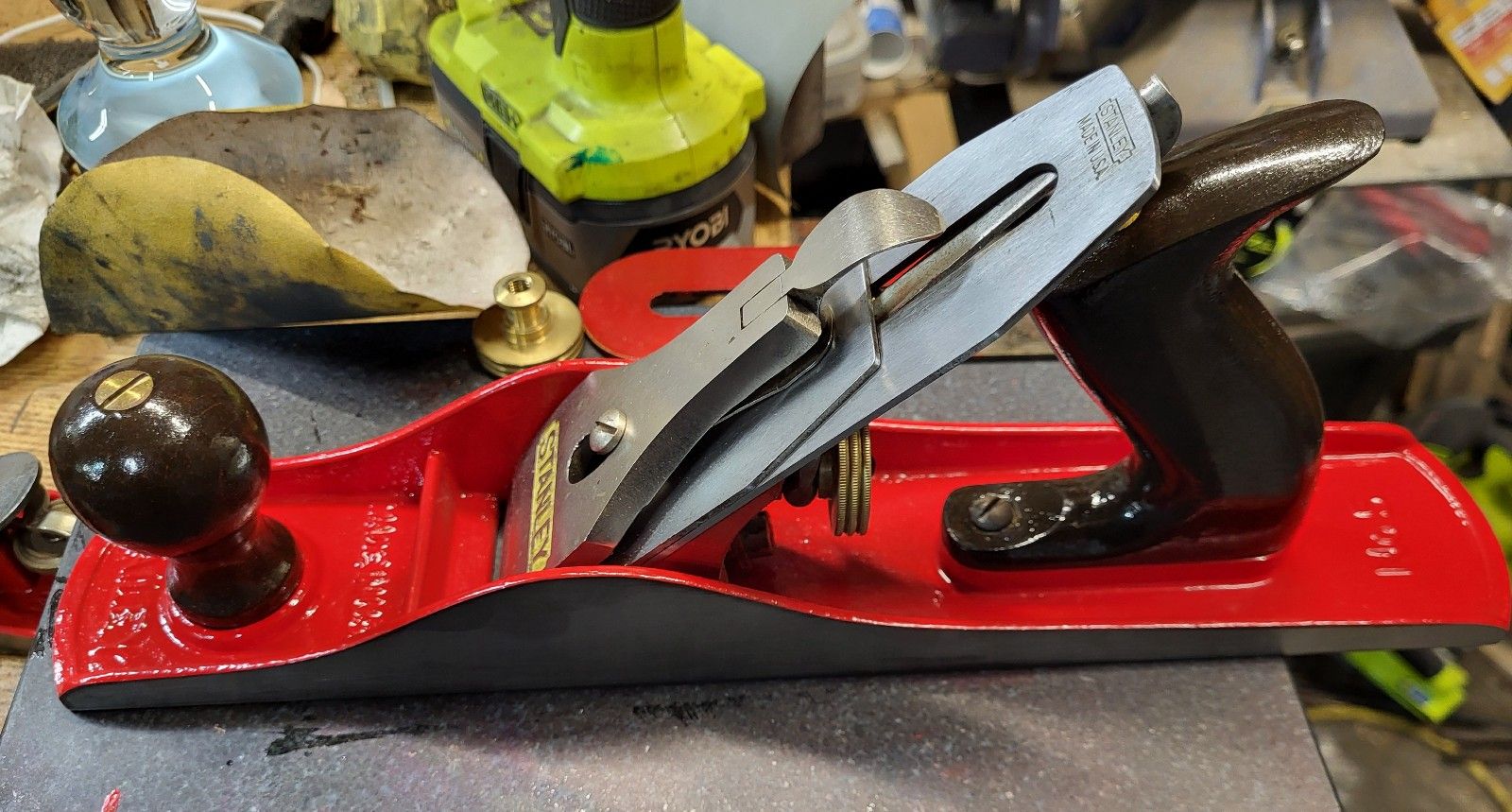
Isn’t that just filthy garish grand? it’ a type 20 formerly blue “was rusty” stanley 5 that I picked off of ebay.
I’ll type more later about making japanning and what I’ve learned, and by saying making japanning, it’s a little misleading. It’s just varnish with pigment in it, and the pigment is ground into linseed oil before mixing it into the varnish.
Because the pigmented varnish after baking will still degloss very easily, I brushed a short oil tung and limed rosin varnish, but that’s also something in the presence of metal dust hands and wood dust and such, it will degloss, too.
if you want to see a closer picture of this, here’s a link.
What’s wonderful to me is it’s kind of ugly. I forgot that there are some second line planes that are red, and when conversing with a few folks online the other day, remarked that chrome ox green might be nice, but then was reminded that’s Kunz. So, we’ll have to do a little thinking.
While I was at it, i brine quenched the iron – it was 61.5 hardness before quenching, as in from the factory at stanley, and I really was only able to get it just north of 62. It’s plain steel with alloying that feels like chromium and something else when you put it to the stones – probably a little excess manganese, and it’s short carbon. As in, I think it’s probably somewhere between 0.6% and 0.75% carbon as no carbides appear in a worn section of the blade.
That translates to if you can get it to 62.5 hardness or something after temper, there’s nothing else there to gain. What’s surprising is that I’ve now tested a whole bunch of type 20 and later irons – they’re all short carbon like this, probably because that became the modern way. Short carbon means little to normalize and the heat treatment process can be something more akin to a bottling line than a furnace.
But every single bench plane iron I’ve tested has been 61-61.5 from Stanley during that era. The short carbon doesn’t impress because it affects fine edge feel a little and also makes the irons really tough, so they hold a burr and give the impression they’re softer than they are. Carbon 0.8-1.25% gives a range of kind of bite to an edge that shorter carbon doesn’t maintain. But it’s not hardness that’s lacking, and given all of the comments from gurus over the years about inconsistent heat treatment and softness and things of the like.
It’s bullshit. Stanley may not provide exactly what we like, but even in their cost cut era, they are fabulously consistent.
Modern block plane irons with “lots of slots”, not the three slot super modern type, but what you find on 9 1/2s – I’ve tested three made at different times, bought at random. 62.5, 62.5 and slightly above 62.5 in hardness (but not 63).
Again. not exactly a 50,000 iron sample, but there are 7 irons in two types here – in the small sample not differing by more than half a point.
They’re better than I thought. I learned long ago that the derided type 20s are better than i thought they would be, too – they’re lovely. If the short carbon iron is undesirable, it’s $10 and an hour of time for me to make another one in something else, but i could not make a case that any of these irons couldn’t work on any wood that’s come through the shop and be adjusted to deal with anything (including silica), because they don’t have the fatal sub-60 hardness that a lot of low and mid grade tools do out on the market at present from other sources. I’ve had LV’s O1 irons – they are just not up to the task of end grain or dedicated smoothing work. While the Stanley irons here aren’t better than a Hock iron, they’re better than LV’s version of O1 in metal planes.
OK, a dose of reality before you look on amazon -these irons are short carbon, they’re blanked, and probably cost a dollar each to make. They’re practical. Amazon says $20 each. I’d still go find a vintage iron instead – they’re not short carbon if they are from the era before this and are just a little better. But if you have one of these laying around, at the very least, the bench plane irons could be made into two stellar marking knives.
I just wonder what our perception of some of the pedestrian things available would be if we spent as much time figuring them out as we are willing to spend if we waste a bunch of money on something we don’t need.
 Of Making by Hand with Wood and Steel
I think it looks great. I’ve a bunch of candidates for this treatment.
Another thing to wonder is how long the finish will look this glossy. A freshly black japanned plane can also look a little too glossy, but over time, with use and dust it won’t stand out that as much.
LikeLike
It’s not going to look glossy for long. Dusty hands and especially if there is any metal dust will degloss it pretty quickly. if keeping it gloss is an aim, I think shellac is actually a better choice – it’s pretty hard despite the low melting point and you can brush on a thin layer any time vs. the varnish that will be partially dry in a day and slowly harden over a long time.
After doing this with varnishes just to do it with all varnish, I think if keeping the gloss is the aim, I’m going to use shellac for the top coat. I’ve done it in the past.
That said, too – bright colors are never going to let the dullness hide as well as a black or dark blue japanning will. Anything bright will show its damage easier in terms of damage on the finish as well as any missing contrasting with bare metal.
you can brush shellac on black worn out japanning that’s only 70% covering the metal and still not have a terrible looking plane.
LikeLike