Tuba Fours

I’ve completed testing the four chisels I wanted to test, but I kind of decided that it might be nice to add a Narex Richter, which by spec and by finish appears to be decent, especially considering it’s a straight forward drop forged plain steel machine finished chisel, and with the bloated network of distribution we see these days and to some extent always have, you can get such a chisel for less than $50.

Could I make something like that? No. If I ever make chisels, they’ll be at least $100 per.

Another set caught my eye discussing things and that was a horn tooting that I often do, which is if you can make aldi type chisels in china for less than $1 per, why can’t you spend five bucks in production and make something with a better finish, better heat treatment process (like molten salt or lead and some thermal cycles along with that) and surplus carbon steel instead of minus carbon steel. Minus carbon allows heat treatment that’s pretty much make it hot, quench and temper – plus carbon generally doesn’t.

So, I found out of curiosity a listing of chisels on Amazon from china that are about $10 each at retail or so, claim to be 100crv (generic name for a 1% carbon steel with minimal additions of chromium and vanadium – makes things a little easier and prevents brittle edges) and salt bath heat treated. And the chisels appear to be machine finished but more neatly than the typical china stuff.

They claim to be 59 hardness, but I suspect that’s just copying ad copy details. So, we’ll see how those do, too. I struggle all the time when someone says “what chisel would you recommend?” It’s not like five people ask that a day, but once a month maybe and I always bend my mind. I could make a nice set for about $100, but realistically that’s at my cost of materials and consumables for a set of five. I’m curious about these two, though – the richters, and then a 1% carbon set that costs the same in a set of five or six as one richter. there’s no reason that a good bench chisel needs to be expensive, it’s just there’s no reason for someone to retail a good chisel because …

…..how many people do you think buying aldi chisels are looking to make dovetails vs. walking past at aldi or harbor freight and saying “my chisels rusted, I need a new set” and then the next thing you know, those chisel are opening paint cans, scraping grout and chopping door jambs.

Good God, I cannot help going on. The point of this is something I found while visiting my parents. Tubafours.

Tubafours?

I think any of us who found a gift for problem solving and maybe not verbal efficiency or “rizz” or other such things probably have a fair chance of ending up on the spectrum – or being identified as being there. I’ve never been diagnosed, but the spectrum is a spectrum. I can write well for work and very to the point when being paid, and considering the respect for clients who are paying quite a lot for me to do what I would want someone to do for me about a subject that was important but I couldn’t learn and apply as the client.

One of the things that occurs in my head is connecting things. I connect Carbon V steel in old case or Camillus knives to 100crv. I connect statements of words that mean something but sound identical to something else or close that’s not implied, well, my brain explores both routes at once. By that, I mean it just happens, I don’t ponder consciously, it’s just there. It’s happened since I was a kid.

One of the things people who speak poorly say where I’m from is “TUbafours” (Two-by-fours). You’ve probably had that happen even if you’re not a little on the “problem solvey and not pattern recognizey” kinds of ends.

Two by fours have no great big place in my shop other than to make shelving. if I had left over offcuts, I’d use them instead. What’s a virtue of 2x4s and 2x10s and such in a typical shop other than being able to screw them if they’re not very old – and no pre drilling? they’re cheap. But when I think about how they end up in houses vs what barns look like and what the wood inside my parents’ house (1924, houses is stone with plaster walls) but inside some attic areas, you can see the lumber that was used. It’s hardwood in some places and all rough.

Dad’s burdened with taking care of mom, who is now no longer to process information or communicate or really recognize anything. It’s not really a pleasant situation, but it’s part of getting old and later years can be tough. As my mom aged, she gathered stuff because she was a crafter. her ability to see something and think of a use for it went haywire, and dad doesn’t mind much as long as it’s not in the living space. In getting rid of much of the accumulated nonsense, we’ve found things long forgotten.

One is oak tubafours.

This one was rough, so I planed it, but I spotted these laying in the upper part of one of the two garages that dad has (not a great situation for a parent losing their memory and wanting to keep everything! Two multi-floor garages)…the only thing dad has kept after the junk man went through is some original doors to the house that are still in good shape – just not wanted – and a stack of these. Oh, and the shiny bits at the top of it. out of curiosity, I want to apply varnish to it and see how it looks, so it got a first coat of varnish on the end.

So, these don’t have some kind of far off “back in 1924” story. Our hillside was a quarry for granite, and thus the house is granite. It was stripped clean at least once of trees and is now covered with all kinds of stuff, but the largest of the trees in a second or third growth forest like this are red oaks. There is no market for it, but when this wood was sawn – around 1982, it was at least used for utility wood instead of allowing it to sit and rot only to drive to home depot and buy wood that nobody would’ve used 80 years ago.

What’s the significance of this 2×4 besides that? nothing other than it survived. It survived because it has a knot in it. What was the wood in this case purchased for? it was purchased from Green’s saw mill to make a goat house. That’s right. This is “utility junk wood” and Greens probably charged the current equivalent of a dollar a board foot or so for these. On a few occasions, dad took logs to Green’s on his own. The saw mill no longer exists and I don’t remember it, I was too young. I have several things made from the wood sawn there and another local mill, though, from Oak to an old pasture walnut tree that my grandfather had sawn.

I don’t have any real big ideals to spout here other than that kind of nagging thing – we let wood like this lay on the ground now, and buy garbage at home depot out of convenience. If Greens operated anywhere close to where I live now, it would probably get zoned and taxed out of existence, and someone would complain about noise or the smell of wood. Even where I grew up, complaining about neighbors is probably much more popular – well, it definitely is. if someone was doing work when I was a kid, sawing wood or whatever it may have been, we looked the other way. “Leave them alone, they’re doing something”.

Too bad. It’d be nice to have this as utility wood now. Rift oak as a default construction lumber. Who could imagine that now.

The Borrowed Zen Wu “White Steel” Chisel

First off, this is not going to be an endorsement of anything at all. It’s following curiosity, and every time I hear about the new brand that “James Wright really prefers”, I want people to go find every link under the video and go ask Wright to publicly disclose the details of all of the revenue nominally and in percentage that he gets from “Zen Wu”

Second, it’s not a company I would patronize because the whole vibe irks me, but I am declaring these things from a position of luxury. At this point, it’s unlikely that I’d need a tool other than a die grinder or drill press, etc, that I can’t build, so I have become very particular. I also wouldn’t buy a chisel of this type no matter what because it appears to be a copy of Lee Valley’s chisels. I didn’t care for the example of the V11 chisel that I received and used in the unicorn chisel test. It only outperformed a hardware store chisel 58 hardness, and it grinds and sharpens half as fast as chisels that are better, and in that case that tested better.

However, there has been a rash of copying things that Lee Valley has made, from the Hongdui router plane sold by Katz Moses, to QS tool made pullshaves and spokeshaves and who knows what else, and this chisel looks like it’s just lifting the pattern right from the bench chisels that Lee Valley makes. By the way, i don’t know all of the details about the Katz Moses router plane other than it looks like if LV didn’t actually give them permission for the lower casting, they just copied it. That’s dirty pool in my book, and please spare me the touting of adjusters, etc, that somehow people got along without for more than a century but are “really needed now”. If someone is going to sell a tool, it should be public domain from age in terms of design or create something on your own.

Lastly, that I have this chisel to test is very generous in the first place, because I’m past the point that I’d buy things to test them and the fact that it’s strikingly similar in design to LV’s offering would prevent me from buying it even to test. A subscriber, Clayton sent it to me, and since I don’t know that he’d want his whole name in a post, I’ll leave it at that. Commenting is voluntary if he’d like to say more. The offer is much appreciated.

Anything I say about this chisel from this point on is my observation, and as much as I don’t like tool copying and strange naming or “woo”, I also refuse to lie or throw selective shade on something’s performance. It is what it is.

The Attributes

The chisel is at bottom in this case next to a 52100 mule I’ve made. On my mules, the handle is even a little bigger than I’d make for other folks, so it makes the turned handle on the subject chisel look diminutive. For someone who grips by the handle only and doesn’t pinch and point the tip of a chisel near the bevel, required is a tapered handle that you can hold and keep your hand off of the metal bits as well as the hand web off of the thumb well away from any covering of the end and a mallet strike – surprisingly painful! When I was a beginner, I pinched a chisel tip like a lot of people do – you don’t know what you can do or how easy it will to learn to move a chisel around just with an off hand on a handle.

The handle on this chisel is finished reasonably well, it appears to be hard maple, and it’s really smooth feeling. maybe too smooth and slick for my taste, but you can fix that. I think it’s too small for my taste given the above and the whole thumb hold thing where it’s puffed out makes no sense. if you’re going to push a chisel, the butt should be in your palm and it’s unlikely you’ll appreciate that slim area and “thumb hold”. Pushing with any power with your fingertips or thumb on that part of the chisel is a recipe for pain.

The chisel is otherwise flat, it’s not expensively finished, but it’s finished well enough. There’s no top part to be a bolster and I have no clue if that will matter over time. that’s lazy in my view, but it allows for an easy way to just cut chisel and stuff them in a handle without having a third dimension. A minus for me, but the chisel is $70 and not $125. And it’s not like the same design isn’t used in expensive chisels and chisel-shaped objects.

The last thing of note here is the handle is not straight on the chisel:

If you look closely at this picture, the handle is on firmly but it leans to the left here. This is fantastically hard to photograph properly, but it’s a little worse than it looks. It’s also not a deal breaker – just an observation. Both off center handle installations and bowing of boxwood can be seen on older tools.

I’m not taking this apart, but I expect it’ll cause no problems before I send it back.

There are no other fit issues, but I’ll comment on the profile. These chisels are made with fairly steep sidewalls just like the chisels I think they’re copied from. Older chisels typically have more taper to the side walls and I think if you use chisels for long, you’ll prefer the older style. it’s less easy to make a chisel with wider flatter bevels, and these have zero lands like the LV chisels and that’s also likely to be less expensive. The wider flatter bevels require leaving some land but those lands left behind – even if pretty small – are better for keeping the corners on chisels. So, the sidewall design is just OK, but again. a $70 chisel and I think as of this posting, a set of 4 is something like $235.

I could show more pictures that I took just in general, but there’s not really much to learn from them, so I’ll not flood this post with meaningless pictures. The backs of these chisels are fine and if they are actually made from a 1.2% carbon plain steel (could be), they are presumably ground after heat treatment. Who knows – I know about poor man’s methods, not contracted manufacturing, but it’s easy to get water hardening steel to be something other than flat, but these don’t suffer from that.

Hardness

Hardness claim for these chisels is 64. I measured in four different places and the chisels are 63.5 end to end. Initial use shows they have a crisp edge and the feel on an india stone, which usually gives me an indication of what a steel might be once I know hardness, the steel feels more plain than O1. File steel, essentially what these claim to be, is more plain than O1, so that’s a good sign.

While these are cut from flat stock, there is a slight taper in thickness from tang to end. Not like older chisels, but enough to see it. My eyes aren’t good enough to see if there is also a compound angle for the sidewalls, but there might be a little. if there is, the chisels are steeper at the tip and more angle toward the tang – opposite of what I’d expect and opposite of what I make. No big deal either way – part of the reason on the mule is cosmetic, so the top flat doesn’t get considerably narrower than the tang – that looks stupid. Also for strength, but the bevel angles on this chisel aren’t shallow enough anywhere to worry about strength.

Here’s the one concern that exists from this. I’m not going to break this chisel, but I did nick part of the edge off to get a look at the steel and the grain, and I can imagine at some point, someone will break these. How do you avoid that? Differential hardening – partial hardening from the shoulder to the bolster and then nothing for the tang. I’ve already seen pictures of Cosman’s mortise chisels broken at the threaded apparatus where the tang goes into the handle. There’s no great reason for lower toughness steel to be fully hard other than that industrially, maybe it’s easier? I don’t know.

All that said, they’re close to or on spec for hardness, and not way over and not under – that’s a good sign.

Here’s a picture of the snapped grain at 75x optical:

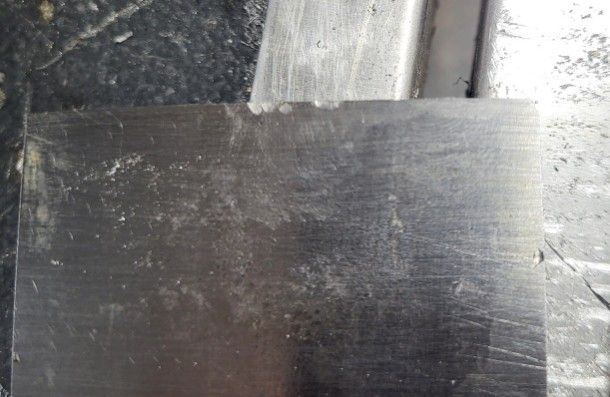
It looks fine. the steel didn’t offer too much resistance to the punch when I nicked the edge off, but it’s not due to enlarged grain. You can ignore the bright spot in the middle, it’s likely just due to shear or something else. We just don’t want to see something that looks like distinct glitter – but rather gray stuff that looks nondescript. I would also expect to see carbide, but either there’s an odd shear or a few grains big enough to look back that I can’t really tell from the picture. It’s possible to make file steel look a step finer than this, but this is pretty good. you don’t often see truly enlarged grain in anything made commercially and this is on par with what you’d find in a nicholson file.

Too, I’d never break the handle on these, or at least I think I wouldn’t. I’m speculating that these will be easier to break than a chisel with differential hardening from the shoulder down, because they will be – but there’s no data so that’s not proof. That’s really important – until they break, my speculation doesn’t carry that much weight other than opinion.

I have sample of my own with 125cr1 below – kind of middle of the road results. These steels are similar. This sample is 65 hardness after tempering and given the composition, I’d expect the results to look similar. O1 and 1095 or 1084, for example, I’d expect to look finer because the carbides are actually finer in those steels than they are in Japanese white steel or file steels or 26c3. These two are fairly comparable – I think I can always get higher hardness than commercial for the same grain size and same steel, but that’s just constructive competitiveness.

Feel on the Stones and Initial Thoughts

I don’t have any regular chisels in 26c3 or 125cr1 sitting here, but I do have the 52100 mule and the thin apple handled 26c3 chisels that are on the front page of this site, and a later kind of just before the bottom dropped out ward bench chisel. I’ll make a post at a later date after I get a chance to do a legitimate test and take pictures.

This chisel feels like file steel, though, and the burr comes off really easily. You guys may not use oilstones, but a broken in fine india stone and a hard (but not finest grade) arkansas stone tell us a lot about burrs and toughness. If a typical sharpening results in the burr mostly coming off on the arkansas stone without anything special, but not to easily on the india stone, we’re in a real sweet spot for pleasant use. It’d be great if the burr left at the grinder and the chisel was good, but my experience with chisels that lose their burr in the middle of the india stone is they’re hard tempered.

So feel in this case is very good. I expect from just a little playing that this chisel will be great for joinery work steel-wise and may be intolerant of prying or twisting, but the latter done sloppily is the realm of beginners.

Since I expect that this chisel is actually pretty good for work other than prying and abusive things, I am not going to search for a cheap junky chisel to compare it to. If it matches my mule (which is also 64.5/65 hardness), it’s a good chisel.

I do expect the thin 26c3 chisels to hold up less well in the test that we’ll put together – those chisels are .07″ thick and they are sprung – that spring in heavy use seems to make rough use much harder on edges than when a chisel doesn’t have it. We’ll see. It’ll be at least a week before I get a chance to put this test together and maybe longer, so perhaps before then, I’ll also order a Richter.

Could I live with this chisel and are there ranging thoughts with it? I’d rather have it than PM V11 hands down, but the ethical issue would prevent that. Is it as good as a Richter (if I ever call those Raptors, well, you’ll know that I almost call them Raptors every single time I have to sit for an old man moment and remind myself what they are. I’ll have to come up with a memory ruse…like “huge fart chisel” or something, but that could easily result in accidentally calling them sphincters).

What about an older set of Ward or English chisels. Not a chance for the new one, I’ll take the old. The Ward that I will use in this test is around 62 hardness. It may not win the battle here, but the attributes of its shape and proportions still win overall. I’m not aware of anything else similar to these. I’d take them over A2, and certainly over much of the lower market stuff that’s $40 or $50 a chisel and made from much lower carbon steel. With the exception of the Iles Mk2 – which I hear can vary. The ones I had were decent, but we’re talking about considering these against some desirable chisels. Of the other steels “woo” claims to make chisels from, especially 60/61 hardness PMs, i wouldn’t be surprised if these outperform them.

Sample of 1

Lastly, anything you do to talk about something ends up being advertising. I obviously have no skin in the situation here, but it still creates a dilemma. Mentioning these as kind of public service data has two issues:

  • repetition is advertising. Products have stupid advertisements on TV just so you get used to seeing the name of them even if you think “that ad didn’t do anything to convince me to purchase something”. I wish there was a way to provide a mention of something without moving the needle, especially in the case of something copying another maker. the best I can do is guarantee there’s no motive of any type here and certainly no revenue generation involved nor will there be.
  • This is a sample of one chisel. I don’t know if it’s going to do well or not well – nothing indicates it’s junk. But given I can only report on this single chisel’s behavior, if you buy something that doesn’t measure up to my review, your remedy is a return policy, and not because any later information is bogus.

I wish we had deep data out in the wild, but we’re still in reality dealing with people running around saying that V11 sharpens as fast as O1 but lasts twice as long planing. Both of those will not be true – Kees Heiden already proved that at least the former isn’t true.

Metallic Plan Co. Iron Part 3

I need to mark the tag. Having the plane in hand will offer the chance to make sure the tab engages.

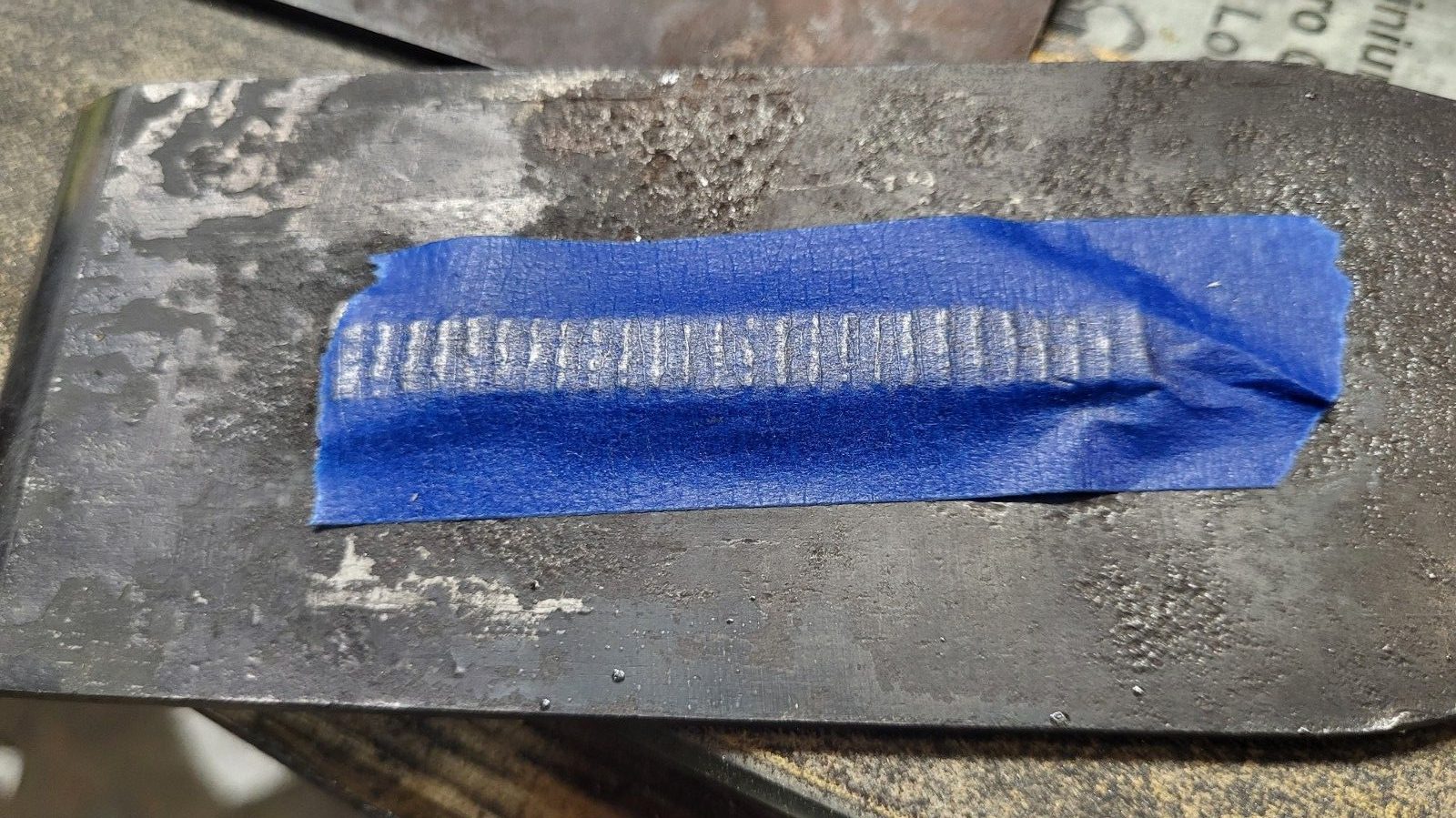
I need to either count teeth, which I stupidly did before, or be smarter and take the marks from the teeth on the original iron and transfer them – tape on in this picture, pencil over the tap and then transferred to the rebated tab that’s not yet attached to the replacement iron.

If you look in the original post, the tab on the iron is crooked – but you can see it above here, too – it’s not perfectly parallel to the iron length. The replacement tab is still on the CA block, which allows for easier work starting the initial teeth and hoping to minimize any file marks on the final iron, still left a few file marks on the iron after installing the tab and correcting the teeth.

At this point, I removed that tab from its wooden block and marked center on the iron and CA glued it on and drilled through the iron just going through the holes that already existed on the tab, knocked the tab back off then and removed all of the dried ca glue and then peened the tab in place with brazing rod. I wanted the rod to be narrow diameter so that some of the tooth is still steel and won’t be bent or folded by the matching teeth on the plane’s adjuster.

And noticed that mine, too is crooked – I guess it moved a little while I was placing it and then made that issue permanent by drilling. Oh well. A little late to fix it without unnecessary trouble – a check of the plane shows that it’ll still be fine with the adjuster, just like the original. The plane’s adjuster has a lot of lateral room seemingly to allow just for such an issue. Smart. The initial teeth with the tab peened to the iron look like this:

Woof – those teeth are pretty ugly. The bronze adds an interesting challenge if you work by feel – it feels like grease when you’re filing it and it hides that you’re filing steel at the same time, you can’t feel it. I’ll do what anyone with self respect would do, fix the teeth a little and blue the whole iron so you can’t see them very well.

At this point, the iron is close to being done, and is it flat enough? It should be. I did check the iron before peening the tab on – it’s ever so slightly hollow along its length, which is just what I wanted. If it was convex at all, rather than lapping it flat, I’d belt grind a tiny hollow in it. like several thousandths, but something that will show up as visual confirmation everywhere on the iron. it’s probably a lot flatter than the original. I ground the top corners off, and cleaned things up a little but not like a brand new surface ground iron – I don’t want it to look like CNC in an old plane. that looks stupid and it would be doubly dumb to waste time going over this iron to hide that it’s hand made.

A couple of the teeth could still be evened better to improve the uniform look. but we’ll see how it works, first. I did nothing else after this but apply some carnauba wax so that it if it rusts, it won’t do it on my watch.

I do wish I hadn’t been in a rush through some of the parts – the holes not in line, the wonky teeth and the tab going on somewhat diagonal. But it’ll be fine and none of that stuff will show up when the iron is in the plane. From start to finish, it took about 2 1/2 hours to make this iron. It’s not exactly simple, and with limited tooling, I had to figure out what I’d do to rebate the tab and so on, so the first one always is a little ugly and takes a while. It would still never be a one hour project without having a production setup that would take enormous amounts of time to create. That obviously wouldn’t make sense, and posting this in an online forum would probably draw some retired machinists who would tell you how they’d do it. See if they can set something up in 2 1/2 hours including heat treatment. And do it for free.

Metallic Plan Co. Iron Part 2

This is a continuation of the oddball plane iron replacement for an original that will not harden properly, at least without risking the original warping in brine. that would normally be a “so what”, but the iron in this case has an adjuster tab peened in and brine would mean grinding the bevel off to prevent warping at the very least.

As of the prior post, I’d tapered a blank – just a blank iron to match the dimensions of the original roughly.

I hardened and tempered that iron, which isn’t any different than any other iron but for avoiding hardening anywhere that I’ll need to drill to install a tab on the back by peining – in my case with bronze rod.

Hardening and tempering was relatively routine but for a surprisingly high out of the quench hardness. the terminal hardness after a long double 400F temper is 62.5 – this iron is bohler O1.

The tab in the picture above is in the ballpark of 0.1″ tall at the top of the notches, but perhaps slightly less. I have a 1095 steel bar that I got from an online supplier, and it’s defective. I’ve seen this supplier in action coming up with reasons other people are at fault and don’t want to risk access to things they have that I like, so it’s better just to put something cheap like this aside. Years later, this is just the thing for that steel. It’s defective in an annoying way (shiny inclusions that wear at a different rate than the rest of the steel), and one that doesn’t at all threaten usefulness here.

Fast forward after measuring the tab here and cutting some off of that bar, I’ve affixed the bar to a piece of wood with nothing more than CA, which will come off easily later. The first order of business is both drilling holes for peining and the second is rebating the tab.

There’s probably a million ways to do this and if I had to do more, I’d rig something to use the die grinder and then finish file. Instead, I just filed and floated this one, which took about half an hour – no desire to do it twice.

The file setup is simple – leave a certain reveal below a block of wood and that sets the rebate width:

Filing this is simply a matter of holding the block upside down and running it against the stop block, stopping every 5 strokes or so to brush the filings off.

At this point, some things are particularly sloppy – I could’ve drilled the holes in a press, but I did so with a cordless drill. They don’t need to be perfect and this isn’t that kind of project. I think the sloppiness will be inconspicuous.

But before I move on to the tab, I left a little excess on the end of this iron just to check the grain. Since this isn’t a fast process, I just want to double check by putting the iron in a vise and ticking off some of the newly cut bevel:

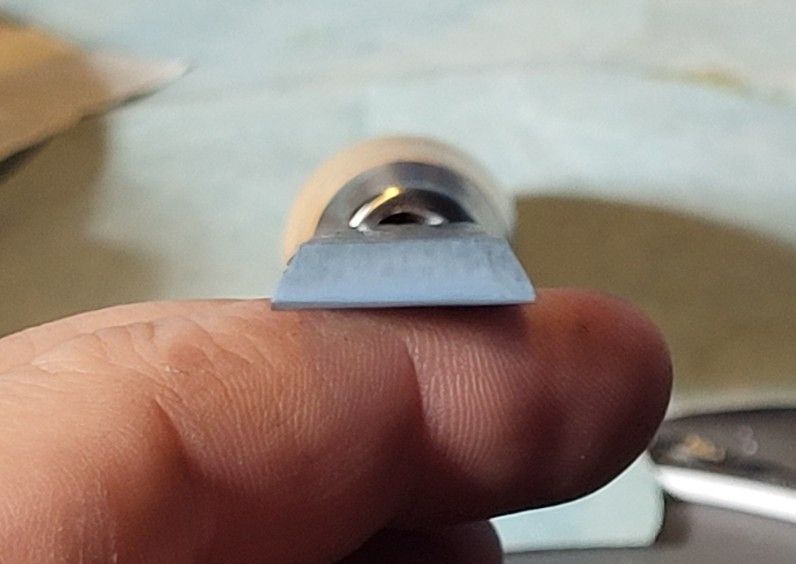
This works better from the bevel side. You just take a tiny bit off. The punch is sitting low here, but in use, we’re hoping to take something 1/3rd the size of a BB off.

I got to this point hammering with the punch and took more and more aggressive strikes and this would’ve been enough – there’s no toughness problem, but just for the purpose here, I turned the iron around in the vise and struck from the bevel side. These breaks are really irregular most of the time when they occur, but I only need to confirm that the steel doesn’t look like a million little shiny diamonds. Here’s the hand scope picture. It’s not a great picture, but I can gather from it what I need:

This is at 75x. you’re going to get some shiny areas due to shearing, but this looks good. Within the gray matrix, I just want to see uniform gray matrix and not something that looks like a pile of glitter.

This is what bad looks like, and this is at half the magnification:

These may not immediately look that different, but notice there are a few glints here and there on the first sample, at double the magnification. I think those are probably shear from the awkward tearing, and they may be more than one grain. In the second picture here, you can see that the whole sample is pretty much enlarged. This sample is from my experimenting with 1084 to see how tolerant it is of heat (not at all, but it doesn’t need extra heat) and then prove that it can be shrunk back to better than off the rack bar. You get the point. This kind of glinty grain would make a chisel that just chips a little at the edge, but over time you just won’t be able to tolerate it if anything else is at hand.

Part three / finishing this will follow.

Oddball Stuff – Metallic Plane Co Iron 1 and a Gripe about Miserable Failures

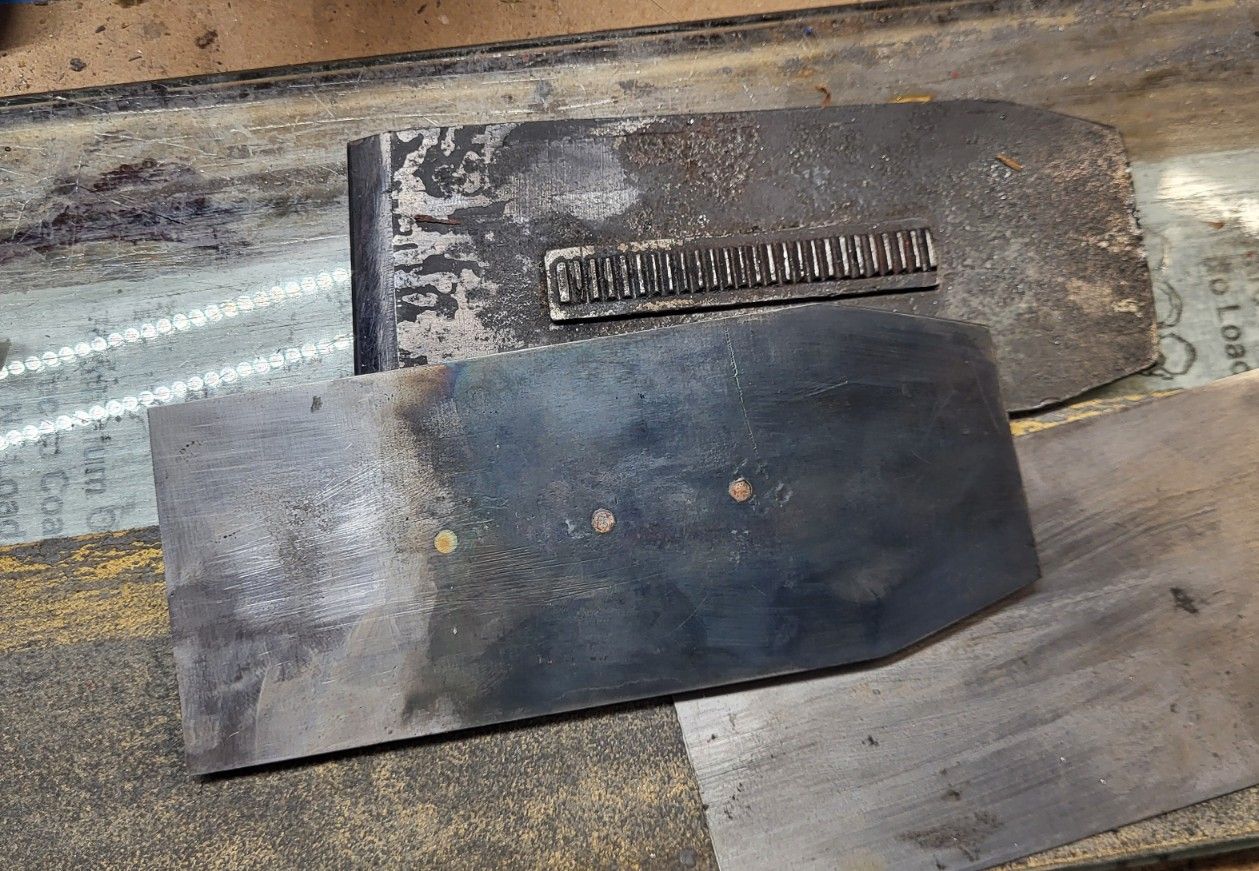
Would be dumb enough to make things like this? The iron on top that is.

I think this kind of stuff is interesting. It probably isn’t interesting enough to other people to do it and for some, maybe mental scorn about how it’s not “real woodworking”. Most of us aren’t doing “real woodworking”, though I’ve never been able to figure out what that is in the first place. Does it have to be real wood or can it be plywood but what you do is real? And who makes tools and calls it’s real woodworking – what is the rebuttal against? I don’t know. More on that at the end of this – but first on what I’ve devised, and it could be something different next time and so on. What I don’t want is to be bound to needing some kind of specific tooling or method to do this to a point of accuracy that’s at least as good as the iron that’s already there.

I’m thinking this is about a two hour project on top of that. A typical iron like a stanley replacement iron without machine tools is less than one.

I started with .187 bar stock. The decision to forge or shape comes up. If I had a flatter hammer and a second person who would hold it, this would’ve been faster to forge. I don’t, and my large anvil isn’t set up with space for someone to stand opposite – so there would be no time savings with that and it’s out. The subject iron here is about 0.16 or .155 and the far end of the taper is .085″. The raised area with teeth is a separate issue – you can’t see on the old iron but it’s got pins that go through to the front of the iron – they’re not flush peined, but I would assume they are affixed by being driven in and they obviously never came out.

Back to the stock. My favorite way to deal with something like this is a round contact wheel and a pair of calipers. And since it’s short, a one-time holder for the iron isn’t a bad idea, but that can come after the iron is cut out of bar stock and the ends have been beveled to set a visual stopping point.

This is what the one-off holder looks like:

What you see is a longer stick of cherry, and I took a picture after the fact, which may not be quite as helpful. the idea here is just a longer piece of throw away wood that’s a little less wide than the iron so that I can check the sides with a caliper. The screws are driven in close to the ends of the iron, but they are driven in far enough that they put lateral tension on the ends of the iron. There is no belt and suspenders thing that does more than that. The screws have to be below the level of the final article or they will get in the way of grinding.

This is then ground against the contact wheel for a variety of reasons, but among them are the fact that a belt grinder at high speed with a contact wheel is efficient, I can direct the dust and metal shavings toward a bowl with a vacuum hole at the bottom, and I can remove metal in just about any way from a point on the edge of the wheel to a line across, and rotate the iron with that line to lay it crossing prior passes. As long as you don’t grind the ends of the iron off in specific ways, you can literally use this method to make an exact replacement for an old wooden plane if you need to. In this case, it’s within a few thousandths of the original, which isn’t that accurate. The lower corners on the fat end (left) are not totally in plane, but they’re not far out and probably won’t need to be addressed, anyway.

the next step is to locate and install the toothed strip on the back of the iron for the plane’s adjuster to engage. I have the plane in another room that’s clean and dry and can test the result to make sure it will work. but you can envision a lot of difficult ways to make this strip and file it. The smartest for simplicity’s sake is not to machine the whole thing including the legs that go through the iron in one piece, but rather just take flat stock about the same thickness as the bottom to the top of the teeth – in this case .105″. That’s nearly identical to hot rolled unmachined 3/32nd stock.

What’s First?

This iron will need to be hardened and it has to be relatively flat, and then the adjuster fixture will be installed after. It would be possible to do all of this first and then just harden an inch of the iron or so. This plane belongs to Raffo – it would be a challenge to get Raffo to use an inch of the iron – that would take a long time, and there’s no guarantee the plane will be nice to use. This was Lie Nielsen’s philosophy with W1 irons long ago – challenging to harden to the slot in an industrial setting so only half of the iron’s usable length was hardened.

But I would really rather have the length up to the adjuster hardened and not just a little, and I’d like it flat. So it will get a typical routine here for irons – heat/thermally cycle, ramp up heat, quench at the top end and then plate the iron on the anvil under an aluminum plate for about 10 seconds. It’s uncommon for an iron to get away from that routine and not be pretty flat. Before adding the plating with thin irons, I would bow a few trying to both use no fixtures and also precut a little of the bevel to game the bowing of the back. if you have a bevel, the flat side will be hollow 19 times out of 20, but too much and it’s a wasted effort and getting too much hollow isn’t hard. So I shoot for flat now and cut the bevel in its entirely when the iron is hard.

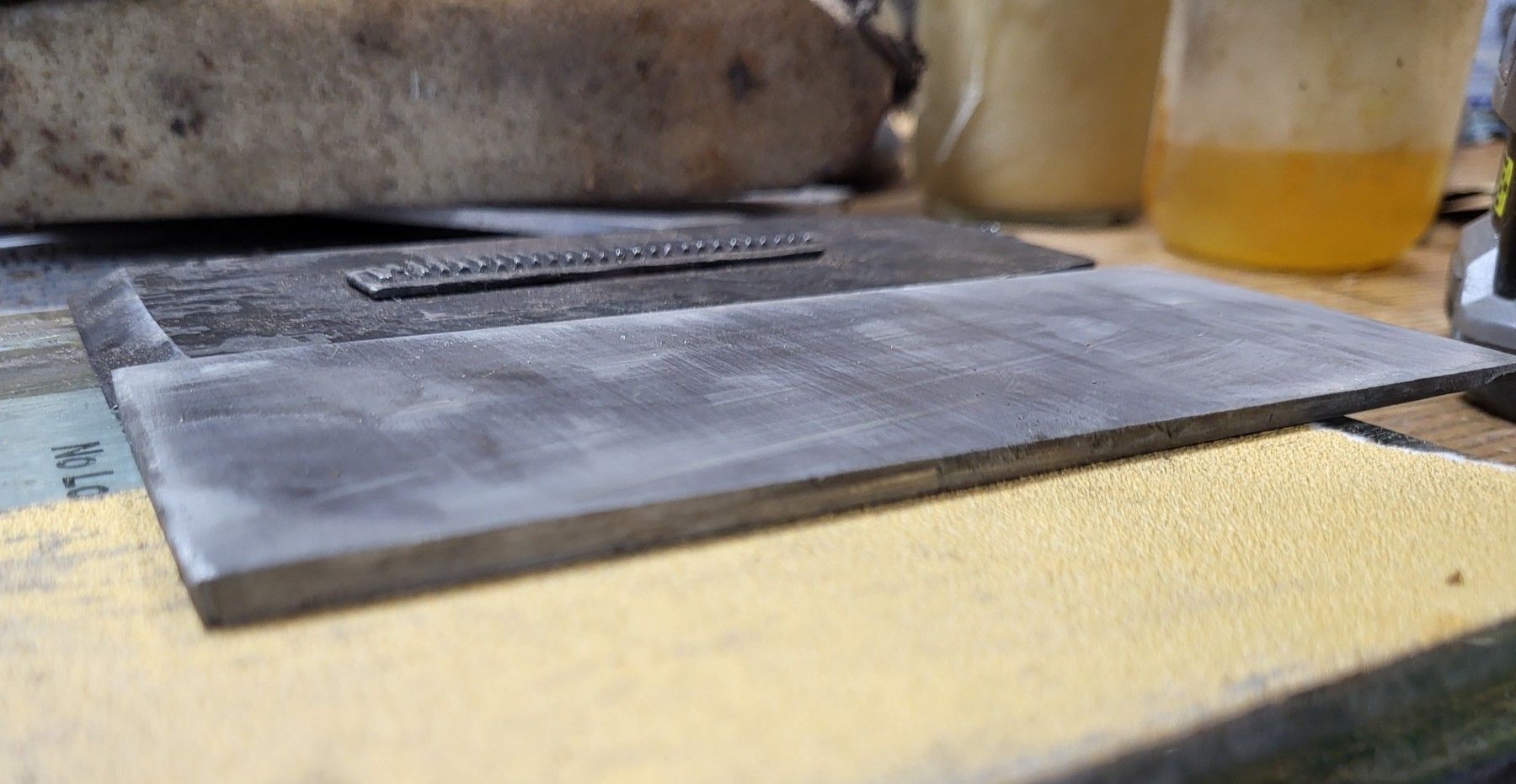
I’ll make a small tool out of a board and a file to cut the rabbet on the stock next to the teeth and then pin the fixture to the iron with bronze brazing rods 1/8th in diameter and file the teeth in last. That will be done after the iron is hardened, so the hardening can go up to the point where the first pin will go in. Pictures never show taper well, but here’s an attempt, anyway:

I think it’ll turn out fine, and the sort of visual here so far aren’t the end – it’s a rough iron at this point and can be touched up after hardening both in grinding and lapping if desired, but also just for visuals. Lateral lines from sandpaper will be gone – they’re not exactly appealing.

if you’re wondering what’s wrong with the original iron – it’s not very hard. I don’t think it ever was and I attempted to reharden this iron in fast oil and it didn’t get appreciably hard. Rather than chance ruining it by quenching it in brine, it can be put aside – that can be done any time in the future if it’s desirable, but the bevel would need to be ground off and that length lost. Doesn’t seem optimal. I don’t commonly find defective irons among mainline tools, but finding auburn or ohio or below that the lower volume one offs that just don’t have very good irons is common. I tested a very pretty Ohio iron yesterday that was later make and is laminated and it’s a whopping 31 hardness (!!!). Hard to believe, and a second strike with the hardness tester showed the exact same result. Luckily, it was unused.

I’ll return with a finished post sometime in the next couple of weeks – busy season at work and this is still a hobby.

“A Real ____ Would Be___”

Since starting, a few members on forums would always say ” a real maker would be making furniture ” or what furniture or how. Knots was full of Taig Frid acolytes, but I doubt any of them were legitimate fine makers of anything. They’re acolytes – at least self-appointed – of the people who were writing articles in magazines when they started out. Knots was pretty toxic, but it was closer to the average adult just getting on the internet and feeling like they could say or do whatever they wanted, failing to admit to other people that they were…..well, a failure.

One with a numeric name would tie you up in anything. I don’t know what his point was, but I think it was the careful craft of implying that he knew something and just enjoying the endless text referring all of the things he knew about against the things you were doing. I ran into him after making an infill plane. He instantly showed up and told me no real woodworker he knew would use an infill plane. Well, I don’t really use one much either – I made the plane. that was the point. I’m grouchier and older now – I’d instantly ask him for a portfolio of his work, the name of his woodworking business and thoughts on how much of the household share it takes on.

One of the other animals there turns out to be a tax preparer, I could never find a portfolio, and business attempts by court documents end in bankruptcy. I guess the bankruptcy filings are their portfolio. That’s what they make other than a hassle for you on the forums. Why would you look for a portfolio? Well, first, if someone loves Danish modern or CNC use, finding their portfolio would kind of tell me at least that I’m not looking to do things the way they do. You may be.

What you’ll usually find, though, is no portfolio at all and digging deeper just finds things that will make you wonder why you’d take any advice at all. Especially about what you should do with your time when you really are interested in something other than going bankrupt. Or making furniture, or whatever else.

You can probably get pretty good at deciding exactly what you want to do if you’ll allow yourself the freedom. Even if that’s doing something that involves impressing others (more power to you) by doing just what everyone else is doing. I’m not a real anything in my leisure – it’s really enjoyable.

How Do You Know What You’re Getting?

The mention of Wright talking about zen-wu chisels moving the needle, so to speak, really gives people who are into the whole influencer thing the idea that something odd – like a titanium backed chisel – is really going to move the needle. It doesn’t, of course. As much as I love making chisels, a good drop forged chisel at 62 hardness with relatively plain steel is going to be super – if you can find it.

I despise the kind of “secret steel” thing, as I mentioned in a previous post, and think that it would be a public service for someone to have the chisels XRFed, and then point out the actual or likely alloy in each offering. Most PMs are going to be biased toward carbide volume, which is antithetical to good chisel performance. Carbide volume in harder carbides adds edge life, if you can manage to avoid damaging edges. I think for anyone with experience, a plain steel edge that’s appropriate hardness and stable is going to be a better fit due to the damage/wear balance. If you’re doing more than planing pine that’s already clean and completely free of knots, you’re going to end up with edge damage. If you’re competent, effort sharpening is a pretty much linear association with the upper limit of time you’ll get with a plane. With a chisel, that doesn’t exist. If O1 lasts half as long in a planing test as V11, you’ll potentially get your time back unless you are not very good at sharpening.

That’s a good motivation to get better (faster, neater, sharper) at sharpening and figure out where you’re wasting time.

When you incur damage, you get to abrade the steel instead of the wood. Most carbide volume steels have some edge stability issues, or at least can, and some don’t wear very nicely. And some steels (like 52100) that don’t have that much carbide volume just don’t pick up a shaving as easily while they wear as something like O1, despite having similar edge life. You’ll work harder using 52100, which has always flummoxed me. Why? I don’t know. The things that show up on the microscope for 52100 are similar to XHP (V11), but in smaller volume. XHP picks up a shaving well if you can avoid chipping it – 52100 doesn’t. Sometimes knowing what is easy and why isn’t as easy and you just have to accept what and avoid getting stuck in the trap of reasoning that what you experience is just bad data. It probably isn’t – don’t try to outsmart yourself.

In the end, it’s nice to use an edge with less damage and avoid the scenarios where you just need extreme abrasion resistance. And hint, it’s not hard wood, silica or anything of the sort – it’s inability to understand that you don’t have to do most of your planing with the thinnest shavings you can make. Doing that doesn’t even give you better accuracy -it’s worse if you’re doing more than smoothing and probably worse if you’re just smoothing. That involves seeking edge stability, something you can sharpen in a minute with confidence and maybe that even points toward something where if you come up short sharpening, the uniformity of the edge is so good you’ve just accidentally done the smartest thing you can do with straight razors – you’ve left the original edge but improved the clearance behind it.

For cold woodwork (laning and chiseling, for example) I don’t see the point of anything CPM, but some of the stuff can be interesting. The lone high toughness steels that I can think of are 1V and 3V. I don’t think you’re going to find CPM 1V – literally a CPM version of a plain steel with a small vanadium addition, but it is fantastically tough. The market itself doesn’t seem to be that interested in super tough steels that may not have that great of an abrasive wear life. if you’re making dies, for example, it would have to be very difficult to find a situation where there are arises so acute that 3V doesn’t handle the situation. 3V can be super tough, but at 59 hardness, it would be a bung to use in a chisel. The 3V iron I tested, mistakenly hardened at 59 instead of 61 by Bos would form a burr on 1 micron diamonds and it never felt as sharp as V11 or really anything else. I kept having to look at it under the microscope. CPM M4 also offered fantastic resistance (not in a good way) at same sharpness, and none of this may have been as obvious if I weren’t using one plane, one board, and rotating six irons through. The differences were very stark doing that, and I’m glad to have done it, even if an intermittently employed CPA would say it’s not a good use of time.

That test made me fall in love with V11 irons. I quickly bought $400 of CTS-XHP steel, duplicated the results from V11, then went to work in wood and learned the lesson about nicking and running a test. Confirming with your style of real work is always worthwhile.

So, what does this have to do with Zen Wu – I get the kind of gas station knife goes upscale to google software engineering manager draw of the Zen Wu stuff. I think i could have Warren Mickley over, and I think Warren would never use something I made and just unconditionally say he’d like it, but he has used some of my stuff and told me the things he didn’t like about it and the things that confused him. That’s an A+. I don’t think you could give Warren a CPM chisel for production work and have him come back with any compliments. Even if you gave him free diamonds. And the reason Warren’s opinion is more important than mine or a software engineering manager’s is simple for anyone other than the chisel seller who is appealing to the engineering manager – Warren is encyclopedic, he’s accomplished and he actually does things day to day that people claim nobody does (make a living working a volume of wood by hand, and at a high standard). It’s not frequent that he visits, but I enjoy when he does – it’s like being a star trek nerd in a house full of Barbie enthusiasts when someone you know reasonably well but doesn’t show up often pops out of the car dressed like Spock. You can talk, and without saying “well, I guess I’d have to explain what that is and I don’t know how it relates to Barbie”.

The What are you Getting Part – Chinese White Steel?

I don’t expect anyone to remember this, but I’ve pipped off more than once about if someone had a desire to make a drop forged thermally cycled 62/63 hardness chisel in china with a nice profile and plain steel for a $5 unit cost instead of 75 cents per for the Aldi chisels, I would have no hope of making any chisels in retirement.

Zen Wu could maybe be that company? I don’t know, maybe they don’t work that way. The mention of them with Wright caused me to peruse the site and find these:

That is not an affiliate link, by the way!! For posterity, because the link could go dead, it claims to be a set of chisels that are White Paper Steel. For the price, it’s possible they could be Hitachi white paper steel, but here’s where the critical may be valuable for you if you just assumed that. Sometimes people are honest, and sometimes they are misleading. It could be either, but if i were spending the dosh on Hitachi White #1, I would call it exactly that. I have a bar of it, still haven’t used it. It’s expensive beyond its usefulness because it has that kind of aura around it. It would be possible to make a four chisel set like this for $200+US – probably $50 worth of white #1 steel. I can only get white and blue 1, and not #2, so i don’t know what #2 would be.

White steel is not that kind to modern heat treatment process. We’ll just skip that. The part of me that is always a cynic immediately sees this and looks for the incontrovertible proof that it’s Japanese white steel and then assumes it’s not if it’s not there. I would imagine it’s not, but the way the ad copy reads, I can almost guarantee 90% or more of the market will think it’s the same steel.

Here’s the stuff that doesn’t make sense. 1.2% carbon and 0.04% sulfur. First, White 1 and White 2 Hitachi steel don’t come in 1.2% carbon – they come in a range for white 2 that ends at 1.15% and white 1 ranges from 1.25%-1.35%. 1.2% is an odd number.

White #1 in this case also has a sulfur limit of .004% (ten times less). Even the lowly 125cr1 from Buderus that I got has a melt certification sheet of 0.001% sulfur. Why is sulfur important? One of the more common faults in plain steels and probably in others is manganese sulfide inclusions. These occur, confirm for me if you’re a chemist, when manganese and sulfur get together. Rolling stock then takes those inclusions and stretches them from a ball shape to a linear shape.

What do they do? Since they are not part of the stable steel structure, they act as points where cracks start. if you already have excess carbon, or any carbide, you have points where cracks should start before the matrix of steel around them – and the less uniformity there is, the bigger the problem can be. I am not a historical metallurgist or even a metallurgist, but I would bet these kinds of things – inclusions – have a lot to do with why it’s hard for me to find a surplus carbon vintage plane iron or chisel, and it’s also probably why you will find stories about a camp razor from 150 years ago that the entire combat camp wanted to use instead of their own.

Hitachi White #1 is often touted as being able to achieve higher hardness due to purity. These inclusions are an example why. if you have 2% carbide volume, you don’t need to add some surplus more in sulfide inclusions – especially if the carbides are iron carbides – which still have pretty good toughness. harder carbides less so, but iron carbides still confuse me a little.

How useful is it to ask a maker of chisels like this if the steel is Hitachi white 1? I don’t know, because if they don’t tell you the truth – something we have no reason to believe they’d avoid doing – but if they didn’t, you’d have no way to tell short of XRF analysis and then even if sulfur was in low form, it doesn’t necessarily mean the steel is Hitachi white 1.

If it is the case that it’s not, I can’t deny that it’s much more valuable for the retailer to say it’s white paper steel than it is to say it’s a Chinese origin or even European origin file steel. 125cr1 seems to be pretty good – but it wouldn’t sell chisels like the words “white paper” will.

The same thing here – the court numbers case. “Your honor, they said it’s 1.2% carbon and here is Hitachi’s product list”. That and the sulfur limit – could just be typos. They may not even be shown on this page – I didn’t double check. Dictum states those amounts. they could be really good, but I can make a 26c3 chisel with a beech handle for about $15, and with a nicer handle for $20. it’ll take me two hours, but I kind of like that part. I probably wouldn’t sell them for less than $100 per, and if these were just as good for $70, which they might be, how could I look in the mirror if I recommended you just pay more to make me feel special.

The Dude wouldn’t do that.

No worries on the recent crabbiness, it’ll subside. My next post will be about making things, and probably so will some after that, even if there is some delay between posts while I’m doing stuff and it’s busy season at the day job.

Floating A Few Things

One of my longer-term friends where I live, which is not where I grew up, is actually the person who got me into woodworking. Last year, he expressed an interest in Japanese planes, and since I had probably at least 6 at the time, I offered to sell him two of the better planes that I have for some fraction of what they’d cost new on the open market. Of course, I didn’t get them from a retailer marked up in the US, either – I got both from Japan.

When demonstrating the setup of one of the planes, which is basically a simple fitting operation that’s far overdone in terms of something a reasonably skilled planemaker would do, I mentioned to him that most planes when new, just with some shrink since new, would be a ten minute proposition to fit properly with better tools than you’d typically see on an instructional page. So, I made him an edge flat for the sides of the plane and a legitimate Bill Carter style rehardened (stanley 750 now at 66 hardness at that!!) push chisel to scrape. These are crudely done, not heirloom tools. the finish on the handle on left looks really bright, but it’s just a few very thin coats of shellac and then carnauba.

I hadn’t thought too much about it but I’ve got a bundle of LN floats. They’re not exactly fresh and new any longer, but I’m going to dump them on ebay because people seem to be nutso for them. and I’d rather make my own. there’s a freedom of working with your own tools – not an ego freedom, but I can beat it and someone else wouldn’t have to remake the tool for me and I won’t feel guilty kind of freedom. I like to work with tools I’ve made because of this – the ability to use without too much regard.

Floats need to be fileable, or should be. the float at the top is half hard, meaning it’s a steel that needs a fast quench to harden, but rather than do that and then temper back to spring, the steel itself is 3/16ths and won’t need to bed, so it’s just plate quenched, which partially hardens it. This works, but it’s not that great for something that needs to be spring because as far as I know, it’s just unconverted austenite and some martensite rather than tempered martensite. Austenite will stabilize over time, but it’s just tough chewy stuff.

After sending the tools above off, I decided that it’s my preference also at the top of beds on japanese planes to reference the center of a bed and use one of the small cheek floats or whatever Lie Nielsen calls the float below. So I resolved to make two, or at least two. I don’t have much use for the pull version of this float, so I took a first shot at making one of these and it’s to the right in the picture below. Pretty hideous. I got an idea, and maybe it’s a stupid one – or probably, that the first tooth or first couple of teeth for me clog, so I’d make the first tooth big. you can see if you look closely that it got a little out of hand. It looks fragile here, but it’s not.

This did, however, necessitate a way to spring temper brine quenched steel. Now that i’m quenching stuff in brine, I just much prefer to use it due to how efficient and fast it is at sucking the heat out of steel and transitioning it immediately. The confounding issue here is that spring on the lower side is generally 600-700F. You can slowly heat steel and temper by color, but this is kind of difficult if you have something you can’t hold on to – maybe more suitable for small springs that would be used in mechanical stuff.

I saw a penknife blade forger on one of the Hawley videos heat a piece of steel in the forge and then temper a blade over it by color, so I decided to do that. I got lucky, and the first attempt ended up 45-48 hardness all over. Seemed like problem solved right away. To heat a piece of steel in my forge to high heat, even a pretty substantial piece of 1/4 bar about 8-10 inches long and fairly wide is only about 90 seconds, and I can lay that bar stock on refractory brick next to the forge and not have to grab or hold or drop or touch (!!!!) something that’s orange or red. however, it didn’t work well again, and after rehardening the second piece of stock twice, the third time I decided to instead use some aluminum quench plates that I use for tempering, and instead heat them with the orangey bar stock, get a thermocouple reading from them as they have holes in them for the toaster oven just so that I can see the plate temperature while items are tempering, and then use those hot aluminum plates for direct contact and prolonged. that worked great. Aluminum with significant mass is so good at moving heat, that a bright orange billet of steel under the aluminum block doesn’t melt anything.

But there are still a few kinks to work out. The steel is 1095 that I found that has a little vanadium in it as well as chromium. I was more thorough with the heat this time around, and the piece laying loose on top of a wooden blank below is the result. this one is 52 hardness on one end and 54 on the other. Probably could be drawn back a little further but it’s spring and it still filed neatly – very neatly. What caused the tempering to be hard beyond just more heat and a better quench to start has something to do with which side of the aluminum plate/bar I’m heating and then other little details. Safe to say, not big enough to go on discussing here other than to say the refractory brick that I have is low mass, so it doesn’t take much out of the aluminum, and I can cover the whole setup with a piece of kawool and greatly slow the heat loss. 675F is what the thermocouple said on the second one, but that’s just for a bit before it descends.

The first one is always a trial, and since the second one will be given to the friend mentioned above, it needs to be a little nicer and more neatly made. But I don’t necessarily want the float teeth to be identically sized, so they’re eyeballed in the same float below and very slightly to try to prevent resonance or chatter on surfaces. I picked lacewood for the float handle, and some glue remains in the picture, but I removed that. I picked lacewood because the reality is it’s not that great of a choice and I have two pieces of it that I’ll never do anything with. Also, this friend and I prefer to make fun of each other, and this will give me a chance to say “this is a shitty wood for a float handle, it won’t be very durable, but I’m sure it will last ten times longer than you’ll need it to, anyway”.

I zapped this handle after this with carnauba, too, but wish I’d have had the patience to varnish it. Which I’m going to go and do with some of the remaining billet after this, just to see how it looks. It should look dazzling with depth – the sort of oil and carnauba finish it received just kills it.

I have another idea for spring tempering in the future. Steve may nod to this one – I think I’d be closer to 50 hardness here with a much longer 600F immersion. This could be done in a melting salt, but I don’t have a pot, or it could be done in a pot with rosin in it – something I think I will try. Rosin’s not expensive. It doesn’t love a long time at 600F, but …well, it’s not expensive and it’s pretty easy to handle if you don’t do something stupid.

Dealing with the plates isn’t too bad, but the “cold one” is 700F and the orange one, who knows. Sooner or later I’m going to grab one of them while they’re still hot and remove my fingerprints at the very least. BTDT.

Formal Definition of Astroturf

A little more for the older guys, like me, and older yet. Astroturf is a great word – fake grass. Or in this case, a fake grass roots effort. Plenty of definitions online, but they generally refer back to a marketing campaign that presents a fake grass roots effort.

A simple example that we can all gather being obnoxious would be company W2 employees and 1099 contractors going out to social media like Reddit and posing as the general public. I suspect this stuff will get much better with AI, but on Reddit, it wasn’t difficult to tell if someone was a shill. Their post history would usually show one or a few things that they commented on all the time, but the comments weren’t differentiating or very deep, and they managed to show up when a company name or product was mentioned responding to a query, for example. Mechanically, that’s pretty easy. You want X, Y or Z’s two part “hard wax oil”? Shills as part of their day job monitor sites or do open searches by date to see if something is mentioned, and probably beyond that, have a bot that does it.

There’s also some buddy buddy boutique tool astroturfing. E.g., if a planemaker or sawmaker is getting critical comments for something not done well or not delivered at all, then another will show up and attest to their products being great just kind of like a drive by. And then do it several times, perhaps giving a quasi logical explanation as to why the original poster is wrong or claiming nothing else is available and the trouble is just the cost of getting the best.

But the direct astroturfing – employees posing as customers faking a grass roots effort by the public, it’s obviously disgusting if you have any ethics at all. And at this point, illegal to my understanding.

Commissioned Turf Weaving

Somehow, we all have some holes in our logic. Cognitive deficits and biases. They can be relatively more innocent, like believing that Chris Schwarz only recommends things that he thinks make sense in a trade situation or professional situation. Maybe he does, but I doubt it. However, he’s not Stumpy Numbs on my kind of scorecard of people stitching the turf for someone else. But what Chris says he uses creates a pretty big barrier because Chris isn’t selling the stuff that he recommends.

Let’s look at this through a different lens, because I experienced a financial advisor taking advantage of both my parents and a huge group of their friends. They all have more money than they’ll need in their lifetimes, though not because they’re rich, but because they have moderate incomes, pensions and social security and don’t care for stuff that costs much. Let’s frame this accurately – consider a group of people who are spending X% of their annuity income where that figure is probably about 50%. Inevitably, they have a surplus and end up at a financial advisor. The advisor is lacking honesty, but is classified as being independent, but not fee for service. I’m not apprised of anything while this is going on because of another cognitive bias as well as other types of bias – parents often do not like their kids to know what they’re doing and after a lifetime of being the one teaching the other, they certainly don’t want to learn from their kids. And my parents were good parents, but this dynamic still exists.

So, an independent investment advisor invites one of them to a learning session. This is not really a learning session, it’s a sales lead session, to give information that seems to be separated from the products being sold and tout the independence of the advisor, and also boast about their accomplishments and book of business, which implies credibility. I think it implies something else, but we’ll leave that out. One person goes to this advisor, and the next is brought to them or one of their sessions by word of mouth. They tout that they are not captive to a specific company and say they would like to see your complete financial picture so they can give good advice. That part is potentially partially true – they need to know what your means and needs are, but collection of information about your entire financial picture also affords the advisor the ability to try to get those assets under their management, too.

Suddenly, the entire group of folks who are over 65 with no savvy are buying income annuities, and they believe these annuities are earning 8% because the advisor told them verbally they are. The advisors also make pitches that they are screening the companies they broker products for and can change every time, and that makes them on the clients side. Legally, this is what’s supposed to happen. However, this is a shield and you’re left guessing first whether the advisor is actually operating on your behalf when selecting a type of product and then second when they’re selecting the company offering the product.

The advisor in this case failed the first test, but the group didn’t know it. Had they met with something like a captive insurance agent, or someone who had a shingle that said “commissioned salesperson who gets X%”, they would’ve refused to buy an annuity. My dad’s reasoning was a critical friend of his (critical in opinions) trusted the advisor. I asked him to have the advisor call me. At my dad’s age, an annuity that pays 8% of the purchase price at the time was earning about 2-2.5% interest per year. Taxable. The group of marks in this case were loaded up with the claims – the market may average 9% but they’re getting 8% guaranteed, and they have no clue what the whole profile is or that the actual price of the annuity builds an expense-adjusted return of 2-2.5%.

I can guarantee my parents would’ve been distrustful of a captive insurance agent who sold them something, and probably a lower expense load. What they experienced was something that elder law protects people from, but it’s too seldom enforced.

In that case, I requested my dad have the investment advisor called me. My intention was to refer him to the state attorney general’s office, because what he was doing as someone who should’ve been acting in the interest of my parents was acting in his own interest. Another relative of mine who works as a consultant to larger entities (not individuals) has had a lot of success getting similar folks prosecuted, and I guess you could say he went on a tirade at the end of his career cleaning things up voluntarily.

The Situation Isn’t as Dire

In woodworking, this situation isn’t as dire, but disclosure is also weak. My dad’s advisor never called because my dad’s poker skills in terms of withholding information involved “my son says what you sold me earns 2% and not 8% and that I shouldn’t have been sold an annuity”. Of course, the advisor told him he’d gladly call me, that I was wrong about the return (zero chance of that) and he had nothing to hide. A couple of months later, he sold his practice to a large national chain. My dad referred to this as issue solved, because the dishonest advisor retired. I guess you could look at it that way. That also gives the impression that this is a one-off thing, and other than really high fees for the follow-up advisor, things are better. My dad, as you would expect, also expressed dissatisfaction with this situation in the end because what I pointed out “made him feel stupid”. He’s an upstanding 100% honest guy, and has nothing to hide, but people feel embarrassed if they look stupid rather than wanting to settle the score. That’s too bad.

But the dynamics underlying here are the same. Influencers create a situation where they are paid like a salesperson in the companies they are referring would be paid, but can present a front as if everything they show is what they picked and whatever else happens is just circumstance. I can practically guarantee you that the larger influencers have employees who seek affiliate agreements and find products that offer affiliate agreements, buy those products so they can say they did and the arrange affiliate terms later. If someone is pitching nano-silica “ceramic” finish to you and saying they bought the finish, do you think they just ran into what they bought and it’s just happy ending they could get paid? It’s possible they’re telling you they bought the product with their own money because they did even after an affiliate agreement was in place. if someone buys $100 worth of a product and collects $10K in affiliate commissions, would you consider them to be the same as someone you know who bought a product once, liked it, and never said much? Of course not, but your eye is not on the ball as a consumer of information.

The $10k or whatever it may be of affiliate commissions and “discount if you use my link” is really only telling you the price of the product has a big enough margin as it’s claimed at retail to pay both affiliate commissions, probably an investor group who is paying to set up the product along with other similar items on different sites, and still make a margin. How much is nanosilica finish directly from China? It’s a few dollars, and maybe ten for 60ml for nanosilica and a small graphene addition. that’s not to say there’s any reason to buy it – I bought some, haven’t used it yet, but the gimmick is the silica is hydrophobic. I can tell you for sure adding nanosilica to tung oil and wax makes the water bead well, but guess what – the effect is superficial. It gets even more puzzling when an influencer announces the durability of the product and then tells you that the maker recommends you apply another finish over the “ceramic” finish so that it will hold up better and be protected.

It’s not dire – you buy stuff you don’t need or at a price you didn’t need to pay. Ultimately, my dad isn’t going broke, either – though fiduciary rules would make it difficult for his advisor to argue what he was doing was legal. As far as I know, there’s nothing at all illegal for an influencer to choose what they talk about based on the biggest affiliate commission and then tell you whatever they fell like saying as long as the video they’re saying it in wasn’t directly sponsored by the vendor of the product.

The illusion of objectivity that could exist is there. It’s even better than astroturfing – not for you, but for the influencer, because if you are in the majority of long-time viewers, you already trust them vs. just seeing someone you don’t know and adding that to a list of random comments.

The influencer further is going to make the effort to manipulate the algorithm, and almost certainly, the social media platforms are going to place a value on the audience based on their data. That means, in less polite terms, the more gullible you are, the more valuable and targeted the audience is. I think people don’t believe that youtube would actually be interested in what an influencer gets for affiliate commissions or their pattern of videos and how they’re composed outside of views, but that’s very naive. if you are creating videos like Wandel, for example, who demonstrates a bunch of interesting stuff that doesn’t involve buying, you’re more likely to be deprioritized in search. It’s been a long time since I watched Wandel’s videos, but I recall that he was fighting a rash of the system making it hard for subscribers to get updates. My last remnants of youtube as a viewer involved the same thing. I had difficulty getting notifications from a few people publishing videos. they were all “bugs”, of course, where the notifications didn’t work just by chance. That “bug” that occurred at random just always pointed me toward someone else providing lower level content, like the influencers mentioned here.

Around four years ago, when it was clear this would never change, I came up with a pretty simple system – if anyone has an affiliate link in their videos, I would tell Youtube not to recommend them to me. Youtube completely ceased recommending any woodworking videos. I guess they didn’t like my choices.

Just like you will see financial advisors giving “free advice” where they don’t directly sell anything, or sponsoring something local and showing up, I’m sure you will see youtube influencers at woodworking events or presenting media about a manufacturer or a seller or a flea market or whatever else. It’s part of making sure that the important part remains – the trust level that allows you to be easier to get to for an affiliate link than you would be if the company itself sent you advertisements. You’re still playing on astroturf as a customer, but maybe you think it’s grass because of everything else around it.

That creates a completely different interesting question for another day – is it better to just be intentionally ignorant and do what feels good or makes you happy? It might be, but I can’t really offer any useful commentary.

I can offer a list of considerations, but I’ll spare you – just the first simple one, as a consumer if social media if you consume it, do you believe that the information you’re getting is there for its own sake, and if something appears in a video or is even touted or referred to that it is chosen by merit and the chips fall where they may? If the influencer you’re watching primarily gets their income from another source, it’s possible. The more their channel is the primary means, the less chance I think that’s the case, and just because an influencer has several streams of income doesn’t mean that one is where they farm marks and the others are objective.

And lastly, the nice person thing. I have known a few people who I consider to have serious ethical problems and issues with respect for other people during the day. Off hours, they are really nice, at least they are attested to be very generous and nice by other folks they have nothing to gain from. My view of influencers is dim. I think they see most people as someone to get something out of, especially if they are on the gimmick, so to speak. Which is more than just when the camera is running. They may be very nice when there is something completely outside of the area where they’re looking at people and just considering what they can get out of them. Probably, the folks who operate that way and are otherwise nice will be the most successful, even when they are also the most exclusory in terms of what they are getting out of you.

At least the mark farming is just for woodworking, though. You can get the equivalent of turf toe on woodworking stuff and it won’t change your life a whole lot.

How Much in Hobby Woodworking is Astroturfed?

I stopped reading reddit – it was interesting for a while, like shopping at a different buyer’s club store for a while, and learning some new words.

Astroturfing – creating artificial impression of public genuine feedback on items and I guess there probably already is a definition of what follows after that. A snowball where marks (as in of mark and con) begin to add to the astroturf with glowing comments. If this kind of effort goes through influencers, in my opinion here- because you’ll never get an influencer to reveal how much they’re getting or in how many other ways – you get people like James Wright pushing Zen Wu tools.

Behind astroturfing and the snow ball, you first have a product that appears to have some positive differentiation. I’ll leave that to other peoples’ opinions, but what I see is tools that are either cheaply made, or they’re made in an expensive way that’s pointless. Cheap in chisels is slab bar stock stuck in a handle (check, that’s there), and pointless is titanium, for example, with expensive milling for a bottom layer of steel. The draw for the mark is not naming the steel and making people think it’s exclusive. It’s never going to be with the rare exception of an alloy exclusive to a very few inclined folks. Magnacut is the development of Larrin Thomas. It’s a genuine effort, and what it does is novel, but there is no hiding what it is – Larrin wants to celebrate what it is and pretty much tells you everything about it from the composition, to micrographs, etc. Larrin is legit. The world of woodworking astroturf isn’t. I don’t really see the point of Magnacut in woodworking tools, but I can guarantee if I emailed Larrin (I think Larrin doesn’t care too much for my way of doing things, but he’s too quality of a guy to just tell me that, and he still will answer any question I ask – I respect him for that, too. I would answer legitimate questions of people I don’t care too much for – buddies and information are kind of separate to a point).

At any rate, here’s the key elements to the mark formula:

  • An influencer who has never really done significant work and really doesn’t have a qualified opinion about anything other than influencing. Once in a while, you’ll see a professional go off the rails which looks like they’ve given up on being legitimate, but the world of social media has generally brought us people who started with no skill and haven’t gotten far. Stumpy, Animal Trades, Wright, etc.
  • Information that comes through the influencer that seems to be novel. It may actually be new and not related to you being a better maker or really benefiting you at all in any way, or it may be copied (“the last finish you’ll ever need” – with every mark farmer offering to let you know a secret – that you can mix an oil, a thinner and a varnish and rub it on things. “psst…don’t tell anyone!!”)
  • The implication that the influencer isn’t really in on a gig. The selling is just ancillary, or hidden in token links and not discussed.
  • Offering something and getting an uneducated base to make a comparison. Years ago, for example, someone offered 3V chisels. They were all the rage. 3V at the upper end of its heat treatment range would make a decent chisel. It wouldn’t make a great one, but if you compare it to a chisel that isn’t very good, it will look good. The blueprint for a superb chisel is probably 200 years old and but for affordability of the materials improving, has not been bettered.
  • A huge group of individuals who really don’t know much then praising both the item being sewn into the field of fake’s playing surface as well as the influencer.
  • A group then reading who just is really itching to buy and has lost sight of the hand on the keyboard and the other on the bench – it’s a dopamine trip at this point, I’ve been there – that group is looking for confirmation that they can get in on the excitement. And maybe buy some competence.

There’s another odd byproduct in the woodworking world. The people who actually make stuff and sell it are viewed as shills. The influencers, who are just grifting a gullible audience are seen as saviors. If you don’t believe that, just go ask about Rob Cosman on Reddit and then James Wright.

You and I don’t really need either of those guys, but the former is a guy who really sells his stuff hard. It should be more respectable than the latter, but the latter is the model for finding marks in greater volume and not being called out. Does that mean I think you should purchase stuff from Cosman? That’s up to you – I think you don’t need anything Cosman sells and just like any other guru, you’ll be on rails if you start believing everything has to be done his way.

The pleasant David Charlesworth got me on rails when I first started. I like David, he certainly isn’t a salesy pusher nor is he a grifter, but if you’re going to work entirely by hand, a little bit from him is enough and move on or you will be stuck. That’s life. None of us needs each other. Nobody needs anything I type about, either, I’m not delusional.

Blue Forum Post

A blue forum post that came up this morning reminds me of astroturfing, but I think the poster is a Mark. That’s what brings up the Zen Wu topic. Someone asked almost exactly a year ago, the post died quickly but then was probably brought back by someone who probably searched the maker and then found a negative opinion about influencers. As i understand it, even Reddit is far behind the wave of stupidity that is flowing in the woodworking world now, but I won’t patronize any real social media sites to find out otherwise. They are a world just as artificial when there is “knowledge sharing”. They’re advertising sites, and when the advertising at the local level goes beyond the junk guy hauling stuff away from your elderly parents’ house and doing you a favor, it’s nonsense.

At any rate, the poster responded “I don’t think youtube influencers are paid”. Maybe in another 30 years, people won’t be quite so dumb. Another follow up as the plastic grass began to grow, though, described that Wright announced that his “go to” smoothing plane is now better than a boutique plane and it has the Zen Wu iron. Of course, that sentence should end with “and if you buy it, I get paid X% of your order amount if you click on this link”. The grass grew a little bit further then with a discussion of $1,500 5-piece chisel sets that were impressive at a wood show.

If I Unicorned a $50 chisel, and put it on a bench, it would snag the beginners at any show because it would be sharper than anything most of them have used. If I made a paring chisel and demonstrated malleting it into hardwood, that’d be pretty interesting, wouldn’t it? It wouldn’t to me, it’s something the chisels can handle, and so can an older Marples paring chisel and a Ward or Nurse marked chisel or anything else. But we’ve gotten to the point that a lot of stuff is marketed at, well, marks, and some of it says you can only push half length paring chisels, leaving one of the tenets above covered – compare the results to another product that isn’t very good.

I couldn’t resist seeing what chisels are $300 each, and that resulted in finding a titanium bodied chisel with a dovetailed lower layer. that combination makes no sense. The fake steel name is added to the equation. What is the actual steel? I don’t know, but it wouldn’t outperform 26c3 chiseling wood, and 26c3 is affordable. *you* can thermally cycle 26c3 heat it a step past nonmagnetic for 15 seconds and then quench in brine. You’ll also need to learn to tackle some things like warping, but there isn’t that much there in the way other than desire. A laminated chisel of that type will bend before a solid 26c3 chisel would. Will we see breakage on some of these tools like we have seen with Iles D2 mortise chisels from time to time (those wouldn’t break if they were something else but ingot D2, but luckily the market of users doesn’t really do much using).

All of this stuff – the astroturfing, the self-fertilizing marks and the whole formula makes for a good adventure, I guess. But it has staying power. What is it? I used to think, and probably a lot of folks did, that the whole commission and as in the case with SMC (blue forum) “non-competitive advertising environment” arrangement was good for sort of connecting people to each other and if you’re in the pool so to speak, you kind of deserve what you get.

But participation goes farther than that. My last paragraph implies to you and me and everyone else, “well, no big deal – if you don’t get caught up in that, you won’t ever be exposed to it”. Lee Valley at one point said only about 10% of their customer base perused forums, so when there is conflict, I’m sure they don’t like it, but what they were letting us know is most of their customers aren’t buying from there. I’m sure that’s changing.

As I learned at a sharpening class that I gave (only one I ever did!), one of the attendees floated to the front of the room with a Benchmade pocket knife. It wasn’t hard enough to survive dressing a deer. I can only guess that if you search for a Benchmade knife, you’ll get a lot of hits from social media. The days of getting a catalogue and using that and calling someone to order are pretty much over. Cross contamination here from Stew Mac – the prior post – a good friend of mine remembering Stew Mac the family owned company now long gone was frustrated that there was no phone number to call to ask questions. He ordered something anyway, and was disappointed with the quality compared to what he remembered.

Here’s the point – the efforts to spend in social media and create enough marks to taint the punch everywhere flows back out into searches for information about products. And we see now that forums that die or that haven’t yet get bought by conglomerates like Group Builder – those forums have been indexed by search engines and the users can be solicited for donations and the unregistered folks who are referred to from google will see – last I counted – 8 advertisements including a full screen or mostly full screen ad. Everyone wins all the way around except the folks looking for legitimate information.

The unicorn will save the guy I mentioned by preventing the knife he has from rolling while he dresses a deer. But it would do the same thing for a Chinese-made Buck knife (or a USA made one!) that’s $12.

So, this makes me angry and motivated, right?

Not really, you just watch and observe and shake your head once in a while. I think for anyone who will get serious in the hobby, as soon as you start making things, you quickly find out what it takes and if you never start going backwards in time to more permanent knowledge, you wouldn’t have, anyway.

I think it’s unethical – the whole influencer system, but that’s for other people to really determine for themselves. I’m sure the FTC’s intent is blown up a little bit in terms of disclosure of sponsorship by weasel wording, but again, since the beginning of time, creativity has allowed pushing the limits on the legal or regulatory side of things. There’s no reason to get too excited by that.

I will admit that if I’m talking to someone in a DM or email and they are extracting information out of me and then spring up with “James and Rex do this and this, though”, I’d like to know if you’re going to do what James and Rex advise, when all is said and done so I can reply “I think they’ll be good sources of information from you and you don’t need anything from me”.

I do think the Public Deserves Information

If you’re buying chisels, you may be indifferent about what the steel is, or you may be curious. XRF analysis will out what any of these “secret proprietary” steels are, and there is nothing that prevents you from getting that information. There is no legitimate consideration for “courtesy” here and it’s not illegal or even unethical to spend $35 for XRF analysis and publish what you find.

If I ever make something professionally in the future and don’t disclose the alloy (it’ll never happen), there is only one reason I would do it – for lack of want to use the same alloy every time. For a company like Pfeil, who probably uses 80crv2, not disclosing the alloy may have some to do with marketing, but it also will insulate them from getting bound up in discussions from armchair experts reading knife forums who want to lobby them to use something else. Same for ECE. ECE doesn’t specify the alloy – their metalwork isn’t good enough at this point for it to matter, anyway, but there’s nothing for them to gain.

I would encourage anyone to have anything I make XRFed and hardness tested even if it’s a matter of seeing if I’m honest.

When Lee Valley picked a steel that would be V11, much of the public believed they developed it and it was proprietary. The woodworking boards were abloom with discussion about how it would be illegal to have the steel tested and disclose what the alloy components are because that’s IP. It isn’t, and if LV did something other than choose CTS-XHP (as in, adjust the alloy at all outside of its spec), it would be very ill advised unless they lucked out and had Larrin give them a tip. Several people XRFed the steel, including a sawmill creek member, and described it as CTS-XHP. I think disclosing that would’ve been a boast – it’s expensive, but to the average person who is getting into the hobby with white-collar pockets and no collar knowledge, maybe thinking it’s exclusive is more valuable. To have something that’s not easy to get. Well, CTS-XHP itself isn’t easy to get – Carpenter just never really found a market for it that wasn’t better served by something else.

I guess we all pay our entry fee into this. I did. I bought enormous amounts of stupid stuff, and other than once in a while feeling a little guilty about spending money that was of no consequence to me to spend at the time.

You shouldn’t feel guilty if you mention to other people that the world of influencers really doesn’t have anything to do with making, but you’re not obligated either. I don’t think any of the influencers deserve deference – the persona of providing information doesn’t hold water and you’re not being rude by asking influencers to disclose what they’re paid for and how much. Ask them what the affiliate commission is for everything they sell. It might create a little bit of real grass growing in the world of astroturf if enough people start asking and the volume of requests gets to be too large to just moderate out every comment.

You’re never going to do anything that will change the course of real makers, so you can ignore anyone who thinks you’re “damaging the community”.

Of course in all of this, i could be all wet about all of it. Could I be all wrong? Sure, I could be wrong about Wright, I could be wrong about Animal Trades – we’re left to suppose things because there’s no disclosure. Sometimes. There can be misleading disclosure. In my opinion this would be something like Stumpy Numbs talking about a product, claiming the video isn’t sponsored by it, collecting affiliate token revenue for the item and then having a different sponsor at the end. Sometimes this switcheroo is done so that the affiliate commission is generated by someone that the influencer might like as a sponsor or that has sponsored something else, just not that video. What would clear it up? Disclosure by influencers – but that does require diligence from all of us. If you ask Wright about something used as filler to fit around the affiliate stuff, make sure the answer is for everything, not for the filler.

Wright is interchangeable with a gaggle of anyone here, just used as the example because people quoted his opinion on chisels and blades doing something material for a maker. My experience? They don’t, but peddling that narrative wouldn’t provide much financial incentive, and leads back into something the marks in the farm will tell you “if they didn’t get paid, we wouldn’t have the videos”. If they didn’t get paid, there would probably be fewer, they wouldn’t be high production quality, and you might learn something much better from them. When I quit youtube, it was for an array of reasons – but one of them was that the volume of content goes up and up, and the chance of learning something useful from it vs. learning at the bench went down. And Youtube got too aggressive believing you should either watch enormous ad numbers or pay for content that is generally just a carrier for advertising, or is veiled advertising itself.

I have personally left a lot of comments in videos about what the total take is or disclosure of revenue sources. You can guess what the response to them is. I’ve never received any answer to intent but for coming from one person. Rob Cosman, who politely answered the questions I asked. That’s far from making me consider patronizing his business or carrying water, just as rare as that kind of matter of fact response, and nicer than it really needed to be is unheard of.
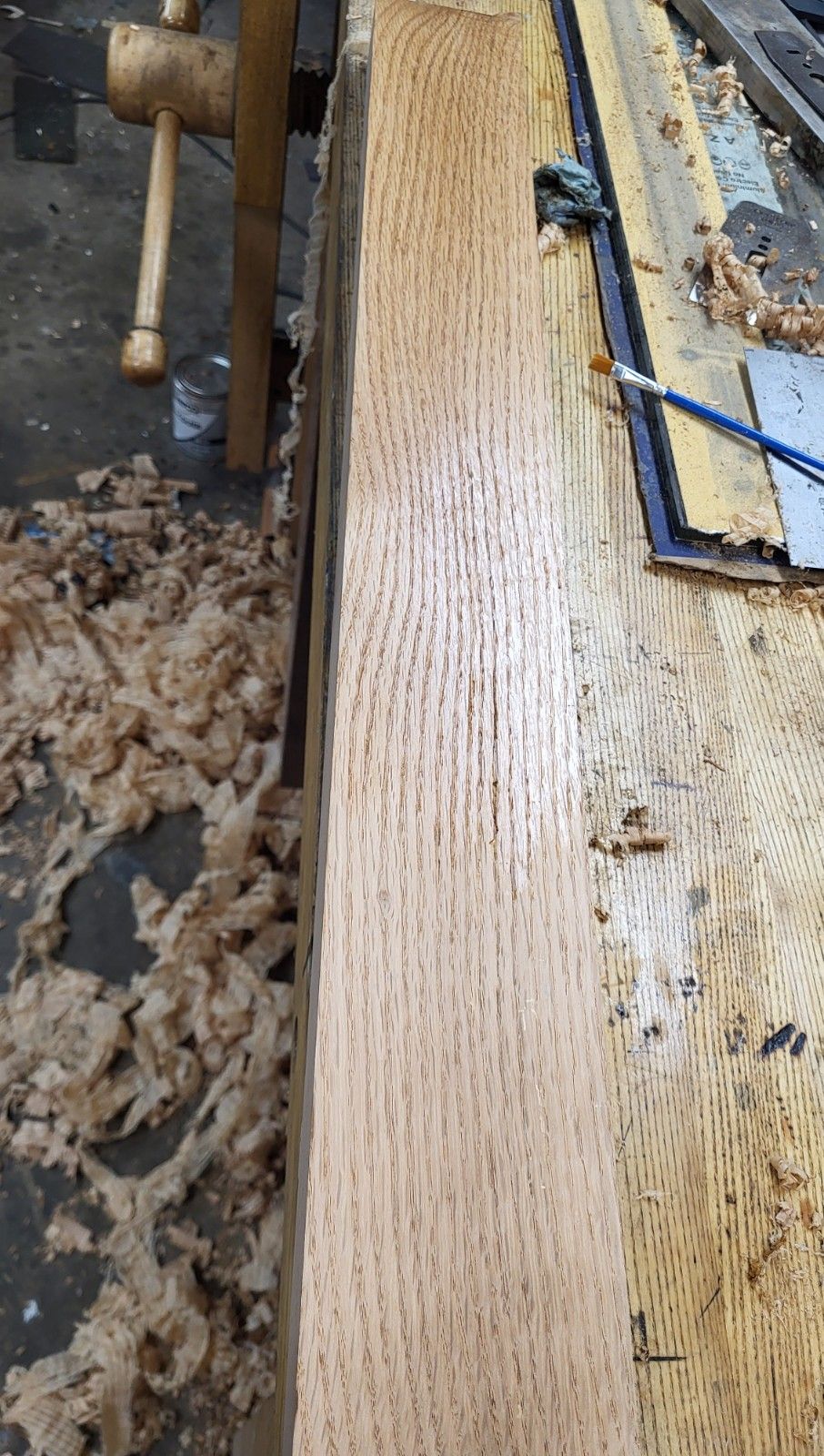
Acquisitions and Lack of Genuine Sources

https://www.lmii.com/

Barf.

When I got into making guitars a few years ago, I landed like many of us do in a crowd of people who were making basic guitars or getting into it, as well as a few older folks who learned a long time ago.

What came up as “oh you have to” was patronize LMII and Stew Mac. I did a little, but quickly realized that through the lens of someone with woodworking experience, what people described to me in the past about “Stewart MacDonald” and calling over the phone and talking to someone with questions, etc, was long gone.

I also began to notice two things:

  1. Stew Mac seemed to be phasing in more and more Chinese and lower market cost tools, but not at a low cost, and the versions of some tools like fret nippers, etc, that were Japanese were being replaced. With that, anything that was Japanese and listed could be found elsewhere for much less. Sometimes that’s just the way it goes with suppliers, though.
  2. The site seem to have a fix that made no economic sense in my view, especially for someone building one or two or ten guitars, but in a lot of cases, not for a repair person with a little creativity.

I joined their “buyer’s club” to get free shipping for the year anyway and in a fairly short period of time, there wasn’t much more than fretwire that I could justify getting. The little tools and jigs aren’t needed for anyone with some hand work ability let alone someone who does hand work and makes tools. And when I would get things like jack plates, they would have free shipping and still be more expensive than similar quality elsewhere.

I then located some of their humbucker type pickups on reverb for about 2/3rds of stew mac price and sent them a message and asked if the gray market pickups were the same as theirs. They said yes. I asked where they were made, and they said USA (still have the email).

Turns out, they’re not. The price of them showing up gray market didn’t make sense for USA made pickups in terms of someone making humbuckers wound in the US.

LMII also quickly ran out of things that I could buy, but it seemed like an alternative.

Stew Mac at some point went from being family owned to being owned by someone else. I am going to guess there was a sale of a business involved, of course. It’s my opinion that when something like this happens, everyone loses except the prior owner and the buyer. The customer loses and the suppliers to the retailer probably don’t do that well.

Seeing LMII shut down and turn into an advertising jump off point for Stew Mac – not really a great sign – at least that’s my opinion. But when it had already kind of become a place that was hard for an able bodied consumer to patronize, especially if the hobby of making things isn’t just about acquiring a lot of stuff to make a little, I guess it doesn’t make much of a difference.

There are other options now (Philadelphia luthier supply, etc), more fractious carrying a short line of things, and I use them. So all is not lost, but it’s still a reminder of where the hobbies of making things go and part of the wider picture of who -knows-what ownership that’s taken over. So much of what was out there when I first started each hobby is toast. McFeely’s was kind of one of those small line one-off places to get decent screws, only made in the US at the time. That changed and then so did the ownership and who knows what else. I don’t remember having some kind of fit and refusing to patronize them, but the loss of the original mission just sort of made it happen over time, anyway.