Would be dumb enough to make things like this? The iron on top that is.

I think this kind of stuff is interesting. It probably isn’t interesting enough to other people to do it and for some, maybe mental scorn about how it’s not “real woodworking”. Most of us aren’t doing “real woodworking”, though I’ve never been able to figure out what that is in the first place. Does it have to be real wood or can it be plywood but what you do is real? And who makes tools and calls it’s real woodworking – what is the rebuttal against? I don’t know. More on that at the end of this – but first on what I’ve devised, and it could be something different next time and so on. What I don’t want is to be bound to needing some kind of specific tooling or method to do this to a point of accuracy that’s at least as good as the iron that’s already there.
I’m thinking this is about a two hour project on top of that. A typical iron like a stanley replacement iron without machine tools is less than one.
I started with .187 bar stock. The decision to forge or shape comes up. If I had a flatter hammer and a second person who would hold it, this would’ve been faster to forge. I don’t, and my large anvil isn’t set up with space for someone to stand opposite – so there would be no time savings with that and it’s out. The subject iron here is about 0.16 or .155 and the far end of the taper is .085″. The raised area with teeth is a separate issue – you can’t see on the old iron but it’s got pins that go through to the front of the iron – they’re not flush peined, but I would assume they are affixed by being driven in and they obviously never came out.
Back to the stock. My favorite way to deal with something like this is a round contact wheel and a pair of calipers. And since it’s short, a one-time holder for the iron isn’t a bad idea, but that can come after the iron is cut out of bar stock and the ends have been beveled to set a visual stopping point.
This is what the one-off holder looks like:
What you see is a longer stick of cherry, and I took a picture after the fact, which may not be quite as helpful. the idea here is just a longer piece of throw away wood that’s a little less wide than the iron so that I can check the sides with a caliper. The screws are driven in close to the ends of the iron, but they are driven in far enough that they put lateral tension on the ends of the iron. There is no belt and suspenders thing that does more than that. The screws have to be below the level of the final article or they will get in the way of grinding.
This is then ground against the contact wheel for a variety of reasons, but among them are the fact that a belt grinder at high speed with a contact wheel is efficient, I can direct the dust and metal shavings toward a bowl with a vacuum hole at the bottom, and I can remove metal in just about any way from a point on the edge of the wheel to a line across, and rotate the iron with that line to lay it crossing prior passes. As long as you don’t grind the ends of the iron off in specific ways, you can literally use this method to make an exact replacement for an old wooden plane if you need to. In this case, it’s within a few thousandths of the original, which isn’t that accurate. The lower corners on the fat end (left) are not totally in plane, but they’re not far out and probably won’t need to be addressed, anyway.
the next step is to locate and install the toothed strip on the back of the iron for the plane’s adjuster to engage. I have the plane in another room that’s clean and dry and can test the result to make sure it will work. but you can envision a lot of difficult ways to make this strip and file it. The smartest for simplicity’s sake is not to machine the whole thing including the legs that go through the iron in one piece, but rather just take flat stock about the same thickness as the bottom to the top of the teeth – in this case .105″. That’s nearly identical to hot rolled unmachined 3/32nd stock.
What’s First?
This iron will need to be hardened and it has to be relatively flat, and then the adjuster fixture will be installed after. It would be possible to do all of this first and then just harden an inch of the iron or so. This plane belongs to Raffo – it would be a challenge to get Raffo to use an inch of the iron – that would take a long time, and there’s no guarantee the plane will be nice to use. This was Lie Nielsen’s philosophy with W1 irons long ago – challenging to harden to the slot in an industrial setting so only half of the iron’s usable length was hardened.
But I would really rather have the length up to the adjuster hardened and not just a little, and I’d like it flat. So it will get a typical routine here for irons – heat/thermally cycle, ramp up heat, quench at the top end and then plate the iron on the anvil under an aluminum plate for about 10 seconds. It’s uncommon for an iron to get away from that routine and not be pretty flat. Before adding the plating with thin irons, I would bow a few trying to both use no fixtures and also precut a little of the bevel to game the bowing of the back. if you have a bevel, the flat side will be hollow 19 times out of 20, but too much and it’s a wasted effort and getting too much hollow isn’t hard. So I shoot for flat now and cut the bevel in its entirely when the iron is hard.
I’ll make a small tool out of a board and a file to cut the rabbet on the stock next to the teeth and then pin the fixture to the iron with bronze brazing rods 1/8th in diameter and file the teeth in last. That will be done after the iron is hardened, so the hardening can go up to the point where the first pin will go in. Pictures never show taper well, but here’s an attempt, anyway:
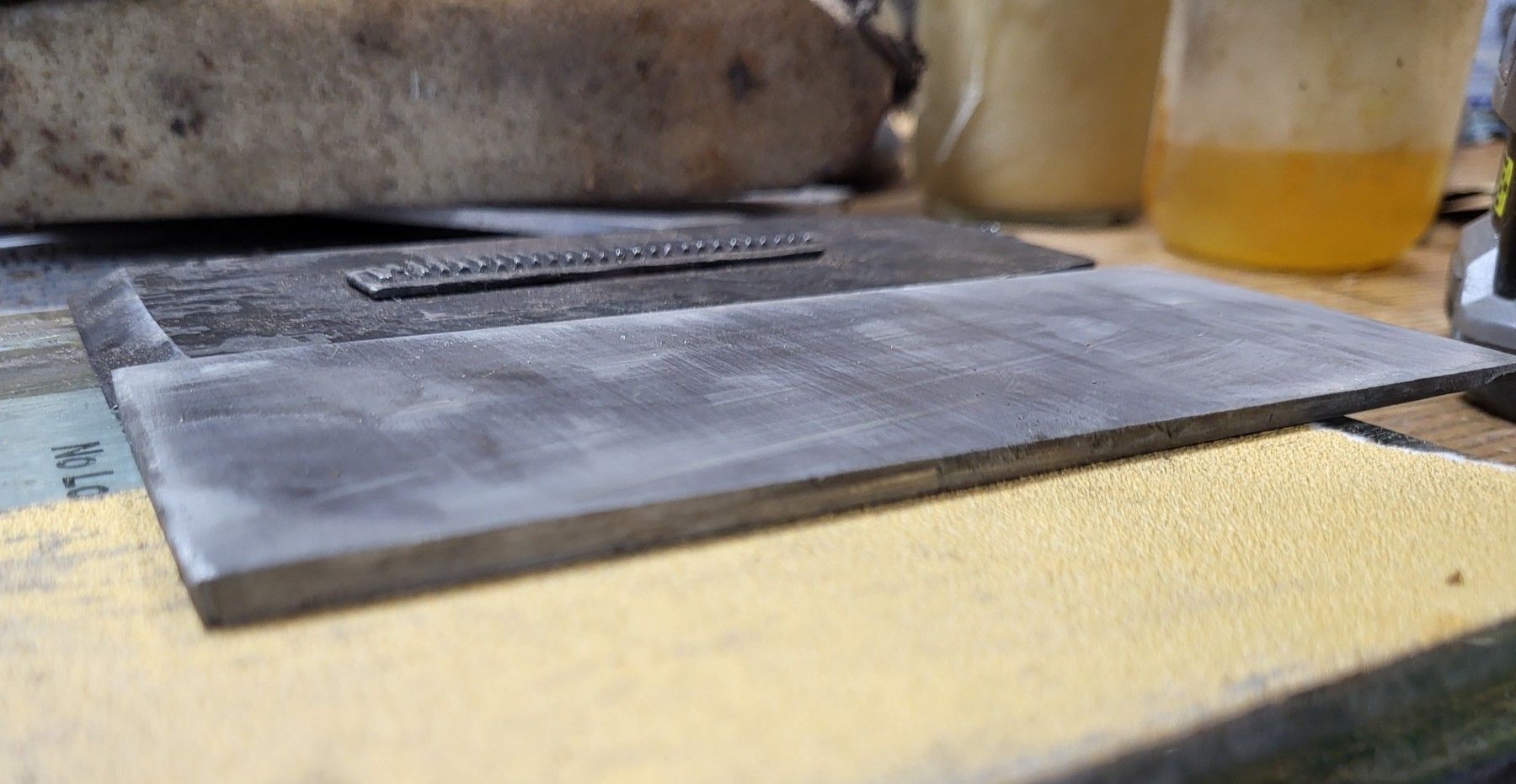
I think it’ll turn out fine, and the sort of visual here so far aren’t the end – it’s a rough iron at this point and can be touched up after hardening both in grinding and lapping if desired, but also just for visuals. Lateral lines from sandpaper will be gone – they’re not exactly appealing.
if you’re wondering what’s wrong with the original iron – it’s not very hard. I don’t think it ever was and I attempted to reharden this iron in fast oil and it didn’t get appreciably hard. Rather than chance ruining it by quenching it in brine, it can be put aside – that can be done any time in the future if it’s desirable, but the bevel would need to be ground off and that length lost. Doesn’t seem optimal. I don’t commonly find defective irons among mainline tools, but finding auburn or ohio or below that the lower volume one offs that just don’t have very good irons is common. I tested a very pretty Ohio iron yesterday that was later make and is laminated and it’s a whopping 31 hardness (!!!). Hard to believe, and a second strike with the hardness tester showed the exact same result. Luckily, it was unused.
I’ll return with a finished post sometime in the next couple of weeks – busy season at work and this is still a hobby.
“A Real ____ Would Be___”
Since starting, a few members on forums would always say ” a real maker would be making furniture ” or what furniture or how. Knots was full of Taig Frid acolytes, but I doubt any of them were legitimate fine makers of anything. They’re acolytes – at least self-appointed – of the people who were writing articles in magazines when they started out. Knots was pretty toxic, but it was closer to the average adult just getting on the internet and feeling like they could say or do whatever they wanted, failing to admit to other people that they were…..well, a failure.
One with a numeric name would tie you up in anything. I don’t know what his point was, but I think it was the careful craft of implying that he knew something and just enjoying the endless text referring all of the things he knew about against the things you were doing. I ran into him after making an infill plane. He instantly showed up and told me no real woodworker he knew would use an infill plane. Well, I don’t really use one much either – I made the plane. that was the point. I’m grouchier and older now – I’d instantly ask him for a portfolio of his work, the name of his woodworking business and thoughts on how much of the household share it takes on.
One of the other animals there turns out to be a tax preparer, I could never find a portfolio, and business attempts by court documents end in bankruptcy. I guess the bankruptcy filings are their portfolio. That’s what they make other than a hassle for you on the forums. Why would you look for a portfolio? Well, first, if someone loves Danish modern or CNC use, finding their portfolio would kind of tell me at least that I’m not looking to do things the way they do. You may be.
What you’ll usually find, though, is no portfolio at all and digging deeper just finds things that will make you wonder why you’d take any advice at all. Especially about what you should do with your time when you really are interested in something other than going bankrupt. Or making furniture, or whatever else.
You can probably get pretty good at deciding exactly what you want to do if you’ll allow yourself the freedom. Even if that’s doing something that involves impressing others (more power to you) by doing just what everyone else is doing. I’m not a real anything in my leisure – it’s really enjoyable.
 Of Making by Hand with Wood and Steel
For what kind of plane is that iron? I do not recognize the shape.
Yeah, that kind of comments are so incredibly silly. Having a hobby is all about having the joy and creativity of making something but without everything that comes from it actually being work. Who cares what material you use? And honestly, making a living from any kind of craft based woodworking is incredibly rare, and insanely rare if it is based on using hand tools. I know of one high end bespoke furniture maker in the part of Sweden I live in, and a large part of his living comes from working together with architects to make insanely high end and well finished interior wood work (wine racks and display cabinets) for wealthy clients. Another part that probably is important is the small stuff that (like pepper mills) is sold at his wife’s ceramic studio. Jögge Sundqvist is probably the only one up here that could make a living from just selling stuff he has designed and made (with hand tools only!) but he is more of an artist than anything else really. And he holds courses as well, and that is probably important for him to make a good living. This is why I get a bit annoyed when you see influencers talking about “this is the tool that puts food on my table” and not talking about the camera! Or forum lords talking about what “real” woodworking is about.
It is funny that you should post on this topic today. We were out in my parents summer cottage making it ready for winter yesterday and I helped my father to take down a dying birch. While my wife was out foraging for lingonberries and mushrooms and the kid played with the grandparents I managed to take time to make a small shrink pot from a branch of the birch. Why a shrink pot? Well, there was a sharp mora 106 in a cupboard, there was a fresh birch and getting stock was incredibly easy (I tell you, the new battery electric chainsaws are insanely practical and comfortable to use). But more importantly I got a chance to to fulfill my urge to make something. Seriously if I got some time over and all I got was a couple of pallets, I would go to town on the pallets and see what I could push myself to make out of them.
LikeLiked by 1 person
Shrink pot is something i’m not familiar with, but guessed it would be something that shrinks after making – and looked it up. Kind of like barrel making!
Plane in this case, by the way, is a Metallic Plane Co. plane. I’m not much for orphan brands, so I can’t really provide much info though you can search the name. Looks like primary period of business was 1870s. This is Raffo’s plane (geographically, Raffo is nearly a next door neighbor – only a couple of minutes away). Once it’s up and running, I’ll take his word for it on how well it works. it needs one more part after the iron.
Interesting planes to look at as the adjuster looks more complex and expensive to make than stanley type, and there is a sliding mouth section in front of the plane.
———————————————————————————-
As far as the vitriol – I guess there are a couple of categories. People who were in peripheral or part time woodworking and who left their day jobs and found trouble. They just don’t seem to trouble beginners like the Knots crowd did. To find out some of those folks were frauds solves the puzzle of why they would waste time on forums if they were professional makers (they weren’t). To see some of them start a side business and run it bankrupt and have that show up when you try to find what they’re making and selling or a past portfolio, that part is humorous. It wouldn’t be if it happened to decent people, but circumstances often matter!
My grandparents did their “final” furniture buying in the 1950s and got a grandfather clock and a huge number of solid furniture wares from a single maker in town. By the 1980s where I grew up, there was one remaining furniture maker and he had switched over to buying and repairing antiques and flipping them. That’s not counting a furniture store that popped up in town – must’ve been part of a trend. Cheap wood, kind of quickly made – but honest – very plain unfinished furniture. What the store offered was the ability to get unfinished furniture for some fraction of finished furniture and then do the sanding and finishing yourself. it lasted a few years and then was gone.
My mother, by the way, was in the craft circuit. There were spoon and bowl people back then, a guy who made seemingly endless numbers of brooms for the same price as you’d get in a store, but better quality, and a host of other things. Gift sized art between “you could do it easily” and “fine art” really sold well. Some of the people made a living doing it. My mother made the equivalent now of about $30k a year after expenses (and complained loudly about the burden of paying taxes on the income!). I doubt the market is even as geared for that as it relied about half on people filling their house with trinkets and half on those or others buying gifts in the fall. The better you were positioned in the gift area, the better you did both in sales and on how much you could pay yourself an hour. Bigger and more complex stuff was good for show at a stand, but it didn’t turn over very fast and the amount my mother could get for an hour of effort was less beyond that. Forgot the point – i’d guess that’s a sort of dying venue or at least downsizing because the requirements for everything to be hand made and made by the person selling the stuff have gone away. maybe there is more soap and food/soup spice kits now – there wasn’t much of that stuff back then.
LikeLike
Shrink pots and similar traditional objects from the Swedish craft tradition because you can just do them in the kitchen or the living room, which is great when you have kids and are busy at work and with fixing up the house. I tried to google the term shrink pot and saw that it didn’t really showed much high quality work (for some reason a lot of green wood work in the UK and US often seem to be about making rough “rustic” things). People like Per Norén, Knut Östgård and Kristine Krag shows some of the possibilities in working from tradition. But I am nowhere near their level!
LikeLiked by 1 person
there’s a lot of rustic whimsey here in the states. Sort of reminds me of George Wilson criticizing nail clinching that one of the influencers blogged about. it was done sloppily, but most people here wouldn’t care as long as it looks “rustic”. to George, it was a matter of laziness that would’ve taken little to no more effort to do tastefully. My mother did the craft circuit – you’ll sell a little more stuff if you do nice work on whimsey, but a lot of really crude stuff also sells fine. I guess etsy is that now – it’s a cold buy from someone looking, and some of the folks wouldn’t like a neatly made item, nor would they appreciate the difference in effort needed to get a neatly made item.
LikeLike
I’ve a 2″ diameter wooden handled auger I got, among other tools, from an old lady. I haven’t restored it, but the idea of making these pots using this auger has peeked my interest. I need to figure out where to green branches, though. I just cut a big branch of a Persian Silk tree in the yard, perhaps I could use that.
LikeLike
on pallet wood – most of the time, I get garbage. Twice, I haven’t – one pallet had english brown oak for the main beams or whatever running the length of the pallet and another one – I wish it would’ve been wider – had quartersawn catalpa on the top and bottom a full inch thick. it was a narrow pallet, unfortunately. Interesting wood that probably would be good for guitars in larger size.
LikeLike
Here pallets are almost always made from fast grown spruce or pine. I think I have seen one hardwood pallet (not very nice beech), it came when we ordered tiles for our bathroom that were made down on the continent. I have however found several nice pieces among the 50x50mm studs that are used to keep the bands that tie piles of lumber together from damaging the lumber. Nice straight dense pine and spruce. I have a couple saved that were perfectly sawn for making legs for a stool I have sketched out, another piece I have put away to be used for reparing windows and window frames. Real dense pine filled with resin, something you usually have to find a specialist supplier to get hold of.
LikeLike
The iron is for my plane. It’s for a Metallic Plane Co. three-lever patent jointer plane. The original iron shown in the pictures, it just won’t hold an edge, it folds.
https://www.datamp.org/patents/advance.php?pn=64790&id=8784
It’s a cool plane, whether it is a super plane, that’s unlikely.
Yes, forums are populated by many amateurs with enough free time, from actually making something, to tell other people what to do. In particular, to work wood instead of making tools.
There’s another type, the “I don’t have time to learn how to refurbish or prepare a tool, I rather be woodworking” type. They usually have extra cash to spend and gravitate towards buying expensive boutique tools the “look” like they’re ready for use, but in reality don’t live up to the expectations.
LikeLiked by 1 person
The “tycoons” that I mentioned, who have time to file for bankruptcy, quite often say the same thing. “Lawsy, heavens, buy the first thing you can use and get to getting product out the door”.
It’s nonsense in both cases, but the “tools you’re using may be good enough for you but not good enough for me” types are easier to avoid than the folks full of vitriol hiding their failures and pretending to be something they’re not.
it’d be nice if there was a color code under user IDs to be able to sort out the different types and figure out who you can avoid. That’s obviously not the point of forums, though – or wasn’t when they were actually commercially successful linking up beginners with advertisers.
LikeLike
That is a cool plane! I hope you and David will share how it looks and works with the iron in!
The point of being an amateur is of course to do what you love. The hypocrisy is of course that some people do not mind discussing commercial tools forever, but do not like it when people discuss toolmaking. Personally I have no great interest in toolmaking right now other than fixing and modifying tools, but I do like to read about it. People making things with their own hands is inspiring.
I can understand that getting a working tool and not having to spend a lot of time refurbishing is appealing. I certainly like that considering how little time I have for my hobbies. But considering that a Lie Nielsen 4 costs $602 in Sweden right now, I’d rather spend an hour or so to refurbish a used bailey. When I plane I use an english no 4 and a dirt cheap swedish school rubank (wooden jointer/fore plane). They took me about 3 hours in total to set up and I had very little experience with planes when I got the bailey.
LikeLiked by 2 people
things have changed over time. I think my first LN – a #6 with cocobolo handles – was $350 or $375. At the time, it was $25 upcharge for the cocobolo.
Bronze #4 was $350? and a #9 that I found used but unused was $300. I’d say I wish I’d kept all of them to resell now, but I’m glad to not chase rust on them. Someone paid $550 on ebay for the #4, a shock – from a true auction that started at a penny. no shill bidding either, but a lot of irate bidders who really wanted a deal and wanted it bad. I sent them a picture of payment and the location of the guy who bought it. At any rate, there’s something freeing about ending up the age old problem of N planes and N minus N_1 usable irons, when you can just replace the irons with an hour of work and about $10.
Great hobby. I won’t make more of this type of iron, at least no plans to, but I still got some ideas just from doing it – ideas I wouldn’t have.
LikeLike