Recall the origin of this test really was to see if the Zen Wu file steel chisel – which they refer to as “White Steel” with an alloy that doesn’t match anything from Hitachi – is what they claim in terms of spec. And, also, to see if it translates into something I’d see as familiar based on what I like about file steel chisels, and of course, 26c3, which is a cleaner version of a typical file steel. Cleaner not just in impurities, but based on the fact that the steel is remelted using the electroslag process.
It’s just nice steel to work with. Does the remelting make a difference in chisels? I don’t really know, but it does harden more easily at the same composition than another voestalpine sub company’s also super clean, but not remelted steel of the same composition.
At any rate, I think the Zen Wu (hard not to call it Woo based on their other offerings) chisel acquitted itself well. But more interesting was that chisel in context with a couple of mine, a Richter and a surprise Chinese chisel probably made by Luban. There’s no reason to discuss any thoughts on mine, so the others are as follows.
I don’t see a reason to get into any greater detail about the test results because of what I mentioned in the 2nd part: there are probably ways to differentiate them further and microanalyze everything, but all of the chisels in this test can do work, and I’d take any of them over highly alloyed chisels. Can do work is a little bit too much of a generalization – they are all substantially better than something like an aldi chisel, or even the Two Cherries or Pfeil sets I’ve had in the past. Why? Hardness – none were below 63 hardness. Any shortcomings each has could be overcome with very simple and minimal accommodating of the edges. So, with that….
The Woo (Zen Wu file steel chisel)
Bottom of this picture, of course. I forgot to measure the chisel itself, but if anything, it just suffers from a handle a half inch shorter than I’d like, and the shape isn’t a preference, but the gurus and copies of older construction chisels probably have folks convinced that you need to have somewhere to put your fingers against. Terrible idea. The basic forever-ago carver style handle on the chisel above is superior.
Hardness: 63.5
Fit/Finish: Relatively nicely made, though the handle is seated crooked. The issue with the tilt of the handle is cosmetic only and I didn’t notice any issues malleting.
Testing: Crisp through wood. Sharpens easily and is a very plain steel as it claims to be. Edge holding was good without the need for any follow-up testing. Better than the richter fared, but not quite as good as the mystery/probably Luban chisels.
Price: Individually, $70.
Thoughts in general: Given the origin, it’s expensive for what it is – it’s cut from flat stock with just a little bit of taper ground into it. The test chisel was hardened fully all the way up to the tang, which didn’t give me any pause, but it’s a straight in chisel and not one for any prying. The handle appears to be maple and is really light weight, but nicely finished.
Richter

Not a great picture, but you know what it is, anyway, and searching on google for it if you’re unfamiliar will run you into gurus and affiliate links aplenty.
Overall proportions are nice for a handle gripping chisel in chopping, which is important if you’re going to do substantive work. The blade is thinner than many others, and the finish work is nice, though it’s basically polishing on the long-done process of drop forging and then running a chisel through what is probably a rotary grinding machine, resulting in the step up to the turned tang/bolster area.
Unfortunately, this chisel’s grain appears to be slightly bloated, and in nicking off steel to get a picture of the grain, both the punch easily seemed to crack steel away and also the first test of slight edge with some unicorn resulted in the worst outcome. That result was mostly eliminated when testing against one of my own chisels just honed at a steeper angle, so I don’t anticipate anyone will have any issue using these after figuring out what they like. Lots of grain growth in heat treatment results in an unusable tool. Just a little results in one that’s hard tempered, which is how this chisel comes across. Will it match a chisel with a better heat treat entirely? No. Will it matter in use? I guess if you had something demanding enough, it might reappear, but edge damage from new users probably occurs far more from doing stupid things than it does from demanding wood.
Costs a lot less than the Wu, fared the worst overall, but again among a good group. Still worked through the maple test wood with significant damage because it’s hard tempered and doesn’t hold anything, but it’s too far into the hard tempered range to dismiss that, you’ll end up sharpening more off with that setup, and it really just needs more angle sharpening and discretion.
Hardness: Lost my notes already, but from recollection, also struck in several areas between 63-64 in different spots. It is a point or two less hard just at the step where the tang/bolster cylinder meets the rest of the chisel.
Price: $45
Fit/Finish: Nicely made. The ash handle is commodity feel of sorts, and the leather washer is dorky in my opinion, but some people like that. I don’t think a chisel with a hoop needs it. Compared to the LV pattern with the strange handle shape, and flat look, this is more in the territory of a chisel by definition to my mind and doesn’t just scream “flat stock, designed by white collar folks”. It’s a dressed up drop forged chisel that would’ve been outstanding if it had been pushed just a little less in heat treat.
I have no idea how these are heat treated, and this is the first commercial tool I’ve seen that shows some signs of grain bloat, but given the aim here, to get high hardness and then finish it off beyond that with cryo treatment, it’s understandable that someone along the way may have figured they’d go to the top end of the HT schedule or a little further to get some extra out of it. Cryo will not grow grain, so whatever the issue was, it was before that. Etching the grain to actually get sizes would provide us with more info, but I don’t have etchant and the etchant for steel is nitric acid in ethanol – if attention isn’t paid to the concentration -e.g., if half of the ethanol evaporates from a 5% nitric etchant, it can be explosive.
Otherwise, you could do a lot worse for $45. My opinion from having had a V11 chisel to test with for the unicorn article and then this chisel is I’d accommodate the edge on this chisel all day before wanting to have any V11 chisels on hand as a regular user. that’s without going further into the fact that you can get at least two of these for a single V11 chisel, and the ash handle will almost certainly hold up better in the long run.
Mystery/Luban
These chisels came from amazon, and are listed as being salt bath heat treated from 100cr-v steel. We still have not seen any reliable spec regarding what that is, but I suspect it’s something similar to what knife manufacturers in the US call “1095CV”, which isn’t 1095 anything. It’s a steel that’s still much more plain than anything you’ll find, though, and the Chromium and Vanadium additions almost certainly improve potential in a chisel vs a 1% steel like W1 or so called regular 1095. I don’t know where 1095 and W1 came from in terms of modern alloying, but they weren’t designed to make chisels as neither will match a crucible steel English chisel. At least this set of mystery chisels likely will.
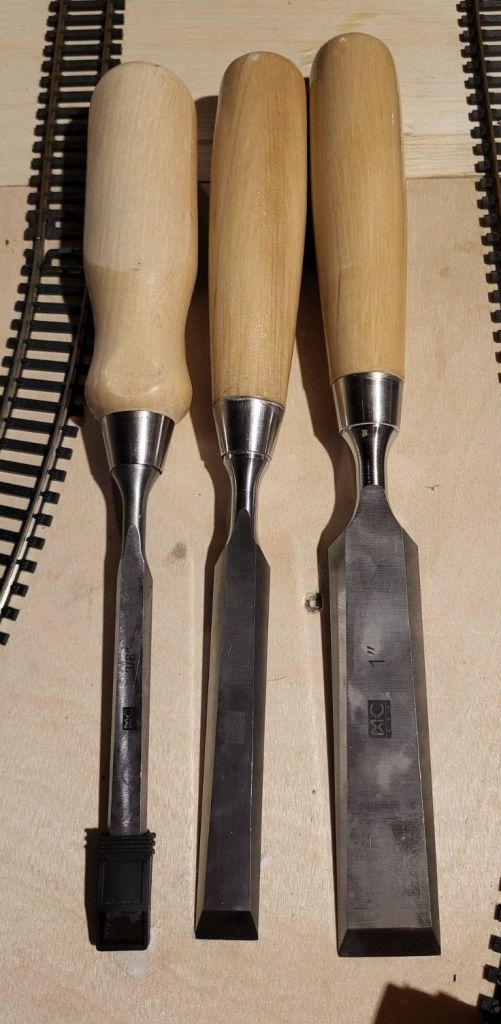
This is a group from a set of six, of course. The handles are just terrible, as bad as anything I’ve seen put on a chisel. The one on the left is as they arrive and I reshaped the other two here.
After reshaping, they are still a little weird looking to my eye because of the steel cup instead of a straight ferrule, but that cup is probably there because it’s better for consumer chisels than a ferrule that would have to be precise fitted and then still may come off. The tapered cone isn’t just a cylinder of thin steel – the bottom is solid and the stub tenon on the handle that fits into it is only half of the length or less. It’s functional.
As mentioned elsewhere, these were $50 for a set of six when I scabbed them from Amazon. They’ll probably usually be more. The heat treatment is superb. A comment at the end of this – I am focusing on the heat treatment and how I really can’t see that it could be done any better, but that shouldn’t be interpreted to mean you can sharpen them at 22 degrees and mallet away. That’s not reality.
Hardness: 63 at the bevel and 64 an inch further up. Nearly full hardness up to the step where the grinding stops below the cone tang/bolster – not the cup that is, but the step on the chisel bit. I can’t hardness test any further up than that as I need a flat surface to test.
Testing: did better than the two above in the tests. The increment above the Woo isn’t enough that you’ll care in use, but we’re still taking about a chisel that’s about the same for six as the others are for one. The steel is “dry” and lovely to sharpen, as are the two above, it’s very plain, and the quality of the steel itself along with the heat treatment is in a completely different class than the run of the mill aldi or HF chisels. On this set, at least, I don’t see how it could be improved. Compact grain, good hardness, and to accommodate this to a point that it takes no damage would hardly take anything at all. Which could probably also be said for the woo.
Fit/finish: Well, the handles are terrible. They’re a hard don’t buy if you’re not willing to reprofile them or replace them with something of your own make. Otherwise, the chisels are not as well finished as the upper two, but they are surprisingly well finished otherwise. The lands are short and will not injure your work, but they are still there, which is important for corner durability. You will spend some time flattening a couple in the set even if some are close to dead flat, but they’ll be worth it in the long run if you are buying a set of chisels and using them on a regular basis. If you spend as much time buying and setting up chisels as you do using them, then I guess getting a chisel that requires no setup is important for no other reason than to prevent the rest of us from hearing how valuable your time is – because it certainly must be too valuable to do woodwork if that’s the case.
The handles are some kind of euro hornbeam. Don’t expect fas+ grade – there are mineral streaks or something here or there, but the wood is sound and it’s oriented correctly and should be durable.
Now – the heat treat fascination. Imagine you’re buying anything and you take a machinist with you. There may be something in the machining that you don’t care about but your machinist friend is smitten with and cannot stop talking about. When heat treat is dead nuts, I just cannot help by being impressed. But as much as people talk about heat treat having never done it, which is usually what you run into “oh, it’s the heat treat!”. It’s like listening to my dad’s teacher friends providing opinions about lots of things they’ve never done. They have a lot of little bits of wisdom that they have no actual practical clue about, have never done, and never would, and if you said “oh, ok, if it’s the heat treat – I have some pictures – which if these is bad enough that it will cause a problem and how can it be fixed?”. None know anything about that.
What it does amount is a chisel here that you’d expect to give up something on because of the price as far as the edge goes. Instead, it performed better than the others, is a delight to sharpen and grind and really provides a lesson in what it really takes to do good work in making a chisel that’s got basic function. The heat treat should be a dollar per chisel issue, especially if it can be done somewhere foreign, and what we’re really talking about is defective or not, or failing on a spec that just makes the whole result crap. A steel like this chisel that’s heat treated to 58 is a waste of time. It doesn’t matter what you say about how perfect the 58 hardness heat treatment is to spec, the chisel is a dog – it’s at a hardness more suitable for a hacking knife.
But the difference between a good heat treatment like the Woo has and one where I’m enamored is probably erased on a degree of edge setup. So I’m paying some respect to the fact that they did it right here, just the way I would do it, and I don’t always get it right, either. When the stars line up and you get a 62/63 hardness Ward chisel, let’s say, and nothing is left to gain other than aspects that don’t exist in reality, that’s where this one is. It will still depend on you to not fail, though.
And the last caveat: I have one set of these. Others have bought them. They are on amazon and can be mixed with others. Do not assume the same manufacturer will make a set like these just as dead on 1 year from now or whatever – we just never know. And don’t assume all of the chisels in a listing are made of the same steel. At the time of this writing, they are fluctuating in price, stock level, and sometimes even a saved link will redirect you to something that isn’t the same thing if the stock of the “good stuff” is gone. That’s the magic of Amazon – Amazon probably gets a service fee for sending these and then taking them as a return when they do something like that.
Which Would I Take over a Good Vintage Ward and Payne Chisel?
Probably none of these. The edge holding is probably in the ball park, but patient looking for older chisels can lead you to sets, especially if they are something like Ward but from a different make of the same era – for the same price as one Woo chisel, and nothing about the three above is as appealing to me in totality in use as something like a bevel edged Ward or really old Marples (octagonal bolster) or something else of the like.
But, those can be hard to find, and a good rule of thumb is to buy twice as much as you need in older chisels, keep the best half of what you get and resell the others. Most people don’t have tolerance for that, and the average newbie to woodworking will have no clue. I didn’t. I bought a lot of stuff I shouldn’t have.
I’m sure that won’t stop, but it’s less now than it used to be!!
I Excluded the Wheezing Ward Here
I’ll call it the wheezing ward because it has to have been made at the tail end of W&P chisels having an octagonal bolster on it. It’s just not finished as well, and two of the four that I have are soft on one corner, which I can only guess is due to piece rate demands when grinding.
Not the greatest picture below. The proportions are that of the good ones. the handle shape here is kind of pointless, but maybe it looked more interesting than the carver style. If you’re gripping them for use, your hands span the cut out area, and it has no function when pushing the chisel. It is a light chisel, though, easy to have in hand.
Ward was probably wheezing by this point in terms of making ends meet, like an asthmatic runner trying to stay ahead of the drop out line. You can’t really buy this chisel, but it was a match other than the corner softness perhaps with the exception of the 100cr-v chisel, but awfully close otherwise. If you’re looking for older chisels, I’d stick with something that has sharp edges on the bolster and tang and not spun/turned. There are likely chisels that have the later turned style tang that is thinner than the cone shaped tang areas on the chisels shown above in this test, or that look like the current Stubai chisels, but some are also just soft, and I have no idea how you can tell which are soft and which are not.
The only perennially soft older bench chisels of this era below, at least that I’ve seen, are Buck. And they must’ve done that on purpose, because their patternmaker’s tools and paring chisels aren’t soft. What’s soft to use for hardwoods may have been delightful for someone working in mid grade mahogany all day.

 Of Making by Hand with Wood and Steel