Padauk. I’ve got some padauk I bought back when it was inexpensive and you could get blanks kiln dried. which is a blessing and a curse. Dried purple heart, padauk, etc. is miles away from being anything like green turning blanks, but it’s also nowhere close to being stable as tool wood. I learned that making a skew infill shooting plane in the winter and then having the purpleheart infill swell a small fraction and telegraph all of the dovetail in the steel plane pretty seriously. Not a big deal. but for something like a fitted stone box, I’d also bet the kiln dried turning blanks cut to a close fit would be split within a year or two. The stone certainly isn’t going to change.
I have been drying the varnish on these in a UV box – it speeds things up nicely. Two or three hours, the box is up to 95 degrees, and you can remove item in question, wetsand if needed (every two or three coats) and brush a fine coat of varnish and keep going at it. The stone boxes that I’ve been making get tight just from being in that heat, and a scraper to the sides is all it takes to relieve things.
So, anyway, even this padauk, which was KD and probably 6 or 8 years old through a lot of dry winter cycles still shrinks in that box a little. when it was new, it may have shrunk enough to split the box in days. Too, I never found a use for padauk and have two 14x14x3″ quartered to rift blanks. They’re ideal. Why? wood is a funny thing – the smoothness of recently dried wood is one thing, the stability isn’t there. Once wood is decades old, it changes in feel, and I’ve started to realize that having wood that I may not use for another couple of decades will mean that maybe the wood won’t be as cooperative in certain ways. Cocobolo, for example, is just dreamy for handles if you find it really old. More than half of the cocobolo I’ve found is a little over 50 years old. Compared to newer oily seeming cocobolo, it’s almost unrecognizable. it’s agreeable, though probably less easy to plane to a perfect finish and the oiliness that it would’ve had has long since disappeared. Those volatile oils that make dry newer cocobolo kind of cakey probably aren’t stable over decades, and we already know the wood itself changes over time to be a little more brittle but much more stable as the volatiles are gone.
So I’d better use the padauk, and when you buy gobs of wood that you find on a deal, if you do, it’s probably good to treat it like a prepper pantry. It’s nice to have stuff around, but it can’t sit forever. (not a prepper, by the way, but I get the sense that preppers need to eat out of their stash on a regular basis and rotate it so as not to get to the end of the world and find something that looks like a WWI military ration).
Padauk in this case, again hand tools only again, same tools, just with a shot at making the lid thicker and the top rounded. 
Padauk is supposedly around 1700-1800 hardness. it definitely has straws that aren’t terribly easy to plane expanses of on end grain easily, but it’s not intolerable. This one again has silica in it!! Too, the profile on the top is cut with little sandpaper, but unlike the other boxes where none is used, after planing, rounding and filing the profiles to near finished state, I did sand them to try to make them look as uniform as possible. I hate sanding – the mess, the boredom, etc, but on a round profile like this, it’s the easiest way I know to not have stray marks. The same beading plane worked fine again across the end grain, it has not been resharpened and the fact that it’s held up without beating up beads or leaving lines on anything is a testament to us often being off the mark about needing abrasion resistance vs. understanding geometry of edges.
Of course, the same design on the bottom after the above, and after pore filling with FF pumice mixed in a long oil varnish, the finish is almost gloss. 
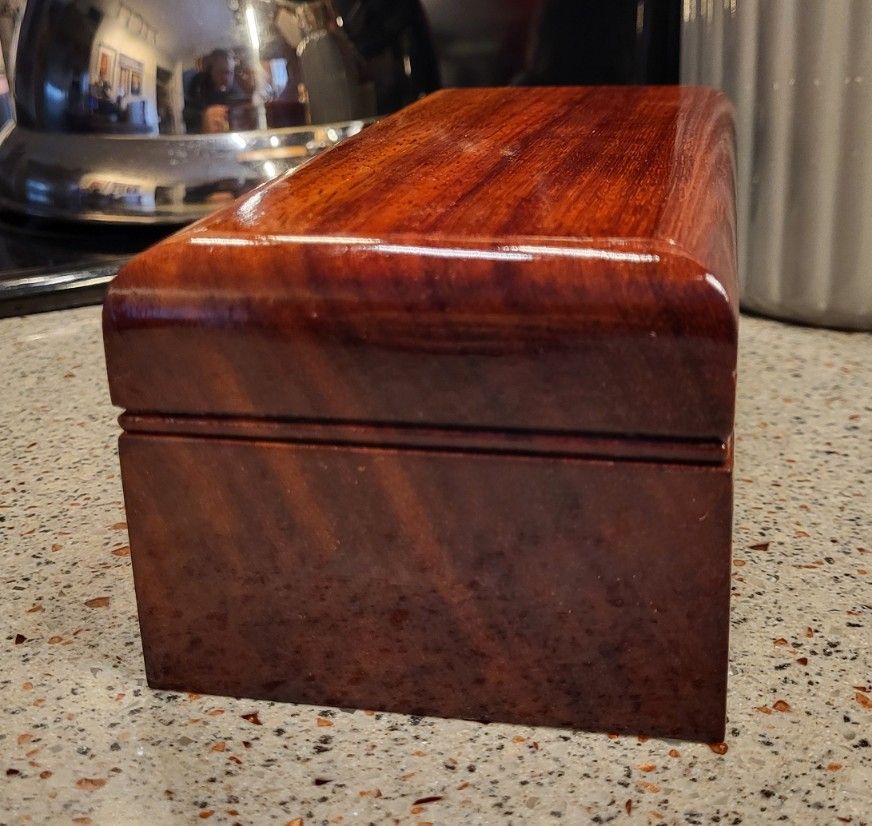

Almost gloss here, which you can see if you look closely suggesting that I didn’t build a big thick finish and the sand and rub out what’s left. Rather, it’s just applied and then wetsanded and after the last wetsanding with relatively fine paper, the final coat is just as brushed with a small fine artist brush. thin so that it will have minimal brush marking or stria.
It’s interesting that in making this box, I used some of the least abrasion resistant tools that I have and never once felt like they were limiting at all. For the gouges, if the tools were more abrasion resistant, it would’ve been aggravating.
Oh….
An after the fact edit – you can see the chip on the corner of the box in one of the pictures, or maybe several. You’d think that’s from chiseling or planing, but I was actually filing the end grain. I really like planing and then filing end grain – it’s miles better than sanding end grain, but it will break out the dry brittle grain that I mentioned, especially on padauk, which is really chippy at edges. I can’t imagine it would’ve been like that just after being dried. I did nothing about it – no repair, no attempt to glue the chip on and hide it because it’s a stone box. I’d be nice to make a jewelry box or something like this style and really tart it up for real – no damage, and build the finish and make it look nicer than the off the brush finish in this case. For stones, there’s no use…..why? As soon as you have swarf on your fingers, whatever you touch in terms of finishes will get deglossed by the metal grit. When these get deglossed, I’ll just hit them with 4F steel wool and wax them with carnauba. What I really want out of the varnish, and what it’s great at, is ignoring any alcohol or oils or WD40 that’ll be used on the stone – it’ll keep the wood clean.
 Of Making by Hand with Wood and Steel