I set out to make a handle for the rosewood plane, and of course, you wouldn’t want the handle to be pine. I have some nice rosewood that’s 8/4 quartered, but it really should be saved to be resawn for a guitar top or acoustic guitar backs – which is what it’s for. I thought I had a pile of 8x8x3 and 6x6x3 blanks, but I don’t. I have a couple.
Over the years, I’ve tied to buy quartered and rift blanks when I see them because they give you a lot more options than one with the typical flatsawn C pattern in the ends. When a handle has wood that shows evidence of that, it looks weird. My best choice is this:

I have a terrible habit of getting a few blanks and then one is like this. What can you do with it? it’s a bummer as it’s sawn off center two ways and if you get obsessed with a 6x3x3 blank like this trying to get every cent out of it, the work suffers. I guess something like this with shipping and tax is about $50, but you can’t just go order 10 because stock pictures mean you’ll get all kinds of nonsense when you want quartered or rift.
I’m growing up a little and instead of procrastinating, the real answer for this is I hope to make stuff nice enough that I can have some waste from resawing this kind of thing into the right orientation and the rest of it be damned. If I spend 15 hours on this rosewood plane and try to save $25, and then don’t like the way the handle looks, it’s not a good decision. I guess that becomes the challenge – if the wood is too nice to waste, but still not good enough, make the work nice enough that you will want to make the wood right.
You can see pencil marks on both the sides and the top. Ultimately, I don’t have much for power tools any longer, though I do have a nice big dolmar chainsaw!! Unfortunately, this isn’t big enough for that. so by hand it is, which is good, because it’s what I want – I want to cut the wood, feel what it’s like, get a chance to look at it. My brain is slow and because of that, my work by hand is better than work that I used to do with machines. The opposite of what most people will tell you will happen.
This is especially true shaping the handle. I have a sort of routine, but it is not end to end step by step with lots of repetition. If I were to try to speed up handle making with power tools, it would result in errors or chipouts, etc, or just not enough time to look at what I’m doing – and my eye is pretty good for a hack, but it’s not good enough to look at something briefly and just slash wood away. 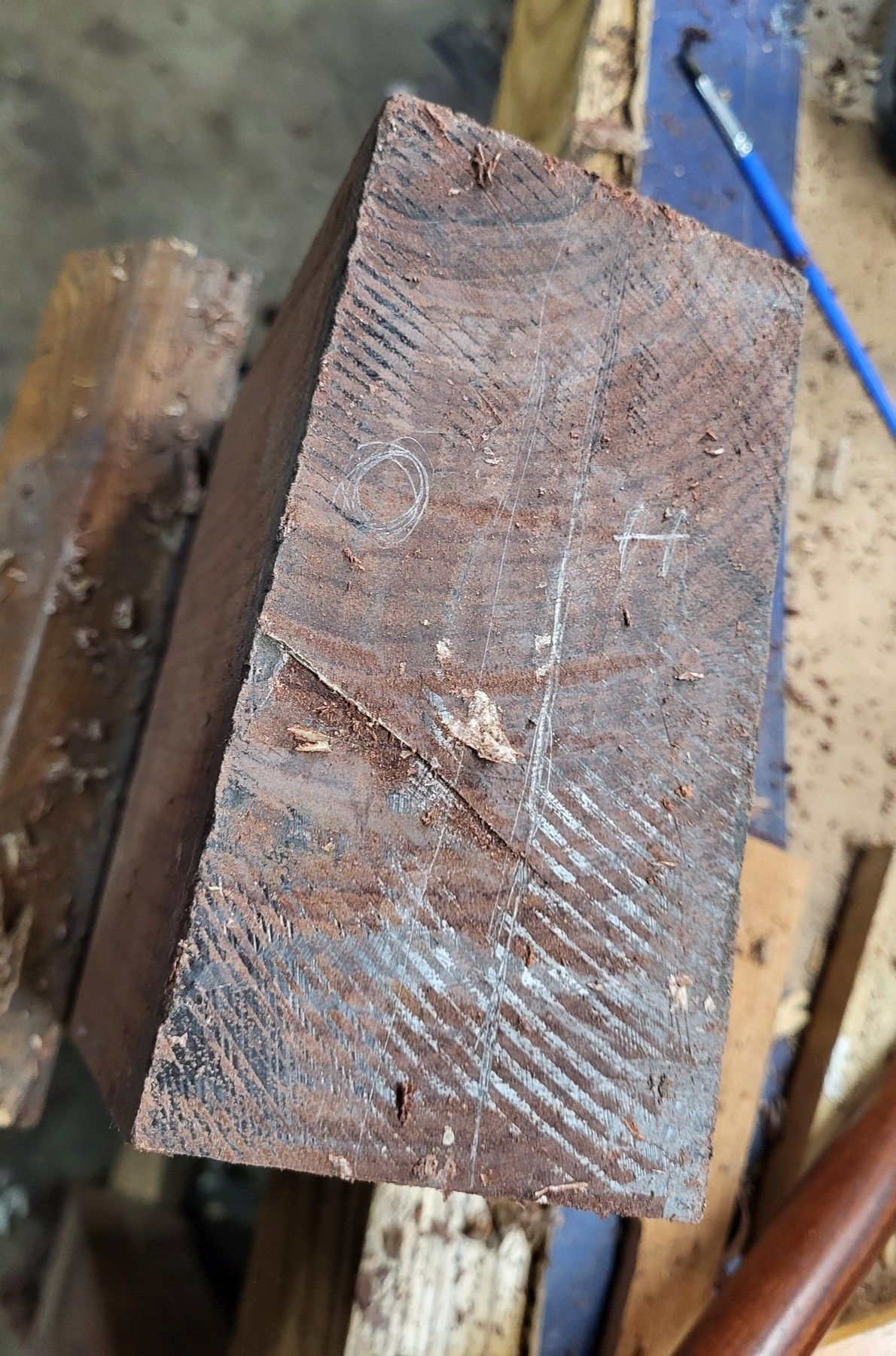
Now…the ends of this leave some decisions. The top left corner is near the pith. that side of the blank is closer to the center of the tree so it doesn’t have grain running vertical into the top of the handle. The wood on the right does.
I have no idea what I meant with the O and the H when I marked this, but I want the wood with the O to be on the back of the handle. Of course, this runs out into the side of the plane quickly, so it’s the right side that gets kept here. The trade is on the other end of the blank, the wood that’s visually nicer and getting cut off here is what’s kept on that side – so the far face on the ends is the back of the handle.
It does take about 20 minutes of hand sawing something like this with a rip saw to get what you want, but it gives me time to consider. If I had a bandsaw, what would it take? Not long, but dealing with dust and changing blades, etc, isn’t time free and at least doing it by hand, I’m working the wood the whole time.
Contrary to popular belief, a normal disston d8 rip set up for anything else cuts this just fine. 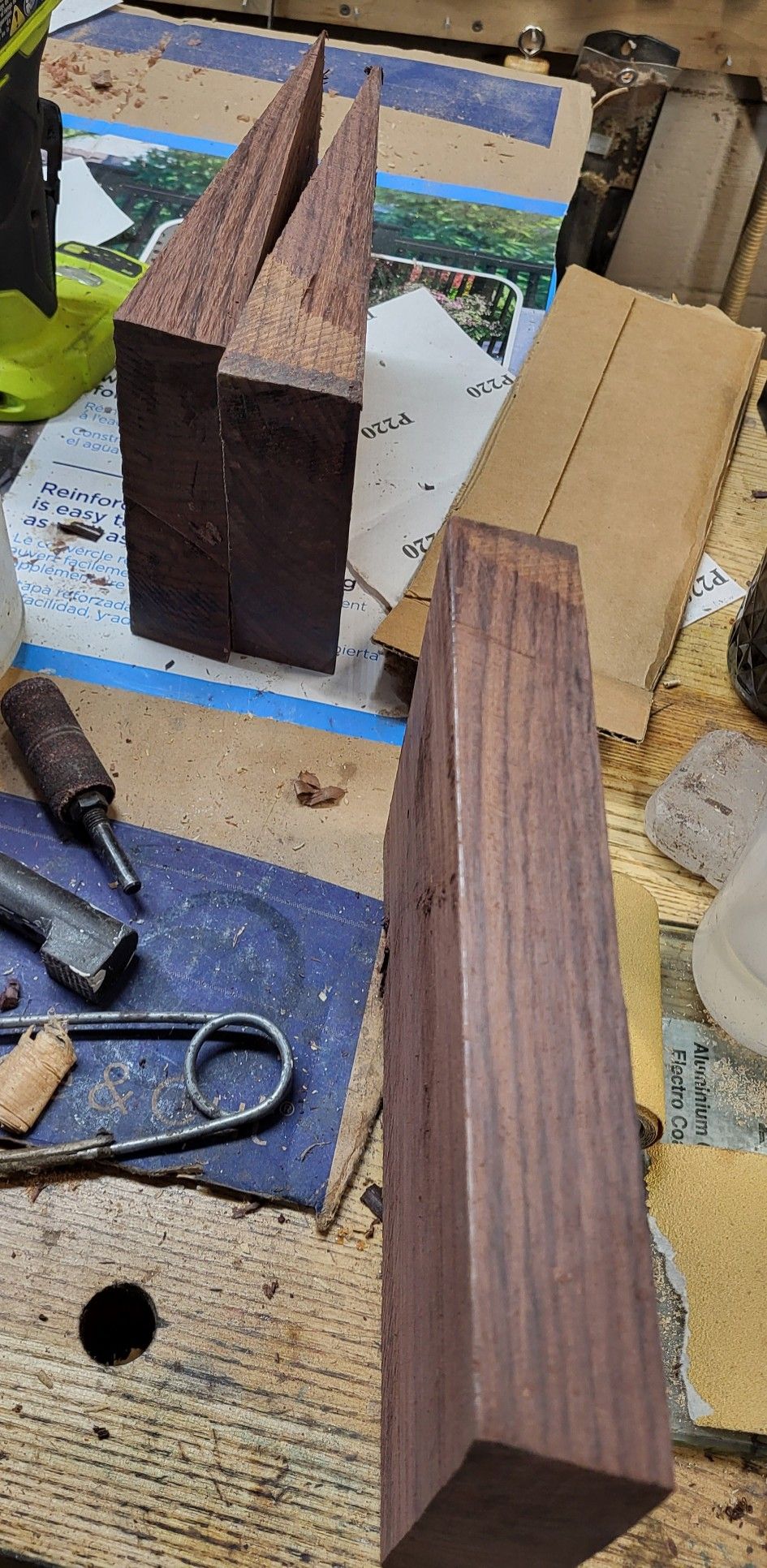
I have two thin wedges from the top and bottom not in the picture and the other two shown here. there may be a use for them at some point and if there isn’t, they can go in the scrap bin. The thin ones are ideal for ripping long boards by hand. hard wood with a really slight taper that will hold boards open, so I put them with the handsawing gadgetry just for that.
I left this a little fat – a little less than a quarter just to make sure there are no surprises, planed it and squared off the ends so that they wouldn’t be a bear with bench dogs, and then thicknessed it with a jack plane and smoother.
Resawing something like this can be a little awkward, but you can figure it out. Black rubber drawer liner – the holey kind, not the thin slick stuff – is nice for something like this as the wood is hard enough that it’ll be slick on a bench top and you’ll be whacking the holdfasts endlessly.
I always print out the handle profile I want, which is always a picture from straight on either as found or in this case, I took it from a plane on my shelves.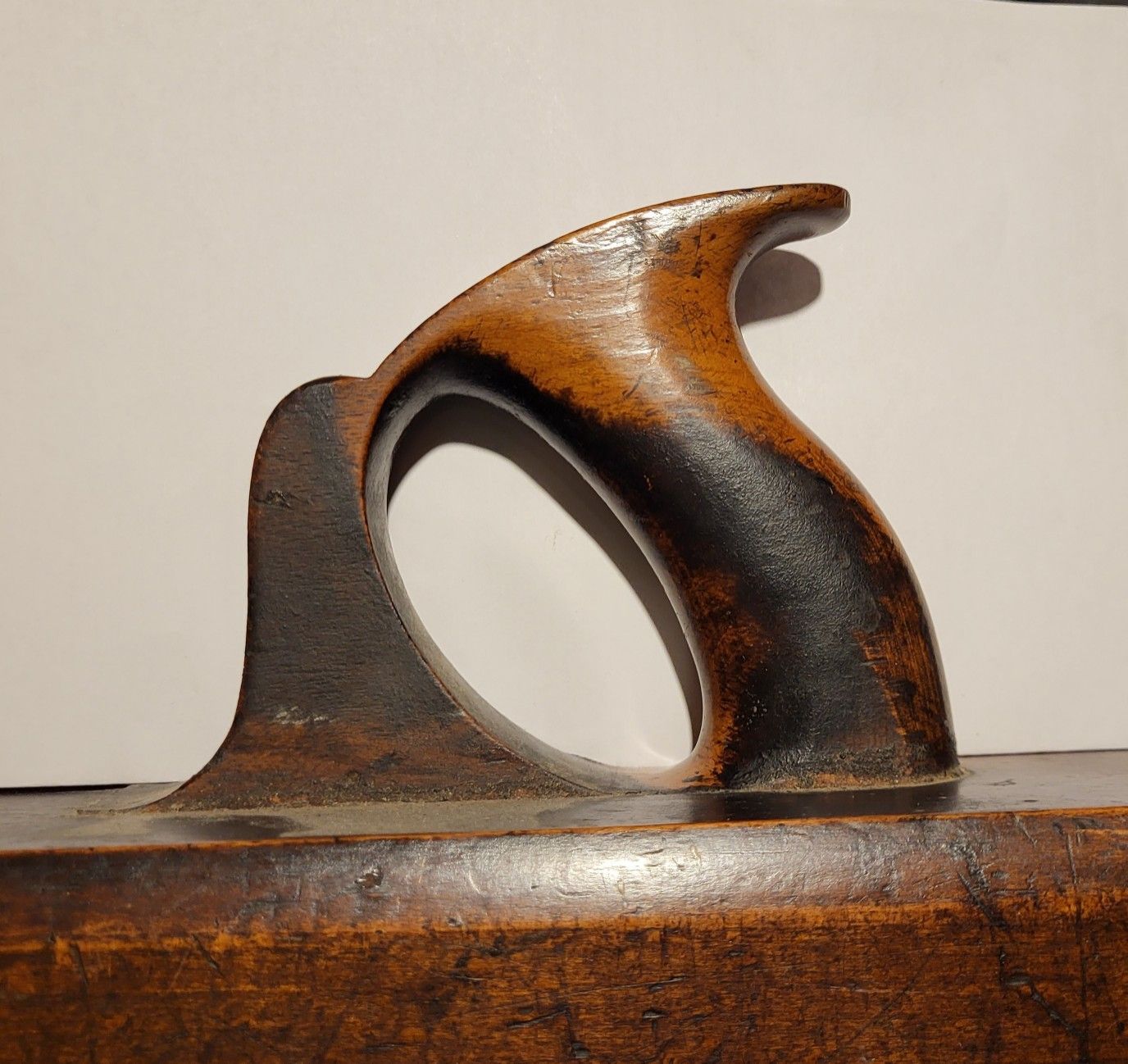
to get the right size, I handle a plane like this – surprisingly it fits my hand, which is kind of narrow – 3.5-3 5/8″ across the knuckles. it’s a snug fit and someone with a larger hand would have to work with a finger or two over the side of the plane. In this case, it’s about 3.7″ to the top of the horn. I want 4 1/8″, just by experience.
Anyway, I use windows paint, print the picture as a % of size as a guess (i guessed 50% in this case, just eyeball it with print preview) and then measure the result. From there, you can adjust the 50% by ratio and hit the mark right on the dot with a second printout, and then you can save the picture with the size and % print scale and not have to do it again in the future. For example, 56% in this case makes a handle 4 1/8. If I get some big handed oaf who wants a plane and likes the handle but it needs to be 4 5/8, then 4.625/4.125 * 0.56 = about 0.63.
I affix the picture of the handle by making it wet with water base finish. it stays on better than glue dries pretty fast and doesn’t have much penetration. if you don’t get the picture to stick right away on the wood blank, you can just brush a little more finish on top of the picture-it’ll go through the paper and contact the wood without issue.
After a few strokes of some tools, and then filing and a little scraping, we arrive here. The level of finish isn’t perfect, but it’s about where I stop with handles on planes that will be used. I’ll probably correct just a little more. No power saws, no routers, no sandpaper, and so on – just something that’s to make by hand, and again with my level of infrequency, things appear slowly enough working by hand that you don’t end up wasting the wood.

I see things that could be better in terms of lines without being stupid. Stupid is a really long flat horn that comes out almost to a point. It serves no purpose but to be broken later. But I also have left the horn a little fat because the break rate at my mailing address for horn tips – for no good reason but carelessness – is a little high.
By the time I’m done with this handle, there’s about 3 hours of work in it. I know that’s garish to some people. I stopped trying to be a factory long ago, and because of that, the work was really pleasant to do. In the end, I’m glad that the wood isn’t just running out in weird directions all over the handle, even if it may not have broken from being made like that.
 Of Making by Hand with Wood and Steel