This post will provide you with results based on water sitting on bare high carbon steel until it has evaporated. It is plain tapwater from appalachia, treated with the chemical industry’s finest, and includes some minerals (it’s a little hard). it has also sat for a while, so maybe much of the sterilizing bits are gone.
At any rate, this is a “test of things that shouldn’t” happen in your shop, but could if you’re ever exposed to storing tools where a leak occurs or condensation on ducting drips on tools. Been there done that in my humid shop.
The tested rust protections are:
- Ceramic finish “with Graphene”
- Dewaxed Blonde Shellac
- Carnauba Wax
- Tung/Rosin Varnish that’s shop made
For anything you’re actually using on a regular basis, mineral oil and wax will never not be enough. However, what triggered this was really aiming to test the hardness of these “ceramic finishes” that cause water to bead. They are quoted in pencil hardnesses, like 9h. I have 9h pencils, but must admit I don’t have a good way of seeing if they are harder than varnish – or maybe I do. It’s not important because based on the results of this test, I never got there. I can’t stand influencers, though, nor can I stand – and it’s just a personal irk – the idea that influencers are providing woodworkers with something so valuable that they can market claims that don’t hold water (or prevent it from touching metal!). It’s my supposition that in nearly all cases, the information provided in non-marketing videos is there to funnel people toward the money making bits and claim that the arrangement arises out of the opposite circumstances. Or in this case, the “technique” videos are the mirrors on a solar oven. The reviews themselves are already veiled advertising – it’s the most convenient way to propose something to you that’s really just directing to purchasing avenues without saying “i’d like to introduce this product that i’ll make money from if you buy it”.
So, the test of these things was simple and the failure of the “ceramic coating” triggered me to try a few others. All that’s done is a glue bottle full of water is squirted onto the steel and allowed to stand without any interference until the water dries. The result for the “ceramic coating” is this:
The coating was applied thinly, but uniformly and then allowed to stand for a day. The result was shocking -this occurs in one day.
Well, then, what about shellac, as I assumed that shellac might be a better barrier than wax, and maybe it is to vapor or humidity, but here’s how shellac did with standing water. 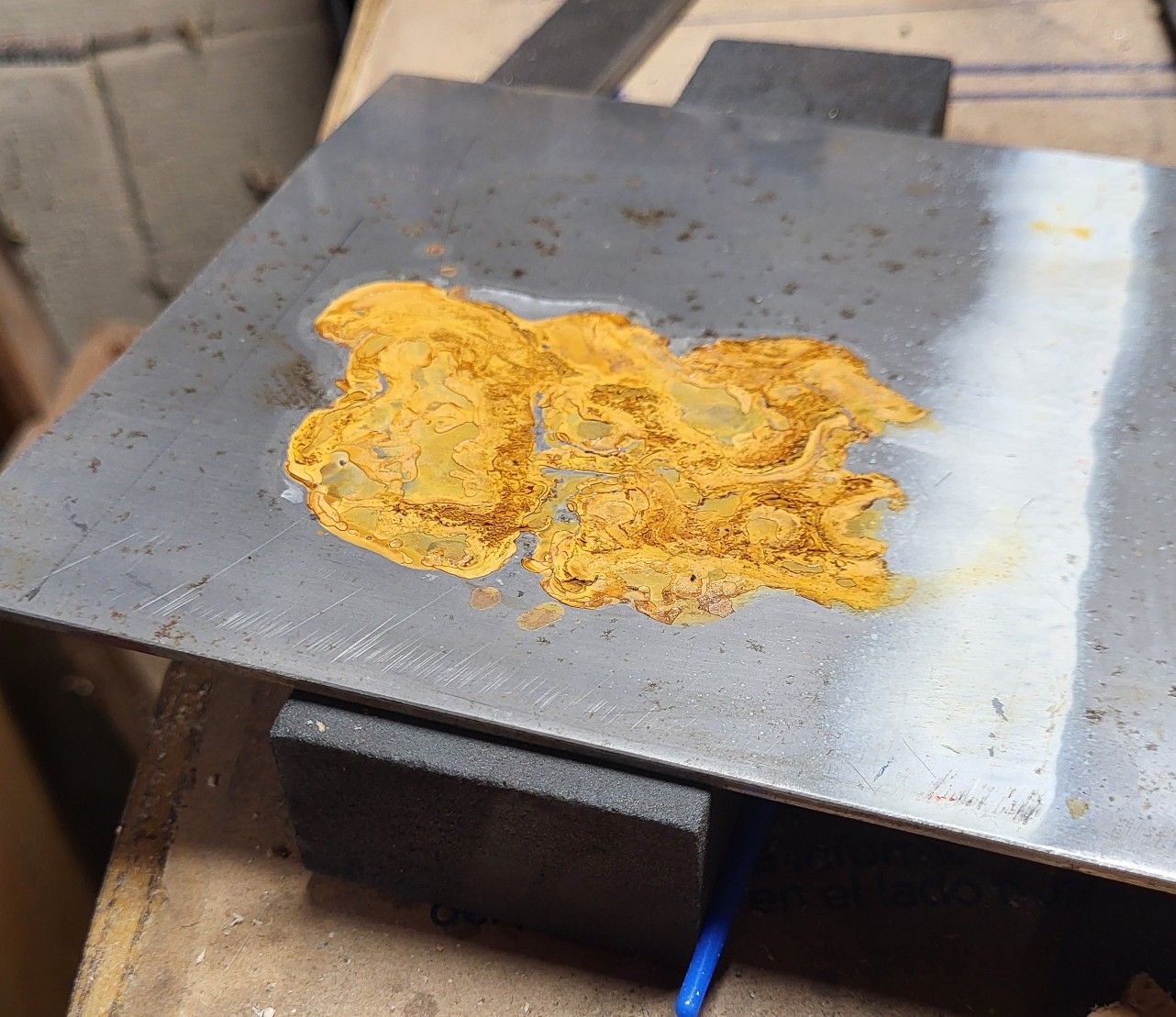
That’s even worse, but what’s curious about it is the water seemed to lay out and perhaps hydrated the finish layer to give such a uniform rusty result. The “nano” finishes do feel like nanosilica additive to the touch and they do cause the water to bead and not lay out like shellac did.
We already know shellac isn’t waterproof – it takes very little time to make something wet and have it soak in.
As bad as shellac fared, I figured maybe “nano ceramic” wasn’t too bad, but it sure wouldn’t help you if you had a drop or condensation that stood on a tablesaw top, and we are well aware that even without that, the wood whisperer’s magic affiliate deal didn’t lead to a stored table saw top that didn’t rust. So regardless, it’s not that great, either.
Carnauba would be the next option – it’s cheap to make a carnauba wax (25% carnauba, 75% aromatic solvent, heat outside, pour in a jar, apply thinly and buff lightly with something like kraft paper). 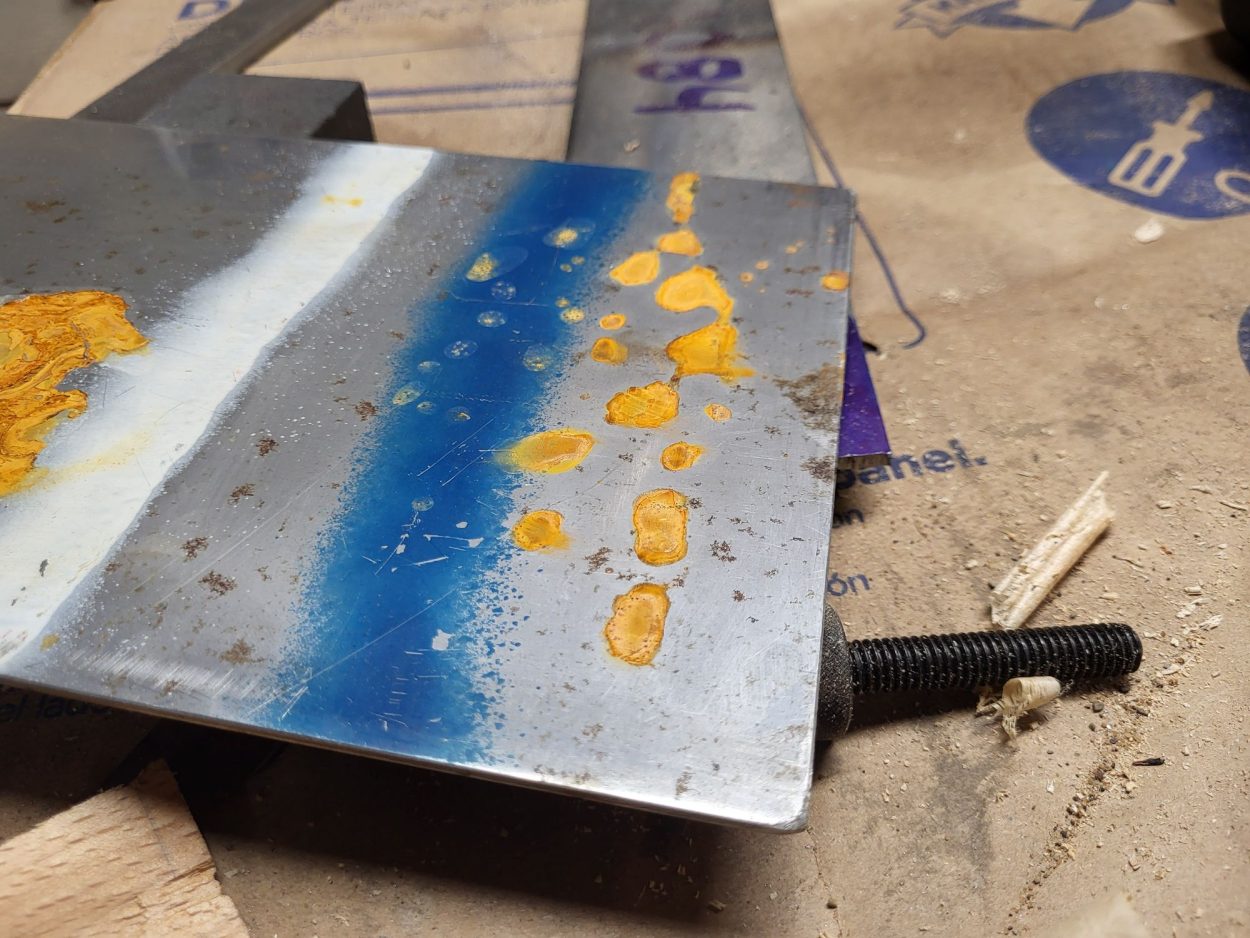
Still not a good result – but the water beaded and then never seemed to lay out to cover a wide area like it did with shellac. This result does look similar in severity to the Ceramic Finish.
And lastly, since these all worked about as well as a bucket of steam in a bull ring, I applied a very thin “by finger” layer of 1/1 limed tung rosin. This varnish has 2% beeswax in it, though that has settled some. I don’t think the wax will improve it, but may test the same without wax. one to one just means the solids are half varnish and half tung oil. 1% japan dryer exists and I allowed this thin film less than a day to dry in an area that’s 62 degrees F. It’s cured “enough” even though it may fare a little better if it could stand for a week or cure in the sun and so on. 
What’s left behind is a little bit of mineral that you can actually see, but it did also degloss the varnish a little. No rust. Post two will go a step further into not just showing the rust in the failures, but how much or how little is removed with a quick scrub of #00 steel wool.
I do have to ask a question at this point that is important, though. The nanosilica finish does cause impressive initial beading. I don’t know about durability but suspect it will stay on a car finish longer than wax, perhaps by a good bit, but there’s practically no chance that one application will last half the life of a car. However, its job on a car is not necessarily to protect the finish from water as the clear coat under it is not harmed by water. In my estimation, it’s more of a way to cover surface scratches and wear with a finish that beads. I have no clue of the beading does anything more than create a result that draws in people who know what a freshly waxed car does with water.
But, as this stuff is being marketed to woodworkers in droves to protect surfaces from water ingress, why in the world would you use it for that? I suspect it’s being sold at you because it’s good for affiliate programs, meaning there’s a huge margin and influencers can extract some of that. It is, in my opinion, antisocial unethical behavior. That makes me Mr. Negative, as there’s no upshot to this post – I’m not selling you anything other than the idea you can take this problem on yourself and not be a lemming. There isn’t enough critical questioning and you’ll find throngs of fanboys if you do it, so if you want to be liked or you’re also thinking of selling things to people, it’s not a good idea to be Mr. Negative. I’m good with it if the motive is something positive, though.
 Of Making by Hand with Wood and Steel