Ill parent, kids at a busy age and an employer going through changes and more work than in the past. It all boils down to doing less discussion online or pondering, but I still get to the shop a little. And hopefully more in the next several months.
What I make when I’m busy tends to be smaller stuff and not full sets of chisels or guitars, etc, or a dozen batches of varnish.
Someone stopped by here a few weeks ago, and left behind nice things in what is, I guess, a de facto trade, though I don’t get involved in much trade of obligation, so it’s not really that. It’s just what happens if you don’t bind yourself into “I have to get even with everyone” or everyone has to pay something for lifted fingers.
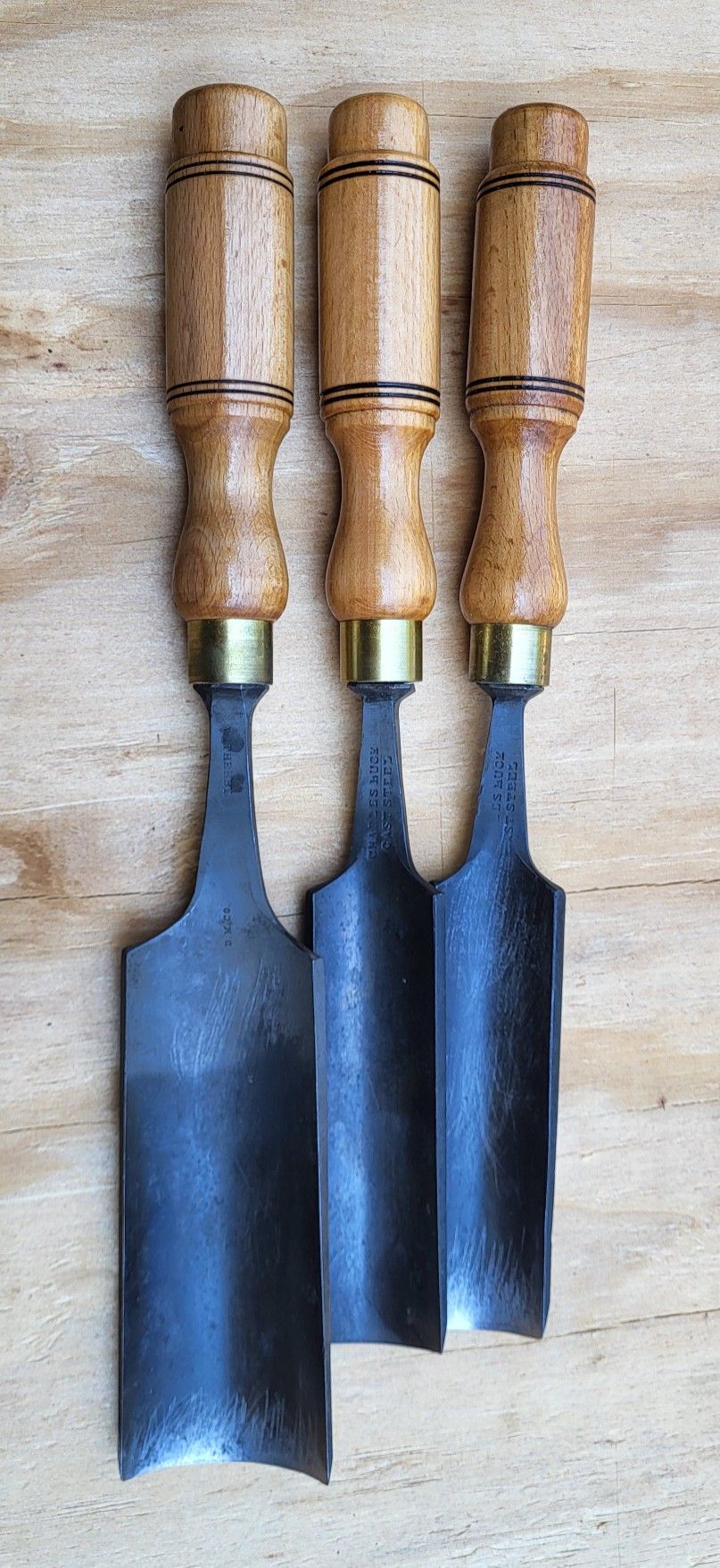
Some of the lot was three wonderful large gouges. I ended up turning handles for them, not because there is something special about the particular handles, but because I wanted to turn three slightly different versions so I could tell what looks nice. Even with limited shop time, it always seems better to gather information from something that just think you make it and nothing could be better, and all three should be the same. I always would like something nicer looking and see ways that all three of these slightly different handle profiles could be better.
But the gouges offer a great distraction because they look so nice. the largest of the three must be at least 2″ wide – these are stout. 
They look like this on the gouges. I should have found a finer wire, but didn’t have one at hand for the burs, so they are tubby and a little unsightly. Ignore the line of light and dark on each, that’s the shadow from a roof overhang above.
And as part of the pop’s pro cut thing, I mentioned the steel to someone I know, who promptly asked if I could make a santoku in the steel with a tanged handle rather than through tang. Through tang is easier to do nicely if you have limited means. Tang is probably easier to do not nicely, but that seems a waste of time. I came up with the idea of two cocobolo handles (one for me, one for the requester) with a satinwood gasket and ebony front cap:
These are getting varnish. Cocobolo’s oil is an antioxidant or something, and oxygen moving around in the varnish and attaching itself as double bonds is the way it cures/crosslinks. the varnish on these is madagascar copal, which is a little more exotic as varnishes go, I guess, but it has good hardness and should be durable without having to be thick.
The more red color handle here became a contest to see if the varnish just dries really slow as it fights the antioxidants, or if it never dries hard. It appears to be the former, but with 2% japan drier, the same varnish is on the chisel handle above – totally dry and will not be sticky or marked in a day. The reddish cocobolo here can spend a day in the sun, or could at the outset, which typically will get a varnish pretty far along in an hour or two… Anyway, the reddish cocobolo here will spend a solid day in direct sunlight over a chafing dish (to reflect the rays to the back side and not waste them), and still need more dry time.
A shellac seal will be susceptible if there is water, but I did a little, not enough, and decided the red handle, which I made for the knife to be sent, will just be mine. The brown handle stunts drying time by a factor of two, but it’s tolerable. Interestingly, varnish must soften into layers when it’s applied within days as even later coats do not dry quickly.
The knife with the brown handle is finished and I will ship it this week:
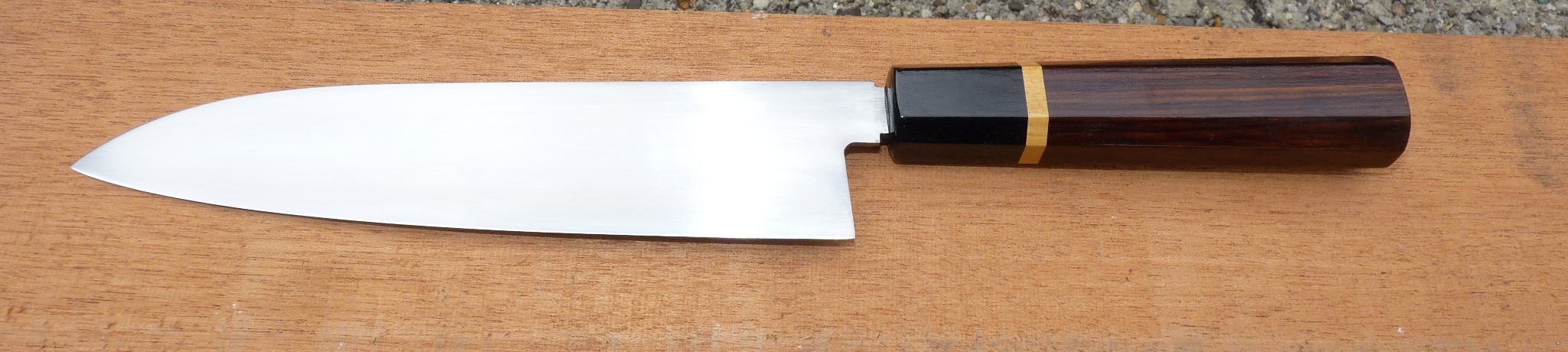
A true professional knife maker could come up with something nicer than this, but it’s about a five hour knife and not a five thousand dollar knife. I think the result is suitable.
The pro cut steel is a little different. It’s not stainless, so it’s not a gen-public type knife. The steel in this case is about 63 hardness after tempering, and it drops its burr really easily. I always buff knives, anyway – the edge is better off of the buffer. A larger picture can be viewed by clicking this text. The picture makes the blade look like it’s polished, but it’s linearly sanded at 400 grit. Why? I want whoever gets a knife like this to be able to refresh the surface simply without finding cleaning up a mark or stain suddenly makes it so the whole visual of the knife is spoiled.
Both knives, this and the other, are a little over 1/100th inch thick at the top of the cutting bevel, and then they taper out, of course. With a unicorn edge, despite the thinness, they can be used to carve, whittle wood without issue other than it’s a little unsafe, not for the knife, but for the user. The real end use for these is easier, though- meat and vegetables.
 Of Making by Hand with Wood and Steel
