The TL-DR of this very long post is that it’s a long discussion about what chisels were like when they were designed for work at the bench, how to find chisels like that, and some supposing about how we got to where we are now with chisels made from air-hardening steel alloys that are cleanly finished but proportionally odd. Remember, this entire blog is intended to discuss working by hand or entirely by hand. Choice of hand tools deserves more consideration and time in acquiring, and while it might be interesting to read through much of this otherwise, if all you want to do is cut some dovetails, just about anything reasonably hard and shaped like a chisel is fine. You don’t need to delve into the weeds that grow below.
1960 is just a choice of year. That appears to be about the time Sheffield, England was switching over to really automating production of bench chisels, and around the same time, tools made in lower volume started to disappear.
I’ve got a set of incannel and firmer gouges made by Marples likely made in the 1950s. They have what good chisels have:
- Wonderful proportions – everything just fits when you hold them, and the bits from the bolster down are not overly fat. As time went on and costs were cut, the finish may have shown a little bit more hustle, but the proportions didn’t change. It’s hard to duplicate these proportions with jigs or CNC – inevitably, chisels get fatter if they’re forged or if they’re thin, they’re just cut out of flat stock.
- Some semblance of hand work around the bolsters, even if they look relatively quickly ground. Once you see a round bolster that looks like it was turned on an automated machine, the odds of the chisel being a great one go down. However, as I’ve seen thus far, the market for used tools prices both the same.
- Plain steel, but not lacking in carbon. Alloying above that needed for hardenability does nothing for you using a chisel. Once the grinder (the person, not the machine) and the glazer (terminology in England for finer grinding or finishing after initial grinding) are out of the equation, focus starts to shift from easy to grind to easy to keep flat and not have to grind much. Steels like A2 or V11 can make good chisels, but they can’t make a chisel as good as a plain high carbon steel that will achieve the same hardness.
In the world of internet guruism, it’s popular to focus on specs. Especially steel. “What’s your woodworking steel?”. This is not necessarily asking the right question as most of the differences that bloggers perceive in “steel” is really differences in hardness. It is true that you’ll have much difficulty getting a barely-high-carbon steel to be harder than oilstones will handle (or above Rockwell 62 or so), but it isn’t the case that something like A2 at 61 hardness will yield anything above and beyond a plain steel at 61 hardness. A2 definitely costs more than something like 1.1% carbon drill rod, but the real reason A2 is being used is because it’s stable in heat treatment.
What do you as a user care about stability in heat treatment? The answer to that should be nothing. That’s the business of the maker, and the stable steels generally have some carbide volume and carbide volume isn’t what you want in chisels. You want fine grain, little to resist abrasion (you’re abrading a chisel when you sharpen it) and hardenability in a range that you can sharpen quickly. Abrasion resistance will never yield anything practical in chisels.
My thoughts are that you as a maker, if you’re going to use chisels, will want to look at how chisels were made when people were making with them, vs. putting them in a tool belt to go to a work site, or later, collecting as beginners. By making, I mean making the things you want to make – likely work at the bench. Not wet wood, not door mortises, not opening paint cans, but working wood at a bench.
I Have an Admittedly Narrow View
This narrow view ends up leading to English chisels with square or octagonal bolsters, a tang rather than a socket, some length greater than you may like if you like “butt chisels” (that’s yet again, something pitched to beginners to make it easier to pinch the chisel blade instead of holding the handle – an unproductive dead-end habit).
There’s a clue here, and there’s a clue in a lot of older tools. That clue is, if you get something that was widely used and prefer what you’re using (for example, a short fat bladed socket chisel), you may have habits that aren’t serving you well. Efficiency in using a chisel comes from striking a chisel in rhythm with predictable use and not a whole lot else. Place and strike, and from time to time, turn the chisel around and relieve something in a corner or pare. If you’re pinching chisel blades or switching hands a lot to cut simple joints, you’re making things unnecessarily difficult and holding a chisel by the handle and putting it in a mark is probably less than one project away.
What has Progress Looked Like?
Having had hundreds (maybe still have hundreds) of chisels, it seems that chisels in the US went to site chisels relatively early. Somewhere around 1900? That led to shorter bits, sockets and softer steel fairly early. A set of stanley 750s will generally be softer than they could be. It’s not that the steel was too low quality to be harder, it’s that stanley chose to make the chisels that hardness. One can only guess that’s what the market wanted. Stanley irons of the same era show no lack of carbon (based on looking at the carbides under a microscope – low carbon steel wears smoothly, but as carbon or other hardenability alloys increase, you can see carbides remaining proud of the worn edge. A stanley sweetheart iron shows plenty of them. My 0.9% carbon O1 irons show almost none. Irons that I’ve made of 1.25% carbon steel show a large crowd of carbides.
So, for this (getting long!) discussion, we probably have a cutoff from US made chisels in 1900 that parallel 1960 in England. Cabinetmaking work simply lasted longer in England. You’ll find if you expose yourself to a lot of chisels before those dates, there isn’t a universal lack of hardness and chisels generally feel like they’re about 61 hardness to me (you don’t have to trust my sense in judging hardness, I’ll prove that at a later date – safe to say, novaculite will tell you a lot about hardness of plain steel tools if they’re anywhere close to the same hardness of the stones). Some are harder than that, and some are slightly softer. With lots of exposure, you can name the tools that are generally softer (buck brothers chisels tend to be softer, and if you go *way* back to the early 1800s, butcher tools will often be a bit softer – I would guess because the stones common in England were slower cutting even than arkansas stones).
After 1960, things were hit and miss and by the 1970s, anything that suited hobbyists as good quality sold new kind of suffered. Interestingly, footprint seemed to have continued making chisels around 61 hardness, and though they moved to socket format, the sheffield made wood-handled chisels have proportions like older tools and with reasonable hardness.
The era that follows the doldrums in the 1970s went to japanese tool enthusiasm in the 1980s (this was likely a function of a hugely advantageous exchange rate and a market that had no clue about the markup being added to sell good quality tools in the US – this was paralleled in the guitar market where japanese guitars selling for $350 in japan retailed for $1,000 in the US). In the late 1980s, the exchange rate declined in the US to the tune of about 1/2 or 40% of the previous purchasing power – and japanese electric guitars nearly disappeared. Someone around at the time may confirm the same with tools – I wasn’t woodworking then – the craze for japanese tools seems to have encountered a gap (exclude retailers in the US who sent glossy catalogues as they have always managed to double the price of the tools in japan and continue to sell them) until most of the public had email and internet access. I do have and like japanese tools – I may post separately the direction I’ve gone when I get them – used high quality tools in japan are no big thing. Most of what has changed in 60 years is the same as the US, which brings us to…
We’ve Traded Proportion and Fineness in Geometry for Surface Finish
…though, to be fair, you can get Japanese chisels now that are as good as any that have ever been made. But the notion that there is something to a $600 chisels performance-wise that isn’t available if you sort through $15 used and under-loved chisels on Japan’s version of ebay isn’t correct. There is (and should be) some care in the expensive chisels in heat treatment, but makers of choice in Japan become somewhat of a fad and as the fad buyers become particularly, the price increases and the surface finishing of the chisels moves to art. You or I can harden plain steels about as well as you’ll find in any chisel, it just takes some testing and understanding to get what you want. We may not be able to press or forge laminated chisels together easily, but that’s generally tradition. You can purchase something like 26c3 and make a chisel that is a match for anything from japan, and that will overmatch anything offered in the United States.
The parallel in the US is chisels that have little hand work in them and are sanded/ground to a fine finish, cut from flat stock, or made in tubby profiles with CNC machinery. They are nice chisels. But there is something lacking when you compare them to older English chisels. The proportions are off a little bit, the cross section is overly thick making them bit heavy, or in the case of some of the popular paring chisels, they’re just flat stock stuck in a handle, but surface finished finely. For some reason, finding them in the sweet spot with a steel that isn’t abrasion resistant is difficult. What’s the sweet spot? It varies by alloy. I’ll cover it better on a metallurgical post in the future, but figure 1095 and O1 steel like something around 61/62 hardness. A2 likes the same, but it offers nothing that makes it a better chisel and will resist you sharpening it, and V11 probably likes to be somewhere around 62 (based on someone on sawmill creek having a chisel XRF’ed (google it) and posting the composition and naming the same or very similar alloy. White 2 steel will like something around 63, and white 1 and 26c3 will like 63 to 65. All of these can be made harder, but behavior changes.
Notice – I didn’t mention blue steel and I only posted A2 just as an example. I’m not even that sure about 1095 at this point as I don’t really see any advantage over O1 with it – especially to you as a maker. Just as I don’t see any reason why O1 in chisels isn’t closer to Footprint and Iles’ spec than softer.
So, we’ve gotten way into the weeds and the above will all seem hypothetical at this point. Where does that leave you?
The Checklist of Aspects to Put the Odds in Your Favor
Let’s flatly state what’s usually found in older good English chisels as they’re probably not equaled for bench work:
- Tang construction (though Ashley Iles and Footprint both have mock sockets and are close in proportion to older chisels – just with a different look)
- Blades that taper along the length-in thickness, and that aren’t too fat at the cutting end.
- Reasonably fine lands, but not zero lands. If you’re looking at older English chisels with a square or octagonal bolster, you’re not going to have an issue here – there just weren’t many fat sided, fat bladed chisels – the market of professionals didn’t accept that. The reason zero lands aren’t practical actually has to do with the corners. The lands provide some support in the corners and zero lands offer little functional benefit and lead to corner failure. Even if it’s small, what’s the point of having a super fine corner if the edge doesn’t stay on?
- A handle with a brass ferrule (and not thin brass, but substantial)
- A maker’s mark stamped into the metal, not printed on it. It’s a fairly simple thing to find, but the stamping of the name into the chisel disappeared partly due to cost and the need for someone to stamp it into the blanks, but also because the act of stamping a chisel actually causes distortion. This is worked out by skill and follow-up grinding on older tools, but it’s not really practical on newer tools when the objective has become hands-off making. It’s useful that this seems to coincide with about the same time that hardness dropped off and chisels were delivered at “site hardness” more often than bench hardness.
This sounds like a great list and you’ll get instant success, right? Well, I like buck brothers chisels -but I’d put them off even though you’ll find many. They are very fine grained if they’re made as mentioned above, but for some reason, generally tempered soft.
These aspects put the odds in your favor, but you may still have to buy a couple and then resell the ones you don’t want. That’s not bad advice in general when the old ones cost about 25% of the new ones. The hand-wringing over “wasting the money” to try a couple of different older sets of chisels is nonsense when two to six sets can be bought for the same price as a new set.
And..you’ll probably have to do some minor work to good chisels to get them in order – like initial preparation of the back and re-establishing the primary bevel.
Beware of Gurus who Specialize in Teaching Beginners
Please keep in mind, I don’t have enemies in the hand tool world. This isn’t a whole big attempt to bend opinion toward some aspects with a grand plan to release chisels that look like the ones I prefer above. I make chisels, but I don’t make chisels for sale – I want to be a maker, but not limited to marketing something. Making things and making them well gives you an understanding of what’s out there and when you finish grind a few dozen warped chisels, you get the sense why manufacturers may not love water hardening steel, or even to a lesser extent, O1 steel. O1 is more stable, and hardens more easily, but it still requires more follow-up grinding than air hardening steels like A2 or V11.
So, on to the issues with gurus. Imagine you’re teaching a class of beginners and you have two hours to get through the first part of the class. Suddenly, three students show up with some old chisels that are pitted on the backs – what will you do? Your objective may be to charge the beginners several hundred dollars each (or more) to get into the first steps of beginner-land and now you’ve got folks who are starting to count minutes and calculate dollars while you’re attending to someone who wouldn’t buy the new tools you suggested. I get that. Once you’re not a beginner, those gurus don’t have anything to tell you, though. If you’re reading this, you may already have chisels that work fine, or you may have 10 sets.
We’re not in beginner-land. This is a foray into making things out of wood, and we will end up discussing making things that we may used to make wood. And when we do, we will do so with the goal of making things that are at least as good as anything we could buy without any real limitations. Further, you’ll find that most of those gurus will want you to have instant success across the board, but we want to work by hand, with skill, comfort (even pleasure) relying as much as possible on our sense and eyes and less on tedious prescriptive methods or unneeded work. In short, when the gurus make blog posts telling you that buying older tools is false economy, they’re living in an alternate reality. I have had A2 chisels, I’ve tried V11 chisels, and blue steel, and HAP 40 and YXR-7, and M2 and probably a dozen other steels. I cannot imagine trading a good set of vintage English octagonal bolstered chisels for anything made now.
Why?
Because they just work in the cycle of work. That cycle is in the context of actual working, at the bench, in wood, where you sharpen periodically and relatively often. The chisels of the proportion used when makers were doing more making and less magazine and blog reading tend to do almost everything very well, don’t require special hammers to strike them (or instructions not to), special abrasives to “cut through the carbides” and generally do everything they don’t do superbly well enough that you will rarely feel the need to look away from your work and find an alternate tool to do something special. No dovetail chisels, no push chisels that can’t be struck or striking chisels that are awkward to push.
George Wilson used to post on one of the blue background forums. I have since come to learn a lot from George, and I know that George is (and has publicly said) that he’s just a tool fanatic. He is a lifetime maker – a maker’s maker who at times has made some of the finest tools I’ve ever seen, all the way down to making a wonderful infill panel plane that was flaked and scraped (and subsequently bought by someone, relieving George of his plane). When I first began to talk to George, I asked what chisels he liked. He said he had made almost everything with a set of Marples chisels that he bought new around 1960 or so (it may have been a year earlier or later). At the time, coked up with magazine articles about socket chisels and Japanese chisels, I was puzzled as to how someone with so much access to have or make *anything* could be satisfied with a name that I equated to soft plastic handled chisels. I’ve since found some older Marples chisels. I get it. I get that they may be used and require someone to tune them up. As George relayed to me, those last-of-the-good-ones Marples were perhaps a little bit overhard if anything. But they are good enough at anything that they leave a maker wanting for little. I’m sure the steel in them (as I’ve got similar era tools now) is very plain, inexpensive and with little more than carbon, iron and just enough other stuff to making hardening them successful.
If you’ve hung on this long, I’ll show you what the English pattern chisels look like, as well as what some of the “dead era” chisels look like
A Marples Parer – the Key Bits

Note, the name is stamped into the chisel (not printed on it), the lands are finely done, and the bolster isn’t round/turned on an automated machine. As much as I love parers and like to make them, even a wonderful chisel like this will find little use if you have a good set of bevel edge chisels of similar style.
Newer Marples – Deceivingly Pretty, But…

Note the boxwood handled Marples chisels at the top. These are so close to being good, but so far away. These are a set of ten – the name is stamped only in the wood and printed on the backs of the blades with ink, and the boster is rounded. You can see the lip at the bottom of the tang where the jigged grinding setup finished its work and left an abrupt stop. But the real problem with these (I can look past the rest – easily) is that 7 of the ten chisels are unhardened. I don’t know what happened, but since no job grinder (a person!) was grinding the bevels on to question why they ground so easily, out they went. Even when they are good, they are a step off of the hardness. An Aside – the chisels in the drawer bottom are of my own make – with a side note that they are .08″ thick at the business end, high hardness and you can still strike them hard enough to break the handles if you wish without any consideration for the metal at all. The style is much older English, the steel is 26c3 (very plain 1.25% carbon steel still made now), and you know from the article above why I would copy English tools in the first place. When expensive chisels are marketed to not be struck, I’m baffled. The marples parer in the prior picture would suffer nothing if it was malleted, even though it’s long enough to swat flies.
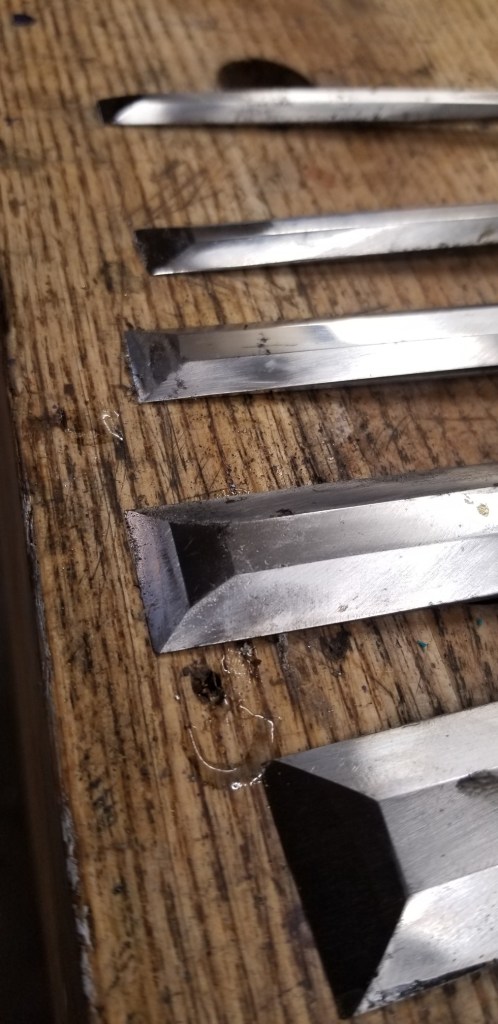
Well Loved Set of Tyzack / Hall

But, I still want to Support Modern Makers
By all means, do. I guess I’m a modern maker, but you can’t support me because I’ve got little to offer other than relaying experience. I know some of the modern makers, especially those who work by hand. I would support them first if it’s under the maker’s mentality. As in, you want to support the makers who are chasing this kind of craftsmanship? Steve Voigt is an example with planes – Steve is making planes that have the spirit of the chisels I’m recommending.
If you’re more of the engineering type who sees surface finish and admires the idea of automated process, by all means. Support the makers who make things you like and can relate to.
But, please -don’t become a parrot bad information telling everyone new to the hobby that advancements have made better tools with better steel since some arbitrary date, and don’t repeat stories from gurus who started in the 1970s and whose view of old tools is whatever was available new when they started.
Where do You Find the Old Ones?
I’ve found most of my older chisels (many have passed through) on the UK ebay site, and some from dealers who will ship to the US. I’m an amateur woodworker and toolmaker. The fact that I’ll buy just about anything to see close up isn’t really relevant if you’re just looking for one good set and then you’ll stick with it. It does, though, give me the experience without relying on statements of others – the experience to tell what works best at the point of this post.
Some dealers won’t ship to the US, and sometimes you’ll find a reasonable set in the US already. Look just a little before you leap. I’ve never had to pay more than about $30 per chisel for a nice vintage chisel, nor more than about $60 for the finest parer that I’ve come across ($30-$50 is more typical). What sent me looking directly from England rather than through dealers in the US is the markup is just too much, though it may be narrowing. Before you could easily find UK dealers or proxy shipping from UK ebay, it wasn’t uncommon to see a parer like the one pictured above for $100 or more. That’s the business of dealers – to find something that’s $30 in the UK, get the good ones and sell them in the US to a captive market.
You’re not captive at this point except to your patience and a little bit of diligence – and the understanding that you may need to do some rough work on the back of an older set of chisels with coarse PSA paper- this isn’t the territory of 2000 grit waterstones.
Be wary of two things – newer chisels that look like older (e.g., the round tang and bolster) and basket cases. There are enough good tools out there that you don’t need to buy a chisel that is broken, overly short or pitted.
One last do if you’re on Ebay – log in to the UK site, not the US site, so you can see sellers who don’t specify whether or not they’re posting to the US. If you see a wonderful set of chisels with every important part photographed and looking fine, and with an auction price that’s really attractive – take advantage of that by asking the seller if they’ll consider shipping to the US. Some will. Chisels don’t weigh that much and it should never be more than $50. Oh ….and never have someone send tools with handles that are rosewood or could be considered rosewood by an drowsy proxy shipper in Ebay’s global shipping program. They’ll be seized – and you’ll probably get a refund – but you want the chisels, not the assurance that Ebay made you whole.
 Of Making by Hand with Wood and Steel