Blog

Influencers Won’t Protect you from Rust – Part 1

This post will provide you with results based on water sitting on bare high carbon steel until it has evaporated. It is plain tapwater from appalachia, treated with the chemical industry’s finest, and includes some minerals (it’s a little hard). it has also sat for a while, so maybe much of the sterilizing bits are gone.

At any rate, this is a “test of things that shouldn’t” happen in your shop, but could if you’re ever exposed to storing tools where a leak occurs or condensation on ducting drips on tools. Been there done that in my humid shop.

The tested rust protections are:

  • Ceramic finish “with Graphene”
  • Dewaxed Blonde Shellac
  • Carnauba Wax
  • Tung/Rosin Varnish that’s shop made

For anything you’re actually using on a regular basis, mineral oil and wax will never not be enough. However, what triggered this was really aiming to test the hardness of these “ceramic finishes” that cause water to bead. They are quoted in pencil hardnesses, like 9h. I have 9h pencils, but must admit I don’t have a good way of seeing if they are harder than varnish – or maybe I do. It’s not important because based on the results of this test, I never got there. I can’t stand influencers, though, nor can I stand – and it’s just a personal irk – the idea that influencers are providing woodworkers with something so valuable that they can market claims that don’t hold water (or prevent it from touching metal!). It’s my supposition that in nearly all cases, the information provided in non-marketing videos is there to funnel people toward the money making bits and claim that the arrangement arises out of the opposite circumstances. Or in this case, the “technique” videos are the mirrors on a solar oven. The reviews themselves are already veiled advertising – it’s the most convenient way to propose something to you that’s really just directing to purchasing avenues without saying “i’d like to introduce this product that i’ll make money from if you buy it”.

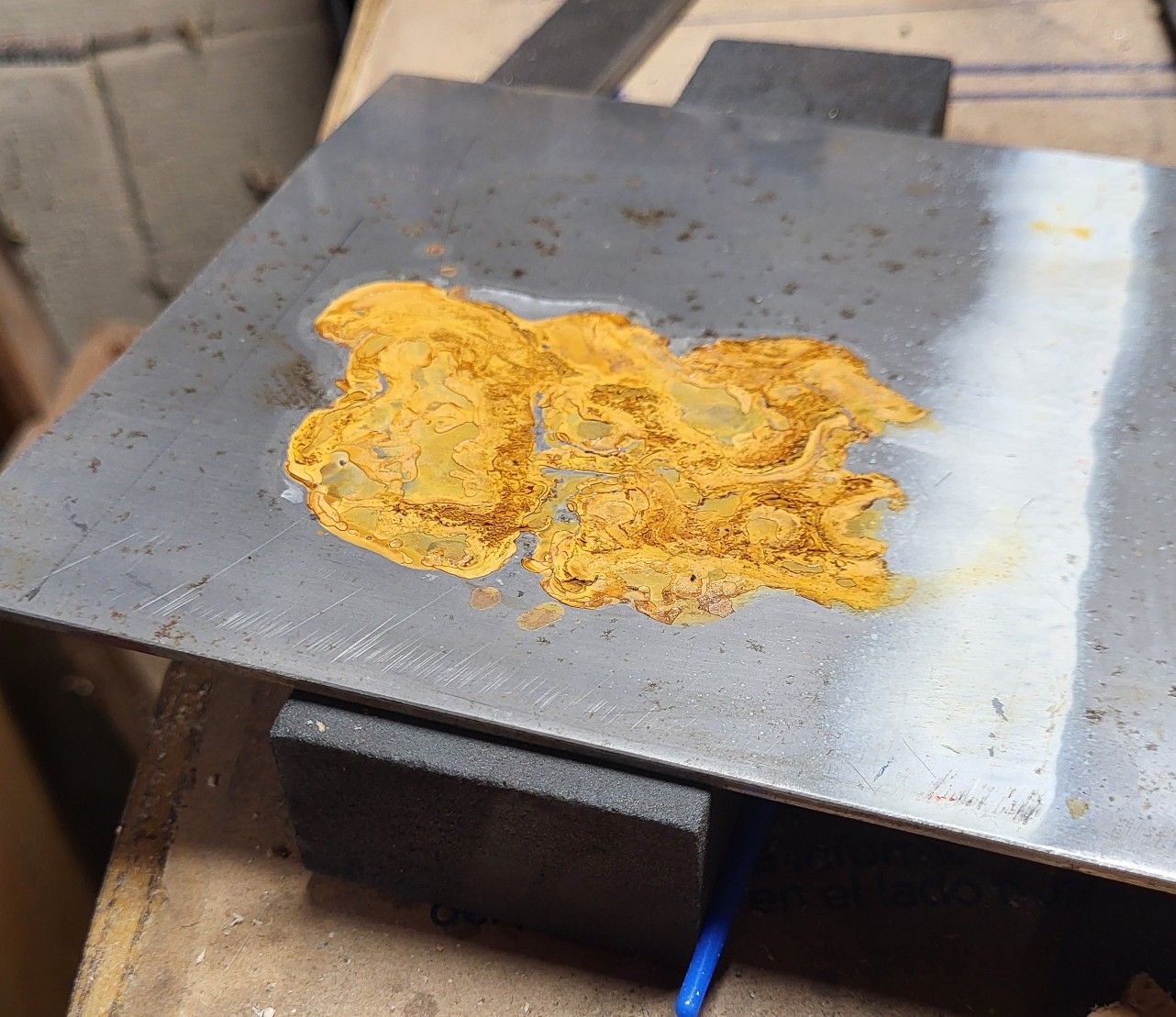
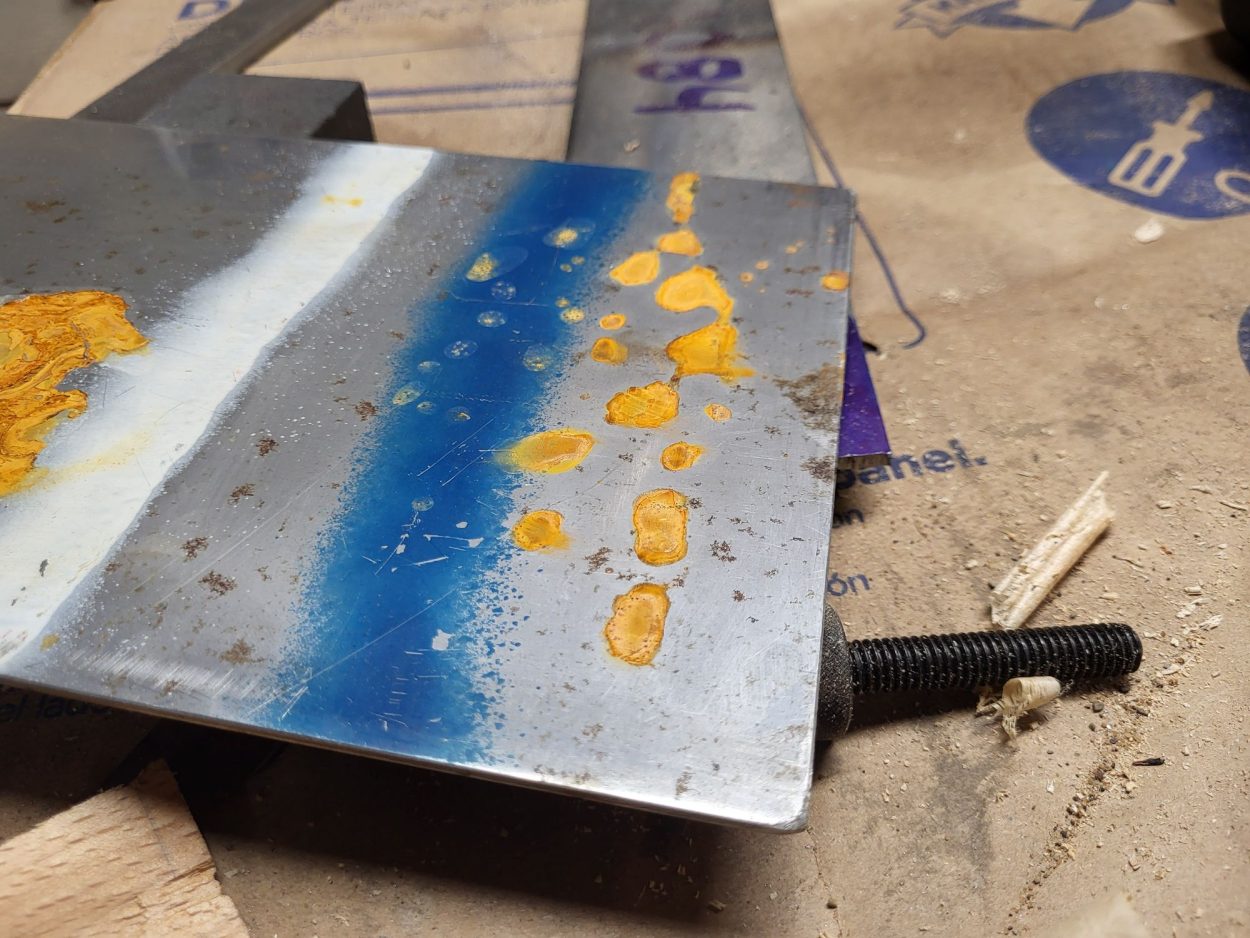
So, the test of these things was simple and the failure of the “ceramic coating” triggered me to try a few others. All that’s done is a glue bottle full of water is squirted onto the steel and allowed to stand without any interference until the water dries. The result for the “ceramic coating” is this:

The coating was applied thinly, but uniformly and then allowed to stand for a day. The result was shocking -this occurs in one day.

Well, then, what about shellac, as I assumed that shellac might be a better barrier than wax, and maybe it is to vapor or humidity, but here’s how shellac did with standing water.

That’s even worse, but what’s curious about it is the water seemed to lay out and perhaps hydrated the finish layer to give such a uniform rusty result. The “nano” finishes do feel like nanosilica additive to the touch and they do cause the water to bead and not lay out like shellac did.

We already know shellac isn’t waterproof – it takes very little time to make something wet and have it soak in.

As bad as shellac fared, I figured maybe “nano ceramic” wasn’t too bad, but it sure wouldn’t help you if you had a drop or condensation that stood on a tablesaw top, and we are well aware that even without that, the wood whisperer’s magic affiliate deal didn’t lead to a stored table saw top that didn’t rust. So regardless, it’s not that great, either.

Carnauba would be the next option – it’s cheap to make a carnauba wax (25% carnauba, 75% aromatic solvent, heat outside, pour in a jar, apply thinly and buff lightly with something like kraft paper).

Still not a good result – but the water beaded and then never seemed to lay out to cover a wide area like it did with shellac. This result does look similar in severity to the Ceramic Finish.

And lastly, since these all worked about as well as a bucket of steam in a bull ring, I applied a very thin “by finger” layer of 1/1 limed tung rosin. This varnish has 2% beeswax in it, though that has settled some. I don’t think the wax will improve it, but may test the same without wax. one to one just means the solids are half varnish and half tung oil. 1% japan dryer exists and I allowed this thin film less than a day to dry in an area that’s 62 degrees F. It’s cured “enough” even though it may fare a little better if it could stand for a week or cure in the sun and so on.

What’s left behind is a little bit of mineral that you can actually see, but it did also degloss the varnish a little. No rust. Post two will go a step further into not just showing the rust in the failures, but how much or how little is removed with a quick scrub of #00 steel wool.

I do have to ask a question at this point that is important, though. The nanosilica finish does cause impressive initial beading. I don’t know about durability but suspect it will stay on a car finish longer than wax, perhaps by a good bit, but there’s practically no chance that one application will last half the life of a car. However, its job on a car is not necessarily to protect the finish from water as the clear coat under it is not harmed by water. In my estimation, it’s more of a way to cover surface scratches and wear with a finish that beads. I have no clue of the beading does anything more than create a result that draws in people who know what a freshly waxed car does with water.

But, as this stuff is being marketed to woodworkers in droves to protect surfaces from water ingress, why in the world would you use it for that? I suspect it’s being sold at you because it’s good for affiliate programs, meaning there’s a huge margin and influencers can extract some of that. It is, in my opinion, antisocial unethical behavior. That makes me Mr. Negative, as there’s no upshot to this post – I’m not selling you anything other than the idea you can take this problem on yourself and not be a lemming. There isn’t enough critical questioning and you’ll find throngs of fanboys if you do it, so if you want to be liked or you’re also thinking of selling things to people, it’s not a good idea to be Mr. Negative. I’m good with it if the motive is something positive, though.

One of my Favorite Garbage Tools So Far

Not the plane, not the float, but the file handle screwdriver.

Have you ever used a narrower screwdriver to find that it’s marking and chewing up a fairly soft chipbreaker screw? What about the case where you buy one of those boutiquey things like LN or LV make (I either have or have had both – still have at least one of them), only to find that some older screw isn’t wide enough or in the case of the LV version, is too large around? Plus, you feel the obligation to keep those things nice…

I like a long handled screwdriver with a wide blade – and you can find them sort of easily, but I will generally have one and then lose it, and do nothing for five years but wonder where it went. In the middle of making the iron and cap iron set for the pictured plane, I thought maybe if I make a dump screwdriver, I’ll have incentive to not lose it. Plus, I can make the handle wooden and just use an offcut of the high carbon steel and hammer out the tip and then grind it after heat treatment. The whole thing should take about 10 minutes as long as lazy fitting of the shaft into the handle is done. In that case, it’s drilling the center out of the file handle and just flooding it with epoxy. If it breaks later, who cares, I’ll make another one. That did all take about 10 minutes and I did it spur of the moment because the pan of sand that I use to stabilize temps in the tempering oven was hot from tempering the iron.

Same steel, same tempering, whatever. The other quirk here is to accommodate the largest number of screws possible, and not break easily, the blade of the screwdriver is very slightly convex, and the tip is fine. If the whole thing was hollow ground, the tip couldn’t be that fine, so the compromise here is even though a convex face screwdriver isn’t what you want in general, when you’re working with a bunch of wide screws and sometimes they are old and the slot appears to have been swaged or chiseled in, convex isn’t so bad.

And, oh yeah, what’s a dump tool?

It doesn’t mean the tool is dumpy, it means it’s made of stuff that was headed for the dump. I made the mistake of referring to a knife I made for someone as a dump knife at one point when they showed a picture of it. The peanut gallery missed the fact that I made it and thought I was insulting the poster and it was more a matter of the poster extolling the virtues of just how much better it sharpened and worked than a two cherries chip carving knife, puzzling over why the steel was so much more friendly and crisp for the user….than it was talking about the wonderfulness of the knife. The result of not thinking about that? “you’re an asshole – just because someone else doesn’t make something perfect, you don’t have to be such an asshole about it”. Yeah, we’ll I made it – it’s a dump knife. It was heat treated with a quick heat and quench, then tempered and the materials were headed to the dump. This is a dump screwdriver. I’d have parted with the handle a little less easy, but in a per-handle purchase of a bunch of file handles off of Ebay, it’s a dollar. The offcut is hard to find a use for.

Back to the Dump Screwdriver

This will perhaps expose my laziness, but I had no intention to do anything but use this as a screwdriver. In a pinch, I’d knocked the corners off and filed the shaft of the screwdriver ahead of time. That means everything on it was slightly convex in general, and then the corners are eased just enough to not make them uncomfortable.

This turns out to be a gold mine for card scrapers. It’s not a matter of whether or not this will dominate the other scraper burnishes that I have, it’s just how much rounding of the corner is needed. I ended up polishing the almost flat faces and then stoning the corners now and buffing them. you can flatten an already-there burr with the width or thickness and then roll the handle ever so slightly to introduce the corner and a burr is had effortlessly.

I am so lazy, existing within a hobby that does have a lot of physical exertion, that something little like this is the nugget of gold that I always look for. you don’t even have to squeeze the scraper tightly on the bevel side, you just rotate the screwdriver shaft a little and introduce the back corner to the edge that’s being turned to a burr (or drawn out) and finding just the right amount of edge aggression to cater to laziness is easy. The screwdriver itself is around 64 hardness, so it’s indifferent about scraper edges, and it’s tough enough that it’s not going to break easily as a screwdriver.

I’m happy to have not made it any nicer than it is, and am now somewhat curious about perhaps making some nice screwdrivers out of round or square stock and maybe making them octagonal and much more carefully filed on the metal parts. They won’t be 125cr1 or 26c3 as long shafted screwdrivers- they’ll be something a little lower carbon for toughness. And if I lose this one, I’ll feel no guilt – the ultimate time spent on this was closer to 20 minutes due to honing the screwdriver shaft and hastily slathering varnish on the handle. I can do that again faster than getting too and from home depot in a busy retail corridor and then doing stupid things like “come on, now the stub screwdriver is $10 instead of $6, and it’s made in China?”.

“Ceramic Finishes” and Why I Can’t Stand Influencers

First, before I show any pictures, I bought a random “graphene” so called ceramic finish off of aliexpress. The bottle that I got is labeled “Adam’s”, which is suspiciously similar to other bottles of the same thing with nothing on the label. So you have to decide reading this if you think I got the real thing and it’s just a private branded version of a $15-$20 finish that you can just order yourself, or if you think this is fake. if you believe that, and you’ve been stained by influencers to tooting your horn about “ceramic coatings”, then all you need is unfinished steel that will rust and you can do the same test.

I suspect this is the same, but have no proof and don’t know who “Adam” is. If “Adam” purchases products from China and resells them, then you get what you get. If “Adam” actually developed something and they are selling it on the side directly, then that’s kind of rude, but not the point here.

What’s in these finishes based on the SDS is a refractory resin, which I read some about. These are resins that are set to cure at normal temperatures, vs those that might need to be baked, and they will handle relatively high temperatures, but relative is doing a lot of work. What I gather is they will tolerate several hundred degrees, but if you’re thinking of refractory bricks or refractory linings in kilns, nothing close to that.

I have gone off several times on forums about people like the Wood Whisperer posting affiliate links to products, coming out and talking about how they didn’t stop rust on a cast iron table in storage (not in the rain, in storage) and that you should buy them anyway. I suspect the second video is just a shot at harvesting more affiliate commissions and that the woodworking hobby has come to this “you should buy this” instead of you should be inspired to make things….that bugs me. George Wilson kind of laid the burden on me that I could make things that look a little nicer. I thought he was wrong, but his view of that accelerated me and really turned what is a burden to a joy – feeling like you could figure things out or make them well, or at least challenge trying to do it. This is missing from the hobby as the algorithms and influencers go – it’s a chance to stay a beginner for 20 years and go to a lot of classes and marketing.

If you love that, fine, but it’s not the message for a maker. The message for a maker is generally you want to make something, you can figure it out, but the core of being a maker (and it’s OK not to be a great one relative to greats! but you can be better vs. you yesterday), is you have to find something you really want to make badly enough to make it well, and then find out what well means. Well usually means function, look and feel of some sort. But looks are important, and feel is important if it can be discerned and function if function is important. These are the joys of making, not trying to buy something that’s sold because the margin is large.

So, I am delighted

…to show you how well a fairly healthy rubbed in coat of ceramic finish does to protect metal from standing water.

OK, so tell me again why you want to put this on other finishes? You can see the dullness here around the finish, and you can tell I scratched off prior rust. This is 26c3 flat stock. How does a “ceramic” finish allow water right through to the metal? And to be frank, this is spectacular rust, but this is a difficult test to pass as it turns out.

Both Carnauba and Shellac tests are now running and the water has not yet evaporated -and they’re already rusty. I’ve had pretty good luck with oils, waxes and shellac from vapor or humidity related rust. So this piece of bar once done here will get stowed near the door where temp and humidity change quickly, and we’ll see if any one of the three Carnauba, Shellac or “Ceramic” areas fares better.

What do I see when putting water on these areas in general? Initially, the “Ceramic” finish does feel like nanosilica (yes, I got a bag of nanosilica to put in other finishes to see if it can do anything alone – short answer, nothing useful), even though it may not be a finish with nanosilica in it the same as I have it loose here. The water beads impressively, but eventually, it breaches that.

We already know that shellac and carnauba are not waterproof. How badly the “ceramic” finish did here is a surprise and it begs the question – why would you use this as a “protective” layer? There are plenty of finishes that are actually waterproof that if you really needed to protect a finish, you could thin them and apply them very thinly and abrade them off – or just wax them later if you don’t want to.

I’ll test one of my varnishes with this, too – but in a really really thin layer. I don’t personally feel like this (varnish) is a great idea for a metal protecting moisture barrier because it isn’t going to be removed easily, but what is “ceramic finish” going to do for your furniture – allow the water through under a sweating glass and then hold it in?

I get what this does for car finishes – you don’t need something waterproof on a car finish and you might really delight in the beading and uniformity of the surface, even though it’s actually slightly dull. Compared to worn and abused car paint, it probably looks very glossy in sunlight.

I didn’t start to coat metal here to set out to embarrass this nonsense about “ceramic” finishes that are supposedly super hard but expressed in pencil lead hardness scale, I wanted to apply it to other finished wood like with shellac on and see just how protective it was and how scratch resistant it was. The first attempt at this deglossed which immediately triggered the desire to see if the degloss was superficial on wood or if it was a significant breach like this.

You can make varnish, and if you don’t want to, the entire coatings industry for furniture and housewares is full of durable finishes that are actually waterproof. if you don’t want them on the surface, you can thin them to death and allow them to soak into wood so they are resident in it rather than on it.

Ask your “friendly” influencers to run this same test, and if they show no rust, then do it yourself, because if they show no rust, they’re probably cheating the test perhaps by putting it on top of a waterproof finish. I’m fairly sure at this point if I apply my own varnish, and put this on top of it, there would be no rust. Except we now know, it’s the varnish doing the work, not the “ceramic finish”.

Gombeira and Rosewood

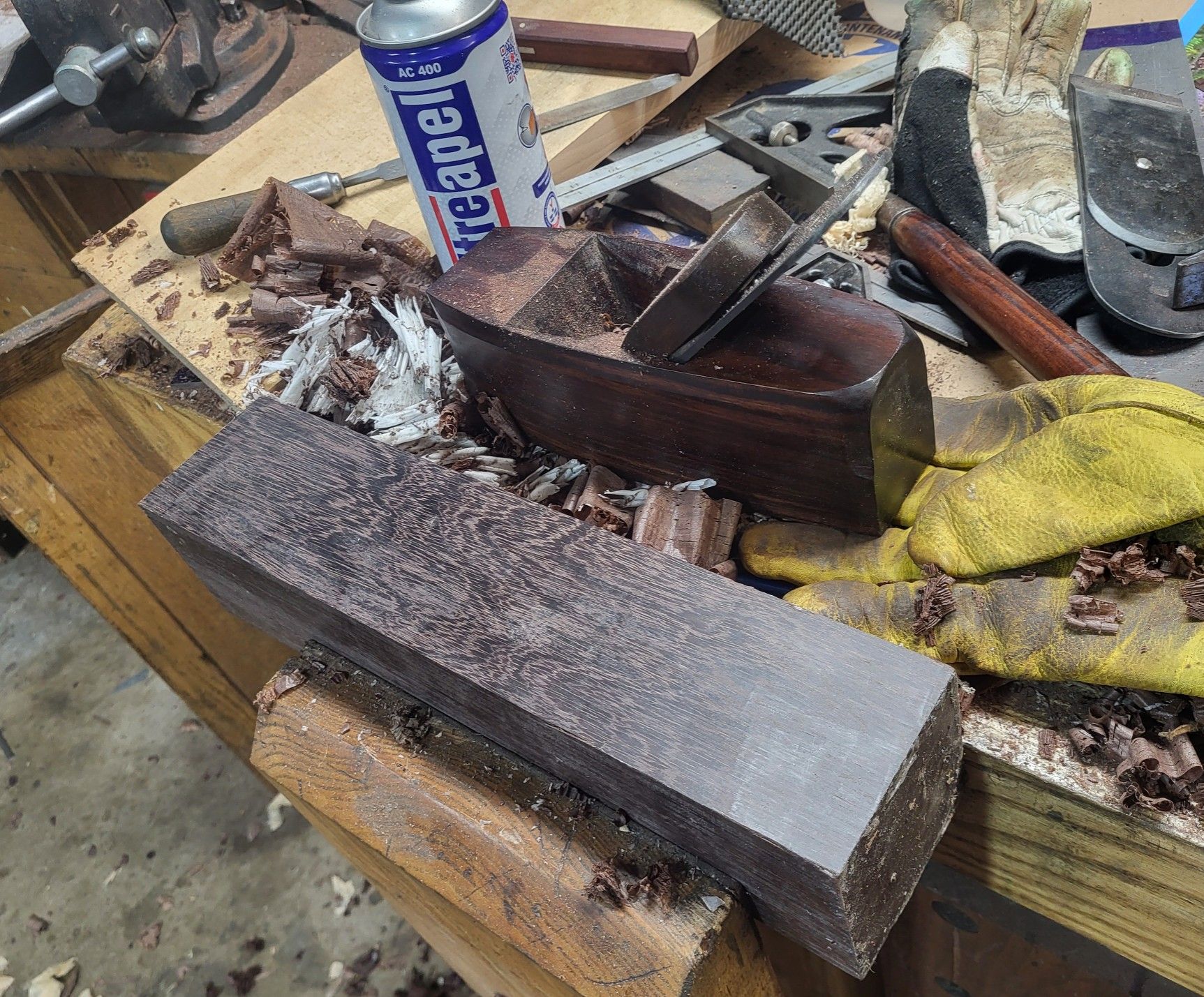
I think the last time I posted, I was making a coffin smoother. I made it, it looks a little funny because I haven’t built one in a while, so I made another. Planes 1 and 3 are here – the second indian rosewood smoother I still have and will use, but this smoother is Gombeira. About 30% more dense than water in the case of this sample.


All three recent planes have the same kind of iron – a tapered iron made of 1.25% steel referred to as 125cr1. it’s a very clean steel and easy to work with, but not bumped into a class of the remelted steels as far as I know. My limited use of remelted steels suggests they are just a little better for the maker.

I went on a tear pulling old beech sticks out that I have left from when I was making more planes and to my shock, the four from horizon that were euro beech all twisted moderately or bowed a *lot*. I’m glad that they sat here for a while and I didn’t make planes out of them, but I suspect that they were under tension because the wood wasn’t straight and without tension in a tree and they’re moving toward that.

Backing up a second, I’m convinced coffin smoothers were used differently than you’d use a stanley smoother. And it might be more efficient in some ways, but torturous in others. I think the platform allows easier removal of big shavings, but obviously adjustment to a small degree is less convenient and the fact that there is less friction means the plane has to be more in the cut and will not enter a cut as easily or stay in an iffy cut.

Some version of this is the nature of using the double iron – it lets you bolster the shaving thickness, get a lot more done and work a lot more cubic footage of wood with each sharpening cycle. And if you have a marginal iron, you have to focus on this even more and end up learning something useful in all work. This ability is what eliminated the single iron plane. You can’t do it with a single iron and for all but the thinnest smoothing and using perfect wood, a double iron plane will pretty easily outwork a single iron plane at least two to one and without the user feeling like they are having to rush or slash around.

So, back to the wood:

This piece has two issues – one the grain isn’t straight cut center down the length of the billet, and this was expensive wood – something like $15 a board foot, but when it’s good or even just pretty good, I’ll gladly pay it. You can’t make good planes with common wood unless you laminate. No thanks on that.

er…forgot the second issue – the second issue is the billet itself bowed at least 3/8″ through the center. we don’t really like planes that bow a few thousandths, so hopefully it’s over that.

I’ll make myself a plane with it. I much appreciate the look of american beech – it has more of a beeswing look and can be dazzling like quatered sycamore, and euro beech looks nice but it has these little brown egg shaped dots all over it that make it recognizable in ikea laminations, etc. the camera is confused by the lightness and bright white overhead LEDs and the picture is not true color, but that’s the way it goes.

After hand sawing off these wedge shaped bits, the wood ends up like this:

The end of this stick is within only single digit degrees of being perfectly orthogonal – I’ll plane one face of this that would be a sole perfectly flat to a straight edge and then see what it does over the next couple of months as the weather changes. Kind of like you’d do with wood for a guitar neck, except I’d never use this for a guitar neck given its history.

it does have some nice curl along the top, which should look brilliant with a varnish finish.

One of my Finest Creations

It seems like a good time to make one more plane. I have some chisels I told people I would make, so at some point, being more responsible and doing it would be polite. But I’ll finish this plane first:

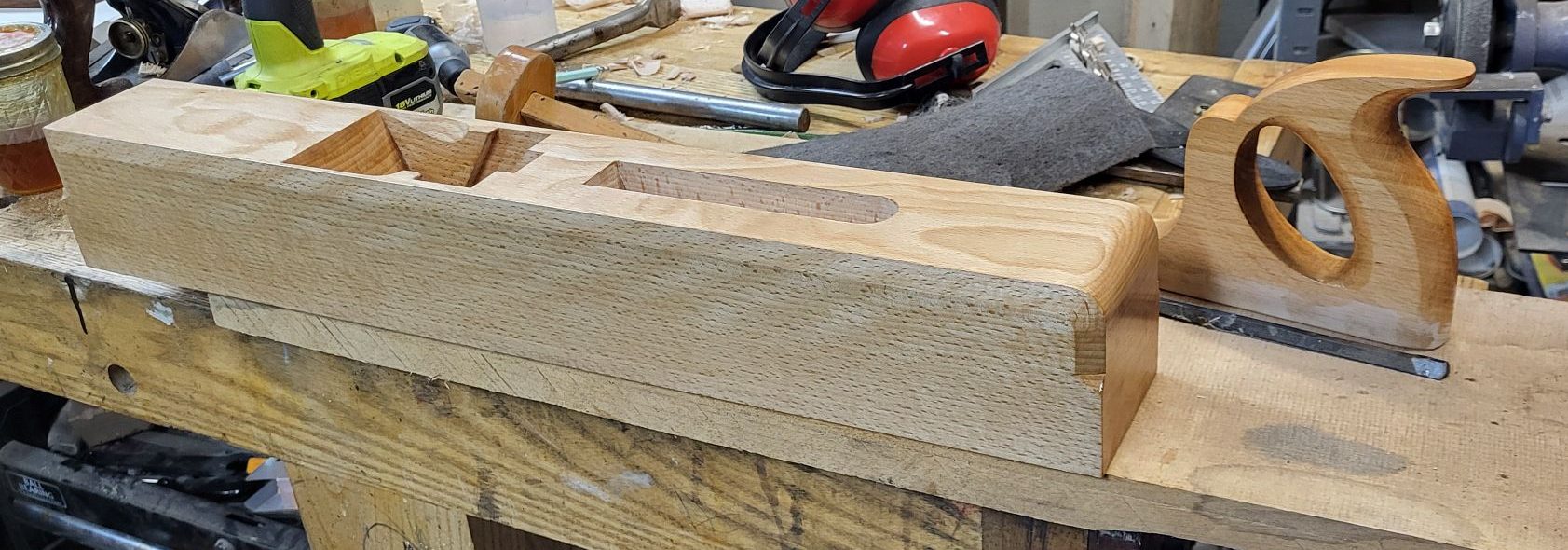
It’s the shell of what will become a coffin smoother in gombeira. Kind of an ugly wood – it’s sort of a combo stacked straw and fish scale look, but it will become dark brown soon enough. It doesn’t ever fully lose the fish scaly texture on the surface, though, even once it’s past rosewood brown.

What is in the back of my mind though is out of laziness, I’ve never made an abutment saw. I don’t really have any interest in making one right now, either, but the idea of using the zero clearance or flush cut saw that I’ve used for a very long time (not the right tool for the job – and slow), really didn’t appeal for gombeira. Cross cutting gombeira or katalox gives the same feel with a sharp saw that normal wood gives with a dull saw.

I found something that I could convert quickly.

What is it? Remember those plastic handled tool box saws that came with three blades and each blade could be affixed with a single wingnut? This is from one of those. If it’s not 30 years old, it’s really close to it. And I bought it new or my dad did.

I have a lot of things in the shop that could be converted to make a saw like this – from raw 1095 spring stock to something salvaged off of a spring steel machine guard. But recalled this tool box saw blade laying on top of the tool box that I’d looked in for a soldering gun. The blade was covered with plastic including between all of the teeth. Why? I have no clue if it was used to mix plaster or to cut through wet plaster, but that combination of statements tells you why it’s good to be wasted on something else.

Let me describe the custom handle. CA glue, activator, yard stick that was already ripped to half width with the cut away piece used for something else the kids were doing. Perfect combination of spontaneous junk. Blue tape for comfort and also to keep one scale from coming off completely at once.

I try to make nice things. Try is a word that has a lot of range. But there is also particular delight in making something that would terrify or offend someone obsessed with only making and using “proper” things.

It was a little slow through the gombeira, but if anything, the teeth and the blade are a touch hard for regular files. It’s not differentially or impulse hardened, but the future for it was the garbage can, anyway.

Ward and Payne vs. Ohio Tool

When I compare pictures of grain in my tools to older tools, I often see larger grain in the older tools. The Ohio Tool was over the top, though – beyond that.

I lost my manners with old irons this past year and started nicking the edges, or in some case for irons I wouldn’t use, just breaking them to look at the grain.

So, when I compare pictures of my grain, there’s something going on in the older irons where the composition of the steel tolerates some grain enlargement, probably because the steel itself would be ultra tough at lower hardness.

The first ward iron I chipped the edge off of is probably 210 years old at this point, and I have to apologize, I don’t have a picture of the steel but to say that it’s almost identical in look to the much later iron I have a picture of below.

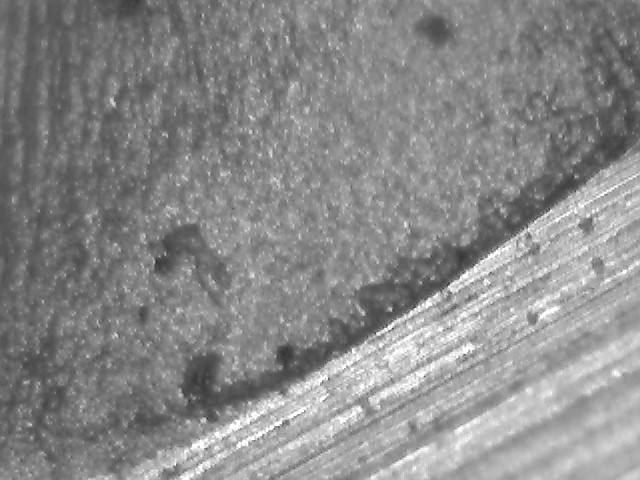
This is that Ward and Payne Iron (for the record, taper plane iron 61 hardness):

There’s something unfamiliar enough to me about this steel that I can’t say visual comparisons to mine are that relevant. And to some extent, Ohio Tool’s irons may be missing something a little if trying to compare them straight up. As in, it may be unfair.

In contrast to the ohio tool iron, partially due to hardness, but at least some due to grain, this 61 hardness W&P iron first deflected a lot and then in another section, I managed to strike it very hard and get a section to come out. it’s a very good iron under the punch test sensing how hard it is to get it to let go of some of its edge in the first place.

If I made an iron out of the steels that I use and the picture was as coarse as above, they would break too easily and have somewhat chippy behavior.

I thought knowing that the Ward and Payne grain doesn’t look as small as mine, it would be not totally fair to compare the Ohio Tool iron grain in the prior post to a modern steel that may not even be made from the same type of iron ore. It’s out of my area of expertise.

But just for reference again, here is a picture of that Ohio Tool steel iron:

It’s possible that those aren’t grains but rather agglomerations, but the force needed to nick the edge out of this was a tiny fraction of what was needed for the Ward. I don’t know if I’m going to venture into wasting my time with the Ohio Tool iron to temper it and see what the resulting hardness is. One thing is true on plain steel -if you push steel with a higher temperature prior to quench, even for a little, it’s easier to hit a high hardness target as the time interval to get to 900F or so widens, and when that interval at heat just above critical is 2 seconds, to get it to 3 or 4 is a lot of forgiveness.

The only way I know of to get actual grain boundaries and eliminate the guessing on these two steels would be Nital (nitric acid and ethanol mix) and polished samples. I’m just not looking to go that far. Nital can be dangerous (explosive) if some of the ethanol evaporates and I don’t have a separate lab building or something where that wouldn’t risk burning something down).

But I am genuinely curious. One, why ohio tool irons were never made better than they are, and two, why the Ward and Payne irons can look coarser than my irons but still be just as tough and very stable at the edge.

Mine again, for comparison, in case you don’t want to go backward chronologically (actually, this is another 125cr1 picture and I think I may have considered the grain a little questionable and given the iron away to a friend):

I don’t know what Ward and Payne used – but the 1.25% steel in this last picture, and even 1084, won’t tolerate too much in terms of enlarged grain. toughness can be reduced to a fifth or a tenth very quickly, and my first attempts at 1084 irons with somewhat enlarged grain were intolerable to use. It’s really high toughness, though, so making a 60.5 hardness iron out of it tempered at 400F and tiny grain is also annoying. It’s too tough and deflection damage will hang on – something you don’t want with plane irons and chisels. if damage occurs, you want it to remove itself so you’re not pushing an edge or deflection that’s really wide through wood.

If you’re curious about a modern commercial iron, the hock france iron that I broke and tested previously – in O1 – had grain similar in size to the 125cr1 picture above. I can shrink grain to a little smaller than O1, but can’t make the claim that it makes a difference. The Hock iron was a little chippy, but not due to grain. It was a little chippy because O1 is a low toughness steel and undertempering it just exposes that very quickly. I suspect Hock’s French irons were or are tempered around 325-350F. O1 comes into its own at 375F in my opinion, and if you can get a good hardness out of the quench, is noticeably better at 400F temper. That’ll knock down hardness from Hock’s iron by 2 points or so – I measured 64.5 on the one I had. O1 is ideally suited to 62/63..

So, anyway, I can’t totally solve the mystery here with the different looking grain pictures. Modern alloys look different under the scope. Iron carbides of size will start to show up and steels like O1 with tiny carbides (which still doesn’t result in good toughness) will look very fine.

All of these trivial things, even with the modern steels, will seem confusing until you’re working with the different steels. 1084, 1095 and O1 can just look supremely fine under magnification. the 1.25% carbon steels start to get some volume of iron carbide, which isn’t much of a threat to toughness like harder carbides are, and you can’t conclude much from each unless you’re comparing pictures of the same alloy.

Very likely that the four pictures here are all substantially different compositions. An XRF of the Ward and Ohio Tool irons would be interesting, to find out what’s different about them vs. something plain like 1084. 1084 is often suggested as being “like old steel” but if you make an iron from it and then use a Mathieson or Ward iron, they’re not the same, I’d say by feel, really not similar.

Ohio Tool Stuff – Terrible

When I started making planes – which I don’t do much of now – I bought a lot of wooden planes. I don’t remember the number as some were junk, and most were sold off, or cut up and thrown away, whatever was appropriate -but it was perhaps 20 planes. One thing that stood out to me was Ohio Tools planes could sometimes have good wood, but I’ve never had a single Ohio Tool iron I liked. Including one of their metal planes with a tapered iron. They’ve all been chippy, though it seems to vary from one to the next.

Fast forward to today, and I’ve made two rosewood planes in the last month – a jack and a coffin smoother – and I’m in the middle of making a coffin smoother out of gombeira, or “brazilian ebony” or Swartzia Panacoco. Whatever. Typical density at 12% MC is 1.2 for the wood and it’s unique in how it works. It does have a little bit of directional preference like oak does, and that has no effect on handles, but it may not be appropriate for a plane. We’ll see if it splits the abutments. The dry sample that I have has a specific gravity of 1.32%.

What better way to size it than to use the just-made smoother. That smoother in this case has a 125cr1 iron that came out of a 390F double temper at 66. It actually performed fine, and was still at 66 here, but I bumped the temper up 25 degrees and it’s at 65 where it will remain. Nothing you ever make won’t chip or roll on something, but it’s still annoying if you’re a maker and using your own tools if they chip at all. is the chip because it’s not good, or because you did something that will chip anything. You never really know.

So, the shape of this coffin smoother isn’t that interesting – it’s one that I copied from an Ohio Tool coffin smoother that I have that I like and even the iron looked decent. Like well enough made that it should have been difficult to heat treat it improperly given the rest of the effort. Heat treatment isn’t difficult to do on plain steels. I haven’t, however, had any experience with Ohio irons that has been in a class with any decent English iron, and it’s a head scratcher. I don’t mean just mediocre, I mean it always falls short of even that.

I didn’t buy the plane in question to use it, though. I bought it because it’s a decent layout that still leaves some tubby plane rear in your hand and I like that – it’s less hand stress to use it even though it’s not very pretty.

So I tested the iron (which I haven’t pictured here).

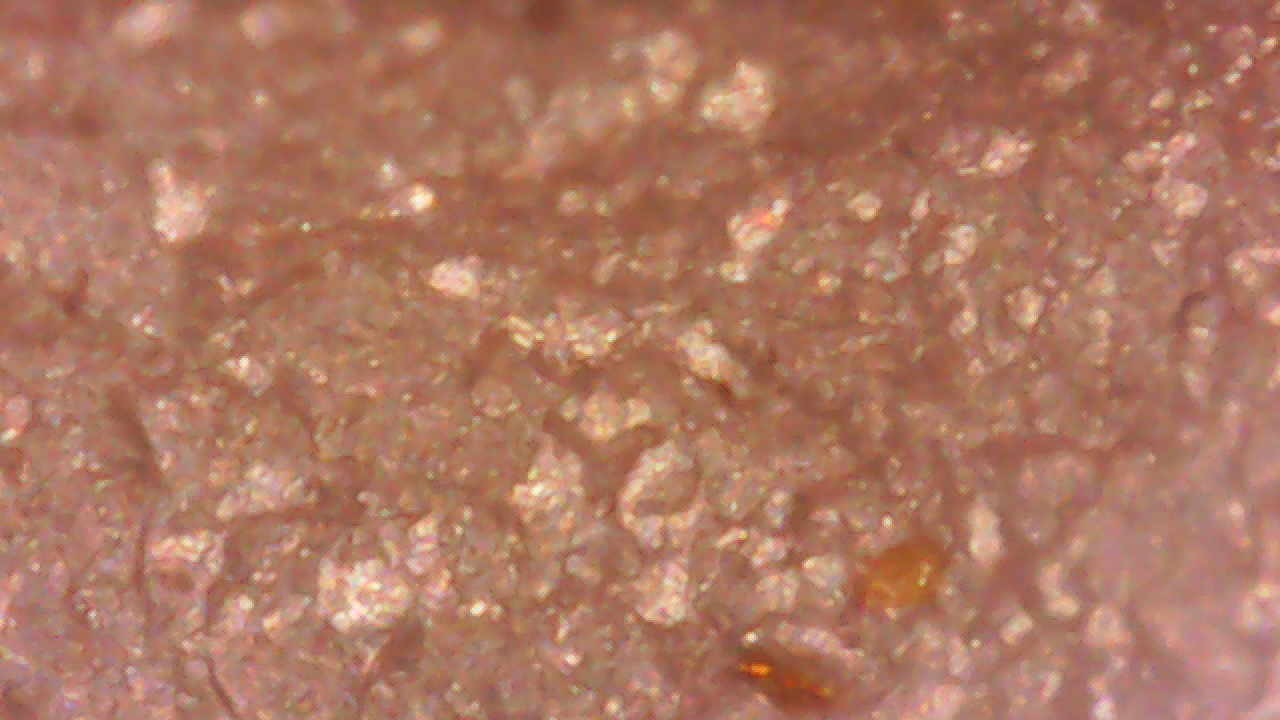
66 hardness. WTF. Maybe I’ve always been wrong – maybe it’s just undertempered, but before I waste time doing that, I knocked some of the edge off with a punch. It looks like these two pictures:

!!!!!!!!!!!!!!!

Given my recent iron at 66 and this one coming through at the same, I had to bust out the calibration block that came with the hardness tester to make sure the diamond hasn’t cracked off at the tip. Nope, it’s fine.

I doubt all Ohio Tool irons look this bad, but I have never seen anything like this before. it’s at 75x magnification, but those big flat facets probably are grain boundary defined. We shouldn’t be able to see much of anything.

Too, I used a tiny cross pein hammer (6 ounces?) and a punch to knock the edge off. That shouldn’t really be possible – the punch should just bounce off, but each strike of the hammer knocked a chunk out no problem. This iron has no chance. I have no idea what would’ve been going on when this was made – this is not difficult to avoid if it is just a heat issue. No clue what else it could be.

For a refresher, this is what my 125cr1 steel looks like punched.

Sometimes, it’s not quite as tight as this, but it’s always close. And always better than the grain in the Narex Richter was. That was also unacceptable but not remotely close to the scale of the Ohio Tool irons.

I would not buy anything made by Ohio Tools, especially trying to save a few pennies buying an iron to make a wooden plane. Spend the money on something from England. Mathieson, Ward, Early Marples, I. Sorby, or even consider eventually making your own.

Coffins and Stuff – Super Hard Coffins?

While I’m making rosewood planes, well two now – I guess it seems like a good time to make more than one. The one plane I’ve made few of is coffin smoothers. No offense to people who love them, I just cannot find a way to make them as productive as a Stanley four in regular use, just as I can’t find a way to make a metal Stanley jointer or #5 as efficient for jack and trying work as a wooden jack and try plane.

My favorite smoother I’ve made (out of two? maybe I should wait for a larger number) was an experiment to use scrap purpleheart and intentionally make an insert in the plane like you would see on a plane that’s had a plug or block installed when the mouth gets too large. The point of the plug was to control both the mouth size and create some room for the wear in side the plane before redirecting the shaving up and out. It worked great to be able to separate the main wear angle and the plug – from above the plane looked normal, but a wear block inserted in a new plane is a fart in church kind of thing. Good luck convincing someone that they shouldn’t wince or squint at it – it’s associated with clapped out planes.

Of course, the wedge isn’t fitted and shaped yet – I have a little bit of abutment work to do as well as the final fitting and shaping. The wedge be much shorter and rounded at the top to match the iron and cap iron.

Continuing a slow trend- once every 6 years I make a coffin smoother – the eyes got away from me here. Some smoothers have the front escapement tilted forward to make a bigger opening, and the cheeks are not a flat as this is then transitioning into a diagonal relief cut, but rather diagonal from the abutment all the way to the front. Much more room and more open looking, and the eyes can be longer because they won’t start in a weird place. So the eyes ended up getting short and tall as I faffed with them.

The combination makes this a tubby plane and the sides are particularly fat at the back of the eye. I’ve got a bunch of older coffin planes and they seem to have all kinds of shapes – from fat at the eyes to thin at the front and back, to more subtle like this one where the front is tubby, but the back is also tubby. I chose these based on the desire to have a bigger rear and a looser rear hand, but just like the eyes, there are other styles (fat front like this and thinner boat tail style back) that are more stylish .

The iron is 125cr1 and the hardness after a 390F double temper is 66. There is no visible grain growth at magnification, but we are probably pushing the limits of where hardness can be with a tempering temperature that’s not that low. They make this steel all the time, and beyond that, I have plenty left – if it’s hard tempered, I can bump it up to 425F and get hardness to around 64/65, and if that doesn’t work, just make another one.

However, I don’t notice anything unusual when wrapping this iron up and giving it an initial edge. The burr behavior is good – it doesn’t break off early but you can tease most of it off on a hard Arkansas and have little to strop or buff.

The odd nick that you see in the end of the iron is something I just feel like doing on everything going forward – a punch mark where I ground a small bevel on the other side, put the iron in a vise, and then hit it with a steel punch and heavy hammer. Ideally, you’d like less of it to break out than that, but whatever – the difference in time to grind it out and then set the final bevel is about 1 minute ,and not grinding a bevel and then testing a small break preserves the ability to re-do the heat treatment if the grain is bloated. Once the bevel is on with a water-hardening steel, you’re asking for trouble if you try to only take a little of it off and re-do the quench in brine. Terminal trouble – cupped on the face side and convex on the bevel side. No thanks.

I’m disappointed in how this plane looks in pictures given it kind of has the proportions that I like for handling a coffin smoother. I don’t like a cramped thin rear or the ache of a closed hand. I do like the fact that this plane will be a little heavier due to the wood type – we’ll see.

Once again for this one, the wedge is walnut – rosewood on rosewood is just kind of harsh and it doesn’t grip the iron as well. And there’s a chicken feeling, or “pucker factor” – you know what that means if you know what it means. Hardwood wedge on hard plane and burnished wood on the wedge and abutments and wedge to iron contact just leaves you feeling like one or two taps to get everything seated could be followed by a pop as one of the abutments cracks. I’ll color the wedge so it looks similar to the rosewood, and this time pore fill it a little bit so that the remaining look beyond just the color matches rosewood a little better.

No sandpaper yet on this plane but for the bottom! When it gets oil and shellac or varnish and shellac and wax (impatience on my part – if I use a long varnish but then rub shellac into it, I can use a turpentine-solvent wax right away rather than letting the plane sit for a long time to avoid trouble with the turpentine softening varnish a little. I ended up doing the same thing with the recent rosewood jack. It’s kind of a nice combination even though most folks would think putting a less durable finish over a more durable finish doesn’t make sense. On furniture, it probably wouldn’t.

Not sanding anything will mean flaws appear when I apply finish – file marks, little facety things that could’ve been rounded over better. We’ll see.

How Strong Does a Chisel Need to Be?

A couple of years ago, I wanted to make some seaton-like chisels. Not copies for the first ones as what if they weren’t very good to use? They are the apple handled chisels that are on the front page.

I made those out of 26c3 and at the time, a little too chicken to grind them that thin, I left them around .08″ at the tips. One of them was a touch soft and I later found that one to be 60/61. For 26c3, to have a chisel that soft is pointless -it evades the usefulness of the steel, which is to have good (not great, but good) toughness or resistance to breakage at relatively high hardness. something like 64/65.

I thought they were all soft because of that, though i can’t recall why. But you can tell when a chisel isn’t where it should be based on how the burr responds, at least if you have some familiarity with what it should be like. I put these chisels in a drawer and gave one to Warren, and he used it for a week or two and said “I wouldn’t want it to be any harder” and brought back the one he was using. Warren doesn’t like really high hardness tools and i thought all of these were soft, and later tested a couple and they are 64/65 or maybe half a point harder than that yet.

The soft one, I probably got impatient while thicknessing and that’s that, or I may have had a snafu tempering by leaving something not fully protected by a mass sandwich (a mass of aluminum that is) in the toaster oven.

I pondered throwing these away and almost did, just because it does get aggravating sometimes to have stuff around that you think is only half good. Fortunately I was wrong, and fortunately i didn’t throw them away before getting a hardness tester. And I also learned that I spoofed Warren unintentionally by giving him a 64.5 hardness chisel that he had no trouble sharpening, so that made for a nice bit of proof that alloying means a lot when it comes to sharpenability.

I’ve made some other closer to Seaton chest reproduction chisels and am slowly getting around to making a set for another friend who I have no business making tools for in the first place. But with all of the sharpening stone box making and now a couple of planes, I’ve come to appreciate a thin chisel.

The apple handled chisel here that’s in the middle did all of the excavation in this plane as well as the rosewood jack that I last posted. rosewood is a nice working wood, but it’s still a lot more punishing than beech and I don’t baby the chisel. I’m sure I could break it by trying to pry great amounts, but that’s stupid, anyway. chisels sever and the real usefulness for prying is getting little bits out of corners or thinner bits split off by rotating. This is borderline abuse, but nothing was suffered here.

The Difference

The big difference using this chisel and going a little slower – something I need to do with rosewood anyway so as not to waste it or leave garish chunk outs on side grain, is that this chisel can be sharpened indefinitely with two stones and never see a grinder, and never cost the user any time.

In wider work like dovetails/half blinds, etc, it wouldn’t be any slower and if the corners need to be gone, the edge is so thin at the front that it could be done easily by honing a slight bevel on the sides. Not a big wide flat one, just one that’s subtle. That is, after all, on some of the chisels in the seaton chest pictures – a user-added very small side bevel, but one that’s functional.

The amount of time to sharpen this chisel sans grinder is not more than a minute and a half total including stropping or buffing and to do each of these planes, I sharpened twice. For cherry dovetails or something like that, the edge would last an eternity.

I’d have been worried about breaking a chisel like this – this particular one is at least 65, and also wooed by the discussions of Japanese steels and that steel is always fragile at high hardness. It isn’t. these very chisels are going to make for an interesting comparison against hitachi white 1, as I suspect that the 0.25% of chromium in 26c3 is probably a benefit and not a detriment, but we’ll see when I finally get a set of solid steel chisels made out of hitachi white 1. It may not be until later this year unless I get laid off or who knows what else.

If I do, there will be a toolmaking bonanza for a little bit. I’d prefer not to get laid off, of course! But there’s definitely not enough hours in the day to make just the things I want to make let alone make a few more things for other people.

As with many things, the experience here using this chisel has really made me think some things just from function and feel that I would not have guessed. Yet another thing where informed or experienced opinion is just far better than supposing.

I know the answer for mortising in general is that a chisel should be thicker than this one. This one wouldn’t tolerate that much hard forces because it just isn’t thick enough for that, and it wouldn’t rotate in a mortise. but I’m starting to get a sense as to why cabinetmaking didn’t require or prescribe any “firmer” chisels in the sense that people errantly think of them now. It required firmer chisels as Nicholson described them – chisels strong enough to form wood.

What I really don’t have any need for is chisels that were designed to survive uninformed hands on a construction site. When I first started woodworking, I would’ve called stanley 750 chisels “delicate”. Things change over time.

Rosewood Fackry Plane

That would be part fore, part Jack, and part try. The reality is, I don’t need the plane, but I need what it offers to build the plane, which is just the same kind of three dimensional satisfaction that you can’t get by reading about things or having to sort out real problems. That’s the draw of the shop for me.

There are some ulterior motives. I wanted to make the iron and cap iron and see if I can make them to a standard that ward would. Jury is out on that. And also, i’ve always just loved running a jack and try plane through wood, but once in a while, a full sized try plane can be a little much. So this tweener plane really has the most potential use as a smaller try plane. if it fails at that, it’ll just be set less aggressive than my usual jack and used in its place.

The reality is this role is also undertaken well by a stanley 6. But it would take a long time for me to figure out how to make a Stanley 6 and it probably wouldn’t be that great.

This is what it looked like originally. I like what walnut does as a wedge – it’s protective of the abutments but also far better at confirming to little differences in the abutments themselves or the top of the cap iron. I really don’t have any interest in putting the iron and cap iron together and then belt grinding the top so that the spring in the cap is straight along the top. It’s not needed, but with a rosewood wedge – as I found out – there isn’t enough give in the wedge and fingers and along with fiddling with grip, I was afraid I’d get stiff at some point and split an abutment.

The look of the wedge is a bad match, though, and it’s not aesthetically very good, either. It’s just OK.

So, keeping track, this is the original wedge. I needed to make another one no matter what to address a few feed issues, and then I made another one out of rosewood but never managed to get to profiling the top due to its behavior, so I don’t have a picture.

At the very least, making a new wedge, staining the walnut a little darker with earth pigments. I don’t like coloring wood, but I’m willing to do a cheesy job here for a specific reason. Walnut gets lighter with age and sun exposure.

Notice the iron. somewhere I lost track of how close it was to the handle due to either a layout error or something logical in terms of what I was marking off of. that leads to jumping to conclusions, but now that I’ve had the chance to refit, refine the feeding so it doesn’t clog for any reason or even hold the shavings in the mortise temporarily, I realize that the iron is clear if the handle front (just barely) and it has no impact here, so there’s nothing to fix.

I’ll sludge up the pores in the wedge with french polish and it’ll stand out even less.

Making something is a process of making little mistakes and avoiding big ones, and then even if you make big ones, seeing if you can live with them or learn from them.

The handle position and gouge cut at the end of the chamfer stick out to me. I used a gouge that wasn’t what I normally use and had to correct it and widen and flatten the cut. I made the others kind of bland and boring just so they’d match. I’d rather see it or someone else see it and say “i don’t prefer that look – a smaller gouge cut and steeper with a bigger step looks better” than why don’t they look relatively similar?

This is a rare case where that’s all I have to say. It was really nice to conquer making a tapered iron and a hardened cap iron and the tapered iron also has the very classic back curvature in it, so there’s nearly nothing to bedding. It was over in a couple of minutes and the bias points are stark – there’s no contact with the bed other than at the bottom at the top.

The whole thing is already getting cruddy from handling and touching things up, and that’s a point where I like tools to be. Near perfect starting shape and trying to preserve that is a huge burden. Not a fan.

The billets are in the background, because I think it might be nice to make a matching style coffin plane.