Blog

Poorly Sawn Wood – Dealing With It

I set out to make a handle for the rosewood plane, and of course, you wouldn’t want the handle to be pine. I have some nice rosewood that’s 8/4 quartered, but it really should be saved to be resawn for a guitar top or acoustic guitar backs – which is what it’s for. I thought I had a pile of 8x8x3 and 6x6x3 blanks, but I don’t. I have a couple.

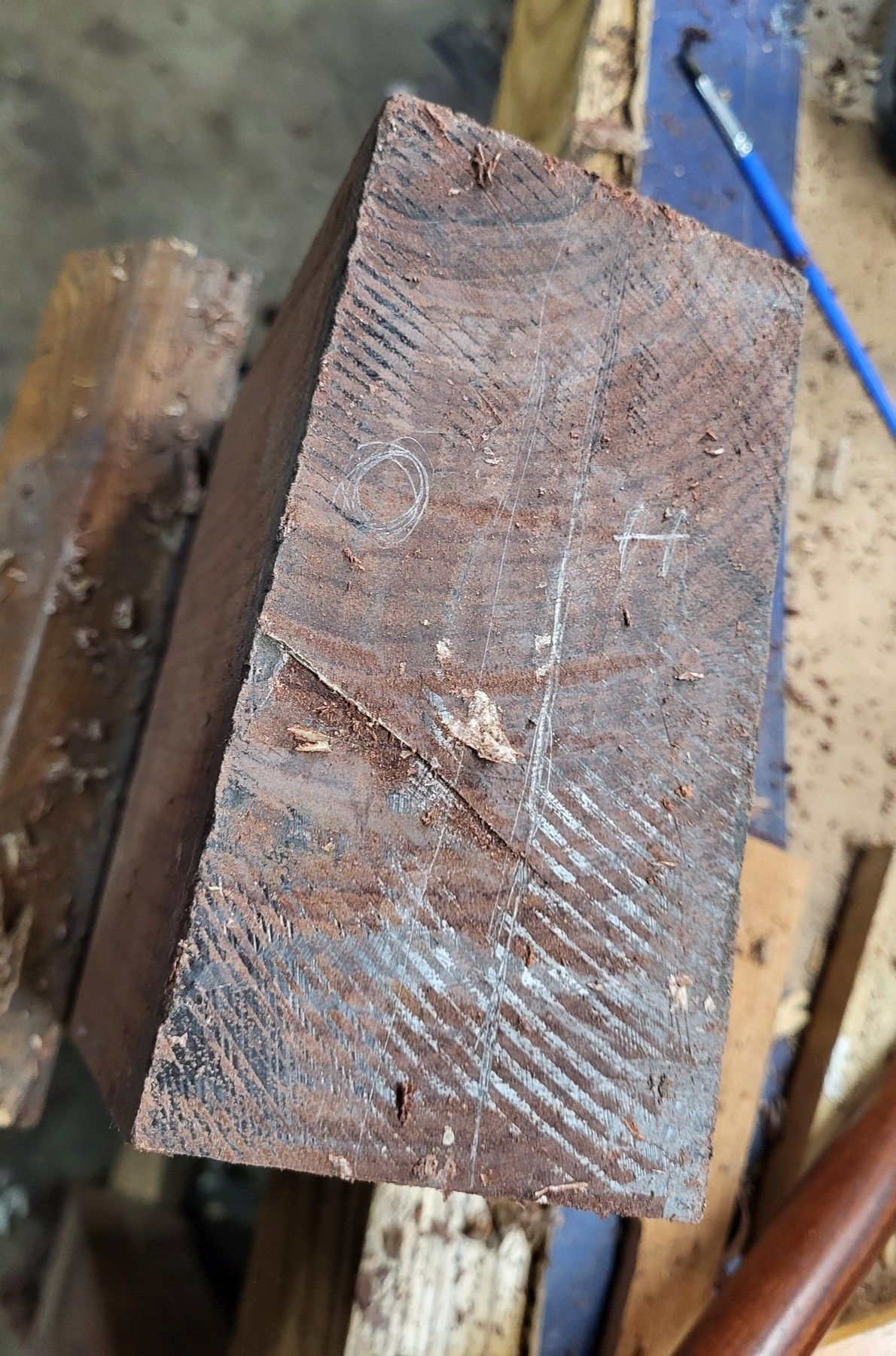
Over the years, I’ve tied to buy quartered and rift blanks when I see them because they give you a lot more options than one with the typical flatsawn C pattern in the ends. When a handle has wood that shows evidence of that, it looks weird. My best choice is this:

I have a terrible habit of getting a few blanks and then one is like this. What can you do with it? it’s a bummer as it’s sawn off center two ways and if you get obsessed with a 6x3x3 blank like this trying to get every cent out of it, the work suffers. I guess something like this with shipping and tax is about $50, but you can’t just go order 10 because stock pictures mean you’ll get all kinds of nonsense when you want quartered or rift.

I’m growing up a little and instead of procrastinating, the real answer for this is I hope to make stuff nice enough that I can have some waste from resawing this kind of thing into the right orientation and the rest of it be damned. If I spend 15 hours on this rosewood plane and try to save $25, and then don’t like the way the handle looks, it’s not a good decision. I guess that becomes the challenge – if the wood is too nice to waste, but still not good enough, make the work nice enough that you will want to make the wood right.

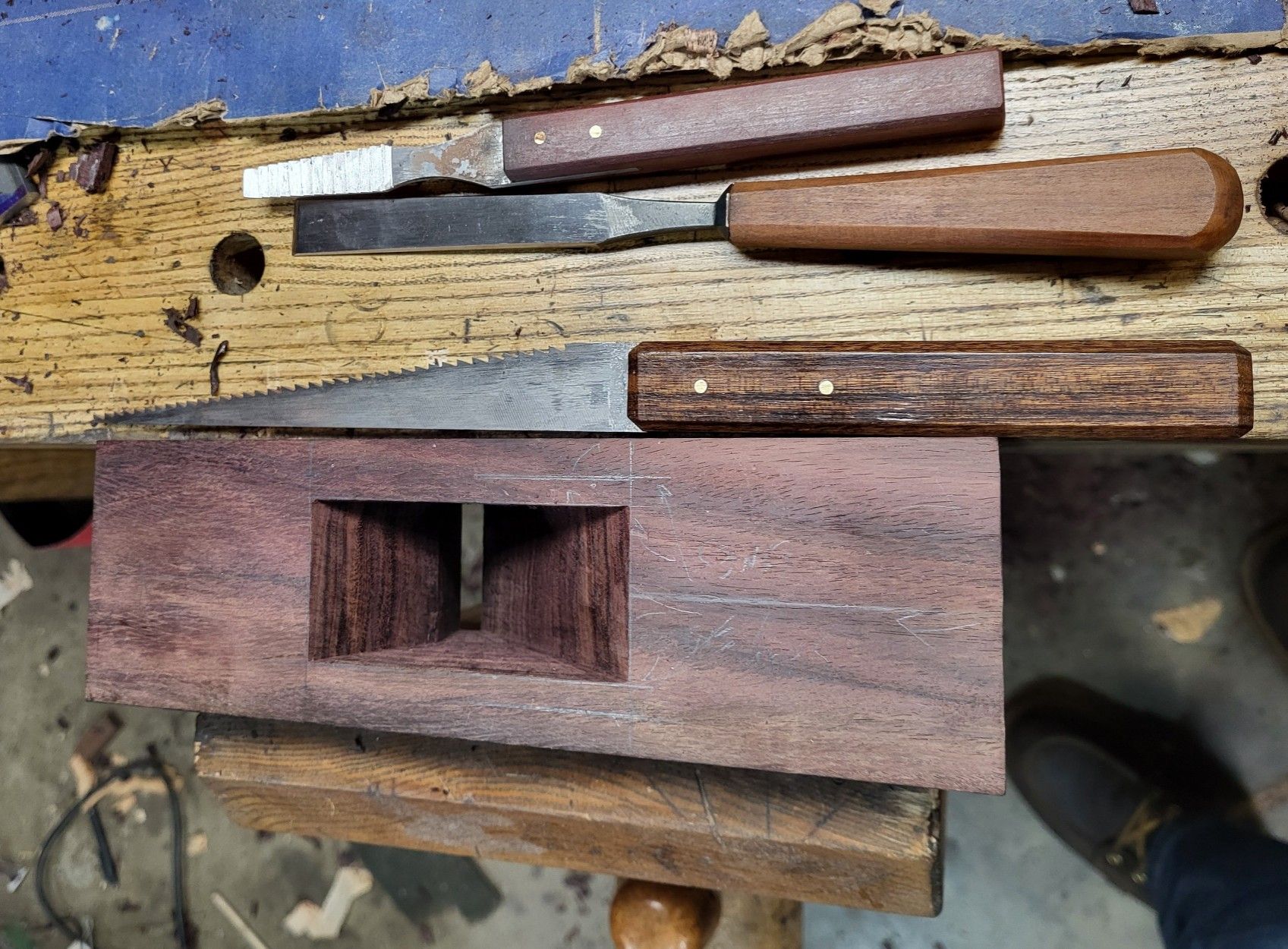
You can see pencil marks on both the sides and the top. Ultimately, I don’t have much for power tools any longer, though I do have a nice big dolmar chainsaw!! Unfortunately, this isn’t big enough for that. so by hand it is, which is good, because it’s what I want – I want to cut the wood, feel what it’s like, get a chance to look at it. My brain is slow and because of that, my work by hand is better than work that I used to do with machines. The opposite of what most people will tell you will happen.

This is especially true shaping the handle. I have a sort of routine, but it is not end to end step by step with lots of repetition. If I were to try to speed up handle making with power tools, it would result in errors or chipouts, etc, or just not enough time to look at what I’m doing – and my eye is pretty good for a hack, but it’s not good enough to look at something briefly and just slash wood away.

Now…the ends of this leave some decisions. The top left corner is near the pith. that side of the blank is closer to the center of the tree so it doesn’t have grain running vertical into the top of the handle. The wood on the right does.

I have no idea what I meant with the O and the H when I marked this, but I want the wood with the O to be on the back of the handle. Of course, this runs out into the side of the plane quickly, so it’s the right side that gets kept here. The trade is on the other end of the blank, the wood that’s visually nicer and getting cut off here is what’s kept on that side – so the far face on the ends is the back of the handle.

It does take about 20 minutes of hand sawing something like this with a rip saw to get what you want, but it gives me time to consider. If I had a bandsaw, what would it take? Not long, but dealing with dust and changing blades, etc, isn’t time free and at least doing it by hand, I’m working the wood the whole time.

Contrary to popular belief, a normal disston d8 rip set up for anything else cuts this just fine.

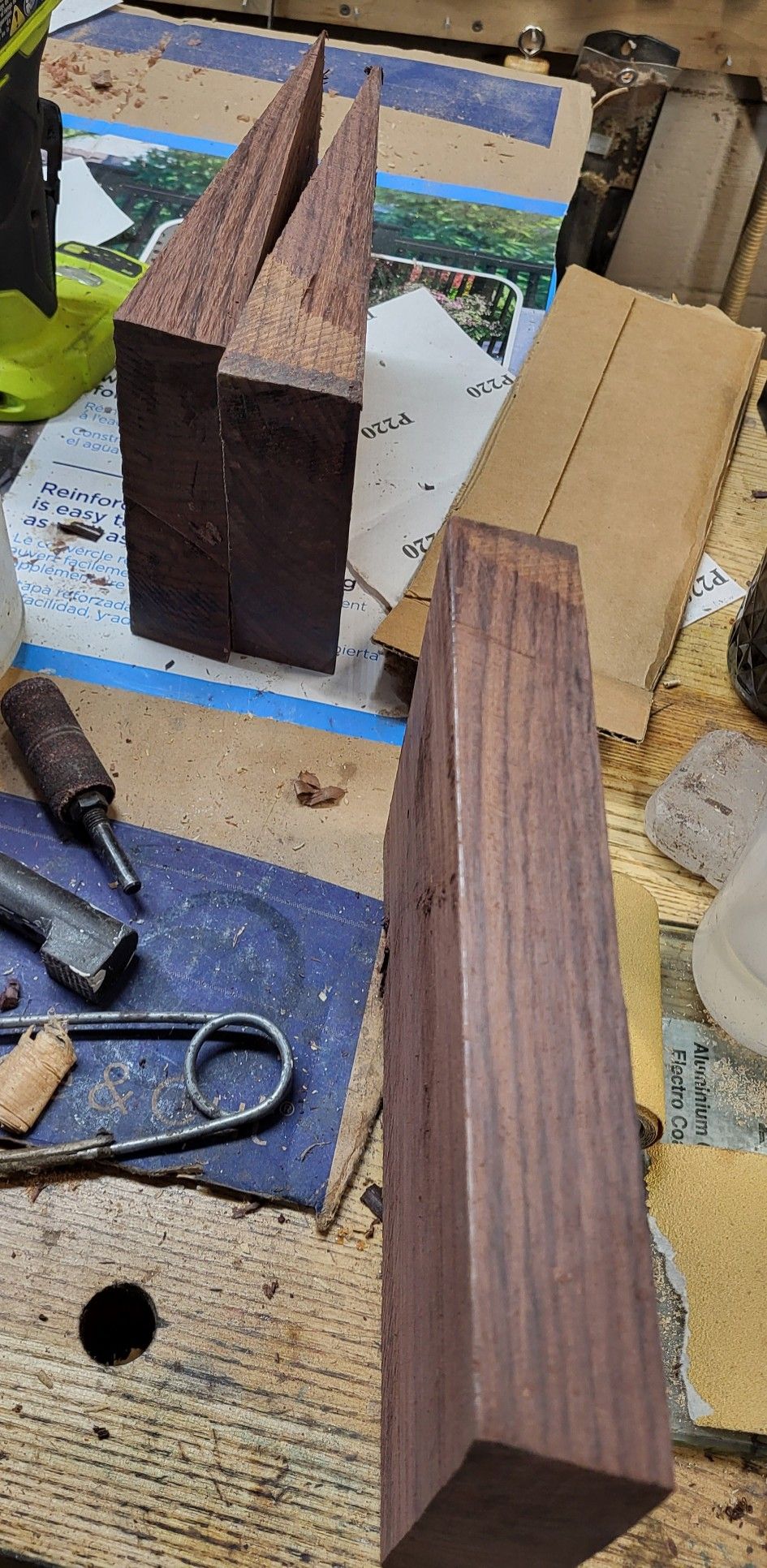
I have two thin wedges from the top and bottom not in the picture and the other two shown here. there may be a use for them at some point and if there isn’t, they can go in the scrap bin. The thin ones are ideal for ripping long boards by hand. hard wood with a really slight taper that will hold boards open, so I put them with the handsawing gadgetry just for that.

I left this a little fat – a little less than a quarter just to make sure there are no surprises, planed it and squared off the ends so that they wouldn’t be a bear with bench dogs, and then thicknessed it with a jack plane and smoother.

Resawing something like this can be a little awkward, but you can figure it out. Black rubber drawer liner – the holey kind, not the thin slick stuff – is nice for something like this as the wood is hard enough that it’ll be slick on a bench top and you’ll be whacking the holdfasts endlessly.

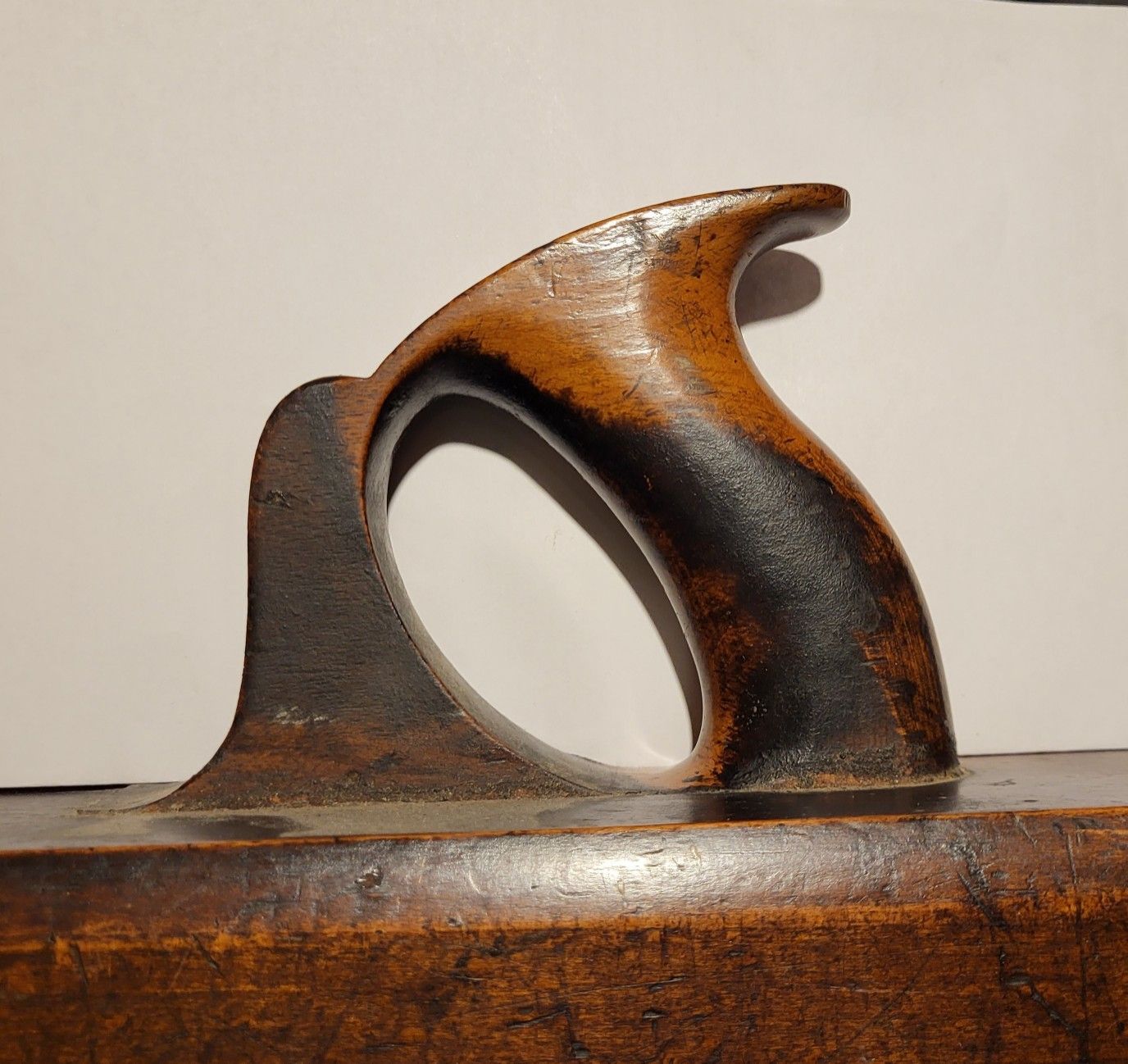
I always print out the handle profile I want, which is always a picture from straight on either as found or in this case, I took it from a plane on my shelves.

to get the right size, I handle a plane like this – surprisingly it fits my hand, which is kind of narrow – 3.5-3 5/8″ across the knuckles. it’s a snug fit and someone with a larger hand would have to work with a finger or two over the side of the plane. In this case, it’s about 3.7″ to the top of the horn. I want 4 1/8″, just by experience.

Anyway, I use windows paint, print the picture as a % of size as a guess (i guessed 50% in this case, just eyeball it with print preview) and then measure the result. From there, you can adjust the 50% by ratio and hit the mark right on the dot with a second printout, and then you can save the picture with the size and % print scale and not have to do it again in the future. For example, 56% in this case makes a handle 4 1/8. If I get some big handed oaf who wants a plane and likes the handle but it needs to be 4 5/8, then 4.625/4.125 * 0.56 = about 0.63.

I affix the picture of the handle by making it wet with water base finish. it stays on better than glue dries pretty fast and doesn’t have much penetration. if you don’t get the picture to stick right away on the wood blank, you can just brush a little more finish on top of the picture-it’ll go through the paper and contact the wood without issue.

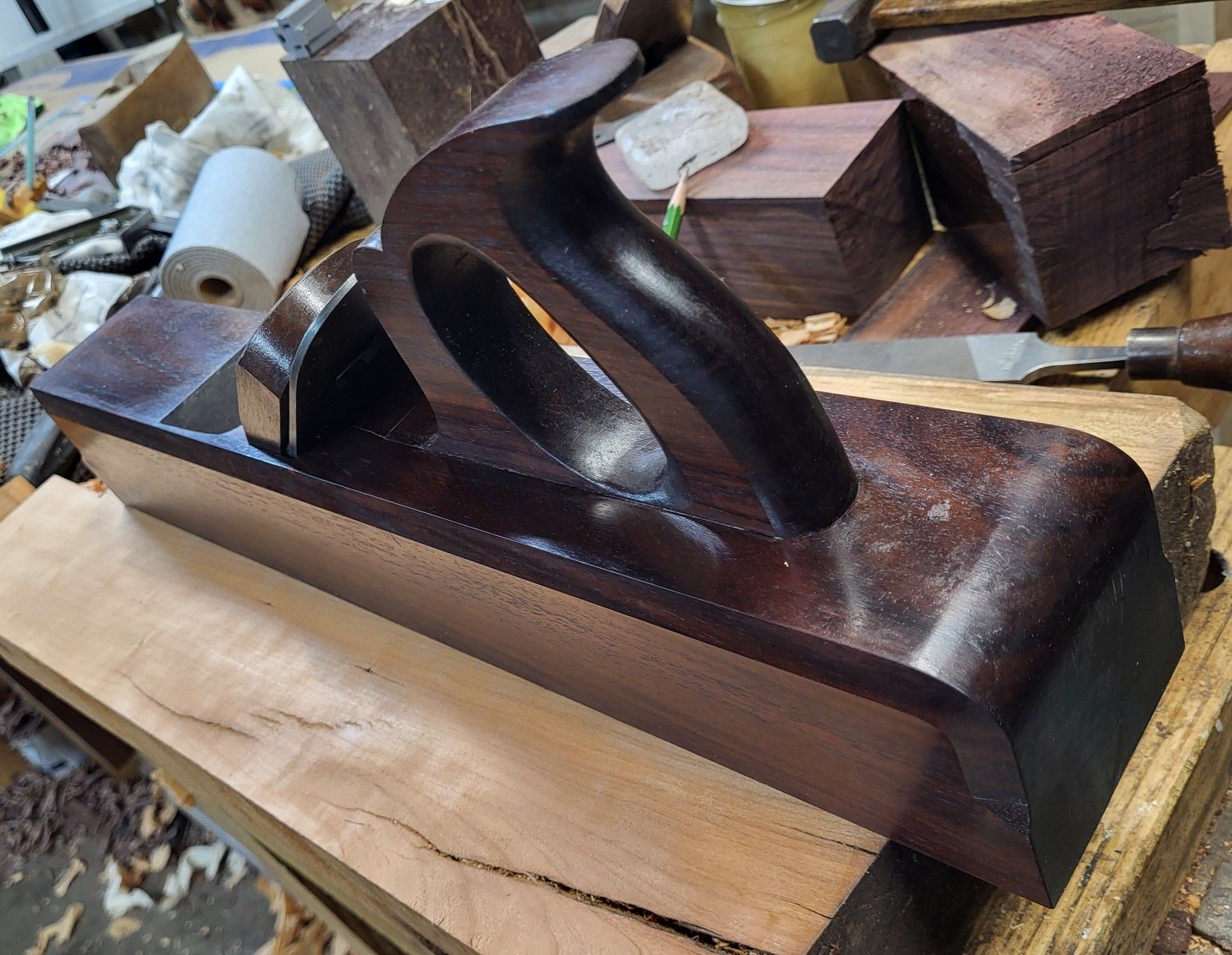
After a few strokes of some tools, and then filing and a little scraping, we arrive here. The level of finish isn’t perfect, but it’s about where I stop with handles on planes that will be used. I’ll probably correct just a little more. No power saws, no routers, no sandpaper, and so on – just something that’s to make by hand, and again with my level of infrequency, things appear slowly enough working by hand that you don’t end up wasting the wood.

I see things that could be better in terms of lines without being stupid. Stupid is a really long flat horn that comes out almost to a point. It serves no purpose but to be broken later. But I also have left the horn a little fat because the break rate at my mailing address for horn tips – for no good reason but carelessness – is a little high.

By the time I’m done with this handle, there’s about 3 hours of work in it. I know that’s garish to some people. I stopped trying to be a factory long ago, and because of that, the work was really pleasant to do. In the end, I’m glad that the wood isn’t just running out in weird directions all over the handle, even if it may not have broken from being made like that.

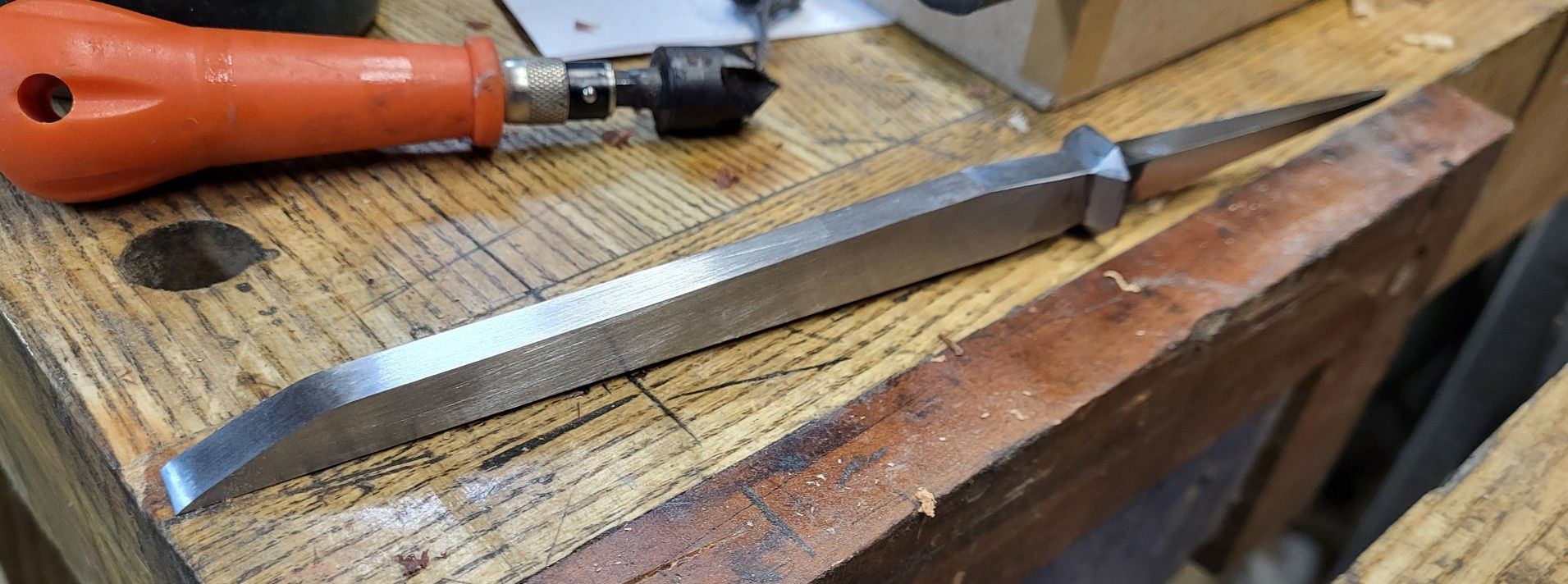
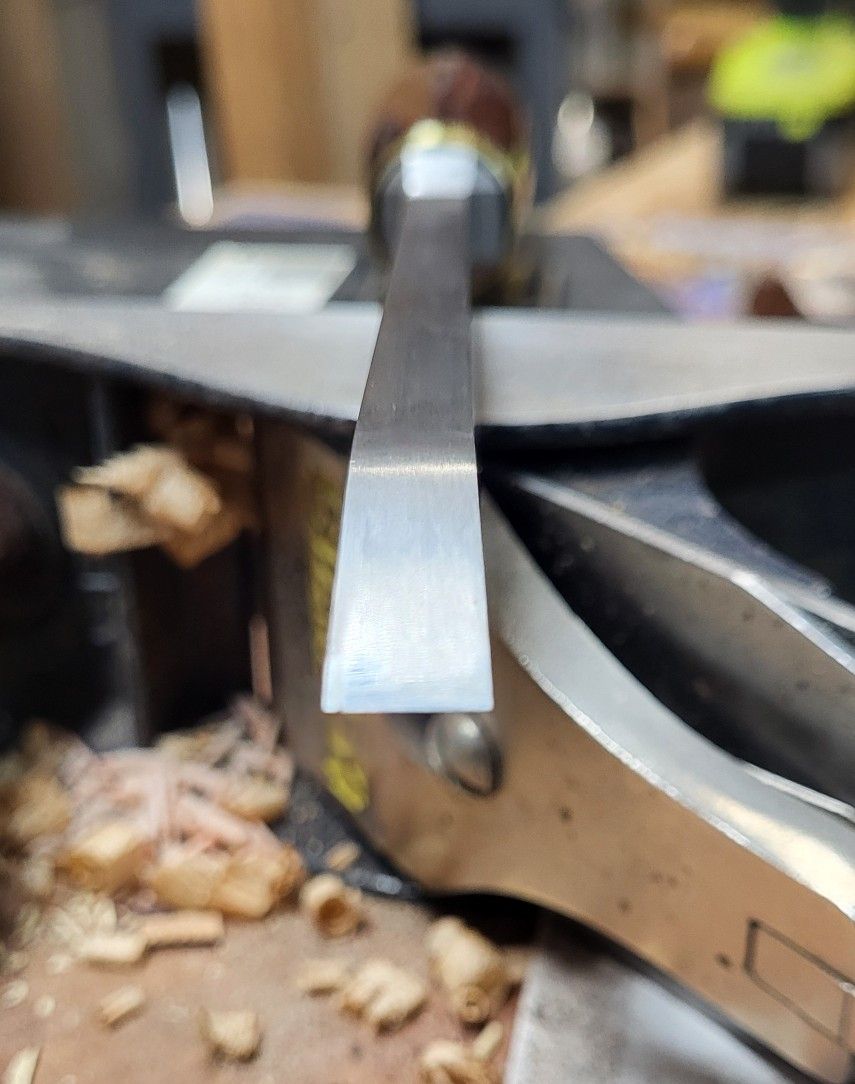
Mortise Chisels – 1.25% Carbon Steel

I’ve dabbled with making mortise chisels off and on the last two years. Pardon if I end up repeating anything I’ve already said on here, but before even getting into it, what makes a good mortise chisel?

  1. Proportions – they need to be good both for feel in terms of chisel length and stiffness in the right place, and the height needs to match the purpose. Really tall mortise chisels rotate laterally pretty far and don’t do well in short or shallow mortises, for example.
  2. Toughness vs. Hardness as well as edge stability. We’re dealing with mortise cutting, not paring, but you will find pretty quickly that if you can get a steel that has good toughness at high hardness, the edge will hold up better. Not worse.
  3. Taper – part of proportions, but the taper needs to be something that helps the performance of the chisel , doesn’t create a bind by getting less tapered moving toward the bolster, and it can’t be so much that the chisel rotates too easily in the cut or is narrow at the top. Narrow just results in you bruising the ends of mortises. Interestingly, other than that, there is no magic level of taper. I can’t find anything to suggest that and a look at some similar ward and payne mortise chisels to the ones in this post shows that W&P at some point in the early to mid 1900s, applied all of the taper to one side of the chisel and the other was square. In practice, you end up with the taper even and the bottom isn’t square to it. it doesn’t seem to matter, but I’m looking to apply it to both sides of the chisel for looks and would prefer that.

To-date, I’ve made mortise chisels of O1, W1 and 52100. They’re all “good enough”, but it’d be nice to have better. The problem is, my better is 26c3 and probably 125cr1. Translated to english, these are water hardening 1.25% carbon steels. One is remelted (26c3) and the other is not – so in theory and probably in practice, not quite as uniform. Remelting also removes sulfur, which creates a problem called sulfide inclusions or stringers in steel that lower toughness. My recollection is the higher the carbon, the bigger the problem this is. Both of these steels from the suppliers I buy from have sulfur at .001%.

For reasons I don’t know, my 26c3 samples test better than the furnace schedule results say they should. That is, my samples in 26c3 were well harder than O1, but tougher (harder to break laterally). They actually have toughness numbers above anything I’ve seen for A2 and 52100. Of the chisels I’ve forged out of round bar, I guess they’re all fine but 52100 seems to be slightly better. A2 obviously isn’t on my radar, but it has nothing to offer here, anyway.

Not being able to get the 1.25% carbon steels in anything but flat stock of 3/8″ or less is limiting, though. There are other options (sourcing enormous old square files), but the steel would be questionable in terms of how clean and composition, and surprise, when you buy all of the 7/8″ square good files off of ebay, nothing in the money-makes-sense range reappears quickly.

125cr1 It Is

I can get 26c3 in stock up to 0.25″ and 125cr1 in 3/8ths Which means I can make mortise chisels up to 1/4″ in one and 3/8ths in the other. that make the decision pretty easy. I think it’s not hard to find a use for 1/4″ and 5/16″ mortise chisels in cabinet work. 3/8ths is also useful, but less so to me at least on door and face sticking. It looked like one of those cargo airplanes with the nose open, facing straight up. Snap.

the toughness data suggests that shouldn’t happen for my stuff, but you still wonder if you make something hard will it break. It’s a reasonable bias.

So, I made two. It’s not important other than to note – the uniformity of 26c3 does make it a little easier to heat treat. As in, it seems to land at the same hardness without as much heat as 125cr1, but there’s still plenty of wiggle room to get a good result. I would figure given the choice, I’d rather have 3/8ths in 26c3 because once you get to a bigger cross section and a steel that needs to be quenched quickly, you are apply cold liquid to the outside of the chisel (OK physics people, the heat is flowing from the chisel into the quenchant), and the center of the chisel is still providing heat until it finally finds a cold adjacent neighbor to travel into and then out. This is what causes some thick cross sections to not harder, or in other cases to be shallow.

I’m fairly sure when we get to 1/4″ thick irons and 3/8this mortise chisels, we’ll be conceding a point of hardness, and maybe that’s not unfavorable if it means some toughness retention.

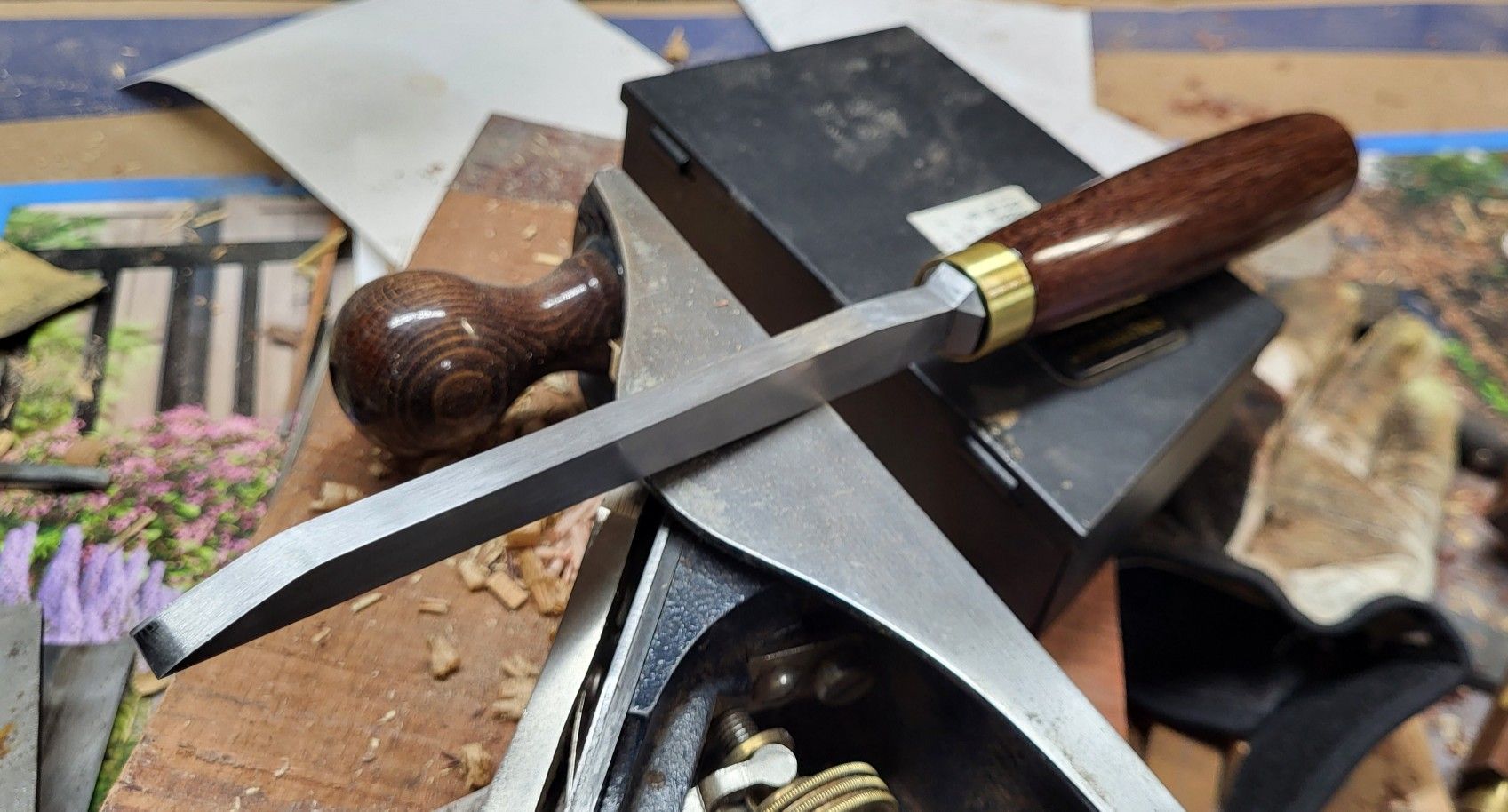
I ended up with these – and aside from all of the above, the complication is added here that I need to forge on a bolster as I don’t have a round bar to work from to just draw out the steel on both sides of what will become an integral bolster. For whatever reason, this turned out to be harder than I expected as the forged on bolster absorbed the current from the induction forge and the tang of the chisel didn’t get much. That’s kind of a pain, but we’ll figure something out so it’s not quite as dicey as it was here.

If I have to think about anything, the first one always comes out wonky. the short one in the back has a very long tang, as I was fighting the bolster, I drove it on a little too far, then forge welded it on and then checked to see if it was in the right place. Nope, it isn’t. Not grinding it off and doing it over on a test chisel.

The one in the front is going in the mail later this week. As I suspected, the first one is fine for my use and the second is what I wish the first one would’ve turned out like. So be it. I also got a box of carpenter pencils in the mail, so there’s no ulterior motive other than that was the cleanest spot on the whole bench at the time, and I step on carpenter pencils all the time and cannot have one or three around or it will be none very soon.

These chisels are both 63 hardness after a pretty good double temper session at 400-410F, and they did come out of the quench 1 1/2 points lower than I’d have expected on a thin chisel. The compromise seems to be fine. The edge is more stable than I’ve had on a mortise chisel of any kind, and I’m sure they could be broken, but they won’t be broken in reasonable use.

I still would rather draw them out from round rod – the two ways take about the same amount of time, and forging is more pleasant than fighting differential heating with the bolster and the chisel, let alone getting out a brazing torch to heat the junction point.

I have cut a dozen mortises with the dumpy chisel in the back of the picture. Works great. The front chisel is just all around nicer. The handle is gombeira and the varnish is a slightly long oil amber varnish.

This one hasn’t hit wood yet, but the snapped sample of grain off of the tip looked good under a scope. It’d be surprise if it was bad. And unlike 52100, it is not on the edge of being a couple of points softer and suffering due to too much toughness.

I do kind of wonder if hand tool woodworking had held on, and by that, I mean to keep the legitimate toolmakers in the past working – what we have now is a bunch of subcontract it all and CNC follow – ons, it’s not the same – would we have seen offerings in steel like this? It would be difficult to do the same thing as i’m doing with an electric or gas heat treat oven, but i’m sure it could be done by induction in a production environment or salt bath.

There’s some second guessing in that statement, too. As in, if I’m perceiving better results with these two 1.25% carbon steels, why does it not appear in anything but razors and files historically?

Plenty of Time to Left…

…to screw this up.

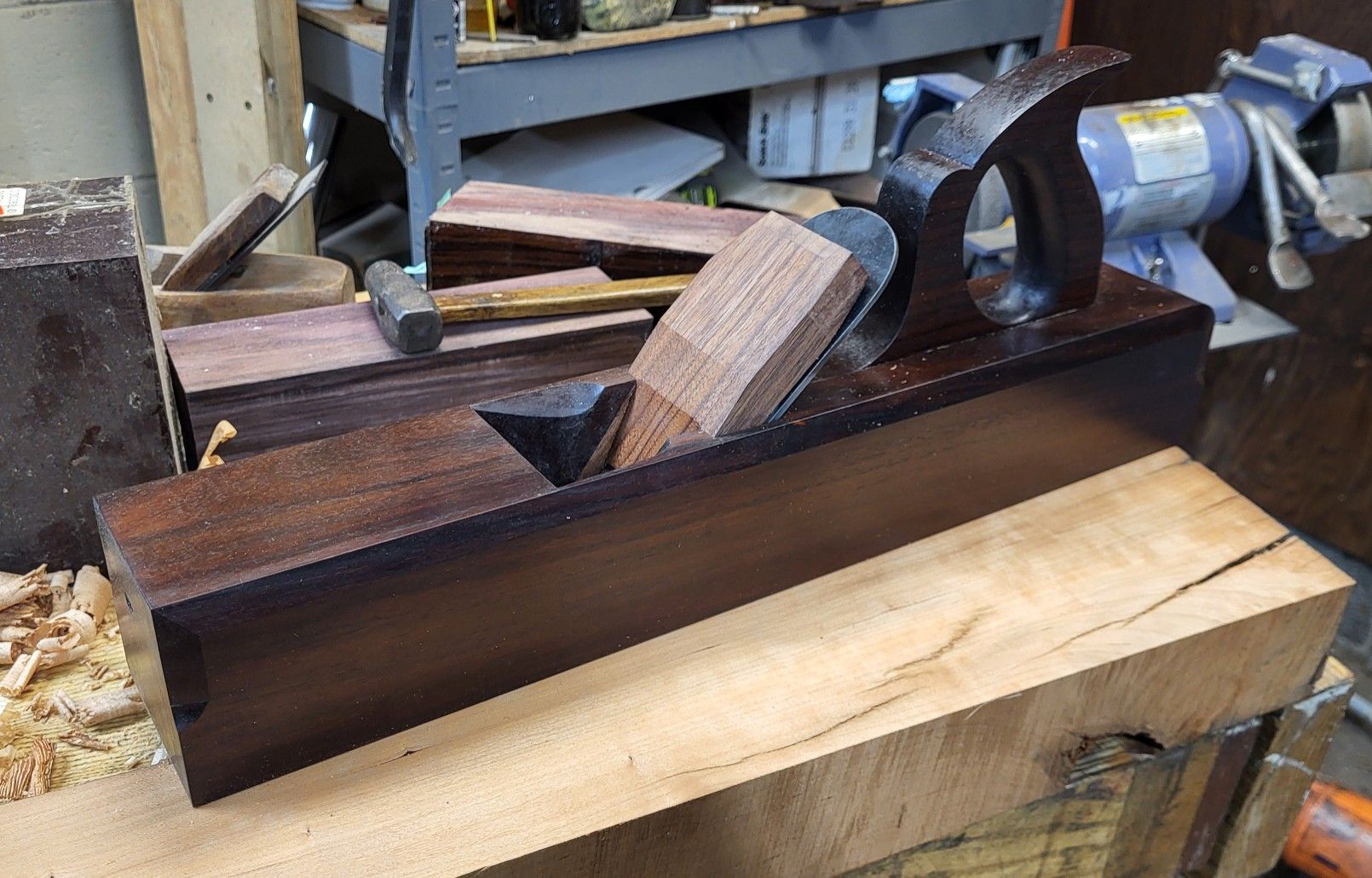
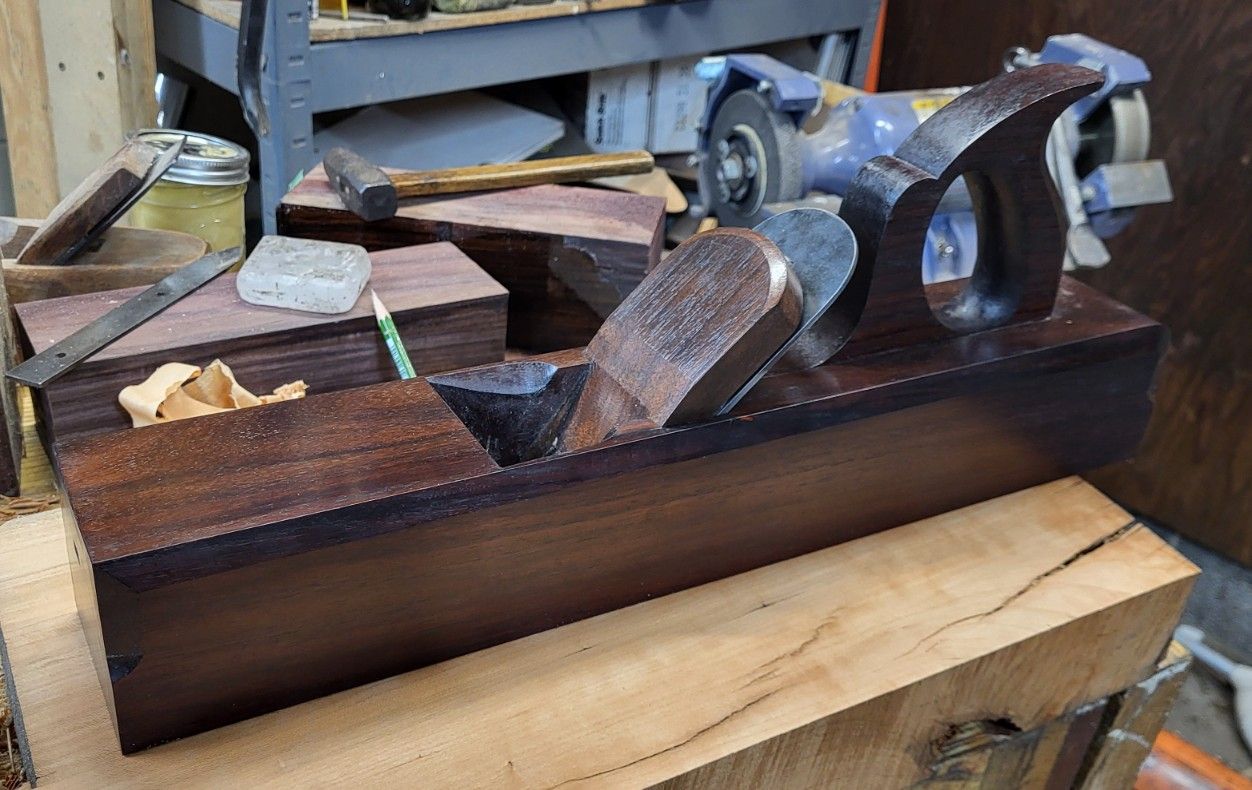
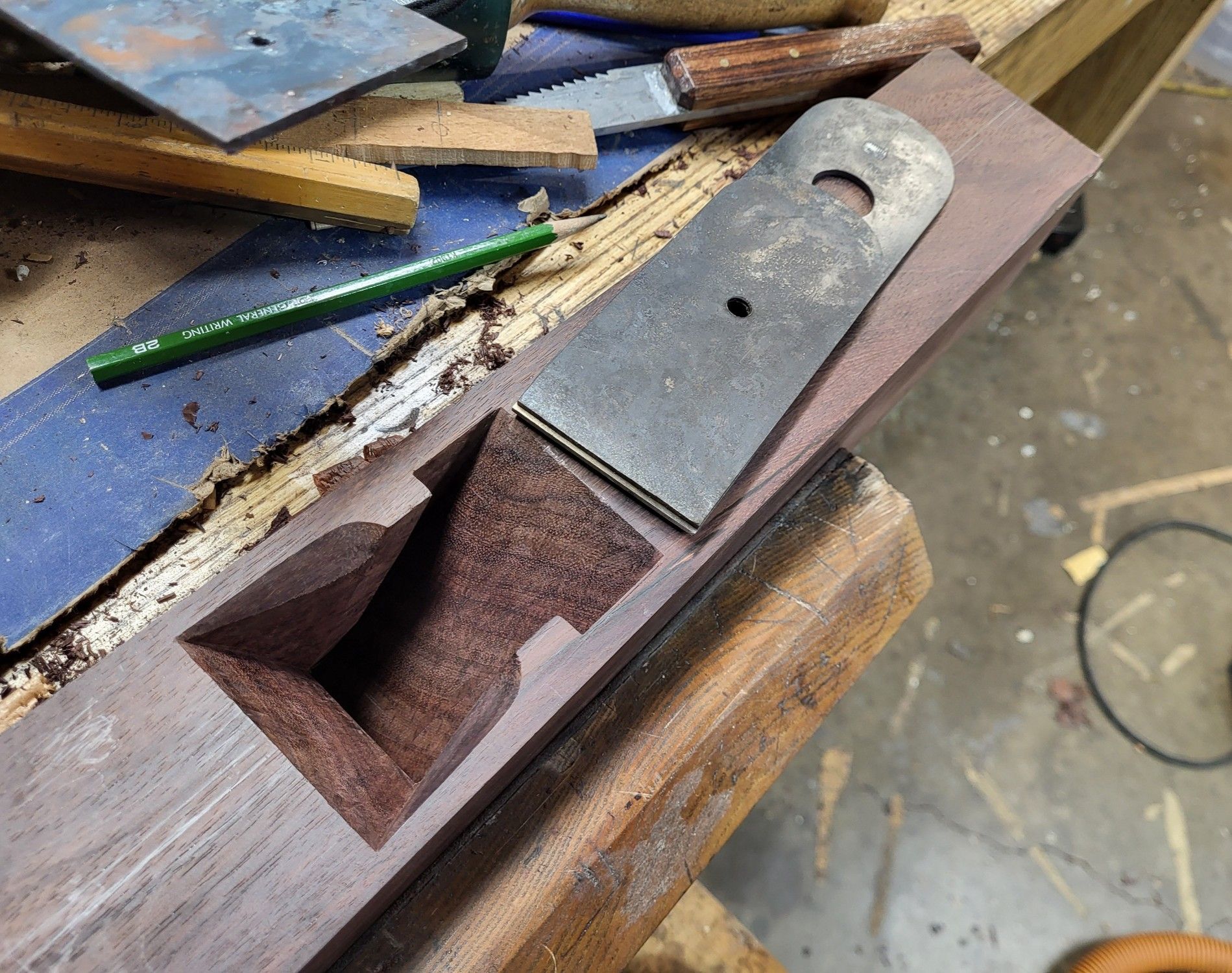
So, what is it? Obviously, it’s a plane. At one point, I thought I might make a lot of planes, and compared to the average woodworker, I’ve made a lot. Especially if usability counts. As in, I know a lot of people make an LV kit or a krenov plane or something, but I doubt they see 1000 board feet of wood and 100 sharpenings. I made those, too, they were just single iron more classic style planes out of whatever I had around and I ended up throwing them away.

Because of the whole chisel thing, I usually will buy turning blanks when they are a good deal. Last couple of years, I found 3x3x18 Indian Rosewood blanks for $40 if you bought 3. About half were dead straight and the other have weren’t. I couldn’t understand how they could sell blanks that cheaply, and the last time I looked, their website returns nothing. too bad.

this blank is straight in parts, but other parts not. I don’t make push chisels, so the wood really has to be used for something else. Really, you’d want a dead straight or certain specific biases to make a plane, but these blanks will be used as their fitness will allow. This one is probably good enough for an 18″ plane. By the time you square them, they could take about a 2.3″ iron. I’d love something slightly larger, but that’s what’s there.

So I’ll end up with a weirdo plane that’s 2.25″ wide iron, just over 18″ long and with a closed handle as I don’t need a jack plane. Too, I wouldn’t want a try plane made of rosewood, so this gets relegated to making a pair of smoothers (will do that with another one) or in this case, something that seems like it might have limited usefulness. A plane that can be used on harder woods when a 2 1/2″ try plane just beats the shit out of you. And if you have hardwoods with runout, it takes a lineman to do that with the same ease I’d do with straight wood. So that’s the point of this one.

The other point is to use some of my tools to make tools that I’ll use or that someone else might. I need to make a bathroom vanity and rather than being smart and buying one that’s on sale, i’ll make one out of solid wood instead, and varnish it.

Iron and Cap Iron

The other thing at play here is I’ve learned over the years to make stuff out of metal. Early on, Larry Williams told me basically that without spending $3k, I’d not be able to make a tapered iron worth having. He wasn’t saying that to be mean, he was saying it because that was his experience and his lens was making an iron like the blanks that LN sells – the moulding plane blanks at that time.

So many people told me that you can’t heat treat hand and eye that I’ve lost count.

Both of those made me want to figure out how to do them and then get good results that meet my goal. Which isn’t “i have to be better than everyone” or any of that kind of chest thumping, it’s to make something that isn’t obviously amateur done. When you use or sharpen an iron that I make, it shouldn’t have faults and you shouldn’t immediately think “well, it’s decent for an amateur”.

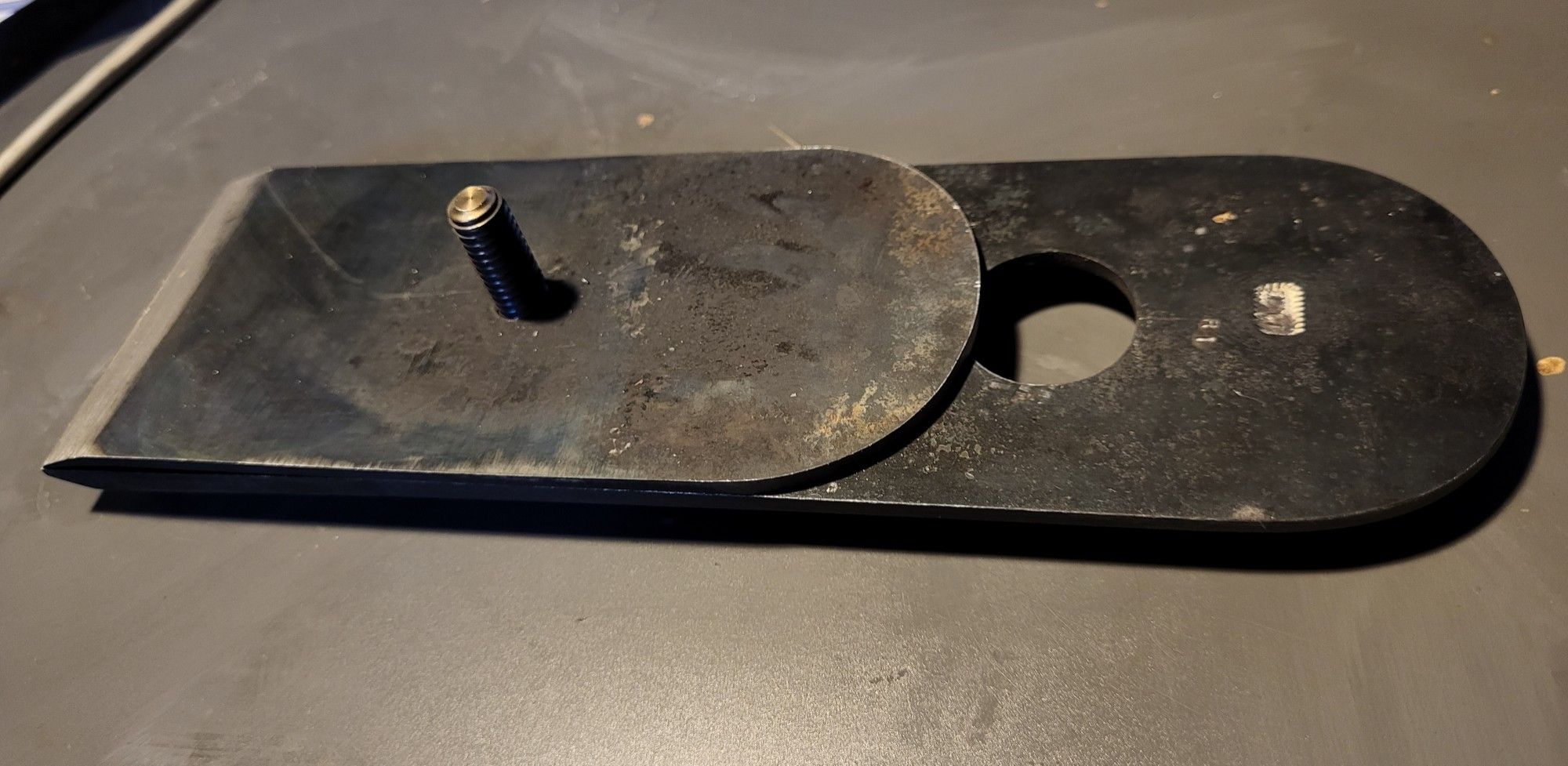
I’ve gotten to the point that I can taper a full sized plane iron like this one with a belt grinder and contact wheel accurately, make the back slightly hollow like the old ones and hammer out any straightness issues along the way (so forget a clean surface ground type look) in about 20 minutes. All told, the pair here took about 1 1/2 hours from bar stock to a little further along than the final result *and* I still need to buy the screw, so I can’t quite say I made everything in the whole plane. I’ll think about doing that another time as I can’t think of an efficient way to make a screw without a lathe, but I can think of a way to do it grinding down round bar.

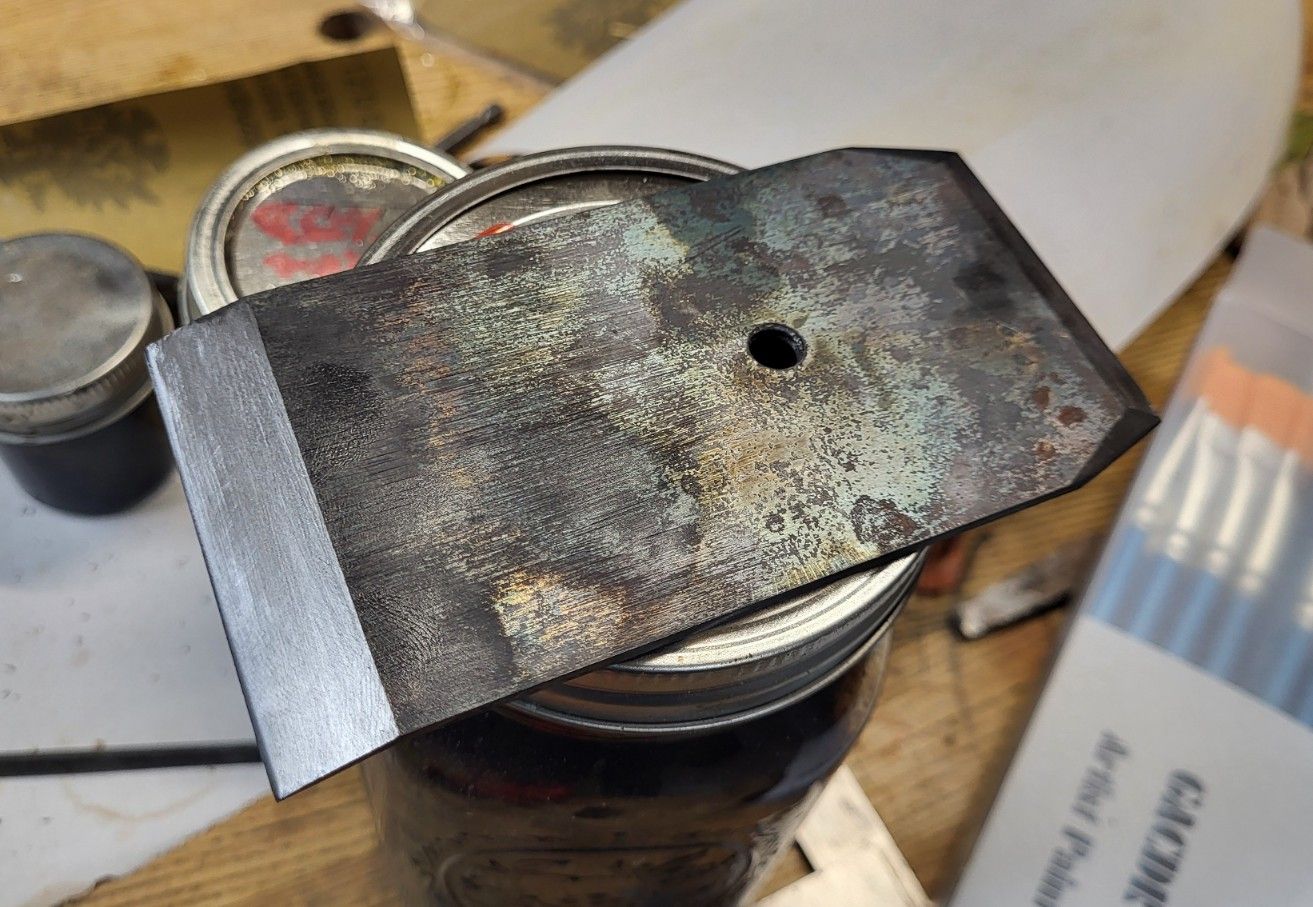
This is the shop made pair. The screw needs to have length cut from it, obviously, and I need to do some aesthetic things. With the oxide left on, I don’t need to consider grinding out all of the little hammer marks from adjustment – that part is nice, and I don’t think it looks bad. The carnauba wax stuck in the maker’s mark might be!, and the business end of the cap iron needs about five or ten minutes of bulk filing to get the final shape set, but we’ll get there.

This whole process also gave me the chance to harden the cap iron, which I like, but in sampling my planes, is only seen a small % of the time on older english stuff. As in, it probably doesn’t matter or it would’ve been done, but it costs me nothing more than five minutes of time with an induction forge and then a torch to blue the iron to spring, so I’m going to do it.

When this is done, if I don’t screw it up between then and now, I should have exactly what i’m looking for. The iron is 63 hardness 1.25% carbon steel, or maybe half a point harder, which is nice, and I’ll have a handle that I like and I think the wedge probably will be walnut just to start as it’s softer, won’t stand out too much and will have a little more give and grip.

Sometimes, it’s nice to make something just because the materials are on hand and it puts accumulated past experience to use. I think not enough of that is emphasized in the hobby – make something ten or 30 times instead of 1 so that you can do it better than you feel like your talent will allow. I don’t have that much talent compared to real makers, but you don’t have to make something unparalleled to be able to at least call it nice work. My work comes up short of fine, but “nice” is good enough.

Cream Puff Marking Gauge

Not much posting lately. I’ve made a few things, like my first hot formed and hardened chipbreaker as it just seems like a good idea to make an entire plane end to end:

That turned out well, and the first is good enough that the second will be exactly what I want. And it leaves just making screws without machine tools. We’ll see about that.

But turn of the year with some family obligations and kids in their mid to later years of youth before going off to college pinches time.

I don’t need much as far as woodworking goes. I need to buy steel occasionally, and getting rid of unused stuff is more important than getting more, but I did two things in the months before Christmas up through Christmas. I bought a bunch of boots to wear in the shop (did I mention that already?). Some new, some very little used – all US made stuff to try out various pairs. It’s perhaps not normal, but rather than buying a pair or two of shoes a year, I usually buy a glut of shoes every half decade to a decade. If it’s casual work shoes, I’ll track down five pairs and those will go at least ten years if they’re good shoes.

So, the boots are the same. Thorogood moc toes and a pair of redwing heritage boots. I don’t know why I never thought to look closer at them, but it was a chance thing replacing one pair with some heel pain courtesy of daughter getting better at tennis – I can no longer keep up, and putting the boots on to replace one other ratty pair of boots only to find they are more comfortable than any shoes I’ve ever worn. To see how the different boots are made, especially the simplified by really high quality redwing heritage stuff (smaller in profile, with your pants over the laces, they just look like shoes – solves shoes and boots at the same time). Great – it fits something I like to do, which is to make something you have to do something you like to do. You have to shave, or probably do. Shaving with a straight razor is a nice way to do it, one that you eventually look forward to. I need shoes – and dread finding out how crappy the stuff floating around really is as nothing is sacred in shoes.

Anyway, the tools:

I figured I’d like to get a forkstaff plane since I’ve never had one, and I found some from England and bought all three. They seem to be slow movers!! for the uninitiated, hollow sole, bench plane with a double iron. They sell for pennies and would be pretty difficult to make, especially because the cap iron matches the sole profile.

I quacked out one of my good calipers by getting tung oil in it and not noticing it until it was dry, and replaced it for now with two older vintage mitutoyo calipers. I know, no woodworkers need a dial caliper. It’s a nice thing to say. They’re awfully nice to have making tools, though and having older high quality ones that cost the same as new ones that are garbage is a far better idea – you don’t have to fight them or get annoyed with their function. And they’ll do better than new cheap ones even if they’re already used.

And lastly, I found this style of marking gauge on ebay – I knew there were a couple, but found out later that they’re pretty common:

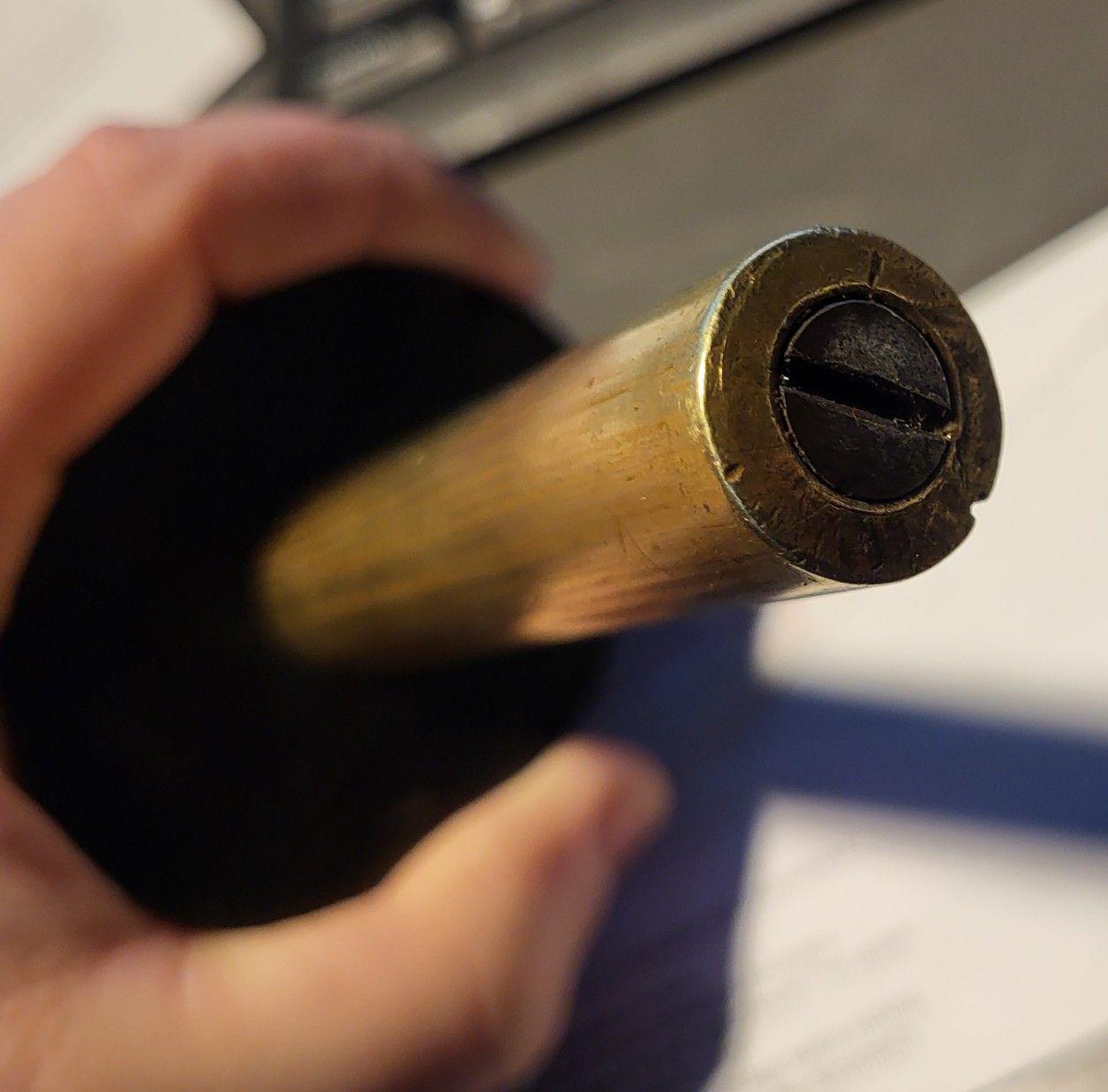
these were apparently made by marples, but there is no name on them. As far as I can tell, there is a length of threaded rod, but it’s extremely close tolerance with zero slop, and there is some boxwood inside the brass tube.

I can’t vouch for all of them, but this one has the feel of a hydraulic clutch in a car – it is just worlds different than the average mortise marking gage, and it was about $65, I think, to get it shipped here from England. The cost of shipping is really something from England. One seller will ship something like this for $45 and the next $15. The former probably won’t find a buyer in England and because of the shipping, they won’t find one outside of England either.

But this gauge is just dandy, and I really have no interest in making one like it, so it is the rare pickup. Everything on it is just superb, and I can leave it set for 1″ work with my favorite mortise chisel and maybe use the adjustments for sport just to appreciate them.

Jeez

And as I sit here typing this out, I realize I also got a try plane or long plane that’s probably from about 1780-1820 – all depends on whether the iron is original, as well as a pair of ward mortise chisels that I should’ve left in England, but they are the kind of thing that I really thought someone should make, but are really uncommon to find. They’re a sash proportion chisel, but with more height for actual cabinet mortises, and moving toward the oval bolstered type in design – long bevel, tapers, etc, but without the heft.

So, Jeez -I guess I bought more than I could remember at the start of typing this ten minutes ago, but remember now. No wonder there’s a space problem here. I’ll have to check the gig rules for taxes on ebay, because as a never-made-profit type person, the last thing I want to do is unload a bunch of my stuff and then get stuck trying to figure out the value of it to offset the gains. How stupid.

One More Box Yet – Ottoman

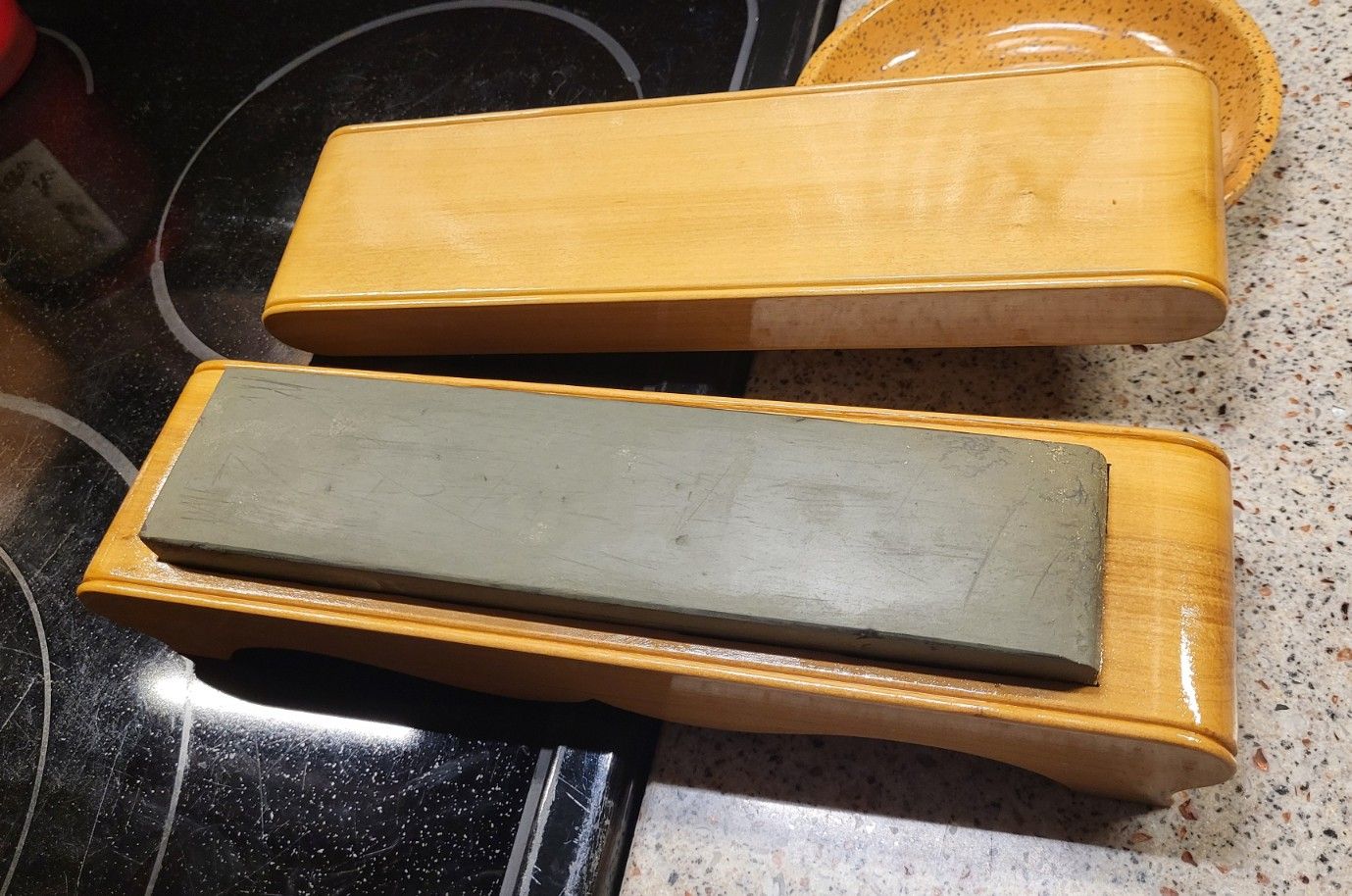
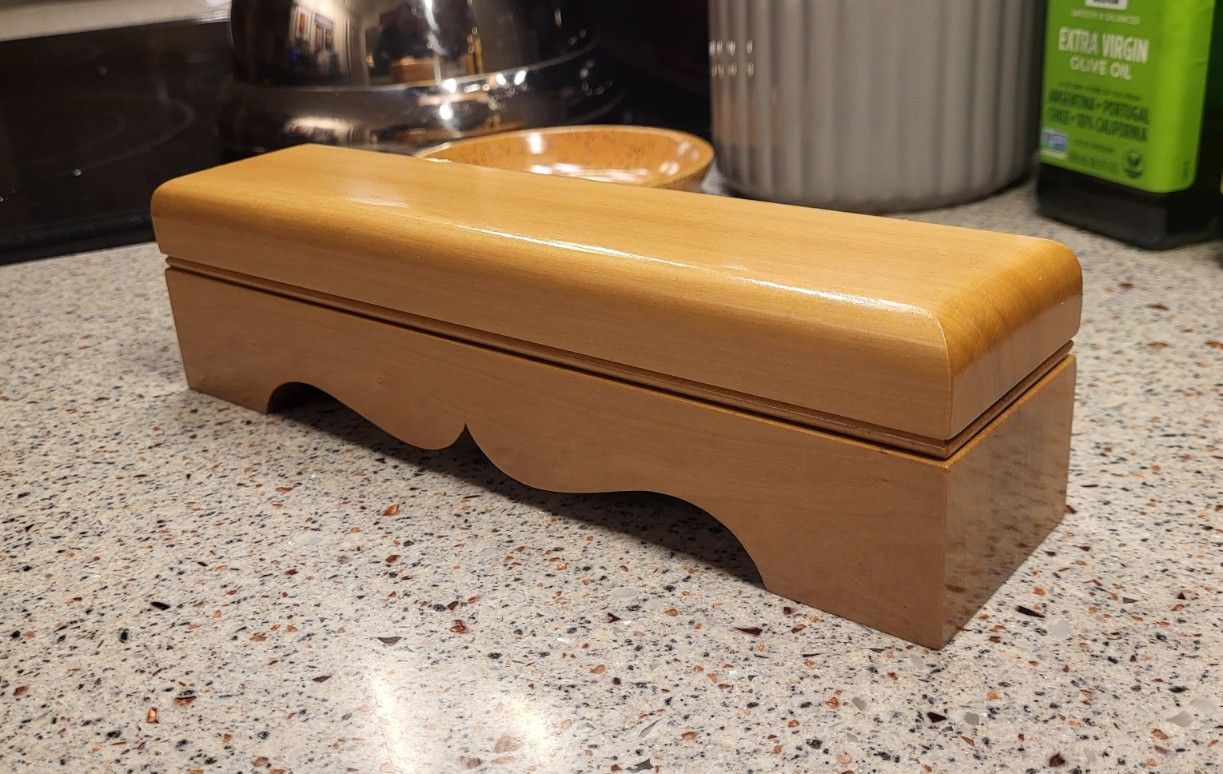
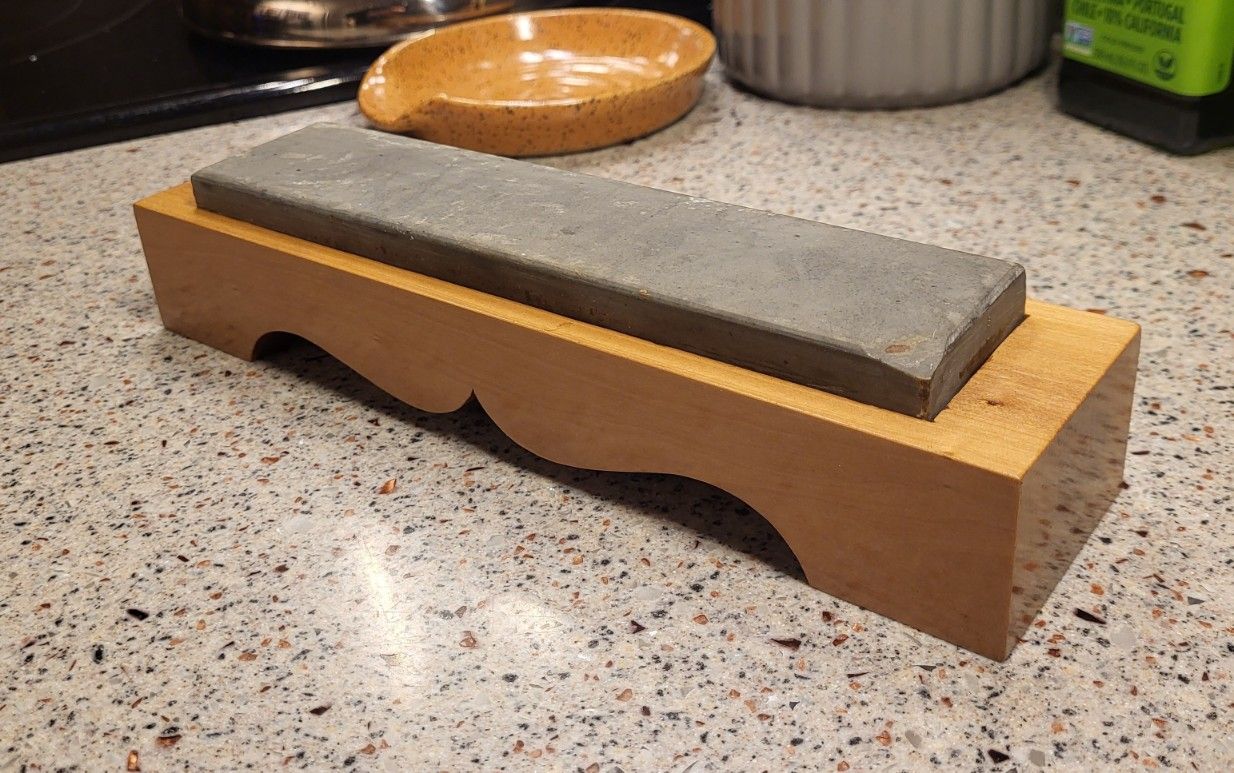
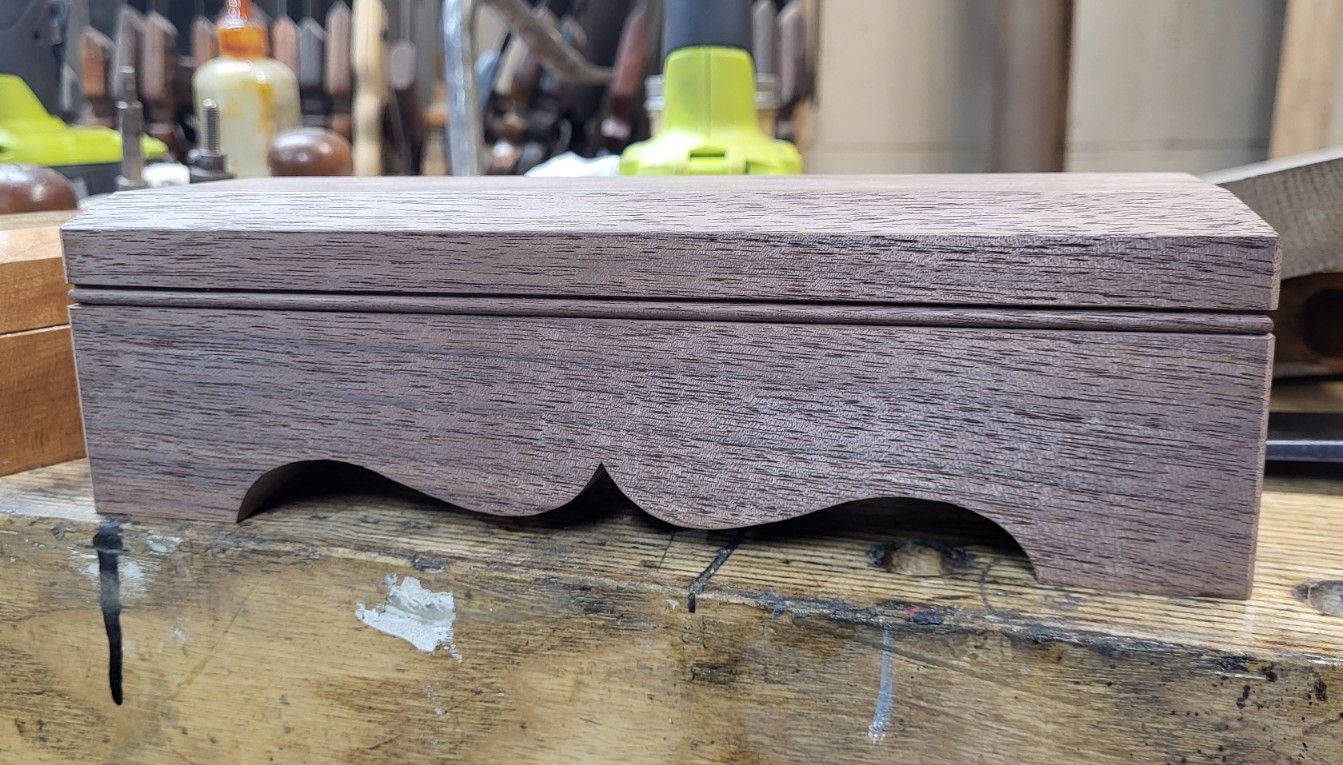
I mentioned in the last post that I wanted to explore something more interesting with the boxes, like a furniture-like shape. I thought this would look like a couch without the back. Which my daughter came down and quickly blurted out “that’s an ottoman”. Which made me also realize that I missed the opportunity to do this style of box with one of the turkish oilstones. The two I have are permanently seated in something already and they are very irregular in shape, so that ship has sailed.

I think this is an interesting shape, but it’s lacking something a little bit and could be more interesting without much more work. Maybe another time. It’s the same boxwood substitute – Castelo Boxwood, which is interesting because it doesn’t stand out as much at first and could be confused for Maple. It’s harder than maple, but in some ways, easier to work by hand.

The ends are rounded over and the bead goes all the way around. I don’t scratch bead much and this curve on a wood that’s fairly hard isn’t trivial, so I had to sort of figure it out. There’s one other box that appears to be made of mahogany with curved ends online and when I first decided to try this, i took a closer look at it and the beads on the ends are pretty shitty. That box has interesting little carved details, and the maker of it was likely never intending to show pictures online. The trick to getting a beading blade to work across this was to sharpen the bottom of the profile to a point, otherwise it would just ride on the wood and not sink in.

the filing on the rounded side that goes onto the workpiece- the left flat – is pretty crude and it doesn’t need to be totally sharp. the center, this is a tiny bead and I don’t have files that would do it so much at a reasonable angle to the profile, but a small chainsaw file held at a very shallow angle did a good job. Night and day. It will bead anything now, even some of the 3000+ hardness central American woods.

The varnish on it is not the full set of coats, and It’ll get as much again more along with some steel wooling or sanding to try to make sure it stays level. This varnish is set with japan drier so that it can be brushed on two or three times a day. Two if no light box or warm box, and it really could be brushed on four times a day with the light box. So, it looks a little funky because it’s right off of the brush.

The stone housed in it is charnley forest. These all vary a little and this one like most is just OK as a finisher. It’s easy to see why hard arkansas stones took over for the few who needed them (dentists, engravers, some carvers) and the washita took over the end below them. They’re not a stone you need no matter what – they’re a little slow and most of them can take gouging with stuff like engraving tools.

Years ago, I bought the two handled beader that Veritas made just because I was in that phase where you’re doing a little woodworking and buying stuff that looks like a good idea, which is maybe too quick. the beading blades for this thing are decent to start with, but the beader is good for something I haven’t yet figured out. it’s pretty much garbage for this box project and there’s a handle in the way of everywhere you’d really like to put your hands to make sure the fence never leaves the side of the work, a long lever to help you accidentally spoil a bead if the beader catches, and enough cast iron and fence stuff to both trap the shavings and stop the beader from cutting, and also increase friction to 90% of the effort you’re expending.

I wonder if it was designed by the same person who decided chipbreakers don’t work. Whatever the case, I had to make a small very jiffy (fraction of an hour) stock to do the concave parts and then just turned to using it for all of the beading. It’ll be worth making a flat version of the same thing for more general use. I don’t think LV makes this tool any longer – which is too bad – too bad that it’s not lie nielsen where out of production means increased value.

So, What was my Diatrabe of the “Freds” About?

If you haven’t read the prior post, there’s no need to. Fred is a household term here for someone who doesn’t do anything, but always has an opinion on what you should do, what’s doable and how it should be done. There are polite well-intentioned Freds, but more common are the passive aggressive know it alls who really celebrate around them if nobody else enjoys themselves or accomplishes anything.

The last thing this hobby needs, or really any of us as individuals – because our intentions and wants as individuals are more important than the hobby itself. That should make sense – the hobby can be anything, but each of us wants to do something or nothing. The something could be making, researching, reading, whatever it may be. The hobby will be what it is around that. None of us has an obligation outside that. you don’t have an obligation to buy $1900 chisels or $200 router planes from China. You have an obligation to yourself – to figure out what you would like to do most and do it if you want. Very little of the information you get when asking or getting information unsolicited, will be useful to you, and most of it will be from people who are less qualified to give it than you.

One More in Castelo Boxwood

Similar box. I posted a picture of the prior boxes on reddit and reddit is not exactly a site for much average depth – it’s a sign of the times…well, a decade ago when people started moving to devices vs. PCs. However, folks are usually positive there, except there’s often one or two people who are critical. I think they are Fred critical. Fred is an esoterica name in my parent’s sphere, a term for someone who can tell you the right answer for everything, offer an opinion, imply comparability with accomplished people and disappear if having to prove anything.

Freds on internet forums, reddit, whatever, are the folks who drop in on threads and disagree about something, get upset if you challenge them to offer a relevant suggestion or show something they’ve done. In my parents’ sphere, Freds also often like to tell you ahead of time you shouldn’t bother trying something because it won’t turn out well or whatever you might do will cause problems, so don’t bother.

You don’t know the Freds we do, but we know more than one person named Fred who has these qualities. Thus the name. Freds are fascinated with what you may have wasted money on (wood) or wasted your time on (making things with wood), offering unsolicited coaching as you’ll often find. People who talk the most about wasting time with something are not atypically the same folks who do nothing useful with theirs.

So…

Being notified that these boxes are a waste of time and money, it makes me want to make something more elaborate. I did want to first use stock nicer than the other wood I’ve used- which was cherry, padauk and walnut. Nothing wrong with those, and the padauk under varnish has surprisingly pleasing color. But I wanted something less common looking:

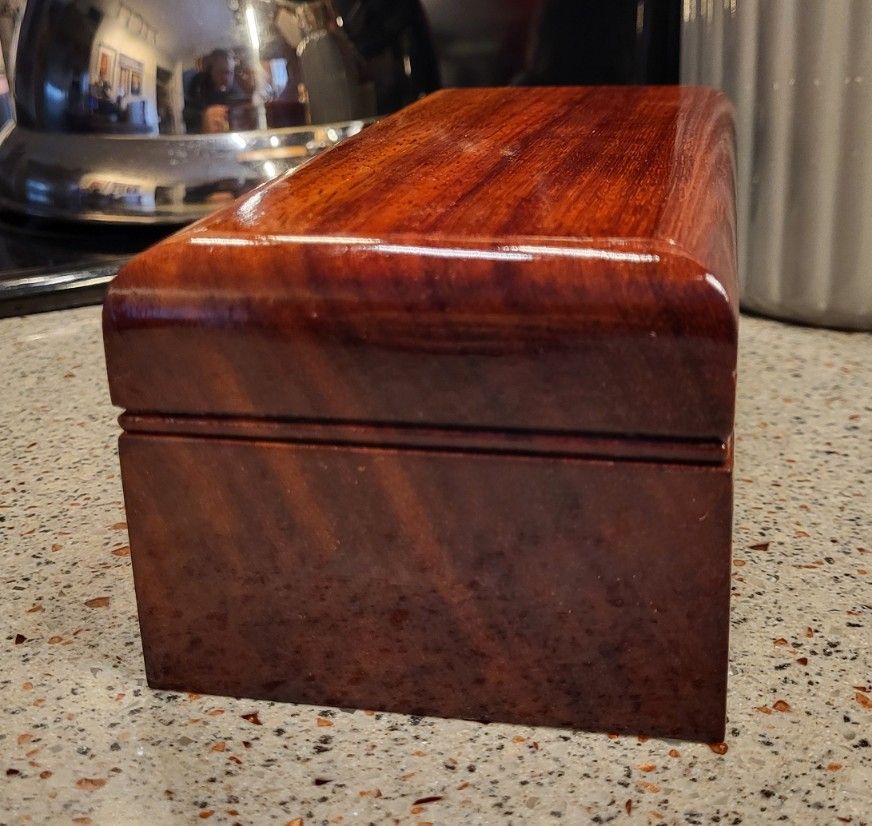
This box houses a stone that has been on a shelf in my bathroom – it’s an oilstone, but I have used it only on razors. It’s a nice burr chaser, maybe as fine as any natural stone I’ve ever used, but it’s slow cutting. I don’t think stones like this were even really used much for razors – they’re a little too slow for even that – but this one would be excellent for engraving tools or chasing burrs on profiled tools. That’s a little beside the point other than to describe why it doesn’t make it to the shop – it’s too fine for anything other than perhaps as a base for 0.5 or 1 micron diamonds.

The wood is castelo boxwood. Gilmer wood sells it on a regular basis and it’s a relative of lemonwood. It’s not cheap, but there are more expensive woods and it is divine to work. After planing the first of two blanks I bought years ago, I bought 5 more. Surprisingly, this billet has some brownish stuff in the middle, but not at the edges, so that kind of dictated the orientation of the grain here. I’d rather not see the stuff you see on the bottom at all, but on the ends is better than on the front and top, so it’s flatsawn looking on the side and at first glance, looks a little like maple.

The box is plain, I think done well enough that I want something a little more challenging in terms of uniqueness and that’ll mean difficulty.

The Freds of the world would declare it’s a waste of time, and I’m not the accomplished type who turns out something never seen before on a continuous basis – more the type who quickly responds “what have you made lately?”

Sweet Spot

I can make tools well enough now that the tools would have some open market value. But I think this box adventure has been sort of the sweet spot of what I like to do. There is no “make one” and it should be perfect sort of internet idea, nor is it something I want to do just kind of half shitty half OK in one example and move on. this box makes it five of the type with a carved bottom after what I really started out with was making several plain flat boxes to use oak that my dad had milled long ago. They left me feeling like I could make something nicer because it’s annoying for me to just make things and not think much about it other than fighting a power router or something. The difference between me and the difference between me 15 years ago wasn’t so much skill as it was tolerance to figure things out. I guess there is a lot of trivial knowledge gained, but the mindset is more important. If I was less talented, I’d make less nice things. If I was more talented (and pretty much every pro and lots of amateurs are more talented), I’d make much nicer things than just plain boxes like this. But I would be just as happy either way.

I’ll get back to chisels and cutting tools soon – it’s still nice to make those. I think I can do things more interesting – maybe subtly – and better than what I’ve done so far.

One last one for a while…

Padauk. I’ve got some padauk I bought back when it was inexpensive and you could get blanks kiln dried. which is a blessing and a curse. Dried purple heart, padauk, etc. is miles away from being anything like green turning blanks, but it’s also nowhere close to being stable as tool wood. I learned that making a skew infill shooting plane in the winter and then having the purpleheart infill swell a small fraction and telegraph all of the dovetail in the steel plane pretty seriously. Not a big deal. but for something like a fitted stone box, I’d also bet the kiln dried turning blanks cut to a close fit would be split within a year or two. The stone certainly isn’t going to change.

I have been drying the varnish on these in a UV box – it speeds things up nicely. Two or three hours, the box is up to 95 degrees, and you can remove item in question, wetsand if needed (every two or three coats) and brush a fine coat of varnish and keep going at it. The stone boxes that I’ve been making get tight just from being in that heat, and a scraper to the sides is all it takes to relieve things.

So, anyway, even this padauk, which was KD and probably 6 or 8 years old through a lot of dry winter cycles still shrinks in that box a little. when it was new, it may have shrunk enough to split the box in days. Too, I never found a use for padauk and have two 14x14x3″ quartered to rift blanks. They’re ideal. Why? wood is a funny thing – the smoothness of recently dried wood is one thing, the stability isn’t there. Once wood is decades old, it changes in feel, and I’ve started to realize that having wood that I may not use for another couple of decades will mean that maybe the wood won’t be as cooperative in certain ways. Cocobolo, for example, is just dreamy for handles if you find it really old. More than half of the cocobolo I’ve found is a little over 50 years old. Compared to newer oily seeming cocobolo, it’s almost unrecognizable. it’s agreeable, though probably less easy to plane to a perfect finish and the oiliness that it would’ve had has long since disappeared. Those volatile oils that make dry newer cocobolo kind of cakey probably aren’t stable over decades, and we already know the wood itself changes over time to be a little more brittle but much more stable as the volatiles are gone.

So I’d better use the padauk, and when you buy gobs of wood that you find on a deal, if you do, it’s probably good to treat it like a prepper pantry. It’s nice to have stuff around, but it can’t sit forever. (not a prepper, by the way, but I get the sense that preppers need to eat out of their stash on a regular basis and rotate it so as not to get to the end of the world and find something that looks like a WWI military ration).

Padauk in this case, again hand tools only again, same tools, just with a shot at making the lid thicker and the top rounded.

Padauk is supposedly around 1700-1800 hardness. it definitely has straws that aren’t terribly easy to plane expanses of on end grain easily, but it’s not intolerable. This one again has silica in it!! Too, the profile on the top is cut with little sandpaper, but unlike the other boxes where none is used, after planing, rounding and filing the profiles to near finished state, I did sand them to try to make them look as uniform as possible. I hate sanding – the mess, the boredom, etc, but on a round profile like this, it’s the easiest way I know to not have stray marks. The same beading plane worked fine again across the end grain, it has not been resharpened and the fact that it’s held up without beating up beads or leaving lines on anything is a testament to us often being off the mark about needing abrasion resistance vs. understanding geometry of edges.

Of course, the same design on the bottom after the above, and after pore filling with FF pumice mixed in a long oil varnish, the finish is almost gloss.

Almost gloss here, which you can see if you look closely suggesting that I didn’t build a big thick finish and the sand and rub out what’s left. Rather, it’s just applied and then wetsanded and after the last wetsanding with relatively fine paper, the final coat is just as brushed with a small fine artist brush. thin so that it will have minimal brush marking or stria.

It’s interesting that in making this box, I used some of the least abrasion resistant tools that I have and never once felt like they were limiting at all. For the gouges, if the tools were more abrasion resistant, it would’ve been aggravating.

Oh….

An after the fact edit – you can see the chip on the corner of the box in one of the pictures, or maybe several. You’d think that’s from chiseling or planing, but I was actually filing the end grain. I really like planing and then filing end grain – it’s miles better than sanding end grain, but it will break out the dry brittle grain that I mentioned, especially on padauk, which is really chippy at edges. I can’t imagine it would’ve been like that just after being dried. I did nothing about it – no repair, no attempt to glue the chip on and hide it because it’s a stone box. I’d be nice to make a jewelry box or something like this style and really tart it up for real – no damage, and build the finish and make it look nicer than the off the brush finish in this case. For stones, there’s no use…..why? As soon as you have swarf on your fingers, whatever you touch in terms of finishes will get deglossed by the metal grit. When these get deglossed, I’ll just hit them with 4F steel wool and wax them with carnauba. What I really want out of the varnish, and what it’s great at, is ignoring any alcohol or oils or WD40 that’ll be used on the stone – it’ll keep the wood clean.

How Much is Enough?

Just a little bit more.

I wanted to make a few carved bottom boxes just to get the experience. No big plans, but it’s hard to guess into carving stuff and I’m not going to start with some kind of sculpture and get lost.

you can do this a million ways, and a little flat combination ogee like this is quick. You can just mark it and chisel it off. Turns out, sanding is the shits on something like this (which is great!), so sawing a depth line to the center and then just carving in from the edges and across followed by draw filing. as these scrolls get deeper, it would make sense to saw some of them out, but not the way you might be thinking.

I don’t have a bandsaw and I know it’s tempting to want to saw a series of saw cuts all the way along the profile, but you have a great chance of sawing one or two through the lines and spoiling the whole thing.

No electricity and no sanding with any of these boxes – the scroll itself is just too much end grain and sanding would slow everything down.

A flat file and a triangle saw file both end up being really useful – the flat files will ride their edges in the concave parts and you can run them very slightly diagonally in areas – especially on the curved part of a bastard file at the top end. A fine saw file can do the same thing – not much for material removal for each, but you can get close enough with the gouges and a chisel to have not much work left.

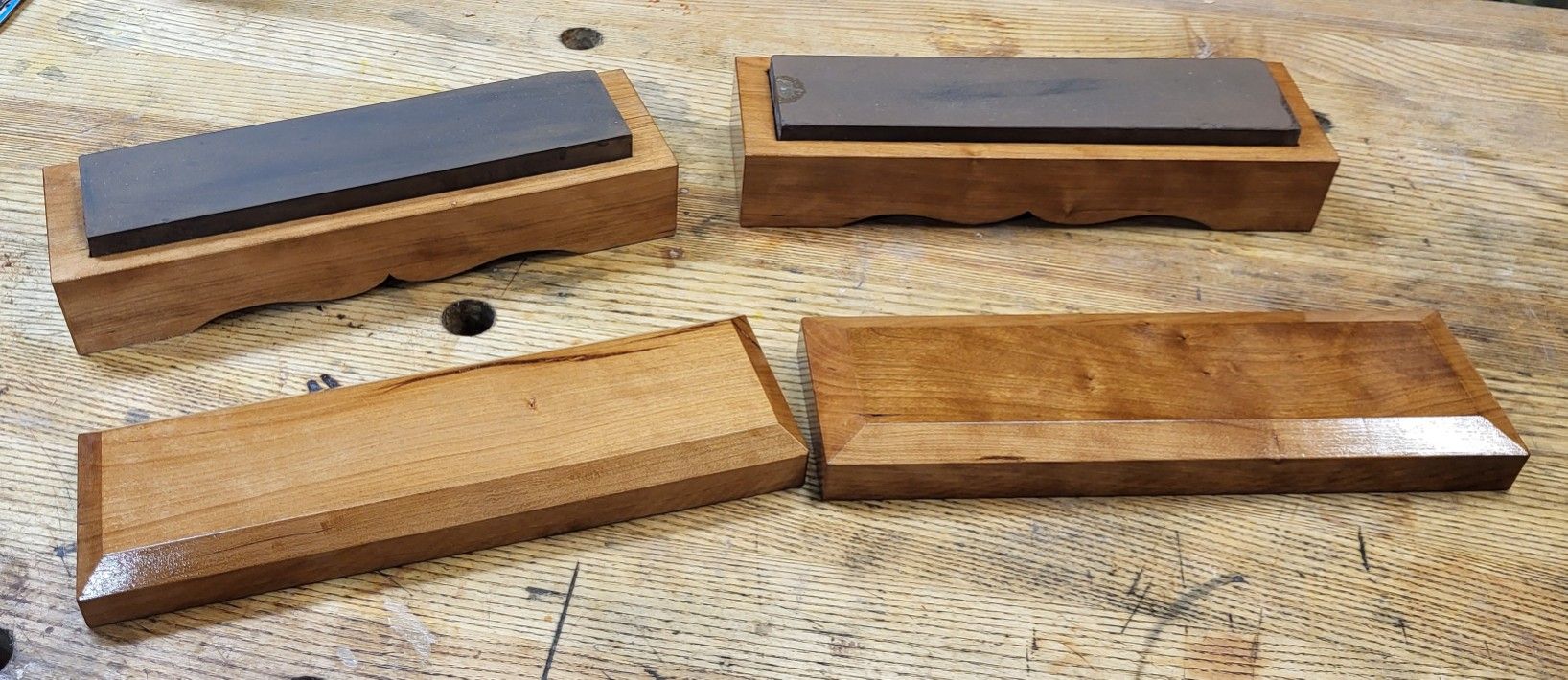
The cherry boxes look like this:

Each has an ultrafine India, and the reason for the shallow scroll is partly because the cherry stock I’m starting with isn’t thick enough to do anything more without leaving the inside of the box bottom thin.

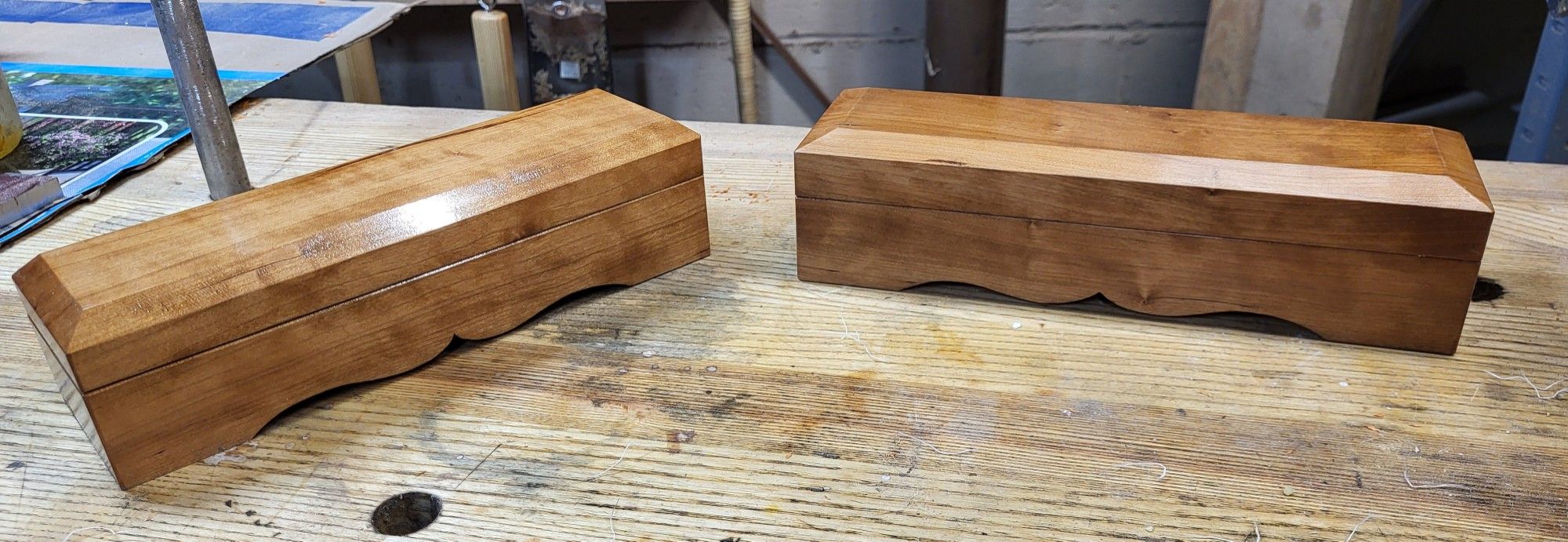
These boxes are finished with varnish, and the dull one is steel wooled and waxed. This is a waste of time for finishing a box instead of just finishing with shellac or something, but it gives me a chance to experiment. I’ll use these stones (already am), or at least one of the two.

It seems like a bead would be nice, along with a deeper carve, so I tracked down some very dried out and long forgotten walnut – you can see it to the left in the picture above.

Sawed in half with a rip saw, of course. The sawing seemed weird, but I marked this billet and sawed it accurately There’s no need to do that, but I think it’s a good idea if you’re going to work by hand – it takes little longer and makes you better at it when it counts.

Resawed with the same saw and then planed the wood, which immediately let me know the wood is full of silica. It’s straight on two corners and grain running diagonal on another. Must be stump wood or close to a stump.

Since the picture isn’t big enough in this format to see the silica, you can zoom in on this link.

This gave me big enough wood to make a deeper carve. How do I come up with the profiles? First of all, I don’t know anything and can’t draw that well, but there are four ogees in this – two on each side, and a business card is probably good enough for a pattern. I have some cheap plastic curve templates and snagging curves off of different parts of them allows me to make something that’s not just perfectly symmetrical, resulting in this. something a little more radical yet would be nice, and after making this box, I realize that it would look better with the bead either in the bottom (it’s in the lid) or with a taller lid. next time!

You always hope for each one to get a little nicer, and this box is still all kind of freehand, but it’s a little nicer than the others.

The bead is just planed in it, of course across the end grain, too, with a griffiths beading plane. it’s safe and easy and a router would probably do this OK, but I don’t get out of bed to use a power router.

I’m going to try a cheesy way of filling the pores on this one, which is to use pumice and 1000 grit sandpaper in thinned varnish to pack the pores. Shellac would work, but varnish is better at showing depth in wood.

I should be making tools – I can actually make things people want doing that, but this diversion was something I had trouble resisting, and I couldn’t explain why. Since woodworking is a hobby, I try to follow the scent like pepe lepew did rather than trying to justify what I like or come up with a reason that I should like pointless little ventures…..like making chisels, for example.

Edit to Add Later

In the process of varnishing this box. Pore filling was pretty mediocre and varnish is a finish that favors rough surfaces so it’s seemingly harder to get coats to level vs. something like lacquer. I can’t tolerate the stink of the brushing lacquers indoors, though, and they’re hard, but not tough, and would chip.

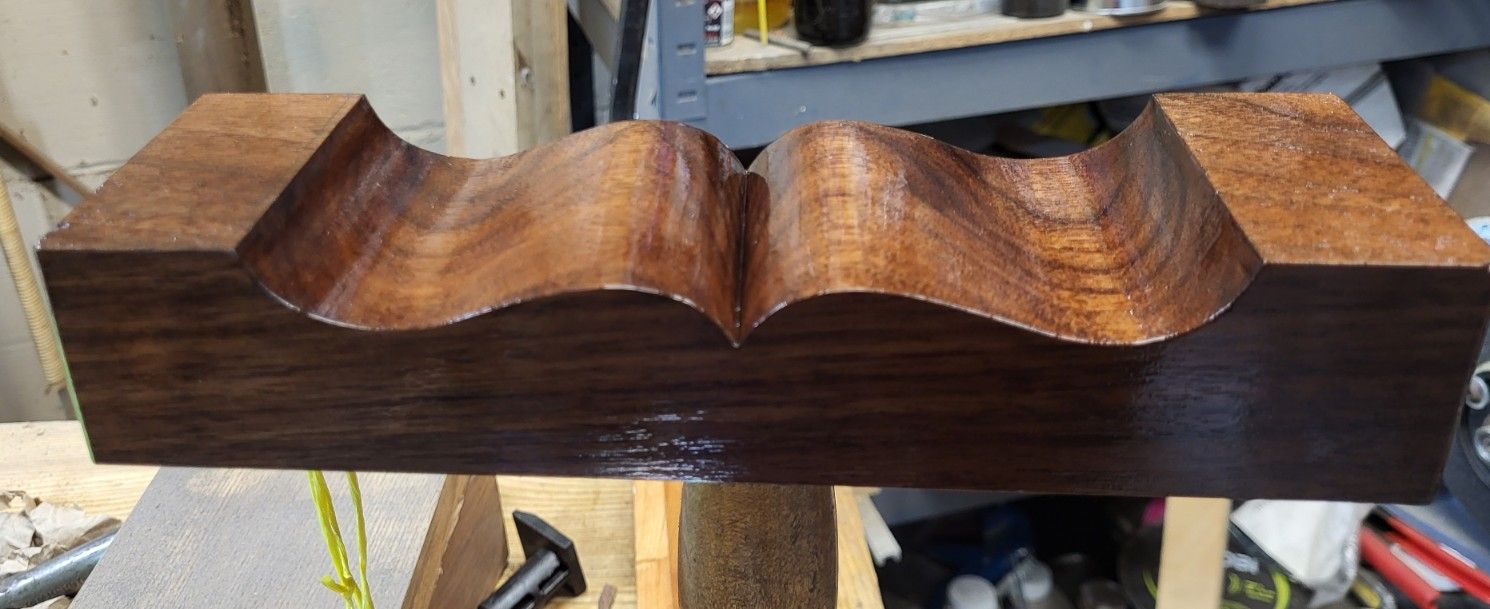
but when I turned this box over, it’s not like the scroll is ground breaking, but it’s probably the best feature of the box and will pretty much live a life of use hidden out of view.

Too, notice the color response of the wood when varnish is involved. Varnish and buttonlac are two finishes that I really like – both – based on the tone they impart. They make everything seem more colorful.

I Still Like Tools

One of the things on forums that’s not as popular as it used to be is for the “tycoons” to tell everyone that they have too many tools and said tycoons could build much more with 1/100th. Most of those guys turned out to be tax preparers or just frauds, but there are legitimate makers who aren’t fascinated with tools.

But I think there are more that are. I hope to be a legitimate maker when i’m retired, but who knows what direction life will go.

I still like nice tools, especially if they are pleasing to feel in use, efficient and nice to the eye.

I made a set of paring chisels for George a few years ago, and in return, he sent me these gouges – patternmaker’s and firmers:

The lighting is terrible – this is the transition from the basement to the garage, which I have completely …well almost both, claimed as my space. There’s bright light to the left, so this picture looks washed out. If you look closely, you can see these are practically unused and the handles are really nice for what is probably fairly recent marples work. Are they 60s? or 50s? work, I don’t know, but they are still hand ground bolsters with a brass ferrule.

George bought these, as far as I know, because of the look. The handles are a nice style, the stickers are in pretty close to perfect shape and they are beech with a divine sort of buttonlac color, but they’re not shellac. I don’t know what the finish is, but it’s durable, and the surface is completely pore free.

Again, sorry the pictures aren’t better than they are – the overhead lighting is bright daylight white LED. For whatever that’s supposed to me, getting pictures in real daylight always leads to better color, and these look better. Through some sort of anomaly, the picture at the top shows the tip looking like it’s not straight across. Whatever the case, it’s not like that – it’s perfectly straight. These are unused as far as I can tell.

The desire to do toolmaking won’t go away, but I want to get more familiar with removing wood with gouges – not just hammering, but doing all kinds of stuff, so I’ve excavated a few sharpening stone boxes for all of these japanese india stones floating around. Just crude square boxes – the stones aren’t expensive and the boxes won’t be fancy. I even did a couple of them with a makita plunge trim router. That was the shits, and between being surprised how fast bits dull, and smoke and whatever else, if it takes 1 1/2 times as long to make these boxes by hand, i don’t care. I’ll do it four times as many hours.

But not only do these look nice for such late tools, the steel is also really good. It is classic feeling and not the cut carbon steel that was popular at the time to run through automatic grinding machines. Why? I don’t know, but I’m glad it wasn’t changed. These are just like using an older vintage tool in terms of hardness and how they sharpen. I don’t have a great way to hardness test them because they are not polished on the inside. I did dent one of these quite some time ago, and it read something like 60 with the grind marks. Add one or two points, and you’d get to what the number would be with a polish. What a treat.

Oh…why the kind of grungy old Oak? it’s wood my dad had sawn by a local sawyer in central PA more than 40 years ago. It’s more suitable for 2x4s, which is what it is, and it’s had some bugs on the surfaces in the past, but they’re long gone courtesy of the wood being stored in a hot loft once we moved to the house I did most of my growing up in. I was struck by the wood laying in the garage loft, not knowing we ever had it – not because there’s anything special. Red oak is probably worth far less as a lumber log there, even a perfect log, than it is as a firewood log. The one thing that did strike me is how much better its sawn than commercial lumber you’d get at a supplier, and I’m sure it cost a fraction even back then of what you’d pay at any lumber or trimwork retailer. It’d be just super if we could get back to the idea that you could make something for someone else without trying to get 14 other skimmers involved between the falling and the selling to Joe Cool at 15 times the price at the stump. Someone in that long chain of people who really don’t care about the product, the ability for the person who gets the log and then saws the log to make something good is forbidden.

(after writing this, I took another picture of the edge – completely unrelated to this article other than for the picture part – but whatever has “improved” with cell phones since the days of something like a lumix panasonic hand held camera, it can be really bizarre! Current phone is like many with more than one lens, and I can no longer trick it to get things like the surface reflectivity of a nicely planed piece of wood, for example…

here is the end of the gouge:

same gouge as the second picture above – I have no idea what distorts the look of the edge above and makes it look like a big notch is taken out, but even the shadow at the edge from the buffer’s polishing work appears to be distorted.

Compensation run amok? Cameras always catch my belly and fat face – if there’s an error, I’d like to be able to bias it to distort those things for the better! At any rate, these gouges are just lovely. You scarcely find something that has never had an issue with rust – these sit in the cabinet that has the door on them and the shop itself is extremely humid in summer -often 90% or more, which you’ll never find outside on a hot day, but when you take that hot outside air with a 75 degree dewpoint, which flows freely through the garage door and goes through the basement, and introduce it to a 78 degree garage, there’s a lot of humidity. Not a spot of rust on these and they’ve been here for years. I waxed them when I got them and of course if they are touched, somewhere in the process is oilstones. It does make me marvel at the huge industry of spray oil and wax in cans that doesn’t do any better than routine materials, and often is worse.

Chisel Test 3 – Individual Chisel Thoughts

Recall the origin of this test really was to see if the Zen Wu file steel chisel – which they refer to as “White Steel” with an alloy that doesn’t match anything from Hitachi – is what they claim in terms of spec. And, also, to see if it translates into something I’d see as familiar based on what I like about file steel chisels, and of course, 26c3, which is a cleaner version of a typical file steel. Cleaner not just in impurities, but based on the fact that the steel is remelted using the electroslag process.

It’s just nice steel to work with. Does the remelting make a difference in chisels? I don’t really know, but it does harden more easily at the same composition than another voestalpine sub company’s also super clean, but not remelted steel of the same composition.

At any rate, I think the Zen Wu (hard not to call it Woo based on their other offerings) chisel acquitted itself well. But more interesting was that chisel in context with a couple of mine, a Richter and a surprise Chinese chisel probably made by Luban. There’s no reason to discuss any thoughts on mine, so the others are as follows.

I don’t see a reason to get into any greater detail about the test results because of what I mentioned in the 2nd part: there are probably ways to differentiate them further and microanalyze everything, but all of the chisels in this test can do work, and I’d take any of them over highly alloyed chisels. Can do work is a little bit too much of a generalization – they are all substantially better than something like an aldi chisel, or even the Two Cherries or Pfeil sets I’ve had in the past. Why? Hardness – none were below 63 hardness. Any shortcomings each has could be overcome with very simple and minimal accommodating of the edges. So, with that….

The Woo (Zen Wu file steel chisel)

Bottom of this picture, of course. I forgot to measure the chisel itself, but if anything, it just suffers from a handle a half inch shorter than I’d like, and the shape isn’t a preference, but the gurus and copies of older construction chisels probably have folks convinced that you need to have somewhere to put your fingers against. Terrible idea. The basic forever-ago carver style handle on the chisel above is superior.

Hardness: 63.5

Fit/Finish: Relatively nicely made, though the handle is seated crooked. The issue with the tilt of the handle is cosmetic only and I didn’t notice any issues malleting.

Testing: Crisp through wood. Sharpens easily and is a very plain steel as it claims to be. Edge holding was good without the need for any follow-up testing. Better than the richter fared, but not quite as good as the mystery/probably Luban chisels.

Price: Individually, $70.

Thoughts in general: Given the origin, it’s expensive for what it is – it’s cut from flat stock with just a little bit of taper ground into it. The test chisel was hardened fully all the way up to the tang, which didn’t give me any pause, but it’s a straight in chisel and not one for any prying. The handle appears to be maple and is really light weight, but nicely finished.

Richter

Not a great picture, but you know what it is, anyway, and searching on google for it if you’re unfamiliar will run you into gurus and affiliate links aplenty.

Overall proportions are nice for a handle gripping chisel in chopping, which is important if you’re going to do substantive work. The blade is thinner than many others, and the finish work is nice, though it’s basically polishing on the long-done process of drop forging and then running a chisel through what is probably a rotary grinding machine, resulting in the step up to the turned tang/bolster area.

Unfortunately, this chisel’s grain appears to be slightly bloated, and in nicking off steel to get a picture of the grain, both the punch easily seemed to crack steel away and also the first test of slight edge with some unicorn resulted in the worst outcome. That result was mostly eliminated when testing against one of my own chisels just honed at a steeper angle, so I don’t anticipate anyone will have any issue using these after figuring out what they like. Lots of grain growth in heat treatment results in an unusable tool. Just a little results in one that’s hard tempered, which is how this chisel comes across. Will it match a chisel with a better heat treat entirely? No. Will it matter in use? I guess if you had something demanding enough, it might reappear, but edge damage from new users probably occurs far more from doing stupid things than it does from demanding wood.

Costs a lot less than the Wu, fared the worst overall, but again among a good group. Still worked through the maple test wood with significant damage because it’s hard tempered and doesn’t hold anything, but it’s too far into the hard tempered range to dismiss that, you’ll end up sharpening more off with that setup, and it really just needs more angle sharpening and discretion.

Hardness: Lost my notes already, but from recollection, also struck in several areas between 63-64 in different spots. It is a point or two less hard just at the step where the tang/bolster cylinder meets the rest of the chisel.

Price: $45

Fit/Finish: Nicely made. The ash handle is commodity feel of sorts, and the leather washer is dorky in my opinion, but some people like that. I don’t think a chisel with a hoop needs it. Compared to the LV pattern with the strange handle shape, and flat look, this is more in the territory of a chisel by definition to my mind and doesn’t just scream “flat stock, designed by white collar folks”. It’s a dressed up drop forged chisel that would’ve been outstanding if it had been pushed just a little less in heat treat.

I have no idea how these are heat treated, and this is the first commercial tool I’ve seen that shows some signs of grain bloat, but given the aim here, to get high hardness and then finish it off beyond that with cryo treatment, it’s understandable that someone along the way may have figured they’d go to the top end of the HT schedule or a little further to get some extra out of it. Cryo will not grow grain, so whatever the issue was, it was before that. Etching the grain to actually get sizes would provide us with more info, but I don’t have etchant and the etchant for steel is nitric acid in ethanol – if attention isn’t paid to the concentration -e.g., if half of the ethanol evaporates from a 5% nitric etchant, it can be explosive.

Otherwise, you could do a lot worse for $45. My opinion from having had a V11 chisel to test with for the unicorn article and then this chisel is I’d accommodate the edge on this chisel all day before wanting to have any V11 chisels on hand as a regular user. that’s without going further into the fact that you can get at least two of these for a single V11 chisel, and the ash handle will almost certainly hold up better in the long run.

Mystery/Luban

These chisels came from amazon, and are listed as being salt bath heat treated from 100cr-v steel. We still have not seen any reliable spec regarding what that is, but I suspect it’s something similar to what knife manufacturers in the US call “1095CV”, which isn’t 1095 anything. It’s a steel that’s still much more plain than anything you’ll find, though, and the Chromium and Vanadium additions almost certainly improve potential in a chisel vs a 1% steel like W1 or so called regular 1095. I don’t know where 1095 and W1 came from in terms of modern alloying, but they weren’t designed to make chisels as neither will match a crucible steel English chisel. At least this set of mystery chisels likely will.

This is a group from a set of six, of course. The handles are just terrible, as bad as anything I’ve seen put on a chisel. The one on the left is as they arrive and I reshaped the other two here.

After reshaping, they are still a little weird looking to my eye because of the steel cup instead of a straight ferrule, but that cup is probably there because it’s better for consumer chisels than a ferrule that would have to be precise fitted and then still may come off. The tapered cone isn’t just a cylinder of thin steel – the bottom is solid and the stub tenon on the handle that fits into it is only half of the length or less. It’s functional.

As mentioned elsewhere, these were $50 for a set of six when I scabbed them from Amazon. They’ll probably usually be more. The heat treatment is superb. A comment at the end of this – I am focusing on the heat treatment and how I really can’t see that it could be done any better, but that shouldn’t be interpreted to mean you can sharpen them at 22 degrees and mallet away. That’s not reality.

Hardness: 63 at the bevel and 64 an inch further up. Nearly full hardness up to the step where the grinding stops below the cone tang/bolster – not the cup that is, but the step on the chisel bit. I can’t hardness test any further up than that as I need a flat surface to test.

Testing: did better than the two above in the tests. The increment above the Woo isn’t enough that you’ll care in use, but we’re still taking about a chisel that’s about the same for six as the others are for one. The steel is “dry” and lovely to sharpen, as are the two above, it’s very plain, and the quality of the steel itself along with the heat treatment is in a completely different class than the run of the mill aldi or HF chisels. On this set, at least, I don’t see how it could be improved. Compact grain, good hardness, and to accommodate this to a point that it takes no damage would hardly take anything at all. Which could probably also be said for the woo.

Fit/finish: Well, the handles are terrible. They’re a hard don’t buy if you’re not willing to reprofile them or replace them with something of your own make. Otherwise, the chisels are not as well finished as the upper two, but they are surprisingly well finished otherwise. The lands are short and will not injure your work, but they are still there, which is important for corner durability. You will spend some time flattening a couple in the set even if some are close to dead flat, but they’ll be worth it in the long run if you are buying a set of chisels and using them on a regular basis. If you spend as much time buying and setting up chisels as you do using them, then I guess getting a chisel that requires no setup is important for no other reason than to prevent the rest of us from hearing how valuable your time is – because it certainly must be too valuable to do woodwork if that’s the case.

The handles are some kind of euro hornbeam. Don’t expect fas+ grade – there are mineral streaks or something here or there, but the wood is sound and it’s oriented correctly and should be durable.

Now – the heat treat fascination. Imagine you’re buying anything and you take a machinist with you. There may be something in the machining that you don’t care about but your machinist friend is smitten with and cannot stop talking about. When heat treat is dead nuts, I just cannot help by being impressed. But as much as people talk about heat treat having never done it, which is usually what you run into “oh, it’s the heat treat!”. It’s like listening to my dad’s teacher friends providing opinions about lots of things they’ve never done. They have a lot of little bits of wisdom that they have no actual practical clue about, have never done, and never would, and if you said “oh, ok, if it’s the heat treat – I have some pictures – which if these is bad enough that it will cause a problem and how can it be fixed?”. None know anything about that.

What it does amount is a chisel here that you’d expect to give up something on because of the price as far as the edge goes. Instead, it performed better than the others, is a delight to sharpen and grind and really provides a lesson in what it really takes to do good work in making a chisel that’s got basic function. The heat treat should be a dollar per chisel issue, especially if it can be done somewhere foreign, and what we’re really talking about is defective or not, or failing on a spec that just makes the whole result crap. A steel like this chisel that’s heat treated to 58 is a waste of time. It doesn’t matter what you say about how perfect the 58 hardness heat treatment is to spec, the chisel is a dog – it’s at a hardness more suitable for a hacking knife.
But the difference between a good heat treatment like the Woo has and one where I’m enamored is probably erased on a degree of edge setup. So I’m paying some respect to the fact that they did it right here, just the way I would do it, and I don’t always get it right, either. When the stars line up and you get a 62/63 hardness Ward chisel, let’s say, and nothing is left to gain other than aspects that don’t exist in reality, that’s where this one is. It will still depend on you to not fail, though.
And the last caveat: I have one set of these. Others have bought them. They are on amazon and can be mixed with others. Do not assume the same manufacturer will make a set like these just as dead on 1 year from now or whatever – we just never know. And don’t assume all of the chisels in a listing are made of the same steel. At the time of this writing, they are fluctuating in price, stock level, and sometimes even a saved link will redirect you to something that isn’t the same thing if the stock of the “good stuff” is gone. That’s the magic of Amazon – Amazon probably gets a service fee for sending these and then taking them as a return when they do something like that.

Which Would I Take over a Good Vintage Ward and Payne Chisel?

Probably none of these. The edge holding is probably in the ball park, but patient looking for older chisels can lead you to sets, especially if they are something like Ward but from a different make of the same era – for the same price as one Woo chisel, and nothing about the three above is as appealing to me in totality in use as something like a bevel edged Ward or really old Marples (octagonal bolster) or something else of the like.

But, those can be hard to find, and a good rule of thumb is to buy twice as much as you need in older chisels, keep the best half of what you get and resell the others. Most people don’t have tolerance for that, and the average newbie to woodworking will have no clue. I didn’t. I bought a lot of stuff I shouldn’t have.

I’m sure that won’t stop, but it’s less now than it used to be!!

I Excluded the Wheezing Ward Here

I’ll call it the wheezing ward because it has to have been made at the tail end of W&P chisels having an octagonal bolster on it. It’s just not finished as well, and two of the four that I have are soft on one corner, which I can only guess is due to piece rate demands when grinding.

Not the greatest picture below. The proportions are that of the good ones. the handle shape here is kind of pointless, but maybe it looked more interesting than the carver style. If you’re gripping them for use, your hands span the cut out area, and it has no function when pushing the chisel. It is a light chisel, though, easy to have in hand.

Ward was probably wheezing by this point in terms of making ends meet, like an asthmatic runner trying to stay ahead of the drop out line. You can’t really buy this chisel, but it was a match other than the corner softness perhaps with the exception of the 100cr-v chisel, but awfully close otherwise. If you’re looking for older chisels, I’d stick with something that has sharp edges on the bolster and tang and not spun/turned. There are likely chisels that have the later turned style tang that is thinner than the cone shaped tang areas on the chisels shown above in this test, or that look like the current Stubai chisels, but some are also just soft, and I have no idea how you can tell which are soft and which are not.

The only perennially soft older bench chisels of this era below, at least that I’ve seen, are Buck. And they must’ve done that on purpose, because their patternmaker’s tools and paring chisels aren’t soft. What’s soft to use for hardwoods may have been delightful for someone working in mid grade mahogany all day.