1095 Steel – Finally – Good to Master, but No Ultimate Use

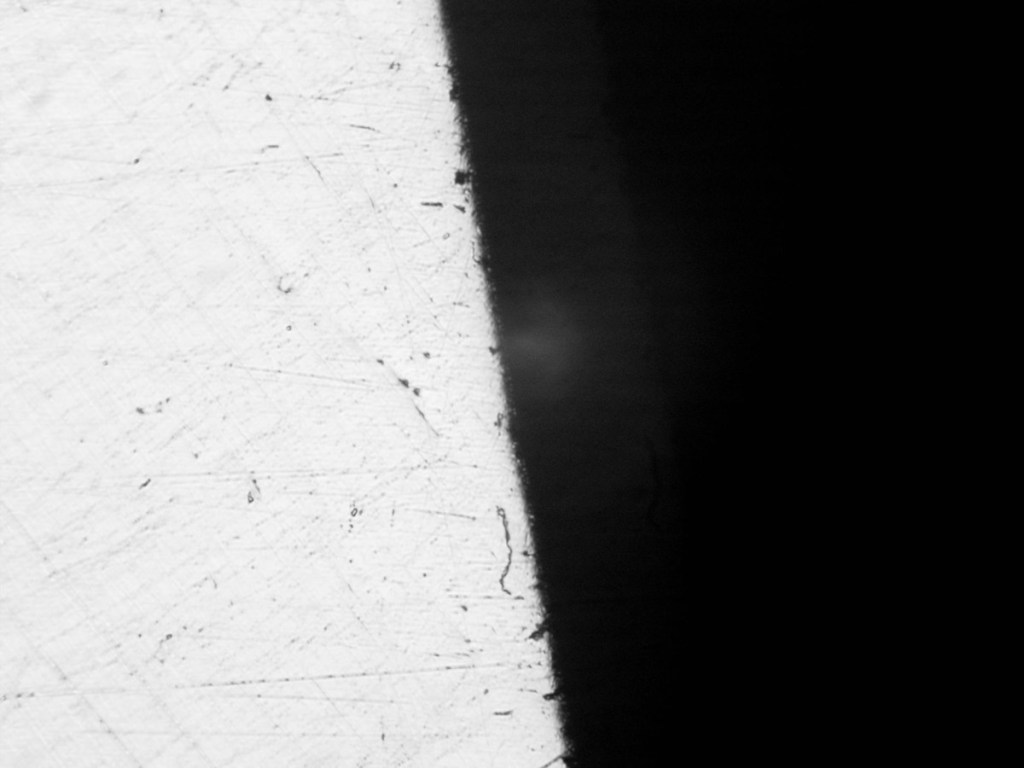
1095 is a steel that most people think of when they mention modern handsaws or card scrapers. Or perhaps older knives and some current kabar knives. Except none of those knives are actually 1095. They’re a modified alloy with chromium and vanadium.

But, you can’t really get that publicly.

I had a relatively lengthy post – OK..all of them are – about solving 1084. Solving 1084 had to do with just how fast grain grows in 1084 if it’s overheated a little. Other steels seem to like a fast overheat just before quench, and 1095 is one that doesn’t suffer too much. but….

What’s wrong with 1095?

You’ll probably never see 1095 in commercial tools other than spring steel. It’s really cheap, and it tends to have some of the manganese (hardenability) replaced by chromium, presumably because just adding carbon to 1084 results in a really brittle steel.

Chromium takes up some of the slack for missing manganese in terms of hardenability, and 1095 is what you would call a high hardness steel with poor hardenability. The former refers to hardness potential. The latter refers to have fast steel has to cool to get there. 1095 needs a fast quench. Parks 50 is the only thing I’ve found that gets it right. You can screw around with water/brine and intermittent quenching or whatever else, but Parks 50 and a very thorough quench will probably harden better than anything you can do with water that doesn’t end in cracking.

I have since found “solving” 1095 that it’s tolerant of a little temperature overshot, which probably has to do with having chromium in the alloy. But less tolerant than 26c3. So if you’re going to quench it, heat it past nonmagnetic a little but not too much and not for too long, then quench it as fast as you can and get it to the lowest temperature you can at the end of the quench as fast as possible. For me, this is parks 50 for a couple of seconds and then immediately to cold water after the high heat has been removed, and then into the freezer. This sounds stupid, but I leave a band of frost on the freezer and within about 30 seconds from hot like to stick a plane iron or chisel to the frost in the freezer and then I leave it in the freezer while the tempering toaster oven and the “metal sandwich” that stabilizes temperatures heats.

But….that’s not what’s wrong with it. What’s wrong is two things: 1) there’s nothing really in 1095 that will prevent a soak from getting and leaving a lot of carbon in solution – far more than the eutectic limit. 2) I don’t think the quality of 1095 that’s available now is that great, but some is good. And I’ve been warned by several people that the quality is iffy.

All three sources that I’ve used for bar stock have been different. It’s nice to find someone who lists the alloy, and then purchase whichever source has the highest chromium level. And hope that it’s quality – if it’s not, move on.

What about #1, though? if steel has too much carbon in the lattice, and not in iron or other carbides, the form of martensite is different and it can be filled with small cracks. If you get 1095 just right, it’ll be about as tough as O1. if you don’t, it might be half as tough, and in my experience, that’s enough of a problem to have a chippy plane iron.

I still like it better than 1084 when it’s done right as far as plane irons go. Why? it feels sharper. I can’t think of a real reason to use either 1095 or 1084 for plane irons at this point, though. 80Crv2 makes a better plane iron than 1084 and 1095. But it’s nice to experiment, and if you can really nail 1084 and make it work at high hardness, and the same with 1095, it will improve your accuracy and make heat treatment of other steels better.

Three Tries – Three Different Steels

First, I sent samples to Larrin Thomas without thinking much. I just applied the same heat treatment routine that I would use for O1 and 26c3. I think this causes a little bit of grain growth. Keeping the thermal cycles tighter (right at the point nonmagnetic starts to occur and then let the steel cool) will keep the grain from growing and keeping the temperature overshot lower will keep grain small but beyond just the looks, the result is slightly less hard. My 400F samples were 63.1 hardness and something like 4.3 ft lbs toughness. You’d expect something more like 61/62 and 8-10. Had i tempered them further, I have no clue – maybe they’d have been OK.

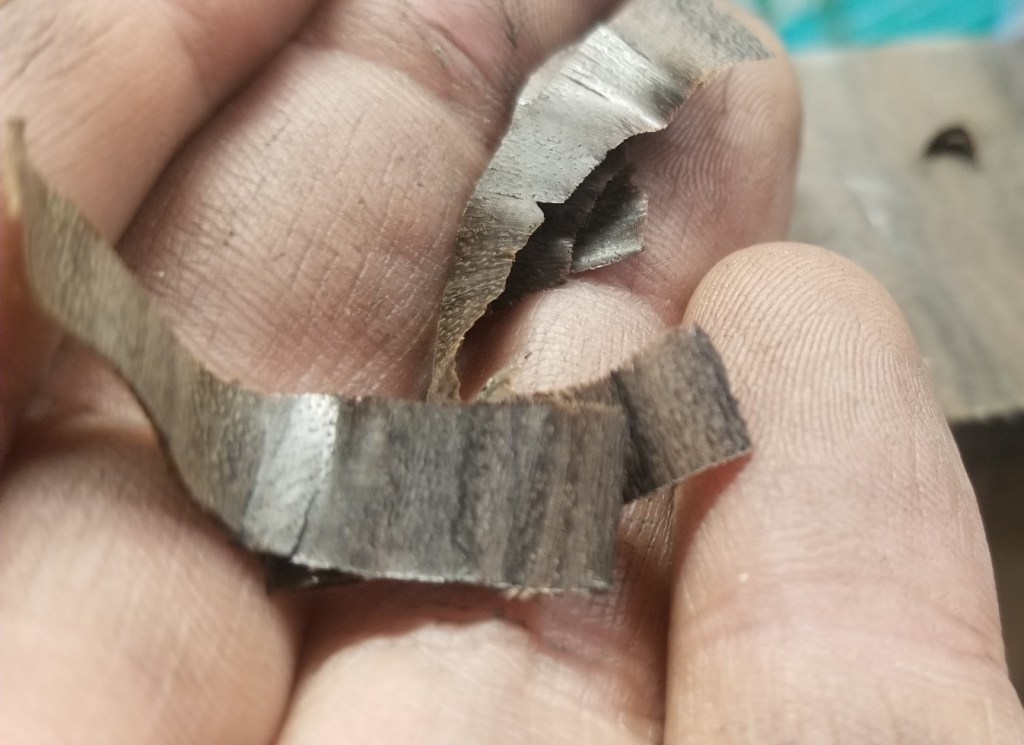
After solving 1084, I did the same with 1095, snapping samples and both observing grain size and seeing how easily they broke untempered. Steel should break easily when hit with a hammer untempered, but there are alloys that retain austenite at a high % that would prove that wrong. None of the plan steels that I’ve tried will resist breaking though. Breaking tempered steel would be more accurate in terms of actual usable toughness, but high toughness steels can become really hard to break so I don’t do it – the grain is the focus.

The first 1095 that I bought was from New Jersey Steel Baron. Since I didn’t have Parks 50 at the time, I was kind of unimpressed by it. It was also very cheap, so I didn’t care that much and put it aside. fast forward to now and I like the version that New Jersey Steel Baron sells. I try to avoid anything that would resemble a soak to maximize the amount of carbon in carbides. I do this with a pre-quench and then a sort-of anneal in vermiculte, and then do as much as possible to not go past nonmagnetic for thermal cycles before quenching.

Still, the result isn’t exactly a cornucopia of carbides and I haven’t found the free lunch. But the early samples that I made showed almost no carbide and I’ve gotten to this point. The iron may be a point softer, but the edge holds up. And the straightness of the edge is wonderful. This uniformity seems to be important along with an edge that doesn’t look very rounded right at the tip (AEB-L, for example, wears longer, but the edge shows a more rounded profile – I don’t know why this is).
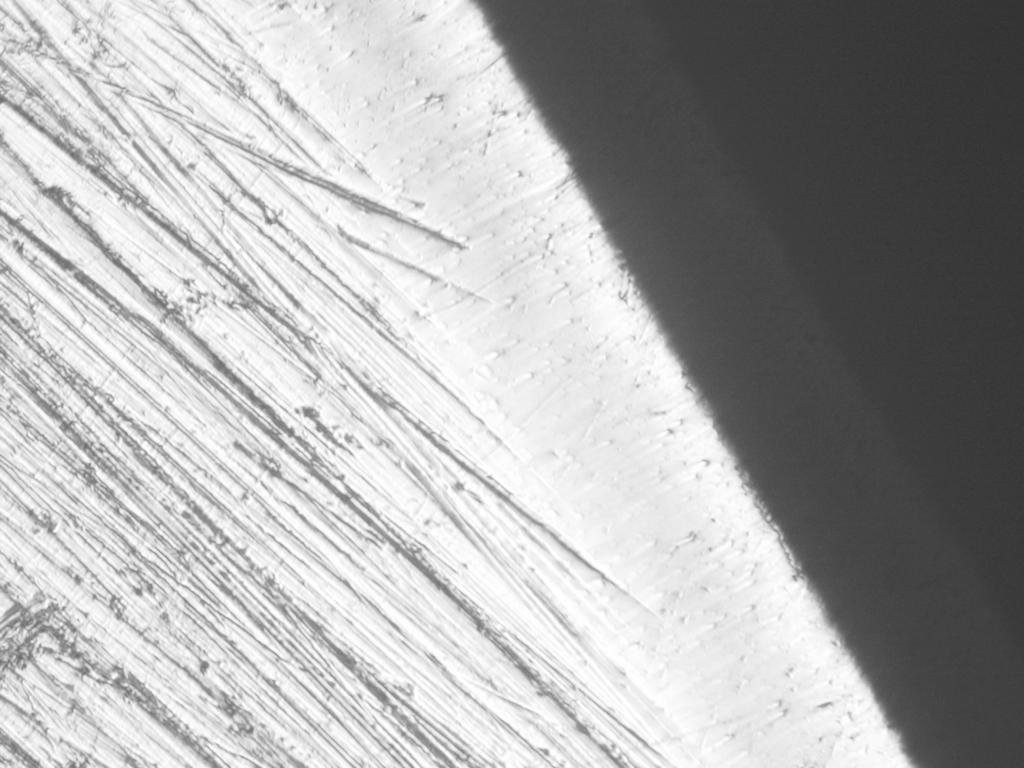
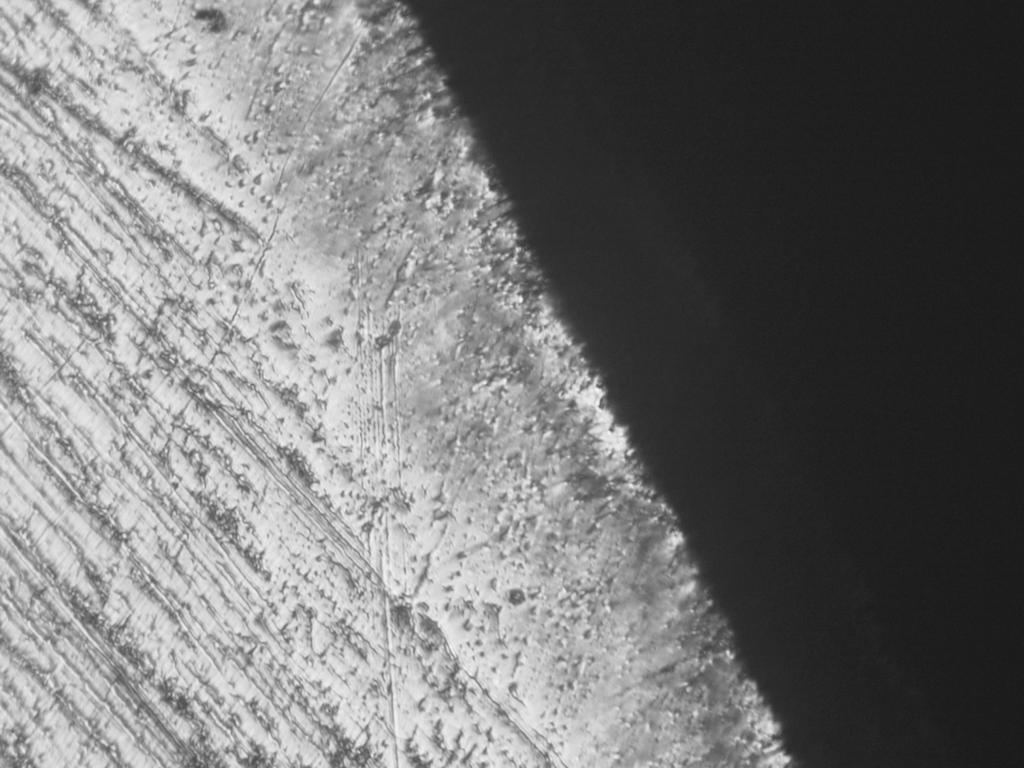
NJSB 1095 tempered at 375F – a very sweet plane iron.

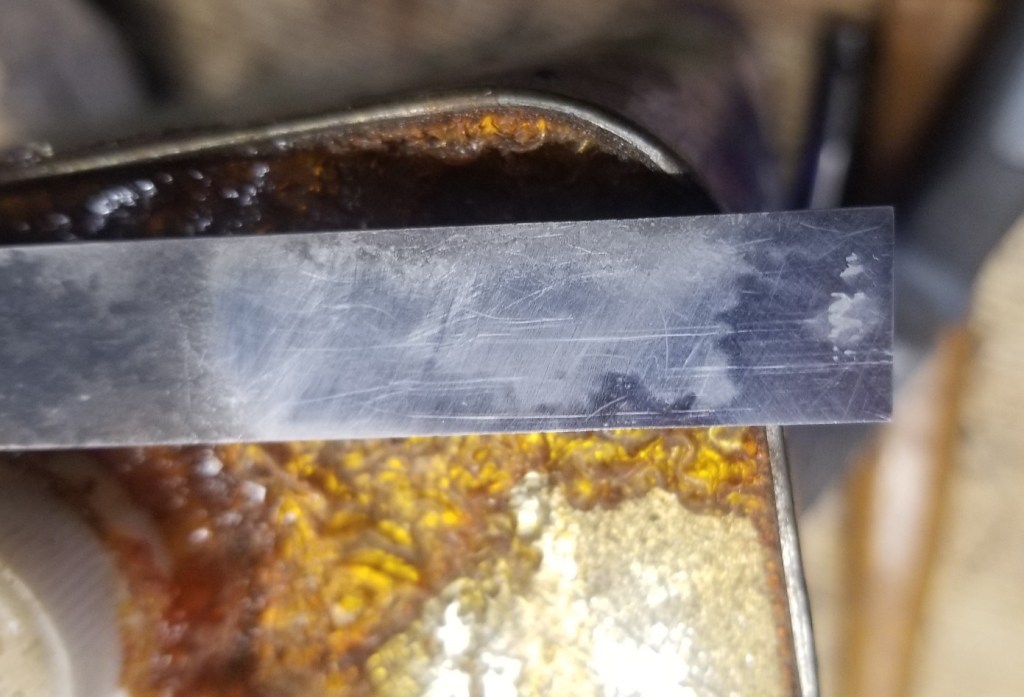
The second 1095 that I bought was from Alpha Knife Supply, which is where I get 26c3 (love it for chisels, obviously). The listing doesn’t reveal the mill but mentions that if you want great quality, finding bohler or ordering a melt from bohler is safe – or something to that effect. So, it’s probably not bohler, or the listing would say. This 1095 seems to have some oddness in it – not terminal by any means, but the shiny spots in it look like something that wasn’t fully dissolved, and I didn’t normalize the steel or do anything unusual, it’s just bar stock, so I think this is how it arrived. This bright spot wears just a little slower and leaves a stripe on wood that can be seen but not felt.

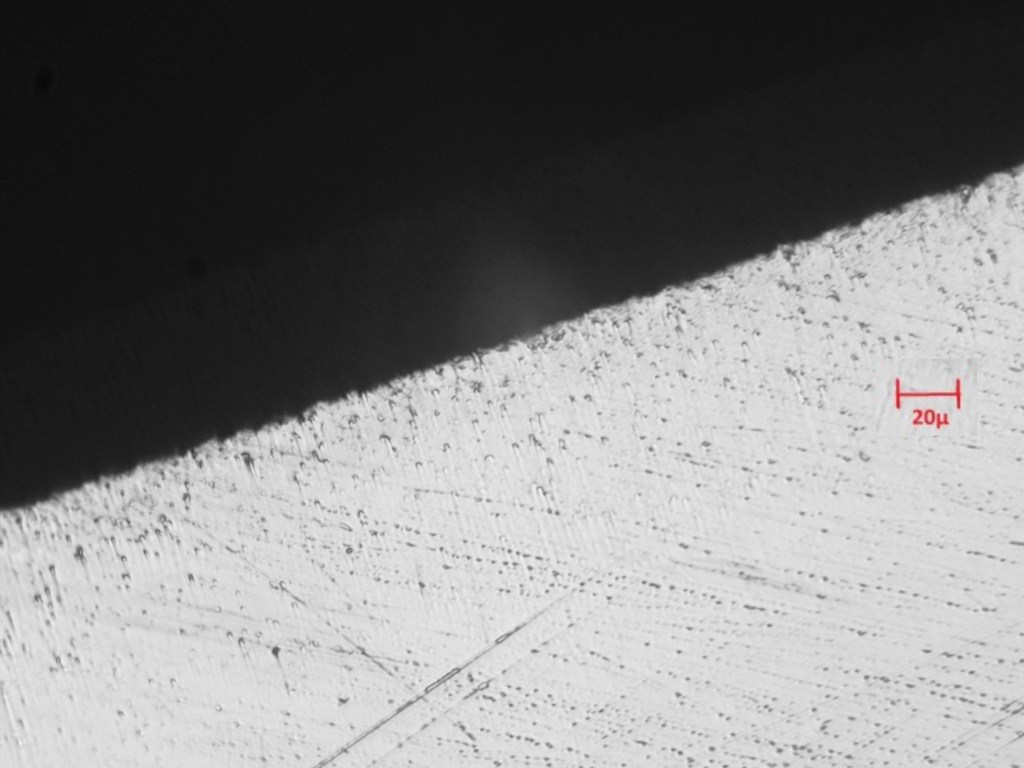
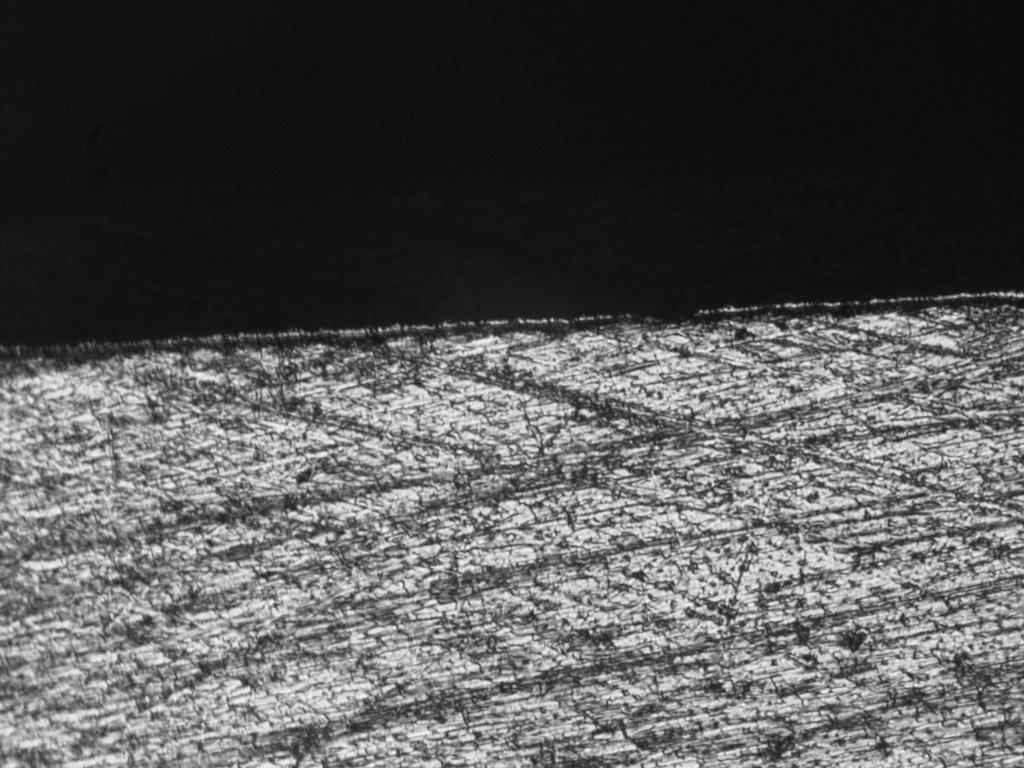
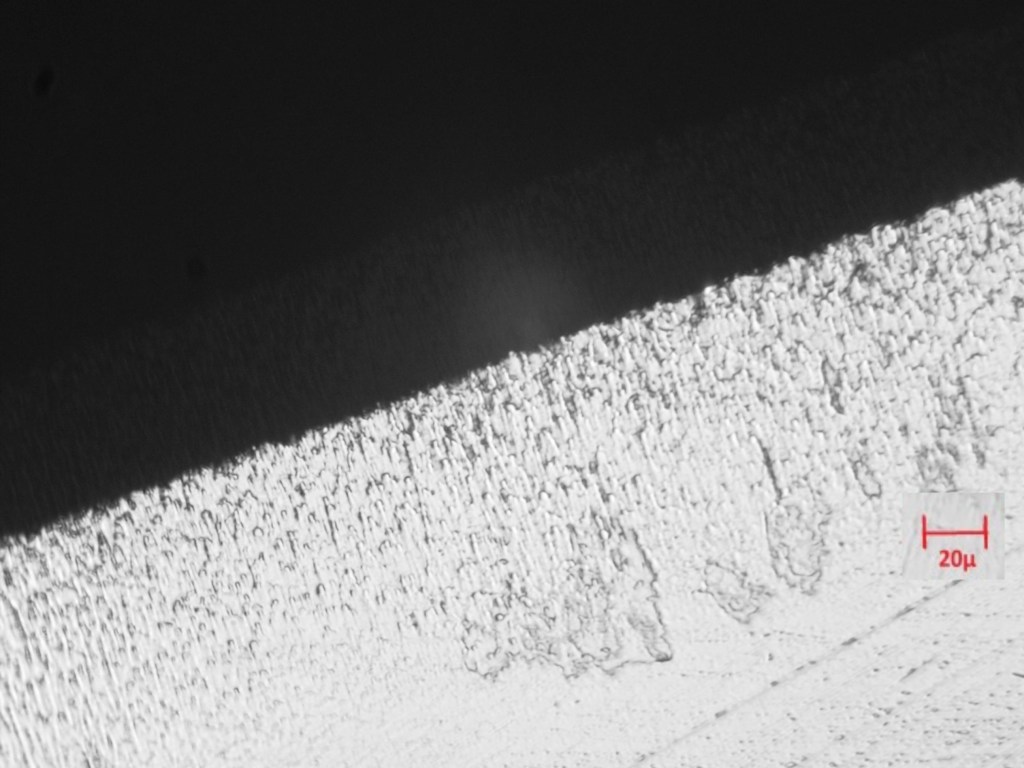
Alpha Knife Steel 1095 – nice fine carbides, but what is the bright area? It’s about 4 thousandths long. Is it undissolved Chromium? Notice that the edge isn’t as neat – reminds me of 52100, and then it’s very neat on either side. The effect on wood (there are more spots like this in the edge) is little stripes that aren’t as bright looking.

The AKS sample here is actually the first one I got right, and I puzzled about the stripes in use until getting the blade under the microscope. If the iron isn’t very good, there will be defects, anyway, so you don’t know right away if you did something wrong or if it’s the steel. It’s *rarely* something in the steel.

In an effort to find 1095 with more chromium, or more like an an observation while browsing for other steels, I found that USA knife maker had a listing with chromium near the upper end of the spec range and also had added nickel. The results of that are also good, just as the NJSB version. There’s no guarantee that some of the vendors aren’t selling wholesale to each other or selling from the same wholesale source, so the first and third pictures could be the same stuff just from different sellers.

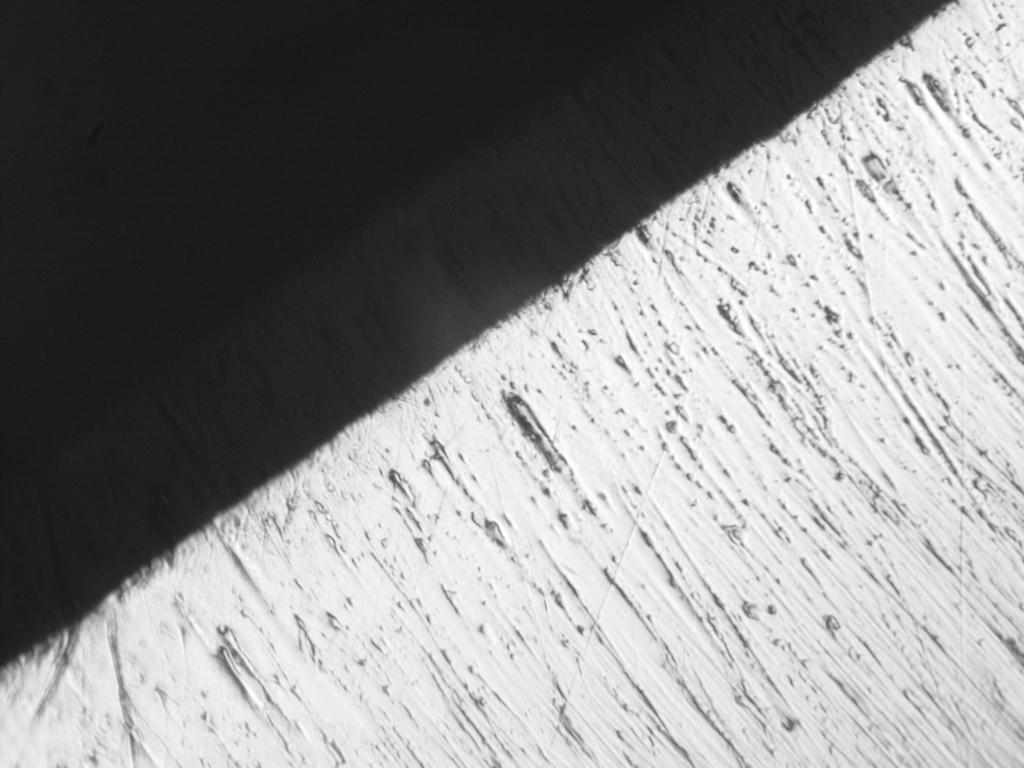
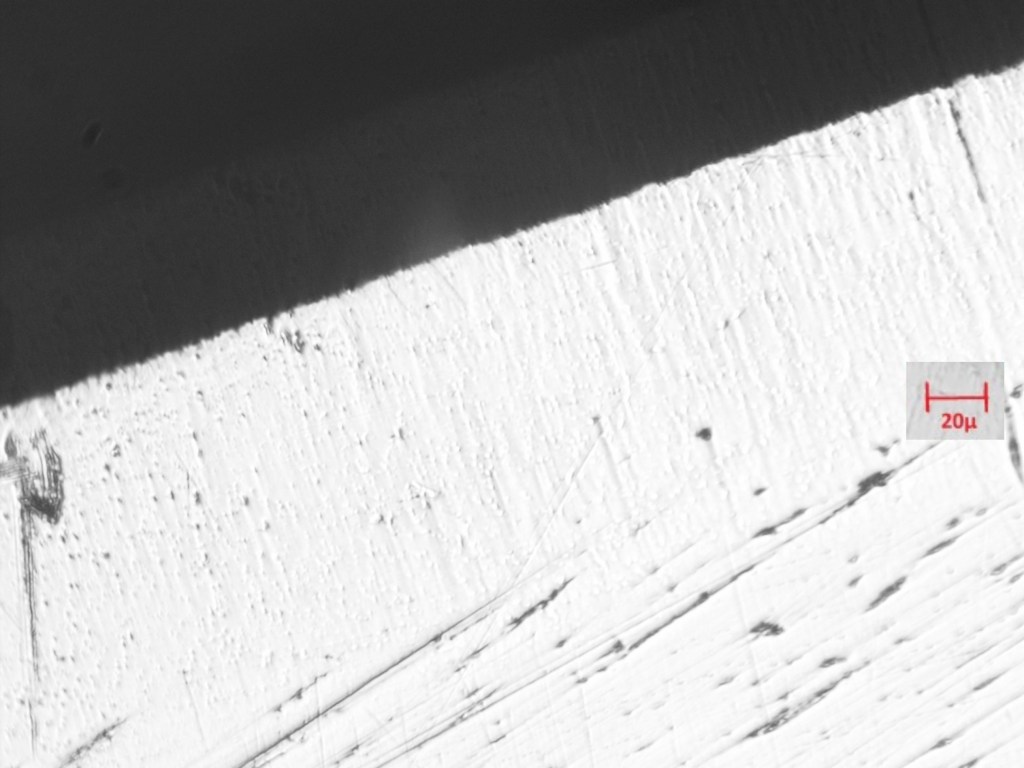
usa knifemaker’s 1095 steel

I don’t see much there, but will take another shot at wearing one of these irons. it seems the key to getting a really robust view of the carbides has to do with setting the cap iron closer and wearing more deeply in to the back of the iron.

nonetheless, this iron seems to work well.

I haven’t done any roughing of wood lately so I don’t know if toughness will be an issue. These irons subjectively wear a little less long than 80CrV2 or O1, but not too much less. the edge quality is nice and they feel more crisp than 1084.

But I also can’t think of a practical advantage to continue to make or use them. It’s just nice to get them right.

1095, like 1084, is cheap. if it costs more than $7 of bar stock to make an iron, I’d be surprised.

I sure would love to get a hold of the Sharon 50-100B (I only have the version without vanadium) or Carbon V or whatever Kabar is currently using to make knives. I get the sense that the extra chromium and the vanadium do the same favors they do in 80CrV2 and the toughness would be greatly improved enough to maybe be worth using that steel in chisels as well as plane irons.

AEB-L Stainless – Not What I Expected

I heat treat in a propane forge. That generally means I can’t do what’s important for stainless steels, which is a high temperature soak. I can do the other part of the need for chromium stainless steels, which is get a small area of steel really hot. But along with breaking the rules, this is usually highly controlled for temperature and duration, and temperatures that you really can’t get away with in the open atmosphere.

Instead of doing that, I preheat steel quickly to above critical, let it cool just back to where critical would be and then ramp up temperature by eye to as hot as I can as quickly as I can and quench. I’m aiming for almost yellow and not much exposure time to open air and then quench and get to cold as fast as possible. Stainless and high chromium steels often will cool with plates just fine, but I’m just tinfoil hatting that I will come up a little short and I want the quench to be fast.

Is this a long term plan? No. If a stainless shows potential, then at some point, I will either get a furnace or I will send a batch off and give half of them away at cost. But I’m not there yet.

V11 is Somewhat Stainless

A few years ago, two posters on woodworking forums talked about an XRF of V11 showing that it is CTS-XHP. I don’t know if it is exactly, but the composition matched CTS-XHP spec. XHP is a relatively high carbon steel with enough chromium to be referred to as stainless – very high if you’re used to numbers like 0.8 or 1%. I don’t know enough about steel chemistry except to speculate that a lot of the chromium gets tied up with carbon when the carbon content is high and stainlessness won’t just be discernible by percent of chromium because chromium has to remain in the lattice and it even has to remain in the right place in the grains in the lattice. Put differently, a very very low carbon steel may be very stainless with 13% chromium, but XHP is only borderline stainless if you’re really going to neglect a knife.

Why did I bring up V11? I learned that the high temperature soak for stainless steels that frees elements to go back into the steel’s lattice/solution before quenching isn’t just important for dissolving chromium carbides. If you reason that you don’t need to do that and you can just heat it and quench it at a lower temperature, it will lack hardness. As in, you can’t just reason that you’ll work with what’s already in solution quickly and get hardness – it comes up short.

That comes to play here. I’d suspect that if you’re willing to make XHP really hot really quickly and quench it and then run it to the freezer very quickly after finishing the tail end of the quench in water, you can get 60+ hardness after temper. That is, you can get close to the furnace schedule. In doing this, you’re relying on the bars from Carpenter Steel being good quality to start. It seems to be fine.

Here’s another why – XHP has a lot of carbides in it, and it’s a little lacking in toughness in chisels. There’s a little something else going on that I don’t know – it could be volume of carbides (cracks start in carbides) or it could be lack of the same directional property that some other steels have. the following link shows a micrograph of XHP, the white “balls” are carbides, you can read the entire page which is half history lesson at knife steel nerds.

AEB-L, however, is a completely different animal.

What is it?

First start with the micrograph (you can click this)

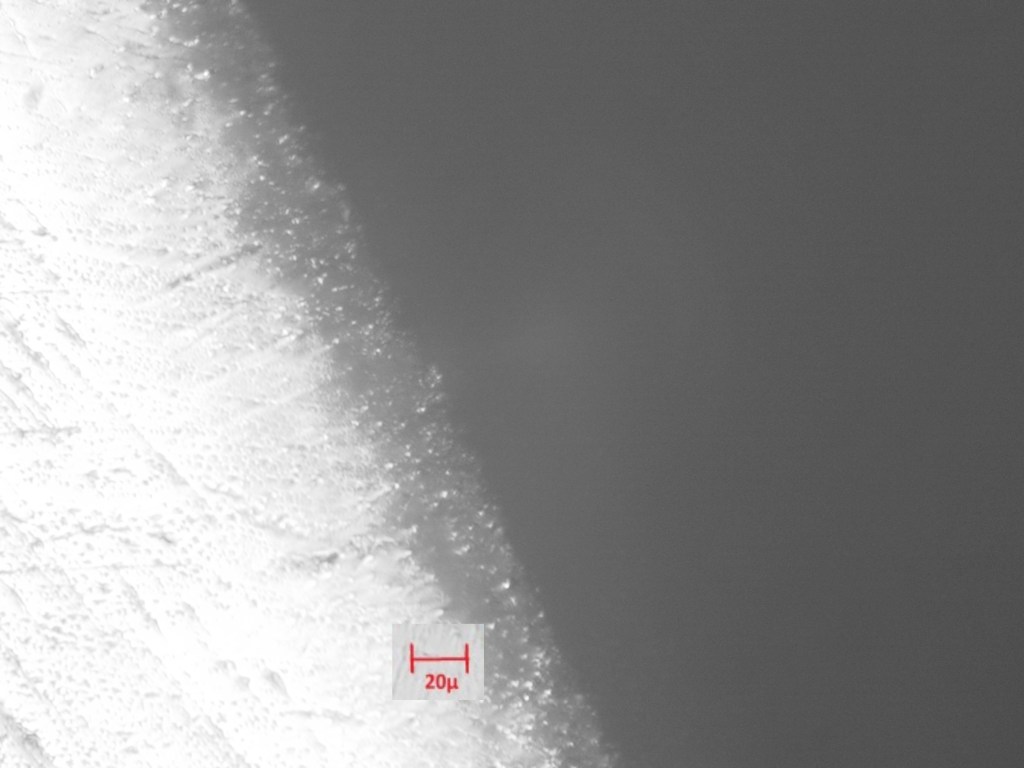
Notice how fine it is? It’s much lower in carbon. XHP is about 1.6% carbon and AEB-L is about 0.67% carbon. A drastic difference. I’ve quick heated it in the past without knowing just how important the high temperature is and it makes a kind of soft iron that needs to have the edge buffed to not fold. Then it planes a long time, but that’s no good.

AEB-L is also cheap – it’s a steel used to make razor blades. Knife steel nerds also has a nice write up on where it’s used. Just follow the link above and search for AEB-L.

An interesting side fact here is the idea that PM steels are the finest grain-wise ignores reality. PM allows steel compositions that would be too coarse if it cooled from a large ingot, but it doesn’t negate the fact that there are other compositions that are very fine without needing a powder process. This results in AEB-L being finer than any powder metal stainless that I’ve seen.

What’s the Draw of Fine Grain?

Somewhere this seemed to imply “it’ll be like carbon steel but stainless”. That’s kind of true, maybe? If you read about AEB-L, it can be done in furnace and finished with a cryo dip after the quench to get very high hardness and still have good toughness. 64, in fact. it should hold up at high hardness better than XHP/V11, be finer grained, and I surmised maybe a little easier to sharpen.

So, yesterday I gave heat treatment another try concentrating heat just on the last inch of the plane iron, quick quench, finish in the freezer. I don’t know what the hardness is, but it must be close to 60 as it shows no ills. It also appears from pictures following that there’s no evidence of suffering anything from not being soaked – for woodworking purposes at least. it would be interesting to see what it’s like at high hardness, but I don’t have the means to get the steel any harder.

Suddenly vs. prior samples, this sample has strong hardness and it’s not quick to hone. Prior versions of this had planing test edge life of 1.6 or 1.65 times more than O1 steel. I’d need to use this iron planing for about 2500 feet in edges just to test that once, and I don’t really have the desire right now.

The reality is that wear resistance makes it slower to sharpen and it is. It also makes it grind kind of hot, which isn’t what we want. It’s not a high temperature tolerant steel and the temper is 350F in the sample here. Grinding it to an accidental brown edge will have undesired effect.

This is part of the conundrum with steels like XHP and now confirmed with AEB-L, too. When you grind these steels, which you’ll be doing a fair amount if you use tools much, the steel wears more slowly and it grinds less cool. XHP takes about twice as long to grind even without considering that and AEB-L speculatively took me twice as long to establish a bevel on a belt grinder. Just estimating based on wear life in wood, AEB-L would grind only about 60% as fast, but that’s compounded further by having to stop more to dip.

Overall, finally getting a hard sample and that’s a little bit of a road block to day to day use (it’s annoying). But it’s worth having a look at how it wears.

This image is the wear after 540 feet. It wears slowly and the wear area looks so odd because of the lack of any visible carbides even at 300x optical . I usually get wear pictures on carbon steels to see carbides at only about 200 feet of planing on cherry. If this iron felt like carbon steel in wood – like in a free lunch way – longer wearing, feels the same – I’d consider planing a volume of wood.

But, it doesn’t. I don’t know why for sure, but I’m starting to get the sense that some carbide volume right at the edge makes for an edge that wears more thinly somehow.

So, this iron would last a long time, but it doesn’t have the feel that carbon steel does, and strangely, XHP/V11 with its high carbide volume has a really keen and sharp feel. Its achilles is that in less than perfect wood, it takes nicks like anything else, or maybe even a little easier, and grinding and honing them out is twice the work.

So, I think I’m back to using plain steels. Too bad. if I ever get a furnace and a dewar of liquid nitrogen, I’ll consider trying to make a very high hardness sample and see if the edge is different.

So…..razor blades? I don’t think AEB-L is ever used in a plain razor blade. I think it’s used as the steel stamping, then it’s honed, and then the edge is coated with something hard. You can see ads claiming razors are platinum coated or whatever – I have no idea what they are actually coated with, but I have honed the coating off of them before when they are dead to see if they can be resharpened, and what’s left is just steel that’s too soft to work at an acute edge.

Steels that d0 well in straight razors rather do have a relatively large volume of carbides compared to AEB-L, but they’re iron carbides and not chromium carbides.

Free lunch yet again not found.

But I have confirmed previously that this steel, which is slower to sharpen but not difficult like steels with a lot of vanadium, will wear much longer than A2 steel and it’s creeping up on XHP – and it’s cheap. About $10 per plane iron in steel costs.

I have no idea if the qualities of picking up shavings more easily during a wear cycle are important to the average user. They should be for anyone who may be sometimes planing several hundred board feet from rough each year as how easily the shaving is picked up is far more important in terms of effort than how many feet are planed carefully in a test. This same factor is why I don’t care for 52100 – it will technically wear longer, but it requires more effort from the person using the plane to keep it in the cut as it dulls and that just isn’t very practical.

For Reference

Here’s how much wear I encountered in the O1 test on the same board after 540 feet. You can see that a great deal of wear has occurred rounding a larger section of the edge and forcing me to increase the light level significantly.

80CrV2 Steel – Way Better than Expected, and Probably Better than O1

Half the price of O1 and at least as good in plane irons. I put off even considering this alloy for chisels because the data sheet shows it being around 60 hardness at a 400F temper. I find favor with most 1% and higher steels around 400F, but admit that I don’t have a great reason to believe that it’s the best temperature for everything.

The other thing against 80CrV2 is that it’s a not an expensive steel but it’s not as cheap as it could be with some retailers, and the prices is around what you’d expect for O1. While making an order a couple of weeks ago, I found that NJ Steel Baron doesn’t charge too much more than the very lowest cost HC steels like 1084 and 1095.

So, what is it? I’ve never heard of it as a woodworker, but saw someone else attribute a statement to Larrin Thomas that it is used in woodworking tools. If you’re purchasing LN, LV or other boutique tools, it’s probably not going to be there. Maybe it’s used in carving tools and plane irons in europe, or maybe it’s used in what are lower class chisels for woodworking, but the top of the range hardware store chisels in the $15-$20 each. I really don’t know.

From 1084 and 1095, the Troubles

1084 and 1095 gave me trouble until I snapped samples to see what color and time they will show before grain growth is a problem. 1095 isn’t too bad, but 1084 is a different story. Shoot a little too high before the quench and grain growth doubles. Do that while thermal cycling and the point of cycling gets lost, plus the quench. You have to be attendant with it, and give it only a few seconds if chasing the quench temperature up and not nearly as high as something like 26c3 will tolerate. Put differently, the routine that I used to better any published results for 26c3 results in *very* poor 1084.

I’d hoped to find 1095-ish with chromium and vanadium. The former to add some toughness without sacrificing hardenability, and the latter to pin grain size, allow for the overshot that I like to ensure hardness. It’s not to be, and 52100 just isn’t very good for woodworking.

1084 also will not ever wear as long as O1, but it does OK. that isn’t a problem with chisels, and the toughness of 1084 was good enough once I solved not growing grain that it will make a fine plane iron tempered a little lower. Translation – it can be as hard as O1 and 1095 will tolerate planing.

Seeing the better than expected corrected version of 1084, I made a couple of plane irons out of 80crV2 and used an offcut that was waste off of the same sheet and snapped samples. The grain is as fine as anything I’ve ever seen that attains high hardness, and the hardness was a little better than I expected starting with a 375F double temper. I suspect it’s around 61/62, about the same as O1 tempered at 400F.

I’m going to avoid going into a broad discussion about how much carbon is in solution (not in carbides) in each of the steels, but for brevity, some steels suffer from too much of it remaining in the lattice and not in carbides. The resulting toughness vs. pictures of the snapped grain or micrographs can seemingly be 1/3 of expected. This isn’t always bad – o1 is far less tough than 52100, but it’s nicer to use.

What is it?

Despite the dreaded “chrome vanadium” name, it is not some soft shiny steel that makes a terrible chisel. That label given to the variety is ill attributed because someone knew the combination of favorable properties – limiting grain growth and toughness, but paired them with a low carbon amount – often 0.5 or 0.6% carbon. This isn’t really much good for woodworking, and the 0.6% variety is listed a lot in not-quite-hard-enough-chisels from China. When I reharden them, they are only a little better – there’s just not much potential.

80CrV2 is 0.8 or 0.85% carbon, manganese of about 0.4% (just over half of 1084), Chromium taking place of some of the manganese (0.5%) and a small amount of vanadium (0.2%). It’s a water hardening steel, so we’re not likely to see any of the boutique US makers making it. The chromium and vanadium are enough to make it more friendly to heat treat than the plainest of steels, but they won’t make it feel gummy or slick like A2, etc.

In woodworking, you will often see O1 labeled as plain carbon steel, but if you work with older tools or 1095 or 26c3 or whatever else of that sort, you’ll notice the feel of the alloying in O1. it’s not bad, but you can feel it. it’s more obvious in 52100 due to the chromium content (1.5%), and, of course, once you get used to plain steels, A2 feels terrible. V11 also gets its slickness for a huge dose of chromium.

I can’t well compare grain size from snapped samples with 80CrV2 to anything else I have because I had to double the magnification on my hand scope to 100x optical to see any difference in samples just heated from bar and quenched, then thermal cycled and then the same as the latter but with an intentional simulated careless overheat.

Here’s the snapped sample from the quick heat at 100x:

Next, the same magnification but with three thermal cycles.

that’s outstanding. Even looking at this under a loupe you can’t see much.

Here’s the kicker – doing the same thing as above but allowing the sample to overshoot in 15 seconds to a very bright orange resulted in….wait for it.

Nothing. This is not a long duration forge heat, so it’s not license to just disregard what temperature does to steel. This would be more like what a beginner may unintentionally do. It may look at first sight like the second picture shows larger grain than the third, but I think that the actual sample had a little more toughness breaking and if you look at the individual grains, you’ll find them similar in size – especially given the limitations of snapped samples being photographed with a microscope that I got for $12.

1084 steel is constantly recommended to beginners. I think they have no chance if they’re using a forge. This is what beginners should be starting with. But the forgiveness allows more advanced forge heat treaters to get otherworldly consistent results without being as taxing as 1084.

There is toughness in reserve with this steel, so it would probably hold up in a plane iron tempered hard (like 63/64). Hard tempered irons are OK, I guess, but I generally like something around a hardness that the washita likes – somewhere around 62. More hardness means slower sharpening and the sharpening effort seems to increase faster than any footage gained planing.

So, How Long Does it Wear?

About the same as O1 – which is nice, because 1095 and 1084 don’t last that long, and neither does an old Ward iron or an iron made of 26c3.

To test this, I planed a single board alternating with an O1 iron that I already have and one of the new 80Crv2 irons, and I took pictures of the carbides about 2/3rds of the way through. I want to see how long each planes, but discern difference in how the edges feel because there’s a fair chance I may start using this stuff in my own plane irons.
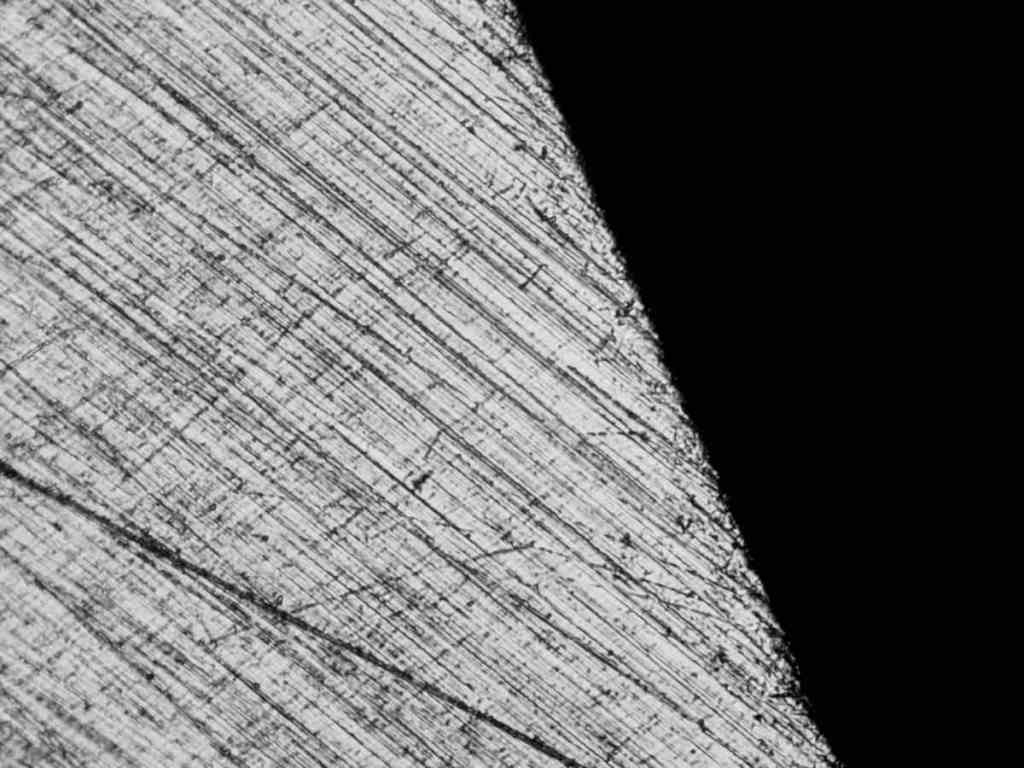
The bottom line is at similar hardness, the edge life was almost identical. On the cherry board with a chosen shaving thickness, I planed 783 feet with 80CrV2 and 778 with O1. When clearance runs out, it lets you know ahead of time, but when it tips over toward not allow the plane to pick up a shaving, it seems to happen all at once. the margin of error in this test is probably 25 feet of planing, so figure these are about the same. that’s all I need to know.

Pictures of the carbides – O1 first, and since there was a lot of heavy edge wear, I had to turn up the light on the microscope. What I’m looking for is a nice even edge, and even carbides.

In the 52100 post, I showed O1 with much less wear. This is Bohler O1 and I think the others was starrett. But the real difference is far more war, exposing more shadowing with carbides in the worn edge. That is, some part of them is pointed directly back at the lens wheras the edge is rounded and appears dark because it reflects light elsewhere. there are a few odd carbides here or there, but these are seemingly 2 or 3 microns. Maybe they’re tungsten.

Now, the 80CrV2:

These are extremely high magnification (300x optical – the height of the picture is less than 1/100th of an inch in reality), but look at the tiny evenly dispersed carbides. The slightly different shape in the wear – who knows, it could be just how the steel wears or slight differences in cap iron setting. nonetheless, anywhere you see anything that looks like it’s even 2 microns, it’s probably two carbides close together.

it felt just a little sweeter. The evenness of the edge probably shows why.

So, what are we looking at in costs? A sheet of steel that will make 6 stanley plane irons costs $32.50 as I type this. There’s enough left for half a dozen marking knives or several nice kitchen paring knives. After allocating shipping to this sheet, we’re in the ballpark of $6-$7 an iron. bumping up to Lie-Nielsen or Infill thickness irons and the cost goes up a little bit, but I’d consider making a few LN replacement irons as there is no alternative to dumpy A2 now. I don’t have LN planes any longer, but I do have spokeshaves, and the A2 blades for them are just a terrible choice.

What about Chisels?

26c3 is probably unbeatable – it sharpens easily, it attains really high hardness easily and the crispness of the edge is superb. It’s not nearly as widely available, either.

But I will probably make a few 80CrV2 chisels just to see what they feel like at 350F temper and then down from there (or up in temperature and down in hardness). I think 26c3 is easy to get right, but a beginner may not have much chance of doing that in a forge, and my test samples bettered published specs, so I would be hesitant to guess how good it is in a furnace. The knifesteelnerds suggested heat treatment doesn’t get results that I get, and I think that’s a shame, but the steel itself may also not have that much value to knife users who can be wooed with the promise of something better that isn’t functionally better.

And in all fairness, though I have not a single positive thing to say about Devin Thomas, Larrin is the one who in his characteristic brevity when I asked about a 1% CrV steel, suggested 80CrV2, and maybe seeing the suggestion the 15th time tipped me from feeling like I didn’t need to short carbon well below 1% because I have the skill to work with steels more difficult ….to trying it anyway.

Would We Ever See it in Boutique Tools?

I doubt it. There are some things that I do to chase hardness that require hands on skill and some experience. I’ve now probably heat treated at least 300 items and I have not just heat treated them, but I have been using it as a fun exercise to try to get better and more consistent. I’ve also never had to do it on a Tuesday afternoon with a hangover or organize 50 items at a time. If I harden and temper 10 items in a busy week, that’s a lot, and I usually limit what I’m doing to cycling two items at a time. I’m kind of dumb, and trying to keep track of more than two things that are changing colors and in and out of the forge is a good way to make a mistake.

Why Not 52100 for Tools? It Just Isn’t as Good in Wood as Some Lower Toughness Steels

Well, to start out with, I ended up getting banned from a knifemaking forum because I wanted to talk about heat treating in a forge. But I really went there in the first place to try to find 1095 with upper end of the spec chromium and a little bit of added vanadium. That would make forge heat treatment really easy. It turns out, you can solve (if you’re me) the issues with 1084 and 1095 pretty easily just by manipulating temperatures by eye with some samples, snap them, and then make actual tools with them and confirm they’re better. But I didn’t bother to do that until I got berated about “poor results” from one of the most undesirable individuals I’ve ever met on a forum – Devin Thomas – the father of the metallurgist who did my test results for 26c3 and O1. I later sent more samples, as I’ve mentioned on here, with 1095 and 1084 without looking much at them just to see how they’d turn out.

The 1095 was mediocre and the 1084 was undertough by a lot. What resulted was finding out that though I’ve never talked to Devin, he was pretty pleased to see the second set of results from steels I don’t generally work with and pretty excited to ignore the fact that my other samples were as good (O-1) as book results and never-to-be-mentioned, I guess, far better than furnace schedule results for 26c3. Those weren’t by chance.

What is the problem? Apparently, Devin, who is by others accounts an accomplished maker and provider of some materials to other knife makers, doesn’t like anyone to talk about heat treating in a forge. I don’t really care what he likes, but he doesn’t know much of anything about woodworking tools and I couldn’t get discussion out of anyone else about questions that had nothing to do with it. He gets my award for the least desirable person I’ve come across on any forum for inability to discuss something unrelated to what he wants to drone on about. So, eventually I got banned for talking about heat treating in a propane forge and posting the results because I refused to stop talking about it. The official reason “poor behavior and being suspected as a returning troll”.

This is BS, of course – I don’t have more than one ID on any forum and have a distaste for people who maintain multiple logins. I can’t think of a single person who does that and adds anything positive to any forum.

I may also be underestimating the whims of advertisers on the forum or other paying service providers. In short, talking objectively about what you’re doing and after much goading, showing factual results that aren’t in line with assertions you weren’t asking about in the first place? It must be some kind of threat.

The very simple fact is that by not following published schedules, I got better results than anyone has ever published with 26c3, and it breaks the rules of not normalizing steel and then giving it an austenitizing soak before quenching. I had no idea those things were supposedly rules in the first place. they can be needed for some steels that do need them – 26c3 doesn’t. If far better results than steel done with those steps isn’t proof, I have no clue what is.

What resulted when I was found out to be a forge heat treater and then my comment that I wasn’t getting a furnace in the near future, from Devin, is something I wouldn’t have expected to see from a grown man, but life is full of surprises. I did later scroll back and find out that i’m not the only person who has been subjected to it, and there’s a whole group of (maybe well meaning?) sycophants who will request the moderators ban anyone who posts methods they don’t like. I suspect posting results that support them is even less well liked.

Where does 52100 come into this? I got the same thing I always get from people who have made knives when I don’t mention 52100 as a preferred steel.

What’s the problem?

52100 is very different than other relatively plain steels. It has an amount of chromium in it that gobbles (binds) a lot of carbon so that the carbon doesn’t remain in the lattice/grain framework. It’s also offered in a lot of inexpensive bar stock in very different starting structures. Some of those structures won’t achieve good hardness, especially if you just heat it to nonmagnetic and then quench it.

I have worked enough with it to know that I can get it reasonably hard in the quench – to the point that it’s difficult to deal with sharpening comparatively – in woodworking tools.

The lack of carbon in solution appears to make it too tough. This is a foreign concept for knifemakers – “too tough”. Tough keeps people from breaking knives – they bend instead. I don’t think people have the cajones to return a knife they bent but that didn’t break and then claim they weren’t abusing it. That’s great for a maker. Let’s be honest, too, few people are doing much with custom knives they buy outside of some really strange competitions that look just ourtright weird to anyone who is a woodworker. The average person is pushing a knife through things or slicing with said knife.

When I first started playing with it, I expected to find low hanging fruit, that 52100 hadn’t been used, and maybe it was a mistake not to use it. Maybe the reason was that it was harder to heat treat, or who knows what. I suspect that the early 1900s tools from the carbide patterns that I see are lightly alloyed water hardening steels with some addition of tungsten, and some may be oil hardening steels when they’re solid. but I don’t think I’ve ever used a tool that behaves like 52100.

Everything used in woodworking has enough toughness, but not an excessive amount. You wouldn’t expect to take a chisel, bend it over in a vise into an L and bend it back and not have it break, but 52100 can do things like that without breaking outright.

First Experiements

I made a couple of blades of all kinds. 52100 was one of them. Disregarding effort made, it planes about as long as O1. I didn’t test it directly against O1 right away and figured it should be good. it also has a persistent wire edge at “normal” plane iron hardnesses. In chisels, I found the toughness intolerable – when an edge would deflect it would just stay there increasing the cross section of the edge and making the chisel harder to get through wood. An unexpected problem.

I later compared a couple of the irons that planed about as long as O1 and noticed that as the two steels wear, 52100 takes more effort to keep in the cut and on woods that a plane likes to come in and out of the cut on (figured or runout), the cut was more rough at the same interval. that creates a big difference in physical effort even if both irons plane the same distance, and planes not staying in the cut is part of the reason the average person fails to get a finish ready surface off of a plane. This is what the carbides looked like – they were a little larger than I would’ve expected, but evenly distributed and all in all, not bad.

first shot carbides – not bad. the edge doesn’t look too uneven, but it looks like it doesn’t wear that crisply. This is hard to see, but a more vivid example of this can be found in my prior post about the mountford HSS iron. That iron also fails to cut nicely as it dulls. You get usable resuls, but not as good as steels that established themselves for use in planes and chisels – those being less tough or lower in alloy.

Compare the edge of that picture to O1

Notice the shape of the very edge of O1 – it’s more even and there’s no visual evidence of a thicker initial edge.

I think there is a fundamental difference in how the edge wears – how round or blunt does it get, and how does that effect planing.

O1 does not keep carbon out of solution the same way 52100 does and the alloy is different, but it’s easier for a fast heat treatment process to get a lot of uniformity. I think moving the cap iron around would show a few more carbides, but it’s not a surprise that they aren’t as vivid. the “stuff” remains in solution and creates a problem that metallurgists call plate martensite. This problem reduces toughness…..except for woodworking, I’m not convinced that it’s a problem.

Knife folks are still fixated on the fact that you can break O1 – what are they cutting? I don’t know. I think they cut the cheese more than they cut things with their knives. We don’t have that luxury in woodworking.

I keep coming back to O1 being a really pleasant steel for woodworking, but I’m not trying to create an argument for it – I’m working from outcomes first, which can be unexpected – it shouldn’t be better according to anyone, but if it shows better in outcomes every time, and it’s also easier to heat treat, and the issue of toughness doesn’t apply to us, maybe it would be smart not to deny the outcome. Even if you never figure out the cause, the better performance is right in front of your face. And if you hand plane 15 or 20 board feet from rough in a day, that difference will be drastic. It can work longer into the dulling cycle without you as the “planer” having to sharpen as often or you as the planer leaning on the plane and really creating a lot of problems that are both unpleasant and unproductive.

I also noticed while looking at grain size that these 52100 samples were outright abusive to my vise. I break samples by hitting them with a hammer. I want to see the grain size under a microscope – but you can also feel a difference in how hard you have to hit the steel to break it. A tempered factory file will break easily. A 3/16″ thick sample of 52100 that’s even moderately tempered may actually be a threat to break a vise.

what does that clue us into? the next reasonable thing is to leave it hardly tempered or untempered and see if the edge holds together. it’s really unpleasant to sharpen when it’s left really hard, but it’s not that slow to grind. the washita won’t touch it. Why is this reasonable. It’ll be much less tough at really high hardnesses, but it may still be tough enough almost untempered to plane wood without chipping.

52100 untempered. to my surprise, what no more tempering than it would get just from grinding the initial bevel, it did not chip. the hardness level is absurd. It must be 65 or 66 hardness as it’s relatively low alloy and even an india stone doesn’t do much with it. I think the only thing I’m really doing with the washita if I get a small burr is deflect it. Nobody would ever sharpen this with oilstones.

Figuring it would chip and then I would walk back the temper until it didn’t, I was wrong. it didn’t chip untempered. It was, however, a right bitch to sharpen when compared to tempered irons. Slower even on diamond hones. there’s nothing in it diamonds won’t cut easily, but at some point, harness can be so high that the diamonds don’t penetrate as much.

But…compare the edge to O1. I don’t know if the picture is meaningful, but the edge rounded look is still there………and the result of planing is that it again felt really keen initially and then continued to plane, but it doesn’t have the sweetness of O-1. the combination of attributes doesn’t offer anything. Again, a surprise.

I Put it Aside and Got it Out Later

After being goaded on the blade forums (and then banned for talking about forge heat treatment, or because of the outrage that the topic causes), I decided I’d see if I could get some of the carbides in solution without a furance. I don’t think this would be that hard. Here’s the thought process:

Larrin posted an excellent article about how much differently 52100 turns out in a furance depending on the initial microstructure. Some of this is canceled out by the fact that I use a temperature overshot when heating and no real duration, but probably not all of it.

When I first used 52100, i heated it a couple of times and quenched it, and tried a few things. Since then, I’ve learned to shrink grain with extreme reliability. I also think I can manipulate carbides a little bit without having too much carbon escape the steel. Again, a very high heat overshot, and then something I haven’t done before much – heat to critical with another iron (for mass) and stuff it in vermiculite. the hope is that I will get carbon back into solution (less toughness, higher hardness yet), and the thermal cycles will shrink grain without moving much of the excess carbon in the lattice back into carbides.

I would then follow this up with a temperature overshot quench (heat to a brighter orange as fast as possible then quench as fast as possible back to the lowest temperature possible). I have all of these mule irons on hand already, they’re just waiting to be turned into knives or something instead, but if I can actually change how they look under the scope, I will know I’ve changed the outcome without any question as to the difference in the bar stock used.

So, I did this – I know conceptually this is difficult to follow. But here are the same irons with microscope at same magnification. Apologies if the light reflection is slightly different.

First iron, 350 F temper, which would be untertempered for O1:

Smaller carbides, and seemingly less of them

I would estimate this first iron’s hardness at 62 based on the stones. the washita doesn’t do much with it, but it’s not intolerable. it cuts OK on an india stone. As with prior versions, the burr is persistent, but I’ll let the buffer deal with it.

This is after planing. Look at the edge again – it still looks like it doesn’t have the uniform sweetness.. And it doesn’t. It just doesn’t perform as well with thin shavings.

The hardness is a little better that before. Did I do what I think I’m doing? I have no idea.

so I did one more iron with the same thing, one of the ones previously made, and tempered it at 300F instead. It should be around 64 hardness. It feels like i is. the washita has no interest in it. For reference, the abrasive particles in washita are about the same hardness as rockwell C64. If you slurry an oilstone, it can abrade steels harder than the particles, but the mechanism isn’t by rasping grooves in the steel.

300F tempered iron – high hardness. Still seemingly fewer and smaller carbides.

this harder iron is unpleasant to sharpen if you’re used to something like 62 hardness O1. It’s not more abrasion resistant, it’s just harder.

The edge is maybe slightly finer and if I didn’t take too thin of a shaving, the plane wasn’t unpleasant to use. However, it wasn’t better to use than 62 hardness O1. it still exhibits more of a decline in ease of use through the dulling cycle.

I’m not sure exactly what I’m seeing, but I think for this steel and for 1084 at higher hardness, the edge wearing actually forms a bit of a burr, too, or something that reflects light in an unexpected way.

Whatever it is, the outcome remains the same. It’s just not as nice to use on wood.

And, I think that fact – that you can feel the difference and anyone actually making tools when people were acutally using them could feel the same has a lot to do with why we don’t see ultra high toughness steels in woodworking. No matter how much some knifemaker tells you “it doesn’t make any sense”.

The sharpenability of lower alloy steels like this at really high hardness is there, too. It doesn’t make sense to someone not sharpening in volume why it would be an issue, but you don’t get double the edge life for double the sharpening effort, and that’s ultimately going to be annoying to experienced woodworkers.

Rehardening a Stanley “Made in USA” Socket Chisel

This post follows the first three posts rehardening various Stanley plane irons, which can be found as subtopics here.

The summary from those articles is that Stanley used a range of steels at the very least (each of the rehardened irons is definitely a different composition), but that in the heyday, the irons were tempered to a target and could’ve been left far harder. Even the later (type 20) plane iron had potential to be better, but less so than the earlier tools.

What about a Stanley Chisel?

Stanley’s socket chisels are a general-purpose construction site type, and provided in different lengths. I’ve worked on construction sites, but not since high school, and we would’ve scraped grout or pried something with chisels, so what sites were like in 1920 or so, I don’t know. Higher hardness 1800s English cabinetmaking chisels wouldn’t have made much sense for site work, though, and it’s fair to say that cabinetmakers would’ve had no interest in Stanley socket chisels (as evidenced by no change in the English market until toolmaking was automated – even then, the tang type remained, just with rounded tangs turned on a product lathe).

It’s likely that the early (720, 750 and Made in USA socket types) chisels were hardened to a spec that was considered to be OK for various sharpening media and various uses. Overall, I find the idea of gripping the handle (vs pinching a chisel tip to hold a chisel in place) at a bench uncomfortable, and have few socket chisels. But I do have one earlier Made-In-USA socket chisel that’s no world beater at its stock hardness.

“Made in USA” socket chisel. Older and well finished (for Stanley). Dark due to rehardening.

At some point in the past, I ground the subject chisel for this post into a skew, and for this test, I undid that, removed half of the bevel after squaring and ran it through “the hardness cycle” that starts with re-establishing new grain, shrinking it with thermal cycling and then rehardening it. Tempering is again 400F (double tempered).

How Hard is It? What’s in it?

I would estimate the hardness of the rehardened chisel is around 62. It may be a click harder, but it isn’t any measurable amount softer. The back side of the chisel is pretty much immune to the washita and no significant bevel can be cut on the bevel side (which is the aim of using a hard chisel on a washita – any cheap aggressive stone can prep the bevel for the washita to finish it). Back work is doable on an india stone, but it doesn’t just slough away.

As far as the alloy? I don’t know. To add to the confusion, the older irons that I examined previously (sweetheart era or thereabouts) were two different compositions, and this chisel isn’t the same as either of those. To guess at any of these three would require someone who wanted to get an XRF analysis (that’s beyond my scope). This chisel is a little slick feeling on the stones, and may be an oil hardening alloy. Strange as it may seem, oil hardening steels (like O1) have a notable slickness compared to very plain carbon steels like you’d find in files or saws.

How does it Compare to Boutique Chisels when Rehardened?

It’s easily an even match for an A2 or V11 chisel, and probably even with something like an Ashley Iles bench chisel (in feel). I can’t do a quick test in the same wood to compare those, though I’ve tested V11 and Iles chisels in the past. V11 is an outlier as it’s created differently and I couldn’t easily prevent minor damage when testing the “Unicorn” method, though the damage it took on in a small section of maple was minor. In the same test, a mid-level japanese chisel and the Iles Mk2 chisel sustained no damage.

I chopped twice as much maple with this chisel (and it’s half the width of the chisels mentioned above), so the edge itself has seen four times as much use. No notable damage.

A picture of the initial edge at 150x optical after the washita. The black stuff and what looks like a nick is just carpet or clothing fibers from wiping oil off.

The volume of maple chopped (about 2 cubic inches – which in tasteful drawer work would be half a dozen or a dozen half blind sockets):

If you don’t have a microscope, you can do something similar to this – just chop, feel for damage (rolling edges with your finger, or use the tip of your fingernail to find nicks by running along the edge). And look at the chopped wood to see if there are any small lines. None on this.

The edge after this chopping – note how the chopping appears to have removed the initial apex but only to the order of ten thousandths of an inch, and left behind a bit of worked metal at the very tip. The chisel is perceptively the same sharpness here. The steel is beginning to be burnished a little bit, but the edge will chip long before it’s worn to the extent the plane irons show in other posts:

Note the compressed looking edge. Not all of the edge looked like this, though – some remained closer to the initial sharpened edge.

I thought it would be interesting to pare rosewood with the remaining edge, which isn’t that choosy (due to density) in absolute sharpness, but a poor edge will prevent you from being able to pare at all. Unfortunately, all of my rosewood is loaded with silica (sometimes it’s not, and is pleasant working wood)

(note, the black oxide from rehardening may look odd, but rest assured, this is just a labeled stanley “Made in USA” chisel)

Paring was no issue (no resharpening has occurred), but silica in end grain will spare nothing. Before accumulating any damage, though, you can see the bright finish on the shavings – no nicks in them:

As a matter of illustration, this is what silica will do to tools. Note the scratches. This will sometimes terminate in nicks at an edge with the scratch following, or in the case of some, scratching that starts away from the edge. Good geometry will protect the edge to some extent and scratches can form without notching the actual bevel (but sooner or later one will take part of the edge with it).

Is the edge nick related to the scratch? It’s hard to know for sure

If you had clean wood in the rosewood hardness range, though, this chisel would handle it fine. A stock stanley chisel could do it with more edge modification (a steeper initial apex), but less modification of the edge means better perceived sharpness.

What’s the Conclusion?

The chisel, like the prior plane irons, is delivered at a temper softer then could’ve provided. This was a choice by Stanley, likely to aim at their market. They could’ve used less capable steel, but chose not to. At present, the chisel is a match in terms of usability for anything marketed and would only be bettered by Japanese chisels (white or matrix steel like YXR-7). More importantly, is the assertion that the steel in Stanley chisels isn’t a match for boutique tools now correct? No, I’d prefer the result of rehardening here to anything with more alloying – it will easily hold its own in durability, but doesn’t have much in it that resists cool fast grinding and easy rehoning.

This wasn’t a difficult tool to reharden (but you would still need to be good at hardening to match these results, so this isn’t an encouragement to buy a plumbing torch and attempt this with canola oil – it’s a little more involved than that). But it’s not unruly like the laminated iron, and anyone competent with hardening in open atmosphere could do this. At near zero incremental cost (probably 20 cents of propane/electricity for hardening and tempering).

A Third Stanley Iron Rehardened – Lands Between the First Two

I made two other blog posts about rehardening stanley irons. First, a laminated iron that was very high carbon water hardening steel and rehardened to a very high level (but stability is an issue). And then yesterday, a type 20 iron that doesn’t have the same potential, but did turn out to be a nicer iron for the bench after rehardening and by no means low quality steel or too soft. Just a more modern lower carbon fine grained steel that doesn’t show anything that threatens uniformity. That post is here:

examining-a-later-stanley-iron-rehardened-how-bad-not-as-bad-as-the-reputation

Referencing that relieves some of the need to repeat a lot of the details.

The third iron in this case is a replacement iron for a stanley 18 (it probably fits other planes, but I don’t use block planes much). I’ve since lost the box that a group of these came in, but they’re a little soft. Enough so that a beginner comparing them to a boutique plane would probably complain, but the steel is uniform. Buffing the cutting edge (they’re bevel up, so no concern about clearance) eliminates any edge holding issues they’d have due to softness, and you can then use them stock to plane anything. Your hands will hurt before they’re dull (anything includes cocobolo with silica or bubinga, something you’re not likely to read on forums or in ad copy – I’ll save geometry at the edge for another time. Safe to say, you can plane anything with an iron like this until your hands are sore if you modify just the very tip of the iron (not even enough to make it feel dull).

At any rate, a picture of the iron (it’s filthy from being rehardened – when you buy a new iron, the iron is ground post heat-treat all of the hardening and tempering colors are erased).

I’ll leave guessing the age to the tool collectors.

Rehardening Results

This iron is solid, and it’s a different steel than the type 20 stanley iron and definitely not the same water hardening steel that’s laminated in on the sweetheart iron.

Hardness is also between the two. It cuts freely, but not fast, on the india stone and cuts little on the back side on the washita and lets go of its wire edge pretty easily. Hardness is probably a point harder (maybe two is more likely) than the type 20 bench plane iron after rehardening and a point softer than the laminated iron after rehardening (same 400F double temper, same hardening process). (Adding as an edit – a second session trying this iron with some stones shows that the washita is struggling in a fair fight with this one – it’s fairly hard. Any harder, and it may be impractical for use with the washita stone).

Behavior in the quench was good (as in, it’s entirely reasonable to reharden these if you can swallow the cost of setting up a small forge and buying fast oil to get full hardness). You can temper in your kitchen oven if you use a thermometer to find an area where temperature is steady.

The feel is different – more like water hardening steel (the feel on the stones that is), and less like oil hardening, but it’s difficult to know for sure without having XRF analysis done to tell the composition – that’s not something I have easy access too. The carbides might tell us something.

The finished iron (without any type of stropping at all) after teasing off the bulk of the wire edge is here (straight off of the washita). The buffer does a nice job of making the edge very straight after this, but it would plane fine with this tiny burr left on the iron.

A very nice even fine edge straight off of the washita. The fragment of a burr that’s left after the wire leaves as part of the honing process is a fraction of a thousandth of an inch long. 150X magnification. Strop this on your pants or palm and the light remnants are gone instantly.

Picture of the Carbides

Carbides do stand proud of the steel matrix in this iron. I think they’re probably round and the steel tail behind them is matrix that is protected by the grooves they cut in wood. These grooves are only about 1-3 microns, though – you’ll never see them. Picture is 300X optical and slightly under a hundredth if an inch from top to bottom.

So, as I’d suspect from the feel and the hardness, there’s a little more of something here than there was in the perfectly uniform later iron in yesterday’s post. It’s not as subtle and even as iron carbides in 1095, which makes me wonder if there is some tungsten in the iron. That wondering will have to live on (but the comment is based on the fact that tungsten in quantity will make the odd large carbide here or there, and they’re not consistent in size).

I can make the statement, though, that this is a very good iron, and again like the laminated iron, stanley left it softer by choice. This iron has (and shows by results) a little more potential in rehardening than the later irons, though by feel on the stones, there’s nothing in it that would make it highly wear resistant for boutique edge chasers. It’s just honest, wears very evenly, lets go of its burr in sharpening without any effort and is quick and very practical without being soft.

I don’t know Stanley’s motivation for making irons softer than they needed to be based on the compositions they chose, but that speculation is in prior posts to some extent, but it may also be a case of steels like this being more forgiving to fast or cheaper processes. There’s nothing difficult about my hardening routine, but it does take a little bit of time. I think for practical purposes, just making the iron really hot and requenching it would be 90% as good, and still nicer for a bench user vs. a site user (carpenter). Carpenters were probably the target market, anyway – quick here and there use. Planing any significant amount of time with a block plane is a good way to know why you don’t want to use them for serious work.

(would I honestly tell you that I’d pick this iron over a replacement V11 or A2 iron as a matter of both use and productivity? Definitely. I think if you stray from those alloys or something from hock and get into lower cost sources of irons, you chance ending up with an iron that’s not much harder – or any harder – than the original. I would choose this iron over a boutique iron because it’s far nicer to sharpen and grind and the difference in edge life of a boutique iron wouldn’t be proportional to the additional sharpening time. This equation may be different for a beginner who sharpens everything the same way with a guide).

Examining a Later Stanley Iron – Rehardened – How Bad? Not as Bad as the Reputation

Yesterday, I posted about a laminated Stanley iron and my surprise at just how high carbon the iron is. It was not well behaved in rehardening, but the ultimate finding was that with routine 400F tempering and a fast oil (and good technique), the iron yielded very high hardness and it’s closer to a Japanese white steel than anything else (albeit, the carbide density looks more like a white II type steel).

So, looking for a solid iron from a “good” era of stanley tools, I found that all of the good-shape irons that I have are laminated except for a type 20 iron from a later 6. This irons are notoriously bad, but in my experience, they feel like they are slightly lower carbon and just tempered soft. I don’t know what Stanley’s market was in 1960, as in, who they were aiming for – but I can imagine that few planes were being sold for fine bench work. Regardless, I have a soft spot for types 20 and have three of them. Once they’re flattened, they work wonderfully. I’ll post a flattening process at a later date – it’s useful if you’re going to work entirely by hand as it speeds dimensioning and you can rely on the plane to communicate when something is flat.

The Conclusion for the Type 20 Iron

Since my posts go long, I’ll tell the findings first, and then the details. The type 20 iron (in this case, one with sharp corners and not rounded corners) is solid and not laminated (no surprise), it does not have surplus carbides appearing in the wear matrix (so it’s likely something around 0.9% carbon or below – I would guess a little below that based on resulting hardness), and when it’s given the standard routine and double tempered at 400F, the resulting hardness is good, but well below the old laminated iron. I would estimate it at 60 on the C scale as the india stone hones it readily but it hones finely on a washita and has excellent behavior.

It won’t be a long-wearing iron compared to anything with abrasion resistance, but it hones well, takes a fine edge, holds it and would probably be a better iron for someone working entirely by hand than something like A2 or V11 (because in heavier work, just the course of regular honing should keep the edge free of damage). In nearly all cases, a modern iron with chromium in it in significant amounts should outlast this iron all other things being equal.

Now, the Details

You may wonder why I’m rehardening these. It’s really a matter of three reasons. I use the same rehardening process for simple steels every time. The process should improve anything that doesn’t have surplus non-iron carbides, and where the iron lands in terms of hardness after a 400F temper is a good indicator of how much carbon is in it. Plan irons are thin, and with fast oil (Parks 50 in this case), it’s not hard to get good full hardness results with them.

Irons that end up with lower hardness (testing with an india and a washita stone – two stones that will give good feedback of how hard a simple steel is), generally do so due to lower carbon. There are often other things in smaller irons, but not in large amounts (perhaps a small amount of vanadium, some small amount of chromium, and in older irons, sometimes tungsten). These change the feel on a well used sharpening stone.

So, anyway – reason 1 is to see what the hardness will be after a standard process. Reason 2 is that I’ll probably like the actual iron better after rehardening (if I don’t, there’s no real hope for it). And Reason 3 is to see how practical it is to reharden.

I would estimate the hardness of the iron in this case to be around 60 on the C scale. I doubt i’m off by more than 1 in any hardness guess with plain steels. I expect off of the stone that we’re not going to see excess carbides unless they look like chromium carbides. The one plain steel that would have excess chromium is a bearing steel, but this doesn’t feel like a bearing steel. So I really don’t know.

The iron is improved for bench work – which is pleasant since it’s such a poorly regarded era – and would now make a really wonderful day-to-day iron. It’d be great if it hit high hardness like the old laminated iron to have a biting sharpness off of natural stones, but it still attains a nice edge and is practical. Why did stanley leave it softer than this? I don’t know. The demands of the market, perhaps, a nod to sharpenability (a softer iron will always sharpen faster and easier, no matter what it is), and maybe margin of error as a chippy iron will yield complaints while one that’s slightly too soft may result only in a few groans. I’m convinced the world of consumer knives is filled with underhardened knives to prevent damage that results in returns from low-experience users as it seems fairly easy to better commercial knives with shop made knives. Even marking knives.

The Initial Edge and Carbides

After rehardening, the initial edge comes off of the washita stone relatively fine. Use of this stone is a preference because it’s got such a wide range as long as steel isn’t too soft or far too hard for it (it’s a great tip finisher for japanese chisels, though). A picture of the initial edge is here (you can see a tiny burr left – that burr is probably about a thousandth of an inch long).

A fine edge off of a washita stone – with a minimal burr left. The height of this picture is 1.9 hundredths of an inch, so this burr will depart with first use, but it’s better to remove stropping.

This edge looks a little strange, but it’s safe to say it’s at least as good as an 8k waterstone. Looking at the other anomalies, I flattened this iron quickly after rehardening – the back is near polish but some of those marks are probably dirt or oil.

A comparison of washita to an 8k waterstone will be shown at the end of this as you can’t tell how fine this edge is without a reference.

The thinness of shaving possible from the edge shown above is in the next picture. I didn’t strop the edge, but it’s a good idea to – and doing it very lightly with a very fine oxide on wood or hard leather (or a buffer) is even better.

This is a reasonably fine edge and can be recreated in less than a minute once the iron is dull (which is the advantage of an iron that’s not that abrasion resistant). The steel is fine, there aren’t edge anomalies, overall very pleasant.

Confirmation of Carbides

The stones don’t communicate any significant abrasion resistance or slickness, and the hardness suggests we won’t see any carbides emerging in the matrix. A picture of the matrix after planing 300 feet of cherry edge follows (and shows no significant free carbides).

The matrix shows no free carbides, suggesting the carbon content isn’t well above 0.8%. We start to see free iron carbides in steel that’s got 0.9-0.95% carbon, but not below that level.

All in all, a pleasantly good iron, but safe to say, it’s not a flawless diamond just waiting to be rehardened. That said, if you look at the edge wear (the wear picture is at twice the magnification of the original edge, so the picture’s height is less than a hundredth of an inch top to bottom), you see wonderful uniform wear. This leaves little for you to do resharpening other than remove wear. Nicking in irons generally goes about .001″ to .004″ deep (any number of nicks greater than .004″ deep makes it difficult for an iron to start a cut, thus you’ll have to do something catastrophic to see that). Minerals, silica, dirt, knots, etc, can create the typical depths mentioned. It takes a while to hone them out, and in the picture above, they would pass through the wear strip in some cases. That wear strip does not need to be honed off to refresh the iron – at least not its length. Flattening the back and honing off somewhere around .001″ of length on a completely dull iron will do the job.

Overall, nothing groundbreaking – but the iron above is a good iron and holds up its end of the bargain in sharpening vs. edge life (which is to wear uniformly in proportion to sharpening time). If I have to make a guess at carbon content, I’d say 0.8%, though I don’t think it’s 1084 – it feels as though there are a few additives – probably to make it easier to harden and temper fully. Behavior in rehardening was fine and post-heat treatment re-flattening only took a couple of minutes. Less than 5 minutes total to get to the edge shown above.

I also rehardened a block plane iron (the only iron that I may have that’s solid and between the later-make stanley and earlier laminated iron) and a “Made in USA” 750 style chisel. I’ll post those in the next several days.

A Comparison of Washita to Waterstones

It’s difficult to make a blanket statement about washita stones. I love them (the real ones – and the real ones are no longer mined and won’t come with a label like “CASE” or “SMITHS”, etc, though old enough smiths may have slipped a few in, it’s not a great bet.

A washita stone can be slurried to cut fast, it can be used with heavy pressure or it can be used with light pressure and in combination with steel hardness, you can end up with an extremely fast sharpening routine that is pretty much zero maintenance. Less than a minute for chisels and about a minute for a plane iron that’s very dull. The touch sensitivity and wide range makes it an ideal stone for an experienced user.

Over the years, I’ve had several hundred sharpening stones (probably a hundred synthetic and 300 or more natural stones). At one point, I brought in and resold (generally at cost) japanese natural stones – I just like sharpening things, but not for no reason, and I don’t like jigs or finicky things – I like methods that save time and get results.

To get on with it, I never read about using washita stones other than that a lot of people like them (and then move on to something else, but these folks are always moving on to the next thing a retailer says is great – we’re not looking for that here). It didn’t take long to find the dimension of these stones and see how fine they are. A slurried waterstone has much less dimension (synthetic types) and one of the reasons beginners like really hard irons and waterstones is they have no feel, no sharpening sense.

Next is a picture of an edge gotten off of an 8k grit waterstone (one marketed as “kitayama”). Notice not so much what’s on the back of the iron, but at the very edge and how straight the edge line is, and how many scratches interrupt it. You can see from the edge wear photo above that scratches on the edge don’t matter much – on a good iron, the wood just wears them off, and you’ll never see their effect – the edge itself is leaving the finished surface.

Kitayama stone edge – picture height is 0.019″. Note the scratches are uniform, but wrap around the edge. Not an unpleasant edge, but the stone does one thing and this is it (unless you let it dry and burnish and cease cutting – that works, but the stone needs to be abraded to refresh the surface after that)

Shapton Cream (12,000 Professional):

The shapton cream is a stone that claims to be 12k, but I think particle size variation makes it more like an 8k waterstone. A quote of 1.12 or 1.2 microns is given, but many of these scratches are much larger. The variance gives speed, though – it’s otherwise a fair trade off. Again, note the torn nature of the edge.

Washita on Stanley ‘Made in USA” chisel:

First edge on the rehardened stanley chisel on a washita. Scratches don’t look much different than the stones above (which should be a surprise based on grit charts. Finishing the edge for ten second with a light touch shows an edge even-ness little different from finish waterstones, but the scratches are shallower.

Sharpening fineness vs. claimed fineness is really interesting once you get a microscope. There are stones that are closely graded and very fine (like sigma power 13k and shapton 30k), but those stones give up speed for fineness and end up being less practical in use.

A picture of a sigma power 13k edge is below – this stone claims about 0.72 microns, and does appear to be closely graded.

Sigma Power’s 13K stone does look to be closely graded, but it pays a price – it takes a long time to get this finish to the edge of a tool replacing all prior scratches unless you come from another coarser finish stone first. It’s about 1/3rd to 1/2 as fast as the shapton 12k professional, and is a bit soft and easy to gouge, so you can’t just use a really heavy hand.

If you need a fine edge following something like the washita (finer than shown), 10 seconds on MDF or hardwood with autosol yields this:

Autosol after Washita. Inexpensive, just as effective as the very fine grit sharpening stones and at least as fast (faster in this case). The polish is so bright that I should’ve turned the exposure down when taking the picture. Black spots at the edge are dirt. It’s actually pretty difficult to get all of the oil (and then clothing fibers) off of an edge to get a good clear picture.

Stanley Irons – Are they Really Substandard?

One of the things that I see often (and I believed when starting woodworking) was that Stanley original irons weren’t very good. On one of the US forums, there was constant drumming of “good” steels like A2 and how poor old steels were because they were made with little control, and then later not that well compared to the “modern” steels we have now.

This kind of statement is generally nonsense, but it’s hard to tell when you’re first starting out. It is true from what I’ve seen that stanley didn’t chase abrasion resistant steels with the exception of some M2 (or similar alloy) plane irons in Tasmania. The reason they probably didn’t (And older makers didn’t adopt alloy steels) is because an experienced user doesn’t gain anything with them, and quite often, the balance of sharpening and use goes south as grain size increases. With few exceptions, adding carbides increases grain size (Those exceptions are steels like AEB-L, CPM 3V and matrix steels like YXR-7 in japanese tools. Even YXR-7 is often wrongly referred to as HAP40). Matrix steels are generally fine grained steels that are lower in carbon but tolerate very high hardness for their carbon content. They’re out of our scope here, as I don’t know of a way to harden them in the open atmosphere, and they will proportionally match wear and sharpening.

But, for a while, I’ve suspected that Stanley chisels and planes are probably softer than a lot of modern steels by choice. The hobbyist crowd and misleading ad copy come along and refer to stanley irons without having a clue what the professional market would’ve wanted. Site sharpenability without a grinder was almost certainly a need. If you took 61 hardness 3V or 67 hardness YXR-7 to a site with no grinder, you’d end up regretting it.

I’ve also seen plenty of references to Stanley steel as O1. I doubt any of it was. The laminated irons were almost certainly water hardening steel (otherwise they’d be a problem to forge weld to the soft iron).

A Discovery – Carbides

In making 26c3 chisels, I figured it might be a good idea to make some knives and plane irons. It turns out that the plane irons are wonderful, but they offer no increase in edge life over something like 1095 (for some reason, the irons are harder, but as is the case with japanese steels – the edge life doesn’t improve). Below are pictures of a few irons – take a look at the edge. These are generally 300x optical and the carbides are just a few microns each.
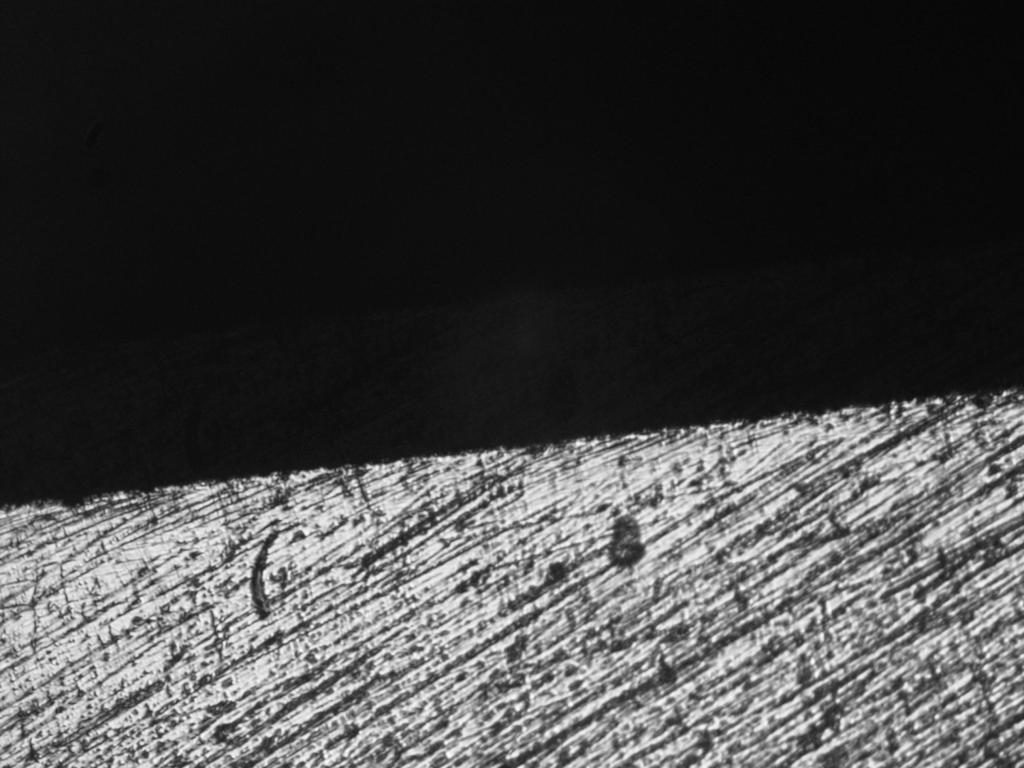
Hock O-1 – Just a few Carbides and Very Small (probably 0.9 or 0.95% carbon)

This Hock iron shows the same carbide pattern that my own made starrett O1 irons show – as in, very little. Starrett is 0.9% carbon and I can imitate hock’s irons or give them a slightly better temper (and take a point or so off of hardness where they seem to work better in general use).

1095 – Also likely 0.9-1% carbon – Almost No Free Carbides

wear resistance is just baseline, but look at the uniformity of the edge as it wears. In my experience, this generally leads to less chipping in use and fewer lines on work

26c3 – 1.25% Carbon – Plenty of Free Carbides

See the carbides remaining near the edge after planing with the iron to wear away the steel matrix around them?

Stanley Sweetheart – Laminated – A Surprise – Carbon Unknown

Fairly significant carbides appear after some edge wear! Unexpected!

And- XHP (the same or similar to V11 – high carbide volume, but lots of surplus Chromium)

Notice how the carbide volume increases substantially with the significant amount of Chromium and very high carbon. It does lead to abrasion resistance, but reduces toughness and increases particle size. The particle size itself isn’t a big problem, but increased abrasion resistance with poor toughness isn’t a great trade for experienced woodworkers. It may be a good trade for beginners who could nick a rubber hammer with a feather.

When we examine the pictures above, the carbides appearing suggest whether or not there is surplus alloying. For high carbon steel with little in terms of additives, the free carbides are carbon. They’re not that wear resistant, but the matrix remains reasonably fine and toughness can be kept. As carbon increases, peak hardness also increases and there is some loss of toughness.

These terms and the results are not well described in the woodworking community. Claims of increased hardness, toughness and longer edge life are combined constantly, and they’re rarely accurate. Maybe never. What beginners generally think is “difference in steels” is the chosen temper. So, stanley plane irons are described as substandard (perhaps some in the 1970s or so are lower carbon – I will test that later as I’m sure I have some – the laminated iron above has a pretty strong surplus of carbon)

An Opportunity Comes from This

If my suspicions are correct, the stanley iron is fine grained – there’s little toothiness to the edge in wear – and it has peak hardness in reserve and will make a great iron for bench work at higher hardness (it was already a great iron, but I’ll temper it like modern irons are tempered).

I suspect at 400F temper, it will be harder than a comparable A2 or O1 iron (V11 is more or less around the same hardness at 400F temper).

So, I ran it through the heat treat cycle that I generally use for anything water or oil hardening and, in fact, it does come out very high hardness. I would guess it’s 63 hardness or so, and the feel on the stones is water hardening steel, not 52100 or anything of the like (definitely not O1). The pictures suggest and the performance in hardening also suggest that it’s a plain steel with surplus carbon – maybe something like 1.1%, give or take.

Now, for the rotten part – this iron is laminated. I didn’t know it was. The behavior it had in heat treat was worse than any I’ve seen by a factor of 10 when dealing with solid steel irons (even vs. 1095, which is warpy). The lamination is probably not constant thickness and I didn’t know why it was so poorly behaved, so after hardening and tempering, I hammered it on the anvil – this is risky, but at this point, I still didn’t know it was laminated and I was ready to write it off, so it got abused a little. I would suspect stanley has rollers or something that these irons run through right out of the quench, just as files are straightened quickly – I don’t have any such setup and didn’t want to concede hardness by hammering when it was still warm. There *is* a short window after quench where you can bend or straighten things (it’s very short) if you don’t get too rough – I hammered a little then and a lot more after tempering. Point of this is that there’s probably an industrial process to deal with the warping just as there is with files, so these laminated irons may not be the best candidate for rehardening.

I generally use an india stone and a washita stone to sharpen, and if needed, buffer or compound on wood – why? It’s far faster than modern stones. It’s faster still even on V11 – as long as someone is freehanding, and on everything, the thin film of mineral oil has translated to no rust on any chisel or plane iron in eons (it was a constant problem in my garage shop when I used waterstones, and flattening stones, wiping irons with oil -that’s a farce).

At any rate, plain (mostly iron and carbon with other additives not floating free in the matrix) high hardness irons will take a finished edge off of a washita and leave no perceptible burr, but without having toothiness. Here’s what this iron looked like straight off of india and washita at 150x.

When you sharpen further, or spend more time, the little nits at the edge there will be gone. I didn’t bother to push things further – this is easily an equal of an 8k waterstone. I used the buffing wheel to lightly strop, and this is the resulting shaving thickness.

There’s a lot left in the tank for this iron at its new hardness (sans crack!) – as in, 20 seconds with a honing compound on medium hardwood would make a much finer shaving than the one above. I finally figured out that this iron was laminated when cutting its new bevel – and I have two more sweetheart irons. Sadly, most of my original stanley irons went out loaded on bench planes when selling to save the “good” modern ones. I wish I hadn’t done that, but who knew?

This test is worth repeating with an iron that is solid and that will behave better. I suspect we’ll see the same and I’ll post those results. That is, that the irons themselves have much higher hardness potential and Stanley didn’t skimp on carbon (higher carbon generally does result in a more crisp fine edge – if that doesn’t seem like it could be true, find a 5160 knife at some point and see how good the edge taking is. A little surplus carbon over 0.75% (which is about the most you’ll get in solution so there is no free carbon) leads to lower toughness which to a point, actually leads to better edge behavior. If you’re going to have small damage, the last thing you want is an iron that has a burr that will tear the edge or propagate more deflection – so clean departure of damage is a *good* thing.

How good is the surface left on a cherry edge by this initial “utility edge?”. Note the reflection -the wood is, of course, unfinished. As mentioned, there’s more in the tank than this – but for practical purposes?

So, what did we learn?

  • There’s no lack of quality in the steel that stanley used in this laminated iron, though it’s probably not practical to reharden them without developing a process to remove flatness issues out of the quench VERY quickly.
  • the hard bit in the laminated stanley irons is *not* O1 (which isn’t a surprise – why would they have spent the money for diemaking steel in thin strips back then?)
  • These irons have surplus carbon, leading to the potential for very high hardness when quenched and tempered in the “sweet spot” (375-400F temper for most plain steels). That sweet spot being for woodworking, not for lawn mower blades.
  • You can hammer laminated irons to flatten them somewhat, but not as much as I did – you’ll risk cracking
  • Follow-up with a solid iron is worthwhile – I’ll locate one, give it an initial wear test to see if there are surplus carbides in the matrix and then reharden

Is there really a practical gain here? I don’t think so, we’re just trying to get truths instead of rumors or suppositions. For the average person starting out making tools, dealing with O1 will be much easier and you can get good results in vegetable oil with it and less warping. You can ignore most of the pundits who tell you that you can’t make an iron as good as a commercial iron – it’s nonsense. You can compare the picture below of the “house iron” to the hock O1 iron above. Notice the carbide volume and overall look – not much different. If you achieve good high hardness and temper to 350F, the iron will be completely indistinguishable, but you will also appreciate in “real work”, tempering around 375-400F – the iron will resist chipping better and sharpen easier without giving up functional ege life.

“Later That Day”

I went through my pile of irons to see if I had any earlier stanley solid irons. I think I probably don’t. That’s OK (I have two more laminated irons, but not interested in cracking them at this point or figuring out how to get them to stay flat through temperature changes).

So, I took the iron that I had in the plane and noticed that the way the crack and another small crack were oriented, they’d do nothing to prevent me from making left and right marking knives. I refer to these as “dump” knives – knives made of things you’d throw in the dump otherwise. It occurs to me that there’s plenty of times that I’d love to have a wharncliffe-ish (like chip carving style tip) knife laminated with a very hard layer.
See the “dump knives” at the bottom. These can be cleaned up further later, but they’re a good opportunity to learn about geometry. I want them to hold their edge well but not have too much wedging force when cutting, and the tip of these will do marking against a rule or square (perhaps even cutting with something like leather). Most carving knives (chip carving, marking, etc) will not be close to the quality of these as far as cutting, fineness and strength. I don’t know why – you can beat most cheap little knives on the market (about $25 or so) with just a scrap of O1 steel. These irons at high hardness should make a marking knife at least as good as the best of the O1 irons and the high hardness will make them crisp. The fine grain makes them relatively tough for their high hardness.

The Place for Boutique Tools

My Posts about Tools You Don’t Need…

May make it seem like I’m anti-boutique tools. That’s not really the case. I started with mostly boutique tools because they work out of the box, but unfortunately, due too to the reiterated repetition that “they’re better”. Most of the things that they’re better at have nothing to do with you being better with tools in the long term. For example, a LV or LN plane is flatter on average than an older stanley plane (and if you’re dimensioning wood, flatness at the jointer and smoother level will save you a whole lot of work), but it’s also true that you can generally flatten a stanley plane sole to less than LN or LV’s spec and bias it in your favor for about $2 in materials and an hour of time. When you’re a beginner, that kind of thing is out of your reach. But, it shouldn’t be for long.

Supporting the Makers

I could make chisels and sell them, but I don’t (I don’t want to). The idea that if I did, someone might see additional value in supporting a current maker is something I can’t sit with. It would be my job as a maker to make the tools better than or at least as good as anything you could buy, and my bent is in favor of making tools that experienced users would like. I don’t think there’s anything sold at this point that is the equal of a 26c3 chisel made in an English pattern. But, there are boutique makers who do make very nice tools and some make them in classic proportion and usability, and if you like them and they give you pleasure, that’s something you should decide. It’s not always about whether or not they’re better or if you can justify utility, it should be what you like.

You have no obligation, though. The maker is selling you something. You are the buyer. This isn’t a relationship that goes both ways, and the magazines and some publishers will push the idea that you have some kind of obligation to support current makers. You don’t – you have an obligation to yourself to do whatever you like. And for a lot of people, that’s going to be less in terms of heavy thinking or learning to work by hand and more along the lines of taking a test shaving once in a while and being a Tool Preserver.

It’s not Just Boutique Tools

I can’t tell you what’s virtuous about infill planes other than that they’re pretty. Well, there’s one thing – if you get a shoulder plane from England and it’s not Norris or Holland, you can often find such a thing for about $100 in very large format. Though, even when you do that, you may find that what you’re really looking for is a rabbet plane, as there’s not much in woodworking that a shoulder plane does better than a rabbet plane, and in most of the cases where you can think of something (like endgrain), there’s probably another way to make a joint that is better and would avoid planing anything at all (for example, malleting the shoulders of a tenon with a strong marked line and a simple bench chisel – if you mark well, there’s little else to do).

But I still have a bunch of infill planes, anyway. I like them. I like the older planes that have proportions that do seem to lend themselves better to longer duration work. For example, a Norris 2 or a Spiers handled smoother will generally be near the weight and proportions of a Stanly smoother, but not all – even some of the old ones are nose heavy and overweight. On my shelf is a Norris 15 1/2 inch long #13 panel plane -8 1/2 pounds and really tolerable only for a few minutes if you’re doing more than Wood Show planing. There’s no virtue to the weight, even if you are doing the odd bit of work on rosewood sticking. This may also help explain why there are so few of them.

I couldn’t tell you a sane reason that I have the infills except for the chance that I may make more infills (they’re not difficult to make and the barrier to entry in making them accurately is low as far as tooling goes).

But, I’m comfortable with being able to say that it doesn’t make great sense that I still have those planes. If you read far on internet forums, you’ll see all kinds of descriptions about “difficult wood” or whatever else there may be in terms of intangibles, but it has nothing to do with doing a volume of work or doing accurate work, and I have yet to see an infill plane that can out-plane a properly set stanley plane, and it’s no contest when efficiency is involved

So, it’s Something Else, I Guess

Maybe for folks, it’s the connection with something current. But we should all be honest enough that we’re not telling the next person who comes along that it’s got something to do with making.