How Flat is a Type 20 #8?

First off, I don’t really do much following of type studies, but have taken a shine over the years to later stanley planes. Up to a point at least. Once there is a gap between the frog and the casting, I’m out.

At this point, I already have two 8s – a wartime Record that’s OK, but Record seemed to have a lot of problems shaping lever caps properly to fit over the cap irons, or making them the right length so they were over the hump and not pushing on it from the back (which also allows shavings to get through).

The other 8 is an earlier stanley that’s a typical ebay story. The plane was sold as in good shape, but it’s got a stripped thread for a frog screw that’s solved by a non-original screw, the bottom was nowhere close to flat -and I don’t mean like a little inaccurate – it’s a banana to the point that no sane person would flatten more than an amount of the sole needed. And, the “original” handle stuck on the plane doesn’t fit and can’t be tightened. Fortunately, I didn’t pay much for that – got it at the end of a regular auction.

I don’t use an 8 much – it’s generally a match plane. I plan to get rid of the other two 8s one way or another, but since I’ve taken a shine to type 20s (that are generally blue – but I guess not 8s?) I’d put in the back of my head if I eventually found one in good shape, I’d buy it and dump the others.

I have not yet found a type 20 plane that either has a lot of wear, or that has a serious issue with sole flatness. The smoothers are close to flat, and the 6 and 7 that I have both were hollow in the sole about 1-2 thousandths. Most of the hollow is from the tips front and back – I would guess the machining is done with a heavy hand and flexing of the casting leaves the toe and heel a little low. It’s too bad it doesn’t go the other way.

The tale of this plane is a bit interesting. It came with some other stuff, but what’s usable of that stuff to me is a standard spokeshave without adjuster (I only have LN types, and they are lacking if you are removing wood rather than cleaning up – the mouth is tight). And also included was a newer 9 1/2. I just got a 9 1/2 recently, but I can dump one or the other.

But the tale is this – a mechanic somewhere probably in NY where the plane came from was hobby woodworking and he’d gotten a smoother, a continental gutter plane and this plane. The smoother was worthy of the garbage can, so it went there – not sure what it was, but it wasn’t even on par with a handyman. As is the case with many, I think the hobby is vexing because the planes were all used until the irons were heavily damaged, and what was in this jointer was mostly dust from using the unintentionally toothed iron.

I found it interesting that among the very common things, the person who never got into the hobby as deep as they could have found a Stanley 8 with a smooth bottom. The iron shows some signs of being ground as 1/2″ of the length or so is gone and the plane itself shows almost no wear. The damaged edge has been sharpened recently, it was just blasted away and full of really large nicks, but the edge is otherwise fresh and was hollow ground.

But what about the flatness?

Getting to the point isn’t my strong suit. I paid $225 plus shipping and tax for the whole group. To me, and maybe not to others, to get a plane with little wear like this, I’m good for $200. 15 years ago, you could find a plane like this for $100, but it’s not 15 years ago.

I tipped this thing upside down in the vise and secured it lightly and checked the sole expecting a low toe and heel that won’t be much work to address.

And that’s exactly what I found.

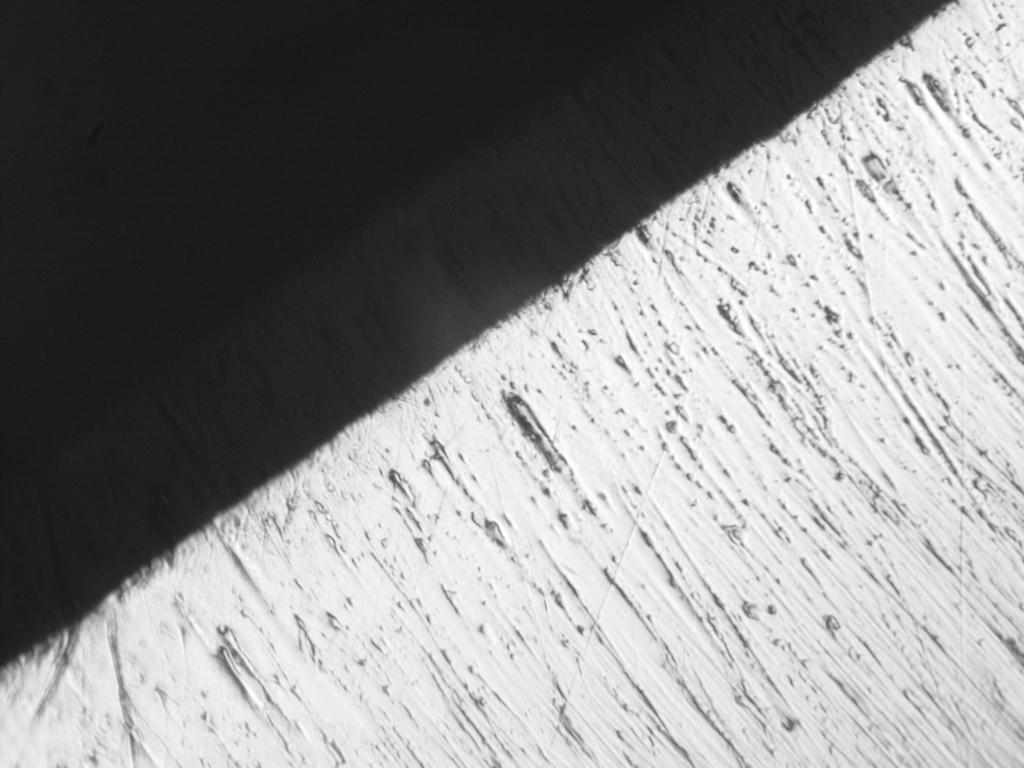
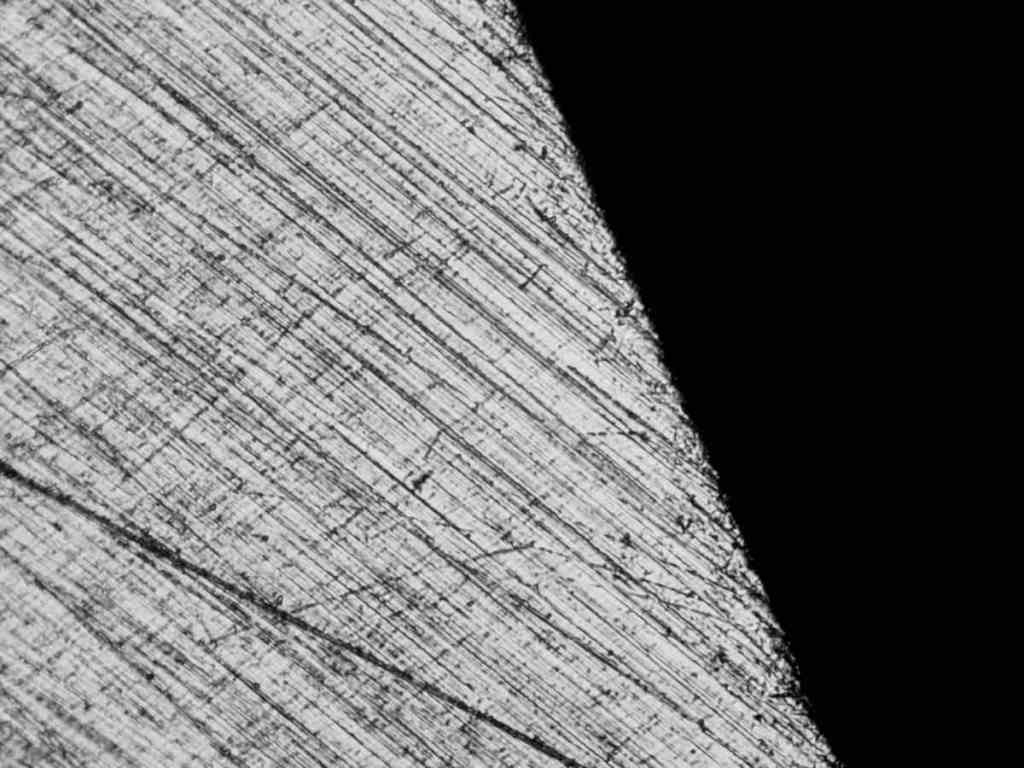
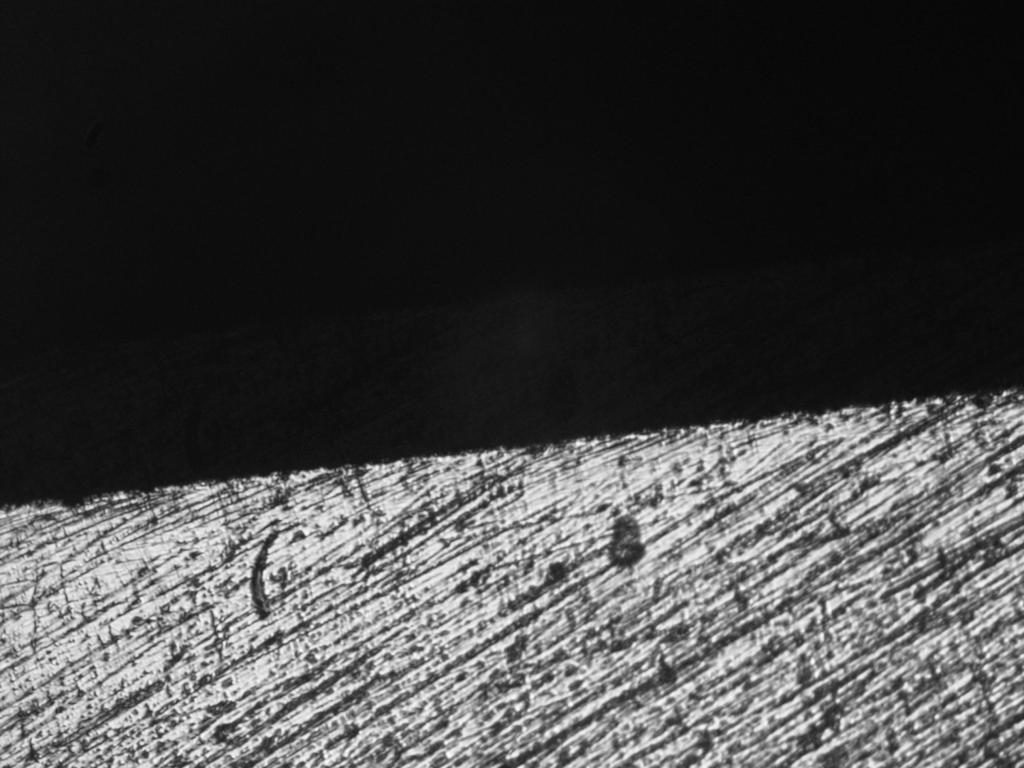
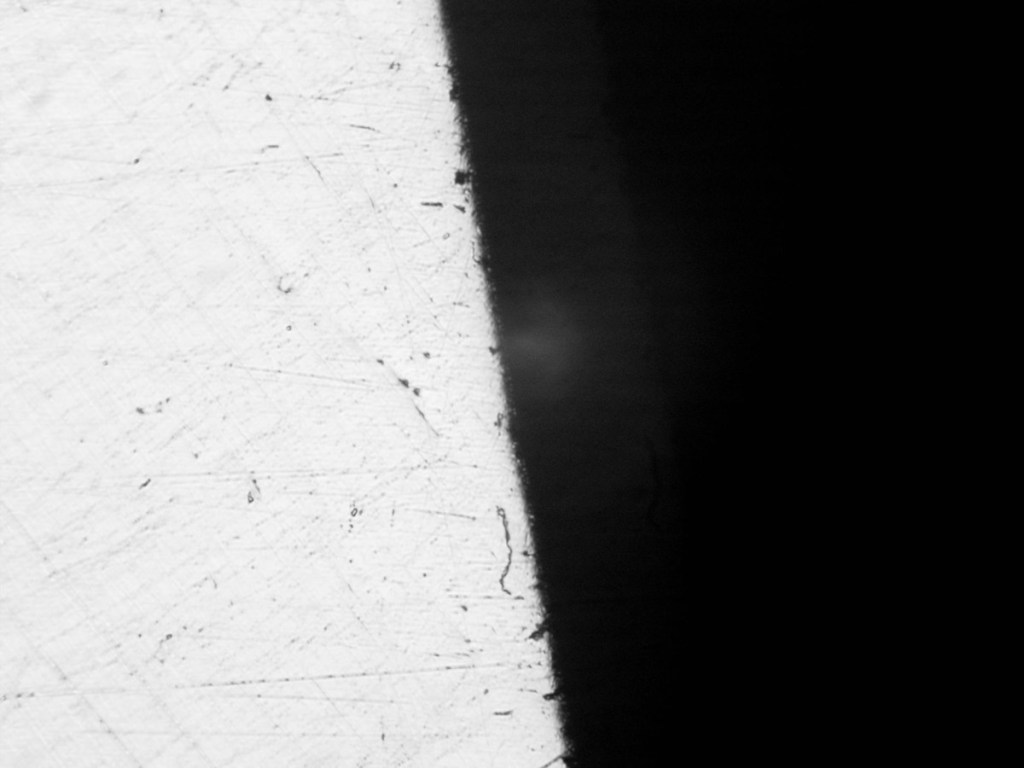
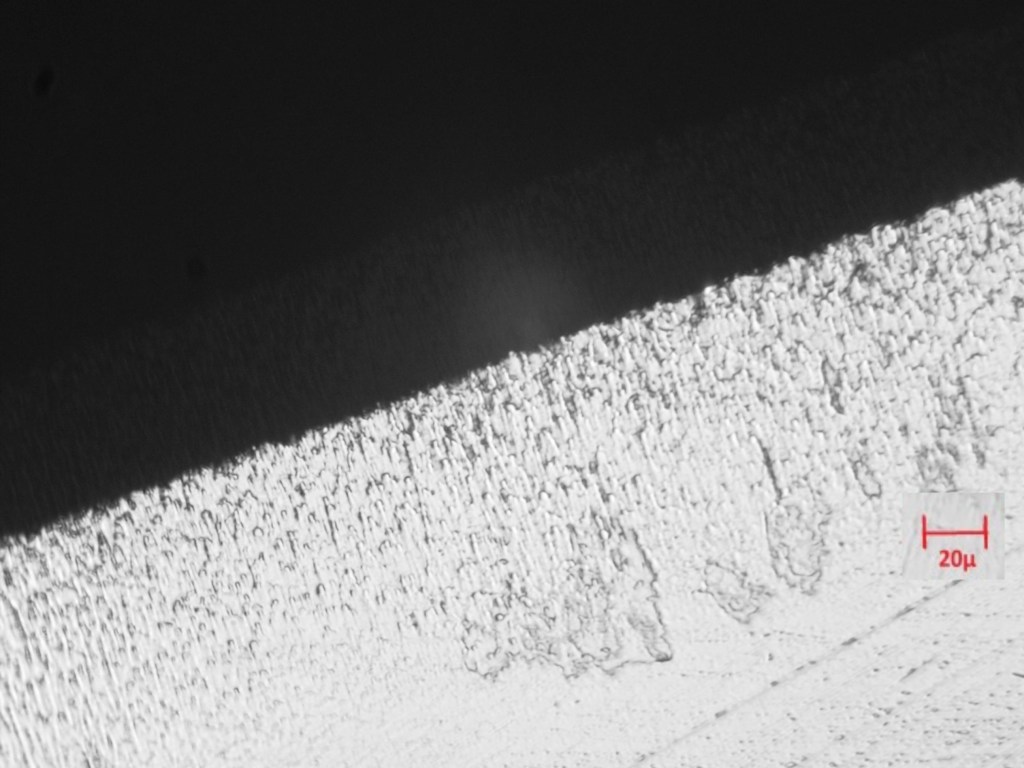
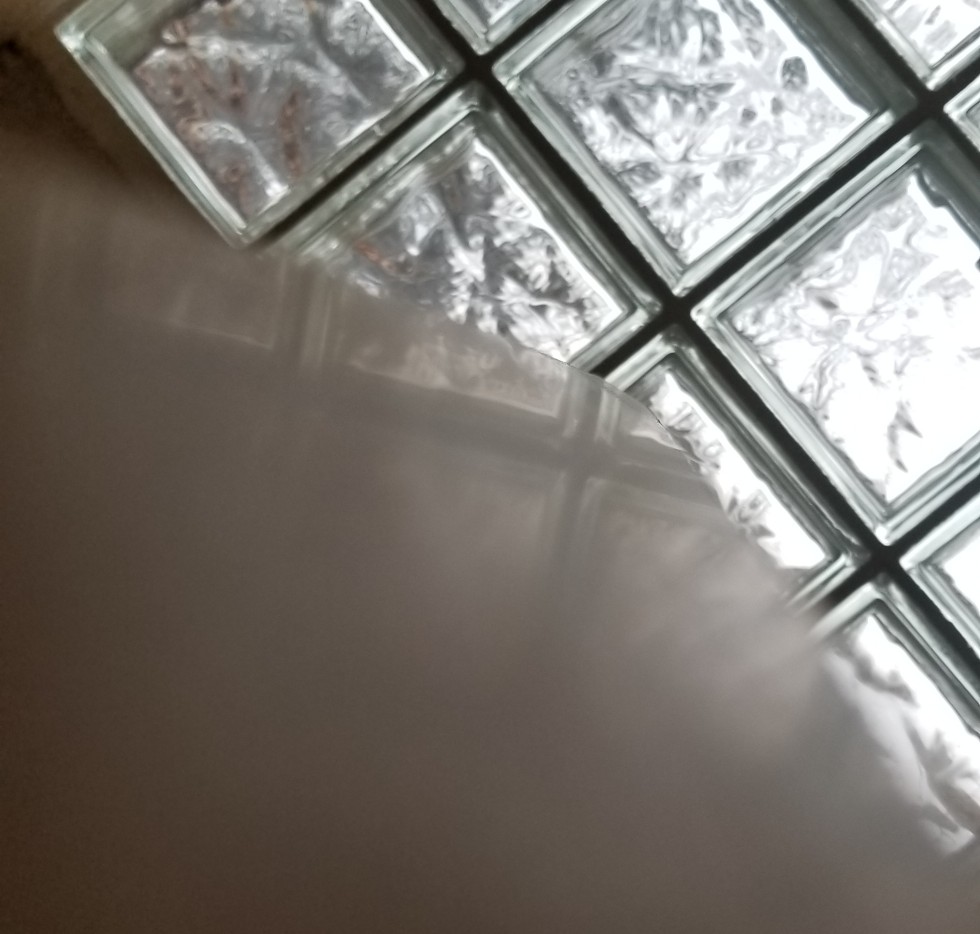
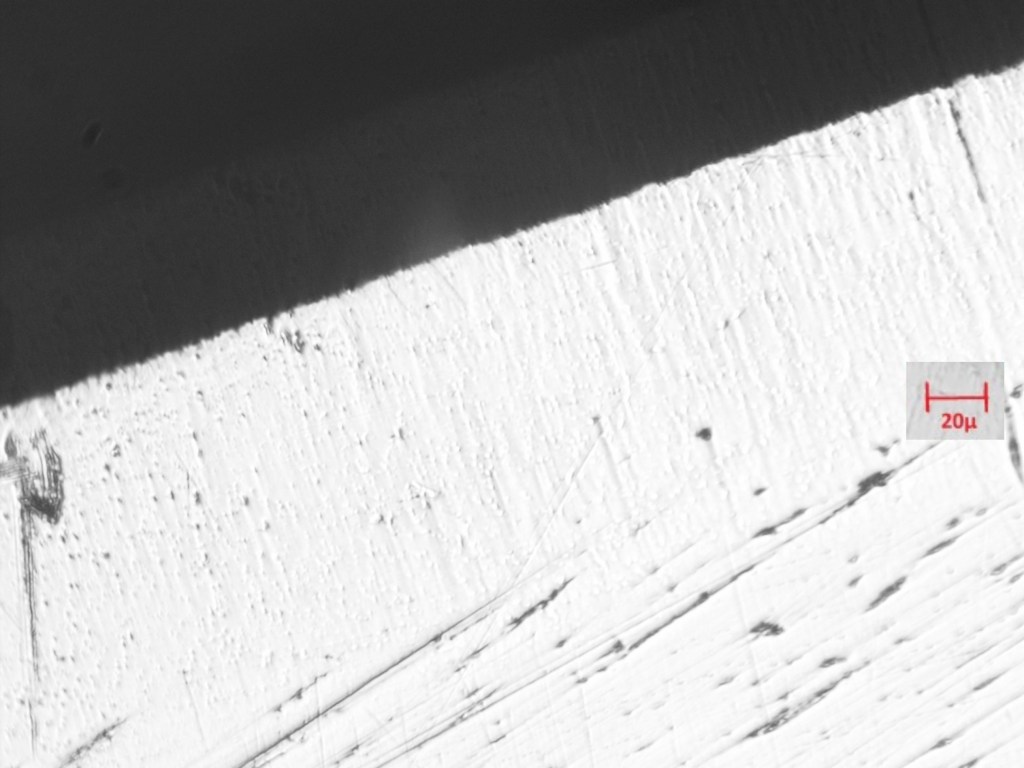
I scribbled on the sole, but the scale of the picture here may make it hard to see. No part of the front allows a .0015″ feeler through. The middle just does allow one through, and then a small section just in front of the heel allows a 2 thousandth feeler just through.

For all of the talk about this or that flatness and how poorly the later Stanley planes were made, I just haven’t seen it. I have seen earlier planes that are out of flat without it looking like wear. I don’t know why.

This one will be quick to address some afternoon when I have an hour to very accurately flatten the sole. The discussion of whether or not the hollowness of this sole between toe and heel even matters won’t satisfy tax preparers and pallet furniture makers who always know more than everyone else about woodworking, but for someone working by hand, it will make a world of difference match planing. if the sole were opposite, flat in the center and toe and heel just off of a board, I’d never bother to touch it unless it had other issues (twist). I’ve not seen serious twist more than about 4 times out of probably 100 planes.

If I’m wrong about the type and it’s not a 20 (8s seem to get less common with later types), good enough

Too, I’ve mentioned it here before – one of my first large plane purchase was a machine gun purchase of both the LN 7 and LN 8. The 7 was straight as an arrow, but had the fault at the time that you couldn’t set the cap iron close to the edge. LN laser cut or punched the hole in the cap iron assuming nobody would want to do it. I ended up selling that disclosing it. The 8, on the other hand, was hollow like this plane. Almost exactly the same amount, and I tried to use it to match plane and joint long ends, and it was difficult to plane something without the ends falling off. People seem to have trouble believing that, but it’s not a matter of mistaking what was going on – it’s a matter of people who don’t believe that could happen overvalue their ability to reason and assert things. Conflicting with reality doesn’t phase them too much.

One Last Thought – What do the Numbers Mean?

I am throwing around thousandths and what matters and what doesn’t from the view of someone who will be using this plane for long edges. I will, of course, make the plane as easy to use as possible.

Given that I’ve had just about everything other than a 24″+ norris jointer, and I’m floating toward a late type Stanley, maybe I should address two questions:

  1. What if you bought this plane off of the internet and you didn’t know anything about flattening planes, what would happen? Well, the answer to that is pretty simple. Not much. You might find it to be a little more difficult to get a laser tight joint at the ends of boards, or that you’d have to take a few shavings on already flat surfaces to get the plane to cut end to end (not great), but otherwise, you could end up with a plane about as accurate from a boutique maker pretty easily. I did from LN, twice out of about 10 planes.
  2. I think the underlying question of “why not just flatten the original LN 8 and use that” could come up as beginners who pick up a new boutique plane will almost certainly think the experience is better. I thought so at first, but when the volume of work increased, I began to prefer older planes. And beyond that, most volume work is better done with a wooden plane if the work allows. In terrible wood and for fine work like matching edges, having an adjuster is a little easier. At any rate, it’s not strictly a weight issue – I just find that the whole stanley package is a little better than the boutique planes when the planes are no longer being used as a half dozen smoothers of different lengths. I also didn’t have the confidence a decade or more ago to just get after the sole of an expensive LN jointer. It was easier to disclose the sole’s shape and sell it – most people don’t care as long as it’s inside LN’s spec. it was uncanny how the #7 in that pair would plane everything easily and accurately, and that little bit of hollowness in the #8 was enough to keep it from coming off of the shelves.

But I do actually like the Stanley planes better, and thus have no boutique planes at this point. I just don’t see a reason to have any, and it’s certainly not a money issue. I migrate to what is easier to use – functional laziness. Now that I have a hammer (can flatten these planes by hand and accurately), the “nail” isn’t a big deal. I don’t care to flatten many more planes as I have better things to do, but to sort of cap off my collection and dump the less common more collectible English planes and go to “plain old cheap later Stanleys”….hopefully that will be a last move.

Rehardening a Stanley “Made in USA” Socket Chisel

This post follows the first three posts rehardening various Stanley plane irons, which can be found as subtopics here.

The summary from those articles is that Stanley used a range of steels at the very least (each of the rehardened irons is definitely a different composition), but that in the heyday, the irons were tempered to a target and could’ve been left far harder. Even the later (type 20) plane iron had potential to be better, but less so than the earlier tools.

What about a Stanley Chisel?

Stanley’s socket chisels are a general-purpose construction site type, and provided in different lengths. I’ve worked on construction sites, but not since high school, and we would’ve scraped grout or pried something with chisels, so what sites were like in 1920 or so, I don’t know. Higher hardness 1800s English cabinetmaking chisels wouldn’t have made much sense for site work, though, and it’s fair to say that cabinetmakers would’ve had no interest in Stanley socket chisels (as evidenced by no change in the English market until toolmaking was automated – even then, the tang type remained, just with rounded tangs turned on a product lathe).

It’s likely that the early (720, 750 and Made in USA socket types) chisels were hardened to a spec that was considered to be OK for various sharpening media and various uses. Overall, I find the idea of gripping the handle (vs pinching a chisel tip to hold a chisel in place) at a bench uncomfortable, and have few socket chisels. But I do have one earlier Made-In-USA socket chisel that’s no world beater at its stock hardness.

“Made in USA” socket chisel. Older and well finished (for Stanley). Dark due to rehardening.

At some point in the past, I ground the subject chisel for this post into a skew, and for this test, I undid that, removed half of the bevel after squaring and ran it through “the hardness cycle” that starts with re-establishing new grain, shrinking it with thermal cycling and then rehardening it. Tempering is again 400F (double tempered).

How Hard is It? What’s in it?

I would estimate the hardness of the rehardened chisel is around 62. It may be a click harder, but it isn’t any measurable amount softer. The back side of the chisel is pretty much immune to the washita and no significant bevel can be cut on the bevel side (which is the aim of using a hard chisel on a washita – any cheap aggressive stone can prep the bevel for the washita to finish it). Back work is doable on an india stone, but it doesn’t just slough away.

As far as the alloy? I don’t know. To add to the confusion, the older irons that I examined previously (sweetheart era or thereabouts) were two different compositions, and this chisel isn’t the same as either of those. To guess at any of these three would require someone who wanted to get an XRF analysis (that’s beyond my scope). This chisel is a little slick feeling on the stones, and may be an oil hardening alloy. Strange as it may seem, oil hardening steels (like O1) have a notable slickness compared to very plain carbon steels like you’d find in files or saws.

How does it Compare to Boutique Chisels when Rehardened?

It’s easily an even match for an A2 or V11 chisel, and probably even with something like an Ashley Iles bench chisel (in feel). I can’t do a quick test in the same wood to compare those, though I’ve tested V11 and Iles chisels in the past. V11 is an outlier as it’s created differently and I couldn’t easily prevent minor damage when testing the “Unicorn” method, though the damage it took on in a small section of maple was minor. In the same test, a mid-level japanese chisel and the Iles Mk2 chisel sustained no damage.

I chopped twice as much maple with this chisel (and it’s half the width of the chisels mentioned above), so the edge itself has seen four times as much use. No notable damage.

A picture of the initial edge at 150x optical after the washita. The black stuff and what looks like a nick is just carpet or clothing fibers from wiping oil off.

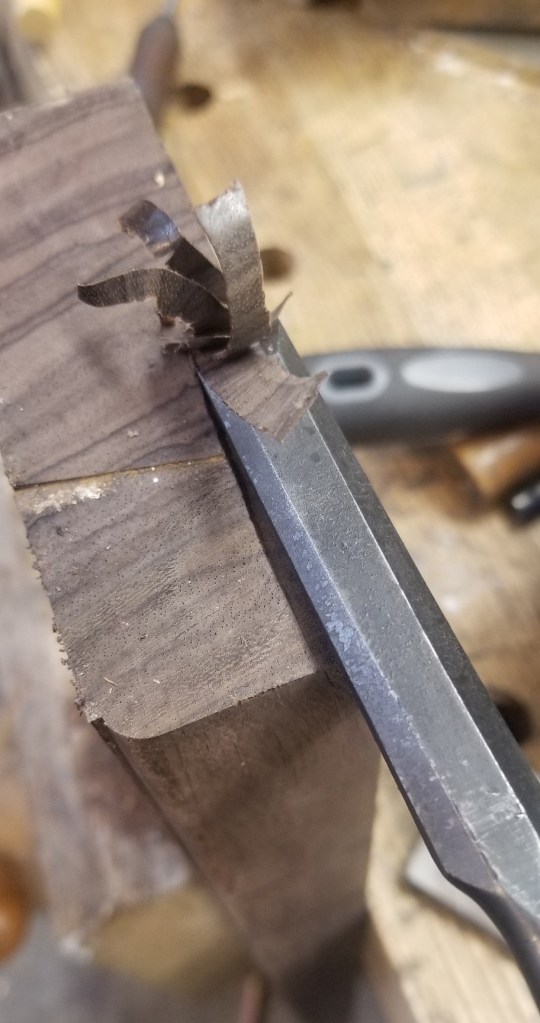
The volume of maple chopped (about 2 cubic inches – which in tasteful drawer work would be half a dozen or a dozen half blind sockets):

If you don’t have a microscope, you can do something similar to this – just chop, feel for damage (rolling edges with your finger, or use the tip of your fingernail to find nicks by running along the edge). And look at the chopped wood to see if there are any small lines. None on this.

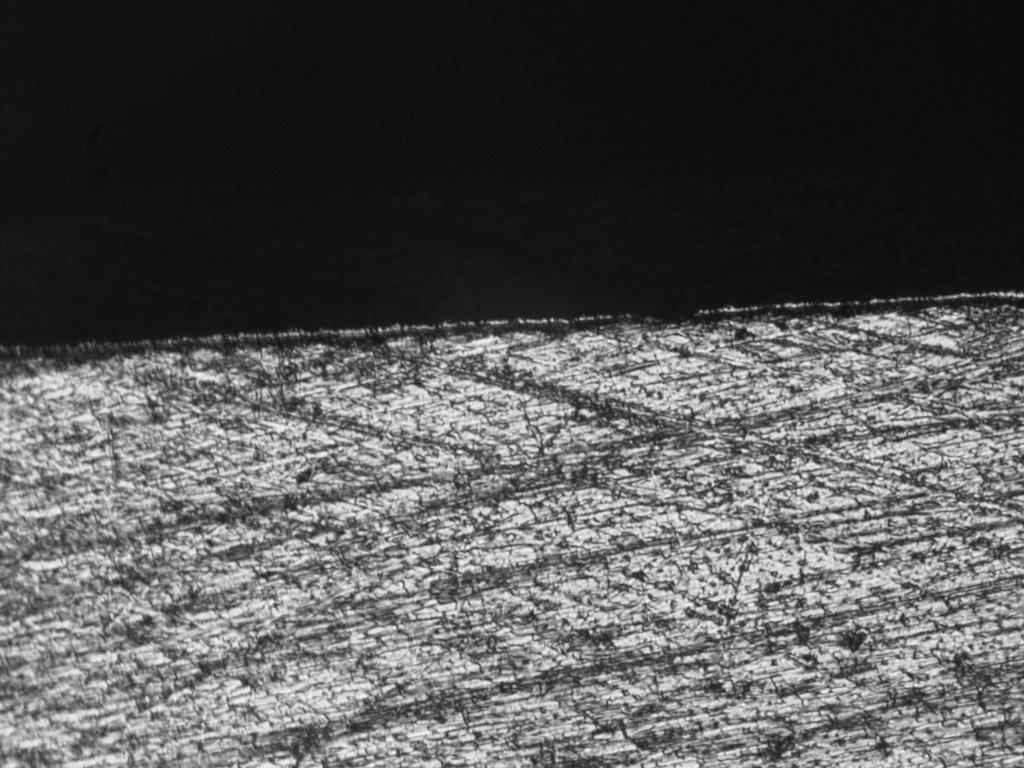
The edge after this chopping – note how the chopping appears to have removed the initial apex but only to the order of ten thousandths of an inch, and left behind a bit of worked metal at the very tip. The chisel is perceptively the same sharpness here. The steel is beginning to be burnished a little bit, but the edge will chip long before it’s worn to the extent the plane irons show in other posts:

Note the compressed looking edge. Not all of the edge looked like this, though – some remained closer to the initial sharpened edge.

I thought it would be interesting to pare rosewood with the remaining edge, which isn’t that choosy (due to density) in absolute sharpness, but a poor edge will prevent you from being able to pare at all. Unfortunately, all of my rosewood is loaded with silica (sometimes it’s not, and is pleasant working wood)

(note, the black oxide from rehardening may look odd, but rest assured, this is just a labeled stanley “Made in USA” chisel)

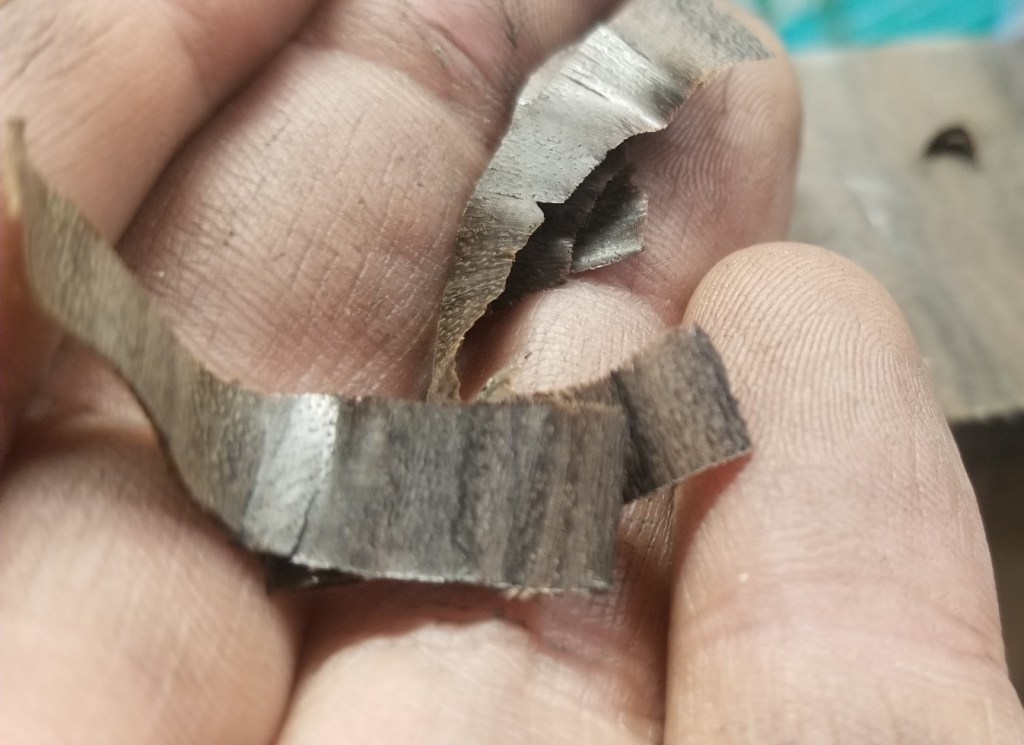
Paring was no issue (no resharpening has occurred), but silica in end grain will spare nothing. Before accumulating any damage, though, you can see the bright finish on the shavings – no nicks in them:

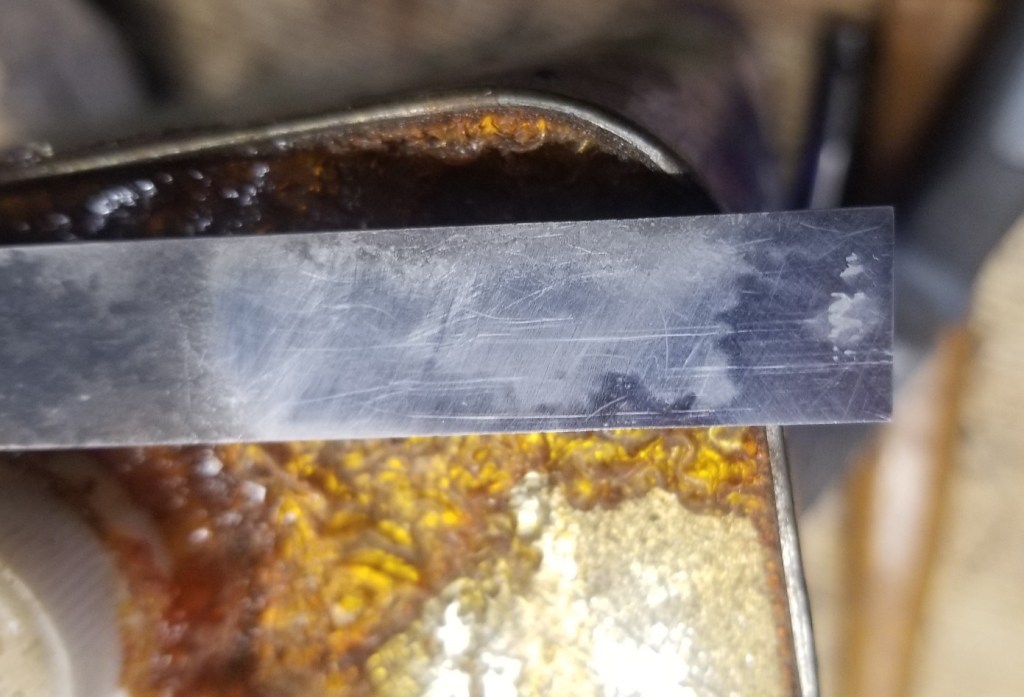
As a matter of illustration, this is what silica will do to tools. Note the scratches. This will sometimes terminate in nicks at an edge with the scratch following, or in the case of some, scratching that starts away from the edge. Good geometry will protect the edge to some extent and scratches can form without notching the actual bevel (but sooner or later one will take part of the edge with it).

Is the edge nick related to the scratch? It’s hard to know for sure

If you had clean wood in the rosewood hardness range, though, this chisel would handle it fine. A stock stanley chisel could do it with more edge modification (a steeper initial apex), but less modification of the edge means better perceived sharpness.

What’s the Conclusion?

The chisel, like the prior plane irons, is delivered at a temper softer then could’ve provided. This was a choice by Stanley, likely to aim at their market. They could’ve used less capable steel, but chose not to. At present, the chisel is a match in terms of usability for anything marketed and would only be bettered by Japanese chisels (white or matrix steel like YXR-7). More importantly, is the assertion that the steel in Stanley chisels isn’t a match for boutique tools now correct? No, I’d prefer the result of rehardening here to anything with more alloying – it will easily hold its own in durability, but doesn’t have much in it that resists cool fast grinding and easy rehoning.

This wasn’t a difficult tool to reharden (but you would still need to be good at hardening to match these results, so this isn’t an encouragement to buy a plumbing torch and attempt this with canola oil – it’s a little more involved than that). But it’s not unruly like the laminated iron, and anyone competent with hardening in open atmosphere could do this. At near zero incremental cost (probably 20 cents of propane/electricity for hardening and tempering).

A Third Stanley Iron Rehardened – Lands Between the First Two

I made two other blog posts about rehardening stanley irons. First, a laminated iron that was very high carbon water hardening steel and rehardened to a very high level (but stability is an issue). And then yesterday, a type 20 iron that doesn’t have the same potential, but did turn out to be a nicer iron for the bench after rehardening and by no means low quality steel or too soft. Just a more modern lower carbon fine grained steel that doesn’t show anything that threatens uniformity. That post is here:

examining-a-later-stanley-iron-rehardened-how-bad-not-as-bad-as-the-reputation

Referencing that relieves some of the need to repeat a lot of the details.

The third iron in this case is a replacement iron for a stanley 18 (it probably fits other planes, but I don’t use block planes much). I’ve since lost the box that a group of these came in, but they’re a little soft. Enough so that a beginner comparing them to a boutique plane would probably complain, but the steel is uniform. Buffing the cutting edge (they’re bevel up, so no concern about clearance) eliminates any edge holding issues they’d have due to softness, and you can then use them stock to plane anything. Your hands will hurt before they’re dull (anything includes cocobolo with silica or bubinga, something you’re not likely to read on forums or in ad copy – I’ll save geometry at the edge for another time. Safe to say, you can plane anything with an iron like this until your hands are sore if you modify just the very tip of the iron (not even enough to make it feel dull).

At any rate, a picture of the iron (it’s filthy from being rehardened – when you buy a new iron, the iron is ground post heat-treat all of the hardening and tempering colors are erased).

I’ll leave guessing the age to the tool collectors.

Rehardening Results

This iron is solid, and it’s a different steel than the type 20 stanley iron and definitely not the same water hardening steel that’s laminated in on the sweetheart iron.

Hardness is also between the two. It cuts freely, but not fast, on the india stone and cuts little on the back side on the washita and lets go of its wire edge pretty easily. Hardness is probably a point harder (maybe two is more likely) than the type 20 bench plane iron after rehardening and a point softer than the laminated iron after rehardening (same 400F double temper, same hardening process). (Adding as an edit – a second session trying this iron with some stones shows that the washita is struggling in a fair fight with this one – it’s fairly hard. Any harder, and it may be impractical for use with the washita stone).

Behavior in the quench was good (as in, it’s entirely reasonable to reharden these if you can swallow the cost of setting up a small forge and buying fast oil to get full hardness). You can temper in your kitchen oven if you use a thermometer to find an area where temperature is steady.

The feel is different – more like water hardening steel (the feel on the stones that is), and less like oil hardening, but it’s difficult to know for sure without having XRF analysis done to tell the composition – that’s not something I have easy access too. The carbides might tell us something.

The finished iron (without any type of stropping at all) after teasing off the bulk of the wire edge is here (straight off of the washita). The buffer does a nice job of making the edge very straight after this, but it would plane fine with this tiny burr left on the iron.

A very nice even fine edge straight off of the washita. The fragment of a burr that’s left after the wire leaves as part of the honing process is a fraction of a thousandth of an inch long. 150X magnification. Strop this on your pants or palm and the light remnants are gone instantly.

Picture of the Carbides

Carbides do stand proud of the steel matrix in this iron. I think they’re probably round and the steel tail behind them is matrix that is protected by the grooves they cut in wood. These grooves are only about 1-3 microns, though – you’ll never see them. Picture is 300X optical and slightly under a hundredth if an inch from top to bottom.

So, as I’d suspect from the feel and the hardness, there’s a little more of something here than there was in the perfectly uniform later iron in yesterday’s post. It’s not as subtle and even as iron carbides in 1095, which makes me wonder if there is some tungsten in the iron. That wondering will have to live on (but the comment is based on the fact that tungsten in quantity will make the odd large carbide here or there, and they’re not consistent in size).

I can make the statement, though, that this is a very good iron, and again like the laminated iron, stanley left it softer by choice. This iron has (and shows by results) a little more potential in rehardening than the later irons, though by feel on the stones, there’s nothing in it that would make it highly wear resistant for boutique edge chasers. It’s just honest, wears very evenly, lets go of its burr in sharpening without any effort and is quick and very practical without being soft.

I don’t know Stanley’s motivation for making irons softer than they needed to be based on the compositions they chose, but that speculation is in prior posts to some extent, but it may also be a case of steels like this being more forgiving to fast or cheaper processes. There’s nothing difficult about my hardening routine, but it does take a little bit of time. I think for practical purposes, just making the iron really hot and requenching it would be 90% as good, and still nicer for a bench user vs. a site user (carpenter). Carpenters were probably the target market, anyway – quick here and there use. Planing any significant amount of time with a block plane is a good way to know why you don’t want to use them for serious work.

(would I honestly tell you that I’d pick this iron over a replacement V11 or A2 iron as a matter of both use and productivity? Definitely. I think if you stray from those alloys or something from hock and get into lower cost sources of irons, you chance ending up with an iron that’s not much harder – or any harder – than the original. I would choose this iron over a boutique iron because it’s far nicer to sharpen and grind and the difference in edge life of a boutique iron wouldn’t be proportional to the additional sharpening time. This equation may be different for a beginner who sharpens everything the same way with a guide).

Examining a Later Stanley Iron – Rehardened – How Bad? Not as Bad as the Reputation

Yesterday, I posted about a laminated Stanley iron and my surprise at just how high carbon the iron is. It was not well behaved in rehardening, but the ultimate finding was that with routine 400F tempering and a fast oil (and good technique), the iron yielded very high hardness and it’s closer to a Japanese white steel than anything else (albeit, the carbide density looks more like a white II type steel).

So, looking for a solid iron from a “good” era of stanley tools, I found that all of the good-shape irons that I have are laminated except for a type 20 iron from a later 6. This irons are notoriously bad, but in my experience, they feel like they are slightly lower carbon and just tempered soft. I don’t know what Stanley’s market was in 1960, as in, who they were aiming for – but I can imagine that few planes were being sold for fine bench work. Regardless, I have a soft spot for types 20 and have three of them. Once they’re flattened, they work wonderfully. I’ll post a flattening process at a later date – it’s useful if you’re going to work entirely by hand as it speeds dimensioning and you can rely on the plane to communicate when something is flat.

The Conclusion for the Type 20 Iron

Since my posts go long, I’ll tell the findings first, and then the details. The type 20 iron (in this case, one with sharp corners and not rounded corners) is solid and not laminated (no surprise), it does not have surplus carbides appearing in the wear matrix (so it’s likely something around 0.9% carbon or below – I would guess a little below that based on resulting hardness), and when it’s given the standard routine and double tempered at 400F, the resulting hardness is good, but well below the old laminated iron. I would estimate it at 60 on the C scale as the india stone hones it readily but it hones finely on a washita and has excellent behavior.

It won’t be a long-wearing iron compared to anything with abrasion resistance, but it hones well, takes a fine edge, holds it and would probably be a better iron for someone working entirely by hand than something like A2 or V11 (because in heavier work, just the course of regular honing should keep the edge free of damage). In nearly all cases, a modern iron with chromium in it in significant amounts should outlast this iron all other things being equal.

Now, the Details

You may wonder why I’m rehardening these. It’s really a matter of three reasons. I use the same rehardening process for simple steels every time. The process should improve anything that doesn’t have surplus non-iron carbides, and where the iron lands in terms of hardness after a 400F temper is a good indicator of how much carbon is in it. Plan irons are thin, and with fast oil (Parks 50 in this case), it’s not hard to get good full hardness results with them.

Irons that end up with lower hardness (testing with an india and a washita stone – two stones that will give good feedback of how hard a simple steel is), generally do so due to lower carbon. There are often other things in smaller irons, but not in large amounts (perhaps a small amount of vanadium, some small amount of chromium, and in older irons, sometimes tungsten). These change the feel on a well used sharpening stone.

So, anyway – reason 1 is to see what the hardness will be after a standard process. Reason 2 is that I’ll probably like the actual iron better after rehardening (if I don’t, there’s no real hope for it). And Reason 3 is to see how practical it is to reharden.

I would estimate the hardness of the iron in this case to be around 60 on the C scale. I doubt i’m off by more than 1 in any hardness guess with plain steels. I expect off of the stone that we’re not going to see excess carbides unless they look like chromium carbides. The one plain steel that would have excess chromium is a bearing steel, but this doesn’t feel like a bearing steel. So I really don’t know.

The iron is improved for bench work – which is pleasant since it’s such a poorly regarded era – and would now make a really wonderful day-to-day iron. It’d be great if it hit high hardness like the old laminated iron to have a biting sharpness off of natural stones, but it still attains a nice edge and is practical. Why did stanley leave it softer than this? I don’t know. The demands of the market, perhaps, a nod to sharpenability (a softer iron will always sharpen faster and easier, no matter what it is), and maybe margin of error as a chippy iron will yield complaints while one that’s slightly too soft may result only in a few groans. I’m convinced the world of consumer knives is filled with underhardened knives to prevent damage that results in returns from low-experience users as it seems fairly easy to better commercial knives with shop made knives. Even marking knives.

The Initial Edge and Carbides

After rehardening, the initial edge comes off of the washita stone relatively fine. Use of this stone is a preference because it’s got such a wide range as long as steel isn’t too soft or far too hard for it (it’s a great tip finisher for japanese chisels, though). A picture of the initial edge is here (you can see a tiny burr left – that burr is probably about a thousandth of an inch long).

A fine edge off of a washita stone – with a minimal burr left. The height of this picture is 1.9 hundredths of an inch, so this burr will depart with first use, but it’s better to remove stropping.

This edge looks a little strange, but it’s safe to say it’s at least as good as an 8k waterstone. Looking at the other anomalies, I flattened this iron quickly after rehardening – the back is near polish but some of those marks are probably dirt or oil.

A comparison of washita to an 8k waterstone will be shown at the end of this as you can’t tell how fine this edge is without a reference.

The thinness of shaving possible from the edge shown above is in the next picture. I didn’t strop the edge, but it’s a good idea to – and doing it very lightly with a very fine oxide on wood or hard leather (or a buffer) is even better.

This is a reasonably fine edge and can be recreated in less than a minute once the iron is dull (which is the advantage of an iron that’s not that abrasion resistant). The steel is fine, there aren’t edge anomalies, overall very pleasant.

Confirmation of Carbides

The stones don’t communicate any significant abrasion resistance or slickness, and the hardness suggests we won’t see any carbides emerging in the matrix. A picture of the matrix after planing 300 feet of cherry edge follows (and shows no significant free carbides).

The matrix shows no free carbides, suggesting the carbon content isn’t well above 0.8%. We start to see free iron carbides in steel that’s got 0.9-0.95% carbon, but not below that level.

All in all, a pleasantly good iron, but safe to say, it’s not a flawless diamond just waiting to be rehardened. That said, if you look at the edge wear (the wear picture is at twice the magnification of the original edge, so the picture’s height is less than a hundredth of an inch top to bottom), you see wonderful uniform wear. This leaves little for you to do resharpening other than remove wear. Nicking in irons generally goes about .001″ to .004″ deep (any number of nicks greater than .004″ deep makes it difficult for an iron to start a cut, thus you’ll have to do something catastrophic to see that). Minerals, silica, dirt, knots, etc, can create the typical depths mentioned. It takes a while to hone them out, and in the picture above, they would pass through the wear strip in some cases. That wear strip does not need to be honed off to refresh the iron – at least not its length. Flattening the back and honing off somewhere around .001″ of length on a completely dull iron will do the job.

Overall, nothing groundbreaking – but the iron above is a good iron and holds up its end of the bargain in sharpening vs. edge life (which is to wear uniformly in proportion to sharpening time). If I have to make a guess at carbon content, I’d say 0.8%, though I don’t think it’s 1084 – it feels as though there are a few additives – probably to make it easier to harden and temper fully. Behavior in rehardening was fine and post-heat treatment re-flattening only took a couple of minutes. Less than 5 minutes total to get to the edge shown above.

I also rehardened a block plane iron (the only iron that I may have that’s solid and between the later-make stanley and earlier laminated iron) and a “Made in USA” 750 style chisel. I’ll post those in the next several days.

A Comparison of Washita to Waterstones

It’s difficult to make a blanket statement about washita stones. I love them (the real ones – and the real ones are no longer mined and won’t come with a label like “CASE” or “SMITHS”, etc, though old enough smiths may have slipped a few in, it’s not a great bet.

A washita stone can be slurried to cut fast, it can be used with heavy pressure or it can be used with light pressure and in combination with steel hardness, you can end up with an extremely fast sharpening routine that is pretty much zero maintenance. Less than a minute for chisels and about a minute for a plane iron that’s very dull. The touch sensitivity and wide range makes it an ideal stone for an experienced user.

Over the years, I’ve had several hundred sharpening stones (probably a hundred synthetic and 300 or more natural stones). At one point, I brought in and resold (generally at cost) japanese natural stones – I just like sharpening things, but not for no reason, and I don’t like jigs or finicky things – I like methods that save time and get results.

To get on with it, I never read about using washita stones other than that a lot of people like them (and then move on to something else, but these folks are always moving on to the next thing a retailer says is great – we’re not looking for that here). It didn’t take long to find the dimension of these stones and see how fine they are. A slurried waterstone has much less dimension (synthetic types) and one of the reasons beginners like really hard irons and waterstones is they have no feel, no sharpening sense.

Next is a picture of an edge gotten off of an 8k grit waterstone (one marketed as “kitayama”). Notice not so much what’s on the back of the iron, but at the very edge and how straight the edge line is, and how many scratches interrupt it. You can see from the edge wear photo above that scratches on the edge don’t matter much – on a good iron, the wood just wears them off, and you’ll never see their effect – the edge itself is leaving the finished surface.

Kitayama stone edge – picture height is 0.019″. Note the scratches are uniform, but wrap around the edge. Not an unpleasant edge, but the stone does one thing and this is it (unless you let it dry and burnish and cease cutting – that works, but the stone needs to be abraded to refresh the surface after that)

Shapton Cream (12,000 Professional):

The shapton cream is a stone that claims to be 12k, but I think particle size variation makes it more like an 8k waterstone. A quote of 1.12 or 1.2 microns is given, but many of these scratches are much larger. The variance gives speed, though – it’s otherwise a fair trade off. Again, note the torn nature of the edge.

Washita on Stanley ‘Made in USA” chisel:

First edge on the rehardened stanley chisel on a washita. Scratches don’t look much different than the stones above (which should be a surprise based on grit charts. Finishing the edge for ten second with a light touch shows an edge even-ness little different from finish waterstones, but the scratches are shallower.

Sharpening fineness vs. claimed fineness is really interesting once you get a microscope. There are stones that are closely graded and very fine (like sigma power 13k and shapton 30k), but those stones give up speed for fineness and end up being less practical in use.

A picture of a sigma power 13k edge is below – this stone claims about 0.72 microns, and does appear to be closely graded.

Sigma Power’s 13K stone does look to be closely graded, but it pays a price – it takes a long time to get this finish to the edge of a tool replacing all prior scratches unless you come from another coarser finish stone first. It’s about 1/3rd to 1/2 as fast as the shapton 12k professional, and is a bit soft and easy to gouge, so you can’t just use a really heavy hand.

If you need a fine edge following something like the washita (finer than shown), 10 seconds on MDF or hardwood with autosol yields this:

Autosol after Washita. Inexpensive, just as effective as the very fine grit sharpening stones and at least as fast (faster in this case). The polish is so bright that I should’ve turned the exposure down when taking the picture. Black spots at the edge are dirt. It’s actually pretty difficult to get all of the oil (and then clothing fibers) off of an edge to get a good clear picture.

Stanley Irons – Are they Really Substandard?

One of the things that I see often (and I believed when starting woodworking) was that Stanley original irons weren’t very good. On one of the US forums, there was constant drumming of “good” steels like A2 and how poor old steels were because they were made with little control, and then later not that well compared to the “modern” steels we have now.

This kind of statement is generally nonsense, but it’s hard to tell when you’re first starting out. It is true from what I’ve seen that stanley didn’t chase abrasion resistant steels with the exception of some M2 (or similar alloy) plane irons in Tasmania. The reason they probably didn’t (And older makers didn’t adopt alloy steels) is because an experienced user doesn’t gain anything with them, and quite often, the balance of sharpening and use goes south as grain size increases. With few exceptions, adding carbides increases grain size (Those exceptions are steels like AEB-L, CPM 3V and matrix steels like YXR-7 in japanese tools. Even YXR-7 is often wrongly referred to as HAP40). Matrix steels are generally fine grained steels that are lower in carbon but tolerate very high hardness for their carbon content. They’re out of our scope here, as I don’t know of a way to harden them in the open atmosphere, and they will proportionally match wear and sharpening.

But, for a while, I’ve suspected that Stanley chisels and planes are probably softer than a lot of modern steels by choice. The hobbyist crowd and misleading ad copy come along and refer to stanley irons without having a clue what the professional market would’ve wanted. Site sharpenability without a grinder was almost certainly a need. If you took 61 hardness 3V or 67 hardness YXR-7 to a site with no grinder, you’d end up regretting it.

I’ve also seen plenty of references to Stanley steel as O1. I doubt any of it was. The laminated irons were almost certainly water hardening steel (otherwise they’d be a problem to forge weld to the soft iron).

A Discovery – Carbides

In making 26c3 chisels, I figured it might be a good idea to make some knives and plane irons. It turns out that the plane irons are wonderful, but they offer no increase in edge life over something like 1095 (for some reason, the irons are harder, but as is the case with japanese steels – the edge life doesn’t improve). Below are pictures of a few irons – take a look at the edge. These are generally 300x optical and the carbides are just a few microns each.

Hock O-1 – Just a few Carbides and Very Small (probably 0.9 or 0.95% carbon)

This Hock iron shows the same carbide pattern that my own made starrett O1 irons show – as in, very little. Starrett is 0.9% carbon and I can imitate hock’s irons or give them a slightly better temper (and take a point or so off of hardness where they seem to work better in general use).

1095 – Also likely 0.9-1% carbon – Almost No Free Carbides

wear resistance is just baseline, but look at the uniformity of the edge as it wears. In my experience, this generally leads to less chipping in use and fewer lines on work

26c3 – 1.25% Carbon – Plenty of Free Carbides

See the carbides remaining near the edge after planing with the iron to wear away the steel matrix around them?

Stanley Sweetheart – Laminated – A Surprise – Carbon Unknown

Fairly significant carbides appear after some edge wear! Unexpected!

And- XHP (the same or similar to V11 – high carbide volume, but lots of surplus Chromium)

Notice how the carbide volume increases substantially with the significant amount of Chromium and very high carbon. It does lead to abrasion resistance, but reduces toughness and increases particle size. The particle size itself isn’t a big problem, but increased abrasion resistance with poor toughness isn’t a great trade for experienced woodworkers. It may be a good trade for beginners who could nick a rubber hammer with a feather.

When we examine the pictures above, the carbides appearing suggest whether or not there is surplus alloying. For high carbon steel with little in terms of additives, the free carbides are carbon. They’re not that wear resistant, but the matrix remains reasonably fine and toughness can be kept. As carbon increases, peak hardness also increases and there is some loss of toughness.

These terms and the results are not well described in the woodworking community. Claims of increased hardness, toughness and longer edge life are combined constantly, and they’re rarely accurate. Maybe never. What beginners generally think is “difference in steels” is the chosen temper. So, stanley plane irons are described as substandard (perhaps some in the 1970s or so are lower carbon – I will test that later as I’m sure I have some – the laminated iron above has a pretty strong surplus of carbon)

An Opportunity Comes from This

If my suspicions are correct, the stanley iron is fine grained – there’s little toothiness to the edge in wear – and it has peak hardness in reserve and will make a great iron for bench work at higher hardness (it was already a great iron, but I’ll temper it like modern irons are tempered).

I suspect at 400F temper, it will be harder than a comparable A2 or O1 iron (V11 is more or less around the same hardness at 400F temper).

So, I ran it through the heat treat cycle that I generally use for anything water or oil hardening and, in fact, it does come out very high hardness. I would guess it’s 63 hardness or so, and the feel on the stones is water hardening steel, not 52100 or anything of the like (definitely not O1). The pictures suggest and the performance in hardening also suggest that it’s a plain steel with surplus carbon – maybe something like 1.1%, give or take.

Now, for the rotten part – this iron is laminated. I didn’t know it was. The behavior it had in heat treat was worse than any I’ve seen by a factor of 10 when dealing with solid steel irons (even vs. 1095, which is warpy). The lamination is probably not constant thickness and I didn’t know why it was so poorly behaved, so after hardening and tempering, I hammered it on the anvil – this is risky, but at this point, I still didn’t know it was laminated and I was ready to write it off, so it got abused a little. I would suspect stanley has rollers or something that these irons run through right out of the quench, just as files are straightened quickly – I don’t have any such setup and didn’t want to concede hardness by hammering when it was still warm. There *is* a short window after quench where you can bend or straighten things (it’s very short) if you don’t get too rough – I hammered a little then and a lot more after tempering. Point of this is that there’s probably an industrial process to deal with the warping just as there is with files, so these laminated irons may not be the best candidate for rehardening.

I generally use an india stone and a washita stone to sharpen, and if needed, buffer or compound on wood – why? It’s far faster than modern stones. It’s faster still even on V11 – as long as someone is freehanding, and on everything, the thin film of mineral oil has translated to no rust on any chisel or plane iron in eons (it was a constant problem in my garage shop when I used waterstones, and flattening stones, wiping irons with oil -that’s a farce).

At any rate, plain (mostly iron and carbon with other additives not floating free in the matrix) high hardness irons will take a finished edge off of a washita and leave no perceptible burr, but without having toothiness. Here’s what this iron looked like straight off of india and washita at 150x.

When you sharpen further, or spend more time, the little nits at the edge there will be gone. I didn’t bother to push things further – this is easily an equal of an 8k waterstone. I used the buffing wheel to lightly strop, and this is the resulting shaving thickness.

There’s a lot left in the tank for this iron at its new hardness (sans crack!) – as in, 20 seconds with a honing compound on medium hardwood would make a much finer shaving than the one above. I finally figured out that this iron was laminated when cutting its new bevel – and I have two more sweetheart irons. Sadly, most of my original stanley irons went out loaded on bench planes when selling to save the “good” modern ones. I wish I hadn’t done that, but who knew?

This test is worth repeating with an iron that is solid and that will behave better. I suspect we’ll see the same and I’ll post those results. That is, that the irons themselves have much higher hardness potential and Stanley didn’t skimp on carbon (higher carbon generally does result in a more crisp fine edge – if that doesn’t seem like it could be true, find a 5160 knife at some point and see how good the edge taking is. A little surplus carbon over 0.75% (which is about the most you’ll get in solution so there is no free carbon) leads to lower toughness which to a point, actually leads to better edge behavior. If you’re going to have small damage, the last thing you want is an iron that has a burr that will tear the edge or propagate more deflection – so clean departure of damage is a *good* thing.

How good is the surface left on a cherry edge by this initial “utility edge?”. Note the reflection -the wood is, of course, unfinished. As mentioned, there’s more in the tank than this – but for practical purposes?

So, what did we learn?

  • There’s no lack of quality in the steel that stanley used in this laminated iron, though it’s probably not practical to reharden them without developing a process to remove flatness issues out of the quench VERY quickly.
  • the hard bit in the laminated stanley irons is *not* O1 (which isn’t a surprise – why would they have spent the money for diemaking steel in thin strips back then?)
  • These irons have surplus carbon, leading to the potential for very high hardness when quenched and tempered in the “sweet spot” (375-400F temper for most plain steels). That sweet spot being for woodworking, not for lawn mower blades.
  • You can hammer laminated irons to flatten them somewhat, but not as much as I did – you’ll risk cracking
  • Follow-up with a solid iron is worthwhile – I’ll locate one, give it an initial wear test to see if there are surplus carbides in the matrix and then reharden

Is there really a practical gain here? I don’t think so, we’re just trying to get truths instead of rumors or suppositions. For the average person starting out making tools, dealing with O1 will be much easier and you can get good results in vegetable oil with it and less warping. You can ignore most of the pundits who tell you that you can’t make an iron as good as a commercial iron – it’s nonsense. You can compare the picture below of the “house iron” to the hock O1 iron above. Notice the carbide volume and overall look – not much different. If you achieve good high hardness and temper to 350F, the iron will be completely indistinguishable, but you will also appreciate in “real work”, tempering around 375-400F – the iron will resist chipping better and sharpen easier without giving up functional ege life.

“Later That Day”

I went through my pile of irons to see if I had any earlier stanley solid irons. I think I probably don’t. That’s OK (I have two more laminated irons, but not interested in cracking them at this point or figuring out how to get them to stay flat through temperature changes).

So, I took the iron that I had in the plane and noticed that the way the crack and another small crack were oriented, they’d do nothing to prevent me from making left and right marking knives. I refer to these as “dump” knives – knives made of things you’d throw in the dump otherwise. It occurs to me that there’s plenty of times that I’d love to have a wharncliffe-ish (like chip carving style tip) knife laminated with a very hard layer.

See the “dump knives” at the bottom. These can be cleaned up further later, but they’re a good opportunity to learn about geometry. I want them to hold their edge well but not have too much wedging force when cutting, and the tip of these will do marking against a rule or square (perhaps even cutting with something like leather). Most carving knives (chip carving, marking, etc) will not be close to the quality of these as far as cutting, fineness and strength. I don’t know why – you can beat most cheap little knives on the market (about $25 or so) with just a scrap of O1 steel. These irons at high hardness should make a marking knife at least as good as the best of the O1 irons and the high hardness will make them crisp. The fine grain makes them relatively tough for their high hardness.