A Prince of a King Stone

I had (have?) a little problem with sharpening stones. It’s not a functional thing for woodworking, though I am probably better at sharpening than I would be without having this little “thing” with stones, and the microscope, and straight razor shaving, and sharpening scissors and axes, and ….anything. Even plastic things with an edge.

But from a lot of exposure, I can identify what’s run of the mill and what’s not. And what’s absurd in price (cough…shapton 30k, anything new from harrelson stanley – my opinion….and so on) for what you’re getting. Not that you can’t make something expensive to make even if the core parts of it are not, but remember you, you can go to 0.1 micron diamonds at low cost and a full pound of linde close graded white alumina at 0.3 microns was $60 the last time I splashed out. it’s so fine that it’s not very dense – it sits in a big tub something like 1/16th of the density of the actual alumina textbook amount itself.

Over time, I’ve kind of lost interest in waterstones because I think they aren’t as practical for most people. They seem practical early on with a guide, but they’re …well, not very convenient for a point and shoot type sharpener with skill. What do they do so well that an oilstone won’t do? Cut fast? They certainly don’t cut faster than a silicon carbide stone with the right oil to flush out particles, and they don’t cut a huge array of steels better than sprinkling loose diamond on a natural stone. Have you seen a waterstone that properly cuts CPM 10V? I haven’t. A slow but wonderful feeling very fine oilstone will cut 10V making it impossible to see under the microscope that it’s even loaded with vanadium carbides that are much too hard for aluminum oxide to cut properly.

Before I go on – there are waterstone I treasure. they all came out of the ground, and in some cases, people have traded something I’m fond of, sold me something maybe they sold because of my excitement, or given in exchange for advice or services. So, on the very slim chance you’re one of a very few people who has done that, I have those stones. They permanently reside here, and I guess when I’m dead, people can figure out what to do with them.

So Why is this about King?

The prince of a King I’m talking about is this stone:

Looks like a ratty old oxidized king waterstone, right? It’s tan.

The writing on the back gives this up as an oilstone. it’s vitrified as far as I can tell – like a Norton stone. It’s also really fine, but I think there’s a skin on it so I can’t tell how fine. It’s in no way, shape or form remotely similar to a Norton fine india and I’m pretty sure I have an old stone that is a norton ultra fine or someone else’s offering of the same. Norton has a stock number for a UF, and that’s the stone we’d all like to have, but I’ve never seen it for sale during the period of time I’ve been a woodworker.

I put some oil on this stone, and once I started using it, the oil went right in.

In fact, all of the Japanese oilstones I’ve gotten other than the ceramic mug type stones that are like a Spyderco white stone have not been oiled or pre-oiled. I’m going to take a shot at that with this one as soon as Vaseline arrives. I usually stand my ground, so I don’t keep Vaseline on hand.

Put differently, these are oilstones, but they seem to be sold allowing for use with water, and they work like shit with water – not the good kind of it, either, more like about as well as a cowpat functions as a frisbee. With oil, they are wonderful. They have a “softness” to the feel that is kind of like soft brick, but other than the white ones in a subsequent picture, they have some feel. I think if folks in japan were not so averse to using oil in stones, these would’ve gotten some footing as an interim stone where there just isn’t much good anything in waterstones -especially natural ones. And yes, I have had huge pure white whetstone size Mikawa nagura. they’re really neat, but they aren’t better than a lot of things that cost $25.

So, what does this do for leaving an edge? After I get some vaseline melted into this thing and then just oil for real, it’ll probably cut a little faster. As it sits, this is what the back of a chisel looks like:
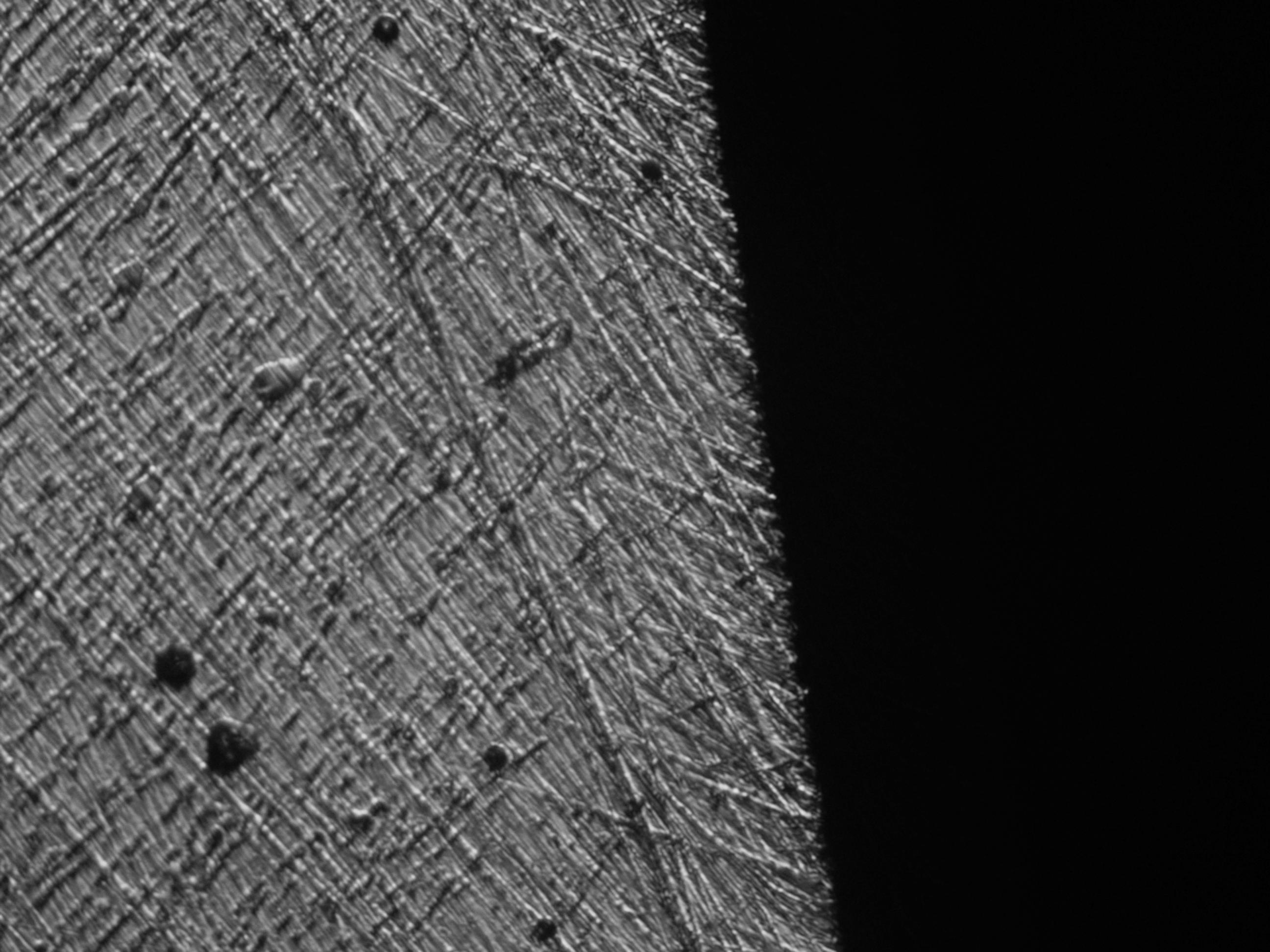
It’s kind of hard to judge that this looks like, but the nature of the stone is it’s touch sensitive. The flat area is bright polish – brighter than 8k. The edge as I see it has no foil without buffing or stropping, just light teasing off of the burr, but it does also not look terribly fine. Just really fine, and it shave shair, but by the polish and the tiny burr, I expected more.

I wanted to get a close up look at 150x with the metallurgical scope, but it definitely is designed for reflective metal stuff, and things like stones absorb a lot of light and this picture looks decent, but i’m sure there is detail missing due to the scattering of the light.

There are no large particles in it, but how fine does the picture suggest it actually is? No clue. Surprised not to see more pore structure given the oil will disappear in it in a fraction of a minute. I have coconut and palm oil on hand, and the palm oil at least is probably pretty stable, but I don’t want to risk soaking the stones with that as it’d be stable for a couple of years, but will it go foul in the longer term? I’ll wait for the Vaseline, but I’m going to make a box for this thing. Vitrified alumina at this level of fineness is not common. Especially in a group of stones that was probably about $100 including shipping from japan. There were about 10 in that group.

Some from that group are here, and some are from prior stone groups. When I was in the throes of buying and sorting and redistributing vintage natural waterstones, I’d get some of these types of stones as a side show thing. As in, for the most part, I never really paid for them in a sense – I paid what I thought the other stones were worth, and the overall average for these probably is $5-$10 per.

The four gray and white stones here are much like a spyderco stone but larger. the top one and the one on the right both are the same – just the front does not say “barber oil stone” on it. they are alumina, very fine, but also are very slow. I see these all the time, but they often look little used and I’d guess for someone used to a waterstone, the operation of them would’ve been confusing. They are a tip of the tool stone.

The prince of a king is in the middle and trials of it made the face filthy. That’s just the way it goes. It’ll be dark once it’s soaked, and look less nice.

Top right is a middle india type stone, also 8x3x1 in size, or thereabouts, and it’s marked 300 vs. the white stones #3000. it is much finer than a norton fine india, so the number on it isn’t meaningful in grit terms that we’re used to. It was, perhaps, relelvant to the old grit scale where 1200FF or something like that was a barber hone abrasive.

In the years after those early 1900s barber hones were made, something changed industrially regarding how fine alumina is made. Precipitating may be the right term, and fine alumina could be had loose. Before that, something like a barber hone must have a glazed surface or it will chew up the edge of a razor in a hurry.

Some of the other red stones here are oilstones, or probably designed to be. Some with a dry vitrified feel and some have a hard but muddy type consistency if you can get something with diamonds on them to abrade them with an oil lubricant. They will go out of flat but not remotely close to as quickly as any Shapton stone, let alone king. The only work of significance I see done with any of these is little grooves from someone sharpening gravers, awls or who knows what – something narrow and hard. obviously, waterstones are not much fun for sharpening gravers or carving tools.

How do you Get These?

I’d never pay a lot for these. You don’t know what you’re going to get- it’s more like a box of cheap stuff and then you see if any is good. They are around in japan on Yahoo (equivalent to our ebay), but someone could want $80 for one, and the next person may sell a pile of them in a group of 20 stones for $60. Beyond just not having anything to return if you don’t like things, you can get a real nasty surprise after you win an auction when you find the proxy services seem to have suddenly lost interest in surface shipping really heavy boxes. A $60 lot of stones suddenly will have air shipping charges of $200. No thanks.

I’d personally put them into a category of if you happen to see one cheap on ebay, maybe. Otherwise, it’s just fun to me to see what was made in different eras, geographies or both.
How Do You Know What You’re Getting?

The mention of Wright talking about zen-wu chisels moving the needle, so to speak, really gives people who are into the whole influencer thing the idea that something odd – like a titanium backed chisel – is really going to move the needle. It doesn’t, of course. As much as I love making chisels, a good drop forged chisel at 62 hardness with relatively plain steel is going to be super – if you can find it.

I despise the kind of “secret steel” thing, as I mentioned in a previous post, and think that it would be a public service for someone to have the chisels XRFed, and then point out the actual or likely alloy in each offering. Most PMs are going to be biased toward carbide volume, which is antithetical to good chisel performance. Carbide volume in harder carbides adds edge life, if you can manage to avoid damaging edges. I think for anyone with experience, a plain steel edge that’s appropriate hardness and stable is going to be a better fit due to the damage/wear balance. If you’re doing more than planing pine that’s already clean and completely free of knots, you’re going to end up with edge damage. If you’re competent, effort sharpening is a pretty much linear association with the upper limit of time you’ll get with a plane. With a chisel, that doesn’t exist. If O1 lasts half as long in a planing test as V11, you’ll potentially get your time back unless you are not very good at sharpening.

That’s a good motivation to get better (faster, neater, sharper) at sharpening and figure out where you’re wasting time.

When you incur damage, you get to abrade the steel instead of the wood. Most carbide volume steels have some edge stability issues, or at least can, and some don’t wear very nicely. And some steels (like 52100) that don’t have that much carbide volume just don’t pick up a shaving as easily while they wear as something like O1, despite having similar edge life. You’ll work harder using 52100, which has always flummoxed me. Why? I don’t know. The things that show up on the microscope for 52100 are similar to XHP (V11), but in smaller volume. XHP picks up a shaving well if you can avoid chipping it – 52100 doesn’t. Sometimes knowing what is easy and why isn’t as easy and you just have to accept what and avoid getting stuck in the trap of reasoning that what you experience is just bad data. It probably isn’t – don’t try to outsmart yourself.

In the end, it’s nice to use an edge with less damage and avoid the scenarios where you just need extreme abrasion resistance. And hint, it’s not hard wood, silica or anything of the sort – it’s inability to understand that you don’t have to do most of your planing with the thinnest shavings you can make. Doing that doesn’t even give you better accuracy -it’s worse if you’re doing more than smoothing and probably worse if you’re just smoothing. That involves seeking edge stability, something you can sharpen in a minute with confidence and maybe that even points toward something where if you come up short sharpening, the uniformity of the edge is so good you’ve just accidentally done the smartest thing you can do with straight razors – you’ve left the original edge but improved the clearance behind it.

For cold woodwork (laning and chiseling, for example) I don’t see the point of anything CPM, but some of the stuff can be interesting. The lone high toughness steels that I can think of are 1V and 3V. I don’t think you’re going to find CPM 1V – literally a CPM version of a plain steel with a small vanadium addition, but it is fantastically tough. The market itself doesn’t seem to be that interested in super tough steels that may not have that great of an abrasive wear life. if you’re making dies, for example, it would have to be very difficult to find a situation where there are arises so acute that 3V doesn’t handle the situation. 3V can be super tough, but at 59 hardness, it would be a bung to use in a chisel. The 3V iron I tested, mistakenly hardened at 59 instead of 61 by Bos would form a burr on 1 micron diamonds and it never felt as sharp as V11 or really anything else. I kept having to look at it under the microscope. CPM M4 also offered fantastic resistance (not in a good way) at same sharpness, and none of this may have been as obvious if I weren’t using one plane, one board, and rotating six irons through. The differences were very stark doing that, and I’m glad to have done it, even if an intermittently employed CPA would say it’s not a good use of time.

That test made me fall in love with V11 irons. I quickly bought $400 of CTS-XHP steel, duplicated the results from V11, then went to work in wood and learned the lesson about nicking and running a test. Confirming with your style of real work is always worthwhile.

So, what does this have to do with Zen Wu – I get the kind of gas station knife goes upscale to google software engineering manager draw of the Zen Wu stuff. I think i could have Warren Mickley over, and I think Warren would never use something I made and just unconditionally say he’d like it, but he has used some of my stuff and told me the things he didn’t like about it and the things that confused him. That’s an A+. I don’t think you could give Warren a CPM chisel for production work and have him come back with any compliments. Even if you gave him free diamonds. And the reason Warren’s opinion is more important than mine or a software engineering manager’s is simple for anyone other than the chisel seller who is appealing to the engineering manager – Warren is encyclopedic, he’s accomplished and he actually does things day to day that people claim nobody does (make a living working a volume of wood by hand, and at a high standard). It’s not frequent that he visits, but I enjoy when he does – it’s like being a star trek nerd in a house full of Barbie enthusiasts when someone you know reasonably well but doesn’t show up often pops out of the car dressed like Spock. You can talk, and without saying “well, I guess I’d have to explain what that is and I don’t know how it relates to Barbie”.

The What are you Getting Part – Chinese White Steel?

I don’t expect anyone to remember this, but I’ve pipped off more than once about if someone had a desire to make a drop forged thermally cycled 62/63 hardness chisel in china with a nice profile and plain steel for a $5 unit cost instead of 75 cents per for the Aldi chisels, I would have no hope of making any chisels in retirement.

Zen Wu could maybe be that company? I don’t know, maybe they don’t work that way. The mention of them with Wright caused me to peruse the site and find these:

That is not an affiliate link, by the way!! For posterity, because the link could go dead, it claims to be a set of chisels that are White Paper Steel. For the price, it’s possible they could be Hitachi white paper steel, but here’s where the critical may be valuable for you if you just assumed that. Sometimes people are honest, and sometimes they are misleading. It could be either, but if i were spending the dosh on Hitachi White #1, I would call it exactly that. I have a bar of it, still haven’t used it. It’s expensive beyond its usefulness because it has that kind of aura around it. It would be possible to make a four chisel set like this for $200+US – probably $50 worth of white #1 steel. I can only get white and blue 1, and not #2, so i don’t know what #2 would be.

White steel is not that kind to modern heat treatment process. We’ll just skip that. The part of me that is always a cynic immediately sees this and looks for the incontrovertible proof that it’s Japanese white steel and then assumes it’s not if it’s not there. I would imagine it’s not, but the way the ad copy reads, I can almost guarantee 90% or more of the market will think it’s the same steel.

Here’s the stuff that doesn’t make sense. 1.2% carbon and 0.04% sulfur. First, White 1 and White 2 Hitachi steel don’t come in 1.2% carbon – they come in a range for white 2 that ends at 1.15% and white 1 ranges from 1.25%-1.35%. 1.2% is an odd number.

White #1 in this case also has a sulfur limit of .004% (ten times less). Even the lowly 125cr1 from Buderus that I got has a melt certification sheet of 0.001% sulfur. Why is sulfur important? One of the more common faults in plain steels and probably in others is manganese sulfide inclusions. These occur, confirm for me if you’re a chemist, when manganese and sulfur get together. Rolling stock then takes those inclusions and stretches them from a ball shape to a linear shape.

What do they do? Since they are not part of the stable steel structure, they act as points where cracks start. if you already have excess carbon, or any carbide, you have points where cracks should start before the matrix of steel around them – and the less uniformity there is, the bigger the problem can be. I am not a historical metallurgist or even a metallurgist, but I would bet these kinds of things – inclusions – have a lot to do with why it’s hard for me to find a surplus carbon vintage plane iron or chisel, and it’s also probably why you will find stories about a camp razor from 150 years ago that the entire combat camp wanted to use instead of their own.

Hitachi White #1 is often touted as being able to achieve higher hardness due to purity. These inclusions are an example why. if you have 2% carbide volume, you don’t need to add some surplus more in sulfide inclusions – especially if the carbides are iron carbides – which still have pretty good toughness. harder carbides less so, but iron carbides still confuse me a little.

How useful is it to ask a maker of chisels like this if the steel is Hitachi white 1? I don’t know, because if they don’t tell you the truth – something we have no reason to believe they’d avoid doing – but if they didn’t, you’d have no way to tell short of XRF analysis and then even if sulfur was in low form, it doesn’t necessarily mean the steel is Hitachi white 1.

If it is the case that it’s not, I can’t deny that it’s much more valuable for the retailer to say it’s white paper steel than it is to say it’s a Chinese origin or even European origin file steel. 125cr1 seems to be pretty good – but it wouldn’t sell chisels like the words “white paper” will.

The same thing here – the court numbers case. “Your honor, they said it’s 1.2% carbon and here is Hitachi’s product list”. That and the sulfur limit – could just be typos. They may not even be shown on this page – I didn’t double check. Dictum states those amounts. they could be really good, but I can make a 26c3 chisel with a beech handle for about $15, and with a nicer handle for $20. it’ll take me two hours, but I kind of like that part. I probably wouldn’t sell them for less than $100 per, and if these were just as good for $70, which they might be, how could I look in the mirror if I recommended you just pay more to make me feel special.

The Dude wouldn’t do that.

No worries on the recent crabbiness, it’ll subside. My next post will be about making things, and probably so will some after that, even if there is some delay between posts while I’m doing stuff and it’s busy season at the day job.

“Best” Copal Varnish

A break from the Nicholson talk. I’ve been trying varnish making beyond my first attempt 5 years ago. That varnish was just a pine/dammar resin combination to be used on a guitar. It was OK, but it lacked hardness which is a problem when used on a guitar. Simply put, with a long time inside a gig bag, the guitar took some imprinting from the bag liner.

At some point, I think varnish making is going to do rounds on the boutique scene, though I don’t know how many people will do it. It needs to be done outside, it’s somewhat unhealthful and potentially very dangerous if you do stupid things.

But what is it in general? With natural resin oil varnish making, it’s preparing (flax/linseed) oil and resin, cleaning the oil, if needed, to make it dry faster and then cooking both separately and then combining them. The oil and resin in a successful attempt bond together and you get something that has different properties than the parts.

Varnish is just a term people use. Almost everything that’s left on the market that’s a varnish is alkyd or modified tung oil with a bunch of solvents in. With new VOC rules, this gets less and less predictable as to healthfulness, and they’re stinky and generally designed for boats or something, anyway.

But even among natural resins, the variance is great. The pine and dammar resins are generally softer and make a varnish that isn’t that durable. At the far other end is amber -which you’ve probably seen sold to tourists in chunks where a bug is magically suspended in the middle. Amber is typically resin that has existed for a long time and is a fossil (or is it a semi-fossil?…whatever, it’s not something that dripped out of a tree ten years ago). Amber is hard, and can be tricky to make into a varnish because the point where it melts for the initial cook is at or sometimes above the temperature that it would burn.

What’s Copal then?

Copal is a group of resins, but fossil or Congo or Zanzibar copal is resins that are semi fossilized and also melt at a very high temperature – could be anything from 450-650F, and some that I’ve “run” (heated to cook out undesirable stuff before used) leaves bits behind that don’t melt at 650F.

But (semi-)fossil copal, unlike pine and dammar resin (and many others), makes a finish that’s much harder, and to my findings, indifferent to water in any reasonable period of time. It was stylish for a pretty long period of time up to the early 1900s because it makes a good varnish, frees the varnish makers from catching their varnish and themselves on fire with amber, and can be a lighter color. Some of us like finishes with a tone, but there was a time when harder darker resins left people grasping for what compromise to make to varnish light colored woods or to make pigmented varnishes of light colors. This is pretty easy to follow if you’ve ever used something light colored or mixed it and had it react and become dark. The best copal resin is lighter in color and if the process is gamed, can probably leave a very durable but relatively light colored varnish.

So, rather than paying my dues properly working all the way up, on my 6th batch of varnish (several others being just variations of one type), i just decided to do fossil copal – went great. And then I decided to do a second batch with some pieces of resin in the container that I got that looked dirtier, and I “smoked” that batch a bit. Smoked meaning that I wasn’t able to find the point where some of the resin would melt before it was just burned. Fortunately, most of the burned stuff seems to have fallen out as sediment and the varnish is still good, but the brief struggle with expensive resins wasn’t that pleasant.

I’m not encouraging anyone to make varnishes and take it lightly. Imagine you are dealing with a 650F resin or a 550-600F linseed oil that could (but shouldn’t) catch fire or splash, and the former is sticky, so aside from noxious high temperature cook fumes, you have the chance of getting serious burns. Or as George Wilson put it to me when he was trying to cook a type that’s somewhat reactive, and ignited it “creating a mushroom cloud” in your back yard.

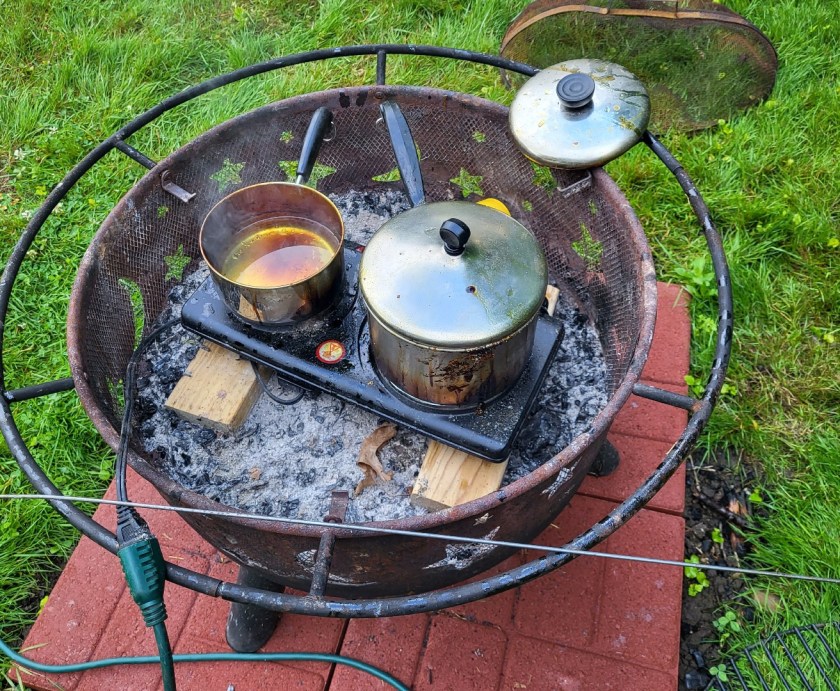
However, if you’re really serious, this is something accessible and while it’s not that cheap to do in terms of the materials, the equipment to do it is pretty much used pots and pans dedicated to the use and a two-burner electric hot plate.

This is my setup – that’s it. Later, the varnish is strained when it cools, but on the left is a pot with oil in it. On the right is (not very instructive), copal from the second cruddy run trying to get hot enough to melt and cook out the impurities.

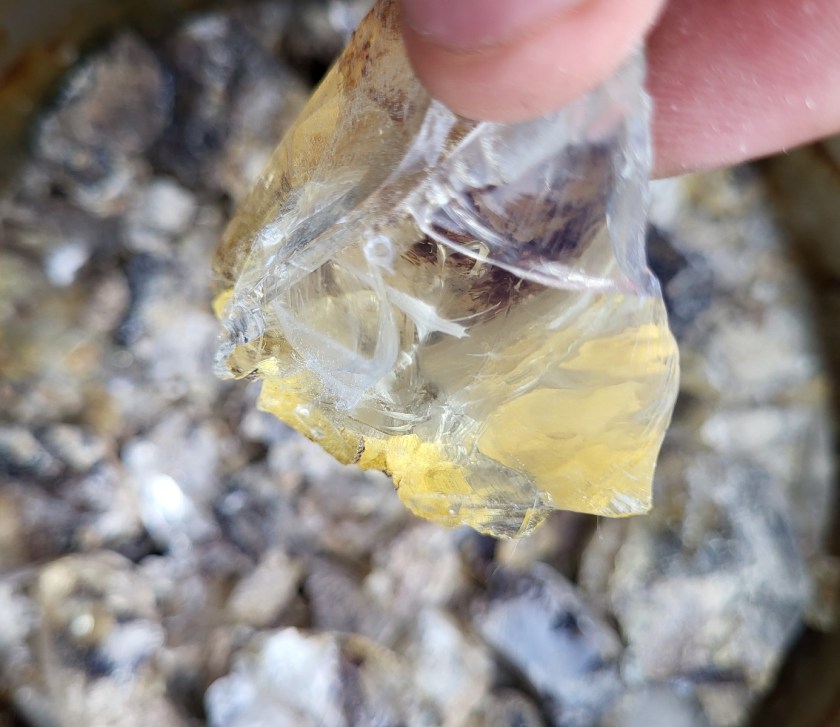
Here is what the better pieces of copal look like:

Probably about 20% of what I get in a bottle – and if you want to find this, all you have to do is search “Congo copal” on google. There’s only one supplier that I know of. Anyway, probably 20% of the congo copal is bright like this and then it varies after that with some of it having some clarity but dark coloring in it. In the old days when it was more plentiful, the various bits were most likely sorted to save all of the lighter bits for the highest paying customers.

The high temperature cook darkens it a little bit – but there is no way to avoid the high temperature cook with the harder resins, so it’s part of the process. Beyond that, once the oil and resin combine, the varnish is made better by extending the cook somewhat, which will further darken it.

Other than for maple (which I don’t care for too much other than for guitar necks or tops – color will be desirable there), I prefer some tone in finishes, and the tone matches the wood. The darker the wood, the darker the finish when choosing shellac. I’ve made too little varnish to have well formed thoughts.

But here is where copal varnish ends up:

This picture is the varnish after cook in the jar, and the jar has been leaned to the side so you can get a sense for the color.

This is what it ends up looking like on beech:

The line on this plane blank divides the better batch from the one that got burned/smoked a bit. This is just two very light padded coats, and the dark corner at the top can be ignored- the wood was dirty, and I scraped it while it was damp (picture of why below) – you’d not have that situation on a regular piece.

I had two test pieces drying in the sun get rained on, and to my surprise, even with a sheer finish, there is no evidence of water having been on the varnish – even though it’s only just initially dried and will continue to dry further over time.

note, the varnished part sheds rain. The bare wood below it definitely does not!

This is the same blank before padding the less desirable batch on the short end. The whole thing got left in the rain and other than some varnish that I may have had on my thumb (see the dry spot?), the wood otherwise just soaked in the rain. The thin coat of copal varnish was indifferent, and didn’t so much as degloss or blush at all.

To see how long this would last, I took another test piece later and put more water than this on that test sample and allowed the water to sit on the varnish until it had evaporated. Again, no evidence left.

Which brings me to the point of making varnish. I love shellac, but shellac isn’t durable in some situations where there’s a lot of hand contact or contact with water. I also can’t think of any cured finish that I’ve used outside of soft spar urethane (gross looking and too soft for a guitar – feels like a plastic case) that has this kind of water resistance. Not even some of the solvent urethanes or various common spray finishes used on commercial furniture.

Making a varnish for use gives the same option to have a warmer tone like shellac, but to have excellent long-term durability. And the resin and the finished varnish have unlimited life on the shelf. There are no driers in these varnishes, though they could be added if something needs to be hard in a day. Otherwise, UV light or longer term exposure to oxygen will cure the finish without any dryers. Making the varnish without eliminates the constant battle you hear people talk about with skinned over commercial varnishes.

Where can you Read About Varnish Making?

There’s a ton of talk on violin boards about making varnishes, but the varnish made for violins isn’t of great use for furniture or cabinets. You can find older texts in the public domain on archive.org or google books or just by searching google. Holtzapffel Turning and Mechanical Manipulation and another text called “German American Varnish Making” come to mind. These describe a relatively commercial process, but there are recipes in the books and enough to start to understand how interesting and broad this trade once was.

I’m not ever going to describe the trials and tribulations in great detail – if it’s something you want to do, you’re better off reading older texts. Just know that the descriptions of using jacketed vessels or open fires or cooking 10-100 gallons at a time are all not going to apply. You’ll be trying this in stainless, cast iron or enameled cast iron pots – the last being the best.

And once again, if you live in an apartment or don’t have somewhere to cook this away from your house and in an area where you can tolerate fire and really stinky smoke, don’t even think about it.

One more thing (Columbo reference)

It’s not cheap – the solvent of choice to add during the cook and thin later is true pine turpentine. There is diamond G in the US or a good quality of pine turpentine that can be gotten on ebay from Portugal a little cheaper. You can make varnish with less good materials – that would be your choice. I wouldn’t bother.

To make the copal batches cost a little bit more than waterlox gloss would cost in quarts when you compare the actual solids content from one to the next. I figure the brown quart jar in the picture cost about $65-$70, but the varnish is also about 65% solids or more, so a quart will go a very long way compared to most commercial finishes. In the case of guitars, it would be enough to finis several high quality guitars, and suddenly, the cost doesn’t seem so high in that context. Could very well be enough in one quart to seal a whole set of kitchen cabinets and pad on a sheer (but very durable) top coat just with one quart, too.

Other resins are much cheaper and can make suitable varnishes, though unfortunately, my initial impression is that the fossil copals really do live up to the glowing comments in older texts about durability and ability to take a high polish.