How Many is Enough? At least One More…

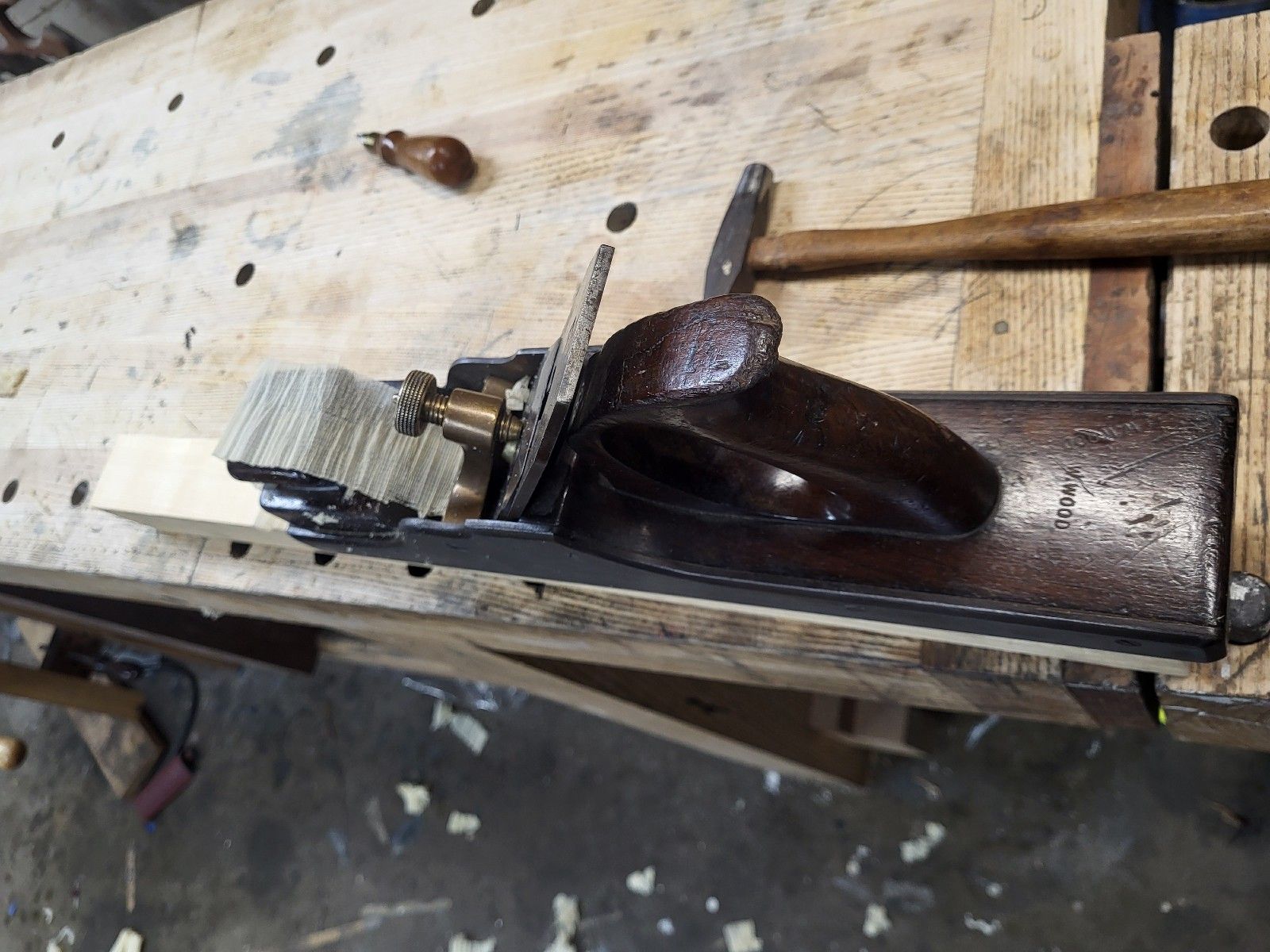
Not the last plane remaining to include shop made irons, but added to the closed handle rosewood jack, and the rosewood and gombeira smoothers.

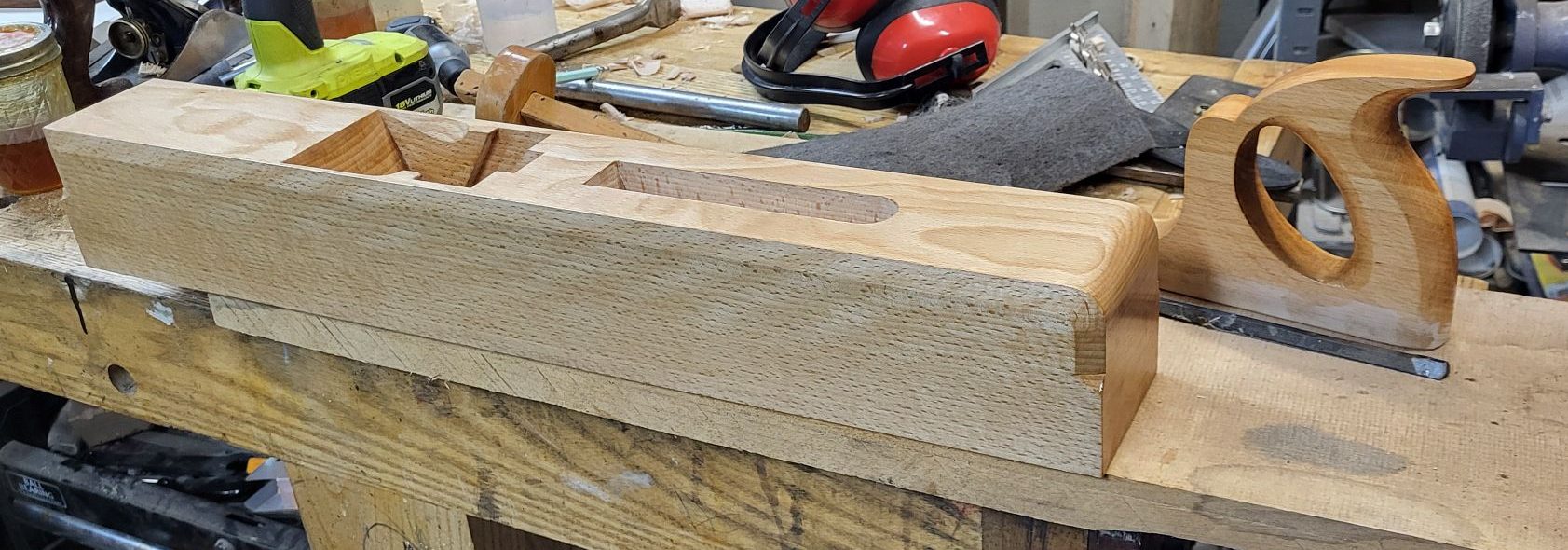
Probably mentioned in another post, but I have two try planes of my own make. One was my first try plane, which was the third double iron bench plane I made. It’s OK. The second is a plane that I got lazy on and didn’t cut the mortise quite straight up and down. that one is actually solvable by adjusting the iron and cap iron, but I never did it. I use the first along with a vintage try plane that I like because sometimes I just like to use old stuff. There’s a credibility to the nice old stuff that my wares don’t have because……you can’t buy age, and you can’t buy provenance of a golden era plane that was made and sold in a competitive market of professional users. That’s gone.

What you can do us buy that older plane for less than the cost of materials in mine, so…there’s that.

This plane is euro beech, but the handle is american beech. It’s nicer than my earliest planes, and it has a 65 hardness plain steel iron in it. Those two together are important to me. Strength from hardness imparts edge stability. Plain steel at 65 means hardenable. The fact that it’s a 1.25% carbon steel means it’s still relatively relaxed getting to that hardness at a 400F temper or a few degrees above that.

There are still some things that could be improved in terms of lines. I chicken out on the handle and always leave the top and front strap a little tubbier than they need to be. A shorter handle looks nicer, too, but what if I decide to give the plane away? My hands across the knuckle are only about 3 1/2″ or a little wider. Someone with a 4″ hand across the knuckle could use this plane, but probably struggle on an older Mathieson plane until they realized they don’t need to have all four fingers on the handle.

Haven’t tested it yet, but anticipate no issues. This one is a little more free in the wear, etc, in terms of clearance in hopes that I won’t end up doing any extra work rubbing the shaving hard into the wear in tight quarters. Some of my tighter smoothers and jack planes do give a sense that the angle off of the cap iron into the wear, along with tightness, are so much so that even shavings not straightened by the cap are being straightened by the wear. It looks nice to have a plane that’s really tight like that, but there are limits to practicality.

I may build more planes this year, not sure – but in the background is a desire to make the chamfer a round over on the top, but elegant, change the carved details and make a much more artistic handle that’s not guarded by material bulk.

This is my first euro beech plane. At horizon, euro beech is still what’s available, and realistically, at not less than about $20 a board foot. Is that really a big deal? I guess it isn’t – if the wood is perfect, I’ll pay it. Some of the blanks on the page look less attractive. This one came out of a billet that wasn’t sawn that well, but there was room to resaw it, and the result is very attractive to my eye but for the contrast in how much color changes vs. american (oh, the wedge, too – also american to my recollection). I like the warmer color of the american stuff, but as this plane gets a few more coats of varnish, it will be sort of tarty and it has the wonderful three dimensional effect in that parts that are dark turn light and the converse as you’re walking past it, making it look a little alive.

If you look closely at the right eye in the last picture and the plane itself, you can tell that I corrected the bottom of the eye a little. It just looks better if the bottom of the eye doesn’t look like it flatten out entirely in the longer thin area of the eye.

There is a cap iron under the wedge, of course. You can’t see it and neither can I, but it’s there. Shop made like the rest of it, but for the modified knurled screw that I cannibalized to come up with the screw itself.

Oh, and the little bit of dirt trapped under the varnish on the front side of the handle – jeez. That stuff shows up less on the bare wood but big time after finish is applied. It reminds me of a childhood friend of mine who could not eat anything other than clear jello without creating a rings around the sun type look….food dirt. I saw that as it was occurring with varnishing and admittedly did nothing about it. One of the luxuries of making things for yourself.

No test shavings yet -the handle glue is drying as the plane sits here, and to some extent, so is a tung oil and wax sole. Just under 8 pounds – a nice weight for a fat guy like me if the upper end of possible use includes rosewood. And nice even in cherry, especially cherry of suspicious quality or grading.
The Infamous Cap Iron Video- it’s Worthless for Setting a Hand Plane

The cap iron video from Kato and Kawai was never intended to provide instructions or a basis for setting a cap iron. How do we know? K&K actually flatly said that. So if you’re telling everyone “it’s just science” that you should use a flat 80 degree bevel angle because you just watched the video and now you know enough to be a doctor of planing, hold your horses and get some actual experience.


So, this whole cap iron thing has made rounds in two different places lately. One of the things that annoys me is it’s brought back up and Nicholson described how you should set up the edge of a cap iron 200+ years ago. It should be rounded. I found out about Nicholson, I don’t know when – probably five years after writing the cap iron article. When I wrote the cap iron article, I was working wood entirely by hand. the only reason I’m doing less of it right now is because of the metalworking.

If you go back and read my article, there are two flaws in it. One is Ellis (the editor) left some tearout in the picture and I am horribly disagreeable – I didn’t like it. I also had become recently aware that being disagreeable and stubborn wasn’t infrequent like I thought maybe it was. Ellis thought the picture was interesting because it showed one of his first few attempts on quartered mahogany, and that removing a lot of tearout from something that couldn’t be planed before was valuable or just as valuable. I didn’t really agree that it was valuable enough compared to showing no tearout, but feeling like I had to get over being disagreeable, I let it go. I’ve heard about the tearout in that picture a lot – but usually from people who pride themselves on opinions without accomplishments.

The second thing I let go was the article at the end saying that it was based on information from the Kato and Kawai video. It wasn’t. I figured out how to use the cap iron on my own as a swan song before quitting woodworking. It worked so I didn’t quit. Bill Tindall sent me a message (email) when I started posting with elation about the world soon changing for hand tool woodworkers. One plane under your bench if all you do is smooth – to replace the myriad of suggestions. Bag the idea of buying infill if you’re an everyman. It’s a waste of money to buy lots of stuff but more importantly (money wasn’t a problem for me), it’s a big waste of time and it also has a little bit of the “i’m a fraud” feel to it if touting that you know 14 ways to slowly get rid of tearout when one works better than all of them 99% of the time. Bill’s message was that they he and Steve Elliot were digging up info from the K and the other K in Kato and Kawai. I think, Bill will remember every detail, maybe they were conversing with only one person. At any rate, there were a bunch of documents and the videos. He sent me a link to the videos before they were public because no permission had been gotten yet in terms of sharing them.

When I described what I did on the public forum, with elation, and as much “best thing ever” excitement as I could, I thought for sure three or four people would try it, see that the Jesus Christ of metal plane parts was right under our nose and we would be saved. Instead, most of the responses were “that doesn’t work, Chris Schwarz says so” or “of all of the people I’ve met or made planes for, only one person other than Warren ever said they use it”. I have no idea who that second person was, by the way.

I either didn’t remember or later forgot the article (on woodcentral) said that it was based on the video. This is an important piece of horseshit for two reasons. The video leads you down the wrong path when setting up a cap iron on a hand plane. You’ll watch it and assume you want to have a plane with an 80 degree flat wall facing the oncoming shaving and have it twice as far away as you would otherwise.

I tried it, it worked like shit compared to a rounded edge. Why I rounded the edges, I don’t recall exactly but it just seemed to make sense. Making sense isn’t worth much, though. It proved to be better in actual use with a shallower flat bevel being an option – pretty sure I wrote 50 degrees if you couldn’t be bothered with curvature. 50 degrees is “fine” like food with decent flavor and a bad texture is “oh well, it’s fine”. That kind of food is a hell of a lot better than an empty stomach, but it’s a missed opportunity. A 50 degree flat bevel will do most things, but it will struggle a little in finer shavings in the worst of woods.

I saw the video as maybe a way to hit people up with some moving pictures and then smack them upside the monitor with a bunch of info about what actually works well in hand tools. But I wanted to avoid the idea that you need to measure things and that you could just take something from the video and have everyone doing it. the “80 degree” setting was subpar and increased the chance that you’d either have the plane stop you in your tracks or leave a fuzzy surface. What’s the point of ramming the shaving so hard back into the wood that it’s compressed and the planed surface isn’t smooth. There isn’t really one. Quickly upon finding a tolerable resistance level planing, you’d then find the thing was too far away and not preventing tearout. The rounded profile suffers the ills of neither the shallow or steep single bevel.

I found it by experimentation, Nicholson documented it long before. It’s too stark to avoid noticing unless you’re only taking tiny thing shavings. If that’s all you’re doing, your advice is no good for anyone doing more. The same is true about general plane design, setup and use if you’re only smoothing and fitting joints. You will never know as much about planing as you would if you did five hundred board feet entirely by hand. Same with sawing and so on. You learn things whether it seems like you wouldn’t or not. What is is. What you imagine is common sense may not be what is.

So, the Video Does What?

The video was apparently a segment to show at a conference in the USA, and according to Bill, the professors stated that it’s not intended to be a guide for setting anything, and Bill mentioned further that the stuff shown in the video didn’t even make the final documentation. The documentation was involved in edge wear profiles and planing kilometers of wood with a planing machine trying out different steels. They found, drum roll, that highly alloyed steels lasted longer, but the wear profiles (going from memory here) also show belly and lack of clearance that the machine can power through that none of us would ever come close to doing. I think Bill was interested in finding a secret to longer edge life and the chipbreaker video was a side show that he provided because I brought it up on a forum. I don’t know if he would’ve worked hard to get permission to show it without the discussion, I think he would have but how it would’ve been presented, I don’t know.

I remember Bill saying there was a separate paper discussing setting up the cap iron with students, or I thought it was maybe students (one of “the K’s” students in Japan). Doing some digging this morning, it was students. The separate paper for hand plane setting is brief, doesn’t explain much and has some comments that are not relevant for western planes. It does not give parameters for set distance or angles, it just says you can’t set the chipbreaker by eye and you need to judge the shaving and perhaps even measure it.

Well, you actually can’t see the end of the iron in a good dai, and if you’re looking in from the bottom, you have a very poor view because you’re relying on seeing depth. So their advice makes sense in Japanese planes. On a western plane with screw together parts that go in, of course you can learn to set it by eye – you can ignore K&Ks suggestion that you can’t. That’s what I was suggesting early on – learn what looks right and then just set it. It took me a week with no instruction to get this. I was planing a fair amount, maybe several hours worth of just planing that week, but it was still just a week.

I think all you need to do is look to see if a shaving is worked if you’re not sure. if it’s starting to straighten out, there is influence and you won’t have a disaster. Noticed in that picture with curly hard maple, the heavy shaving is flattened in areas – there is a feel that planing has when the chipbreaker is engaged.

That’s all the K&K short hand tool article said, though, set it by watching the shaving and Bill was a little unhappy with it. I think like most folks would want, he wanted instructions that were clear? I could ask him -but I’ll go with the guess. I think he doesn’t care. He uses the chipbreaker now quite a bit on furniture work – especially cleaning up junctions and such – and sets it by eye.

The video gets passed around and this part is important – the very guys who put it together said it was not intended to be used as advice for setting or doing anything.

If you’re working by hand, believe what you get for outcomes and what comes from your own hands and nerves and discernment. It’s not that hard.

I didn’t think I found something new when figuring the chipbreaker out, I thought I found something old and at the time, I was definitely pissed that the Chris Schwarz’s of the world wanted to be a source of information but couldn’t figure it out. Using the chipbreaker should be taught at the same time someone is taught about basic sharpening and the adjustment features on a plane.

Oh, and why wasn’t the student paper that big of a deal in Japan? I don’t think anyone does much planing with planes in japan on things like day to day work on building beams and doesn’t set a chipbreaker. Why didn’t we notice it? well, if you don’t know what the chipbreaker is doing, it’s easy to not notice shaving shooting up out of a plane instead of over the iron and back. And a second reason for it is if you get on youtube or the internet and you want to see Japanese woodworkers planing actual work – and not someone teaching students or appealing to tourists, you need to find things that are listed in Japanese. Google’s functionality in youtube still does a terrible job of finding someone planing a beam in what looks like a legitimate workplace.

If you look at this video or this video , notice the shaving come straight out of the plane even though they’re not that thick. Why? I would guess because planing a beam like these without a chipbreaker is a very bad gamble.

This is actually what I thought I’d find out with the chipbreaker – a way to go completely to Japanese tools, especially on smoothing. It just didn’t work out that way.

Updated Thoughts on Scraping Planes – There’s no Practical Gain

If you’re reading this, you may have seen the Youtube video that was superbly done by someone in England. That being a very clear description of scraping cast iron.

So, I scraped 7 planes. Two infills and five Stanley planes. It may have been 8. I planned to scrape 1, but 8 just happened.

I had two Starrett straight edges, and now three. My 24 inch straight edge is a walk about for the shop and it has seen a lot of wear. There’s really no abuse outright, but it’s a $30 (square edge) and the corners are what you try to use if light does not go under the flat edge. And with a blunt square edge, it’s easy to get something flat enough that no light shows. Those edges take wear and it gets a little difficult to tell if you’ve addressed it cleanly with fine files and other tricks to clean it up. One of the easy things to do is check a surface with two parts of the straight edge. Scraping afforded the ability to get things flat within a fraction of a thousandth of an inch and start to see these differences.

So, I went out looking and found a starrett #386, thinking it was a #385 at less than half price, but it’s actually a lighter version for drafting. Fortunately, that’s not bad. But I got it for about 85% of going rate for a new one vs. 40% of the cost of a #385 (both being bevel edge). They have the same straightness guarantee, and I kind of like the lighter weight. It’ll be useful in the shop.

So, having gotten off track already – what’s the fourth? A 4 foot #385 that I bought new a while ago that never gets away from a carpeted area – it’s a reference until or unless something spoils that, but it’s also pretty heavy. And they have become off the wall expensive, so keeping it as a reference is fine.

Back to the planes. it’s very easy to scrape a plane to the point that a 0.0012″ feeler doesn’t have a chance. I found the bias I expected – that the toe and heel on my planes were above the mouth – and I’d also grown accustomed to liking that. It affords some control that makes planing a straight edge just in the process of planing off roughness routine – no extra staps.

A Dead Flat Ground Plane is Not Better Than Properly Lapped

What is properly lapped? Figure on something like a stanley 6, you can just get a .0012 or .0015″ feeler under the toe and heel using a good straight edge. This is a small number, but it provides a very practical benefit. When you use a tool room granite surface, this level of error looks enormous, but it also doesn’t take that long to scrape out, which is where the 1 became probably 8.

Can I tell any difference in use? I have to be honest, I liked the planes a little bit better before scraping, except for one or two that I was lazy on and didn’t finish the lapping job. For years on the forums, we have heard that you can’t do anything practical to a plane that compares to a surface grinder. Since I have quality straight edges and feelers, I could quantify what kind of error I was creating (intentionally) when lapping, but you may recall if you’ve read any of my conquests that I would also file the center out of a plane draw filing if it was that far out or already convex.

A person with a file, knowledge of planing, and a good straight edge will give you a plane that will suit you better than someone with a surface grinder. A person who doesn’t have that knowledge could lap your plane into a banana.

The idea that you can’t address cast iron or steel, even significant amounts, by hand, is bullshit. I get tired of reading the sentiment from people who don’t have experience with both types of tools – one properly lapped and one surface ground or 10 of each, or whatever. It’s usually someone with knowledge of something other than woodworking, be it manufacturing and testing things (like a lab engineer) or machining. I never see a legitimate long term hand tool user ever muse about machining being something that’s needed.

Rather than only scraping, as i’m getting close to a scraped surface being flat, I’ve followed each repetition with some focus on some light lapping of the tail of the plane being scraped. It’s a tiny amount of insurance that the tail end isn’t dead flat or even a miniscule amount low, but even just that little bit makes the outcome better than flat to the reference surface. Flat to the reference surface end to end is practically lightfast on the starrett straight edge, even leaned, edge to edge and corner to corner. An example group of pictures follows with a Norris No 13 panel plane.

Those pictures just show an iron that’s quickly sharpened fine india, hard ark (not the most expensive kind, slightly more coarse) and a quick buff strop. The wood is yellow cedar, though it doesn’t really matter what it is. A lower angle plane would be better, but this is just a quick thing for feel of what the plane is doing as the tail end comes to the wood. You can’t feel it, but I can tell there’s no magic here that will result in better function. The last picture is an attempt at showing a reflection on the planed surface. Of course you’d expect this, but the improvement in cell phone cameras really makes these pictures disappointing. The reflection is glare and the camera really won’t tolerate it, even in manual mode – it’s just blurred.

Interesting things I found

My lapping did leave the planes I lapped slightly bandanaed, but less than my finest feeler in most cases. That was filing and lapping most of the time recently, because it makes it so easy to prevent more banana effect, and the file is *really aggressive and fast*.

But, I also found that I had slight convexity across the width of planes and my lapping made the “error” slightly on the diagonal as the reference plate showed. I say that partially in jest, because it was an error only in the sense of being able to measure something other than straight and true. In reality, it was a nicer plane to use, and all of the absurdly thing shavings I’ve shown were with those hand lapped planes. The scraped planes don’t really do anything better, and the loss of the ability to ensure the far end of a board doesn’t fall off just by pressure variation in a through stroke is a legitimate minus.

So, You Shouldn’t Scrape?

I wouldn’t say that. But I would say if you have a good setup to lap, or file and lap if you have a plane that’s convex, there’s nothing really to gain.

You can see in the plane sole that I didn’t take my time and scrape very deliberately, so some of the scraping marks are deeper than others and there’s no perfect pattern left. Some of this is lack of neatness, and some is that I did work over the sole with 220 grit paper on a block and a lap, so the deeper marks remain and the others are more faint.

I’m glad to have tried it, and it’s an easy way to make sure that what you have (even if you lap the tail and nose off a little) is very dead flat to start.

I spent about an hour each on these planes in total – some less, some more. To do a perfect cosmetic job would probably require using carbide (I used high speed steel) or really careful use of the HSS, which can burr and then leave deep scratches for a ham and egger like me.

This points back to sending a plane off to a machinist. if you’d like to do that, you can. I think it’s a huge waste of money, and I’d never send this particular plane off to a machinist, but to get dead flat and the same feel as this vs. lapping, i’d be disappointed shelling out money to have that. And I’m being prissy saying the next part, but I think modern surface grinding looks really cheesy on a vintage plane. It definitely looks even more cheesy on cheap imported planes that have really really deep surface grinding marks.

The Myth of the Forged Iron

I’m still scraping planes lately, dragging my feet on my chisels, and making some plane irons where necessary for scraped planes. I guess not getting the chisels done is an attention deficit thing. When work is busy and there is deadline pressure, I tend to want to explore things because exploring and getting better quickly at something is engaging to my mind.

That said, I read things fairly often about steel. People talk about it a lot. Often it’s about preferences and then explanations. I feel like from experimenting, there are a lot of things that result in properties I like, but I don’t always know why they do. It’s more important that I can get a result than it is that I can explain it. Why? Because trying to explain the why instead of the what, or put differently, feeling an obligation to explain things when you know the what and have never tested that your “why” is true leads to a lot of false information.

There’s a discussion going on on SMC at this point that’s got several nuggets in it. One is attributing ability to plane certain woods to an alloy when the attribute making the difference is hardness. I’ve mentioned before that O1 and V11 both have similar toughness levels and both have a similar working hardness range. Toughness is an impact test – how much energy comes out when breaking things. In my experience, O1 has a third attribute that’s generally better – edge stability. Stability is a nuanced term used for knives that basically implies the ability to hold a fine edge. Not just any edge that will go through an abrasive laden machine sharpness testing card, but the kind of property that makes small chipping less likely in one steel vs. the next. At any rate, LV tempers their O1 soft, and XHP/V11 is tempered sometimes (at least in the irons and a single chisel that I had) at the upper range. Figure these are 59/60 respectively and 63. You probably would not recognize O1 as being the same steel if you used two irons, one at 60 hardness and the other at 63, and didn’t know what alloy they are.

That aside, all plane irons are forged

Clifton was the last maker of planes that I can remember advertising that irons were forged. I don’t know what they were doing, but I’m sure someone does. I suspect they were drawing steel to length mostly. I don’t see an advantage to doing this and there’s a non-zero chance that the results could be worse than using rolled material and an established process.

Things happen with steel when you’re forging. The grain direction is altered, but grain is also enlarged, and you have to grind, normalize and do whatever else needs to be done after that. But normalizing will be important because the distribution of carbides is not always ideal after forging. Maybe it never is, but at least sometimes it’s not. Why? Carbides can form at grain boundaries creating a layer rather than being neatly spherical or tubular sitting at grain boundaries, but not separating them.

I don’t know what happens industrially, but Clifton’s forged irons were well liked. I think the stamp was actually their biggest differentiator, but so was the price here. The last I saw them at highland, the price of an iron was about double that of any others.

Normalizing steel re-establishes grain. Annealing after normalizing or doing something else to adjust the structure before quenching changes more things – from the state (martensite, pearlite, etc) before subsequent steps, and you can refine grain smaller and adjust the shape of carbides (types of annealing can do that).

Rolling is Forging

If you buy rolled flat stock, the steel has already been elongated and widened by rolling. Rolling is a type of forging and if the steel is not spheroidized, it probably comes with carbides that are more tubular. It definitely has the benefit of continuous grain in steel, and grain is important in terms of edge orientation. Even though grain is established by normalizing, for reasons I don’t know, there is a bias for toughness based on rolling direction.

Nobody here has ever used a cast plane iron, or one that isn’t forged. Even PM products are rolled into bars. Forging at one point was important before modern rolling or die forming (rod) or drawing out because steel that’s as cast won’t have the same toughness or orientation. if you go back far enough to steel like wootz, it was necessary to get layers of toughness alternating with layers of carbides.

Brent Beach had an interesting page on edge life, but what it left behind was also comparative pictures of edges that provide other information. For example, the Clifton iron pictures are here:

https://brentbeach.ca/Sharpen/Cliftontest.html

The edge performed fine. If you want to see ugly results, you can go to the main page and look at the Shepherd irons. I had one of those from a plane kit and mine as equally horrible with surprise failures aplenty out of nowhere. Even looking back now, I have no clue how they made irons of such low quality unless they were really bargain hunting stock.

Back to the comparison – Steve Knight offered O1 irons that were cryogenically treated. I know that instantly brings some folks to suggest there’s no reason to do that because it’s for A2 or other highly alloyed steels. Larrin Thomas (Knife steel nerds) also addressed this well in discussion of various cold treatments. Cryogenic treatment mostly trades some toughness for additional hardness, and it’s true that it’s beneficial to A2 because the toughness is coming from retained austenite (something we don’t want too much of it) and liquid nitrogen converts that to martensite (something we want a lot of). If steel has enough toughness, we usually will like something that’s gotten cold treatment more than something that hasn’t.

Steve’s O1 iron pictures are here:

https://brentbeach.ca/Sharpen/Knighttest.html

Notice the fineness of the edge. The footage planed isn’t the same so it’s hard to make the call for sure that steve’s iron would also have planed longer than the Clifton iron – I’d bet on worse than even odds that it would’ve planed somewhat longer, though.

Steve said at the time “I don’t know what cryo does, but it makes it better” when anyone at the time insisted that it was only for A2. you may recall those days, when we generally didn’t talk about anything but “vintage steel, chrome vanadium, O1 and A2”. Ahh…the same days where folks insisted that chrome vanadium steel was gummy and cheap and less fine and full of stuff that’s not in “good old plain carbon steel”. What most of it was lacking was a good quality melt and roll and, especially, enough carbon to get into the low to mid 60s. It’s less alloyed than O1, though, not more.

Back to Steve’s irons – why were they better than Clifton’s in this test. Finer and probably long wearing? Because they are – the combination of the rolled material and then the process applied before heat treatment and then the cryo made for a better iron.

I had a couple of these irons, but no longer have any, or I’d give you an idea of their hardness. They were bonkers hard without being chippy. They were just good.

I have forged irons from rod (stanley replacement irons) and they are fine. I think the forging got more stuff in solution in my case and the result is the irons are a bit hard and hard tempered, but not faulty. Hard tempered meaning they are bitey and drop their wire edge quickly. Day to day, are they any better than the first good irons I made with starrett steel just by heating to nonmagnetic, a little further past that and then quenching and tempering? i don’t think so. They’re a little different, but I can’t say that perception of properties is more than a slight difference in hardness.

The quality of the stock and then the quality of the process applied after shaping is really what makes a difference. Just as terminal hardness and not alloying is almost always what makes a difference in perception about what can work in really hard woods and what can’t.