This post follows the first three posts rehardening various Stanley plane irons, which can be found as subtopics here.
The summary from those articles is that Stanley used a range of steels at the very least (each of the rehardened irons is definitely a different composition), but that in the heyday, the irons were tempered to a target and could’ve been left far harder. Even the later (type 20) plane iron had potential to be better, but less so than the earlier tools.
What about a Stanley Chisel?
Stanley’s socket chisels are a general-purpose construction site type, and provided in different lengths. I’ve worked on construction sites, but not since high school, and we would’ve scraped grout or pried something with chisels, so what sites were like in 1920 or so, I don’t know. Higher hardness 1800s English cabinetmaking chisels wouldn’t have made much sense for site work, though, and it’s fair to say that cabinetmakers would’ve had no interest in Stanley socket chisels (as evidenced by no change in the English market until toolmaking was automated – even then, the tang type remained, just with rounded tangs turned on a product lathe).
It’s likely that the early (720, 750 and Made in USA socket types) chisels were hardened to a spec that was considered to be OK for various sharpening media and various uses. Overall, I find the idea of gripping the handle (vs pinching a chisel tip to hold a chisel in place) at a bench uncomfortable, and have few socket chisels. But I do have one earlier Made-In-USA socket chisel that’s no world beater at its stock hardness.

At some point in the past, I ground the subject chisel for this post into a skew, and for this test, I undid that, removed half of the bevel after squaring and ran it through “the hardness cycle” that starts with re-establishing new grain, shrinking it with thermal cycling and then rehardening it. Tempering is again 400F (double tempered).
How Hard is It? What’s in it?
I would estimate the hardness of the rehardened chisel is around 62. It may be a click harder, but it isn’t any measurable amount softer. The back side of the chisel is pretty much immune to the washita and no significant bevel can be cut on the bevel side (which is the aim of using a hard chisel on a washita – any cheap aggressive stone can prep the bevel for the washita to finish it). Back work is doable on an india stone, but it doesn’t just slough away.
As far as the alloy? I don’t know. To add to the confusion, the older irons that I examined previously (sweetheart era or thereabouts) were two different compositions, and this chisel isn’t the same as either of those. To guess at any of these three would require someone who wanted to get an XRF analysis (that’s beyond my scope). This chisel is a little slick feeling on the stones, and may be an oil hardening alloy. Strange as it may seem, oil hardening steels (like O1) have a notable slickness compared to very plain carbon steels like you’d find in files or saws.
How does it Compare to Boutique Chisels when Rehardened?
It’s easily an even match for an A2 or V11 chisel, and probably even with something like an Ashley Iles bench chisel (in feel). I can’t do a quick test in the same wood to compare those, though I’ve tested V11 and Iles chisels in the past. V11 is an outlier as it’s created differently and I couldn’t easily prevent minor damage when testing the “Unicorn” method, though the damage it took on in a small section of maple was minor. In the same test, a mid-level japanese chisel and the Iles Mk2 chisel sustained no damage.
I chopped twice as much maple with this chisel (and it’s half the width of the chisels mentioned above), so the edge itself has seen four times as much use. No notable damage.
A picture of the initial edge at 150x optical after the washita. The black stuff and what looks like a nick is just carpet or clothing fibers from wiping oil off.

The volume of maple chopped (about 2 cubic inches – which in tasteful drawer work would be half a dozen or a dozen half blind sockets):

If you don’t have a microscope, you can do something similar to this – just chop, feel for damage (rolling edges with your finger, or use the tip of your fingernail to find nicks by running along the edge). And look at the chopped wood to see if there are any small lines. None on this.
The edge after this chopping – note how the chopping appears to have removed the initial apex but only to the order of ten thousandths of an inch, and left behind a bit of worked metal at the very tip. The chisel is perceptively the same sharpness here. The steel is beginning to be burnished a little bit, but the edge will chip long before it’s worn to the extent the plane irons show in other posts:

Note the compressed looking edge. Not all of the edge looked like this, though – some remained closer to the initial sharpened edge.
I thought it would be interesting to pare rosewood with the remaining edge, which isn’t that choosy (due to density) in absolute sharpness, but a poor edge will prevent you from being able to pare at all. Unfortunately, all of my rosewood is loaded with silica (sometimes it’s not, and is pleasant working wood)
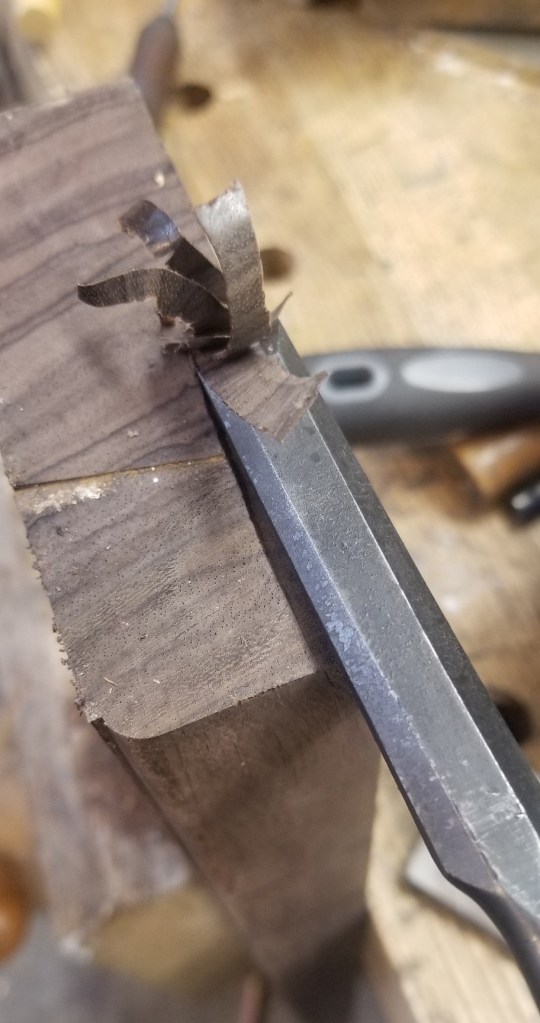
(note, the black oxide from rehardening may look odd, but rest assured, this is just a labeled stanley “Made in USA” chisel)
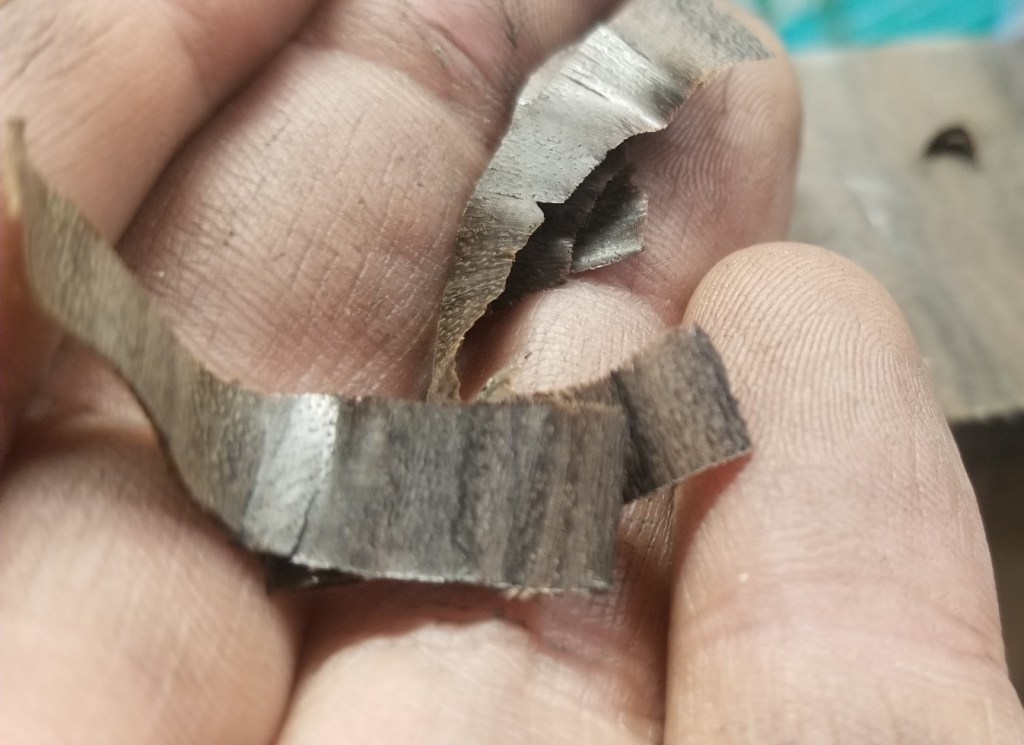
Paring was no issue (no resharpening has occurred), but silica in end grain will spare nothing. Before accumulating any damage, though, you can see the bright finish on the shavings – no nicks in them:
As a matter of illustration, this is what silica will do to tools. Note the scratches. This will sometimes terminate in nicks at an edge with the scratch following, or in the case of some, scratching that starts away from the edge. Good geometry will protect the edge to some extent and scratches can form without notching the actual bevel (but sooner or later one will take part of the edge with it).
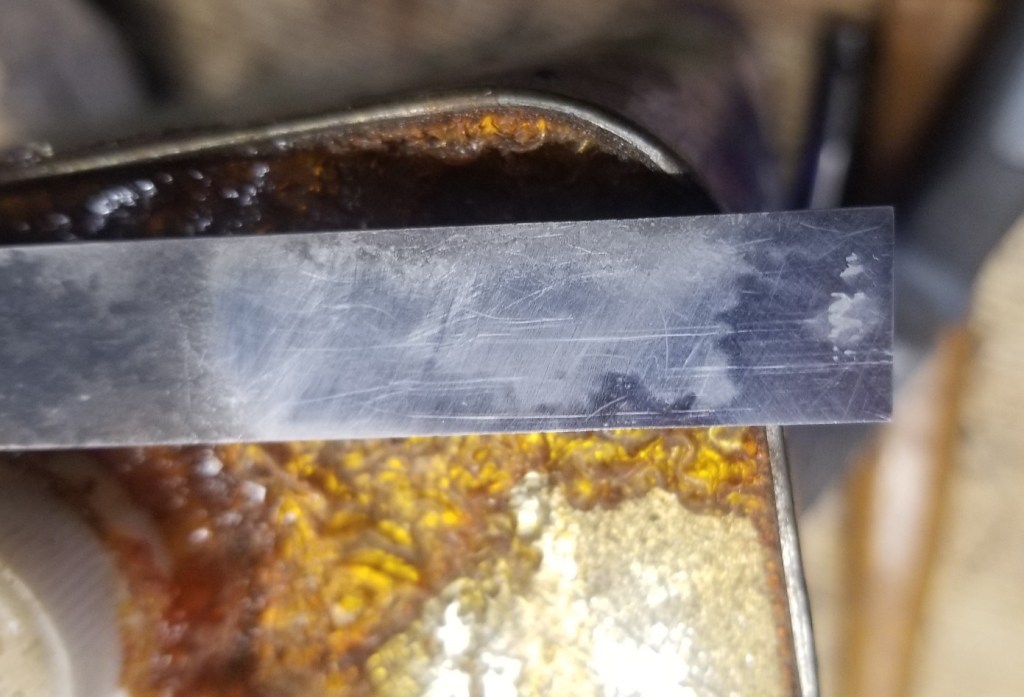

Is the edge nick related to the scratch? It’s hard to know for sure
If you had clean wood in the rosewood hardness range, though, this chisel would handle it fine. A stock stanley chisel could do it with more edge modification (a steeper initial apex), but less modification of the edge means better perceived sharpness.
What’s the Conclusion?
The chisel, like the prior plane irons, is delivered at a temper softer then could’ve provided. This was a choice by Stanley, likely to aim at their market. They could’ve used less capable steel, but chose not to. At present, the chisel is a match in terms of usability for anything marketed and would only be bettered by Japanese chisels (white or matrix steel like YXR-7). More importantly, is the assertion that the steel in Stanley chisels isn’t a match for boutique tools now correct? No, I’d prefer the result of rehardening here to anything with more alloying – it will easily hold its own in durability, but doesn’t have much in it that resists cool fast grinding and easy rehoning.
This wasn’t a difficult tool to reharden (but you would still need to be good at hardening to match these results, so this isn’t an encouragement to buy a plumbing torch and attempt this with canola oil – it’s a little more involved than that). But it’s not unruly like the laminated iron, and anyone competent with hardening in open atmosphere could do this. At near zero incremental cost (probably 20 cents of propane/electricity for hardening and tempering).
 Of Making by Hand with Wood and Steel
David,
I’m thoroughly enjoying reading and learning as you delve into your various topics. Very interesting, especially your assumptions as to the possibly “whys” Stanley did what they did, i.e. market driven factors, sharpenability, etc., much like today. You are covering good stuff!
As some point, could you go over the differences, specified as well as perceived, in quenching media, different oils, water, brine, etc…
John
LikeLike
Hi, John – I’ll make note to cover those. If you do hardening and tempering by hand, you can control some things (like really getting peak hardness out of the quench) that maybe manufacturers usually don’t like to do in the first place.
The one interesting thing that I think will show up over time is that the tools made after a certain point (1950? who knows) did actually move to less hardenable steel, so there’s really almost like two different eras to compare – the era of good materials, and then an era of absolute cost cutting where every penny was followed, and even things like the faster grindability of a lower carbon steel would’ve entered in (those could be as simple as having a completely automated grinding process.
What does seem to be clear with later sheffield tools is that even a dollar or two in a high end chisel (in current money) was enough. That is, if an extra $2 could’ve made a nicer finished and better tool (just, for example, with a round bolster and tang), the decision was to not do it because there was no market reason to.
LikeLike
Quote: “…this isn’t an encouragement to buy a plumbing torch and attempt this with canola oil – it’s a little more involved than that…”
I had to chuckle when I read that. This is EXACTLY the approach I took 15 years or so ago when I decided to try my hand at rehardening some chisels. I used my propane torch, a magnet, and a coffee can of rancid canola oil. I re-hardened an old 1/2″ Buck Bros. socket chisel and it worked resonably well on the first go. Feeling confident (cocky?), I gave it a try on a 1/8″ James Swan that was absurdly soft (it was soft enough to easily file). I failed…three times. I never could get that Swan chisel any harder than the factory.
Anyway, you mentioned the hardness that you ended up with on the chisel and the plane irons…but where do you think they started at hardness-wise from the factory?
I’ve never really thought much of old Stanely chisels as users because they all seemed to be a bit softer than many of the other vintage makers of the time. I’ve got two or three sets of old bench and pairing chisels that I’ve assembled from various vintage makers. I mixed and matched different brands, cherry picking the best ones that seemed to offer the best hardness until I had complete sets ranging from 1/8 or so up to 1 inch. Out of all the chisels across the three sets (30 chisels total), I don’t think a single one ended up being a Stanley. There are probably more Greenlee’s and Pexto’s in my sets than anything else.
I seem to stumble across tons of old Greenless and Pexto’s here in Indianapolis. They gnerally have pretty good hardness. Greenlees tended to make a longer and thinner chisel than most other American maker. They tended towards the English shape that you prefer, but of course they are socket chisels, so they are a bit beefier and not as delicate as the old tanged British parers.
I have a beautiful, old & complete set of Van Camp paring chisels that I bought at an auction about 20 years ago.
They are stamped with the word “RAOLA”. Their advertising indicated that this was some type of special hardening process. I don’t know anything about the process, but the chisels have a very nice level of hardness. Van Camp was a hardware store retailer and distributor in Indianapolis, so the chisels were definitely made by others. They sort of have a Greenlee look to them. I think that the term “RAOLA” adorned their chisels, knives, axes, etc., so I’m not sure that’s anything more than marketing.
Anyway…thanks for continuing your experiments. I’ve enjoyed following them on WC and now here.
-Bryan in Broad Ripple, IN
LikeLiked by 1 person
I hear you on the torch and canola oil – that’s what I also did to start. Luckily, with a piece of O1 steel for a small bullnose plane. It just worked right away so I figured it was smooth sailing. Housing heat with a can, exhaust pipe lined with blanket or using a “real forge” combined with parks has definitely solved a lot of hardening mysteries, though (a simple change in oil and suddenly everything is harder, and marginal things much harder). That’s my actual acid test – if you overheat something a little and quench in parks 50 and hardness is still lacking, the steel lacks what it takes to get really hard.
I’d bet that the swan was either water hardening steel, or just not high enough carbon or both. I’ve only had one or two of them and they were also soft. Stanley’s are always in the lower half, and the wonderful precise little buck brothers cast steel socket chisels are very fine but a little soft (I’ll reharden one of those now that I think of it). Some of the longer thinner buck chisels are a little harder.
Definitely like the pexto and PS&W chisels given a choice in the older ones – they’re a little more plain feeling and a bit harder.
Curious about the RAOLA thing, if they ever described the process, or if it was an attempt at differentiating or (often) selling a local brand at slightly less than something like stanley or english imports and trying to create some kind of branding differentiation to make people think they’re actually better (for chisels that we use, just using the same steel and making it a little harder would make that happen).
I rehardened one of those buck bros irons two days ago, but have yet to write it up. It proves what I think is the case with really low cost tools – it’s soft from the store, and it’s soft after rehardening. There’s just nothing there that has the potential to really perform.
LikeLike
David,
I you have any interest, I have a handful of Buck Bros. tanged chisels that I can send your way if you just want to mess around with them for science. I got them at a school auction, so they are a bit scabby. They are the thinly tapered model with the thin bevel edges that remind me of the English style that you like. They are all 3/4″ wide, and have about 3″ of blade left, but they are VERY soft. They would make an excellent hardening experiment. I don’t have much use for them in their current state, so I’d be happy to donate them for the science.
If you have interest, let me know.
-Bryan in Broad Ripple, IN
LikeLike
I’d be happy to harden them to see what the potential is as long as you’re OK with them coming back when I’m done with them.
I’ve got perhaps a dozen buck chisels (older) and then a whole bunch of the incannel gouges (older ones). Interestingly, the gouges are harder than the chisels across the board, and there is some correlation between tanged chisels and hardness (tanged are a little harder than socket).
if you want to mail a couple, we’ll have to figure out how to exchange emails without making them public (some of my old WC posts have my email). The only real risk is if they’re water hardening with bevels, they can warp spectacularly (But the worst outcomes can still be turned into any manner of small knives with regrinding).
LikeLike
I went back and looked at some of your old Wood Central posts over the years and didn’t find an e-mail address. You’re a bit of a prolific poster, so going through years of posts is a bit daunting
Do you personally moderate these messages here before they are posted to this board? If so, then I could leave my e-mail adress in a post here, and you could retrieve my e-mail address from that, and then reject the message so it doesn’t get posted. Would that work?
-Bryan
LikeLike