I tested plane irons 2 years ago to examine edge life claims. At the time, I also did some extra tests with different finishing stones, methods to see how much extra life is imparted to an edge with finer abrasives. It turns out to be relatively substantial, but also in planing effort – sharper is a large difference in effort keeping a plane in a cut, starting a cut, and in total feet planed). The test was actually a duration test, so I planed somewhere around 30,000 – 40,000 feet as controlled as is possible. The later posted CATRA testing on knifesteelnerds finds ratios much the same as I found.
Because some of the planing was with irons that have vanadium carbides, I used diamonds as the sharpening media. 1 micron diamonds was my practical finishing step – first on hardwood, then on a wonderful cast plate that someone provided along with the test. A cast or steel plate with such fine media needs to be really good – just attempting to flatten a plane sole and use it will not work – the texture on the sole will damage the edge somewhat during use and until you manage to wear the sole to a high finish, it’ll actually raise a burr.
Very few steels will raise a burr on 1 micron diamonds.
It turns out, they will also create an edge that outlasts any stone that I have (15-20% more edge life), but much like the discussions of the true applicability of the tests, in heavy work, you won’t be able to see that gain – only if you are planing continuous clean wood.
So, I haven’t really made any “official” classifications, but I’d call an 8k stone the fine standard, and the 1 micron diamonds, the standard for extra fine (and autosol on wood is surprisingly good at that).
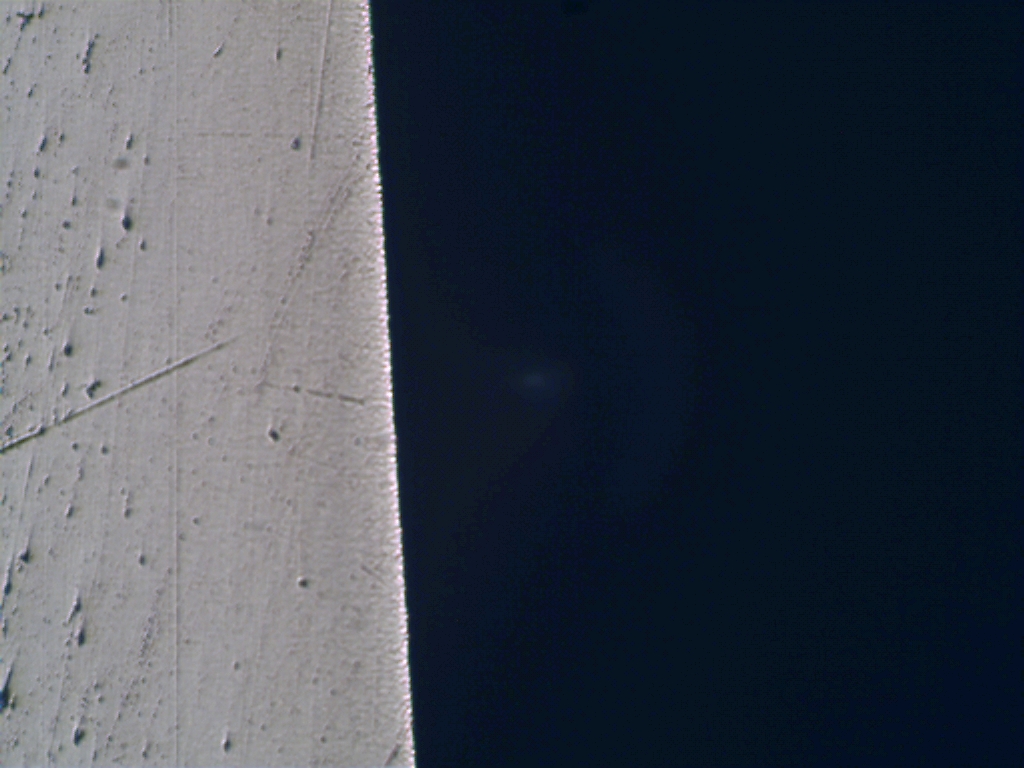
Great edge uniformity – even if a little tooth around the turn, the apex is crisp and wear under normal conditions is uniform (there is no unusual damage that occurs due to the edge being sharpened by diamonds, though diamonds 3 microns or larger do start to result in poorer edge life).
My apologies for the different looking image. Windows versions (changing computers) forced an expensive turret camera replacement and this picture was taken just before the prior PC gave up the ghost. Same magnification, though, and same length of edge shown in the picture.
The one nice thing about very small diamonds is that they will leave a very fine edge on anything, including steels not hard enough to hold it. Natural stones, on the other hand, have much larger particles and steel hardness will go far in determining how fine the actual edge is. The harder the steel, the slower they cut and the finer the edge. Diamonds are like a disposable camera – you just use them.
Typical Price at time of posting (2021): $10 for a vial of dry lapidary grit. Avoid pastes or woodworking suppliers for diamonds – you don’t get much volume compared to buying vials or bags of lapidary grit. Use with any lubricant (a thin oil is nice, WD-40 is fine). Just the same, avoid any “Formulated diamond lapping fluids”. Most specialty fluids targeted at amateur woodworkers are nothing more than hydrocarbons bottled in little bottles and marked up horribly.
So, if they work better (by edge life, and by sharpness), why don’t I use them? I just don’t love the feel of a cast plate, but its effectiveness can’t be denied. A heavy hand on a cast plate can also cause small nicking in the edge (too much pressure), and if there’s any ambient dirt on something like cast, it will notch the edge on the tool you’re sharpening.
 Of Making by Hand with Wood and Steel
You mentioned that you don’t like using the cast plate as the substrate for the diamonds. How well did the plates work out compared to hardwood? Also, how well does 1 micron diamonds on anything work compared to autosol on wood, which seems easier to work with?
LikeLiked by 1 person
I thought I may have responded to this comment, but I guess I failed to do that. Autosol on wood works great. I wouldn’t say diamonds on wood are an improvement except for two things – the film that autosol leaves behind on a tool isn’t there with diamonds – but that film is protective, so I guess you could look at it two ways. you can wipe it off, of course, but if you forget, the film left by autosol on metal will leave black marks on what you chisel.
The other advantage of diamonds is they cut everything and if you have just diamond flour, you pretty much make the abrasiveness as dense as anything.
But autosol is awfully good and if you don’t have steel with vanadium in it in some large quantity, there’s no need to buy a bunch of diamond flour to replace autosol and you may like using it less, anyway, as you suspect.
LikeLike
Thanks! Do you have, buried in this site somewhere, a guide to how to go about using the 1 micron diamond flour? I’m wondering about how to disperse it on the substrate – do you suspend it in some liquid or wax and spread that on?
LikeLiked by 1 person
I don’t think i do. I just sprinkle it out, like a small pinch of it, and then add oil or whatever lubricant you want in a drop and sort of work it around. if it’s in wood, it will obviously get pressed into the wood pretty quickly. There’s a 1-3 micron sort of more loosely graded flour on ebay or aliexpress – it’s called “bonding grade” due to the looser grading but it is super on wood, and insanely cheap. It’s something like $15 shipped for 100 grams of it. the 1 micron graded is more like $15 for 25 grams (100 karats), but even that is dirt cheap.
I like both – 1 micron will be decent on a hard substrate, though, and the bonding grade stuff will be super aggressive due to the top end of the spec. hard being metallic. Wood isn’t really a hard surface.
LikeLike
Thanks again! Say, an unrelated question but somewhere on another forum I think I saw you post that you were able to control fine dust off your grinder using – I’m trying to think of the appropriate term here – “remediation at the source”. There’s probably a lot of us who would like to learn more about that, if you’re interested in another posting subject.
LikeLike
So, control isn’t probably the right word, but greatly reduce. I use an angle attachment to the shop vac and then just took a dollar store large plastic bowl and attached the bowl and that sits under whatever I’m grinding. I have about half of my garage walled off with painter’s plastic and moving blankets to control dust, and with heavy grinding, the particle count could get to 400-500 in there easily – it’s probably not even good for your eyes. In either case here, I’m wearing a mask, but with that much dust in the air, everything gets filthy.
I connect a long hose to the fein, and sit that bowl on top of a camera tripod tipped (this is really sketchy kind of laziness, I guess) and the camera mount and handle form a wye and that lets you put the bowl attached anywhere.
The particle count with heavy grinding in the shop now is about 50, and the quality of the air coming out of the fein is 7 on the particle counter, so it does an enormous amount to improve the quality in the garage. In summer, if nobody is around outside (neighbors are nearby) sometimes I will have a fan on low gradually moving the air and the particle count drops drastically – it could be 10 or so in that case. But leaving the door open and grinding all the time may soon tire the neighbors, so I usually keep the door closed now.
the point of the bowl is to do two things – one give me something to aim at off of the contact wheel, and catch a lot of large dust so it doesn’t just get strewn everywhere and rust, but two, especially, to capture the smoke that’s created with heavy grinding. that smoke is probably the worst of what’s in the air, and it’s not visible with the setup that I have.
Very important is no wood no paper no anything in the vacuum doing this, even with a long run of those pigtails of metal made off of a ceramic belt go through the hose and are still glowing (not many but a few are) when they get into the vacuum and you can quickly have a fire that the vacuum is fanning. You’ll smell it almost right away because even if something is just smoldering in the vacuum, it’s exhausting the smell of burning wood everywhere. I didn’t think a 25 foot run of hose would allow any sparking material to survive the whole run still hot, but it can. Usually won’t, but can. I have a second cheap shop vac for all of the wood dust, and for significant amounts of shavings, I either take them out whole, or if they are a type that won’t clog a leaf vacuum, I use a cheap electric leafblower on vacuum to suck up everything else and reduce the shavings. It also makes the air dirty, but it’s not that bad and it’s an end of the session thing.
I think on the metal side of things, this run of vacuum hose really reduces airflow, and the metal dust in a filter (or the liner thing that fein uses) also constricts flow a lot – a two stage vacuum for this is far better.
LikeLike
Thanks! So, a question encased in a summary of what you wrote (to make sure that I’m getting the picture right): You have a bowl-shaped intake attached to an angle attachment to the intake port of the Fein, and then a long hose attached to its exhaust port to make sure what grinding dust and smoke does get through the Fein ends up a long ways away from the part of your shop that you grind in. Here are my two questions: (1) Does the exhaust hose actually exhaust outside? (2) Does the Fein have nothing in it, filter-wise, that will burn if a spark hits it? Ah, and the bonus question (3) Did I interpret everything you wrote wrong? Thanks again.
What is a “good” level of dust such that the air in the shop is healthy?
LikeLike
Ahh…ok, no. Everything is just a long hose going into the vacuum with the container on the end of the hose. It’s just easier to get it to put upward at something on the end of a run if the attachment is angled rather than straight. There is no exhaust hose. The plastic hanging in my shop isn’t sealed, so the vacuum can be in it or out of it – it doesn’t matter. My point about the air coming out of the vac having a particle count of 7 is just to make a point that the air is so clean relatively that it really doesn’t matter where it is. The air going into the vacuum is probably over 1000 on the particle count. There’s no wooden anything in the vac – no dust and no shavings, but the regular fein filter is in it, which is like a big inside out bowl cloth or fabric fiber type thing. It’s not HEPA. If something hot comes in, it may bounce into that filter, but the filter itself is covered with metal dust. Hot stuff would be mostly spent and just go into the bottom of the vacuum’s container. The only time I had trouble was thinking the run was so long that nothing would get into the can of the vac still with enough energy to do anything, but it created a smolder in the sawdust and I smelled it right away and opened the top, emptied everything and dumped it out. AS far as a good level of dust, if you have a good respirator on, it doesn’t really matter, but counts in the hundreds grinding steel and being able to see the overhead lighting cast a light beam through a light haze does make my eyes irritated.
There’s another problem, though – it takes very little time with that much dust in the air for everything in my entire shop to be covered with a black layer – every surface near the grinding area and in the summer even the garage door opening to the shop that I have open will get enormous amounts of filth on it as it’s parallel to the floor and the summer fan is blowing the light particles out of the shop with continuous flow.
I don’t know the answer in the very long term, but if I have point capture and the dust level in the shop is 10 or 15, I don’t usually use a mask. If it’s 50, I do. With just random particles, that’s not a problem, but I have a feeling that grinding dust is worse than general ambient particles or an outdoor day where wind kicks up dust or brings us wildfire smoke. With the count at 50 in extended heavy grinding, I really don’t notice much of a film on things and much of what would’ve settled or been thrown somewhere goes into the bowl under the belt grinder.
LikeLike
Thanks for clarifying David. That black film everywhere in the shop wouldn’t go over well with my landlord, understandably enough. I think, based on your answers, I’m gonna have to go with a preference for grinding outside, weather permitting, and for only maintenance-and-light-chip-repair grinding inside during foul or cold weather times here in Maryland. Will have to look into a quiet shop vac that has filters that aren’t super-flammable.
The other options would to either: (1) revert to sandpaper runs on a threshold made from man-made marble (marble dust held together by epoxy?) and just accept the higher cost of using paper; Or (2) rig up some sort of misting/wetting arrangement so as to make grinding sludge instead of dust. I’m not sure how that would work long-term with a late-model craftsman bench grinder, but it might work well with a sanding disk mounted on a drill press if I can find a way to contain sludge-throwing.
LikeLike