This isn’t really a guitar blog, but one of the things that I want to do along with continuing to make tools is to get better at making instruments and then branch out beyond guitars (potentially to violins and mandolins, supposing I have the nerve, time, money and initiative to do it in the future – at 45, it’s easy to tell that I have more focus and patience as a kid, but getting turned around thinking about something is easier. Or maybe it’s just also the case that with age comes more intolerance for mistakes and desire to not abandon projects)..
At any rate, this is my first carved top guitar. Indian rosewood top, limba back (to get good low/mid density one piece honduran billets these days is tough, and limba has the nice open low note when tapped that honduran mahogany does).
The neck is hard maple. The hardware is all good stuff (nothing cheap, but nothing weird, either – just tone pros stuff, grover keystones, bourns pots, good wiring and seymour duncan antiquities, which I don’t like the look of. Duncan makes these in “not distressed” version, but a guy who buys used pickups is also a guy who will get distressed when that’s what’s available used).

If this guitar ever makes it out of my hands, the instant assumption will be that the rosewood is a veneer over who knows what under…finding an 8/4 wide board of rosewood that I could justify was a stroke of luck. The equally showy maple cost very little and the limba was a steal (a 16″ wide dead QS board for $170 that I found on ebay years ago – but the board is big enough to make three bodies like this plus some and it’s a little heavy for limba, which puts it in the range where you’d expect mahogany to be).
The result is this guitar is acoustically snappy, filled with all sorts of little unwanted evidence that it’s hand done (that’s sloppy when seen close up, with little mistakes).
It’s a guitar that was designed to be made with carving/duplicator machines, pin routers and jigs and some hand fitting and belt sanding. And there are a few doofuses like me, I’m sure, who want to do it mostly by hand with bits by eye wherever possible.
Maybe it’s OCD, but I can’t build the “keep it moving and use the patterns and power tools” way – I’d need to build 5 at a time to trust at least a couple would turn out OK.

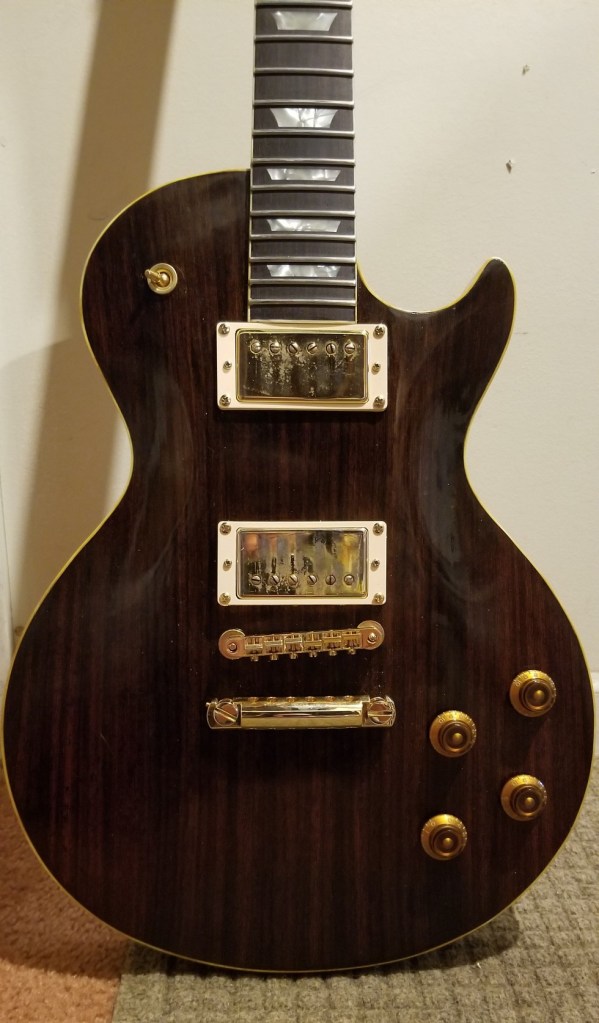

This guitar won’t satisfy purists – especially the peghead design. I didn’t want to copy Gibson’s open book style as I don’t think I’ll ever sell this guitar, but that may change in the future if I make a whole gaggle of things. Listing a guitar with a copied peghead pattern is not a good idea – especially if it’s one of a number of companies (Gibson is definitely one of them).
Working by hand provided the freedom to do a lot of this. planing blanks precisely, match planing top wood precisely and not fearing using a top wood board that is expensive and will be hard to replace. Using incannel gouges to cut the celluloid inlay, working to a thousandth or two when needed, and just to eyeball on others.
I can’t imagine what this would be like without purposely focusing on the freedom of working unjigged elsewhere.
Oh, and the finish? Buttonlac. It’s going to shrink a little and at a later date, I’ll take the stuff that sticks up off of the body and refresh any pores that appear.
 Of Making by Hand with Wood and Steel
This is beautiful. I don’t know much about guitars but can appreciate it being made the way you like to work. I appreciate you sharing, your philosophy of woodworking always inspires me since there is so much noise out there about the power tool way of doing things, or capitalizing on the hybrid way by making the machines do the “dirty” work. It’s nice to be reminded of how lovely it can be working by hand.
LikeLike
Thanks, Jonathan – I get that a lot of people don’t want to do contouring or rough work (much of the shaping work on guitars is also done by shapers, jigs, etc), but to do some of the work – even if it’s just a little, it teaches you so much about seeing proportions and working to what you visualize that I’d imagine we’d all make nicer things if we did some proportion of the work entirely by hand. It does untold things for fine skills, and the “my tailed apprentices” thing is just one of those mantras that’s flung on everyone when they start woodworking. It’s almost like branding – “here’s what you do, turn off brain and don’t think anything else is acceptable”.
This guitar has a feel and look compared to my factory guitars that’s a little different – it’s snappier, maybe partly due to more careful wood selection, but also due to not encasing it in a thick finish to be buffed back. It’s less perfect looking, but feels a little more human and is sonically lively.
LikeLike