(Take me to the summary version instead)
I’ve described some excruciating details of 1084 and 1095 and 80crv2. The last makes a superb experienced user’s plane iron, and actually good for anyone, but I get the whole market thing about wanting to plane 22 times as many feet before sharpening. It’s in conflict with understanding efficient planing. 80crv2 was an attempt to fix issues with 1084 and 1095. But after making W2 chisels last week (substantially better as chisels than 80crv2), I got the urge to make plane irons.
Why? the old laminated water hardening irons set the lower limit on footage planed, which sounds like a problem. They’re about 75% of the life of O1, sometimes slightly more. But they have excellent edge stability and the frequent sharpening and low abrasion resistance means sharpening stays ahead of nicking, which they seem to do less of in the first place. You get in a rhythm with such a thing and nothing breaks it.
O1 and 80crv2 stand out to me as good plane iron choices. I like a certain things in chisels (as a toolmaker, but you would come to appreciate those things if you do a lot of chiseling and are past beginner stage). W2 has those things. 26c3 has those plus some, and 80crv2 is pushing it to be good at them. However the bias toward apex strength (hardness) isn’t really needed with plane irons. We will be wearing the tip of a plane iron, no way around it, and other geometric options solve things that trouble irons – silica, dirt, minerals in wood, etc.
So, liking the feel of 1095 but annoyed by inconsistency with it and sometimes defects in the bar stock, W2 offers the one thing that 1095 was also missing – a trace of vanadium to pin grain size. You can chase the heat level up just a little before quenching and get excellent hardness without any visible (magnified) grain size change. It’s not scientific proof, but thus far, I have not seen any decline in quality in use if there is no visual increase in grain size in a snapped sample.
By not scientific proof, I mean that perhaps there is some loss of toughness that occurs before grain grows, but if there is, it hasn’t affected woodworking.
So, knowing that W2 probably won’t last that long planing, I still wanted to experiment with it to see if it’s the 1095 that I wish 1095 would be, and with characteristics like vintage laminated irons. I don’t fully know the answer to that, but i did get a strip of .094″ stock and have made two irons with it in the last couple of days. And I’ve had a chance to run them through the plane iron routine.
The Routine
I have a routine when making a new plane iron. Part of it involves snapping samples as mentioned, and then moving on to making an iron. I prefer to heat before quench as high as I can, though that’s really in a very limited range – it shouldn’t be taken to mean that i’m eating a sandwich and watching steel turn yellow. It’s a matter of seconds and change in color.
After hardening, you can check steel with a file, but you have to know what you’ll get. For example, M2 high speed steel will be harder in some tempering ranges than it was before it was tempered. AEB-L will not be as hard as something like W2, but it may temper to a result that’s just as hard despite that.
In this case, anything plain steel – like W2 – we want to see “bull hard”, as my grandfather would say. I rarely do this file test on plain steel, but W2 in this case actually has hardenability alloying further reduced from that in 1095 and 1084 to allow it to be manipulated when differentially hardening. You have to be quick. So, i did check it with a file and confirmed that in thin things like chisels (earlier) and plane irons, it’s an instant file destroyer when untempered.
I double tempered the steel at 380F, hoping this would result in hardness around 62, but hoping for a free lunch (a point or two harder would be fantastic, but more realistically, would probably be a sign of grain growth).
After visual confirmation that nothing took tempering colors beyond what’s expected, I’ll finish the steel (remove the scale), and then profile the top of the iron, flatten the back, and then grind the bevel and hone. This should all be quick – the wildcard is the back. if the iron warps almost none, the back flattening and polishing is two minutes. If it warps a lot, this may be ten. I’m experimenting with 10″ diamond rotary laps to see how long they last. I’m wiling to spend a dollar of consumables without a second thought on each tool or iron if that removes dealing with a hand lap to do this. The hand lap is messy, hard on the hands and high pressure and low speed can actually lead to burning the iron accidentally.
After setup and honing, I like to plane a couple of hundred feet with an iron with the cap iron set close, assess edge stability and then get a picture of the edge to see visually how even the wear is and get a look at the carbide patterning. That allows comparing carbide distribution and size with published micrographs. I should not have something that doesn’t match. An SEM at this point would be dandy – that’s sarcasm. They’re not impossible to find used, but a good visual scope is fine here.
If you’re thinking about making five irons, you don’t need to do any of this. You can make your irons, sharpen and use them and over time, you shouldn’t have a thought that you’d rather use a commercial iron. If that’s true, you did well.
A Time Out – My Process in Quenching– Deference to Flatness Hardness at the Same time
Steels like this that need an extreme hurry on the quench have a reputation for warping because…they warp. I used to use oil. Then, I realized that faster steels need a fast oil (parks 50), and eventually found that the result is better if the low end after most of the heat is soaked out is finished with water. The result is better meaning the steel is noticeably harder. Water itself is a no go unless water hardening steel is laminated or thick. Not the case here – you’ll find the cracks instantly, or later when you are preparing the iron.
And then I read and learned that finishing in the freezer will improve a little more, but there’s still the warping thing. And I made quench plates out of aluminum bar that I have around and filled a stainless paint can with propylene glycol (think something used in cosmetics, but it won’t freeze at my freezer’s max effort -30 to -40F, usually right in the middle).
The quench sequence goes like this – you may find something like this useful even if you take part of it.
Step 1 – bring the steel to black as quickly as possible after the heat – in parks 50. Parks 50 is fabulous – it feels like any other oil, but it will draw heat out of steel quickly even when it’s not preheated, and even when it’s in a cold garage. Depending on the microstructure of the steel, it may be a point better than heated vegetable oil, or it could be 5 better. I go a little past black, but not below about 500F or a little more. The objective is to prevent pearlite formation, which is what you do intentionally when annealing in ash – try to get a mostly pearlite structure.
Step 2 – two quench plates. Place the iron between them and stand on it for five seconds to try to constrain the initial movement efforts.
Step 3 – quickly get the iron in water to get most of the rest of the heat out ( you can throw the iron in the freezer right after this – make sure you’ve gotten the heat out of everything, not just the part you’re quenching, as heat in the remainder of an iron or chisel will work its way back toward the end and it won’t draw temper, but it will prevent conversion of the “soft bits” in the steel to stuff that will be hard and tempered back. This is at a level like micro clay, not like sand, but it’s still occurring on a very small scale). This is seconds, but if water is your stopping point before the freezer, you can just drop the items in the water a couple at a time and leave them there. The colder the water, the better.
Step 4 – for me, is to use the propylene glycol so that I can get as cold as possible faster, and then when a pair or quad or whatever I’m quenching is done, I’ll take the metal bits and put them in the freezer.
This all sounds idiotic and tedious. For each quenched tool, the time from getting out of the heat to getting into the bucket of P-G is less than 30 seconds. I’m in a hurry on water hardening steel – it makes a difference. The whole thing is a bunch of compromises, I’ll describe them briefly. The colder the end of the quench, the harder the steel. But just racing to it with no control (as in, leaving out the plates) will result in a lot of warping. So the first part of this is fast – in parks 50. I don’t have to worry about the oil heating due to small batches and because if the oil gets a little warm, it doesn’t make a difference – steel doesn’t finish in it, just start.
I’m chasing every bit of hardness I can get without growing grain and without tolerating warp. The only thing I can think of to chase a little further is the liquid nitrogen, and if I were lucky enough to live next to welding/gas supply, I’d just keep it on hand all the time. It would replace P-G in this case.
The plates don’t eliminate movement, but they lessen it a lot when used properly, and there may be some concession to hardness, but if there is, it’s small. The water prevents whatever is coming out of the oil and plates from heating up the final P-G paint can.
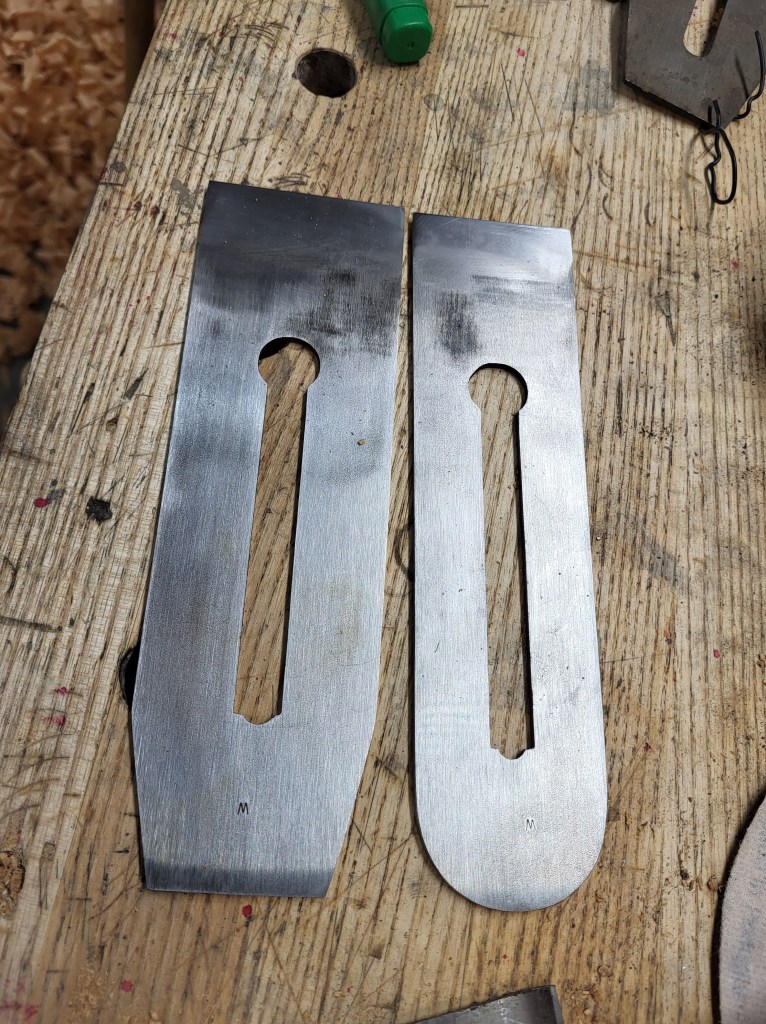
Since this has gone long already, just describing getting something in good shape to test, I’ll post the close up results for W2 in a separate blog post within a day or two. Until then, I can at least show a picture of the two irons. I used to not mark anything, but I’ve realized over time that putting it off until later makes things difficult! I use no other steels with a W, so stamping a W on the top of these irons is good enough for now. I’ll find my number stamps later – finding a source of 1% W1 is always possible in the future.
 Of Making by Hand with Wood and Steel
I’m not sure the level of effort this would require so if it’s anything too much don’t bother, but I would definitely be interested in seeing this sequence in a video sometime. I’m sure there are plenty of videos out there about it, but I enjoy your no nonsense format and simplifying things down to only doing what matters.
For me, I would just be interested in the basics of making a simple O-1 iron, hardening, and finishing it. I realize there are tons of different nuisances in the process depending on different types of steel, which is what you enjoy experiment with. I think just seeing the basic process would be really helpful in understanding a little more since I’ve never seen it before.
Thanks again for sharing your experiences.
Jonathan
LikeLiked by 1 person
I’ll do something with O1 at some point. O1 is a good choice in branded stock because the stock is excellent, it’s already ground in most cases, and it doesn’t need that fast of a quench to get full hardness.
I do “plate” it, though – just not as much of a rush with everything. It’s often advised as not a good starting steel for knife makers, but the reality is it’s better to start with than anything else. I get the sense that knife makers assume forging will be part of the process, and O1 isn’t as friendly to forging as water hardening steels. Steels like W2 here or 1084 can be forged without much risk of cracking, but O1 has a gap between nonmagnetic and the lower end of the forging range.
Of the samples I’ve sent for testing, my method works to get book hardness and toughness right on the mark.
There isn’t any reason to do heavy forging of anything with woodworking tools, so we don’t have the same concerns.
LikeLike