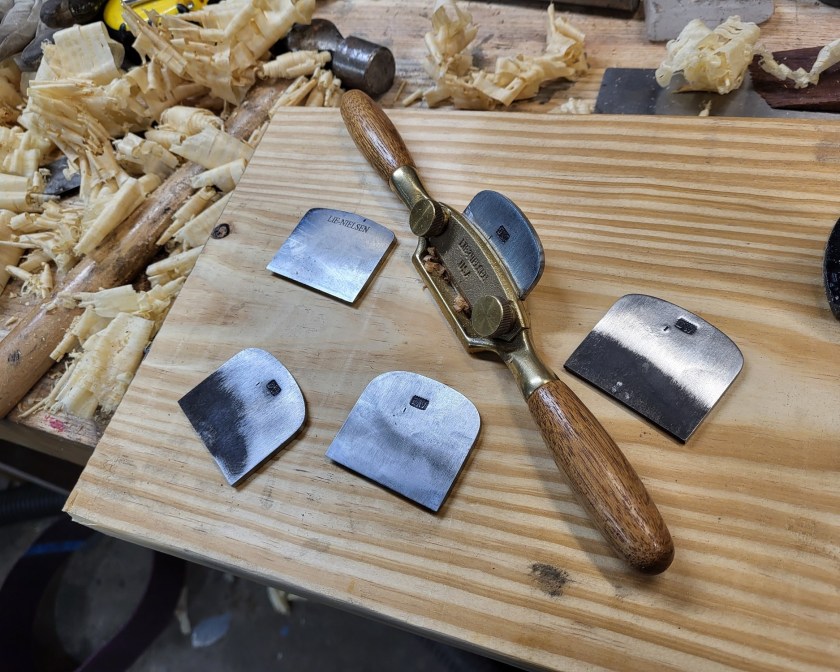
These little blades are a follow-up from the prior thread about “righting a wrong”. I have a distaste for the A2 iron that comes with these, and thanks to some folks mentioning they agree, I know others do, too.
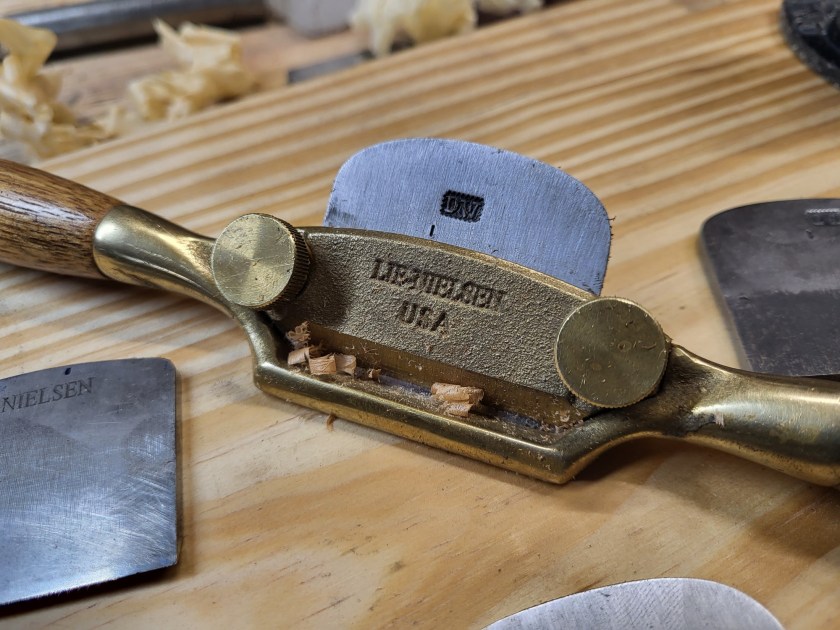
I have intentionally not pushed this blog anywhere or used any form of promotion, because I want the readership to be organic. If I get a couple of comments agreeing, it’s out of a very small group of folks, and that’s a good sign. Maybe not for LN and their A2, but that I’m not off the mark.
What’s the issue with A2? it’s got chromium carbides. Carbides harder than iron cards impart additional wear resistance, but in my opinion if you drop below diamonds, they do not offer a proportional increase in edge life, even if you ignore the fact that damage itself has to be removed as part of routine sharpening and if not, it because extra work.
Considering the damage to not be important is the reasoning of someone who uses a router and thinks about plaining. With a volume of hand work, stopping for anything other than wear is unpredictable and just a straight up pain in the ass.
There was a second incentive in making these – they’re starrett O1. A smarter man would’ve used 2″ precision ground stock, but I only have 3″ and the rest of my stock is oversize. the mouth is so tight on these LN shaves that I don’t think oversize stock would even fit through (about 0.135 for the belt ground .125 stock that I purchased. I probably should’ve asked. I’ll make irons out of it instead – it won’t matter as much.
What was the second incentive?
To use the induction forge and thermal cycle and heat and quench all of these without the use of propane. Everything other than stuff I’ve intentionally overheated has come out well with the forge except for one chisel. One I made for Bill T who used to post on wood central. Bill uses tools and gives me feedback. I value giving people who use tools good ones. For some reason, though bill has gotten about five percent of the tools and knives I’ve made- probably less – he’s gotten about half of the defective tools and knives. At least the price is good ($0).
O1 isn’t what I use for chisels, though I could. It makes a good chisel when done right and is far easier to get right than 26c3, but 26c3 has a crispness and hardness and higher toughness at higher hardness that just is hard to ignore. So, I will trudge on.
For now, these blades are what I wanted for the LN shave. I’ll figure out what to do with the others, but I think it is time that I start selling things. It won’t be on here – that’s not what this is about.
I have one other idea – since I ordered .094″ stock in O1 to make stanley replacement irons, and it arrived also well oversize – .0102-.0105, I will also make some thinner blades so the LN shave can finally “eat like the big dogs” on projects where the tight mouth isn’t needed.
I love the shave, it’s a great tool. At one point, I had the rounded bottom shave, but the rounding is very minimal and I sold it. I wish I still had it, but at the cost of the shaves now, it’s not in the cards.
At any rate, this is the kind of thing I always wished to be able to correct before toolmaking – to get things the way you wanted them. Without much effort or cost.
 Of Making by Hand with Wood and Steel
I’ve long resisted buying the Boggs LN shave because of the A2 blade. I don’t know why it never occurred to me to just get one and then spend half an hour making a new cutter…great idea. Now I have an excuse to buy another tool, lol.
Anyone with a forge should be able to make a decent cutter like this–or if they don’t want to, they can buy a really excellent one from you.
LikeLiked by 1 person
great tool aside from the blade and then limited depth from it, but both of those things can be solved with two separate plain blades. one for close work, one for not. It’s uncommon for me to use the LN shave *not* following a draw knife, even on guitar necks, if the wood allows, it’s nicer to start with the draw knife. so the second blade may be of limited use, but a swift chairmaker who is used to hogging off wood will find the LN spoke shave to be one where thin shavings in the thin mouth are so “no more than that” that they tend to wrap around the casting and need effortful removal.
the mouth is kind of like my single iron (house made) infill. I thought that was great until finding it was like riding with the parking brake on at anything over 2 thousandths thick. guitar neck roughing is a half hour prospect for me, so a minute or two extra with the spokeshave is not meaningful, especially if it prevents overcutting something due to tearout.
The shave itself is fabulous. keep the wax handy with their bronze, but otherwise, really fabulous.
LikeLike
I like the lie nielsen 102 a lot. Extremely useful both when restoring windows and making more sculptural slöjd. Jögge Sundqvist told me that he loves his, and I can understand why. I don’t like sharpening it though. It feels weird and takes longer than it feels it should. Now I understand why, It must be the steel.
LikeLiked by 1 person
it is, indeed. the chromium carbides are sparse, but some large, and they’re tough for carbides (less tough than steel – they’ll crack easier that is). Synthetic sharpening media is only just harder than chromium carbides, so they’re sort of doing battle with the stones. If the stones are a natural type, they can’t cut the carbides so you’re stuck rubbing them and breaking them until they come out of the matrix.
I’ve got pictures of this with vanadium in the 10V thread – the item being sharpened looks like a pebbled surface.
that said, there are some carbides in O1, but they are smaller and less intrusive, and turn of the century stanley stuff has fewer yet. You get wear resistance out of A2, but not in the same proportion as the sharpening resistance unless you’re using diamonds.
I’ll do an article on A2 soon. If people love it and they don’t mind what they’re sharpening, that’s fine. In volume work, it tends to become a pain – might as well get diamonds and use M2. I think you’ll be able to tell from my case study of A2 that it’s mostly used because it’s convenient to manufacture and common for diemaking and is “good” for blades, not because it’s great for blades. The ease in hardening, tempering and follow up grinding and how much room for error it gives can’t be overstated.
LikeLike