First of all, even saying that, I feel like responding to myself “nobody asked”. Which is true! But I haven’t posted for a while and there are plenty of things I’d like to post here.
So, it’s not as if I haven’t made anything or done anything, and nothing bad has happened, just tied up for spring and making and doing things that aren’t really notable in the sense that I don’t want to become yet another blogger who “has a really great idea to share!!!!!” because they learned something a week ago and compared it to little.
But what I’ve been doing that I’m not that great it and that’s been absorbing time is basically three things:
- Experimenting with baking japanning – the real stuff, not paint or tinted boat varnish. Turns out, we’ve all been cheated if we have read that it’s difficult or expensive – by people giving bad advice. The true baked japanning is easy and it’s fantastic.
- Trying my hand at making rasps. Not as something to make a lot of, but just got a flying burr one day (my mother would say “something flew up your rear and now you’re up and around”) thinking wait…with all of this heat treat knowledge and belt grinding equipment, i should be able to figure out not only how to make a rasp blank and stitch it, but I should be able to make a very good graver or stitching tool to stitch one. And the latter is true. I’m on the fence about whether or not I’ll want to make this sort of a relaxing activity because it’s easy to stitch a rasp to some extent, but a little less easy to do several teeth per second neatly on a rounded blank.
- And lastly – getting back to cooking varnish. Natural resin varnishes are superb. they are a much more durable and flexible version of shellac with a lot of variety. Steve Voigt is nipples deep in varnish experimenting for at least a year now, and he also skipped a burr across the state, even though he may never have intended to throw one, and that one flew up my rear and as of yesterday, I cooked varnish for the second time. And it came out not as good as I’d like, which is the best way for me personally to get motivated.
The Japanning
On the japanning – this sprung out of varnish. Japanning is basically a varnish (resin, oil, solvent) and the high quality stuff gets baked, which means the baking can actually do the varnish cooking and catalyze the reaction to dry all at once. If you’ve seen a black singer sewing machine, or stanley tools, same stuff. The recipe is a combination of gilsonite (natural very clean and high melting temp/good hardness asphaltum), linseed oil and turpentine. Asphaltum gets dissolved into the turpentine and then linseed oil added later. OR, it can be cooked into a varnish – I’ll not go into that further at this point but to say it appears that avoiding the parts that separate when mixed cold is attainable just by cooking the resin and oil together and making a varnish. You can search that further if you’d like – gilsonite powder makes this an easy task, but nothing related to making varnish should ever go on indoors – it is outdoor only and can be so stinky that you may want to wear a mask at the same time.
My attempts with cold mix are here, and I’m about to put the cooked version on a stanley scraper. This is so easy to do reasonably well that it’s almost sinful.
The cold mix is baked at 400-450F. Above that, it will smoke and potentially run, and below that, the oil and gilsonite asphaltum may not link, leaving you with a finish that isn’t durable and may separate over time.
Don’t substitute petroleum bitumen or roofing pitch or any of that. Those are softer resins and they are loaded with sulfur, so you’d get a soft result and a very very stinky house and probably a good dose of hydrogen sulfide if cooked in an enclosed area. No good.

The shaves above don’t look like anything special except they’re no longer missing japanning, but they feel divine and there is a durability to japanning that nothing else will touch.
There are so many ways advocated online to avoid making the cold mix and baking it that it really irritated me once I looked at this through the lens of a varnish. They often involve adding some colorant to expensive and very stinky marine varnish. it makes no sense to me other than that it’s just one more example of how we get enthusiastic or egotistical people in the woodworking community who want to be the source of information more than they want to provide accurate information.
The Rasps
There’s not a whole lot to say about the rasps. It’s not hard to make “a rasp”, but to make these, make the graver, and be able to heat treat them without destroying the teeth or having a warped blank is not that accessible, so I won’t go on about what it takes. It’s a personal experiment of mine, just something to add as an idle hands solution as it’s kind of relaxing and interesting enough to hold your attention if you can do it.
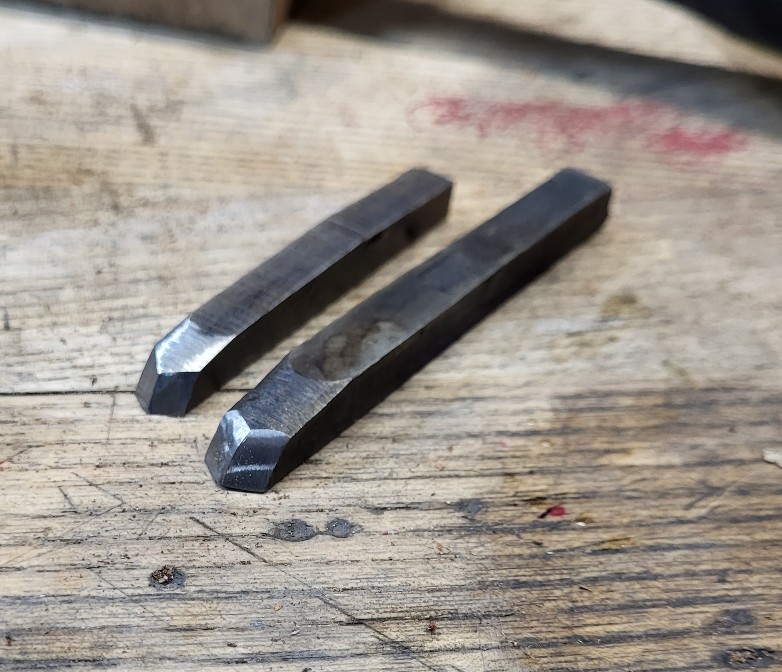

I don’t know that there’s much to read about making rasps. First is on the right, second on the left and third in the middle. They’re each a bit different but it’s safe to say I was still figuring out how to shape the gravers and what angle to hold them and how to not misstrike them and break the beak off on the curved side. A zillion tiny teeth sort of settled it at once. They’re hardened, and they work. And not reading a ton about it allows for finding what’s not so great.
The rasp on the right does have the tip bent upward to make handles – I wanted something more coarse than the gramercy version. it’s coarse. And I saw not long after that gramercy now sells a coarse version, too.
The one on the left with tiny teeth is great in hard woods, but they’re so close together that you have to stop once in a while and brush the junk out. The one in the middle is literally just a two sided coarse rasp for hogging. I’ll spare you my thoughts on the whole blogosphere telling people they should have a whole bunch of rasps aside from saying you shouldn’t have many if money is an issue and there are a whole lot of files that do the same thing as fine tooth rasps. Another irk, that this or that blogger who wants to be the source of information or who works for magazines and feels that it’s more important to convince you to buy tools than it is to give you good information – well, you know. “You have to have these, and a whole bunch of them”. you don’t. I’ll bet there are a lot of French rasps sitting around idle because some Pop Wood article or blog said people should unload $800 on them.
I think I’m mostly through this short experimentation phase…I left the varnish out of the discussion here. Maybe more on it another time. I think it’s worth doing if you’re interested, but it doesn’t need to be added here.
 Of Making by Hand with Wood and Steel
Great to see a new post.
Varnish making intrigues me. I know more about linseed oil and linseed oil paint than I know about wood working. When I started looking at US and UK woodworking online it always bothered me to see someone using expensive and beautiful wood and the slathering cheap and nasty “boiled” linseed oil on it. I have also seen people complaining about the smell of linseed oil or that it has gone bad or isn’t hardening properly, which are two signs that you are using bad stuff. The smell thing could however be a sign that you should get a hobby that doesn’t include naturalism materials. There is something weird about people spending tons of money on machinery, tools and wood and then being unwilling to spend money on a good linseed oil.
I realise that i am being spoiled with the availability of good linseed oil here in Sweden.
When I saw Steve Voigts post about processing the oil I became very interested. One of my favorite products are tre refined linseed oils from Selders in Uppsala. Really great stuff with everything except the hardening fatty acids removed and then prepolymerized to different viscositys. Mikkel Selder has done a lot of research on historical methods and then on how to reproduce the results with modern industrial processes. I think what Steve Voigt does is similar and I am eager to try it out during my vacation this summer when I get
finally get some time for hobby work.
I have a 25 liter barrel of raw linseed oil from Ottosson in my garage that we bought for use during our renovation of our house. My partner put in the order and when I asked her why she bought a barrel she just told me that they were out of 5 liter cans, and since 1 liter is too small, linseed oil doesn’t go bad and that it is always good to have some linseed oil around she ordered the 25 liter barrel. I of course agreed with her completely.
Have you tried heating linseed oil to 130° c before applying it on wood?
LikeLiked by 1 person
There is some refined linseed oil here that’s alkali refined and then the acids that aid in color binding (for pigments) and film flexibility are added back, I think similar to what you’re mentioning. I don’t know if there are any sources of pre-polymerized oils in quantity like you would get if you boiled (or lower temperature, just heating and holding at a below-smoke temp) or blew air through linseed oil for a week or two.
Oil industry distillates and now water based stuff dominates our paint supply, and linseed oil is a small market, so you have to go to artist supply, food supply or restoration supply specialists to get things in quantity – but if you get to the last two, you can get it in ridiculous quantities if you’d like.
I have ottoson oil as well as some other oils that are raw or were sold as 100% cold pressed flax seed. They all seem similar, though the food oils are lighter in color than the swedish stuff and even though they say they’re unrefined, I think they go through a process of filtering or something so that they have good clarity.
In my varnishes, they’ve all been about the same if raw. That’s all of two batches of varnish, but also asphaltum. the rag from the ottoson when washing is bigger, and it’s about the same price as any refined linseed oil here, so there’s no reason for us to not get the “good stuff” from sweden.
too, it’s possible that tried and true danish oil here (which only lists linseed oil and is from steve’s interviews with JR, potentially just a pre-polymerized blown and heated oil) would be pretty much ready for use in varnish, but the retailing of it is crap. It’s either from woodcraft (plus shipping plus tax makes it about $100 a gallon) or from other drop shipping sources for the same cost.
i think the artist and restoration market will make it so that it’s always available here (the swedish stuff as well as refined linseed oils) without paying the extra cost of the food labeled stuff, but it’s definitely not going to be in our large hardware chains where the push is to get everything to water based garbage.
Haven’t applied it heated yet, but my objective in most cases is to have a finish that doesn’t penetrate much. My house is masonry without wood trim, so other than the garage door, I’ve got no exterior facing wood.
LikeLike