Scraping Planes

Just a one-off sideshow that seemed interesting. For framing the discussion narrower than generalized, I’ve typically flattened any plane that I use to be close to a starrett straight edge, but with a combination of files and sandpaper. The usual is to file most of the bulk away, confer the results with the lap, check with the straight edge and then try to have the tail and the front tip of the plane slightly higher than the rest of the sole. I’ve seen comments that this makes the plane the same as a plane only as long as the flattest part, but that’s a false assumption based on the idea that the wood is already perfectly flat, among other things.

At any rate, the starrett edge and feelers allows quickly getting to very close to flat. Within LN’s specs if you’re doing your job. that may lead to question, which is how to file the center of a convex plane a little hollow, because if you’ve done planes that are banana, it’s hard to make a convex plane flat. One that is contacting a surface on the outside perimeter is much easier.

The answer to that is either using a flexible file, or a bastard file and turning the edge up a little bit to use the curved area at the edge of a file. I don’t mean like perpendicular to a plane, but lay the file flat, and rotate it the tiniest bit and then draw file down the center of the plane with the curvature. It will hog material off spectacularly.

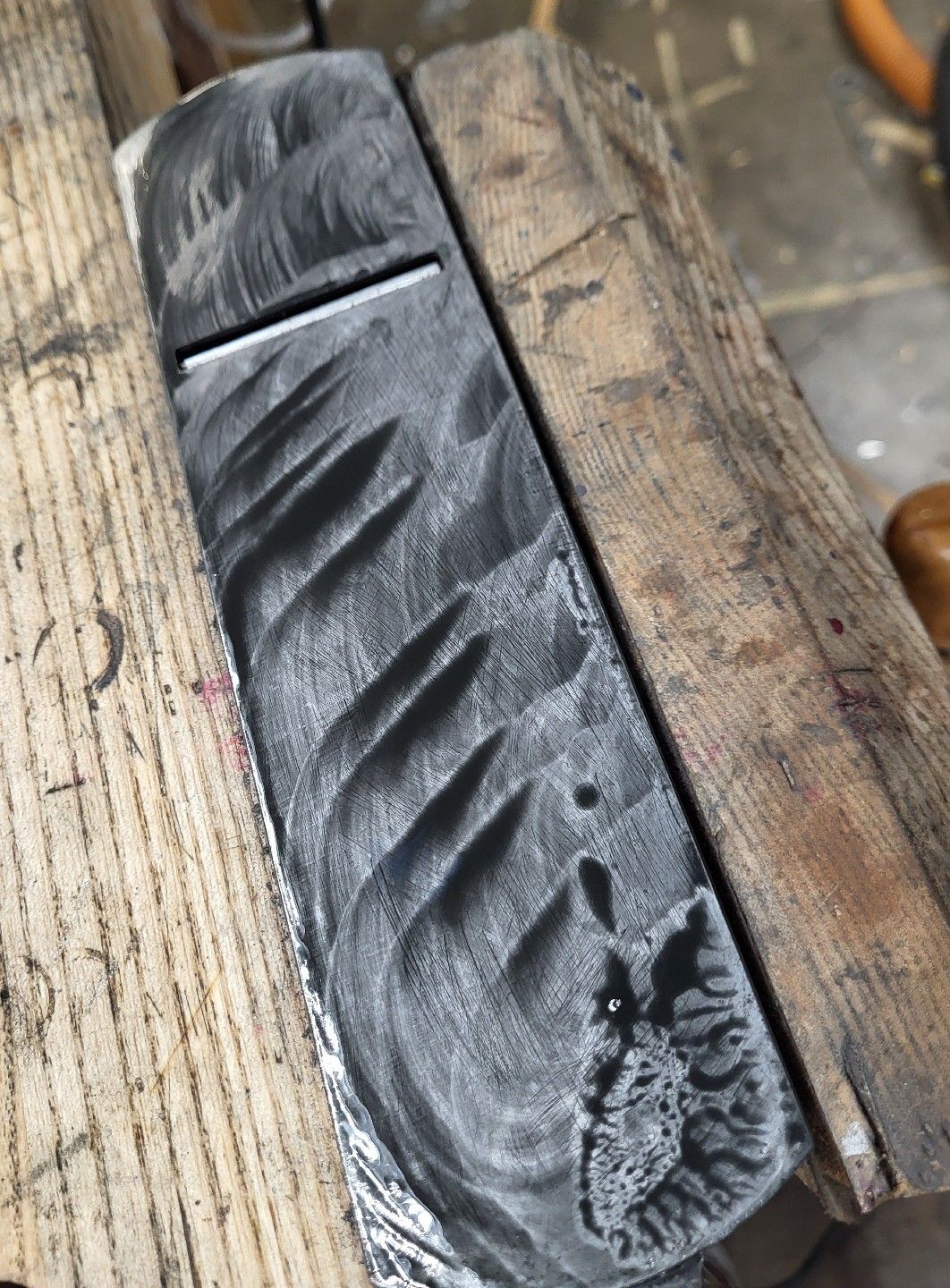
At any rate, the results scraping two planes quickly – that had already been flattened before, are this:

Notice, the bottoms aren’t neatly done like you’d see on machine ways, they’re scraped off using an anderson brothers scraper with a steel (not carbide) insert.

Rather than going into things at length, the video does a great job of describing what to do. I already have a 12×18 reference granite plate from eons ago. MSG or whatever the lower cost machinist supply place used to be offered those big near 100 pound plates for about $70 shipped, and I bought one for applying abrasive paper and never really did use it for much

I’ve cleaned this off completely since, but it sits on a bench that’s used to sharpen stuff and support a machinists vise. Realistically while making tools, I use the IM313 which has been stuffed to the far left in the photo and the rest of the surface just turns into a junk pile.

Generally, we have vises, and I have a leg vise, so if you watch the video above, there’s no need to create a special holding box. And I don’t have prussian blue, so I made marking fluid or whatever it’s called using a thin oil and 0.5 micron green chrome, which took about 2 minutes and didn’t cost anything. If you don’t have stuff to do that, buying the right thing is a better idea.

The fellow in the video mentions carbide, but the scraper that I bought doesn’t have it. I found pretty quickly that a 150 grit belt and a stiff swipe across the belt sander refreshes it. I don’t need carbide on the plane on the right above (Stanley), but the plane on the left is a Marples plane that, frankly, continues my belief that really nobody else made planes as well as Stanley did. This marples plane is older, the casting is bonkers hard and it was twisted. To top it off, it has the pain in the ass overlook of having a lever cap lip that’s too fat to fit in a cap iron screw, so when you’re working with it, you always need to have a screwdriver laying around to take the iron and cap iron apart. The second plane is hard enough that it was a bit of a pain with the steel insert scraper.

At the outset of this, I marked one of the smoothers that I lapped. I’d expect to see contact in the center of the plane and not at the ends because they’re a tiny fraction above. Left to right, you will generally see some convexity, but it’s OK when you lap a plane as long as it’s not enough to affect iron exposure. If it becomes that big of a problem, it’s back to the file trick mentioned above to hollow the plane a little and lap it out.

What I made is far more pigment dense than prussian blue, so it looks thicker than it is. The dimension of the green stuff is probably a small fraction of a thousandth of an inch, but I did work it thinner than this. it’s doing its job accurately here, though. Flat around the mouth and front to back and falling away a little at the sides.

This plane has no performance issues and was just lapped as I recall. It’s not my daily #4, but as mentioned, I don’t keep anything that’s not a jack plane laying around unlapped or untested.

Scrape the green:

not a great picture, but as you go along, you get to the point that the whole surface ends up looking much more broken than this.

After each step, I followed the video above and stoned the sole with a washita fingerstone.
That removed any burrs and abraded just a little off the tops so you could see that the stone was reaching something in every small area. As the video mentions, even little burrs could affect where the next mark shows up.

Most of the markings were not as bold as the second picture above either, I’d probably just reloaded the stone surface a little bit.

When everything is done, the sole looks like this:

There is a neat and pretty way to do this, and I didn’t do it because it’s not the point here. The scraping should be done in directions that don’t match so as to not create a bias or rows, but even that isn’t that important for woodworking. while getting the hang of the steel insert, I could tell that damage to the edge of it that occurred going across something on the plane sole would then create a burr that made more marks. And the shiny little squiggles are due to some piece of grit that I picked up on the washita stone.

But…the whole sole at the end of this is now light-tight to a starrett straight edge. I looked at the result and though it was pleasing to look at.

It took less than an hour to do the initial lapping and the scraping here. I think the lapping is time well spent. Scraping here is a skill I’d like to have if it’s not too time consuming, and in some cases, it’s less mentally taxing than it is dealing with a glass lap and trying to figure out what is right if the lap and the straight edge don’t seem to be in agreement.

Does it make a difference in performance? In this plane, when planing, i couldn’t tell any. It’s a smoother and faults were already removed. Lapping a smoother properly is absolutely worth the effort, and even if it’s twice as much work again to scrape the plane and get to this point, it’s hard to regret that. It’s far worse to work with a plane in a longer term that’s missing efficiency from faults on the sole.

I have enough reference surface length to scrape a #6 and will do one and see how that turns out. neater work and decorative flaking is very interesting looking, but i think doing this neatly vs. getting woodworking flat is many orders of magnitude above just this simple work.

Crack Addict

OK, before anyone thinks the title is drug-related, it’s about cracks appearing in forged tools – especially when pushing things.

It’s been a while since I’ve posted. I have traversed reddit and other forums for a little bit in the interim and I guess when I stop and think, it’s still a waste of time. It’s tempting to try to offer suggestions and then when I think about what caused me to consider the UK forum a waste of time – it was one particular interested person who asked me for information at great lengths, and I thought about it afterward – what’s the chance they’ll ever actually follow through after all failure factors are considered. Probably less than 5%. Never heard from them again, but that’s expected.

That break also gave me some time to realize if the purpose is to post things that are helpful, after this, it should be shorter blog posts and just puttering around in the background and making this more of a webpage and less of a blog. I don’t intend to market the page and have no long term goals other than just laying things out in blog posts. The ability to blog and use widgets is something I don’t want to pay for – that is, those widgets making organizing old posts more easily, and they’d still be too long and rambling. So pack that away.

I’ve made a gaggle of W1 steel chisels and I just find it’s good. I find 26c3 is great. I want great, but 26c3 is not available in rods to fully forge a chisel – it’s available in flats. Analouges like 125cr1 definitely are not as clean when you snap samples and at first, I thought “hmm…..” because it’s easy to assume a high cost steel and a lower cost version chemically similar is a matter of one retailer or maker just hitting their “mark”, so to speak. I would be the mark in that case.

However, some further looking finds that there are things like VAR steel and other remelting. VAR means vacuum arc remelting. As I understand it, the bits that are not fully dissolved uniformly (dissoluted?) end up going through a second controlled environment melt and the result is a sample of steel that actually hardens a little easier and also shows up as cleaner under the scope. Does that matter in a chisel? I don’t know the answer to that yet. But it absolutely can be seen.

26c3, by the way, is remelted, though it’s not vacuum arc – it’s the other type and I don’t remember the names. My interest in terminology and quality doesn’t go to the “if it were a category on jeopardy” level or “look smart among your friends”, but more related to what should I buy? I don’t have the time for romantic escapades into spouting the right words for everything and knowing all of the proper names (and having the t-shirts like a cool youtuber would).

WTF does this have to do with anything?

Well, W1 makes a good chisel. I want a better chisel than can be bought, and not just in shape. I think I can make a chisel that will appeal to someone with experience in terms of shape, proportions and feel. The bar in the market is low to keep manufacturing costs down.

But the combination of sharpenability and stability in the edge in heavy use should also be better. W1 doesn’t seem to be a match for 26c3. It’s almost there and maybe an insane heat treatment process would get it there. My post-forging process is already about 7 heats, sometimes 8. This sounds worse than it is, by the way. With an induction forge, these heats are probably about 2 minutes total time per chisel actually being heated, and then rest time – but if you’re doing more than one chisel, say 3, there is enough rest time to work almost continuously from one chisel to the next.

So what are the round bar options vs. giving up and going back to flat stock? O1, W1 and 52100.

52100 is not my favorite for plane irons, but I know in chisels I also don’t like it if it’s not high hardness. 62+. Below that, it’s too tough and the edge will deflect a little before breaking off – something I don’t care for and good older chisels also don’t do. If you push it, though, you can see high hardness (stronger edge, but less tolerance to bending) and less toughness.

I think W1 is lacking in toughness. It’s not difficult to get it to high hardness.

52100 hardens a little easier, but less easy than O1 by a long shot. However, this interferes with my favorite quench – brine. Brine is a bit harsh on it, and if there is anything going on in the steel that might propagate cracking, brine is going to bring it out. However, I cannot get over the feel that brine leaves in a steel – it’s a very dry excellent feel for a chisel vs. a bendy foldy whatever you may get from elsewhere, and parts of the chisels going into the quench.

And that’s the problem. it results in things like this.

a spectacular crack right along the top of the bevel. No others looked as brilliant as this one.

A more subtle crack, this one is in W1, actually, but similar to what normally shows up in 52100

Figuring these things out with less shop time than normal prevents me from having any smart-alecky things to post.

Starting with less pretty 52100 from Jantz and the finding a cleaner type actually improved hardenability of the steel, but adds a level of skill needed then to avoid doing things in forging that will leave seeds for cracking that wouldn’t occur in a slow quench, and then taking some care during quenching to emphasize max hardness on the business end of the chisel and relax things just a little toward the shoulder and the tang.

Giving up on the characteristics of bring quenching in chisels just isn’t going to happen. Not only does it make the chisel more crisp, it also doesn’t stink up my shop with smoke.

I think this is a problem solvable with skill and experimenting and have hardened three more chisels after cracking 2 of 5 initially made with 52100.

Oh…I forgot, there is also A2 and D2 rod, but I’ll quit making chisels before I’d ever begin to consider those.

I’ve made another 3 after seeing this cracking and adjusted a little, we’ll see how it goes – they are hardened but need to be finished. Which doesn’t sound like much, but water hardened chisels are just a wedge out of the quench and need to be finished to flatness and size, top curvature and side bevels ground in. All of that is done with a chisel that’s already fully hard.

I’d be plenty happy with a 1 in 10 failure rate in terms of cracking if the 52100 efforts yield a measurably better chisel that’s approaching 26c3 flat stock chisels.

Brine and Forged in Fire – They Say Bad Idea

If you’ve watched Forged in Fire you “know” nothing should ever be quenched in water because all forging oils are specially engineered for your goodness and so on. There are a couple of things at play. For plane irons, which are thinner and wide and flat, I wouldn’t use brine. I haven’t tried yet, either. The thin arrangement of plane iron cools to the center quickly. On water hardening steels, it’s not quite so automatic. You’re chasing getting the steel cool and if there is a center that’s cooling slower, as the outside cools, the heat travels from the center into the outer layer slowing what the outer layer is doing.

Knives are more like plane irons, but longer. if there is a thick spine to deal with, it’s usually not at the edge and under hardening of the spine and full hardness for the last 1/2 of bevel is probably a nice compromise. On top of that, the forging that’s going on is violent and often inaccurate on the show. Questionable forging followed by brine in a knife would be a good way to “go home”, as they say on the show.

If a bench chisel is 5.25″ below the bolster, we’re really hoping for 2″ or more of the chisel that’s uniform high hardness. To me, that’s everything being within a point in that territory. We also appreciate a balance of hardness (strength) more than toughness, at least relative to that same balance in knives.

It’d be dandy if they actually provided the post-temper hardness of the results on forged in fire, but they don’t. It would be interesting to see, but for anyone actually making things, you’d also want to see a snapped sample of the final item (the show has to keep them, anyway – go ahead and break them so we can learn) so that we aren’t oohs and ahs about a high hardness sample that has grain like beech sand.

I’ve talked to plenty of other folks who have said the same as I relayed with W1 – W1 likes brine. the light cracking I have in a pair of W1 chisels is from really continuing to forge after the steel has almost entirely lost color. You just shouldn’t do that. 52100 is like that same principle, except the lower range that you have to stop forging is higher -it cannot be allowed to cool to any shade of red and still be taking hammer blows. Most information I see suggests not shaping the steel at all below 1650, and the upper range shouldn’t be above 2200F.

Does it make a difference to work in a narrower range? I don’t think so. going back to the heat timely is probably a lot like sharpening woodworking tools. It feels like you’re getting more done if you don’t stop at the first sign of declining performance in a plane, but you’re really not.