If you’re reading this, you may have seen the Youtube video that was superbly done by someone in England. That being a very clear description of scraping cast iron.
So, I scraped 7 planes. Two infills and five Stanley planes. It may have been 8. I planned to scrape 1, but 8 just happened.
I had two Starrett straight edges, and now three. My 24 inch straight edge is a walk about for the shop and it has seen a lot of wear. There’s really no abuse outright, but it’s a $30 (square edge) and the corners are what you try to use if light does not go under the flat edge. And with a blunt square edge, it’s easy to get something flat enough that no light shows. Those edges take wear and it gets a little difficult to tell if you’ve addressed it cleanly with fine files and other tricks to clean it up. One of the easy things to do is check a surface with two parts of the straight edge. Scraping afforded the ability to get things flat within a fraction of a thousandth of an inch and start to see these differences.
So, I went out looking and found a starrett #386, thinking it was a #385 at less than half price, but it’s actually a lighter version for drafting. Fortunately, that’s not bad. But I got it for about 85% of going rate for a new one vs. 40% of the cost of a #385 (both being bevel edge). They have the same straightness guarantee, and I kind of like the lighter weight. It’ll be useful in the shop.
So, having gotten off track already – what’s the fourth? A 4 foot #385 that I bought new a while ago that never gets away from a carpeted area – it’s a reference until or unless something spoils that, but it’s also pretty heavy. And they have become off the wall expensive, so keeping it as a reference is fine.
Back to the planes. it’s very easy to scrape a plane to the point that a 0.0012″ feeler doesn’t have a chance. I found the bias I expected – that the toe and heel on my planes were above the mouth – and I’d also grown accustomed to liking that. It affords some control that makes planing a straight edge just in the process of planing off roughness routine – no extra staps.
A Dead Flat Ground Plane is Not Better Than Properly Lapped
What is properly lapped? Figure on something like a stanley 6, you can just get a .0012 or .0015″ feeler under the toe and heel using a good straight edge. This is a small number, but it provides a very practical benefit. When you use a tool room granite surface, this level of error looks enormous, but it also doesn’t take that long to scrape out, which is where the 1 became probably 8.
Can I tell any difference in use? I have to be honest, I liked the planes a little bit better before scraping, except for one or two that I was lazy on and didn’t finish the lapping job. For years on the forums, we have heard that you can’t do anything practical to a plane that compares to a surface grinder. Since I have quality straight edges and feelers, I could quantify what kind of error I was creating (intentionally) when lapping, but you may recall if you’ve read any of my conquests that I would also file the center out of a plane draw filing if it was that far out or already convex.
A person with a file, knowledge of planing, and a good straight edge will give you a plane that will suit you better than someone with a surface grinder. A person who doesn’t have that knowledge could lap your plane into a banana.
The idea that you can’t address cast iron or steel, even significant amounts, by hand, is bullshit. I get tired of reading the sentiment from people who don’t have experience with both types of tools – one properly lapped and one surface ground or 10 of each, or whatever. It’s usually someone with knowledge of something other than woodworking, be it manufacturing and testing things (like a lab engineer) or machining. I never see a legitimate long term hand tool user ever muse about machining being something that’s needed.
Rather than only scraping, as i’m getting close to a scraped surface being flat, I’ve followed each repetition with some focus on some light lapping of the tail of the plane being scraped. It’s a tiny amount of insurance that the tail end isn’t dead flat or even a miniscule amount low, but even just that little bit makes the outcome better than flat to the reference surface. Flat to the reference surface end to end is practically lightfast on the starrett straight edge, even leaned, edge to edge and corner to corner. An example group of pictures follows with a Norris No 13 panel plane.

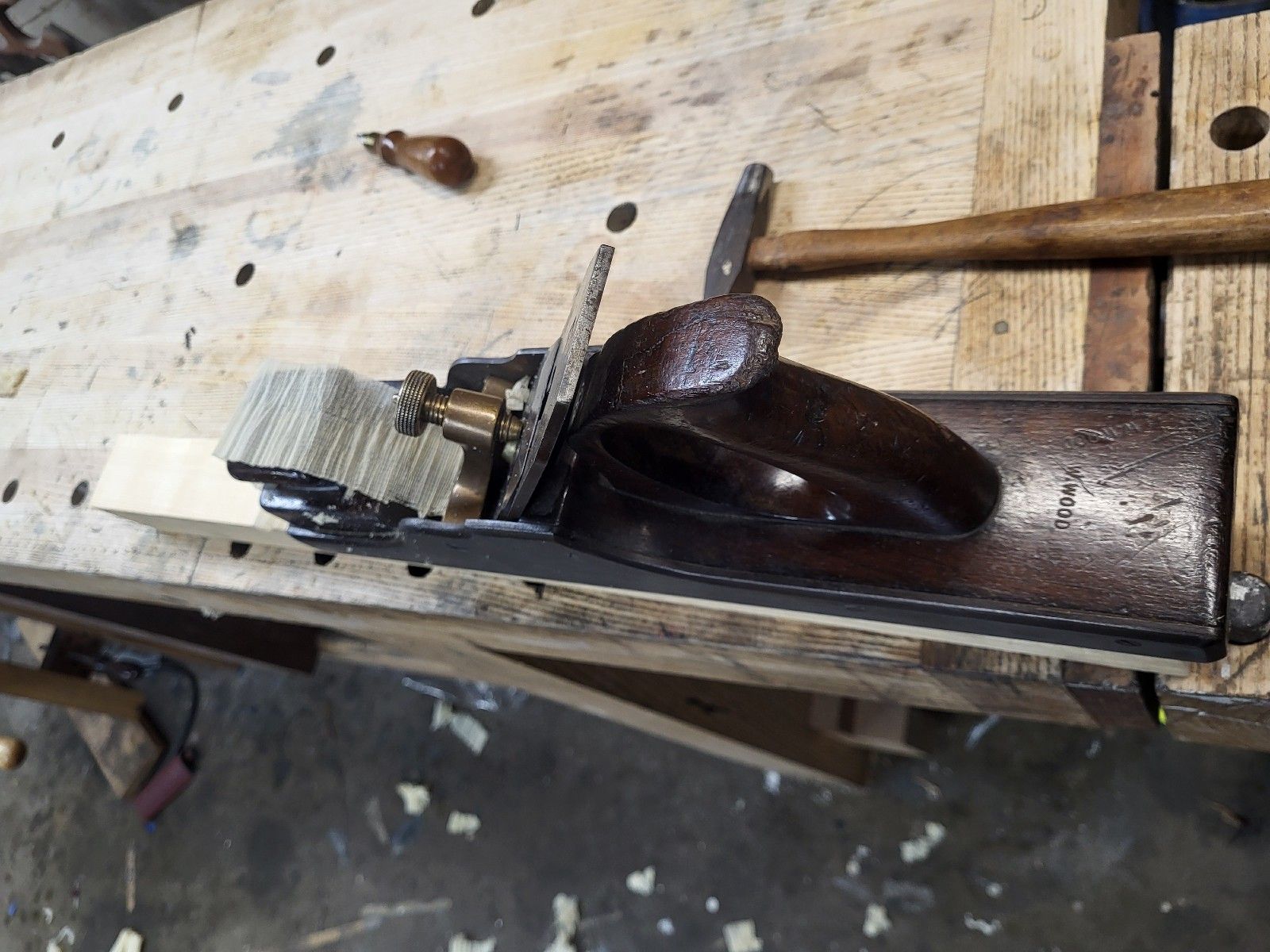


Those pictures just show an iron that’s quickly sharpened fine india, hard ark (not the most expensive kind, slightly more coarse) and a quick buff strop. The wood is yellow cedar, though it doesn’t really matter what it is. A lower angle plane would be better, but this is just a quick thing for feel of what the plane is doing as the tail end comes to the wood. You can’t feel it, but I can tell there’s no magic here that will result in better function. The last picture is an attempt at showing a reflection on the planed surface. Of course you’d expect this, but the improvement in cell phone cameras really makes these pictures disappointing. The reflection is glare and the camera really won’t tolerate it, even in manual mode – it’s just blurred.
Interesting things I found
My lapping did leave the planes I lapped slightly bandanaed, but less than my finest feeler in most cases. That was filing and lapping most of the time recently, because it makes it so easy to prevent more banana effect, and the file is *really aggressive and fast*.
But, I also found that I had slight convexity across the width of planes and my lapping made the “error” slightly on the diagonal as the reference plate showed. I say that partially in jest, because it was an error only in the sense of being able to measure something other than straight and true. In reality, it was a nicer plane to use, and all of the absurdly thing shavings I’ve shown were with those hand lapped planes. The scraped planes don’t really do anything better, and the loss of the ability to ensure the far end of a board doesn’t fall off just by pressure variation in a through stroke is a legitimate minus.
So, You Shouldn’t Scrape?
I wouldn’t say that. But I would say if you have a good setup to lap, or file and lap if you have a plane that’s convex, there’s nothing really to gain.
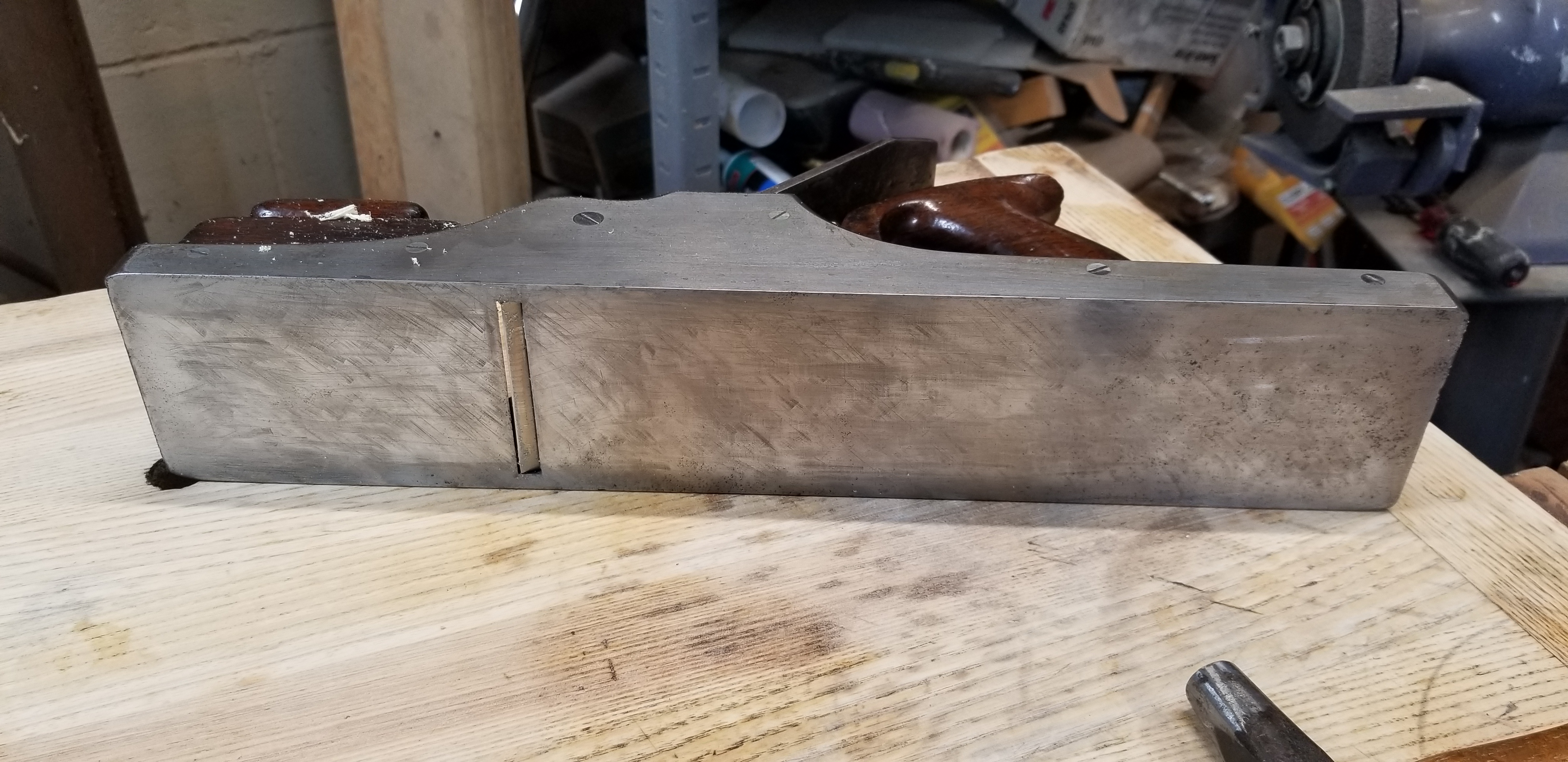
You can see in the plane sole that I didn’t take my time and scrape very deliberately, so some of the scraping marks are deeper than others and there’s no perfect pattern left. Some of this is lack of neatness, and some is that I did work over the sole with 220 grit paper on a block and a lap, so the deeper marks remain and the others are more faint.
I’m glad to have tried it, and it’s an easy way to make sure that what you have (even if you lap the tail and nose off a little) is very dead flat to start.
I spent about an hour each on these planes in total – some less, some more. To do a perfect cosmetic job would probably require using carbide (I used high speed steel) or really careful use of the HSS, which can burr and then leave deep scratches for a ham and egger like me.
This points back to sending a plane off to a machinist. if you’d like to do that, you can. I think it’s a huge waste of money, and I’d never send this particular plane off to a machinist, but to get dead flat and the same feel as this vs. lapping, i’d be disappointed shelling out money to have that. And I’m being prissy saying the next part, but I think modern surface grinding looks really cheesy on a vintage plane. It definitely looks even more cheesy on cheap imported planes that have really really deep surface grinding marks.
 Of Making by Hand with Wood and Steel