First off, this is not going to be an endorsement of anything at all. It’s following curiosity, and every time I hear about the new brand that “James Wright really prefers”, I want people to go find every link under the video and go ask Wright to publicly disclose the details of all of the revenue nominally and in percentage that he gets from “Zen Wu”
Second, it’s not a company I would patronize because the whole vibe irks me, but I am declaring these things from a position of luxury. At this point, it’s unlikely that I’d need a tool other than a die grinder or drill press, etc, that I can’t build, so I have become very particular. I also wouldn’t buy a chisel of this type no matter what because it appears to be a copy of Lee Valley’s chisels. I didn’t care for the example of the V11 chisel that I received and used in the unicorn chisel test. It only outperformed a hardware store chisel 58 hardness, and it grinds and sharpens half as fast as chisels that are better, and in that case that tested better.
However, there has been a rash of copying things that Lee Valley has made, from the Hongdui router plane sold by Katz Moses, to QS tool made pullshaves and spokeshaves and who knows what else, and this chisel looks like it’s just lifting the pattern right from the bench chisels that Lee Valley makes. By the way, i don’t know all of the details about the Katz Moses router plane other than it looks like if LV didn’t actually give them permission for the lower casting, they just copied it. That’s dirty pool in my book, and please spare me the touting of adjusters, etc, that somehow people got along without for more than a century but are “really needed now”. If someone is going to sell a tool, it should be public domain from age in terms of design or create something on your own.
Lastly, that I have this chisel to test is very generous in the first place, because I’m past the point that I’d buy things to test them and the fact that it’s strikingly similar in design to LV’s offering would prevent me from buying it even to test. A subscriber, Clayton sent it to me, and since I don’t know that he’d want his whole name in a post, I’ll leave it at that. Commenting is voluntary if he’d like to say more. The offer is much appreciated.
Anything I say about this chisel from this point on is my observation, and as much as I don’t like tool copying and strange naming or “woo”, I also refuse to lie or throw selective shade on something’s performance. It is what it is.
The Attributes

The chisel is at bottom in this case next to a 52100 mule I’ve made. On my mules, the handle is even a little bigger than I’d make for other folks, so it makes the turned handle on the subject chisel look diminutive. For someone who grips by the handle only and doesn’t pinch and point the tip of a chisel near the bevel, required is a tapered handle that you can hold and keep your hand off of the metal bits as well as the hand web off of the thumb well away from any covering of the end and a mallet strike – surprisingly painful! When I was a beginner, I pinched a chisel tip like a lot of people do – you don’t know what you can do or how easy it will to learn to move a chisel around just with an off hand on a handle.
The handle on this chisel is finished reasonably well, it appears to be hard maple, and it’s really smooth feeling. maybe too smooth and slick for my taste, but you can fix that. I think it’s too small for my taste given the above and the whole thumb hold thing where it’s puffed out makes no sense. if you’re going to push a chisel, the butt should be in your palm and it’s unlikely you’ll appreciate that slim area and “thumb hold”. Pushing with any power with your fingertips or thumb on that part of the chisel is a recipe for pain.
The chisel is otherwise flat, it’s not expensively finished, but it’s finished well enough. There’s no top part to be a bolster and I have no clue if that will matter over time. that’s lazy in my view, but it allows for an easy way to just cut chisel and stuff them in a handle without having a third dimension. A minus for me, but the chisel is $70 and not $125. And it’s not like the same design isn’t used in expensive chisels and chisel-shaped objects.
The last thing of note here is the handle is not straight on the chisel: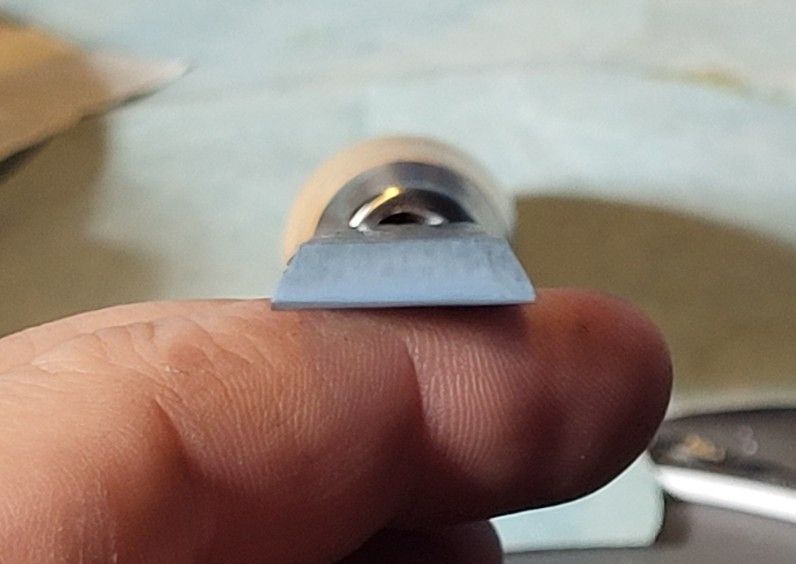
If you look closely at this picture, the handle is on firmly but it leans to the left here. This is fantastically hard to photograph properly, but it’s a little worse than it looks. It’s also not a deal breaker – just an observation. Both off center handle installations and bowing of boxwood can be seen on older tools.
I’m not taking this apart, but I expect it’ll cause no problems before I send it back.
There are no other fit issues, but I’ll comment on the profile. These chisels are made with fairly steep sidewalls just like the chisels I think they’re copied from. Older chisels typically have more taper to the side walls and I think if you use chisels for long, you’ll prefer the older style. it’s less easy to make a chisel with wider flatter bevels, and these have zero lands like the LV chisels and that’s also likely to be less expensive. The wider flatter bevels require leaving some land but those lands left behind – even if pretty small – are better for keeping the corners on chisels. So, the sidewall design is just OK, but again. a $70 chisel and I think as of this posting, a set of 4 is something like $235.
I could show more pictures that I took just in general, but there’s not really much to learn from them, so I’ll not flood this post with meaningless pictures. The backs of these chisels are fine and if they are actually made from a 1.2% carbon plain steel (could be), they are presumably ground after heat treatment. Who knows – I know about poor man’s methods, not contracted manufacturing, but it’s easy to get water hardening steel to be something other than flat, but these don’t suffer from that.
Hardness
Hardness claim for these chisels is 64. I measured in four different places and the chisels are 63.5 end to end. Initial use shows they have a crisp edge and the feel on an india stone, which usually gives me an indication of what a steel might be once I know hardness, the steel feels more plain than O1. File steel, essentially what these claim to be, is more plain than O1, so that’s a good sign.
While these are cut from flat stock, there is a slight taper in thickness from tang to end. Not like older chisels, but enough to see it. My eyes aren’t good enough to see if there is also a compound angle for the sidewalls, but there might be a little. if there is, the chisels are steeper at the tip and more angle toward the tang – opposite of what I’d expect and opposite of what I make. No big deal either way – part of the reason on the mule is cosmetic, so the top flat doesn’t get considerably narrower than the tang – that looks stupid. Also for strength, but the bevel angles on this chisel aren’t shallow enough anywhere to worry about strength.
Here’s the one concern that exists from this. I’m not going to break this chisel, but I did nick part of the edge off to get a look at the steel and the grain, and I can imagine at some point, someone will break these. How do you avoid that? Differential hardening – partial hardening from the shoulder to the bolster and then nothing for the tang. I’ve already seen pictures of Cosman’s mortise chisels broken at the threaded apparatus where the tang goes into the handle. There’s no great reason for lower toughness steel to be fully hard other than that industrially, maybe it’s easier? I don’t know.
All that said, they’re close to or on spec for hardness, and not way over and not under – that’s a good sign.
Here’s a picture of the snapped grain at 75x optical:
It looks fine. the steel didn’t offer too much resistance to the punch when I nicked the edge off, but it’s not due to enlarged grain. You can ignore the bright spot in the middle, it’s likely just due to shear or something else. We just don’t want to see something that looks like distinct glitter – but rather gray stuff that looks nondescript. I would also expect to see carbide, but either there’s an odd shear or a few grains big enough to look back that I can’t really tell from the picture. It’s possible to make file steel look a step finer than this, but this is pretty good. you don’t often see truly enlarged grain in anything made commercially and this is on par with what you’d find in a nicholson file.
Too, I’d never break the handle on these, or at least I think I wouldn’t. I’m speculating that these will be easier to break than a chisel with differential hardening from the shoulder down, because they will be – but there’s no data so that’s not proof. That’s really important – until they break, my speculation doesn’t carry that much weight other than opinion.
I have sample of my own with 125cr1 below – kind of middle of the road results. These steels are similar. This sample is 65 hardness after tempering and given the composition, I’d expect the results to look similar. O1 and 1095 or 1084, for example, I’d expect to look finer because the carbides are actually finer in those steels than they are in Japanese white steel or file steels or 26c3. These two are fairly comparable – I think I can always get higher hardness than commercial for the same grain size and same steel, but that’s just constructive competitiveness.

Feel on the Stones and Initial Thoughts
I don’t have any regular chisels in 26c3 or 125cr1 sitting here, but I do have the 52100 mule and the thin apple handled 26c3 chisels that are on the front page of this site, and a later kind of just before the bottom dropped out ward bench chisel. I’ll make a post at a later date after I get a chance to do a legitimate test and take pictures.
This chisel feels like file steel, though, and the burr comes off really easily. You guys may not use oilstones, but a broken in fine india stone and a hard (but not finest grade) arkansas stone tell us a lot about burrs and toughness. If a typical sharpening results in the burr mostly coming off on the arkansas stone without anything special, but not to easily on the india stone, we’re in a real sweet spot for pleasant use. It’d be great if the burr left at the grinder and the chisel was good, but my experience with chisels that lose their burr in the middle of the india stone is they’re hard tempered.
So feel in this case is very good. I expect from just a little playing that this chisel will be great for joinery work steel-wise and may be intolerant of prying or twisting, but the latter done sloppily is the realm of beginners.
Since I expect that this chisel is actually pretty good for work other than prying and abusive things, I am not going to search for a cheap junky chisel to compare it to. If it matches my mule (which is also 64.5/65 hardness), it’s a good chisel.
I do expect the thin 26c3 chisels to hold up less well in the test that we’ll put together – those chisels are .07″ thick and they are sprung – that spring in heavy use seems to make rough use much harder on edges than when a chisel doesn’t have it. We’ll see. It’ll be at least a week before I get a chance to put this test together and maybe longer, so perhaps before then, I’ll also order a Richter.
Could I live with this chisel and are there ranging thoughts with it? I’d rather have it than PM V11 hands down, but the ethical issue would prevent that. Is it as good as a Richter (if I ever call those Raptors, well, you’ll know that I almost call them Raptors every single time I have to sit for an old man moment and remind myself what they are. I’ll have to come up with a memory ruse…like “huge fart chisel” or something, but that could easily result in accidentally calling them sphincters).
What about an older set of Ward or English chisels. Not a chance for the new one, I’ll take the old. The Ward that I will use in this test is around 62 hardness. It may not win the battle here, but the attributes of its shape and proportions still win overall. I’m not aware of anything else similar to these. I’d take them over A2, and certainly over much of the lower market stuff that’s $40 or $50 a chisel and made from much lower carbon steel. With the exception of the Iles Mk2 – which I hear can vary. The ones I had were decent, but we’re talking about considering these against some desirable chisels. Of the other steels “woo” claims to make chisels from, especially 60/61 hardness PMs, i wouldn’t be surprised if these outperform them.
Sample of 1
Lastly, anything you do to talk about something ends up being advertising. I obviously have no skin in the situation here, but it still creates a dilemma. Mentioning these as kind of public service data has two issues:
- repetition is advertising. Products have stupid advertisements on TV just so you get used to seeing the name of them even if you think “that ad didn’t do anything to convince me to purchase something”. I wish there was a way to provide a mention of something without moving the needle, especially in the case of something copying another maker. the best I can do is guarantee there’s no motive of any type here and certainly no revenue generation involved nor will there be.
- This is a sample of one chisel. I don’t know if it’s going to do well or not well – nothing indicates it’s junk. But given I can only report on this single chisel’s behavior, if you buy something that doesn’t measure up to my review, your remedy is a return policy, and not because any later information is bogus.
I wish we had deep data out in the wild, but we’re still in reality dealing with people running around saying that V11 sharpens as fast as O1 but lasts twice as long planing. Both of those will not be true – Kees Heiden already proved that at least the former isn’t true.
 Of Making by Hand with Wood and Steel
Looking forward to the performance review, everything else aside.
LikeLiked by 1 person
It’s a bit weird and rather telling about our times that a rather simple tool like a chisel can be made so overcomplicated* online. Of course, 60 or 70 years ago most industrialised countries hade a manufacturer that cranked out good quality chisels. Now there is a lot of confusion and an industry of insecurity.
I was looking in to getting a mortise chisel, old swedish ones only turn up once in a while and are expensive and since Brexit used UK tools have become a lot more expensive I was thinking of buying a new. The MHG chisels with a states HRC around 61 looked reasonable in price and quality. The Narex ones I have heard are a little bit soft (even though I have never thought that about my fathers pre-1992 set). Foolishly I googled around a bit, but all I found was basically people saying that they are the same as the hyped Aldi chisels (I would rather believe that they are chinese made to look german), that they are the same as two cherries (no, they are not) and that chrome vanadium steel is inferior to carbon steel or A2 (which of course is just confused). The only thin I’ve learned is that I should just get one when the need arises and see what I think. Honestly there is more to be learned from the descriptions on the retailers (Dieter Schmidt/Fine tools) website than on most review sites and forums!
Looking forward to your test non the less!
*OK, all tools have nuances and there are both aesthtic and personal aspects to their form. But I would still say that as long as it is a chisel of reasonable quality there is nothing that will hold anyone back from good results. Why I read your blog is because while it goes deep in to the aspects of the tools and their materials, it actually makes things less complicated.
LikeLiked by 1 person
You’re pretty much on target with what I’ve found testing the chisels. do they hold an edge differently? I guess so. One of them (the older ward) actually has a corner that was probably overheated in grinding and some fair fraction of the edge deflects – 15% ? Not sure how much. It performed the worst overall of all of the chisels, but I’ve used it for work without any issue because the entire edge doesn’t deflect like that. What you say is, true – there’s not really anything complex at hand here and I’ll fail in writing up the test and showing pictures if the answer is anything other than “there’s nothing wrong with the zen wu chisel in edge holding, it’s quite pleasant, but does it matter vs. any of the chisels shown in terms of the edge holding part? No”. The simplistic part with chisels is are they hard enough to be pleasant in joinery work, especially chopping – and then not defective. Those are really the only two key items. something can be disappointing because it’s not as hard as you’d expect, or the shape isn’t perfect for what you want, but the latter may not be permanent, and the former can be worked around. I was not impressed with the pfeil bench chisels that have short lands because they were kind of on the low side of what the carving tools I have show up as, but was it terminal? No, I just have a lot of chisels and had no reason to keep them. there are a couple of beneficial things to cover in the test of these chisels though, including the myth that there are good chisels and then perfect ones that never take damage and the difference if it seems like that is more than setup. it isn’t. A really superb chisel holds an edge just a little better than a good one, and setup usually narrows the gap -the best just feel a little nicer and more crisp to sharpen and use.
LikeLike
Hi, James Wright did 400 hours of testing of around 40 chisels as I’m sure you know (results on youtube)
Would you say you agree with his verdict on the following chisels?
Sharpenability Keenness Durability
zen wu Y1 3.9 9.2 9.8
Narex Richter 3.0 7.6 9.8
Veritas PMV11 4.0 10.5 8.2
Thanks
LikeLike
looks like the chisels he either has an affiliate agreement with or can link to through amazon did “best”. I posted results here on the richters and the one I have appears to have slightly enlarged grain. The zen wu chisel was fine, but it was beaten by a $10 each chisel on amazon and so was the richter. I’m not much of a fan of the James Wrights and others like him – in my opinion, they all focus viewers on things that don’t matter that much in favor of their potential gain. None of the three chisels above strike me as something I’d buy. They’re all decent, but they all cost more than a vintage English chisel and are not better. Or I should say in actual use in work, not as good.
LikeLike