And no, this isn’t clickbait. Because there is no revenue here and there is no incentive for ego stroking. At least I don’t think there is, but maybe ego prevents us from being self aware? If I were more confident in general, I’d consider it!
So, I’m done with the chisel test. But this isn’t that. Legitimate chisel testing is a puzzler for me because I can take any chisel and make damage stop. Anyone with experience can. The challenge comes when you decide what the setup will be to allow some damage to occur and then the results are disparate, sometimes surprisingly so, and you know that it could be just test variability or chosen parameters. So you adjust the setup, let’s say, of the poorest performer and compare it to another chisel that did better, and the results are much closer. Which is better, then? In reality, you’d take the performer and maybe use it either way, and the chisel that suffered in one test and set it up such that it succeeds.
I tested five chisels – two of my own for familiarity and then three industrially made chisels.
The subject chisel in this case that struggled wasn’t the Zen Woo file steel chisel – it did fine. It didn’t “outperform” but it was pleasant. the chisel that struggled in the original test was actually a Narex Richter. After accommodating the chisel with a little setup, it was just fine.
But the Shock
The shock is that aside from terrible handles, a 1% cr-v steel Chinese chisel that John C mentioned to me, and I found. John, if you sent me a link to it and I forgot, pardon – i can’t remember exactly what I did to find it other than confirming your wife’s account did a chisel review and I knew I had the right thing….
Anyway, that chinese chisel, 6 for $50 performed as far as I can tell as well as anything I have. And it may match my baby or pet formula, which is 64/65 hardness 26c3 chisels. The variability of results makes it hard to tell.
Before I go into details about why these chisels are exactly what I’ve tooted off about in the past (“if someone would just use a 1% steel in China with some chromium and maybe vanadium addition and put a dollar’s worth of effort into each chisel at local costs, they could make a chisel that would blow away Veritas V11 chisels for a few bucks”) …..here’s what they are (link temp. disabled – they’re out of stock and amazon automatically opens a window with a different set without notifying you the link isn’t what you clicked on…how unethical). There are several sets there, and these are labeled “6 piece” and have “100cr-V” in the description. I’m sure some of the other sets in the listing that are cheaper are 60crv, or “aldi chisels” – there is a huge difference between the two. Huge.
Note, that is an amazon link. Not also, it is not a revenue token link – you know I hate that. If you’re hoping to float to amazon and have a charity get a commission instead of this dry link where nobody does, then go through your charity of choice after you find the set in this link.
These chisels test 63/64 hardness on the pair that I’ve tested so far and they are so close to perfect heat treatment that I’m completely astonished. They are exactly what I would do if I could manage to find round bar stock in this stuff to even make a chisel.
Here’s the caveat, or caveats. These are made with a relatively automated process, I’ve got one set, the handles are absolutely terrible and you cannot live with them and will need to reprofile them and even if you get a set that is everything mine has proved to be, they are not perfectly flat.
I cannot state how bad the handles are and cannot grasp that until or unless you grasp them in person. You should not consider them at all if you aren’t willing to address the handles.
I’ve tested a V11 chisel before, by the way, and also had both house made XHP stuff as well as Veritas-made V11 irons. For application in bench chisels, there isn’t a V11 chisel that will touch this set. Not in edge holding and stability, and definitely not in honing or grinding. These are super plain steel, the grain is very fine and the edges are wonderfully stable.
The finish all in all is really good outside of the handles, aside from the quirk that they have very crisp side edges that you’ll need to address if you choose to buy a set.
So, how do you deal with the handles? There is so much wood in the originals, they can be turned into carver style handles just using a coarse sanding belt to round them into a carver style handle. I ran these around rotating until they felt round – just matching taper to the ferrule and to what looks right to my eye. I’ve made a few hundred carver style handles, so you’re on your own if you think this is harder that I’m guessing it might be. There’s plenty left, though, to the two here that are reshaped.
and again, how terrible the original handles are in shape- they are also flattened on the front. imagine a knife handle that is indexed 90 degrees from the way you’d like to hold a knife – that’s what they feel like. I know nothing else about them other than use so far, so if you destroy the handles should you buy a set, I don’t know if the tang is of appreciable length or if they are “just got out of the pool” length and need something like hornbeam to hold up well.
They are not going to be chisels you’d want to use making mortises, but chopping and push paring, they are divine once the handle is addressed, and they exhibit the sparky fast grinding and the sublime honing properties on stones that steel that is plain and hardened and tempered ideally exhibits.
I’m shocked.
Oh, the handles: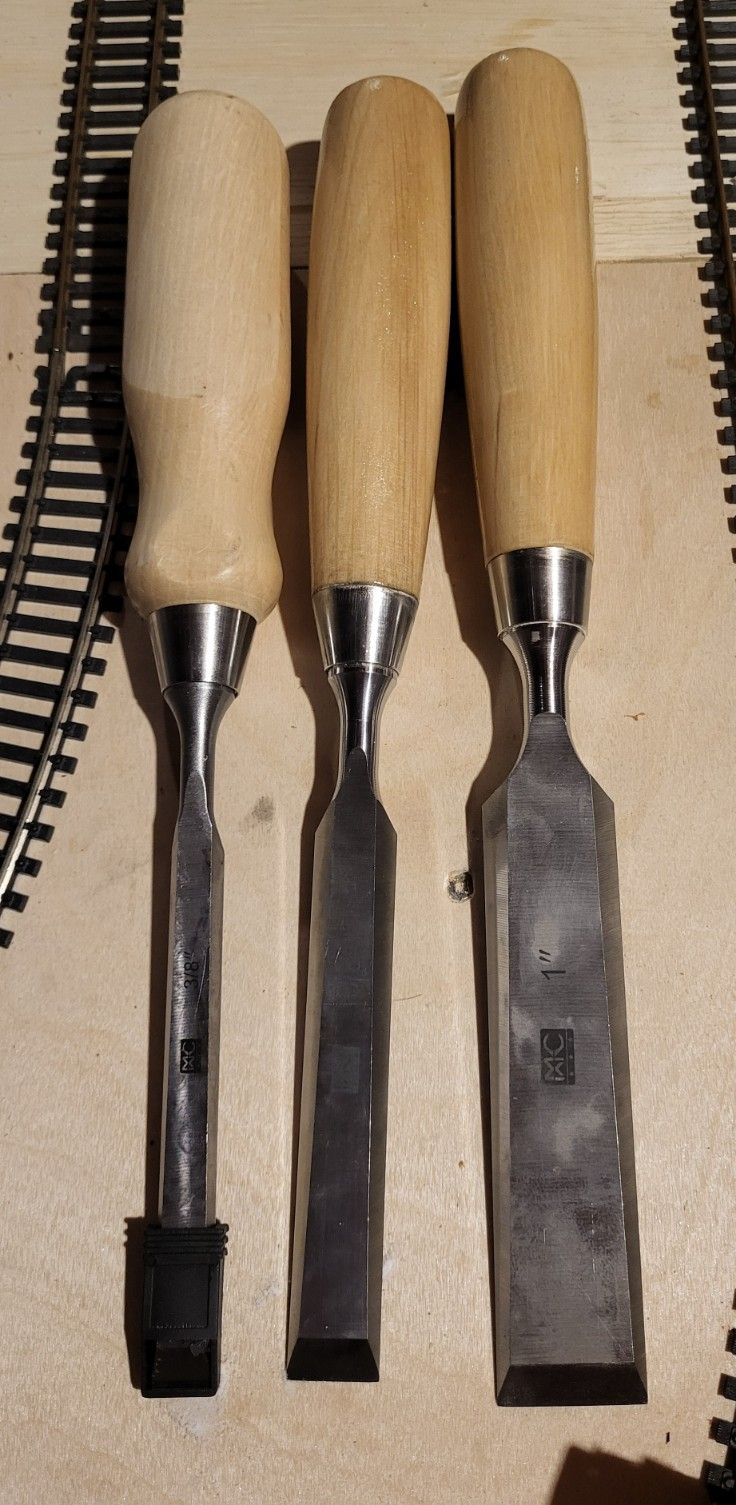
As delivered on the left, and after sanding/grinding off the excess wood on the right two. Boring hornbeam made to look a little more “lifey” with limed tung rosin varnish.
If they were delivered any harder, they’d have hard tempered behavior. if they were delivered any softer, they’d be less good.
The 59 hardness claim in the ad copy is humorous – if you heat 1% carbon steel with a small chromium and vanadium addition to a hundred degrees past critical temperature, you just aren’t going to be able to get anything that soft. I wasn’t deterred by their claims, but the key language in these is that the ad copy says that they are heat treated in a salt bath. This is not a random comment that you’ll see anywhere and salt bath is, as my guitar teacher used to say, “tits”. Flashback to the 80s when I was 12 and he said something “great”, concert was “tits”. it was just as confusing as the old people talking about tubafirs or tubafours. Maybe these are the cat’s ass instead (yeah, who knew if that was good the first time they heard it, too…especially if you ever had a cat back up into your face leaving you scrambling to get away any way you could).
Thile we’re at it, because I took pictures, have a look at the steel magnified for the test – I gotta look. this is an intentionally chipped out section of first the Richter:
And then the Chinese chisels:

Same magnification, same scope. What do you see? The shiny part at the bottom of the Richter, ignore it. It’s probably shear. However, notice the light colored glints and the overall slightly higher coarseness of the richter picture. these are at 75 optical, but even stuff that shows up there isn’t “too small to make a difference”. The odds are the bright glints are facets of larger grains. i’ve seen what carbides look like at this magnification – they look like tiny fine stars like the little white dots in the picture below.
I think the Richter is slightly overheated, and that would explain why it was so intolerant of not being set up with a little more concession to edge holding.
This is sort of a surprise, but this is a level of grain growth that you are not likely to be constrained by if you start heat treatment as a beginner – you’ll do far worse. In my opinion, and that’s all it is, we shouldn’t see the enlarged grain artifacts in that picture and when I see grain like that in my own chisels, I generally find someone to give a tool to or toss it if it’s not in a condition that the grain cycling and heat treatment can have another round. that would be something like a bevel chisel fully finish ground -there’s too much bevel surface to have another go and get high hardness without warping.
I do not think the carbon level in the richter chisel is any higher, and both steels feel very plain on an india stone whereas something like 52100 or O1 does not.
Please Don’t be a Dick
I’d guess most of you will find this interesting, few will buy these chisels. I hope they restock them at some point without changing anything because I finally can recommend something to people who want their first good chisels. I could even spend an hour reprofiling the handles on 6 of these as a gift for someone and perhaps make them unhappy with later “premium” chisel purchases like Blue Spruce A2 or V11.
If you buy a set, I hope everyone has the manners to not gobble up the group and leave everyone out to dry.
Why am I even concerned about that? I don’t think the market itself will realize what we have here. There is truth to the issue of chisels being in a handle format and proportions that you really like, and that ergonomics are important. Do I think a new engineer or doctor on sawmillcreek will have any clue just how much potential is here if they stop checking themselves in the mirror and just fix the handle issue? probably not.
Is there an incentive for a retailer to do anything with these chisels? i don’t think so – what do you think the margin is on a set. $25?
And beyond even that, what are most people who buy chisels at aldi or harbor freight going to do with the chisels? They’re going to scrape grout in a bathroom, open a paint can or pry a nail. And with something like that, these will go from offering no advantage possibly to breaking off in the middle with enough abuse. I can make an equivalent chisel that is a little tougher, but I don’t think the open market can, and O1 or W1 at full hardness will break just as easily as these – so they’re not defective, but they won’t tolerate being used to break locks and a 0.6% carbon steel version that’s 58 or 59 hardness will bend instead, allowing the abuser to use the chisel once more while it’s just bent.
But, wow. I thought I’d be judging the Zen woo chisels, which I have done. and then thought I’d splash out and buy the richter, and what if James Wright is correct about them and it’s just a happy match for the barnacles that something good can be sold and the barnacles doing no favor for anyone else can just collect a commission, anyway. Instead, the chance to add one more on slapped me right in the face with the hypothetical “somebody could do this if there was an incentive” ….and that hypothetical at least for this small snap in the history of the universe just showed up in person.
If I got a bar of 100cr-v and manage to thermally cycle the steel and get the same result, I’d be just delighted. The small cr-v addition addresses a problem with 1095 and W1 which is it’s in a no man’s land as far as carbon in solution. I cannot get either of those to be as good as this sample thus far and have never seen either from anywhere match the results of the 100cr-v here. Those additions beyond what’s in any w series steel, but below any more highly alloyed steel just create an opportunity to prevent quite so much carbon existing outside of carbides and making the steel brittle.
100cr-v may not ring a bell. I don’t know if it’s an actual spec, or if it’s a marketing term. But I do know things that we think maybe 1095, like Case or Camillus knives or some of the previous Ontario knife efforts before they gave up and went to 1075 and just accepted a less desirable edge quality, none of those is actually 1095 steel. They are a steel that’s about 1% carbon with a small addition of chromium and vanadium, and possibly molybdenum and nickel – to address some of the things that make W1 and 1095 less than perfect for chisels and knives.
Edit to Add after Writing the Above – Construction
One of the six chisels I had was a little loose fitting, which gives me the opportunity to pull it apart easily. I guess the sensible fix for this will be epoxy. I hope nobody freaks out about glue and “irreversibility” because there’s a simple fix when you epoxy on a handle and you want to get rid of it. you cut it off, chisel it off and then chisel or file the epoxy off of the tang. you could do this fifty times without removing appreciable metal from the tang.
At any rate, since these aren’t “my make”, I’m not going to make any handles for the chisels and press fit them into the ferrules. Here’s the picture: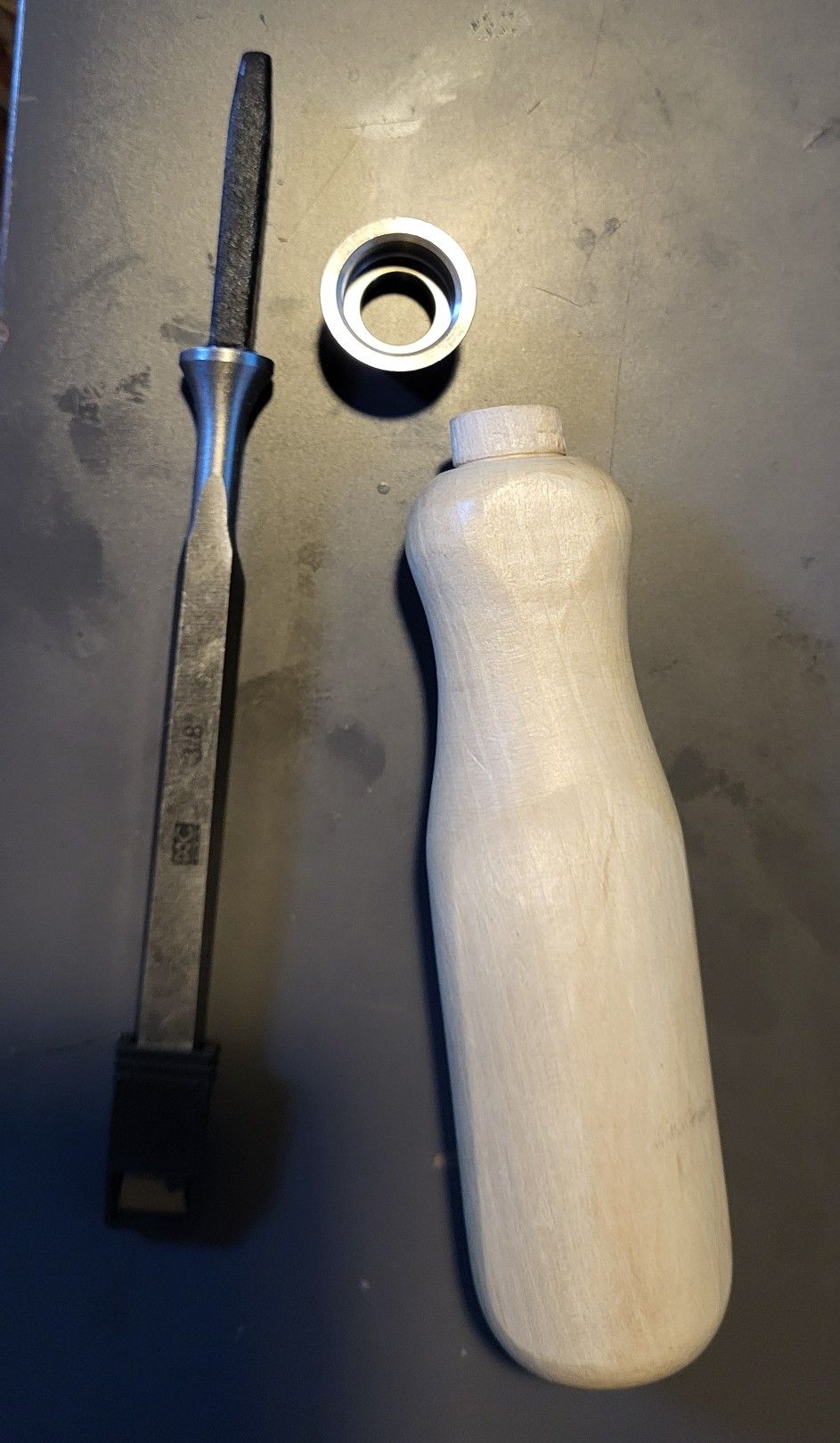
Sort of a weird hybrid setup. The tenon off of the chisel end is a stub, and the cup instead of being a thin ferrule all the way down is pretty thick at the bottom and the whole thing kind of half does what you’d expect by meeting in the middle. The tang is plenty long enough and epoxy will do the rest of the work in this case. If the others come loose, they’ll get the same fix.
the fit is kind of half assed press fit in a round tang. I obviously have “mr important” opinions here from fitting longer tapered tangs without glue, but it’s really a touch thing and requires some time as well as adjustment of the tang for straightness. No way that’s going to happen on production chisels of any type. So this seems pretty decent. Beats the hell out of thin flat stock chisels that have a tiny tang and ask you not to hit anything with a hammer.
I could “class up” these chisels later by putting a straight brass ferrule and a more classic handle on them, but as close or right on my best work as these our, i’d better spend my time seeing if I can find any more improvement in heat treatment before an $8 chisel embarrasses my pet 26c3 work.
 Of Making by Hand with Wood and Steel
Interesting find, would have given those chisels a try but unfortunately they can’t be shipped to the EU it seems. Best I could do is give your review on Amazon a ‘helpful’ vote.
LikeLiked by 1 person
Dictum appears to have the same things but with a different handle style. They could be the same chisels or made by someone else with the same automatic grinding equipment, but a different maker. They also want more than double for their version, but this is typical of woodworking tool retailers. Markup is usually high. On lower cost imported stuff, it’s even higher and such stuff is a big profit center without much cash outlay to buy the wholesale product.
Given the small size of the listing on amazon here, it’s likely these are around in several places made by similar process, though. If getting something from europe involves shipping and gets above $150, it obviously starts to make much less sense than the $50 cost here.
LikeLiked by 1 person
Thanks for the tip David, I might order one of those chisels as a test next time I shop at Dictum. It’s definitely in a different price category, but still more affordable than some brand names. I did find this Polish youtube video that reviews the Dictum chisels, maybe that can tell you if they are the same as the ones you have? It doesn’t seem to have subtitles unfortunately.
LikeLiked by 1 person
Looks like the same chisels to me – the finish on the bevels is the same, though it looks like someone removed the same little grind marks or nibs that are on the side bevels from the top. the ones on amazon just have those nibs remaining, but they aren’t an issue and are smaller than they look close up.
The tang and bolster/ferrule setup is the same.
What I obviously can’t tell is if they’re made to the same spec. Dictum says 61/62 hardness. this is kind of a minimum of what you’d get but is very conservative for a 1% plain carbon steel without much alloying. Can be achieved though by heating prior to quench at a temperature 50F less or so, maybe 75F, depending on what applies, or modifying the quench process. it’s to no benefit in my opinion – if we are looking for chisels for joinery, the ones I pointed to have sharpening and edge quality that we would love to find in a higher end chisel and are easily a match for any white II japanese chisel I’ve ever used. White 1? i don’t know. My 26c3 is similar to white 1 – I have none of those in regular bench chisels but will make a few – it’ll be pretty embarrassing if they beat my best efforts, huh? if they do, I’ll post it. My best efforts so far with 26c3 hold an edge in a western chisel style better than anything commercial that I’ve ever gotten my hands on , but I haven’t seen anything in the behavior of a couple of these 100cr-v chisel to suggest separation between the two other than that I can hit 65 hardness without having tempering issues showing up in the hardest of woods. the case where that would be beneficial would have to be so narrow that even if it amounted to anything, I it would have zero impact day to day and I’d never actually notice it working on something.
LikeLiked by 2 people
Looking forward to trying them out both because I’m hoping they’re as good as the one you got and because I’m still trying to get a sense of what you mean by desirable sharpening and edge stability characteristics. (I have a Hirsch carving gouge that sharpens easily and doesn’t feel “gummy” on diamond plates but chips when I try to buff it.). It’s also pretty nice that the handles are so ridiculously oversized in that it means more options for reshaping.
LikeLiked by 1 person
Edge stability is sort of generic – just meaning when the tool is used, the edge stays there. I asked Larrin at one point why tools that have good hardness and toughness don’t necessarily come out that great in terms of things like chiseling results, or edge holding on a fine knife and asked if there was a term for it. Edge stability is something he’s used as descriptive – I guess it’s a more official term at least trade wise than I thought. But it fits here – he said it’s often a combination of hardness and toughness or something like that – I could risk misquoting him. But it’s what we’re after – what looks unchanged or changed the least under a microscope or lens after you do work. Razors obviously rely on a whole lot of it – very little distortion at the edge completely ruins the ability to shave.
As far as the nice honing characteristics – when you have steel that isn’t chippy, but it’s not soft and doesn’t hold on to the wire edge for too long. These will lose their wire edge on a medium arkansas stone with a couple of back and forth light pressure strokes. there is still a tiny burr at that point, but not like the whole thing from sharpening and what’s left is far easier to address than a big persistent burr hanging on the edge what you see coming off of plastic if you’ve ever tried to file something to shape on plastic or file away damage on a kid’s toy so that the result isn’t a sharp edge. When the edge behavior is good, the tendency of the edge to be stable but not roll is also usually there, too.
LikeLiked by 1 person
Thank you. That explanation should give me some things to pay attention to. I think I was heading in that direction, but this will probably speed things along quite a bit.
LikeLike
A couple of other things: I think I’ve seen this brand before and have some recollection of them being a contract import, but the only thing I see now is “designed in German”. (There also seems to be a 4 piece set of the 100-CRV with the same handles and salt bath description.). I remember being quite happy with the edge retention on the Richter but less impressed with their lack of flatness (why polish if it’s not flat?) , some sharp lands and what I perceived as flex in the blade when chopping.
LikeLiked by 1 person
The Richter chisels are full hardness right up to the point where the conical bolster starts, so the flex is an artifact of them not being too fat. if you’re not prying, you can ignore it – that feel is there, but the chisel will still have a little bit of spring without a threat of breaking.
these are similar – they drop off only slightly in hardness all the way up and the ground profile is kind of similar.
It’s possible that Dictum is the reason these chisels are able to show up on amazon with the hornbeam handles in different shape. As in, someone either specified something like these, or made the first order for a hypothetical offering on alibaba. There are other chisels that are offered in 60crv (like aldi stuff, or harbor freight chisels 58-60 hardness), GC515 or something like that (ball bearing steel) or 100crV. There’s not much cost difference between the first and the last, but the excess carbon well over the eutectoid limit does obligate someone wanting to do a good job to have a slightly more complex process…e.g., normalizing the steel somehow after the drop/die forging and perhaps doing something to refine grain. that can be accomplished a bunch of ways, though. The 0.6% carbon steel can just be made hot and quenched, that’s it. There is no “how much is in carbides vs. out in the matrix” kind of thing to deal with.
As far as the profile, though – these are similar to the Richter in terms of thickness, flex may be kind of like that and they do have really “crisp” edges that need to be stoned off. the stoning can be anything, though – medium stone, 400 grit paper on a block, and it doesn’t have to be too prissy as some of the back will be honed off over time and even if not, if half a hundredth of the chisel corner is missing, it doesn’t result in wood remaining in the corner of a socket. They will be pretty brisk on fingers and uncomfortable, though, if the deburring or easing isn’t done.
I knew 100cr-v labeled tools were out there from looking around on alibaba recently, and then finding one defunct link on amazon. they could be out there in other tools here or there without being labeled specifically to say they are not just 60crv or 65mn (another low carbon common steel in china). Just never found them in stock for cheap like this, and the salt bath heat treatment comment closed the deal for me at least – in terms of what the result would be. If they were just run through a heat and quench process like lower carbon steel chisels are – in a moving line, the result could be inconsistent, and if they were 59/60 hardness, there would be no benefit to the increase in carbon. All of the details kind of have to be there at once.
LikeLike
The truly wonderful thing is the price point because it makes experimenting a pretty low risk proposition. The other benefit, sort of along the lines of what you mentioned with the float, is that making all those adjustments yourself can result in being more comfortable with a tool than an off the shelf product. At least that’s how I feel about a couple of planes that I did a bunch of work on.
LikeLike
I can’t help to wonder if it is also the same factory that also makes these ones: https://www.fine-tools.com/isi-sharp-chisels.html. looks very much like the same bolster. Also harder than your typical chinese chisel (61-63 in the link). The linked chisels have thicker lands and states t10 instead of 100crv2 (couldn’t find if it is just another name for the same steel. The price is in the same ballpark as the amazon ones.
LikeLiked by 1 person
I found the name and idea of the isi-sharp chisels a bit silly when I first saw them, and did not even look at the price. But if the steel is good and they are under 10€ each, it is on the level of l e slipping in to the shopping basket when ordering something else.
LikeLike
T10 appears to be a generic spec that has only some manganese, and no chromium or vanadium. Chromium and vanadium are kind of key here if 100cr-v is close to 1% steel, but the name may not necessarily mean they are. I found a rail supplier that claimed 100cr-v spec is 0.65-0.85% carbon, but then said 110cr-v is the same, and didn’t list cr as one of the elements – so it’s probably just bogus.
T10, though, is more like W1. it’s definitely in the same carbon spec, but this is what I keep seeing for composition for T10:
“The chemical composition (mass fraction) of the steel: C0.95% ~ 1.04%, Si≤0.35%, Mn≤0.40%, P≤0.035%, S≤0.030%.”
I haven’t yet seen anything reliable for 100cr-v, but we have a similar industry name here for carbon V and sharon 50-100B, which are the “1095” variants sold in “1095” knives, now sometimes referred to as “1095CV”.
Sharon is out of business, but someone must be doing the melts for ….actually, I don’t know who uses Carbon V-like steel. Ontario knife used it, from what I saw, used a molten salt or lead type process and then replaced their expert with equipment, had problems with breaking or warpage and then went on to select 1075 before the brand or business owner sold out the US knives to smoky mountain knife works. there’s a parallel here – 1075 is easier to heat treat – the edge stability isn’t as good, even if pushed up to higher hardness. the knife company stated that they found users liked it just as much or some such comment – which may have been true for new users. If you had a taste for an edge with higher carbon, you’d have found it boring, though (i do) and less biting keen.
To my knowledge, their US production business is over. Case is still making knives, but do they use carbon V? I don’t know.
A lot of info here just to say if something is made from T10, I don’t think it’s the same thing, and T10 probably is both less easy to work with than something with an extra chromium addition plus V, but my experience with W1 that has both cr and v is there still isn’t enough chromium in it and the carbides are less even than they could be. And the behavior just isn’t the same. I’ve made W1 plane irons, as well as W2 (slightly lower carbon, plus vanadium for certain) and they just don’t wear as evenly as I’d like. Whatever is in these chisels, that plus a 1.25% carbon version is what I want – and have no luck finding in rods to forge chisels. Comment on that listing separate in regard to the grinding process
LikeLiked by 1 person
When you make a chisel of this type, it will have some tendency to warp from the tang toward the edge – one way or another. i think the maker’s desire to grind the back out of the chisel is just a way to eliminate that lack of flatness – remove the metal and the user can’t tell. i’d rather they didn’t take it out – being anal retentive, I don’t like stuff that interrupts the grain flow in steel that’s been drawn out or shaped by forge. I’m careful when forging my own to try to keep the flow through the length and continuous, and if anything, fanning out towards the edge of the chisel toward the cutting end.
Too, a listing that says one chisel is 100cr-v and another one that says the next chisel is T10, neither or both could be correct. We won’t know. The amazon chisels may remind the average person of W1, but I’ve had a lot of time on W1 chisels trying to get them close to 26c3 there’s just no success for me doing that. its widespread use for diemaking and maybe stamps would not have included narrow angle edge tools like chisels, and it wouldn’t have had any use in razors that i can tell. Silver steel and file steel type compositions (much excess carbide) did. I’m perhaps chasing an ideal in properties – the next plain steel chisel that can do everything that the others can and it’s been a while since I’ve seen anything like this – let alone at $50 for a set of six. I wish I could influence the grinding patterns to be slightly different to not have the step, but that’s the way most automatic machines are set up – it gives a lot of margin. I’d also love to see these in parers, but that is probably a much taller order. they might give 26c3 parers and vintage english parers a run for their money.
that said, I don’t quite trust the listings – if two are 100cr-v, one might say T10 just because it’s a ubiquitous statement of plain steels in chinese tools. along with 100cr6 (bearing steel, same as GC 515 and similar to 52100), very commonly 60crv, which is much like our hardware store alloy, and infrequently, 65mn, which appears to be a common spring steel in china and perhaps a little better than the 5160 in the US that’s often tooted off as being leaf spring steel by blacksmiths. You wouldn’t want an expensive chisel out of it – it would make a chisel hard to break, but at the edge, hard to like if you had chisels with better edge stability.
LikeLike
I have about a hundred chisels more than anyone realistically needs. Yet I’m sitting on my hands and biting my lips to NOT to get these. Seems like this post also needs “Please Don’t be a Hoarder” paragraph
LikeLiked by 1 person
I’m sure I have more than 100 chisels, so you can get them.
Of course, you’re allowed to sell off some of the others. I’ve sold a lot, still have too many and then ..well, making them removed most of the buying but it certainly didn’t reduce the numbers.
you definitely don’t need these. if you hate profiling handles, you’ll really hate these. Hoarding is OK as long as you pick little things here and there like berries from a bush. hah.
it’s the people who look at this and go “oh, 8 sets left, i’m getting them all” – not a fan of that. I tested a third one of these today. Yet again, hardness strikes for all of them 63/64. Maybe I’ll find where they’re a turd, and definitely I’ll get back to making chisels again soon, but I’m so happy for some stupid reason to see that my assumption that “you could just do this in china if you really wanted to and blow away the V11 nonsense” actually proves true. maybe it feels like a way of saying, “see? i’m not insane” but we know it doesn’t prove this. It may just prove insanity but correct on this issue.
LikeLiked by 1 person
Looks like they have already restocked them and probably they have enough. What might happen is they figure there’s a demand and they will jack the price to above 100$. Btw, they’re making less than 25$ on a set since Amazon takes 30% in fees and there are storage and shipping fees since they’re shipped from Amazon warehouses. Which brings a question of how much it really costs them to manufacture. Unless they keep the price low for a promotion. This vendor also offers a nice looking set of mortise chisels with trapezoidal blades, I wonder how those fare?
My concern is not that 50$ is too much or they would take much space. It’s rather that I won’t be using them. I just really doubt they’re better than Mifer (made in Germany, no less, which I was fishing for 6mos or so), perhaps only marginally, but most of all they will be about the same. Or that they’re that much better than a set of old Harlequinn Sheffield set with square blades. Or a nice used set of HSS oirenomis (really happy I read that post of yours on WC and got me one). Or a few other sets sitting in a box in a cupboard. I mean, I’ve been picking berries for a very long time now and it feels that it distracts from making stuff. There’s a certain guilt when you know your restoration queue is at least a couple of years long and you’re getting yet another “project set” – I still have a HF set kicking around that I wanted to re-handle and grind the lands. But the temptation is strong, lol.
Handles don’t really bother me. Diefenbacher sells handles for 8$-12$, depending on a length – that’s with a ferrule and a split ring, or a hex shaped carver type with just a ferulle (I can’t beat it even turning my own handles). So worst case I’ll end up with a set like Dictum sells for about their list price minus shipping. Or I might use them like they are. E.g. I don’t have issue with Narex original handles like other people. I don’t like the shape and they don’t hold edge well, but when building about 5 projects with them handles didn’t bother at all.
LikeLiked by 1 person
double check which set you’re looking at. the 6 piece set shows stock of 1 remaining. The four piece set of the same type shows 11. I didn’t notice the butt chisels, but see they are the same steel- and at the same time, I have a chance of zero in regard to buying butt chisels.
LikeLike
I am late to the party(one day) and guess have to go with the 4pc set instead.
I might be wrong, but they seem a lot like the chisels made be “LUBAN/QUANSEHNG”, the blade profile and bolster are very much the same, only diff is the handles. Judging from the price(a set of 6 w/o wood box goes for about 58USD retail in China), they are probably seconds from the factory hence the unfinished/fat handles; otherwise, considering the seller has to make a profit it is hard to justify the cost. Again, it is just my guess and I could be totally wrong about it.
T10 is considered a superior tool steel within the Chinese WW community. By the Chinese National standard, it could ineed contain some Cr and V, “<= 0.25% and <= 0.02%” respectively. Not sure if 0.02% of V would make any difference.
Once again, hats off to you, David! For being honest and objective about the real quality of the tool, despite the country of origin.
LikeLiked by 1 person
I’d be surprised if these are seconds, but they could very well be finished chisels that had no destination and ended up getting the cheapest handle possible. The comments about the flaws in some of the woodcraft branded chisels are definitely not present in mine, and the level of flatness is perhaps not what someone in a c-suite planning to cut their first dovetails may want, but I haven’t spent more than a couple of minutes on the first four of them that I flattened, no more coarse than a broken in fine india.
T10 sounds like it may be like our W1 but with more leeway. W1 can have chromium and vanadium, but it cannot have enough to match these chisels. Carbon V and sharon’s efforts for a more viable commercial knife “carbon steel” do have that room, though and probably weren’t a lot different than what’s in these chisels.
There are some routines to make O1 and W1 steels tough by making the grain so small that the martensite won’t be plate, but they are from what I read, literally the result of experimenting with dozens of grain refinement cycles in a row – something that won’t happen.
And, of course, adding some chromium to seed some carbide volume and improve the carbon in solution as well as hardenability, and then tacking on a pinch of vanadium to create a small array of persistent carbides that will pin grain that’s been overheated a little…probably achieves the same thing.
I go back and forth on country of origin stuff. As in, blatant copies of someone else’s trade dress, I’m no fan of at all. But this is a basic case of someone doing something we don’t do here, and unlike the online houses, not quintupling the price. I’m enamored with the quality of the heat treat and the core ability of the chisels to work in anything other than prying and can opening -they should be excellent for bench work beyond just the tests.
At any rate, they could’ve been made on spec by luban – the narrow chisels still do have kind of steep bevels, but the one thing I notice with these vs. the luban pictures at “ruby store” or the stock ones from woodcraft is the lands if these chisels are cut low and not with a fat side and they’re relatively even. The ones shown in luban files are pretty fat sided – if they were that even as good as the steel is, I probably wouldn’t have mentioned them because it’s always possible to grind more to make better lands, but very unlikely the average person would be interested in doing that.
It’s probably obvious already, but I spend so much time looking under a microscope at edges to see the last little differences in what makes the chisels that are really nice to use so nice, and it’s the ability to set up at a reasonable set of parameters and have a stable edge, beyond the ergonomics and aesthetics – but those are usually in good shape with the old english stuff, it’s a given.
the richters is actually the first commercial anything i’ve nicked steel off of and both felt the ease in nicking it away as well as the slight visible appearance of grain growth – I expected nicking the ends was a waste of time other than trying to see visual carbide density. These chisels are just superb for that – it’s too bad nobody will put them on amazon – or likely won’t – in the same condition indefinitely with a stocking of thousands. To show the richter’s performance in this case vs. the chinese chisel probably wouldn’t be popular.
LikeLike
Yeah, shows 1 set to me now. Note I’m talking about mortise chisels – slightly more expensive, but still good price.
LikeLike
I would guess those are 60cr-v and comparable in quality steel wise to the aldi and hf stuff.
Risk with square mortise chisels instead of the relieved type is they can easily be inverted taper by accident, even if just a few thousandths. I have a vintage 1/4″ champion mortise chisel that was always a huge bung to use – socket, but small cabinetmaker chisel size and very tall cross section. Turns out, I never checked it – it was intended to be ground square but the bottom of the chisel was a little less wide than the top. I’d use it to make a mortise or two, then write off the friction to having no relief, but it was actually pushing the wood wider and a real workout to get out of a mortise.
LikeLike
If that’s the case you could perhaps grind a bevel on the other side?
It’s hard to tell from the photo whether the ones they have are trapezoidal or not, idk why I have assumed they are. My opinion that a square mortise chisel should be bang on and have relieved sides like Japanese do, therefore I usually pick trapezoidal ones, – the top is at least 1/16″ narrower than the bottom – since they’re less sensitive to be out of square and slice the sides just fine with just one pair of arrises. Definitely not experimenting with these though, I mean, you can test steel, hardness, grain structure, but I could only asses whether I could use them – my review won’t guarantee somebody else could. And it will probably be down to personal preferences: somebody wouldn’t like a handle again, somebody would complain about rough grinding, you know, barely relevant stuff. Like Rob Cosman made it a big deal that Richter mortising chisel he was reviewing was 0.001″ out of flat (he almost got to a reference plate with feeler gauges to show that though). Good thing I’m pretty happy with mortisers that I already have and that these days I need only light mortising where a bench chisel still works. Like, the smallest chisel from a HF set or a BUck Bros 1/4″ – they’re essentially mortising chisels, just tiny.
I get your interest in making chisels and the process and it’s immense fun to follow along. But if I would have a setup like yours I’d probably do special purpose ones: a true sash chisel for narrow styles, mitering chisels for sash bars, coping gauges that match a specific profile (they also need handles with a stop, but I’ll probably go with a coping plane for this one), apparently there’s no decent offers for fishtail chisels and so on. So far I’ve been getting around with a die grinder and a puny belt sander, but looking at what you do I want aesthetics too now.
LikeLike
Just checked the link. The 6 piece set looks like the HF set with the sheet metal “hoop” at the top. The lands are thick as well. The description does not say 100CrV either.
The 4-piece set seems to be what you’re talking about, including the awful handle.
LikeLiked by 1 person
I’ll have to edit it to deactivate the link for now. Amazon literally took my product link and directs you to a different set now. Automatically. How beneficial for them and misleading and potentially costly (for the seller getting returns) for everyone else. I guess ethics have never really been their strength.
LikeLike
That’s be what the lands look like on the right ones. Yes, six of the same thing you see as a set of four. Rather than leave the listing up showing no stock, either amazon or the seller eliminated the listing, but with the crap fix of using my individual link to then lead you to something else that isn’t the right thing.
LikeLike
I bought one of the sets of 4, what the hell.
LikeLiked by 1 person
They’ll probably be terrible 🙂
LikeLike