The answer to that, of course, is one single good one is enough. Good in my book would be a strong cutting stone as far as washitas go, as you can always allow one to break in and you can palm strop to hair splitting after some light pressure strokes. And then get beyond 8k waterstone type edges in ten or 15 seconds with something really cheap.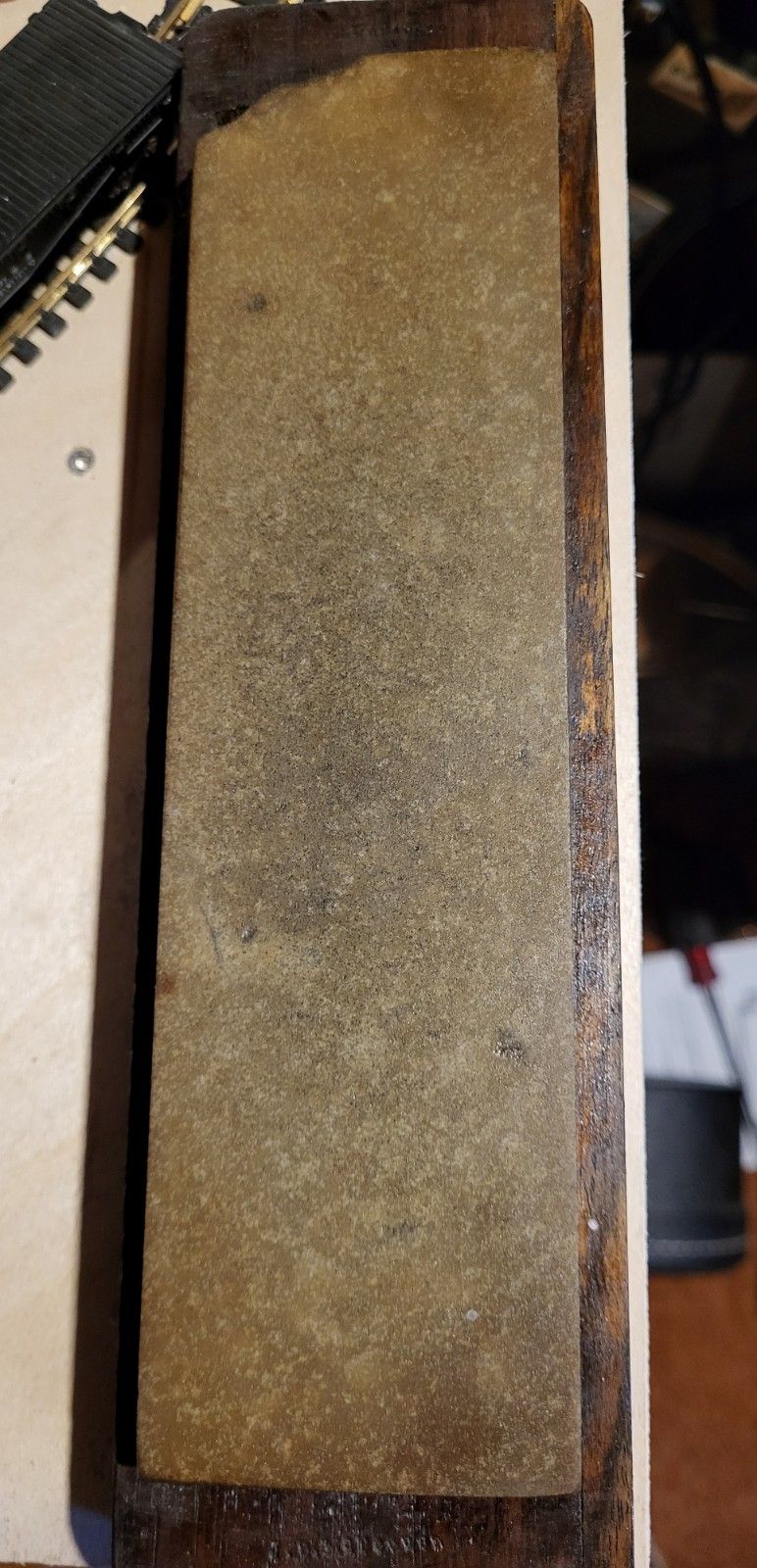
On another quick weekend home to visit my mother, who at this point won’t remember that I visited, but my dad definitely does, I stopped again at the “honey hole” along US route 30. This time, I didn’t stop for antiques, I stopped to pee, but I do have a want that I’ll need to fill eventually – one of the old cobbler’s lasts as I am getting to the point that I want to buy permanent shoes and boots and do my own resoling. Or have bought.
I have fallen in love with moc toe boots, perhaps due to being somewhat obese and aging at the same time, but also due to the fact that you can strip a sole off of them a couple of times and reglue another on before having to have the job done properly down to the midsole.
At any rate, I figured there’d be two in every flea market, but no luck yet.
However, there is a dealer flipper at this flea market who pulls in stones. Funny enough, I think there was a shapton grit like japanese setup with a kanaban, all complete for about $15 and in great shape, and there’s a host of would-be useful finer india stones that I just don’t need because I’ve got a lot of that stuff already. Everything stone-related there is cheap, and so is basic component stuff, like the hardened starrett or mitutoyo rules that are matched to heads. There are so many that you can quickly get three together and check that they reference each other proving that they are lightfast. One of the things I’ve wanted to do for a while is get another starrett 24″ straight edge, but I’ve got 36″ and 48″ beveled starretts and just can’t justify being so lazy as to spend another $140. I guess I could, just won’t.
The 24″ hardened rules are awfully functional and there must be ten of them in little or unused shape for $35 each. I got one last time I was there.
Short Story Long
Never found the shoe stuff, don’t need more straight edges but the oversized washita above with a corner broken off was $6. It’s more than an inch thick, also and before cleaning it a little, I could see enough to know it would have a nice texture.
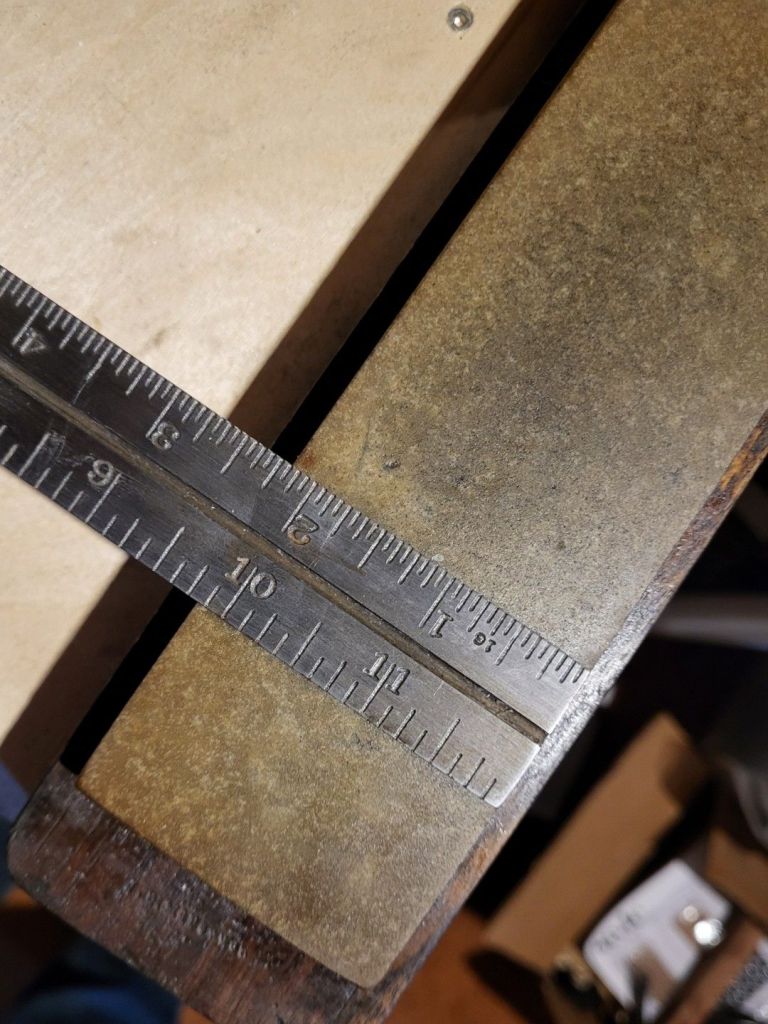
Just under 2 1/4″ wide

Just over 8″ long
There is a lid for this box with leather so old you could scrape it off in dust. No problem. if you look closely, the right side of the box is not original. It was missing. I put some kind of exotic on the side after flushing off the broken bits and glued it, then pigmented it and put shellac on. It looks less of a match in person, but it’s a $6 stone.
I also managed to find that the seller had bought gobs of finger stones. I think for a woodworker, these little stones will seem pointless. If you’re making tools, though, and you can find all manner of little really fine synthetic oilstones that are a little friable, they are gold for surface finishing little stuff. But they’re not that inexpensive once you start adding piles of them to a cart.
In this guy’s shop, they’re $1.25 per.
I haven’t got a need for this stone, but like pizza, I just want to see if this one is a little better than the ones I already have.
A close up look of the color at the top and bottom of the first picture is a better indicator of what this stone will look like. It sound stupid, but I really like the way they look. The color, to me, is “earwax”. not sure how else you’d describe it, but I find the texture and the color monstrously pleasing in a way that a normal person may not get. It was almost flat to start with – this is five minutes of lapping on worn out paper that was already in line to get changed off of my glass lap. A little more should have the entire surface looking like it does here.
Plenty of things are no longer on the ground, but the little finger stones, I find with some regularity. Washitas and other naturals, not quite as much, but sometimes, and my very favorite of these as far as cutting goes have all by some chance been unlabeled stones that have this kind of appearance.
 Of Making by Hand with Wood and Steel
Seriously! This almost makes jealous!
I recently bought a stone from a Tradera (swedish Ebay), the photos were (very bad) bad, but the colour made it look like a natural stone and it was in what looked like a decent wooden box. I took a chance. The equivalent of $15 later it arrived. Of course it turned out to be a ordinary grey combination stone. And the size given in the ad was of the box. So smaller as well. After cleaning it I now have a way too expensive way to stone my scrapers. Not a lot of money wasted, but still a tiny bit annoying. On the other hand it made me really appreciate simple oil stones.
So being able to get used good india stones that cheap sounds very appealing! Oh well, I’ll just have to order a new stone from germany whenever I get over the fact that I already have fully functioning sharpening equipment. Because Norton stones are absurdly expensive in Sweden, they seem to be at least around $60 for an IB8.
And getting a Washita for $6! They would probably end up somewhere around at least $90-$100 shipped to Sweden from the UK!
I have a little theory why that kind of good metal working tools seem to turn up proportionally more often in the US. Is it so that a machinist or mechanic were expected to own their own tools in the US?
LikeLike
Aluminum oxide is a well known abrasive, just get whatever local manufacturer you have. Norton guarantees that their stones have uniform hardness throughout, other than that it’s the same abrasive sintered with the same binder – other manufacturers produce uniform hardness stones as well. And “India” is just a brand name. I once got a few silicon carbide and aluminum oxide stones of various grits for 8$ a pop from eBay. I couldn’t tell a difference between those stones and Norton’s. A vendor didn’t say anything about their origin except proudly stating “they are made in USA”, which rules Norton out: they have factories in Mexico now.
In other words look for quality, not for a brand. Also look for other abrasive types – cubic boron nitride, de-gussit, etc. You will find a huge variety of man made abrasive stones for very modest prices.
LikeLike
Not really concerned by brand. The things is that in Germany this kind of stuff is so much cheaper than in Sweden. When you find oil stones here (both norton and german/austrian like Zische, müller, Tyrolit etc), they are either sold through industrial suppliers where their company customers with an account (and a discount) never pays the price stated, which we private customers have to pay. The webshops that sell oilstones usually never have them in stock, they just take the price directly from the list, and since this is not a tool that drives customers to their site they never seem to bother to adjust the price.
In Germany you can usually find Norton stones that are at least half the price from Sweden. I took your advice and took another look at the different european manufacturers and found a bunch of interesting stuff. Even some that make oil loaded aluminum oxide stones. I’ll have to think some more about it!
LikeLike
If you don’t mind Amazon the IB8 looks to be 349 SEK/~$33 with delivery which isn’t too bad: https://www.amazon.se/Norton-knivslipare-kombination-korn-oljesten/dp/B000XK5ZDY/
LikeLike
Thanks for the tip! I found that Dictum sells a norton fine india (200x50mm) for around 250 SEK, and the IB8 for the same. With shipping it is about the same, and I prefer to buy from dictum rather than amazon.
Researching oil stones for a while I found that there are a few japanese manufacturers who make “super fine” india-like stones. Shame that they aren’t retailed in europe.
Yamabuki|Products|YAMATO GRINDING CO., LTD.
Futakamito|Products|YAMATO CO., LTD.
Sakura|Products|YAMATO GRINDING CO., LTD.
Matsunaga, Naniwa and others also manufactures oil stones it seems.
LikeLiked by 1 person
All of these are finer than a fine india, some as fine as a translucent arkansas (the white ones). the one curious thing with these stones is that they’re rarely used much, can be fantastic, and they do not have any oil fill in them as they appear here – some are dirty from me putting oil on them. they often show up loaded on the surface from trying to use them with water only. I’m waiting for a tub of vaseline to heat them and get some fill in them.
the tan one with the king label on it was clean until it got to me. It’s got a skin on it and is like a quadruple ultra fine india stone. Other than waiting to oil fill it, I’m kind of curious to see what it’s like without the skin. I will post at some point in the near future about this group of stones. that these are seemingly less well used than stones that are soakers and sloppy is bonkers to me. The ones that have a significant amount of wear seem to have been used for maintenance sharpening with gravers, small knives and carving tools.
white ones don’t absorb anything, but even the really really fine versions of the others are vitrified and will pass oil through.
LikeLike
Not to worry, I bought my share of $50-$100 washitas – especially if I could find one with unusual proportions. I never had much tolerance for antique shopping because is an exercise in most cases of buying nothing, or something that you don’t need at the time just because it’s cheap. I think the least I ever paid for a washita on ebay was $17 plus shipping, and this is the first good one I’ve seen on the ground that wasn’t just a stone in pieces or a small slip or something.
IB8 for $60 would be a hard no. machine shops and fabrication places, and tool and die around here are a good source for older – but will be hard maybe due to aging – finer india stones. Flea markets here usually include nothing good, but could have several india stones that were clearly used until the surface loaded and then discarded. In a shop where wages are paid and a new india stone is $15, it probably doesn’t make sense to clean them.
As far as tools go, mechanics have always had their own tools in the US with perhaps the exception of shop monkeys / go-fers (kids whose job is to just do whatever a mechanic says – like fetch something, thus the term “go-fer” or the kid who “goes for” things a mechanic doesn’t want to move to get.). that and I’m sure with some cars – VW comes to mind, and I’d bet more expensive cars, if there is a model specific tool like in a dealer shop, I’ve heard of shops covering those. Farms and mechanics here all usually have a pretty solid set of mechanic’s tools and wrenches, though – they’re everywhere used and inexpensive if you don’t need yours to say snap on.
LikeLike
When I hear about nice back saws being bought for a couple of pounds in the UK, or stanleys being found cheap in the UK or the US it does sound nice. But I shouldn’t complain really. I thought about what I have found at flea markets and second hand stores over the years, and realized it isn’t too bad. And I haven’t really been hunting for tools either) I have bought two nice horned planes for very little, a plough plane, a couple of Sandvik handsaws (maybe paid the equivalent of $2-3 each), a box of C.I Fall auger bits and a brace, a frame saw with a very nice (thin and aggressive) rip blade, a bunch of 300 mm Öberg files (paid the equivalent of 50 cent each), a T-auger and probably a bunch of stuff I can’t remember that I got at flea markets. One of my best finds was at a car boot sale held five minutes walk from my house where I found a saw vise, something that very seldom turns up even online in Sweden. The other weird find was when there was a multi village flea market in the villages surrounding our summer house. It is a typical Swedish summer event where a bunch of villages decide a date when everyone there who wants to join in have a garage sale so they can make an event of it and market it. Then you cruise around, look at stuff, eat hot dogs and drink coffee. Anyhow, we decided that we should go looking for some clothes for our 3-year old. Second hand clothes for kids has it’s own ecosystem, and you can find good quality stuff cheap. Anyhow, despite that these villages have loads of kids we didn’t find any nice clothes but at the first stop i saw two back saws hanging on the wall, one was a really large disston (probably a saw for a miter box) and the other was a split nut tenon saw with a steel back. I took it down and saw that it said Sheffield on the back. It had a straight back and a handle that had some small damage to the horns and was worn, but no cracks and nothing that couldn’t be fixed. The price tag said 40 SEK ($4-ish). I bought it immediatly. I later managed to date it to the 1860’s or 1870’s. It is not in any way a collectible saw, but a very nice find that I’ll turn in to a user. I also have to wonder how those saws ended up there? I sometimes regret that I didn’t but the disston as well, but I don’t think I would have had any use for it.
Otherwise, log building tools and ox planes often turn up here. But since I am not planning on building a log house or planing 30-40 cm wide floor boards I haven’t bought any ox plane. The irons are impressive though, usually at least 8-9cm wide, and I have seen some that are at least 10cm wide.
LikeLike
Oh, if you are curioius about ox planes, google “oxhyvel”. They are two-man planes that are used to remove a lot of material fast.
I think most mechanics here use tools supplied by their employer. Same thing at machine shops. Mechanics tools and wrenches turn up all the time here as well.
LikeLike
There are pictures of planes of that sort in some of the English plates, if I recall – though I could be wrong, they could be continental europe. But they do look a lot more practical for heavy work, at least of some types. For example, if you have 3″ wide mouldings, good luck roughing it full width alone – but two on a plane could do it.
LikeLike
Sorry about your mom. I went through this not too long ago, it’s quite disheartening.
I would disagree with the answer. My answer is two: one is settled, another is refreshed once in a while to stay a bit faster. That’s assuming that there no other stones in a collection (which is never the case, lol) – some harder irons getting scratches from a grinder, takes longer to polish it out. Of course raising a polishing angle a degree or two would help, but then I re-grind more often. Apparently I have two or three Stanley laminated blades which I like a lot and I’m afraid I’m going through them too fast. So after a grinder I’m going with India at the same angle and then Washita for a final edge. Both of these stones are good honing stones, but for some reason I can’t fix an angle if I made it too steep accidentally. Perhaps I should stop worrying about irons too much.
By the way the chisels are back in stock, 65$ for a set of six now. Pretty sure that if this batch sold out the next increase will get them to about 90$. Putting them into a price tracker just to see where this is going.
LikeLiked by 1 person
thanks for the kind thoughts on my mom. it’s been a long road, so it is not as abrupt and shocking and generally 99.99% of my mother has been gone for a large fraction of a year now, and we saw the rest go little by little. All things considered, we are lucky and how do you say “it’s not as bad as it sounds” without sounding coarse. We’ve seen many others get it and pass quickly, or get LBD and really be flung into chaos. It’s never good, but this case is as good as a bad thing could be, including even lifted mood for my mother once she started losing her ability to focus on things that annoyed her. That held right in there for years and was a pleasant surprise.
I don’t disagree with what you say – it’s nice to have one cutting on the brisk side of brisk and another one that robs a fine stone of a purpose because you can just raise a feathery wire edge and remove it and then buff to “better than waterstones” level.
Definitely, if you don’t go beyond an india for maintenance, you have to have extreme diligence on not steepening angles, because laminated or not, it’s grueling. Without a grind stone or a grinder, everything as far as geometry goes is a little at a time then.
Use those blades and celebrate, though! Parsimony is good until it leans toward self torture. No matter what you do, it’s hard to use more than 1 or 2 thousandths of length on average per complete full resharpening.
LikeLike
RE: chisels – it looks like you caught some luck, the tracker says the regular price is 60$ on average, with highest of 80$ a year ago and just occasionally dropping to 49$. Probably they lower the price once they have about a dozen sets left and go back the average after replenishment. If anybody is offended by the 15$ hike I think they will do a discount on a the deals day.
LikeLiked by 1 person
Yeah, that’s first excellent luck. they may cost $2 each to make, or who knows, but whatever it is, it doesn’t matter. For < $10 each, they're super.
But I've pointed toward something or left a good review on a product before only to find someone telling me they "bought what you recommended" at double the price. These could end up at $90 or $100 pretty easily, and price does matter on reviews, at least to me it does.
LikeLike