One of the things on forums that’s not as popular as it used to be is for the “tycoons” to tell everyone that they have too many tools and said tycoons could build much more with 1/100th. Most of those guys turned out to be tax preparers or just frauds, but there are legitimate makers who aren’t fascinated with tools.
But I think there are more that are. I hope to be a legitimate maker when i’m retired, but who knows what direction life will go.
I still like nice tools, especially if they are pleasing to feel in use, efficient and nice to the eye.
I made a set of paring chisels for George a few years ago, and in return, he sent me these gouges – patternmaker’s and firmers: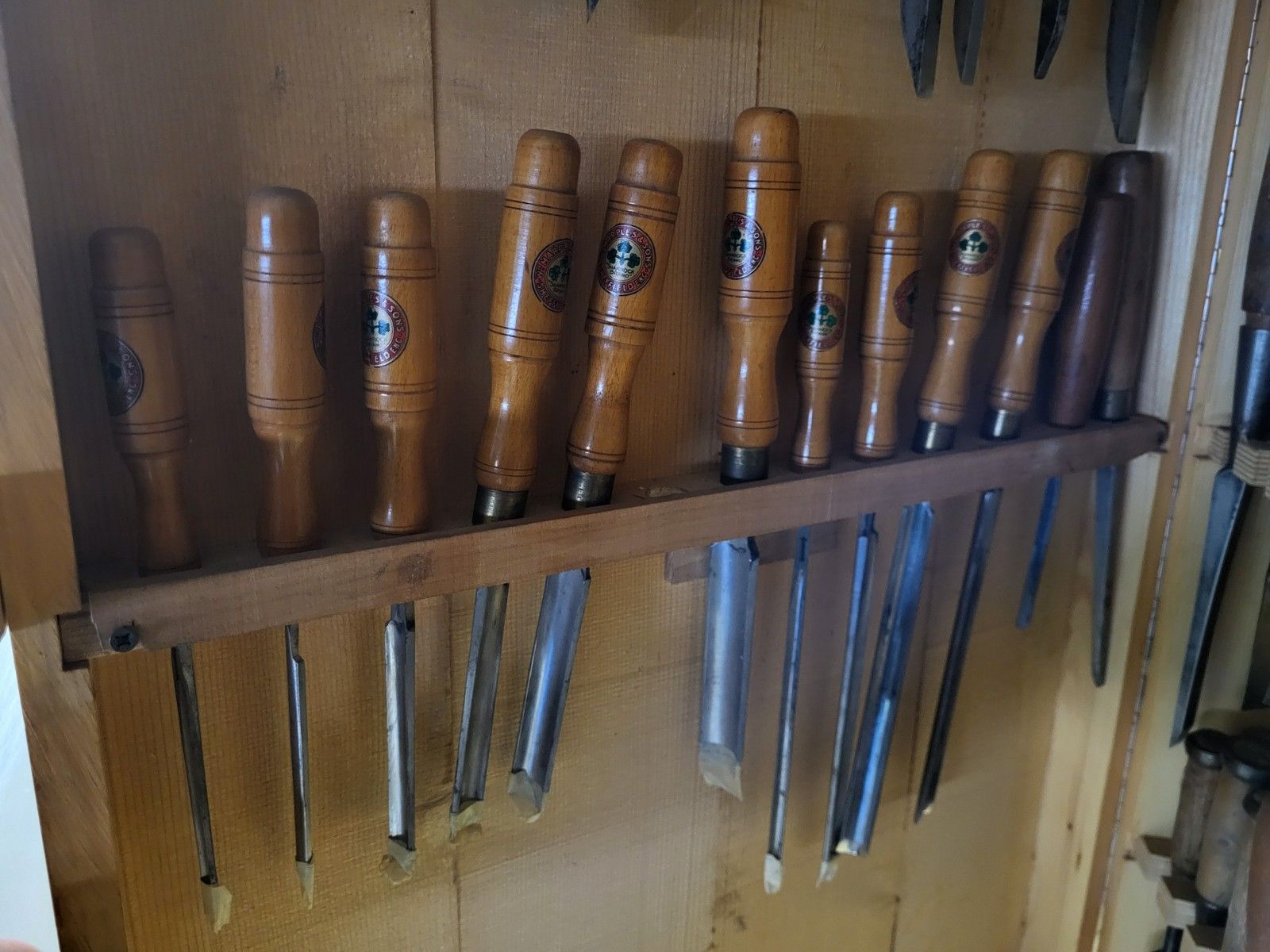
The lighting is terrible – this is the transition from the basement to the garage, which I have completely …well almost both, claimed as my space. There’s bright light to the left, so this picture looks washed out. If you look closely, you can see these are practically unused and the handles are really nice for what is probably fairly recent marples work. Are they 60s? or 50s? work, I don’t know, but they are still hand ground bolsters with a brass ferrule.
George bought these, as far as I know, because of the look. The handles are a nice style, the stickers are in pretty close to perfect shape and they are beech with a divine sort of buttonlac color, but they’re not shellac. I don’t know what the finish is, but it’s durable, and the surface is completely pore free. 

Again, sorry the pictures aren’t better than they are – the overhead lighting is bright daylight white LED. For whatever that’s supposed to me, getting pictures in real daylight always leads to better color, and these look better. Through some sort of anomaly, the picture at the top shows the tip looking like it’s not straight across. Whatever the case, it’s not like that – it’s perfectly straight. These are unused as far as I can tell.
The desire to do toolmaking won’t go away, but I want to get more familiar with removing wood with gouges – not just hammering, but doing all kinds of stuff, so I’ve excavated a few sharpening stone boxes for all of these japanese india stones floating around. Just crude square boxes – the stones aren’t expensive and the boxes won’t be fancy. I even did a couple of them with a makita plunge trim router. That was the shits, and between being surprised how fast bits dull, and smoke and whatever else, if it takes 1 1/2 times as long to make these boxes by hand, i don’t care. I’ll do it four times as many hours. 
But not only do these look nice for such late tools, the steel is also really good. It is classic feeling and not the cut carbon steel that was popular at the time to run through automatic grinding machines. Why? I don’t know, but I’m glad it wasn’t changed. These are just like using an older vintage tool in terms of hardness and how they sharpen. I don’t have a great way to hardness test them because they are not polished on the inside. I did dent one of these quite some time ago, and it read something like 60 with the grind marks. Add one or two points, and you’d get to what the number would be with a polish. What a treat.
Oh…why the kind of grungy old Oak? it’s wood my dad had sawn by a local sawyer in central PA more than 40 years ago. It’s more suitable for 2x4s, which is what it is, and it’s had some bugs on the surfaces in the past, but they’re long gone courtesy of the wood being stored in a hot loft once we moved to the house I did most of my growing up in. I was struck by the wood laying in the garage loft, not knowing we ever had it – not because there’s anything special. Red oak is probably worth far less as a lumber log there, even a perfect log, than it is as a firewood log. The one thing that did strike me is how much better its sawn than commercial lumber you’d get at a supplier, and I’m sure it cost a fraction even back then of what you’d pay at any lumber or trimwork retailer. It’d be just super if we could get back to the idea that you could make something for someone else without trying to get 14 other skimmers involved between the falling and the selling to Joe Cool at 15 times the price at the stump. Someone in that long chain of people who really don’t care about the product, the ability for the person who gets the log and then saws the log to make something good is forbidden.
(after writing this, I took another picture of the edge – completely unrelated to this article other than for the picture part – but whatever has “improved” with cell phones since the days of something like a lumix panasonic hand held camera, it can be really bizarre! Current phone is like many with more than one lens, and I can no longer trick it to get things like the surface reflectivity of a nicely planed piece of wood, for example…
here is the end of the gouge: 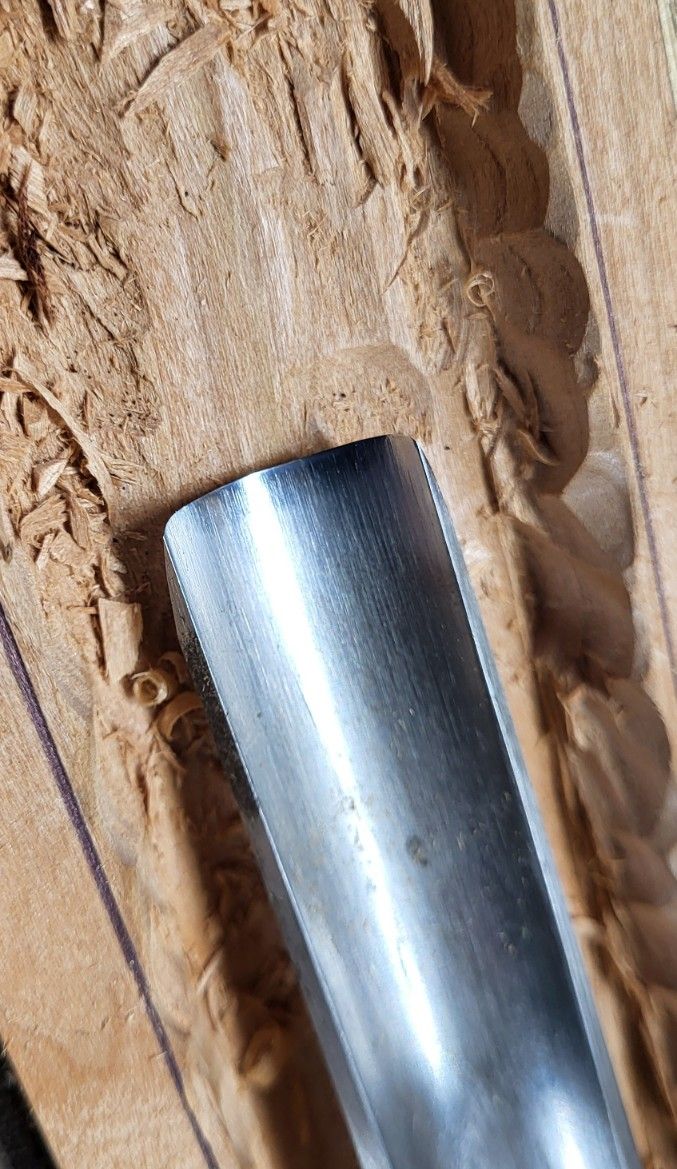
same gouge as the second picture above – I have no idea what distorts the look of the edge above and makes it look like a big notch is taken out, but even the shadow at the edge from the buffer’s polishing work appears to be distorted.
Compensation run amok? Cameras always catch my belly and fat face – if there’s an error, I’d like to be able to bias it to distort those things for the better! At any rate, these gouges are just lovely. You scarcely find something that has never had an issue with rust – these sit in the cabinet that has the door on them and the shop itself is extremely humid in summer -often 90% or more, which you’ll never find outside on a hot day, but when you take that hot outside air with a 75 degree dewpoint, which flows freely through the garage door and goes through the basement, and introduce it to a 78 degree garage, there’s a lot of humidity. Not a spot of rust on these and they’ve been here for years. I waxed them when I got them and of course if they are touched, somewhere in the process is oilstones. It does make me marvel at the huge industry of spray oil and wax in cans that doesn’t do any better than routine materials, and often is worse.
 Of Making by Hand with Wood and Steel
Neat boxes. Tools are cultural history. Personally I find it hard not to be curious about tools, and admire tools that are beautiful without being showy, like the marples gouges above. There are a lot of very accomplished craftspeople who have a lot of tools and are very productive at the same time. There are others who get by with a minimalistic set.
There might however be a correlation between how much you worry about tools and how much you get done. There is this focus on optimising tools and expecting different results with functionally similar hand tools that is unhealthy if one want to do something else than purchasing tools. Of course there is this whole industry that lives of this.
LikeLiked by 1 person