I mentioned in the last post that I wanted to explore something more interesting with the boxes, like a furniture-like shape. I thought this would look like a couch without the back. Which my daughter came down and quickly blurted out “that’s an ottoman”. Which made me also realize that I missed the opportunity to do this style of box with one of the turkish oilstones. The two I have are permanently seated in something already and they are very irregular in shape, so that ship has sailed.
I think this is an interesting shape, but it’s lacking something a little bit and could be more interesting without much more work. Maybe another time. It’s the same boxwood substitute – Castelo Boxwood, which is interesting because it doesn’t stand out as much at first and could be confused for Maple. It’s harder than maple, but in some ways, easier to work by hand.
The ends are rounded over and the bead goes all the way around. I don’t scratch bead much and this curve on a wood that’s fairly hard isn’t trivial, so I had to sort of figure it out. There’s one other box that appears to be made of mahogany with curved ends online and when I first decided to try this, i took a closer look at it and the beads on the ends are pretty shitty. That box has interesting little carved details, and the maker of it was likely never intending to show pictures online. The trick to getting a beading blade to work across this was to sharpen the bottom of the profile to a point, otherwise it would just ride on the wood and not sink in. 
the filing on the rounded side that goes onto the workpiece- the left flat – is pretty crude and it doesn’t need to be totally sharp. the center, this is a tiny bead and I don’t have files that would do it so much at a reasonable angle to the profile, but a small chainsaw file held at a very shallow angle did a good job. Night and day. It will bead anything now, even some of the 3000+ hardness central American woods.
The varnish on it is not the full set of coats, and It’ll get as much again more along with some steel wooling or sanding to try to make sure it stays level. This varnish is set with japan drier so that it can be brushed on two or three times a day. Two if no light box or warm box, and it really could be brushed on four times a day with the light box. So, it looks a little funky because it’s right off of the brush.
The stone housed in it is charnley forest. These all vary a little and this one like most is just OK as a finisher. It’s easy to see why hard arkansas stones took over for the few who needed them (dentists, engravers, some carvers) and the washita took over the end below them. They’re not a stone you need no matter what – they’re a little slow and most of them can take gouging with stuff like engraving tools. 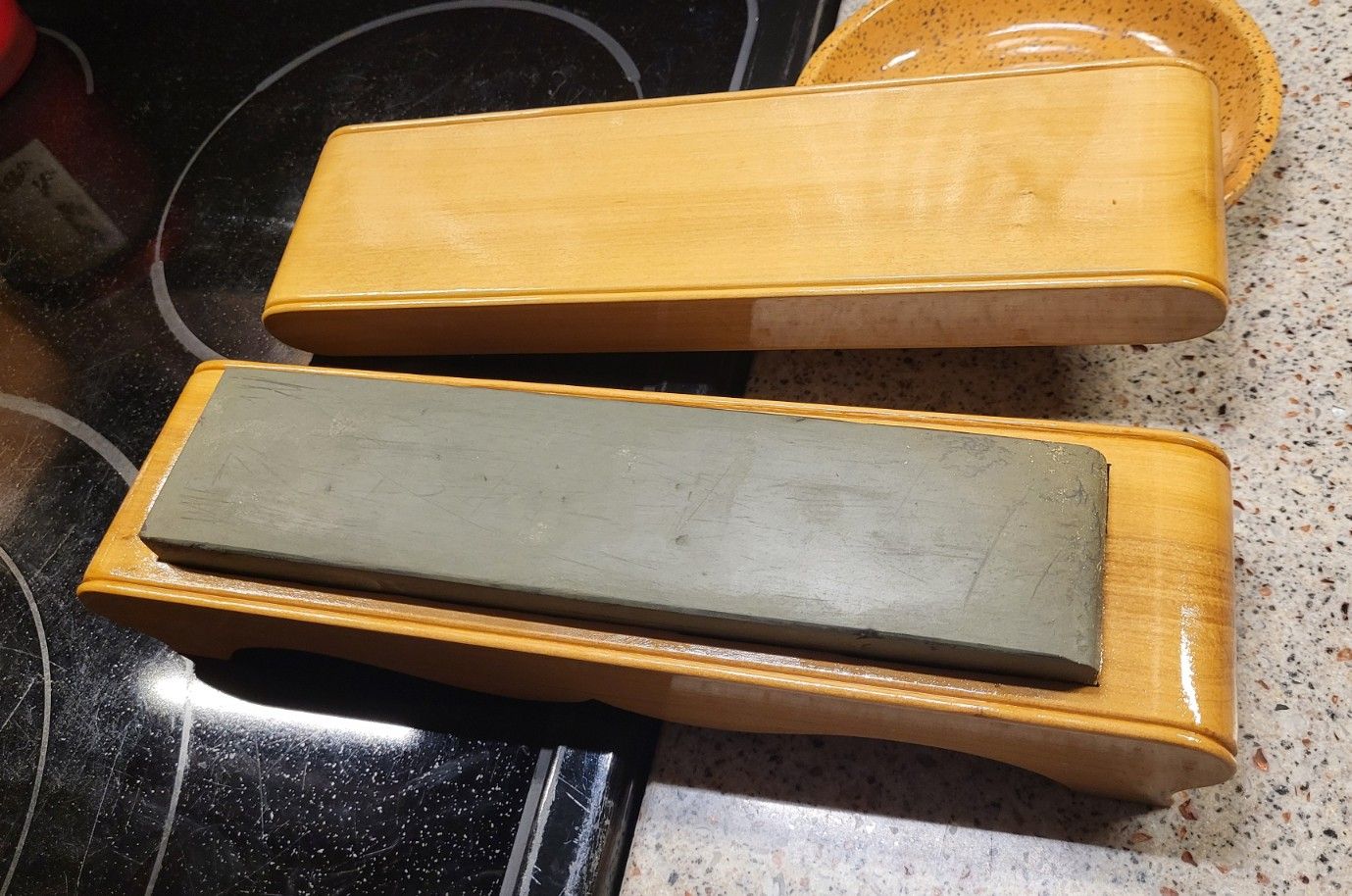
Years ago, I bought the two handled beader that Veritas made just because I was in that phase where you’re doing a little woodworking and buying stuff that looks like a good idea, which is maybe too quick. the beading blades for this thing are decent to start with, but the beader is good for something I haven’t yet figured out. it’s pretty much garbage for this box project and there’s a handle in the way of everywhere you’d really like to put your hands to make sure the fence never leaves the side of the work, a long lever to help you accidentally spoil a bead if the beader catches, and enough cast iron and fence stuff to both trap the shavings and stop the beader from cutting, and also increase friction to 90% of the effort you’re expending. 
I wonder if it was designed by the same person who decided chipbreakers don’t work. Whatever the case, I had to make a small very jiffy (fraction of an hour) stock to do the concave parts and then just turned to using it for all of the beading. It’ll be worth making a flat version of the same thing for more general use. I don’t think LV makes this tool any longer – which is too bad – too bad that it’s not lie nielsen where out of production means increased value.
So, What was my Diatrabe of the “Freds” About?
If you haven’t read the prior post, there’s no need to. Fred is a household term here for someone who doesn’t do anything, but always has an opinion on what you should do, what’s doable and how it should be done. There are polite well-intentioned Freds, but more common are the passive aggressive know it alls who really celebrate around them if nobody else enjoys themselves or accomplishes anything.
The last thing this hobby needs, or really any of us as individuals – because our intentions and wants as individuals are more important than the hobby itself. That should make sense – the hobby can be anything, but each of us wants to do something or nothing. The something could be making, researching, reading, whatever it may be. The hobby will be what it is around that. None of us has an obligation outside that. you don’t have an obligation to buy $1900 chisels or $200 router planes from China. You have an obligation to yourself – to figure out what you would like to do most and do it if you want. Very little of the information you get when asking or getting information unsolicited, will be useful to you, and most of it will be from people who are less qualified to give it than you.
 Of Making by Hand with Wood and Steel
Very impressed with how clean you got the beading on the end grain. As always, I enjoyed hearing how you went about problem solving.
LikeLike
The box is very nice looking, the proportions of a curve are quite pleasing. I prefer plain sharpening boxes ‘cos quirks and beads tend to accumulate dust, grit and metal shavings, but probably it’s not a big deal.
I have a sharpening question. What would be your recommendation for the loos diamond setup? Not that I need it, just OCDing that it’s the last setup I don’t have. Fast rough grinding is what appeals to me, but it’s all theory, so maybe you could talk me out of this. I used your advise about loose sharpening grit on oil stones and it worked great, so the objective is to have a fast, but controlled grinding method for non-straight blades, like moulding irons, carving cutters and such, and also a way to handle stubborn hard steels and to be able to to flatten plane irons, chisels, etc faster and better.
Last time I looked into it, loose diamonds were offered as a paste. Recently you have mentioned loose diamond powder on an oilstone. After everything you figured about diamonds, would you go with a paste or straight to diamond powder? I tend to gravitate towards the paste, but can’t figure a good substrate for it. Going through Bill Tindall’s articles on loose diamonds on WC I figured that the cast iron plates are the best. What kinda bothers me is that there’s no alternative – MDFplywood isn’t going to work for me since nothing stays flat in my shop for long. Another option I’m thinking of is LV plastic sheets on glass, but it seems like half of the population isn’t convinced hard plastics work as well (at least Bill isn’t). If cast iron is the best it’s okay, I just wonder about something like marble or phenolic resin before I go for iron plates. For profiled blades I was thinking something like aluminum or brass rod in a rotary tool – should give me a profile that’s better than sandpaper on a stick or these terrible abrasive stones bits that are always bent and off balance.
I also stumbled upon a suggestion to make own stones by mixing diamond powder with epoxy and pouring it into a rectangular mold. Naniwa sells plates like this, but they’re like 150$ apiece, way above my R&D budged for this. I was thinking about making my own profiled stones like this. It’s a whole different story though: I can’t resharpen a molding iron without altering the profile for a tiny bit, so the idea was to use a plane as a mould for epoxy to get a 100% matching profile for a particular plane, and I’ll end up with maybe a dozen of these. Aliexpress sells flat plates like this, except they replaced diamonds with SiCa while still selling them as “diamonds”.
So anyway, what do you think about all this, is it just a waste of money?
LikeLike
Three things I’d use for loose diamond substrate – hardwood, well polished cast iron and fine sharpening stones that are slow. Anything cast or other harder substrate that is fresh will deflect and damage the edge at a level more coarse than diamond. For loose diamond, it’s my opinion that you want that only for the final step of sharpening. Whatever you use loose contaminates everything. If it’s all over the place in small amounts at 1 micron, no problem. If it is at 15 microns, big problem.
Anything else, the diamonds should be fixed to a plate or sintered so they cannot be loose all over tools and hands – contamination just becomes a problem.
Which leads to the topic of grinding – I think the only economical solution to use diamonds for grinding is round discs on aliexpress or sometimes on ebay if someone is selling them. You can get 8″ diameter discs that can be mounted to an arbor with a thin steel wafer backing and put them on an arbor. You can either back them or stack a bunch together and they will do pretty accurate work. I just use them in a drill press. You can also easily find 10″ discs, but I think they are economically harder to swing. Iight pressure and a relatively low drill press speed and they will do back or bevel work without sparking and having the diamonds be consumed by hot grinding. my recollection is the 8″ electroplate discs are $10-$12 each, and each one is more diamond than you’ll get on a hone and just as good of quality. The 10″ plates are more like $25-$30. For grinding, a pair at 80 and 150 is nice – you can see which you like better. 80 is brash.
I don’t really like the sintered hones too much – their purpose is to be a little bit longer lasting than electroplate, but staying flat isn’t something they excel at. I would guess they are aimed at knife sharpening or maybe bit inserts. Not sure. They cost a lot for what they are, and I’ve made hones by using epoxy and putting abrasive in – it’s possible, but you’ll make something that you’ll never use. There will be bubbles and so on and the feel of the epoxy is not close to even a cheap stone. It’s sticky feeling or if you oil it, then slick then grabby. Just a no go.
On the fine stuff- yes, by far, the powder or flour instead of the pastes. Bonding grade flour on wood that’s 1-3 micron diamonds is something like $14 for 100 grams. it’s an insane amount of flour. IT would be aggressive on a hard substrate, but on wood, it will polish. For the hard substrate, I’d buy lapidary supply (China is fine – the lapidary grit suppliers sell closely graded diamond stuff – lapidary use is intolerant of grading tolerances that allow variation)…lapdiary supply in 0.5 and 1 micron diamonds and then see what you like. The cast plate I have came from a friend of Bill Tindall – it was extra, finely blanchard ground and kind of a revelation vs. trying to use something like a lapped plane sole. IT works just the way it should for fine diamonds.
For hand grinding, I would use adhesive roll paper every time – just aluminum oxide gold, white or gray, some kind of good quality western made or eastern european paper. I never really liked diamonds for manual lapping of something, loose or on electroplate. They just don’t last – in an arbor on the round discs, they seem to last a lot longer, but obviously that kind of lapping setup will still have some flatness error and deep scratches – I use that for “chisel manufacturing” I guess after belt grinding something to the eye or flat belt sanding, there’s some belly or error otherwise, and the round discs do a good job of getting you close to the point you can finish the job by hand – as long as you keep stuff flat on them.
LikeLike