And not just white steel #2, but legitimate Hitachi White Steel #1. I bought a bar a couple of years ago now from New Jersey Steel Baron, which is probably the only retailer in the US who is able to get legitimate stuff with a melt sheet and certificate showing that the certification was actually done for them, and not just a copy someone got off of the internet.
What stood out in my mind is it’s been almost 20 years since I first heard of it, and I was just as easy to get as anyone else with it being mysterious or whatever else, and with all of the rumors. “Smith-san makes the steel by twilight only with pine charcoal, and it is impossible for all but the most skilled smiths to get right because the temperature must be judged by eye within 25 degrees or the tools must be thrown away.” Couple that with the cost of good tools that it’s in and the oft stated “it’s too brittle to stand alone, so it must be laminated”.
The composition of white steel is slightly more plain than one of my favorites, or two – 26c3 and 125cr1. Both of those are certified in melt sheets to be within Hitachi white steel’s spec as far as phosphorus and sulfur and not surprisingly, the remelted version of those two, 26c3, seems very close to White 1. What’s missing in white steel is about 0.25% of chromium and about a third of the manganese. I think those things make 26c3 easier for a garage heat treater to deal with and probably really anyone, and they don’t at all make it feel alloyed. But for a garage heat treater using a brine quench, white 1 is hardenable enough, and I use a method that pre-quench is hotter and shorter than someone would use in an electric furnace. I suspect white #1 might actually provide better results heated with the “overshot” method, but it’s a method that a lot of beginners cannot do without grain growth or under hardening. It takes practice and snapping samples and testing hardness to really get a routine down. But once you have one, it’s quick – everything from normalization through thermal cycling with a pre-quench between them and the final quench can all be done in less than ten minutes and with a lot of discretion about what will be heated and how much. Oh, and there may be 5% or so more carbon than there is in 26c3, but I cannot tell the difference between the two after quench other than if you look at the chisel below, there’s a mock hamon an inch below the shoulder. This isn’t a real hamon as it’s too hard to file the steel until you get to the transition from the bevel at the tang, and then you can only just file that transition and not a wide flat area. I would guess the steel is 55-ish and the hamon line exists because I finished this chisel with some loose silicon carbide. With a natural stone, it would probably all remain bright.

The result after drawing a bar out some on an anvil to get some heat and hammer time on the business end is this. I was a little conservative with the thickness and this thing is 0.15″ thick at the bevel, so more of these may be less thick, which I think is preferable, but it won’t be too bulky as it is.
Heat treatment is much like the other two above, though one of those two needs to be pushed a little harder with heat (125cr1) which I don’t love, but it is what it is. 26c3 and White 1 can be treated identically as long as the quench is in brine. Brine is probably 3 or 4 times faster than the fastest quench oil at the top of the quench and it’s what something that’s got limited hardenability really needs.
Same thermal cycling, same normalizing before that, same pre-quench before thermal cycling and same 2 x 400F tempering sessions after heat treatment and the result is a chisel that is c66 hardness for the first inch and up from there is about 65. I would guess the differing thickness has something to do with that, as well as the fact that it only has a small amount of manganese in it for hardening and nothing else.
Getting 65/66 after two 400F tempering sessions is exactly what I want. It’s about the limit before grain growth and I would imagine it would correspond to nearly nothing being left unconverted in the chisel. At one point, I believed White 1 and other file-like and razor steels could not be 65/66 hardness and be as good as they would be a little lower than that because I hadn’t gotten many or any commercial tools that held up at that level of hardness, and tempering back to 64-ish would make them much nicer to use.
I think that’s false, though, and what was probably missing was hardness after quench due to underheating and a slower quench medium (fast oil), with the 65/66 hardness reached by undertempering instead. I really like steels that can be brittle undertempered at 400F more than I do 325 or 350, by a lot, so the hardness is arrived at after choosing the temper, not the other way around.
Of course, the steel gets the regular rotation of tests, punching some of the end off after the heat treat on a false bevel and then regrinding after. At about 50x optical, the break looks like this. The strands are denim fibers. I just want to see nothing that looks like layers of sand, but the little ripples are break topography, and that’s fine as it’s not individual grains. 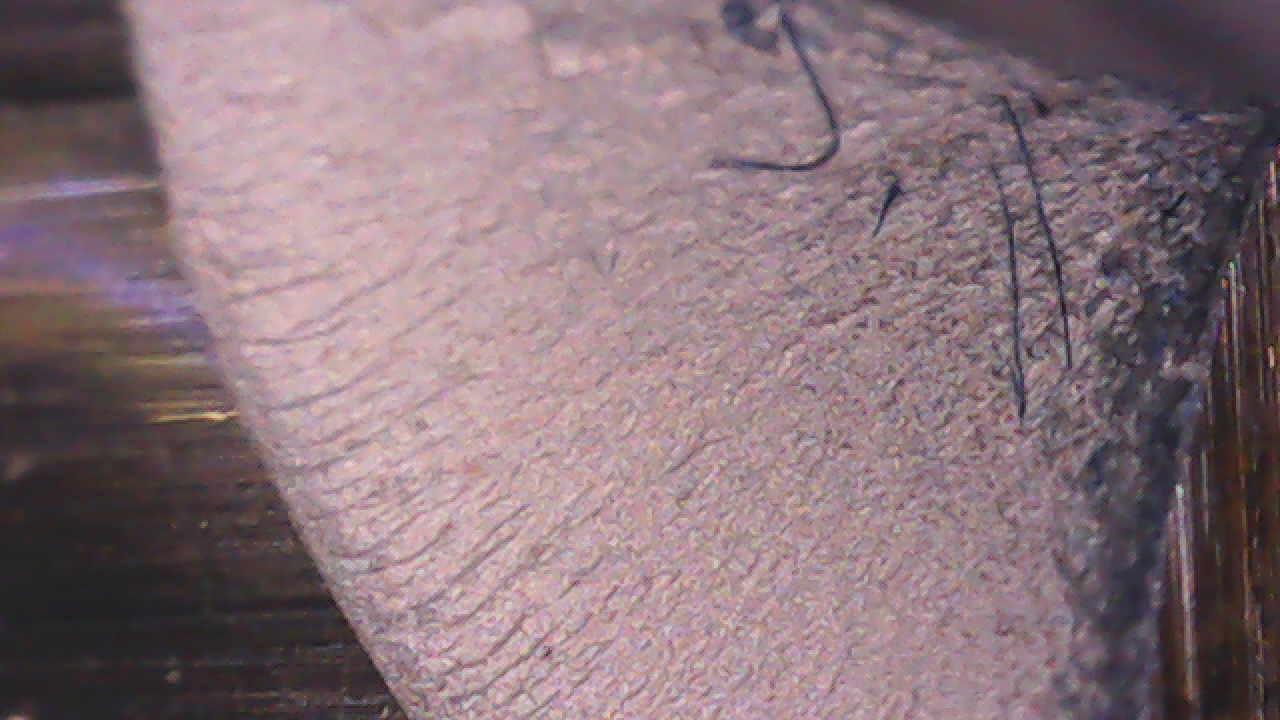
Doubling the magnification leads to this, and we’re really at the limit of my cheap hand held scope. These breaks are not flat, by the way, which troubles my much higher quality stationary scope – that scope’s depth of field makes it suitable only for things that are really flat.

not the greatest pictures, but I hope to see a closer view of the same topography, and with some sparkles embedded in and not as a feature of, let’s say. Those little twinkles are carbides. I’m surprised some of them aren’t a little bigger as the surplus carbon steels can have a few elongated carbides or several that are close to each other. Fortunately, iron carbides don’t seem to cause the same toughness issues that harder carbides do, but they also do nothing to improve edge life. In chisels, this is a good trade off. Easy to sharpen, stable edge. In planes, I like it, too, but the edge life of an iron made to the same spec would be a little less than even O1 at 62/63. And the cost of the bar would keep me from making solid irons from it, anyway.
Testing of the chisel was fine -like every other chisel, without any treatment of the apex, it will accumulate minor damage with heavy strikes in hardwoods, but the corners do not come off of the chisel, which is something you’ll find quickly on chisels that are brittle. I figured that if anything, you never know if the chromium in the other steels is sequestering some carbon and keeping a bit more toughness, but the corner test is passed without issue:

The corner test is just a matter of embedding one side of the chisel in a deep cut and not sparing the rod. a little light twisting of something in the corner of a dovetail socket, etc, to pry fibers loose would not threaten the corners on this chisel either, but attempting to use it as it’s set with fine bevels as a mortise chisel could probably find their limits. We live in a world with mortise chisels, though.
I forgot to take pictures of the minor damage without the buffer treatment, but with it, the edge remains as this across the entire length:

The difference between a mediocre and a good chisel is how much of the buffer one needs to see no damage at all, and this one doesn’t need much. Just like 26c3. But what the buffer does even a little is something all chisels benefit from and a good chisel would last through a case of half blinds before needing to be resharpened if the edge is treated right. More importantly, it just stays the same for you in use for that entire time and there isn’t any “I could do one more with this dull chisel”.
All in all, quite pleasant, and the result is the same boring shape that I like, but its’ a shape that I like for function and that’s that. 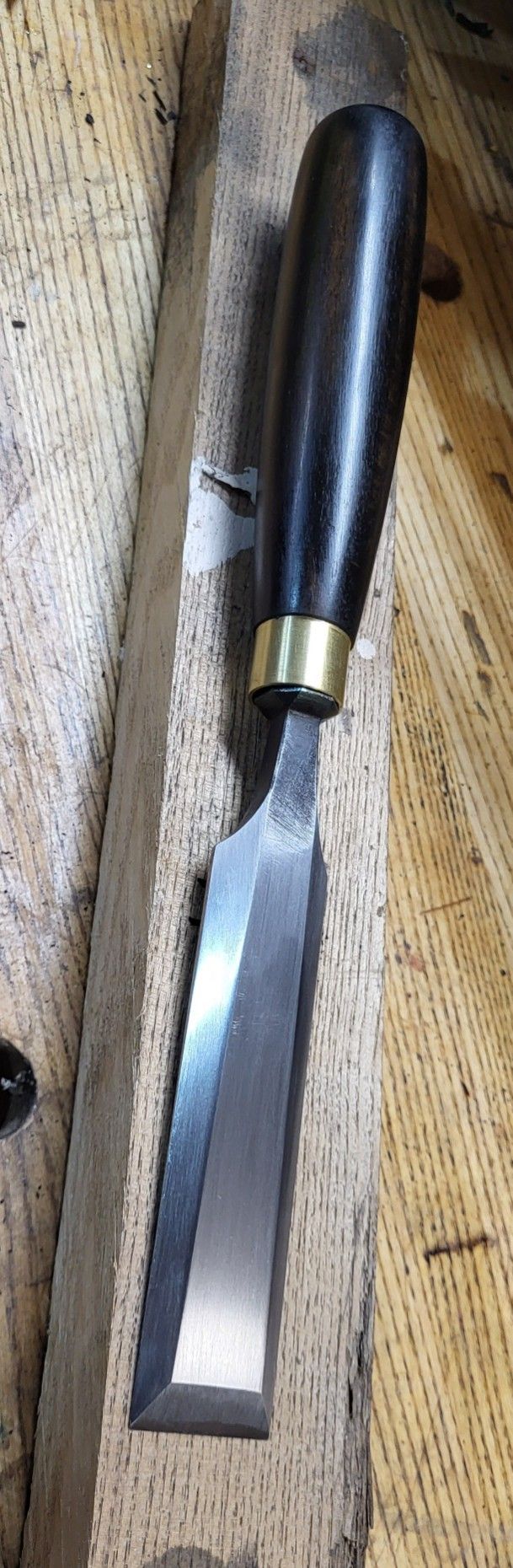
I will make a set for myself as one thing I don’t have is a set of cabinetmaker’s chisels in 26c3 or anything else. Too much experimenting and giving things away or selling for the cost of materials, I just haven’t kept any.
The rest of the set will have to wait for the winter, as I’ve got a few things to make for other people – this 3 hour sideshow of testing some offcuts and then making the chisel here is enough to at least answer the question about whether or not there is some difference in chemically similar steels that would make white unsuitable for solid chisels. There isn’t.
But there is one catch to just using this on a widespread basis. First, who knows if the supply will stay or if this is a one-time thing. If NJSB didn’t get the rights to sell it, I would not find it without some intermediary who would make it really expensive. That leads to the other problem – it’s still expensive. A 1 inch bar 0.3″ thick and 36 inches long is near $200 with shipping. I think I can make a set of 7 or 8 chisels out of that bar – depends much on what width they are but if I get the chance to make chisels in retirement and this stuff is still around, there’d be no way to justify the time making them the same way for less than $750 or $800 for a set of five. They would deserve to be more expensive than commodity low end white 1 chisels, though. The heat treat is better, and there’s enough steel in one of these chisels to make a full set of Japanese chisels.
All of this has been one of the pleasures of becoming an amateur with some skill. Some is an important word here, but some is enough to dispel some myths that don’t make sense. the steel is good steel. Why would it be so difficult to use, and if it was, or if the result was brittle, then why would we call it a good steel? None of that made sense to me. If a steel is too brittle to make a chisel from, then why doesn’t the end just break off of a Japanese chisel (oh, one of the other myths – the “wrought cushions it”. The wrought does allow one thing I don’t have the luxury of – when steel is laminated , you can hammer the wrought to straighten the hardened steel without cracking the hardened steel. When there’s no wrought, or jigane, there is no hammering the result here other than trying to do it in a very short window after the quench, and the reality is, it’s better to improve the process and accuracy during heat treatment to avoid any warp. And though you may not be thinking of that question, it would’ve been one of mine. Did it warp a lot. The answer to that is no, no part of working the entire time was disagreeable or like walking a tight rope. It all just came down to that one question above – will it be able to hold on to its corners in hardwood? Fortunately, it will.
If it were closer to the price of 26c3, I’d buy a whole pile of it and make a bunch of chisels from it over time and sell them slowly. I’ll have to consider this winter whether or not I want to spring for a few thousand dollars worth of this stuff to have, just in case the availability isn’t permanent. I don’t think it’s selling very quickly, and when steel doesn’t sell quickly, it’s often not purchased a second time by a retailer.
 Of Making by Hand with Wood and Steel
I have long appreciated the way you dispel myths for the benefit of others. I, like you, accepted the “wisdom” of the armchair Internet metallurgy mystics regarding white steels and Japanese steels in general, really. The brittleness that I’ve heard so much about has steered me away from even trying Japanese chisels. That’s not to say I believe all Japanese chisels are made from white #1, just that it made sense to assume the same was true of those steels as with white #1. As a long-time follower of your work and your writings, thank you again for yet more inspiration to get out of my comfort zone and try things.
LikeLiked by 1 person
Michael, you’re right – lots of the chisels are made of white 2, blue 2, blue 1, and so on. There’s no perfect cross to western steels. The blue steels are more like a turn of the century steel with extra tungsten in them, because that’s what was popular as the first carbide addition, believed to be one that would be dissolved during forging, and while there’s tungsten in something like O1 steel, it’s less than the japanese blues. I don’t care for them, but they are apparently easier to work with, as in harden easier and are a little more tolerant of temperature variation.
But what I gather with the white steel is if someone does it with compact grain, you can always temper a chisel a little further. Some of the best chisels I’ve used are hard tempered old japanese chisels off of their version of ebay that just need to be brought to 350-375F temper in a normal oven, and then they are wonderfully good. If the grain is grown, though, or the steel is soaked in a modern furnace for long enough that too much carbon is dissolved out of the carbides and back into the steel, it’s just not something that can be fixed without rehardening. And I think most people will be hesitant to take apart a $100 japanese chisel and put one in a covered pan in an oven. it’s not even terribly easy to get them back together without evidence they’ve been apart.
But I have had plenty that one way or another can be made like this chisel- suitable for anything and very pleasant. Not sure of yahoo auction in japan is as easy to deal with now in the era of tariffs, but more and more people learning they can use a proxy service and shop in other markets, but good chisels can be had out of japan for about $25 each ….but the catch, you kind of have to be able to look at them and tell what was made for professionals and what isn’t perfectly finished because it’s newer and is made for amateurs to a price point. And I can’t explain that well.
To develop a little skill, because this is all tinkering skill and not trained, really makes all of this more engaging, and you can manipulate things. I wish I could share the pleasure that it provides, even though much of my early attempts at the first or first five of something were miserable if success is the goal. It’s learning to get over the hump and then that misery becomes a challenge, and pleasant – a motivator, rather than a demotivator. Pondering replaces throwing things, and I’d be lying if I said I’ve never thrown anything in the shop when it didn’t turn out. It used to be as regular as a bran addict.
LikeLike
I appreciate the kind comment, by the way.
LikeLike
Echoing Michael’s sentiments, it’s the manifestation of theoretical notions that makes your explorations interesting, you bring “spirits into ythe material world”.
It might make sense to stockpile a little material that has already cleared customs, prior to additional duties.
LikeLiked by 1 person
Jim. I think you’re right, and I thought about it for a little while. Should I buy 12 times as much or what, and then checked stock at NJSB. I can pull the size selector and everything I pick is in stock. So we’re probably safe from tariffs for a while, but i’m not yet sure how to interpret the lack of demand there is for the steel. It’s a commercialized demonstration of the whole group buy thing. that is, if you asked someone five years ago if they’d buy white steel if it was available, they would talk about “oh man, I wish it was, i’m dying to use it”. and then when the option is there, the wallet acts like it found contact cement in the pocket and nothing happens. I find the price a little offputting, but hitachi has no real incentive to prioritize it – they’re big, they make all kinds of stuff even in steels, and i’m sure shearing knife steels and cobalt steels for industrial stuff makes both their balance sheet and income statement better than white and blue steel do. I’d already heard long ago they only do a melt once in a while, which is a red flag that there’s no regular demand. I think the smiths, who only get a fraction of what we see as retail price are going to be sparing with it, and I’ve seen only one knife maker who makes knives out of white 1 in solid steel – they are unhardened on the spine and for an even smaller market of enthusiasts. So there’s no mechanism to really run product through. Very long way of saying – for now, I bought $600 more – which is enough to make about four more sets of chisels after I make mine. It can be drawn out laterally for knives, but that goes back into the “wanters” scatter when want changes to “can do” – as much as someone would be wowed by how nice a 66 hardness knife of this would cut, they would be put off instantly by the fact that it will rust faster than anything they’ve ever seen.
I can keep in touch with Jerry at NJSB and have him warn me if it’s going to ever get low and they’re not going to get more. IN my view, hitachi screwed up a little waiting so long to open this up to overseas markets – 20 years ago, it would’ve gotten more of a foothold. Before people got so interested in devices and watching endless opinion news.
Thanks for commenting – your comment literally spurred this whole train of thought and got me to buy about $650 worth of the stuff for now. Even if I never do end up making things for pay, it’s getting easier and easier to trade with people. And that’s somehow more human than and enjoyable than “hey, what can I sell at you?”
I fear the knife making market is going the way of the woodworking hobby – that people like to buy stuff, and they’ll buy benchmade knives aplenty for years. but the folks who find a ribbon of pleasure like pepe lepew, and who just get swept into a pleasant escape by making and making and doing more of it….I fear that part of the joy goes away as people like the transient random dopamine hit world of reddit and so on, more than they like a long isolated escape and being tickled by our own pondering for what to do next.
The back yard cat says hi. It’s raining today and I think she may have finally gotten up from the patio couch, even if only to slip under the table next to it and go back to sleep.
LikeLike
She’s a killer Queen, dynamite with a laser beam.
LikeLiked by 1 person
I love your “boring” shape! It’s a beautifully functional chisel and probably feels great in use.
LikeLiked by 1 person